
A listener who plays the same artist at 7 a.m. on a train and at 11 p.m. in bed is two different customers. A taste-only recommender treats them as one, and it quietly pays for that mistake in skips, abandoned sessions, and playlists users build by hand because the app never understood the moment.
This guide covers AI personalization in music apps at the level a product or engineering lead has to decide: what “mood” and “context” mean as data, where mood should come from, which context signals earn their privacy cost, how the recommender consumes them, and how to measure whether any of it works. We wrote it to give a direct recommendation at each fork rather than a list of options.
If you want the wider view first, our guides to AI in music streaming apps and the future of AI in music streaming platforms cover the app layer and the platform layer. This piece assumes you already know you want situational personalization and need to build it well.
Consultant’s Tip: Before you collect a single new signal, write down the one listening situation your product should handle best — commuting, studying, working out, winding down. A feature scoped to one situation ships faster, teaches you more, and is easier to defend on privacy than a general “understands everything about you” promise.
What Do “Mood-Based” and “Context-Aware” Personalization Actually Mean?
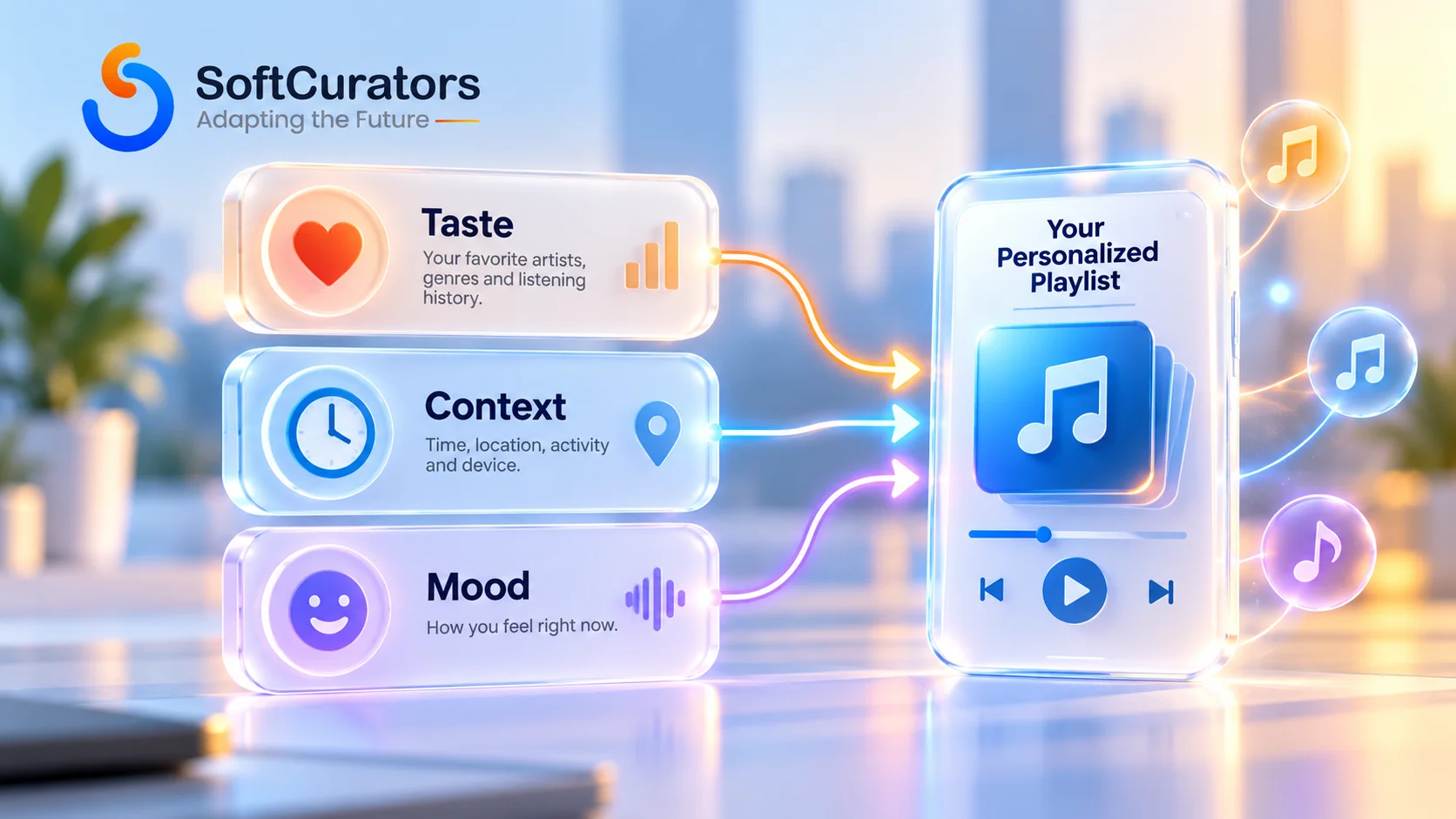
Mood-based personalization selects music to match or shift an emotional state, such as calm, energetic, or melancholic. Context-aware personalization selects music to fit the listener’s circumstances, such as running, commuting, or studying, using observable signals like time, motion, and device. Taste personalization, the older approach, uses long-term listening history alone. Modern apps layer all three.
The distinction matters because the three layers fail differently. Taste is stable and well captured by history. Context is observable but changes minute to minute. Mood is the hardest: it is internal, subjective, and only indirectly measurable. Treating mood as just another context signal is the most common conceptual error in this category.
Mood Is a Preference About a Moment, Not a Fact About a Person
A listener who is sad may want sad music to feel understood or upbeat music to feel better. The same mood label maps to opposite goals for different people, and for the same person on different days. A system that detects “sad” and plays sad songs has not understood anything; it has matched a label. The useful question is what the listener wants the music to do, which is why explicit input often outperforms clever inference.
Who Needs This, and Who Doesn’t
A catalog with enough variety and a user base listening across several situations benefits most. A single-genre or single-purpose app — a sleep-sounds app, a focus-music app already encodes one context in its product, and adding mood selection to it mostly adds friction.
Business Insight: Situational personalization pays back through session quality, not catalog size. Teams often expect it to help discovery, but its clearest effect is on the first thirty seconds: whether the first track fits the moment decides whether the listener stays.
Why Is Situational Personalization Becoming Standard?
It is becoming standard because three conditions arrived together: phones expose cheap, reliable context signals; listeners increasingly describe what they want by situation (“something for focus”) rather than by artist; and competing apps have trained users to expect a shelf that fits the moment. These are directional trends, not settled facts, so verify against your own usage data before treating them as inevitable for your audience.
Listening Is Tied to Activities, Not Just Tastes
Most listening happens alongside something else — moving, working, cooking, driving. That means the activity, not the artist, often determines which track is acceptable. Taste models are good at ranking what a person likes; they have no concept of what a person can tolerate while sprinting or concentrating.
The Competitive Floor Has Moved
Mood and activity shelves are now a baseline expectation in many large catalogs, which changes the cost of not having them. For a new entrant, the bar is not to be more sophisticated than the largest players; it is to avoid feeling oblivious to the moment. Our comparison of Spotify and Apple Music app features and our music streaming app trends overview show how established apps present situational features.
Common Mistake: Treating mood personalization as a differentiator in itself. As a baseline feature, it will not set you apart; the execution , accuracy, speed, transparency, restraint will.
The Central Decision: Should Mood Be Chosen by the User, Inferred by the App, or Both?
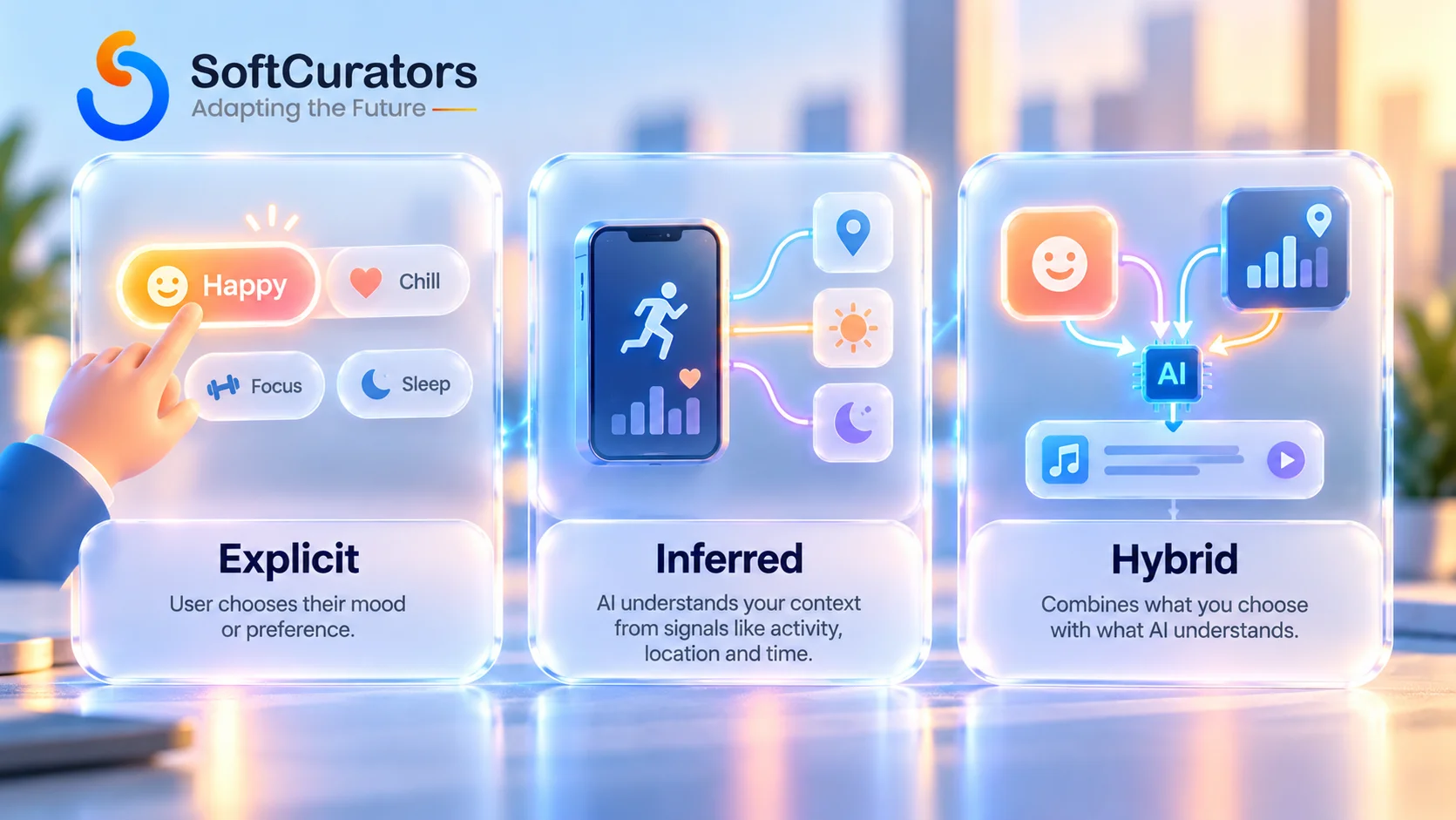
Every mood-aware music app has to decide where the mood signal comes from. This decision determines what data you collect, what you can be held accountable for, and whether users trust the feature. There are three real options.
Option 1: Explicit Mood Input
The user tells the app what they want: tapping a mood chip, moving a slider, or typing a phrase. The app never guesses. This is the most accurate signal you can get, because it is the listener’s own stated intent, and it carries almost no privacy risk.
Option 2: Inferred Mood
The app predicts mood from behavioral and contextual signals — skip patterns, time of day, motion, perhaps wearable data. This removes friction and can feel magical when right, and creepy or insulting when wrong. It also creates inferences about a person’s emotional state, which carries real privacy and regulatory weight.
Option 3: Hybrid
The app proposes a mood or situation based on context and lets the user confirm or correct it in one tap. Inference sets the default; the user keeps the final say. Corrections become labeled training data.
Our default recommendation: build explicit input first, add inference as a suggestion layer, and never act silently on an inferred emotional state. Here is the reasoning, stated plainly.
Explicit input gives you clean labels from day one, which is the scarcest resource in this problem. Without ground truth for what a listener meant, you cannot train or evaluate an inference model honestly. The hybrid path lets inference earn its way in: it starts as a suggestion the user can overrule, and every correction improves it. Silent inference skips that learning loop and bets your user’s trust on a model you have not yet validated.
Choose explicit input when:
- You are launching, or your catalog has weak mood tagging, so you need labeled data before any model is trustworthy.
- Your audience is privacy-sensitive, or you operate in jurisdictions where inferring emotional state raises legal questions.
- Your product is positioned around user control rather than automation.
When to Choose hybrid :
- You have collected enough explicit selections to validate a model against real user intent.
- Your key moments are hands-busy (driving, running) where extra taps cost more than an occasional wrong suggestion.
- You can show the user why a suggestion appeared and make correction a single gesture.
Choose fully automatic inference only when the signal is low-sensitivity and low-stakes — for example, switching to a higher-tempo queue when motion indicates running — and the cost of a wrong guess is a skipped track, not a misread emotion.
Cost implications: Explicit input is the cheapest to build: a tagging taxonomy, a selector UI, and a filter in the ranker. Inference adds model development, a feature pipeline for real-time context, an evaluation program, and ongoing monitoring. The recurring cost is evaluation and labeling, not inference compute.
Maintenance implications: Explicit moods need taxonomy upkeep as language and catalog evolve. Inference models drift as listening habits change seasonally, so they need scheduled re-evaluation against fresh explicit labels.
Scalability implications: Both scale with the catalog. Inference scales with the number of live context signals per session; every added signal adds pipeline load and a new failure mode when a sensor is unavailable.
Risk factors: Explicit input risks low adoption if the selector is clumsy. Inference risks wrong guesses, user discomfort, and regulatory exposure when the inferred attribute resembles health or emotional state. A hybrid inherits some of each but contains both through user confirmation.
Time-to-market impact: Explicit input reaches users in weeks because it depends on tagging and UI. Inference realistically needs the explicit data it will be trained against first, so building it earlier does not make you faster; it makes you unvalidated.
Comparison Table: Explicit, Inferred, and Hybrid Mood Input
| Factor | Explicit input | Inferred mood | Hybrid |
| Signal accuracy | Highest – the user’s own intent | Variable – depends on model validation | High – inference corrected by user |
| Privacy exposure | Minimal | Higher – infers emotional state | Moderate – inference shown, not silently stored |
| User friction | One tap or phrase per session | None when right; trust damage when wrong | Low – confirm or correct in one tap |
| Training data produced | Clean labels | None without ground truth | Labels from every correction |
| Best fit | Launch, privacy-sensitive audiences | Low-stakes signals like running detection | Mature apps with validated models |
Note: A relative planning comparison, not a fixed rule. Verify legal treatment of emotional-state inference with counsel for your target markets.
How Do You Represent Mood as Data a Recommender Can Use?
You represent mood with a small, well-defined taxonomy tied to measurable audio and behavioral features, then validate the labels against listener behavior. Free-form mood tags scraped from metadata or playlists are too noisy to use directly, and a taxonomy larger than users can distinguish will not improve results.
Start From Two Dimensions, Not Fifty Labels
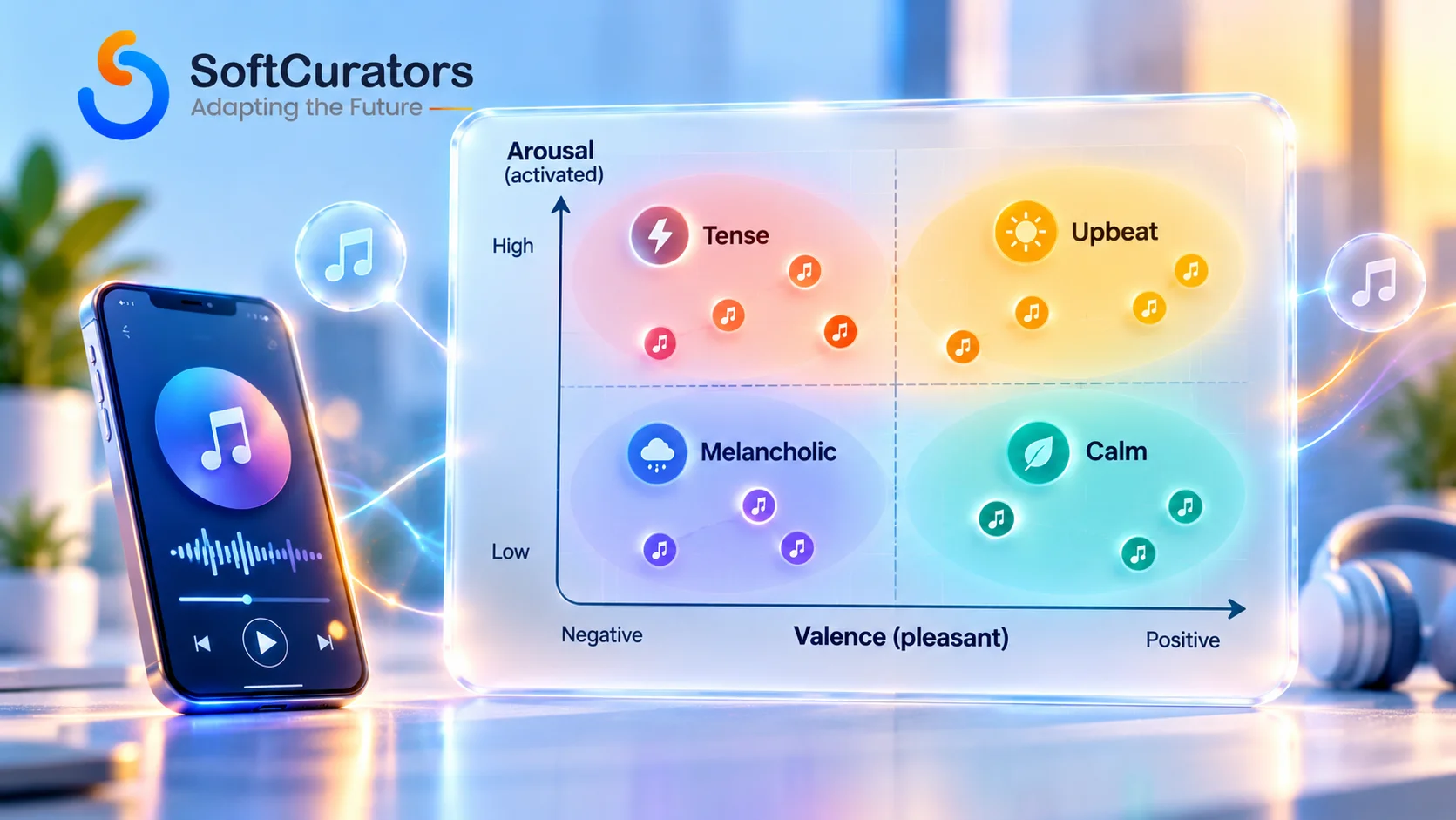
Psychology research often describes emotion along two axes: valence (how pleasant) and arousal (how activated). Many audio-analysis tools expose features that approximate these, such as energy and positivity. Anchoring your taxonomy to two continuous dimensions gives the ranker something it can interpolate across, while friendly labels like “calm” or “upbeat” become regions on that map rather than isolated tags.
Three Sources of Mood Labels, and What Each Misses
- Audio analysis captures tempo, energy, timbre, and key. It misses lyrical meaning and cultural context, so a gentle melody with grim lyrics reads as calm.
- Lyrics and metadata analysis captures themes and tone. It misses instrumental tracks entirely and struggles with irony and slang across languages.
- Listener behavior captures what people actually play in a situation, such as which tracks survive in a workout queue. It is the most honest signal and the slowest to accumulate for new tracks.
Technical Note: Treat audio and lyric features as a prior and listener behavior as the correction. A track tagged “calm” by analysis but skipped repeatedly in calm-labeled sessions should have its mood weights revised by what listeners actually do. This feedback step is what separates a living taxonomy from a static tag list.
Reliable tagging also depends on the data pipeline feeding it. Our AI-powered DataOps guide and DataOps vs. DevOps vs. MLOps comparison cover how to keep that pipeline trustworthy as the catalog grows.
Common Mistake: Letting a licensed audio-analysis vendor’s mood labels become your product’s truth without validating them against your own listeners. Labels trained on a different audience and culture will be confidently wrong for yours in ways you only see in the skip data.
Which Context Signals Are Worth Collecting?
The signals worth collecting are those that change what a listener wants, can be read reliably, and cost little in privacy. Time of day, day of week, device type, and coarse activity (still, walking, running, driving) clear that bar. Precise location, calendar content, and health metrics rarely do, and each adds consent, storage, and regulatory obligations out of proportion to the lift.
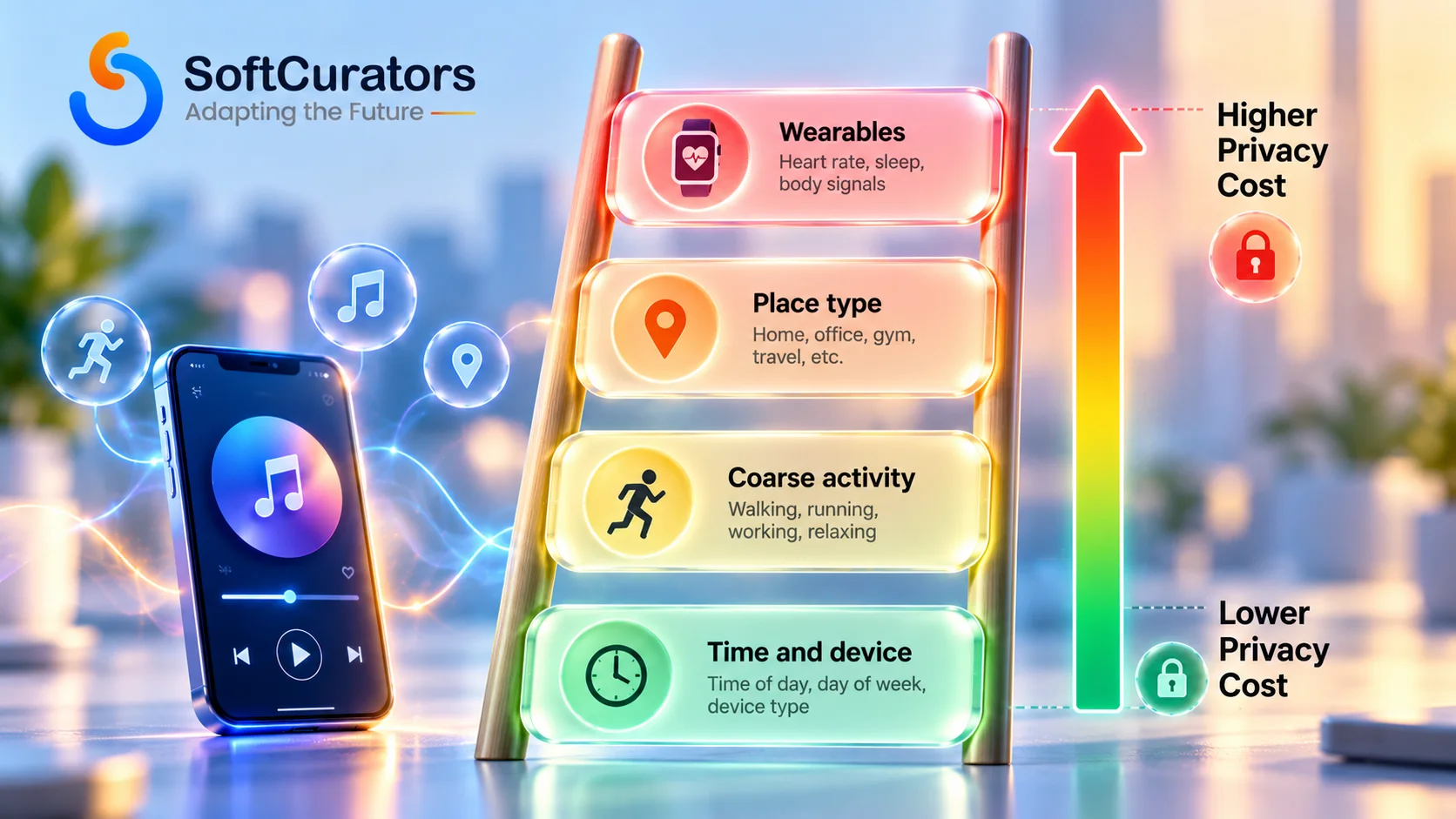
| Signal | Value to ranking | Privacy cost | Our recommendation |
| Time of day and day of week | High — strong, stable patterns | Very low | Use by default |
| Device and output (headphones, car, speaker) | High — different tolerances per output | Low | Use by default |
| Coarse activity (still, walking, running, driving) | High — changes tempo and attention needs | Low to moderate; processed on device | Use with clear permission |
| Place type (home, gym, work) rather than coordinates | Moderate | Moderate to high | Optional, user-initiated only |
| Weather | Low to moderate — weak causal link | Low if coarse | Test before committing |
| Heart rate and wearable data | Moderate for workouts | High — health data rules apply | Workout features only, explicit opt-in |
| Calendar or message content | Low | Very high | Avoid |
Note: Value and cost are relative judgments for a typical music app; validate against your own data.
Collect the Minimum That Changes the Ranking
Every signal needs a hypothesis: “when the listener is running, ranking should favor higher-tempo tracks.” If you cannot write the hypothesis, you are collecting data for its own sake, and you will carry the privacy burden without the benefit. Run each signal as a controlled test before it becomes a permanent dependency.
Signals Fail, So the Ranker Must Degrade Gracefully
Permissions get denied, sensors return nothing, and users switch devices mid-session. A context-aware recommender that falls apart without its context features is fragile. Design the ranker so it falls back to taste-plus-time-of-day when richer context is missing, and test those fallback paths as seriously as the happy path.
How Does On-Device Activity Recognition Work, and Why Does It Matter Here?
Activity recognition classifies motion data from the phone’s sensors into states like walking, running, or driving, typically using the platform’s own frameworks, and it can run on the device so raw sensor streams never leave the phone. That makes it the highest-value, lowest-risk context signal available to a music app.
On iOS, Apple’s Core Motion framework exposes motion activity classifications. On Android, Google’s Activity Recognition API provides comparable detected-activity updates. Both let you request a coarse label rather than handling raw accelerometer data yourself, which is the right level of abstraction for a recommender.
Technical Note: Pass the recommender the label and a confidence value, not the raw stream, and discard the label when the session ends unless the user has opted into history. This keeps the feature useful and keeps your data footprint small. For apps spanning both platforms, the cross-platform route usually shares recommender logic while keeping the sensor integration native, which we cover for iOS and Android separately.
Business Perspective: Activity detection is the one context feature where a wrong guess is cheap and the right guess is obvious. A running detection that switches the queue to a steadier tempo is easy for a listener to understand, easy to override, and easy to explain in a permission prompt.
Common Mistake: Requesting always-on location or motion permission at first launch to “enable personalization.” Ask when the user first reaches a feature that needs it, explain the specific benefit, and make the feature work acceptably without it.
How Do Context Features Actually Reach the Recommender?
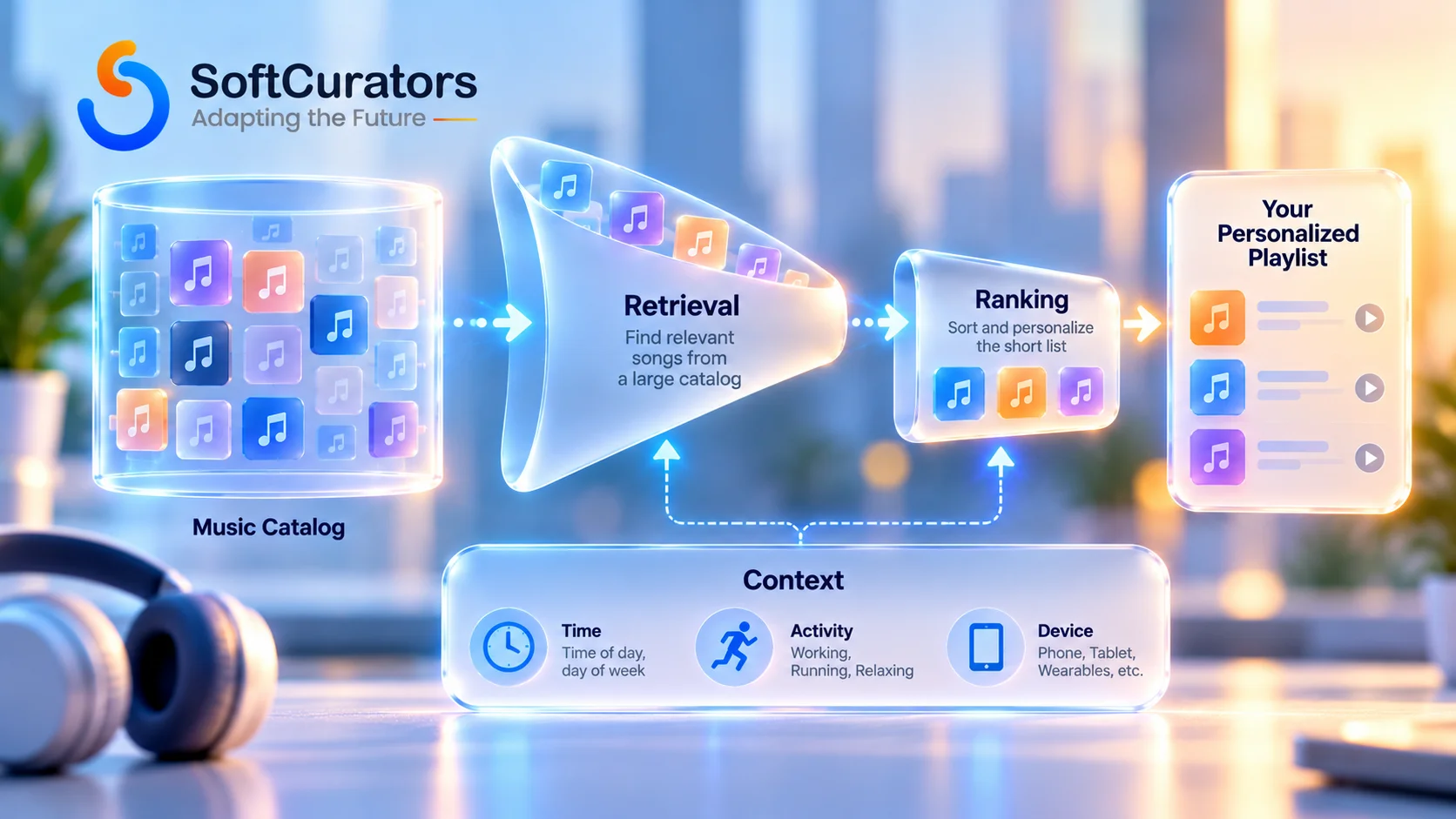
Most production systems retrieve a few hundred candidate tracks cheaply, then rank them with a model that sees both the listener’s history and the current context. Context enters at both stages: as a filter or boost during retrieval, and as input features during ranking. Google’s machine learning course on recommendation systems explains the retrieval-and-ranking pattern in vendor-neutral terms and is worth reading before you design this.
Two-Stage Design Keeps Context Cheap
Retrieval narrows millions of tracks to hundreds using fast lookups, for example tracks whose mood weights fit the requested region of the valence-arousal map. Ranking then scores that short list with richer features, including time of day, activity label, output device, and the listener’s recent skips. Running the expensive model only on the short list is what makes real-time context affordable.
Context Is Fresh Data, So It Needs a Fresh Path
Long-term taste can be computed overnight. Context cannot: a running label from ten minutes ago is stale. Build a lightweight real-time path that attaches current context to each request, separate from the batch pipeline that updates taste profiles. Mixing the two timelines is a common source of subtle bugs, such as ranking a commute playlist at a desk.
Contextual Bandits for the Exploration Problem
Once you have context, you also have a new exploration problem: you do not know which tracks work in situations you rarely observe. Contextual bandit approaches balance playing what is known to work against testing alternatives in that context. They are worth considering after the basic ranker works, not before; they add evaluation complexity that a young system cannot yet support.
Expert Recommendation: Ship the two-stage design with context as ranker features and a simple mood filter in retrieval. Add bandit-style exploration only after you can measure per-context performance reliably. Our explanation of AI-powered recommendation systems in another industry shows how the same retrieval-and-ranking logic carries across domains, including the cold-start problem covered next.
How Do You Handle Cold Start When Context Is Involved?
Contextual cold start has two forms: a new user with no history, and an existing user in a context you have never seen them in. Handle the first with a short onboarding that captures a few explicit situations, and the second by borrowing from similar users or from the catalog’s mood structure until that listener’s own behavior accumulates.
Ask for Situations, Not Just Genres
Standard onboarding asks which genres or artists someone likes. Add one question about when they listen: commuting, working, exercising, winding down. Those answers seed context-specific preferences immediately and make the first week feel intentional rather than generic.
Use Mood Structure as the Fallback
For an unfamiliar context, rank by how well tracks fit the requested mood region, weighted by general listener approval in that context. It is a defensible default that improves as the individual’s data arrives.
Common Mistake: Treating a sparse context as a reason to stop personalizing. A listener’s first run with your app is exactly when a good, situation-aware first track earns trust. Fall back to structure, not to silence.

What Are the Privacy and Consent Risks of Mood and Context Data?
Context and mood data can reveal habits, routines, health, and emotional state, so the privacy risk comes from what can be inferred, not only what is collected. Collect the minimum, process on the device where you can, tell users specifically what each signal does, and do not infer or retain anything that resembles health or mental-health status. This is not legal advice; confirm obligations with counsel for your markets.
Inference Can Create Sensitive Data You Never Collected
A model that predicts “anxious” or “low mood” from listening patterns is generating information about a person’s emotional or mental state. Under the General Data Protection Regulation, data concerning health receives heightened protection, and whether an inferred emotional label falls within that category is a question regulators and lawyers actively debate. The UK regulator’s guidance on AI and data protection discusses inference, fairness, and transparency in practical terms and is a useful starting reference.
Our position: Do not build or store labels that describe a listener’s mental health. Model the music’s mood and the listening situation, not the person’s psychological condition. The product loses very little and the risk drops sharply.
Wearable and Health Data Come With Platform Rules
Using heart rate or workout data means working with platform health frameworks, whose terms restrict how that data may be used. Review Apple’s HealthKit documentation and Android’s Health Connect guide and the store policies that govern them, including the sections of Apple’s App Store Review Guidelines on health data, before you design a workout feature around it. These rules change, so verify current terms.
Disclosure Has to Match Reality
Your store listings must accurately describe what you collect. Google’s Data safety section guidance and Apple’s privacy disclosures both require precise statements, and adding a context signal later means updating them. The NIST Privacy Framework offers a structure for managing privacy risk as a continuing practice rather than a launch checklist, and our overview of mobile app security and compliance covers the wider security baseline.
Risk Alert: If any inferred attribute is stored against a user profile, it can be requested, breached, or subpoenaed. Prefer ephemeral, on-device context that expires with the session, and store only user-confirmed preferences. Protect any locally stored context according to a mobile security standard such as the OWASP Mobile Application Security Verification Standard.

Is It Ethical to Target Music to Someone’s Mood?
It is ethical when it serves the listener’s stated goal and gives them control; it becomes a problem when it exploits vulnerability to extend sessions. The design question is whose goal the system optimizes: the listener’s wellbeing in the moment, or your engagement metric. Build guardrails before you need them.
The Reinforcement Loop
A system that learns a listener plays sad music at night, then serves more of it, then learns they play more sad music, can trap a mood rather than serve it. That is a feedback loop created by optimizing engagement without a counterweight.
Practical Guardrails
- Let listeners set the goal explicitly: match my mood, or lift it.
- Cap how long a single mood region can dominate a session unless the listener asked for it.
- Never use inferred emotional state for advertising or any non-music purpose.
- Provide an obvious way to reset or turn off context features.
Business Insight: Restraint is a trust asset. An app that visibly asks permission and explains its suggestions earns the right to personalize more deeply later. One that surprises people with how much it knows loses that right quickly, and rebuilding it is slower than building it correctly.
How Should the Interface Expose Mood and Context?
The interface should make mood a one-tap choice, show suggestions as suggestions, and explain why they appeared. The control should be reachable in the moment — from the home screen or a lock-screen surface — because the people who benefit most are the ones who will not navigate three menus.
Chips, Sliders, or Free Text
Chips are fastest and work well for a handful of moods. Sliders map naturally to the valence-arousal axes and suit users who want fine control. Free-text or voice (“something calm for studying”) is the most flexible but depends on strong tagging and language handling. Many apps offer chips first and a freeform option for people who want it; we cover the voice and natural-language side in our guide to AI in music streaming apps.
Explain the Why in One Line
A short label such as “Because you’re walking” turns an opaque guess into a legible suggestion and gives the listener a reason to correct it. It also makes your inference visible to you: corrections cluster where the model is wrong.
Good controls come from good design discipline. Our mobile app UI/UX design best practices guide and UI/UX design service cover how to test these interactions with real users, and our music streaming app features checklist and essential features of a music streaming app place mood selection among the other features an app needs.
Common Mistake: Hiding mood controls inside a settings page because it feels like configuration. It is not configuration; it is the main interaction for situational listening, and it belongs where the listener’s thumb already is.
How Do You Know Whether Mood and Context Personalization Is Working?
Measure it by context-specific outcomes — first-track skip rate, session completion, and explicit corrections within each situation — compared against a taste-only baseline, not by overall engagement. Aggregate metrics hide the effect, because the feature only changes behavior in specific moments.
Evaluate Per Context, Not on Average
A model can improve running sessions while degrading studying sessions and still look neutral in aggregate. Segment every metric by context and mood, and watch the weakest segment, not the mean.
Offline Metrics Are Not Enough
Offline ranking scores on historical data tell you whether a model reproduces the past. They do not tell you whether it satisfies a listener in a new situation. Pair offline checks with controlled online tests, and keep a human-reviewed sample of mood labels to catch tagging drift.
Treat Corrections as the Most Valuable Signal
When a listener overrides a suggested mood, you have a labeled example of your model being wrong, in the exact context where it mattered. Log corrections, review them regularly, and use them as a training and evaluation set.
Technical Note: Be careful with A/B tests in music. Listening is habitual and seasonal, so short test windows confuse a real effect with a calendar effect. Run tests long enough to span normal variation, and compare like with like by day of week.
Our mobile app testing, deployment, and maintenance guide covers the broader release discipline, and our AI-powered business intelligence piece covers turning logged behavior into decisions.
Should You Build Mood Analysis In-House or License It?
For most teams, license audio analysis and build the ranking and feedback layer yourself. Audio feature extraction is a mature capability that does not differentiate you, while the way you combine it with your own listener behavior and corrections is exactly where your product becomes yours.
Choose to license when: you have a large untagged catalog, need coverage quickly, and your differentiation lies in the experience rather than the signal processing. Choose to build when: you hold distinctive audio or behavioral data, your catalog has unusual material (regional or non-Western music is often poorly covered by generic models), or licensing terms restrict how you can store and combine the output.
Cost implications: Licensing converts a fixed build cost into usage fees that grow with catalog size and refresh frequency. Building shifts cost to data science and annotation time. Maintenance implications: A licensed model is maintained by the vendor, but you inherit its blind spots and version changes; a custom model needs retraining as the catalog and listeners evolve. Risk factors: Vendor lock-in and cultural coverage gaps for licensing; accuracy and staffing risk for building. Time-to-market: Licensing is faster by a wide margin.
Our recommendation: license, then validate against your own listeners, then replace specific weak spots with your own models where the data shows the vendor failing. The same logic applies to the broader build-or-buy question we examine in how to build an AI-powered app and AI integration costs.
What Actually Drives the Cost of Mood and Context Personalization?
The cost is driven by four things: how many context signals you support, whether inference runs in real time, how much labeled data you need to produce and maintain, and how much of the work runs on the device. A single explicit mood selector is a small project; a multi-signal, real-time, on-device system is a different order of effort. The reason is architectural, not cosmetic.
- Signal count: each signal adds a permission flow, a pipeline, fallback behavior, a privacy disclosure, and test cases across devices.
- Real-time requirement: context must be attached to every request with low latency, which means a streaming path and caching distinct from your batch jobs.
- Labeling: a trustworthy taxonomy requires human review samples and a correction pipeline that never fully finishes.
- On-device processing: it lowers privacy exposure and server cost but adds model compression, device testing, and release-cycle dependence.
For the surrounding app budget, our cost to develop a music streaming app and cost to build a music streaming app like Spotify guides cover the baseline, and our music streaming app monetization models explain how situational features support subscription value.
Business Insight: Teams budget for the model and forget the evaluation. In this category, the recurring cost is the labeling, testing, and monitoring that keep mood accurate as the catalog and listeners change.
What Team Do You Need?
You need mobile engineers who are comfortable with sensor frameworks, a data or ML engineer who owns the ranker and evaluation, a designer who can make a mood control feel instant, and someone accountable for privacy decisions. A music-savvy editor or analyst who can sanity-check mood labels is worth more than their cost.
For a first version, working with a team that has shipped a streaming product and understands both the recommendation and the privacy side shortens the path. Our music streaming app development page and how to build a music streaming app and music streaming app development guide cover the wider build, and our AI app development and AI consulting services work covers the personalization layer. You can see a working example in our music streaming live demo.
To stay disciplined about scope, our guide to MVP development without overbuilding and MVP development service explain how to ship the smallest version that tests the hypothesis.
Common Mistakes When Building Mood and Context Personalization
- Inferring emotion before validating it. Without explicit ground truth, you cannot know whether your inference is accurate or merely confident.
- Collecting signals without a hypothesis. Every signal should predict a specific change in what should be recommended.
- Trusting vendor mood labels blindly. Labels trained on other audiences fail quietly on yours.
- Letting the ranker depend on context. Permissions get denied; the system must degrade to taste plus time.
- Optimizing engagement without a wellbeing counterweight. Reinforcement loops can trap a mood instead of serving it.
- Measuring only aggregate engagement. The feature changes specific moments; averages hide it.
- Asking for permissions at first launch. Ask when the feature is needed and explain the benefit.
- Storing inferred state on the profile. Ephemeral, on-device context lowers risk without hurting the product.
Where Does This Fit Among Our Other Music and AI Guides?
This guide is one layer of a larger build. For generation-focused products, see how to develop an AI music generation app like Suno AI and our review of Suno AI alternatives. Market context, see the best music streaming apps. For the engineering partner and delivery side, see our AI development, AI automation, and AI app development company pages and our AI development live demos. For ongoing care after launch, our maintenance and support services and mobile app development trends cover what keeps a personalization system healthy.
Where Is Mood-Based and Context-Aware Personalization Headed Next?
These are directional trends, not settled facts. Verify them against current platform documentation and your own data.
- More processing on the device, as phones handle activity and context classification locally and keep raw signals private.
- Natural-language requests as a first-class input, as listeners describe situations in words rather than choosing from chips.
- Tighter platform rules around health and sensor data, raising the cost of collecting more than you need.
- Greater regulatory attention to emotional-state inference, likely favoring explicit, user-controlled mood over silent prediction.
- Wellbeing-aware design becoming a differentiator as listeners and regulators notice engagement loops.

Final Summary and Next Steps
Mood-based and context-aware personalization is becoming standard because listening is tied to situations that taste alone cannot see. The decisions that determine success are not about model sophistication: where mood comes from, which signals earn their privacy cost, how the ranker degrades when signals vanish, and how you guard against exploiting a listener’s state.
The teams that do this well start explicit, add a few low-sensitivity signals, measure per context, and treat inference as a validated suggestion rather than a silent judgment. They protect the trust that makes deeper personalization possible later.
Consultant’s Tip: Before your next planning meeting, list every context signal you plan to use and write one sentence for each: what it changes in the ranking, what it costs in privacy, and what happens when it is unavailable. Any signal you cannot finish that sentence for should wait.
Risk Alert: Platform health-data rules, privacy regulation on inferred data, and store disclosure requirements all change. Treat the reasoning here as durable and verify current terms before each release.
Next Step
If you’re scoping situational personalization for a music or audio product, an MVP Planning Session with Softcurators is a practical way to settle your signal choices, mood approach, and privacy posture before committing build time. We work across music streaming app development, AI app development, and mobile app development. You can review our services and solutions, or get in touch to start the conversation.
Frequently Asked Questions
It adjusts recommendations using observable circumstances such as time of day, activity, device, and output. A running listener gets steadier, higher-tempo tracks; a desk listener at the same hour might get low-attention instrumental music. Start explicit. It gives you clean labels and low privacy risk, and it produces the ground truth you need to validate any inference later. Add inference as a suggestion the user can correct, not as a silent decision. Time of day, day of week, device and output type, and coarse activity such as walking or running. These offer strong ranking value at low privacy cost. Delay location, weather, and wearable data until a test shows they earn their cost. Explicit mood selection needs very little. Training a reliable inference model needs enough explicit selections and corrections to validate it, which is why building explicit input first is usually faster in practice. Partially. Audio features like energy and tempo approximate arousal, and positivity measures approximate valence, but they miss lyrical meaning and cultural context. Combine audio analysis with lyric analysis and, most importantly, listener behavior. A common way to describe emotion on two axes: how pleasant it is (valence) and how activated it is (arousal). Anchoring your mood taxonomy to these axes lets the ranker interpolate between moods instead of treating each label as unrelated. It depends on jurisdiction and what you infer and store. Inferring emotional or mental-health state can attract heightened data protection scrutiny in some regions. Treat it as a question for qualified counsel and avoid storing such labels on user profiles. Only for explicit workout features, with clear opt-in and strict compliance with platform health-data rules. Heart rate carries high privacy cost and moderate ranking value outside exercise, so most apps do better without it. Use the platform's on-device frameworks, which return a coarse activity label locally. Pass only the label and a confidence value to the recommender, and discard it when the session ends unless the user opts into history. The feature should still work acceptably. Design the ranker to fall back to taste plus time of day and any explicit mood the user selects, and test those fallback paths deliberately. Explain suggestions in one line, let users correct them in one tap, avoid acting silently on inferred emotion, and never reference sensitive context in notifications or marketing. Yes, if the system optimizes engagement without a counterweight. Offer an explicit goal setting, limit how long one mood dominates a session by default, and give users an easy reset. Not at first. You need a clear separation between batch taste features and real-time context features, with a low-latency path for the latter. A dedicated feature store becomes worthwhile as the number of features and models grows. Make it a one-tap control reachable from the home screen, start with a handful of chips, offer a slider or freeform option for finer control, and explain every automatic suggestion in a short label. More than listeners can distinguish. A small set mapped onto continuous valence and arousal dimensions usually outperforms a long list of subtle labels that users cannot tell apart. Ask new users when they listen, not only what they like, and fall back to the catalog's mood structure for contexts you have never observed for that person. First-track skip rate, session completion, and correction rate, each segmented by context and mood and compared against a taste-only baseline. Aggregate engagement hides the effect. Long enough to span normal weekly and seasonal variation in listening. Short tests confuse a calendar effect with a product effect, especially in habit-driven categories like music. License audio analysis for speed, then validate it against your own listeners and replace weak spots with your own models. The differentiating work is in combining signals with your listener feedback. Signal count, real-time requirements, labeling and evaluation upkeep, and how much processing moves on-device. Each is architectural, which is why a single explicit selector is a small project and a multi-signal real-time system is not. Yes, if scope stays narrow: explicit mood, a few low-sensitivity signals, and a simple ranker boost. A small team cannot responsibly maintain silent emotional inference. Often worse with generic models, because training data underrepresents those catalogs. Validate vendor labels against local listeners and consider custom tagging for regions that matter to your audience. Indirectly, through better first-session experience and retention, rather than through a feature people pay for by itself. Measure its effect on early retention rather than assuming a lift. The sensor integrations are platform-specific, while recommender logic can often be shared. A cross-platform approach typically shares the product layer and keeps motion and health integrations native. Describe exactly which signals you collect, whether they leave the device, and how long you retain them. Update the disclosures whenever you add a signal, and make sure they match actual behavior. They complement them. Natural-language requests are flexible but depend on strong tagging and language handling; chips are faster for common cases. Offer both. The context features and mood selection present at request time, the candidates retrieved, the ranker scores, and the listener's response. Without that, you cannot explain a bad recommendation after the fact. On a recurring schedule, with a human-reviewed sample and a check against recent listener behavior. Catalogs and listening habits shift, so labels that were right at launch drift. One situation, explicit mood chips, time and device context, a retrieval filter and ranker boost, per-context metrics, and a clear privacy explanation. Add inference only after you can validate it. What is context-aware music recommendation?
Is explicit or inferred mood better?
Which context signals should a new music app use first?
Does mood detection require a lot of data?
Can mood be measured from audio alone?
What is the valence-arousal model?
Is it legal to infer a user's mood?
Should I use heart rate data for recommendations?
How do I run activity recognition without sending data to my servers?
What happens if a user denies the permission?
How do I avoid creepy recommendations?
Can personalization trap listeners in a sad or anxious mood?
Do I need a feature store for context?
How should I design the mood selector?
How many mood labels are too many?
How do I handle cold start for context?
What metrics prove it works?
How long should an A/B test run?
Should I build or license mood analysis?
What makes mood personalization expensive?
Can a small team build this?
Does mood personalization work for non-Western or regional music?
How does this affect subscription revenue?
Do I need separate iOS and Android implementations?
How do I explain these features in store privacy disclosures?
Can voice or text requests replace mood chips?
What should I log for debugging recommendations?
How often should mood labels be reviewed?
What is a sensible first release?
