

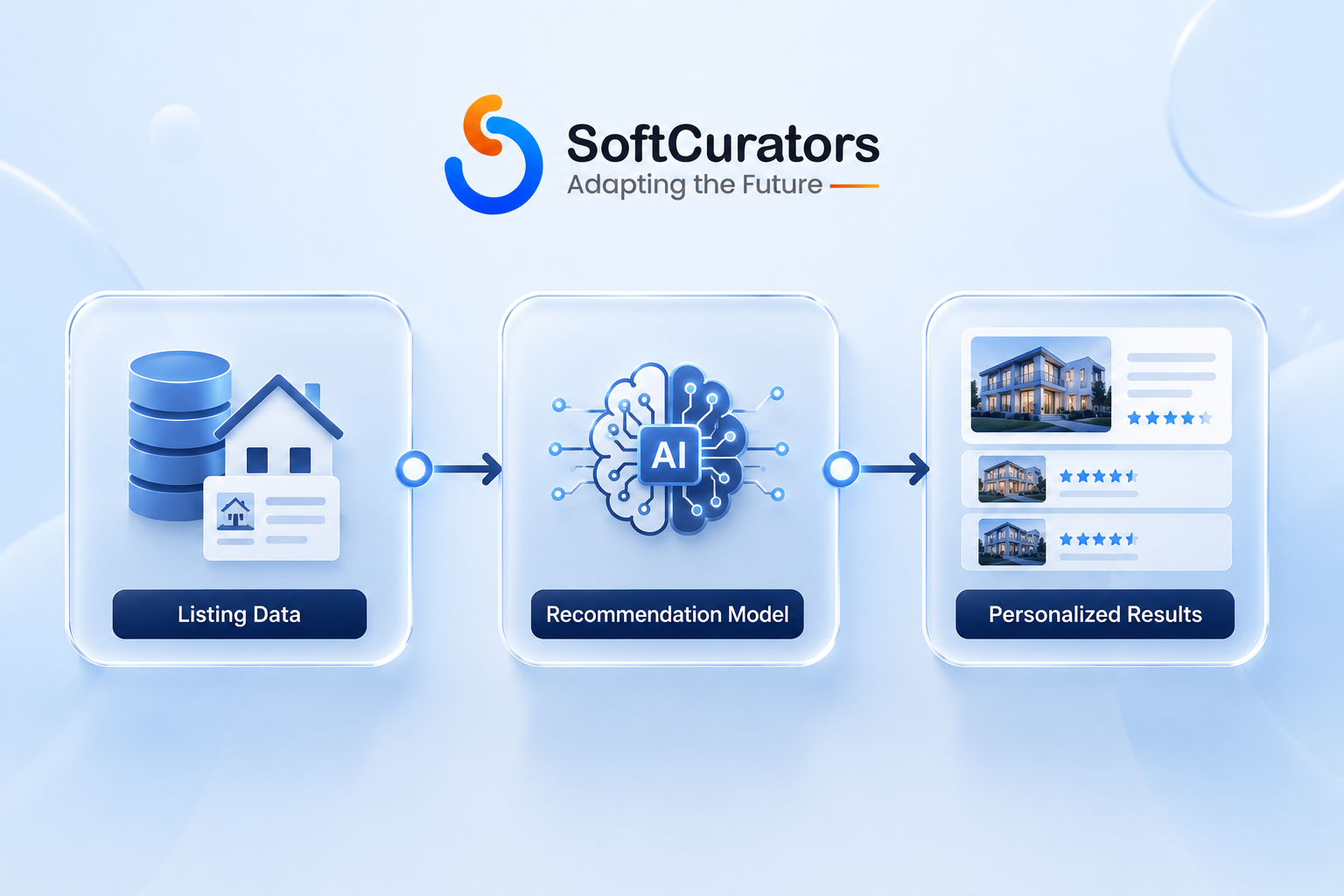
An AI-powered property recommendation system analyses listing data (price, location, features) alongside user behavior (searches, saves, clicks) to surface homes or rentals a specific buyer or renter is statistically likely to want. Most systems combine collaborative filtering, content-based filtering, and increasingly vector-embedding search, layered on top of clean MLS or listing data. The build effort centers less on the machine learning model itself and more on data quality, fair housing compliance, and the cold-start problem for new users and new listings.
Why Property Recommendations Are Harder Than They Look
Recommending a movie is forgiving. Recommend the wrong film and a viewer loses ninety minutes. Recommending a home is not forgiving in the same way a bad match wastes a buyer’s afternoon, or worse, quietly damages trust in the platform they’re using to make one of the largest financial decisions of their life.
That’s the central challenge behind AI-powered property recommendation systems: the underlying machine learning techniques are borrowed from retail and streaming, but real estate adds constraints those industries never had to solve. Listings expire. Inventory is hyperlocal. Legal fair housing rules restrict how you can personalize. And unlike a song, a listing can’t be “recommended” to ten thousand people without eventually running out.
Founders and product leaders evaluating this technology tend to arrive with one of two questions. Some want to know whether a recommendation engine is worth building at all, given the cost and legal complexity involved. Others have already decided to build one and want to understand the trade-offs between a custom model, a managed AI service, and a proptech vendor’s off-the-shelf tool. This guide is written to answer both.
This guide walks through how these systems actually work under the hood, what data and infrastructure they require, where they most often go wrong, and how to decide between building custom infrastructure, using a managed recommendation service, or licensing a proptech vendor’s engine. Along the way, we separate durable engineering principles from techniques that are still actively evolving, since AI capability in this space moves faster than most platform roadmaps. If you’re also scoping the surrounding platform, our guide on how to create a real estate app covers the broader product beyond recommendations specifically, and our piece on how to build a property rental app like Airbnb is a useful companion if your platform spans both sales and rental inventory.
What Is an AI-Powered Property Recommendation System?
An AI-powered property recommendation system is software that ranks or filters property listings for an individual user based on learned patterns in listing data and user behaviour, rather than presenting the same sorted list to everyone. It sits between your listing database and your user interface, deciding which properties appear first on a home screen, in an email digest, or alongside a listing a user is currently viewing.
This differs from a standard search-and-filter experience. A filter is explicit the user sets a bedroom count and a price ceiling, and the system returns exact matches. A recommendation system is implicit it infers preferences the user never typed in, such as a tendency to click on homes with south-facing yards or a pattern of saving properties near specific school districts.
Consider a simple example: a user searches for two-bedroom condos under a certain price in one neighbourhood, but consistently clicks into and lingers on listings with in-unit laundry and a dedicated home office, even in slightly different neighbourhoods. A pure filter-based system never surfaces those adjacent listings, since they fall outside the explicit search criteria. A recommendation layer notices the pattern in clicked and dwelled-on listings and starts weighting similar properties higher, even outside the original filter boundaries without the user ever typing “home office” into a search box.
Who Actually Needs This, and Who Can Skip It
Consumer-facing listing portals and large brokerages with meaningful listing inventory benefit most, since personalization compounds in value as catalogue size grows. A single-office brokerage with forty active listings, by contrast, gets little from a recommendation model – there simply isn’t enough inventory variance for the system to learn from, and a well-organized filter and a knowledgeable agent will outperform it.
Enterprise platforms managing multiple regional markets or a franchise network sit somewhere in between. They typically have enough aggregate data across the network to justify a shared recommendation model, even if individual local offices don’t generate enough traffic on their own. This is a useful test: ask whether your combined listing and interaction volume, not any single office’s volume, clears the threshold described below.
Consultant’s Tip – Before investing in a recommendation engine, check your listing volume and user activity volume honestly. Most collaborative-filtering approaches need a meaningful base of both users and interactions before the output beats a simple ‘sorted by relevance’ list. Below that threshold, you’re paying engineering cost for a system with nothing useful to learn from yet.
How Property Recommendation Engines Actually Work
Most systems in production today combine two or three complementary techniques rather than relying on one. Understanding each helps you evaluate a vendor’s claims or scope a custom build accurately.
Content-Based Filtering: Matching Property Attributes
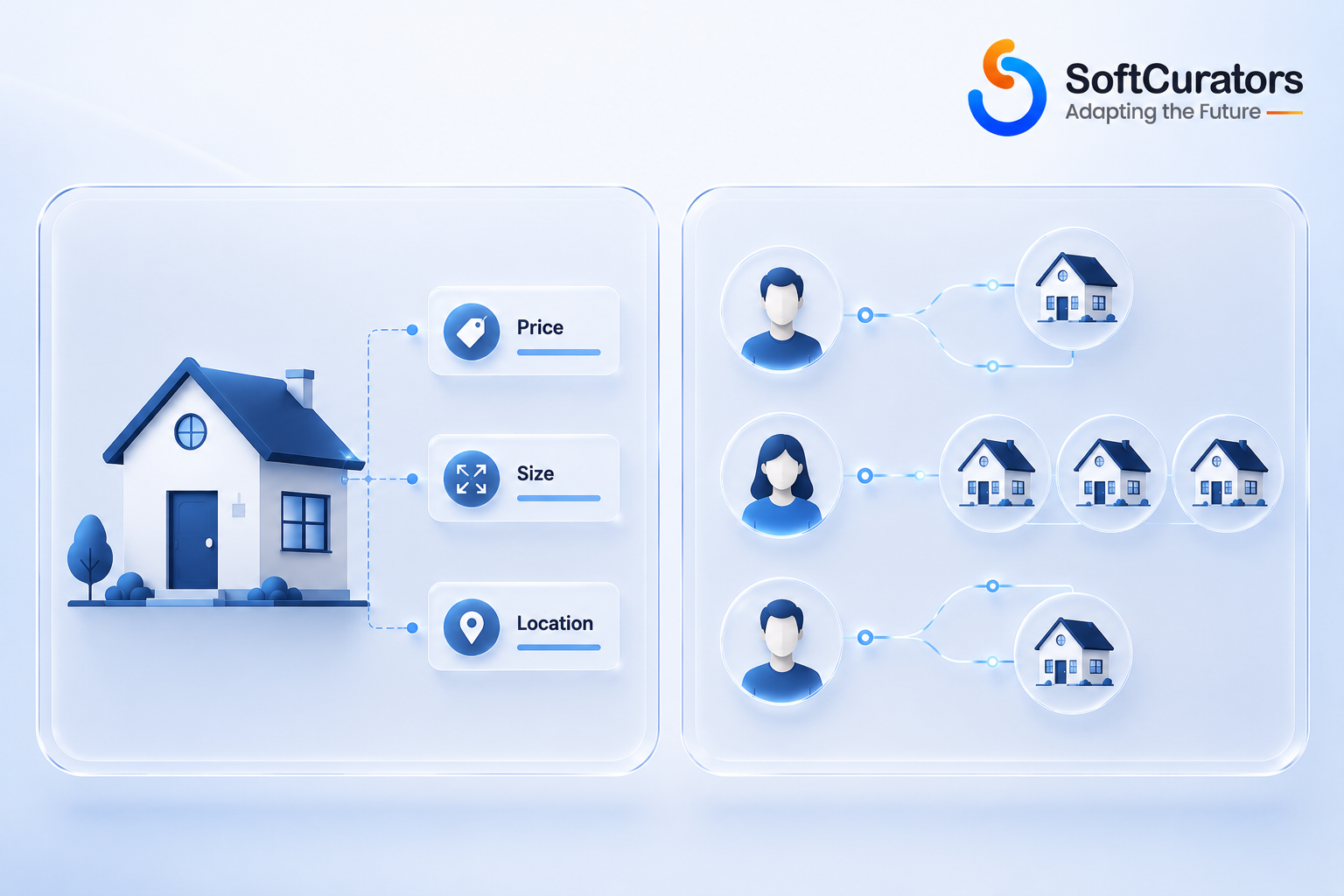
Content-based filtering recommends listings that share attributes with properties a user has already shown interest in — similar price range, square footage, property type, or location. It builds a profile from the listing’s own structured data, so it works even for a brand-new user with no history, as long as they’ve viewed or saved at least one property.
Technical perspective: this requires clean, structured listing data. Fields like property type, lot size, and amenities need to be normalized consistently, which is exactly the problem the RESO Data Dictionary was built to solve across MLS systems. Business perspective: content-based filtering is the easiest technique to launch with, since it doesn’t require a large user base — it only requires good listing metadata.
Collaborative Filtering: Learning from Similar Users
Collaborative filtering recommends listings based on what similar users engaged with, rather than the listing’s own attributes. If users who saved Property A also frequently saved Property B, the system starts surfacing B to new users who show interest in A, even if the two properties don’t share obvious attributes.
This is the technique behind most large-scale commercial recommendation engines, including managed services like Amazon Personalize. Operational perspective: collaborative filtering needs meaningful interaction volume to be useful most managed services set minimum thresholds (often in the range of thousands of interactions and tens of unique users) before results outperform simpler methods, so it’s not viable at very small scale.
Hybrid and Embedding-Based Approaches
Most mature systems blend content-based and collaborative signals into a hybrid model, and increasingly represent listings as vector embeddings — numerical representations that capture semantic similarity, allowing the system to find listings that are conceptually similar even when their structured fields differ. This is what makes a system able to recommend a converted loft to someone who’s been browsing open-concept condos, even though “loft” and “condo” are different property types in your database.
Future perspective: embedding-based search is also what enables more natural, descriptive search queries (“bright, walkable, near good schools”) rather than rigid filter forms, which is where a meaningful share of proptech development is currently headed. This is a genuine architectural shift, not a settled industry standard — teams should verify a given vendor’s actual embedding and semantic-search capabilities rather than assuming the term guarantees a specific technique.
Session-Based and Sequential Models
Session-based models track the order in which a user interacts with listings within a single browsing session, capturing shifting intent — someone might start browsing houses and refine toward townhomes as they scroll, and a sequential model picks up on that shift in real time rather than treating all past behavior equally. These are more complex to implement and are typically added after a simpler collaborative or content-based system is already working well.
Business Insight
It’s tempting to lead a pitch deck with ‘AI-powered recommendations,’ but the technique matters less than the data feeding it. A well-tuned content-based system on clean, complete listing data will consistently outperform a sophisticated hybrid model running on sparse, inconsistent data.
| Technique | Data It Needs | Strength | Weakness |
| Content-based filtering | Structured listing attributes only | Works from day one, even with a single user interaction | Can miss non-obvious matches; tends to over-narrow results |
| Collaborative filtering | Meaningful volume of user interactions across many listings | Surfaces non-obvious matches other users validated | Needs scale; struggles with brand-new users or listings |
| Hybrid models | Both structured attributes and interaction history | Balances the strengths of both approaches | More complex to build, tune, and explain |
| Embedding / vector-based search | Rich listing descriptions, images, or structured data converted to vectors | Captures semantic similarity beyond exact attribute matches | Requires more infrastructure (vector database, embedding pipeline) |
| Session-based / sequential models | Real-time interaction sequences within a session | Adapts to shifting intent within a single browsing session | Higher engineering complexity; usually a later-stage addition |
Explainbility: Why ‘Because You Liked X’ Matters More in Real Estate
Showing a user why a listing was recommended — “similar to homes you’ve saved” or “popular in a neighbourhood you’ve searched” – does more than build trust. It gives the platform a defensible, documented rationale for each recommendation, which matters considerably given the fair housing considerations covered later in this guide.
Technical note: simpler techniques like content-based filtering are inherently easier to explain, since the rationale maps directly to shared listing attributes. Deep learning and embedding-based approaches are harder to explain in plain language, which is a genuine trade-off to weigh against their improved accuracy, not just a technical footnote.
Recommendation Use Cases Across the Real Estate Industry
The underlying techniques described above apply differently depending on what kind of real estate platform you’re building. It’s worth understanding these differences before scoping a system, since they change both the data available and the risk profile involved.
Buy-Side Listing Portals
Consumer-facing portals where buyers browse for-sale homes are the most common use case, and typically the one with the highest interaction volume relative to inventory size, since a single home can be viewed thousands of times before selling. This higher interaction-to-listing ratio makes collaborative filtering more viable earlier than in lower-traffic segments.
Rental Platforms
Rental platforms see faster inventory turnover and shorter user decision cycles than sales platforms, which increases the frequency of the cold-start problem for new listings but also generates fresh interaction data more quickly. Operational perspective: this typically means more frequent retraining cycles are worthwhile compared to a sales-focused platform, since rental market conditions and available inventory shift faster.
Off-Market and Investment Platforms
Platforms serving real estate investors off-market deal flow, distressed properties, or investment-focused listings — have fundamentally different signals to work from. Users here often care more about financial metrics (cap rate, rental yield potential, renovation cost estimates) than lifestyle attributes like school districts, which means the feature set feeding the model needs to reflect investment criteria rather than typical homebuyer preferences.
New Construction and Builder Platforms
Builder platforms selling new construction have a narrower, more controlled inventory set, often within a single development or a handful of communities. Recommendations here tend to focus more on floor plan and customization options than on broad property discovery, and the smaller inventory size generally favors content-based and rules-based approaches over collaborative filtering.
Commercial Real Estate Platforms
Commercial platforms serve a smaller, more specialized user base with longer decision cycles and fewer total transactions, which makes collaborative filtering difficult to justify in most cases. Content-based matching on hard financial and physical criteria – square footage, zoning, lease terms, cap rate – combined with strong search and alerting tends to outperform behavioral personalization in this segment.
The Data Layer: What a Property Recommendation System Actually Needs
This is the layer that determines whether a recommendation system works at all, and it’s consistently the most underestimated part of the project.
Structured Listing Data
This includes price, square footage, bedroom and bathroom count, property type, lot size, year built, amenities, and location data down to neighborhood or even walkability scoring. If you’re pulling from an MLS feed, this data typically already follows the RESO Data Dictionary standard, which normalizes field names and formats across hundreds of MLS systems — a meaningful advantage over building your own schema from scratch.
User Interaction Data
Searches, saved listings, clicks, time spent viewing a listing, contact-agent requests, and price-drop alert signups all feed the model. Risk alert: capturing this data means handling personally identifiable information and behavioral data, which brings GDPR and CCPA obligations into scope the moment you have EU or California users — see the security and compliance section below.
External and Enriched Data
Many platforms enrich raw listing data with school district ratings, crime statistics, walkability or transit scores, and flood or climate risk data from third-party providers. Technical note: enrichment data usually comes from a separate vendor or public data source with its own licensing terms and refresh schedule, and stale enrichment data (an outdated school rating, for instance) is a common, quiet source of user distrust.
Data Governance and Freshness
Listing data changes constantly — prices drop, homes go under contract, photos get updated. A recommendation system built on stale data doesn’t just look outdated; it actively damages trust when a user clicks into a recommended listing that’s no longer available. Operational perspective: this makes sync frequency with your MLS or listing source a direct product-quality issue, not just a backend concern, and it’s worth defining an explicit maximum acceptable data staleness (many platforms target near-real-time or at most a few hours) as a requirement rather than an afterthought.
Governance also covers who owns responsibility for data accuracy when enrichment sources disagree — for instance, when a school-rating provider and a separately licensed demographic dataset show conflicting boundaries for the same neighborhood. Deciding this in advance avoids inconsistent user-facing information later.
The Cold-Start Problem
Every recommendation system faces the cold-start problem: a brand-new user has no history to learn from, and a brand-new listing has no interaction data yet. Decision guidance: the standard mitigation is falling back to content-based filtering or simple popularity-based ranking until enough behavioral data accumulates — typically a matter of a handful of sessions for a user, and days to weeks for a new listing depending on traffic volume. A platform that doesn’t plan for this explicitly tends to show new users a blank or generic feed in their first session, which is exactly when first impressions matter most.
Core Technical Architecture
A production recommendation system generally has four moving pieces, whether you build them yourself or lean on a managed service.
Data Pipeline and Feature Store
Raw listing and interaction data needs to be cleaned, normalized, and transformed into features the model can use — a process usually run on a scheduled or streaming pipeline feeding a feature store. This is frequently the largest engineering line item in the entire project, larger than the model itself.
Model Training and Serving
Models can be trained on your own infrastructure using open-source frameworks, or through a managed service such as Amazon Personalize or Google Cloud’s Agent Search recommendation capability, both of which handle training and serving infrastructure so your team focuses on data quality rather than ML operations. When to build custom: when your data volume and differentiation strategy justify the ongoing data science investment. When to use a managed service: when speed to market and lower operational overhead outweigh the value of full model control.
Real-Time vs. Batch Inference
Batch inference precomputes recommendations on a schedule (nightly, hourly), which is cheaper and simpler but less responsive to a user’s current session. Real-time inference recalculates recommendations as a user interacts with the platform, which feels sharper but costs more to run and adds latency requirements to your infrastructure. Most mature platforms use a hybrid: batch-computed recommendations as a baseline, refreshed in real time as session signals come in.
Integration with Search and Ranking
The recommendation layer typically sits alongside, not instead of, a traditional search index. A user’s explicit filters (bedrooms, price, location) usually take priority, with the recommendation model re-ranking or supplementing results within those constraints rather than overriding them outright.
Evaluating Model Quality Before Launch
Before a recommendation model goes live, it needs to be evaluated against held-out historical data using standard ranking metrics — precision, recall, and normalized discounted cumulative gain (NDCG) are common choices, and managed services like Amazon Personalize provide built-in evaluation metrics for exactly this purpose.
Consultant’s tip: don’t skip offline evaluation in favour of “just launching and seeing what happens” – a model that scores poorly offline rarely improves once it’s in front of real users, and catching this before launch avoids a visible, public quality problem.
Online evaluation matters just as much once the model is live. Click-through rate and conversion metrics measured in production often diverge from offline scores, since real user behaviour includes noise and context an offline dataset can’t fully capture. Running both in parallel, at least for the first several weeks after launch, is worth the added instrumentation effort.
Personalization Features That Actually Matter in Real Estate
Not every personalization feature carries equal weight for a buyer or renter. These are the ones that consistently drive engagement.
- Saved search alerts with smart ranking — notifying users of new matches, ranked by relevance rather than simple recency.
- “Similar listings” modules — shown alongside a property detail page, useful when a user’s first choice falls through or is out of budget.
- Price-drop and market-change alerts — behaviorally, one of the strongest re-engagement triggers in real estate apps, since timing matters enormously to buyers.
- Neighborhood-level scoring and insights — walkability, school ratings, and commute estimates, which increasingly influence decisions as much as the property itself.
- Personalized digest emails or push notifications — summarizing new and relevant listings on a cadence the user controls.
Common mistake: over-personalizing to the point where users stop seeing anything outside their established pattern, which in real estate can mean missing a genuinely good match simply because it doesn’t fit prior click history. A small amount of intentional diversity in recommendations — sometimes called exploration — keeps the system useful rather than narrowing.
AI-Generated Property Insights and Descriptions
A closely related but distinct capability is using generative AI to produce plain-language summaries of why a listing might fit a specific user — “this home is within your typical search radius and has the larger lot size you’ve favored in recent saves.” This is built on top of the same recommendation signals but adds a natural-language layer, which is a meaningfully different engineering problem involving a language model rather than a pure ranking model.
Risk alert: generative summaries need factual grounding in real listing data — a language model that paraphrases loosely risks introducing inaccurate claims about a property, which is a legal and trust problem distinct from a ranking error. Any generative feature in this space should be constrained to only restate verified listing fields, not infer unverified details.
Integrating Recommendations into Agent and CRM Workflows
Consumer-facing recommendations are only half the picture on most real estate platforms. The same underlying signals — which listings a lead is engaging with, what patterns their saves show — are valuable to the agents working those leads, and feeding this into a CRM or agent dashboard is often where the business value becomes most concrete.
Business perspective: an agent who knows a lead has been repeatedly viewing homes with finished basements can tailor outreach far more effectively than one working from a generic contact list.
Operational perspective: this requires your recommendation system’s data layer to expose lead-level insights to internal tools, not just consumer-facing rankings, which is a separate integration effort worth scoping explicitly rather than assuming it comes free with the consumer feature.

Fair Housing, Bias, and Compliance: The Part Most Teams Underestimate
This is the section that separates real estate recommendation systems from nearly every other recommendation use case, and it deserves more attention than most technical guides give it.
Why Fair Housing Law Applies to AI Recommendations
In the United States, the Fair Housing Act prohibits discrimination in housing-related advertising on the basis of protected characteristics such as race, religion, national origin, familial status, and disability. The U.S. Department of Housing and Urban Development has issued specific guidance on how the Fair Housing Act applies to algorithmic and AI-driven housing advertising, making clear that a system doesn’t need to intentionally discriminate to create legal exposure — a model that produces discriminatory outcomes through proxy variables (like zip code correlating with a protected characteristic) can trigger liability even without explicit intent.
How Bias Enters a Recommendation Model
Bias typically enters through historical data, not through explicit programming. If past user engagement data reflects patterns shaped by discriminatory steering or unequal access, a model trained on that data can reproduce the same pattern, even though no protected characteristic was ever an input field. This is a well-documented risk across recommendation systems generally, not unique to real estate, but the legal consequences are considerably higher here than in retail or media.
This concept — a facially neutral system producing unequal outcomes across protected groups — is generally referred to as disparate impact, and it’s a well-established legal theory that predates AI systems entirely. What’s changed is the scale and opacity: a human agent making a handful of biased decisions is a different enforcement problem than an algorithm making the same biased decision millions of times, consistently, across an entire platform’s user base.
Risk Alert
Fair housing compliance for AI systems is a genuinely developing area of regulation and enforcement. This section describes general principles, not legal advice consult counsel familiar with fair housing law and review current HUD guidance directly before launching a personalization system that touches housing advertising or availability.
Practical Mitigation Steps
- Exclude protected-characteristic proxies (certain granular location data, for instance) from model features where they aren’t necessary for legitimate matching.
- Run regular algorithmic audits comparing recommendation outcomes across demographic groups, even when demographic data isn’t a direct model input.
- Maintain human review processes for advertising targeting rules, particularly for paid promotion of specific listings.
- Document your model’s logic and data sources so you can explain, at a reasonable level of detail, why a recommendation was made both for internal accountability and for regulatory response if needed.
This connects directly to a broader theme in AI regulation: the GDPR’s Article 22 provisions on automated decision-making and profiling similarly require meaningful human oversight and explainability wherever automated systems significantly affect individuals, which is a useful design principle to borrow even for platforms operating only in the United States.
Data Privacy and Security for Property Recommendation Systems
Recommendation systems are, by definition, built on behavioral tracking, which puts privacy and security requirements at the center of the architecture rather than at the edges.
- GDPR and CCPA compliance — applies the moment EU or California users interact with your platform, covering consent for behavioral tracking, data export and deletion rights, and disclosure of what’s collected.
- API security — recommendation systems typically expose APIs to mobile and web clients; following the OWASP API Security Top 10 guidelines for authorization, authentication, and rate limiting reduces the most common attack surfaces.
- Data minimization — collecting only the behavioral signals the model actually uses, rather than logging everything indiscriminately, both reduces breach exposure and simplifies compliance obligations.
- Third-party enrichment data licensing — school ratings, crime data, and similar enrichment sources often carry their own usage and redistribution restrictions worth reviewing before display in a consumer product.
For a broader view of these obligations across mobile products generally, see our guide on mobile app security and compliance.
Decision Framework: Should You Build a Recommendation System Now?
Before choosing an approach, it’s worth stepping back and asking whether now is the right time to build at all. This framework applies across every technique and vendor option covered above.
When to choose it: you have meaningful listing inventory (typically thousands of active listings, though this varies by market density) and a growing base of returning users generating consistent interaction data, and personalization is a genuine differentiator in your competitive positioning rather than a feature to check off.
When not to choose it: your listing inventory is small and hyperlocal, your users are mostly one-time visitors rather than returning browsers, or your team lacks the capacity to maintain fair housing review and model monitoring on an ongoing basis. In these cases, a well-designed search and filter experience, possibly with simple rules-based suggestions, delivers most of the practical benefit at a fraction of the cost and risk.
Cost implications: even a managed-service approach carries meaningful data engineering cost upfront and ongoing usage-based fees that scale with traffic, so the investment should be weighed against expected engagement lift, not treated as a fixed one-time cost.
Maintenance implications: every approach requires ongoing monitoring, periodic retraining, and recurring fair housing audits — there is no build-once-and-forget option here.
Scalability implications: rules-based systems don’t improve automatically with more data, while ML-based approaches generally do, which matters if you expect significant growth in listings or users.
Risk factors: the primary risks are compliance exposure (fair housing, data privacy) and the reputational cost of visibly poor recommendations, both of which scale with your platform’s visibility.
Time-to-market impact: a managed service or vendor add-on typically reaches production in weeks, while a fully custom model realistically takes considerably longer once data pipeline work is included.

Build vs. Buy: Custom Model, Managed Service, or Proptech Vendor
This is the central decision most teams face once they’ve validated that a recommendation system is worth building at all.
| Approach | Best Fit When | Weaker Fit When | Key Consideration |
| Fully custom model | Recommendation quality is a core differentiator and you have sustained data science resources | Team lacks ongoing ML/data engineering capacity to maintain and retrain the model | Highest control, highest ongoing operational cost |
| Managed ML service (e.g. AWS Personalize, Google Agent Search) | You want production-grade infrastructure without building MLOps in-house | Your use case needs highly custom logic the managed service doesn’t support | Faster to launch; usage-based pricing scales with traffic |
| Proptech vendor / white-label recommendation add-on | Time-to-market matters most and recommendations aren’t your core differentiator | You need full control over ranking logic or plan to compete on personalization specifically | Lowest upfront cost; least differentiation and data ownership |
| Rules-based fallback (no ML) | Early-stage product with limited data volume | You have enough interaction volume for ML to meaningfully outperform rules | Simplest to build and explain; doesn’t improve with scale automatically |
Decision guidance: most teams are better served starting with a managed service or a strong rules-based system, then investing in custom modeling only once real usage data proves there’s a personalization problem worth solving with a bespoke approach. Our guide on AI real estate software development cost goes deeper into how these choices affect budget.
Cost, Timeline, and Team Requirements
Costs vary significantly depending on data volume, whether you’re using a managed service or building custom infrastructure, and how much enrichment data you’re licensing. Rather than quoting a number that will go stale, it’s more useful to understand the drivers.
- Data pipeline engineering — typically the largest and most consistently underestimated cost, especially when integrating multiple MLS feeds with inconsistent data quality.
- Managed ML service usage fees — usage-based pricing tied to data volume and query traffic, which scales with your platform’s growth rather than being a fixed cost.
- Compliance and fair housing review — legal review of targeting logic and model behavior, an often-overlooked line item in early project estimates.
- Ongoing model maintenance — retraining cadence, monitoring for model drift, and periodic bias audits are recurring operational costs, not one-time build costs.
For a broader framework on estimating a real estate platform build overall, see our guides on real estate app development cost and the cost to develop a property listing app, and our general mobile app development cost and pricing guide for cross-industry cost drivers.
Business insight: it’s worth framing this investment against a specific business outcome rather than treating “add AI recommendations” as an undifferentiated line item. A platform aiming to reduce time-to-lead or improve saved-search engagement has a clearer basis for justifying the data pipeline and compliance investment than one adding personalization purely because competitors have it. If your existing systems are older or fragmented, it’s also worth reading our piece on why enterprises need to modernize legacy applications, since a recommendation system is often the point at which the limitations of legacy data infrastructure become impossible to ignore.
Measuring Success: KPIs for Property Recommendation Systems
A recommendation system needs its own metrics, separate from general app analytics, since a technically accurate model can still fail to move the business metrics that matter.
| Metric | What It Measures | Why It Matters |
| Click-through rate on recommendations | How often users engage with recommended listings vs. ignore them | Baseline signal that recommendations are relevant, not just present |
| Saved-search-to-lead conversion rate | How often a recommended or alerted listing leads to a contact-agent action | Connects recommendation quality directly to business outcomes |
| Time-to-first-relevant-result | How quickly a new user finds something they engage with | Directly addresses the cold-start problem’s real-world impact |
| Recommendation diversity score | Whether the system over-narrows results over time | Guards against the over-personalization mistake described above |
| Model drift / retraining trigger rate | How often live performance diverges from training-time performance | Operational signal for when retraining or data review is needed |
Future perspective: as your platform matures, it’s worth tracking these metrics segmented by user cohort (new vs. returning, buy-side vs. rental) rather than as a single blended number, since a healthy average can mask a recommendation system that works well for power users but poorly for first-time visitors exactly the group where a strong first impression matters most.
It’s also worth resisting the temptation to optimize purely for click-through rate. A recommendation that gets clicked but never leads to a saved search, an inquiry, or eventually a transaction is a weak signal dressed up as a strong one. Tying recommendation metrics back to downstream business outcomes, even loosely, keeps the system honest about what it’s actually accomplishing.
Native vs. Cross-Platform for Recommendation-Heavy Real Estate Apps
Recommendation features themselves are largely backend-driven and platform-agnostic, but the surrounding app architecture still matters for how well personalization feels to the end user. Real-time push notifications for price drops, background location-based relevance, and smooth infinite-scroll browsing are all areas where native development typically offers more consistent performance.
When cross-platform is a reasonable fit: an early-stage product prioritizing speed to market over squeezing out the last bit of native performance, particularly if the recommendation logic lives primarily in the backend rather than on-device. Our comparison of native apps vs. hybrid apps covers this trade-off in more general depth, and our guide on mobile app development technologies walks through the broader stack decisions that surround this choice.
Team and Skill Requirements
Scoping the right team early avoids a common failure mode: hiring a machine learning specialist before the data pipeline that would actually feed their work exists. A realistic build typically needs, at minimum, a data engineer to build and maintain the listing and interaction pipeline, since this is consistently the largest and most time-consuming piece of the project.
Beyond that, a machine learning engineer or data scientist is needed either to build a custom model or to configure and tune a managed service effectively — even managed services require someone who understands feature selection and evaluation metrics to get good results. Backend engineers handle the serving layer and integration with your existing search and listing infrastructure, while a legal or compliance advisor with fair housing familiarity should review the system’s design before launch, not just its output afterward.
Operational perspective: for teams without in-house data science capacity, this is often the strongest argument for starting with a managed service rather than a custom build — it shifts the ML operations burden onto the provider while your team focuses on data quality and product integration, which is a more realistic scope for a small team. Our guide on mobile app development for businesses and startups covers team-scoping considerations for growing platforms more broadly.
Emerging Trends Worth Watching (Flagged as Trends, Not Settled Practice)
A handful of developments are shaping where property recommendation systems are headed, though none of these should be treated as a required feature yet — each is at a different stage of maturity across the industry.
- Natural-language and conversational search — letting users describe what they want in plain language rather than filling out filter forms, powered by the same embedding techniques described earlier. This is gaining adoption but implementations vary widely in quality across vendors.
- Multimodal recommendations using listing photos — models that factor in visual style (renovated kitchen, natural light, layout) alongside structured data and text, which is technically demanding and still maturing as a reliable, production-grade capability.
- Predictive market-timing signals — surfacing listings likely to see a price change or go under contract soon, based on historical market patterns. This carries meaningful accuracy risk and should be presented to users as a signal, not a guarantee.
- Increased regulatory attention on algorithmic housing decisions — expect continued and possibly expanding guidance from housing regulators as AI adoption grows across the industry, making a flexible, auditable model architecture more valuable than a rigid one.
Our broader roundup of mobile app development trends and emerging AI in real estate software development tracks how these shifts affect budget and scope more generally.
How to Pilot a Recommendation System Before a Full Rollout
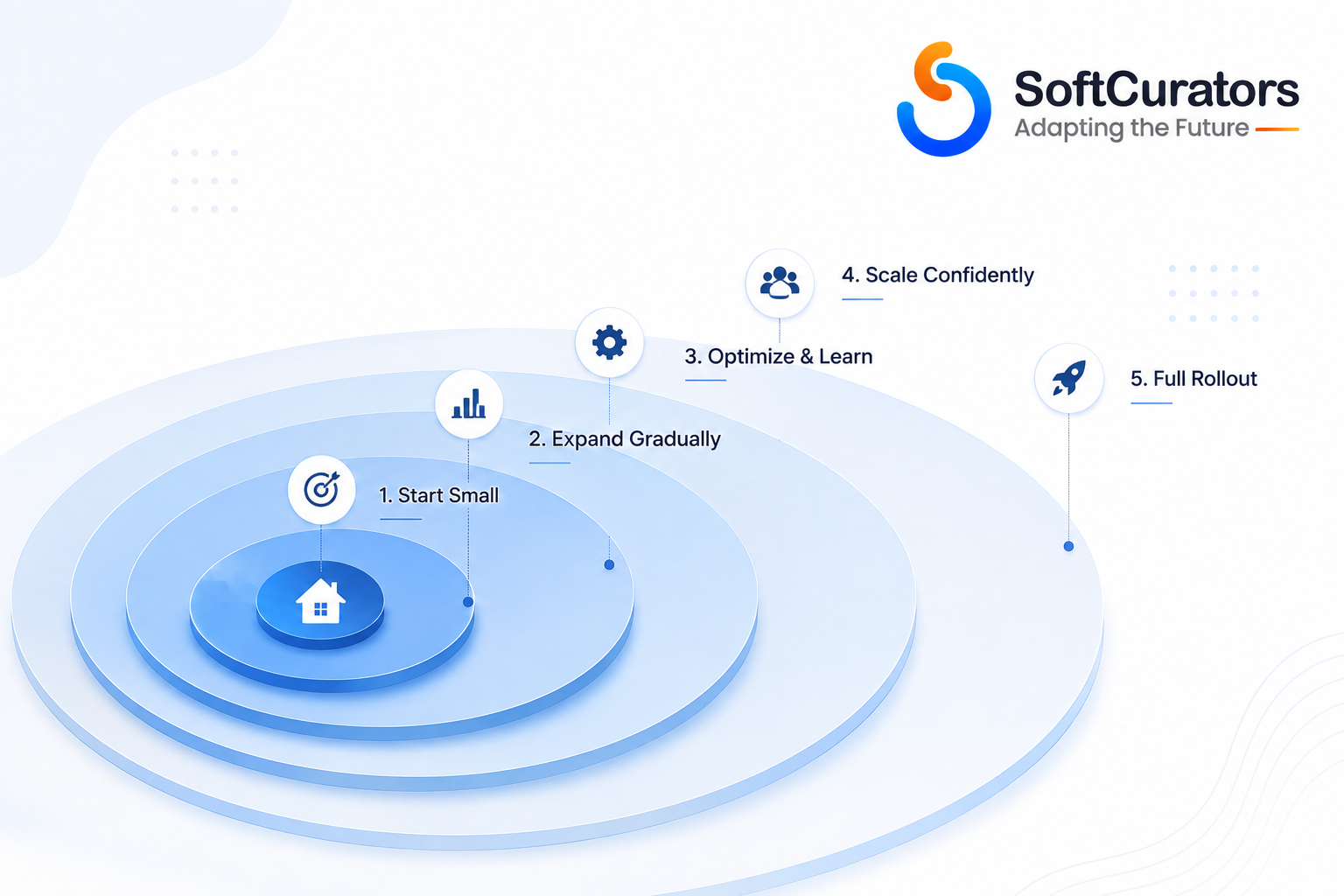
Rolling out personalization to your entire user base on day one is rarely the right approach. A staged rollout limits risk and gives you real performance data before committing to a full build.
Start with a Single High-Traffic Surface
Rather than personalizing every screen at once, most teams get the clearest signal by starting with one high-visibility surface — commonly the “similar listings” module on a property detail page, since it’s low-risk and easy to measure against a simple baseline (most recently listed, or same price band). This keeps the pilot’s data and engineering scope contained while still producing a meaningful before-and-after comparison.
Run an A/B Test Against Your Existing Experience
Compare the personalized surface against your current non-personalized version with a genuine A/B test, not just a before-and-after comparison over time, since seasonal and market shifts can otherwise distort the read. Technical note: this requires your analytics instrumentation to track which users saw which version, which is worth setting up before the pilot begins rather than retrofitting afterward.
Define Success Criteria Before You Launch
Decide in advance what result would justify expanding the pilot — a specific lift in click-through rate or lead conversion, for instance — rather than evaluating success subjectively after the fact. This also gives you a natural, low-drama off-ramp if the pilot doesn’t perform, without having sunk cost into a full platform-wide rollout first.
Expand Gradually, Surface by Surface
Once a pilot surface proves out, expand to adjacent surfaces (home screen, saved search alerts, email digests) one at a time, applying the same evaluation discipline each time. This staged approach also gives your compliance review process room to keep pace, rather than trying to audit an entire personalization system at once after a full launch.
Common Mistakes When Building Property Recommendation Systems
- Launching personalization before data quality is solid. A recommendation model trained on inconsistent, incomplete listing data amplifies the inconsistency rather than compensating for it.
- Ignoring the cold-start problem until users complain. New users need a sensible fallback experience from day one, not a blank or generic feed.
- Treating fair housing compliance as a legal afterthought. Bias review needs to happen during model design, not after a complaint or audit.
- Over-personalizing to the point of narrowing results. Without intentional diversity, users stop seeing genuinely good matches outside their established click pattern.
- Underestimating the data pipeline effort relative to the model itself. Teams routinely budget more time for model selection than for the significantly larger data engineering problem underneath it.
- Skipping ongoing model monitoring. A model that performed well at launch can degrade silently as market conditions and user behavior shift over time.
- Building the consumer-facing feature without the internal agent/CRM integration.</strong> Teams often ship personalized listings to users but never expose the same signals to the agents who could act on them, leaving real business value on the table.
- Letting generative AI features infer unverified property details.</strong> A natural-language summary that paraphrases loosely can introduce inaccurate claims about a listing, creating both a trust problem and a potential legal one.
- Assuming a vendor’s ‘AI-powered’ claim maps to a specific technique.</strong> Always ask a vendor directly which methods (content-based, collaborative, embedding-based) their system uses and what data volume it requires to perform well, rather than assuming from marketing language.
Final Summary: Where to Start
The clearest path into AI-powered property recommendations starts with data, not with model selection. Get your listing data clean and normalized, ideally aligned with an industry standard like the RESO Data Dictionary, before evaluating any recommendation technique. From there, a rules-based or content-based system is usually the right first step, with collaborative filtering and hybrid approaches layered in once you have enough interaction volume to make them worthwhile.
None of this needs to happen all at once. The staged pilot approach described earlier — proving value on one high-traffic surface before expanding applies just as much to the overall program as it does to any single feature. A platform that proves clear engagement or lead-conversion lift on a single “similar listings” module has a far stronger basis for investing in a fuller recommendation system than one that tries to personalize every surface simultaneously on a hypothesis alone.
Throughout, treat fair housing compliance as a design constraint from day one rather than a legal review at the end — it shapes which features you can safely build, not just how you document them afterward. As your platform matures, review our guides on mobile app UI/UX design best practices for how personalization surfaces in the interface, and mobile app testing, deployment, and maintenance for the ongoing operational side of running a model in production. If your platform already handles other data-heavy decisioning, our piece on how Power BI transforms raw data into actionable insights is a useful adjacent read for internal reporting on recommendation performance.
Decision Checklist
Before committing to a build approach, confirm: your listing and interaction data volume actually justifies machine learning over rules-based logic; your data is normalized against a standard like RESO; you have a documented fair housing review process for model behavior; your cold-start fallback experience is designed, not an afterthought; and your team has a plan for ongoing monitoring and retraining, not just initial launch.
Whichever path you choose, treat this as a program with recurring review points rather than a single project with a launch date and an end date. Listing data changes, user behavior shifts with the broader housing market, and regulatory guidance in this space continues to evolve — a recommendation system that stays useful is one your team revisits deliberately, not one left to run unattended once it ships.

Next Step: Talk Through Your Data and Architecture
Recommendation systems succeed or fail based on decisions made before a single model is trained — data architecture, compliance review, and a realistic read on whether your inventory and traffic justify the investment. Softcurators offers an Architecture Review for teams evaluating whether and how to add AI-powered recommendations to a real estate or proptech platform, working through your data readiness, compliance exposure, and build-vs-buy options before any development commitment is made. Learn more about our approach on our why choose Softcurators page, or reach out directly to schedule a session.
Frequently Asked Questions
Do I need machine learning to personalize a real estate app?
Not necessarily at first — a rules-based system (recently viewed, similar price range, same neighborhood) can deliver reasonable personalization at low engineering cost, and is often the right starting point before investing in a full machine learning pipeline.
How much listing data do I need before recommendations become useful?
This depends heavily on technique and platform, but as a general reference point, managed services like Amazon Personalize typically recommend at least a few thousand interactions across a meaningful base of unique users before collaborative filtering outperforms simpler methods — verify current minimums against the provider's documentation, since these thresholds are updated periodically.
Can AI recommendations violate fair housing law?
Yes — a system doesn't need to use protected characteristics directly to create legal exposure; if it learns discriminatory patterns from historical data or produces disparate outcomes across protected groups through proxy variables, it can trigger Fair Housing Act liability even without explicit intent.
How much do app store fees actually add to the total cost?
Store account fees themselves are a small fraction of total development cost, but both major platforms also take a percentage of in-app purchase and subscription revenue, which affects your ongoing business model more than your initial build budget.
What is the cold-start problem in real estate recommendations?
It's the challenge of generating useful recommendations for brand-new users with no behavioral history, and for brand-new listings with no interaction data yet, typically addressed by falling back to content-based filtering or popularity-based ranking until enough data accumulates.
Should I build a custom recommendation model or use a managed AI service?
A managed service like Amazon Personalize or Google's Agent Search recommendation capability is usually the faster, lower-operational-overhead choice, while a fully custom model makes sense once recommendation quality becomes a genuine competitive differentiator and you have the data science resources to maintain it.
How do I prevent bias in an AI property recommendation system?
Practical steps include excluding unnecessary location-granular proxies for protected characteristics from model features, running regular outcome audits across demographic groups, maintaining human review of targeting rules, and documenting model logic for explainability, alongside legal review of your specific approach.
What's the difference between content-based and collaborative filtering?
Content-based filtering recommends listings similar in attributes (price, type, location) to ones a user already engaged with, while collaborative filtering recommends listings based on patterns from similar users, regardless of whether the listings share obvious attributes.
Do property recommendation systems work for rental platforms too?
Yes, and the underlying techniques are largely the same, though rental platforms typically see faster interaction cycles and higher listing turnover, which changes retraining frequency and makes the cold-start problem for new listings more frequent and more important to solve well.
How often should a recommendation model be retrained?
This depends on your platform's data velocity — many managed services retrain on a weekly cadence by default, while high-traffic platforms with fast-changing inventory may need more frequent updates; the right cadence should be validated against your own model drift monitoring rather than assumed.
What data privacy laws apply to real estate recommendation systems?
GDPR applies once you have EU users and covers consent for behavioral tracking and rights to data access and deletion; CCPA applies similarly for California residents; and both require clear disclosure of what behavioral data is collected and why it's used for personalization.
Can I use school ratings and crime data in my recommendation model?
Generally yes, but this enrichment data usually comes from third-party providers with their own licensing and usage terms, and it's worth confirming redistribution rights and data freshness commitments before building it into a consumer-facing recommendation feature.
How is a property recommendation system different from a retail recommendation engine?
The underlying techniques overlap significantly, but real estate adds legal fair housing constraints on personalization, deals with expiring rather than restockable inventory, and typically has a much higher decision stake per recommendation, all of which change how aggressively a platform should personalize.
What team roles are needed to build this?
A typical team includes a data engineer for the listing and interaction data pipeline, a machine learning engineer or data scientist for model development (or integration with a managed service), backend engineers for serving infrastructure, and legal or compliance input for fair housing review.
Is vector search the same thing as AI recommendations?
Not exactly — vector search is a technique for finding semantically similar items using embeddings, and it's increasingly used as one component within a broader recommendation system, but a full recommendation system typically also includes collaborative signals and business logic beyond similarity search alone.
How do I measure whether my recommendation system is actually working?
Track click-through rate on recommended listings, saved-search-to-lead conversion, time for new users to find a relevant result, and a diversity score to catch over-narrowing, rather than relying on model accuracy metrics alone, which don't always translate to business outcomes.
Can small brokerages benefit from AI recommendations, or is this only for large platforms?
Small brokerages with limited listing inventory generally see limited benefit from machine-learning-based recommendations, since there isn't enough data variance to learn from, and are usually better served by strong search and filtering plus agent expertise until inventory and traffic scale up.
What is explainability, and why does it matter for property recommendations?
Explainability means the system can articulate, in plain language, why a specific listing was recommended to a specific user — for example, similarity to previously saved homes. It matters because it builds user trust, and because it gives the platform a documented, defensible rationale for each recommendation, which is directly relevant to fair housing accountability.
Can generative AI write property descriptions automatically?
Yes, and this is a genuinely useful adjacent feature, but any generative summary should be constrained to restate verified listing data rather than infer unverified details, since introducing inaccurate claims about a property creates both trust and potential legal exposure.
Should recommendation data feed into my CRM, not just the consumer app?
In most cases, yes the same behavioral signals that power consumer-facing recommendations are often even more valuable to agents working live leads, and platforms that only build the consumer-facing half of this feature tend to leave meaningful business value unrealized.
How do I choose between a rules-based system and a machine learning model?
Start by honestly assessing your listing and interaction data volume; if you're below the threshold where collaborative filtering outperforms simpler methods, a rules-based system (recently viewed, same price band, same neighborhood) delivers most of the practical value at meaningfully lower cost and risk.
What happens if my recommendation model is trained on biased historical data?
The model can reproduce the same bias in its outputs, even without any protected characteristic as a direct input, because proxy variables in the historical data can encode the same pattern — this is why regular outcome audits across demographic groups are a necessary safeguard, not an optional add-on.
Are natural-language search and AI recommendations the same feature?
They're related but distinct — natural-language search focuses on interpreting a descriptive query into structured search criteria, while recommendations focus on inferring preferences from behavior; many modern platforms build both on a shared embedding infrastructure, but they solve different user problems.
How should I pilot a recommendation system before a full rollout?
Start with a single high-visibility surface, such as the similar-listings module on a property detail page, run a genuine A/B test against your existing experience, and define success criteria before launch so you have an objective basis for expanding or pulling back.
What's the difference between disparate treatment and disparate impact in fair housing law?
Disparate treatment involves intentional discrimination, while disparate impact refers to a facially neutral policy or system that produces unequal outcomes across protected groups regardless of intent — AI recommendation systems are most commonly a disparate impact risk, since bias typically enters through historical data rather than deliberate design.
Do commercial real estate platforms need the same recommendation approach as residential ones?
Not usually — commercial platforms generally have lower transaction volume and more specialized users, which makes collaborative filtering harder to justify, so most commercial platforms rely more heavily on content-based matching against financial and physical criteria combined with strong search and alerts.
