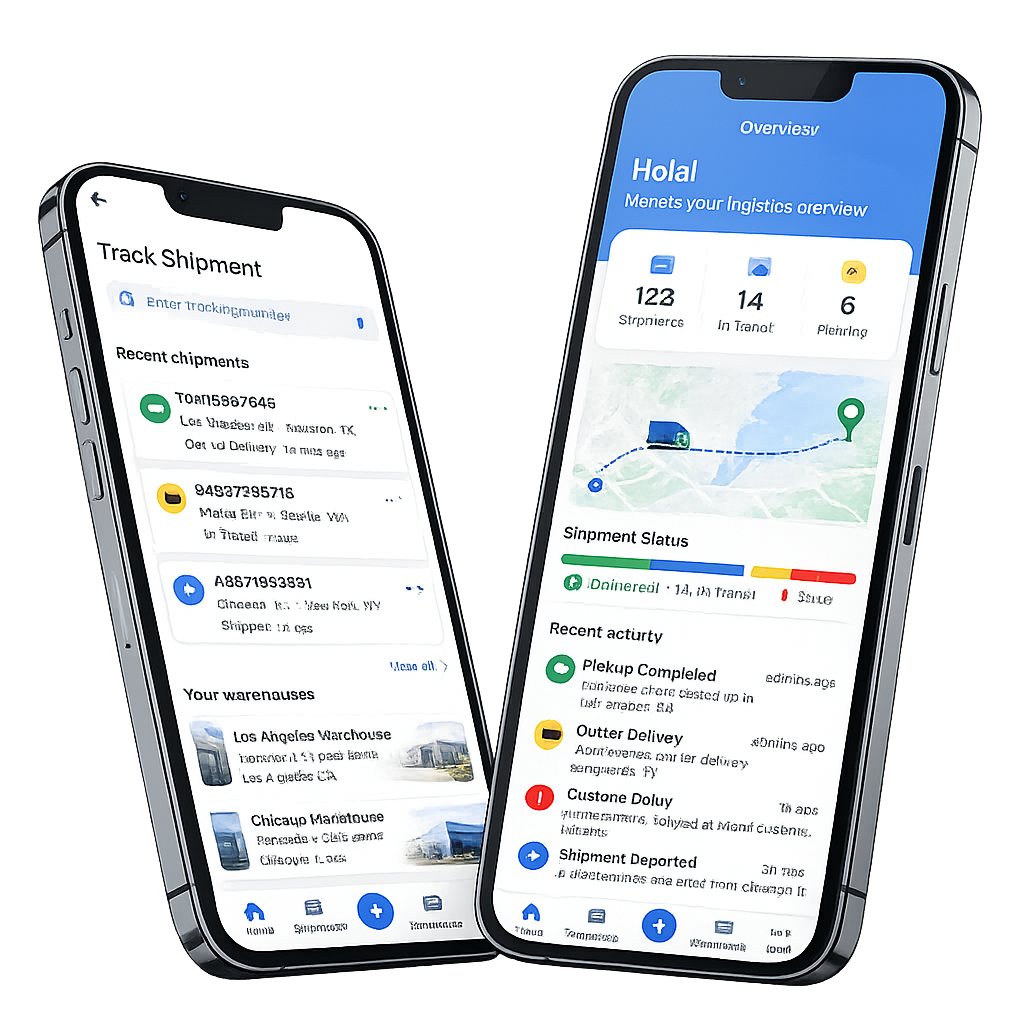








Logistics App Development Company

Logistics app development is the design and engineering of custom software for fleet, freight, warehouse, and delivery operations, covering real-time vehicle tracking, dispatch, warehouse inventory coordination, and reporting across shippers, drivers, dispatchers, and warehouse staff in one system. What’s actually at stake for a logistics business isn’t the tracking map itself, it’s what fragmented visibility costs in practice: missed deliveries from manual dispatch errors, inaccurate ETAs that damage shipper trust, compliance violations that carry real regulatory penalties, and rising fuel and labor costs from routing that no one’s actually optimizing. This page works through when custom logistics software is worth building against adopting an established fleet or logistics SaaS platform, since that decision not the feature list determines whether the investment pays off. The underlying dispatch and real-time coordination problem here has genuine parallels to other categories we build for, including on-demand app development, taxi and ride-hailing, and food delivery platforms, and for supply-chain businesses with a fulfillment or e-commerce component, our e-commerce development page covers the retail side of that same operational chain.

Our Clients

Why ?

Why Invest in Logistics App Development ?

The logistics industry is evolving rapidly. Businesses that rely on manual processes struggle with delays, inefficiencies, and lack of visibility. Professional logistics app development helps you:

Monitor fleet in real time

Optimize delivery routes

Reduce operational costs

Improve warehouse management

Increase customer transparency

Automate order processing

Logistics App Development

The Business Case for Custom Logistics Software

  • Manual dispatch, paper-based proof-of-delivery, and fragmented visibility across fleet, warehouse, and shipment status create costs that compound as a logistics business grows: missed deliveries from dispatch errors, inaccurate ETAs from routing no one’s actively managing, and warehouse inventory data that doesn’t reconcile with what’s actually in transit. Relying entirely on spreadsheets, phone or radio dispatch, or a patchwork of disconnected tools limits scalability in a way that’s easy to underestimate until the business hits real volume a system that worked for ten vehicles usually breaks down well before fifty.

  • The operational impact of not having real-time fleet visibility, route optimization, or integrated warehouse data shows up as measurable business risk: losing contracts to competitors offering better tracking and transparency, rising fuel and labor costs from inefficient routing, and compliance penalties from tracking gaps that a proper system would have caught. A handful of signals indicate a logistics business has outgrown generic tools or a single-purpose SaaS product: multi-modal operations spanning trucking, warehousing, and last-mile delivery, a scaling fleet that’s outgrown manual coordination, a need for custom workflow logic a generic platform doesn’t support, and a strategic desire to own operational data rather than rent it from a SaaS vendor indefinitely. A small regional carrier with a handful of vehicles rarely meets that bar yet  an existing fleet-management SaaS product is almost always the more efficient choice at that scale.

Build vs. Buy: Custom Platform, Fleet Management SaaS or Hybrid

Approach
Upfront Cost
Time to Market
Workflow Control & Ownership
Long-Term Cost
Fleet/Logistics SaaS Platform
Lowest
Fastest
Limited to the platform’s existing workflow and reporting logic
Ongoing per-vehicle or per-seat licensing that scales with fleet size
Custom Development
Highest
Longest
Full control over workflow logic, integrations, and data ownership
No recurring platform fees, but you own ongoing maintenance cost
Hybrid (SaaS core, custom layer)
Moderate
Moderate
Selective control over the specific workflow that matters most
Moderate - SaaS licensing continues for the underlying platform

The right approach depends on your fleet size, how much workflow customization and data ownership you need, and how much recurring per-vehicle licensing cost you’re willing to accept long-term, since custom development and established fleet/logistics SaaS platforms trade these off very differently. Fleet/logistics SaaS platforms make sense for a small to mid-size operation where per-vehicle licensing stays manageable and the platform’s existing tracking and dispatch features cover your operational needs the speed and lower upfront cost are a reasonable trade for accepting someone else’s workflow constraints. Custom development earns its cost once per-vehicle SaaS licensing across a growing fleet starts approaching or exceeding what custom software costs to build and maintain, or once you need workflow logic, ERP/WMS integration, or multi-modal coordination that established platforms don’t handle well. A prototype of the core dispatch and tracking workflow is a reasonable way to validate a custom build’s case before committing to full development, and a hybrid approach keeping SaaS for standard fleet tracking while building custom warehouse or freight-brokerage tooling is worth considering when only part of your operation has outgrown off-the-shelf software.

Who Actually Needs a Custom Logistics Software

Custom logistics software makes sense for businesses with real operational complexity or integration needs, not for every transportation or warehouse business looking to modernize.

  • Fleet and transportation operators with a growing vehicle count needing real-time GPS visibility and dispatch coordination beyond what manual radio dispatch can handle.
  • Freight brokers coordinating between shippers and carriers, needing custom workflow logic for load matching and documentation that generic platforms don’t support well.
  • Warehouse operators needing inventory data that reconciles accurately with in-transit shipment status, rather than treating warehouse and fleet systems as disconnected.
  • Last-mile delivery businesses with dispatch and route-optimization needs structurally similar to what we build for fuel delivery and other on-demand service platforms see also our car wash app development page for a comparable mobile-dispatch use case outside logistics.
  • Enterprise multi-warehouse supply chain teams needing centralized visibility and reporting across locations that a single-purpose SaaS tool typically can’t provide

Solution Readiness Assessment: Is Your Business Ready to Build?

Fleet size or complexity justifies the investment.

Your vehicle count, warehouse count, or operational complexity makes per-vehicle SaaS licensing costly relative to custom software.

A specific workflow need generic platforms don’t support.

You can point to a concrete workflow, integration, or reporting requirement that existing SaaS tools genuinely don’t handle.

You have or can access ERP/WMS or telematics integration requirements.

You know which existing systems (ERP, WMS, ELD/telematics hardware) the new platform needs to connect with.

A clear data-ownership case exists.

You can articulate why owning operational data directly, rather than renting it through a SaaS vendor, matters strategically

Drivers and dispatchers are ready to adopt a new system.

Your team can realistically transition from current tools without major operational disruption during rollout.

Logistics App Development Services We Offer

At Softcurators, our logistics app development services are designed to modernize transportation and supply chain operations

Real Estate

Custom Logistics App Development

We build fully customized logistics software tailored to your operational workflow, whether transportation management, fleet tracking, or warehouse automation.
ecommerce

Real-Time Tracking & GPS Integration

Live vehicle tracking with route optimization and geofencing capabilities.

Real Estate

Fleet Management App Development

Track vehicles, monitor driver performance, manage fuel usage, and optimize routes in real time.

Real Estate

Warehouse Management App Development

Inventory tracking, barcode scanning, stock automation, and shipment coordination.

Real Estate

Supply Chain Management Software

Digitize procurement, inventory, distribution, and demand forecasting systems.

Real Estate

Logistics CRM & Order Management Solutions

Streamline client communication, order tracking, invoicing, and reporting.

80+

Happy Clients

50+

Team Members

10+

Years Experienced Team

100+

Projects Completed

Types of Logistics App Solutions We Provide

We develop scalable logistics app development solutions for diverse business models.

Transportation Management Apps

Complete TMS solutions for freight, cargo, and delivery businesses.

Fleet Tracking Apps

Real-time monitoring and analytics for commercial fleets.

On-Demand Delivery Apps

Apps similar to Uber Freight or delivery management platforms.

Warehouse Management Apps

Inventory optimization and storage automation systems.

Freight & Cargo Booking Apps

Platforms connecting shippers and carriers.

Last-Mile Delivery Apps

Solutions focused on fast, efficient final-mile delivery tracking.

Whether you're managing freight operations, delivery fleets, or enterprise supply chains our expert logistics app developers are ready to help you scale.

The catalysts driving digital transformation. Book your free consultation today.

Key Features of Our Logistics Applications

Every logistics mobile app development project includes powerful multi-panel architecture.

  • Order placement & tracking
  • Real-time shipment updates
  • Payment & invoicing
  • Delivery notifications
  • Order history
  • Route navigation
  • Delivery status updates
  • Shipment confirmation
  • Fuel tracking
  • Earnings dashboard
  • Fleet assignment
  • Driver management
  • Order scheduling
  • Route optimization
  • Performance reports
  • User & role management
  • Revenue analytics
  • Real-time tracking dashboard
  • Commission management
  • Reporting & insights

Advanced Features That Set Our Logistics Apps Apart

We build enterprise-grade logistics software development solutions powered by modern technologies.

Artificial Intelligence (AI) & Machine Learning


AI-driven route optimization, demand forecasting, and predictive maintenance improve efficiency and reduce operational costs.

Big Data & Analytics


Analyze fleet performance, delivery time, and supply chain efficiency.

IoT Integration


Smart sensors for vehicle monitoring and warehouse automation.

GPS & Geolocation Services


Accurate vehicle tracking and real-time shipment visibility.

Cloud Computing & Scalable Infrastructure


Auto-scaling cloud infrastructure for handling peak loads.

Blockchain for Secure Logistics


Secure document exchange and transparent transaction tracking.

Regulatory and Compliance Considerations for Logistics Software

Transportation and logistics software needs to support not just track around regulatory requirements that vary by vehicle type, cargo, and jurisdiction, so compliance needs to be a design consideration from the start rather than a feature added after launch. In the U.S., commercial fleet software commonly needs to support Electronic Logging Device (ELD) data and hours-of-service tracking requirements enforced by the Federal Motor Carrier Safety Administration, which exist to prevent driver fatigue-related incidents but exact requirements depend on vehicle weight class, operation type, and specific exemptions, so this is genuinely not an area where generic platform guidance substitutes for compliance counsel.

Proof-of-delivery and chain-of-custody requirements matter for both regulatory compliance and dispute resolution, and building structured capture (signature, photo, timestamp, GPS location) into the driver workflow gives a business a defensible record without the platform itself making legal determinations. Hazardous materials handling, where relevant, carries its own documentation and routing considerations that vary significantly by cargo type and jurisdiction, and should be confirmed with regulatory counsel specific to your operation rather than assumed to be covered generically by standard fleet software. Building compliance-relevant data capture into the platform from day one is far less costly than retrofitting it once a business is already operating and discovers a documentation gap during an audit.

Contact Us

Ready to scope your Logistics Platform ?

Book a project scoping call and bring your fleet size, existing systems, and compliance requirements — we’ll tell you honestly what it takes to build and launch it.

What Most Logistics Businesses Overlook

What Most Businesses Overlook: the specific gaps that most commonly turn a logistics software rollout into a difficult one.

Underestimating real-time data volume at scale.

GPS and telematics data from dozens or hundreds of vehicles generates far more write volume than most teams plan for upfront, and infrastructure sized for a pilot fleet doesn’t necessarily scale cleanly to full deployment.

Ignoring compliance requirements until late in the project.

Retrofitting ELD, hours-of-service, or proof-of-delivery capture after the core platform is built costs more than designing for it from the start.

Skipping driver and dispatcher training and adoption planning.

A technically sound platform still fails operationally if drivers route around it or dispatchers revert to phone calls under pressure.

Treating warehouse and fleet data as separate systems.

Inventory data that doesn’t reconcile with in-transit shipment status recreates the same fragmented-visibility problem the platform was meant to solve.

Our Logistics App Development Process

A logistics platform build runs through six phases, sequenced around the real-time data architecture decisions that constrain everything else.

image

Requirements and fleet/warehouse workflow mapping

We map how dispatch, fleet, and warehouse operations actually work today before any technical design begins, since generic workflow assumptions rarely match real operational practice.
image

Real-time data architecture design.

GPS/telematics data ingestion architecture gets designed for your actual fleet scale, not a pilot-size assumption that won’t hold at full deployment.

image

Telematics/ERP integration.

ELD/telematics hardware and existing ERP or WMS system integrations get scoped and built against your actual tools, not assumed to connect automatically.
image

Core platform build

Customer, driver, dispatcher, and admin panels are developed against the data architecture and integrations established earlier, alongside a web-based admin dashboard for reporting and configuration.

image

Testing & Phased rollout

The platform gets tested against real dispatch edge cases route disruptions, connectivity gaps in remote delivery areas, exception handling not just a standard functional pass.Launch with a subset of the fleet or one warehouse first to validate data accuracy and driver/dispatcher adoption, with ongoing maintenance and support scoped from launch rather than treated as an afterthought.

Tech Stack for Logistics Platforms

  • Flutter
  • HTML5
  • CSS3
  • JavaScript
  • jQuery
  • Ajax
  • Node
  • Laravel (PHP)
  • Python or Django
  • Java or Spring
  • MySQL
  • PostgreSQL
  • MongoDB
  • Firebase Realtime Database
  • Redis
  • Amazon Web Services (AWS)
  • Microsoft Azure
  • Google Cloud Platform (GCP)
  • DigitalOcean
  • Cloudflare
  • TensorFlow
  • PyTorch
  • Scikit-learn
  • OpenAI APIs
  • Apache Mahout
  • MQTT
  • Smart Sensor APIs

AI-driven route optimization and predictive maintenance features can meaningfully improve fleet efficiency over time, though these depend on real historical data volume to perform well AI consulting is a reasonable first step if you’re not yet sure whether your data supports it.

Data Migration and Fleet/Shipment History Onboarding

Migrating existing fleet, shipment, and customer data from legacy systems means transferring vehicle records, historical route and delivery data, and customer/shipper relationships, and this rarely maps cleanly from a legacy system or spreadsheet without real data cleanup. Inconsistent vehicle or shipment records carry directly into the new platform if not audited first, which affects both reporting accuracy and dispatcher trust in the new system’s data from day one.Change management for drivers and dispatchers adopting a new system matters as much as the technical migration teams used to phone or radio dispatch need training and a transition period where old and new systems may run in parallel briefly, rather than a single hard cutover that risks missed deliveries during the switch. This is especially important for logistics specifically, since a dispatcher who doesn’t trust the new system’s data will revert to phone calls under pressure, undermining the platform’s core value regardless of how well it was built.

Cost and Timeline Planning

Cost and timeline depend heavily on scope and path a fleet-tracking MVP, a full-featured multi-panel platform, and an enterprise multi-warehouse system represent meaningfully different scopes of work. An MVP covering core dispatch, tracking, and basic reporting typically takes around 3 to 6 weeks, while a full-featured platform with warehouse integration, compliance documentation, and multi-role panels typically takes 9 to 12-plus weeks depending on integration complexity. Enterprise multi-warehouse or multi-modal platforms represent the largest scope, given the added complexity of coordinating fleet, warehouse, and freight-brokerage workflows in one system.

What’s your honest recommendation custom, SaaS, or hybrid for my fleet size?
A vendor recommending custom development without asking about your fleet size and integration needs is optimizing for project size over your actual needs.
Have you reviewed our guide on “How to Choose a Mobile App Development Company: Benefits & Tips”?
A broader vendor-evaluation framework is worth applying regardless of which company you ultimately choose.

Questions to Ask Before Starting Your Project

Have you built real-time GPS/telematics data architecture before, at meaningful fleet scale?
Data volume at scale is a distinct technical problem from a small pilot deployment.
How do you approach ELD/telematics and ERP/WMS integration?
A vendor should have specific experience with the actual hardware and systems you’re running, not just generic API integration claims.
What’s your approach to compliance-relevant data capture (proof of delivery, hours-of-service)?
This should be a described, specific workflow, not an assumption that compliance is out of scope.
How do you handle data migration from legacy fleet or shipment systems?
Get a specific answer on data cleanup, not just “we can import your data.”
curators

Why Choose SoftCurators as Your Logistics App Development Company ?

Common Mistakes We See in Logistics App Projects

Mistake
Why It Hurts
What To Do Instead
Underestimating real-time data volume at scale
Infrastructure sized for a pilot fleet doesn’t necessarily scale cleanly, causing performance problems exactly as deployment grows
Architect GPS/telematics data ingestion for realistic fleet-scale volume, not pilot-size assumptions
Ignoring compliance requirements until late
Retrofitting ELD, hours-of-service, or proof-of-delivery capture after the core platform is built costs more than designing for it from the start
Build compliance-relevant data capture into the platform architecture from day one
Skipping driver/dispatcher training and adoption planning
A technically sound platform still fails operationally if drivers and dispatchers route around it under pressure
Scope training and a transition period as part of rollout, not an afterthought
Treating warehouse and fleet data as separate systems
Inventory data that doesn’t reconcile with in-transit shipment status recreates the fragmented-visibility problem the platform was meant to solve
Design warehouse and fleet data to reconcile from the start, not as a later integration
Choosing custom development without a clear cost case
Custom software costs more to build and maintain than SaaS, and without per-vehicle costs genuinely justifying it, that cost is hard to recover
Confirm SaaS licensing costs at your actual fleet scale before committing to custom development
Migrating fleet/shipment data without a cleanup pass
Inconsistent records carry directly into the new platform, undermining dispatcher trust in the new system’s data
Audit and clean fleet, shipment, and customer data before migration

Lets Connect

Ready to Digitize Your Logistics Business ?

    Frequently Asked Questions

     An established fleet/logistics SaaS platform is generally the better choice for a small to mid-size fleet where per-vehicle licensing stays manageable and existing tracking features cover your needs. Custom development becomes worth it once per-vehicle SaaS costs across a growing fleet start approaching what custom software costs to build and maintain, or once you need workflow logic or system integrations SaaS platforms don’t support.

     Commercial fleet software in the U.S. commonly needs to support Electronic Logging Device data and hours-of-service tracking requirements enforced by the Federal Motor Carrier Safety Administration, though exact requirements depend on vehicle weight class and operation type.

    Cost depends primarily on whether you’re building a fleet-tracking MVP, a full-featured multi-panel platform, or an enterprise multi-warehouse system, since each represents meaningfully different technical and integration complexity.

    An MVP covering core dispatch, tracking, and basic reporting typically takes around 3 to 6 weeks, while a full-featured platform with warehouse integration and compliance documentation typically takes 9 to 12-plus weeks depending on integration complexity.

    Route optimization uses real-time vehicle location data combined with a mapping and routing service like the Google Maps Platform to sequence stops and minimize drive time, similar to the dispatch logic used in on-demand delivery platforms. The system also needs explicit handling for edge cases like route disruptions, traffic incidents, and last-minute schedule changes.

    An MVP needs real-time tracking, basic dispatch assignment, and core reporting — for compliance-relevant fleets, this also includes basic proof-of-delivery capture from day one. Warehouse integration, predictive maintenance, and advanced multi-modal coordination are reasonable to defer to later phases.

     Yes, AI-driven route optimization and predictive maintenance can improve efficiency by learning from historical route and vehicle-performance data, though this depends on having enough real operational data to train the model meaningfully. AI consulting is a reasonable first step if you’re unsure whether your current data volume justifies investing in this yet.

    Yes, though it’s rarely a clean import fleet, shipment, and customer records from a legacy system typically need a data-quality audit before migration, since inconsistent records carry directly into the new platform. Planning this as a dedicated step avoids undermining dispatcher trust in the new system’s data.

    Usually not for a small fleet, an existing fleet-management SaaS platform is almost always more efficient than custom software, since per-vehicle licensing stays low and the existing feature set typically covers what a smaller operation needs. Custom development becomes worth considering once fleet size, multi-modal complexity, or integration needs genuinely justify the added cost.

     Proof-of-delivery capture signature, photo, timestamp, and GPS location gets built into the driver workflow as structured data, giving a business a defensible record for both compliance and dispute resolution.

    Yes, ERP/WMS integration is scoped as a specific part of the project based on which systems you’re already running, since compatibility and integration complexity vary meaningfully by provider. We recommend identifying these integration requirements during initial planning rather than after development has started.

     Yes, ongoing support and maintenance covers monitoring dispatch and data-ingestion system reliability, applying security and compliance-relevant platform updates, and adjusting routing logic as your fleet or warehouse footprint grows. This is scoped as a distinct, ongoing engagement rather than a one-time deliverable.

    Our Latest Blogs