
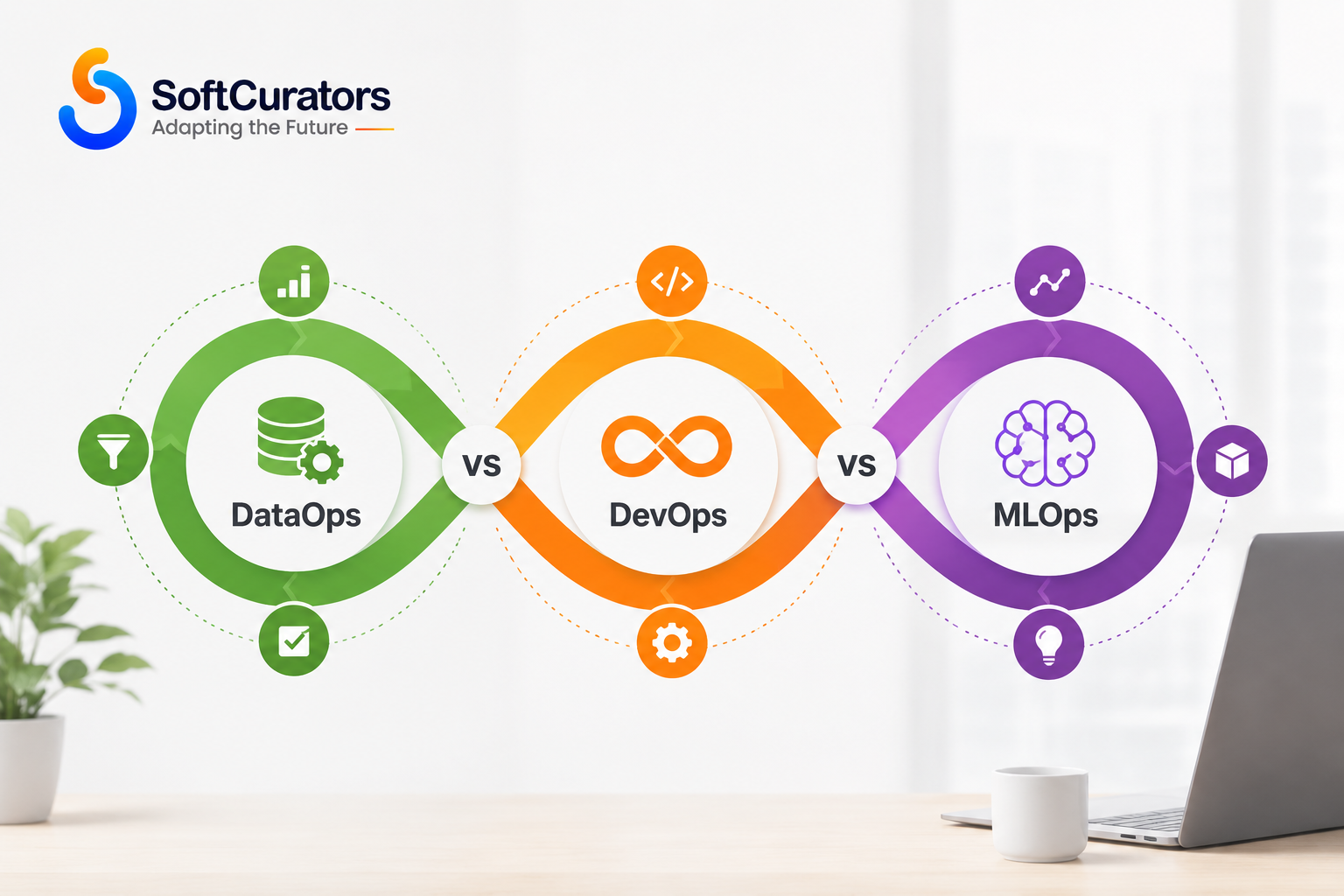
If you have spent any time in the world of software or mobile app development, you have likely heard the terms DataOps vs DevOps vs MLOps thrown around. But what do they actually mean? And more importantly, which one does your business need right now?
These three operational frameworks are reshaping how modern companies build, deploy, and scale technology products. Yet many teams from startups to enterprises still confuse them or use the terms interchangeably. That confusion can cost you time, money, and competitive advantage.
At Softcurators, a leading mobile app and web development company, we work with data-driven businesses every day. We help them architect systems that rely on clean data pipelines, automated deployments, and production-ready AI models. So we understand the real-world difference between DataOps vs DevOps vs MLOps better than most.
In this guide, we break down all three frameworks clearly. We cover what each one does, where they overlap, and how to choose the right approach for your organization. We also show you exactly where Softcurators can help you build or scale each of these systems.
Let us get into it.
1. DataOps vs DevOps vs MLOps: A Quick Overview
Before we dive deep, here is a simple way to understand all three at a glance. Think of them as three different engineering philosophies each one solving a specific problem in the modern tech stack.
- DevOps: Bridges software development and IT operations for faster, more reliable software delivery
- DataOps: Applies DevOps principles to data pipelines to deliver reliable, high-quality data faster
- MLOps: Applies DevOps and DataOps principles specifically to machine learning model development, deployment, and monitoring
Each one borrows from the others. None of them operate in isolation. And all three are increasingly important if you are building data-intensive or AI-powered products.
Quick Stat: According to Gartner, by 2026, over 80% of organizations using AI will adopt some form of MLOps to operationalize their models. The demand for professionals skilled in DataOps vs DevOps vs MLOps has never been higher.
2. What Is DevOps? The Foundation of Modern Software Delivery
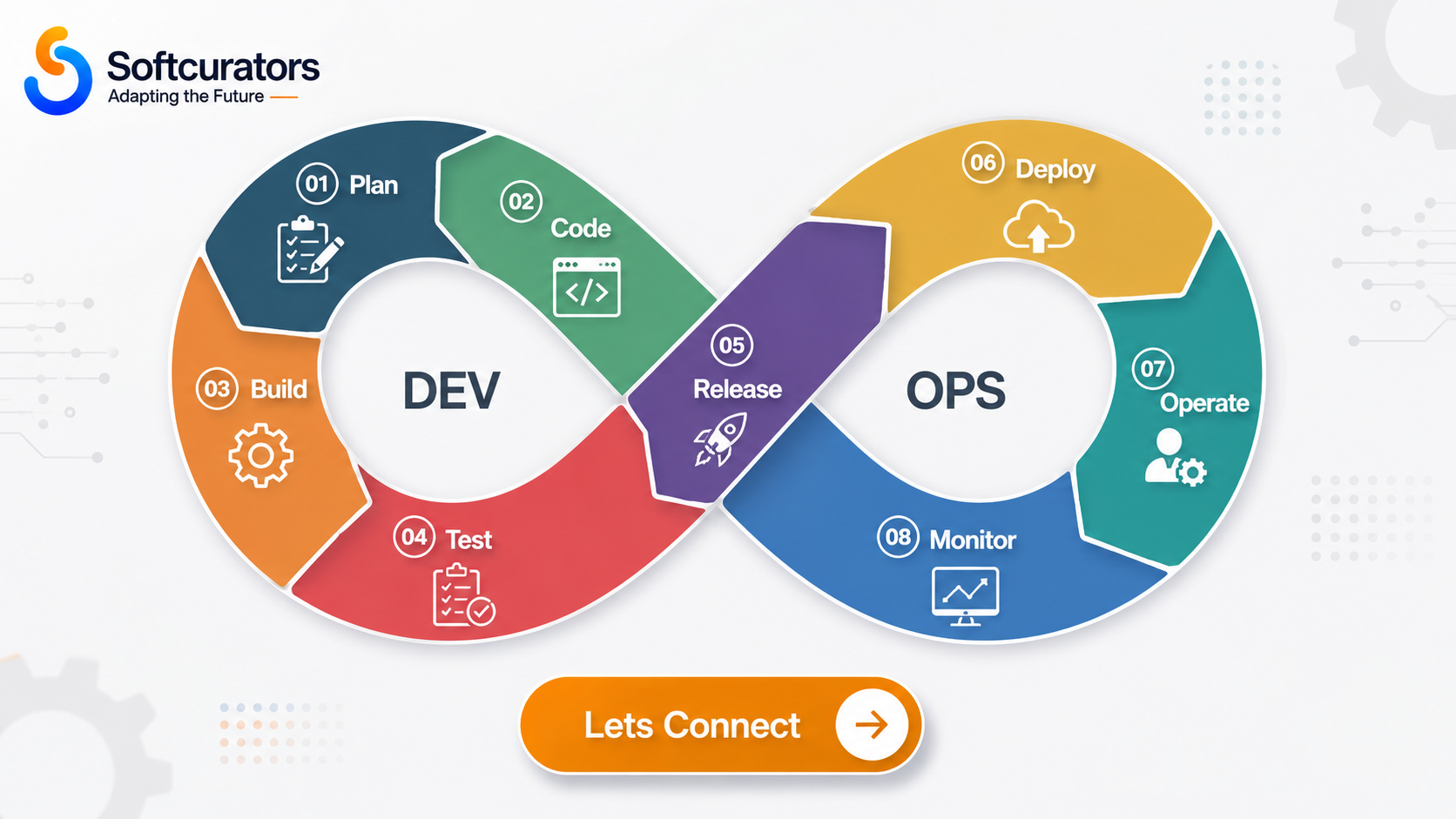
DevOps is the oldest of the three frameworks. It emerged around 2009 as a response to a broken relationship between software developers and IT operations teams.
Traditionally, developers wrote code and ‘threw it over the wall’ to operations teams who then had to figure out how to deploy and maintain it. The result was slow releases, frequent outages, and a culture of blame. DevOps was created to fix exactly that.
The Core Principles of DevOps
- Collaboration: Developers and operations engineers work together throughout the software lifecycle
- Automation: Build, test, and deployment pipelines are automated using CI/CD tools
- Continuous Integration (CI): Code changes are merged frequently and tested automatically
- Continuous Delivery (CD): Software can be released to production at any time with minimal manual effort
- Monitoring and Feedback: Real-time monitoring creates feedback loops that improve system quality
Key DevOps Tools
- CI/CD: Jenkins, GitHub Actions, GitLab CI, CircleCI
- Containerization: Docker, Kubernetes, Helm
- Infrastructure as Code (IaC): Terraform, Ansible, Pulumi
- Monitoring: Datadog, Prometheus, Grafana, New Relic
- Version Control: Git, GitHub, GitLab, Bitbucket
When Does Your Business Need DevOps?
DevOps is the right choice when your primary challenge is software delivery speed and reliability. If your team releases updates slowly, if your deployments frequently break production, or if developers and operations teams are constantly blaming each other DevOps is your starting point.
Softcurators helps companies adopt DevOps practices as part of our broader software development services. We implement CI/CD pipelines, containerized architectures, and monitoring systems that allow your team to ship faster with confidence.
3. What Is DataOps? DevOps Principles Applied to Data
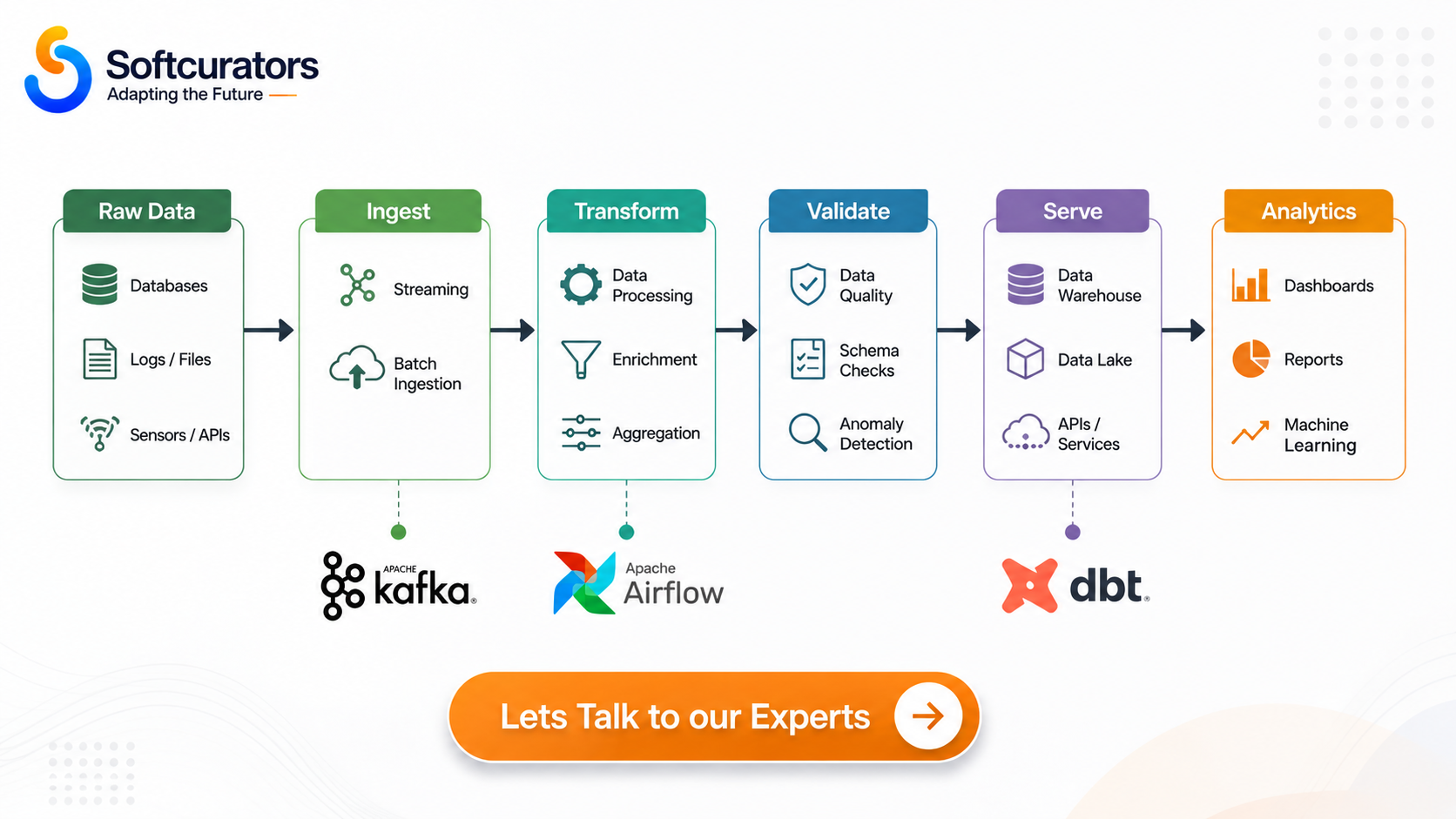
DataOps takes the best ideas from DevOps and applies them to the world of data engineering. It is an agile methodology that improves the speed, quality, and reliability of data analytics by automating data pipelines and breaking down silos between data teams.
The term was coined by Steph Locke and popularized by DataKitchen around 2014. Since then, DataOps has become a critical discipline as businesses have realized that having great data tools means nothing if your data itself is unreliable.
The Core Principles of DataOps
- Agile Development: Data pipelines are built iteratively, just like software features
- Automation: Data ingestion, transformation, testing, and delivery are automated end-to-end
- Data Quality: Automated data quality checks prevent bad data from reaching consumers
- Collaboration: Data engineers, analysts, and business stakeholders work together
- Data Observability: Monitoring of data pipelines similar to application monitoring in DevOps
- Version Control for Data: Data models, transformation scripts, and pipeline configs are version controlled
Key DataOps Tools
- Orchestration: Apache Airflow, Prefect, Dagster
- Transformation: dbt (data build tool), Apache Spark
- Streaming: Apache Kafka, AWS Kinesis, Google Pub/Sub
- Data Quality: Great Expectations, Monte Carlo, Soda Core
- Data Warehouses: Snowflake, Google BigQuery, Amazon Redshift, Databricks
- Data Cataloging: Alation, Apache Atlas, DataHub
Why DataOps Matters More Than Ever
Businesses generate data at an unprecedented rate. But raw data is worthless without reliable pipelines to process, validate, and deliver it. DataOps ensures that the data flowing through your organization is accurate, timely, and trustworthy.
Without DataOps, data engineers spend most of their time firefighting broken pipelines instead of building new capabilities. Analysts constantly question whether the numbers they see are correct. Business decisions get delayed because no one trusts the data.
This is why DataOps is particularly critical for companies building fintech apps, healthcare platforms, and any other data-intensive application where accuracy matters. At Softcurators, we help clients build DataOps-ready architectures from day one.
DataOps vs DevOps: The Critical Difference
The biggest difference between DataOps and DevOps is what they are optimizing. DevOps optimizes the delivery of software code. DataOps optimizes the delivery of clean, reliable data products. DataOps borrows DevOps concepts like CI/CD and version control, but applies them to data pipelines, data quality, and data governance instead of application code.
4. What Is MLOps? The Operational Backbone of AI
MLOps short for Machine Learning Operations is the practice of applying DevOps and DataOps principles to the full machine learning model lifecycle. It bridges the gap between data scientists who build models and engineering teams who deploy them.
The problem MLOps solves is well-known in the industry: around 85% of machine learning projects never make it to production. Why? Because building a model in a Jupyter notebook is completely different from running it reliably at scale in a production environment.
MLOps creates the pipelines, tooling, and culture needed to take models from experiment to production and keep them performing well over time.
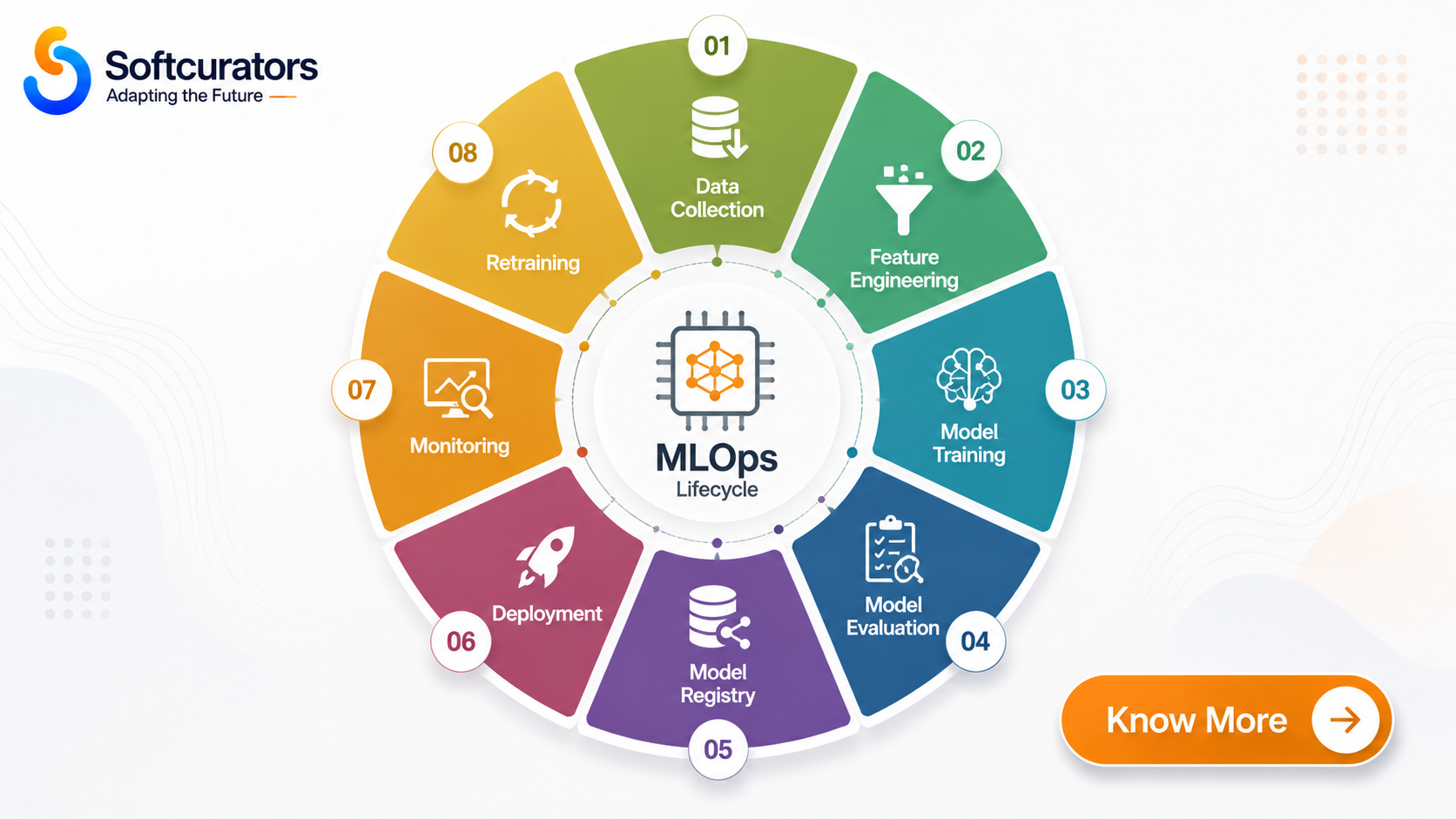
The Full MLOps Lifecycle
- Data Collection and Preparation: Raw data is gathered, labeled, and preprocessed using DataOps pipelines
- Feature Engineering: Raw data is transformed into meaningful input features for the model
- Model Training: Models are trained on versioned datasets using automated training pipelines
- Model Evaluation: Models are tested for accuracy, fairness, bias, and performance metrics
- Model Registry: Trained models are stored and versioned in a model registry
- Model Deployment: Models are deployed to production via API endpoints or batch jobs
- Monitoring and Observability: Model performance, data drift, and prediction quality are tracked in real time
- Retraining: Models are automatically retrained when performance degrades
Key MLOps Tools
- Experiment Tracking: MLflow, Weights & Biases, Neptune.ai
- Pipeline Orchestration: Kubeflow, ZenML, Metaflow
- Model Serving: Seldon Core, BentoML, TorchServe, AWS SageMaker
- Feature Stores: Feast, Tecton, Hopsworks
- Model Monitoring: Arize AI, Evidently, Fiddler AI
- Data Versioning: DVC (Data Version Control), LakeFS
MLOps vs DevOps: Where They Differ
MLOps extends DevOps beyond code deployments to include model versioning, data versioning, experiment tracking, and model monitoring. In traditional DevOps, you deploy software that behaves predictably. In MLOps, you deploy statistical models whose outputs change as real-world data changes requiring a completely new monitoring and retraining paradigm.
MLOps vs DataOps: The Relationship
MLOps cannot exist without good DataOps. A machine learning model is only as good as the data it is trained on. DataOps provides the clean, reliable data pipelines that feed into MLOps training and retraining workflows. Think of DataOps as the foundation and MLOps as the structure built on top.
At Softcurators, our AI development services and AI app development solutions are built on proven MLOps architectures. We help companies move from prototype to production AI without the typical pitfalls.
5. DataOps vs DevOps vs MLOps: Side-by-Side Comparison
The following table gives you the clearest picture of how these three frameworks differ across the most important dimensions.
| Feature | DataOps | DevOps | MLOps |
| Primary Focus | Data pipelines & quality | Software delivery speed | ML model lifecycle |
| Core Team | Data engineers, analysts | Dev + Ops engineers | ML engineers, data scientists |
| Key Tools | dbt, Apache Airflow, Kafka | Jenkins, Docker, Kubernetes | MLflow, Kubeflow, Seldon |
| Output | Reliable, clean data products | Deployed software features | Production ML models |
| Main Challenge | Data consistency & freshness | Fast, stable deployments | Model drift & reproducibility |
| Automation Goal | Automate data processing | Automate software delivery | Automate model training/deployment |
| Monitoring Focus | Data quality & lineage | Uptime, performance, errors | Model accuracy & data drift |
| Overlap | Feeds data into MLOps | Principles borrowed by both | Consumes DataOps output |
As you can see from this DataOps vs DevOps vs MLOps comparison, each framework serves a distinct purpose. However, they are not mutually exclusive. In fact, the most sophisticated technology organizations implement all three simultaneously, with clear boundaries and shared tooling where it makes sense.
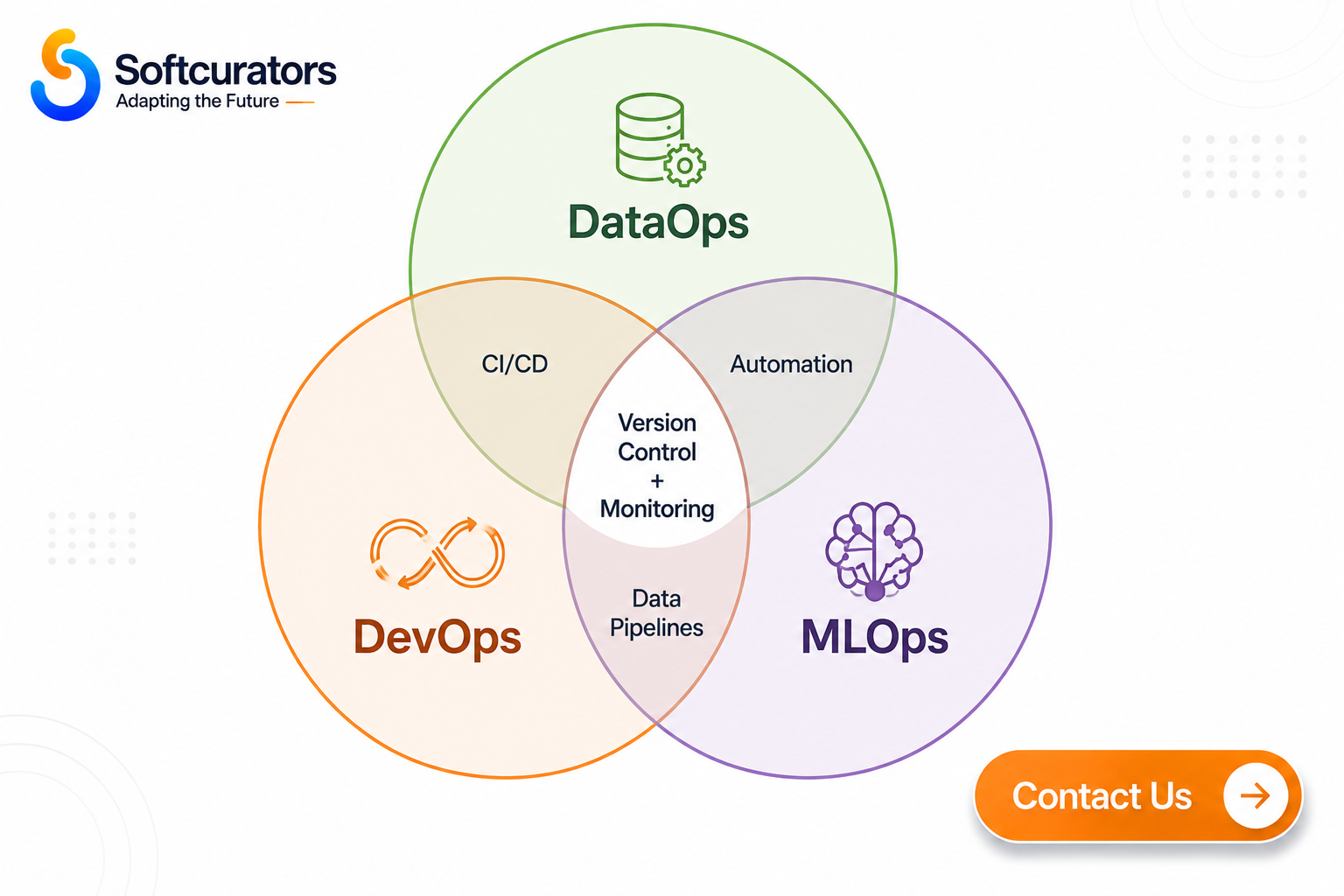
6. Where DataOps, DevOps, and MLOps Overlap
Understanding the overlaps between DataOps vs DevOps vs MLOps is just as important as understanding their differences. Here is where the three frameworks share common ground.
Shared Principle #1: CI/CD Automation
All three frameworks embrace continuous integration and continuous delivery. DevOps applies CI/CD to code. DataOps applies it to data transformations and pipeline changes. MLOps applies it to model training, evaluation, and deployment workflows.
Shared Principle #2: Version Control
DevOps teams version their code in Git. DataOps teams version their data models and pipeline configs. MLOps teams version their datasets, features, and trained models. All three are fundamentally about reproducibility and rollback.
Shared Principle #3: Monitoring and Observability
DevOps monitors application performance and uptime. DataOps monitors data quality and pipeline health. MLOps monitors model accuracy and prediction drift. The tooling differs, but the mindset is identical: measure everything, alert on anomalies, and iterate quickly.
Shared Principle #4: Collaboration and Culture
All three frameworks exist because silos between teams are expensive. DevOps breaks down developer vs. operations silos. DataOps breaks down data engineer vs. analyst vs. business silos. MLOps breaks down data scientist vs. engineer silos. Cultural alignment is as important as technical tooling in all three cases.
Shared Principle #5: Infrastructure as Code
DevOps teams manage their infrastructure as code using tools like Terraform. DataOps teams define pipelines as code. MLOps teams define training jobs, serving infrastructure, and monitoring as code. This consistency is why companies working with Softcurators on web development or software development find it easier to scale into DataOps and MLOps once good DevOps foundations are in place.
7. Real-World Use Cases: Which Framework Does Your Business Need?
Use Case 1: E-Commerce Platform DevOps + DataOps
An e-commerce company wants to ship new features faster and also build a recommendation engine powered by purchase history data. They need DevOps to speed up their software release cycle. They need DataOps to ensure their customer data and transaction pipelines are reliable and fresh. And may not need MLOps yet if they are using pre-built recommendation engines.
Softcurators has deep experience building on-demand app development and ecommerce development solutions that incorporate robust DataOps pipelines from the start.
Use Case 2: Fintech Application DevOps + DataOps + MLOps
A fintech app development company building a loan approval platform needs all three. DevOps for fast, secure software deployments. DataOps for reliable credit data pipelines. MLOps for the credit scoring models that power their underwriting. In this context, understanding the nuances of DataOps vs DevOps vs MLOps is not academic it is business-critical.
Use Case 3: Healthcare App DataOps + MLOps
A healthcare app development company building a patient diagnosis tool needs DataOps to ensure clinical data is accurate and compliant (HIPAA). They need MLOps to train, deploy, and monitor diagnostic AI models. If they are using third-party cloud infrastructure, they may already have DevOps handled by their cloud provider.
Use Case 4: Banking Platform All Three
A banking app development team needs all three frameworks at full maturity. High-frequency trading, fraud detection, customer analytics, and core banking software all require rock-solid DevOps, DataOps, and MLOps working in concert.
Use Case 5: AI-Powered Mobile App DataOps + MLOps
If you are building an AI app or working with AI consulting services, MLOps is non-negotiable. Without it, your AI features will degrade over time as real-world data shifts away from your training distribution. Softcurators builds MLOps-native AI apps that maintain accuracy without constant manual intervention.
8. Common Misconceptions About DataOps vs DevOps vs MLOps
Misconception #1: MLOps is Just DevOps for Data Scientists
This is partially true but dangerously incomplete. MLOps includes DevOps concepts, but it also includes data versioning, experiment tracking, feature stores, model registries, and model monitoring none of which exist in traditional DevOps. Treating MLOps as simply ‘DevOps with Jupyter notebooks’ is a recipe for unreliable production AI.
Misconception #2: You Need to Implement All Three Simultaneously
You do not. Most companies start with DevOps. If they become data-intensive, they add DataOps. If they begin building AI/ML products, they layer in MLOps. The right sequence depends entirely on your business priorities. Softcurators helps companies identify where to start and build a roadmap from there.
Misconception #3: DataOps Is Just ETL with a Fancy Name
DataOps is fundamentally different from traditional ETL (Extract, Transform, Load). ETL is a technical process. DataOps is a methodology it includes culture, collaboration, quality testing, observability, and agile iteration. ETL is one component of a DataOps system, not a synonym for it.
Misconception #4: These Frameworks Only Apply to Large Enterprises
Startups benefit enormously from implementing DevOps, DataOps, and MLOps early. The cost of refactoring data pipelines or ML infrastructure later is enormous. This is why Softcurators recommends that startup app and web development projects include at least basic DevOps and DataOps practices from day one even for MVP development projects.
Misconception #5: Cloud Services Eliminate the Need for These Frameworks
Cloud providers like AWS, Google Cloud, and Azure provide tools that support DevOps, DataOps, and MLOps. But tools are not culture, processes, or organizational alignment. Companies that rely solely on cloud tools without the underlying framework often end up with expensive, underutilized infrastructure. The framework tells you how to use the tools effectively.
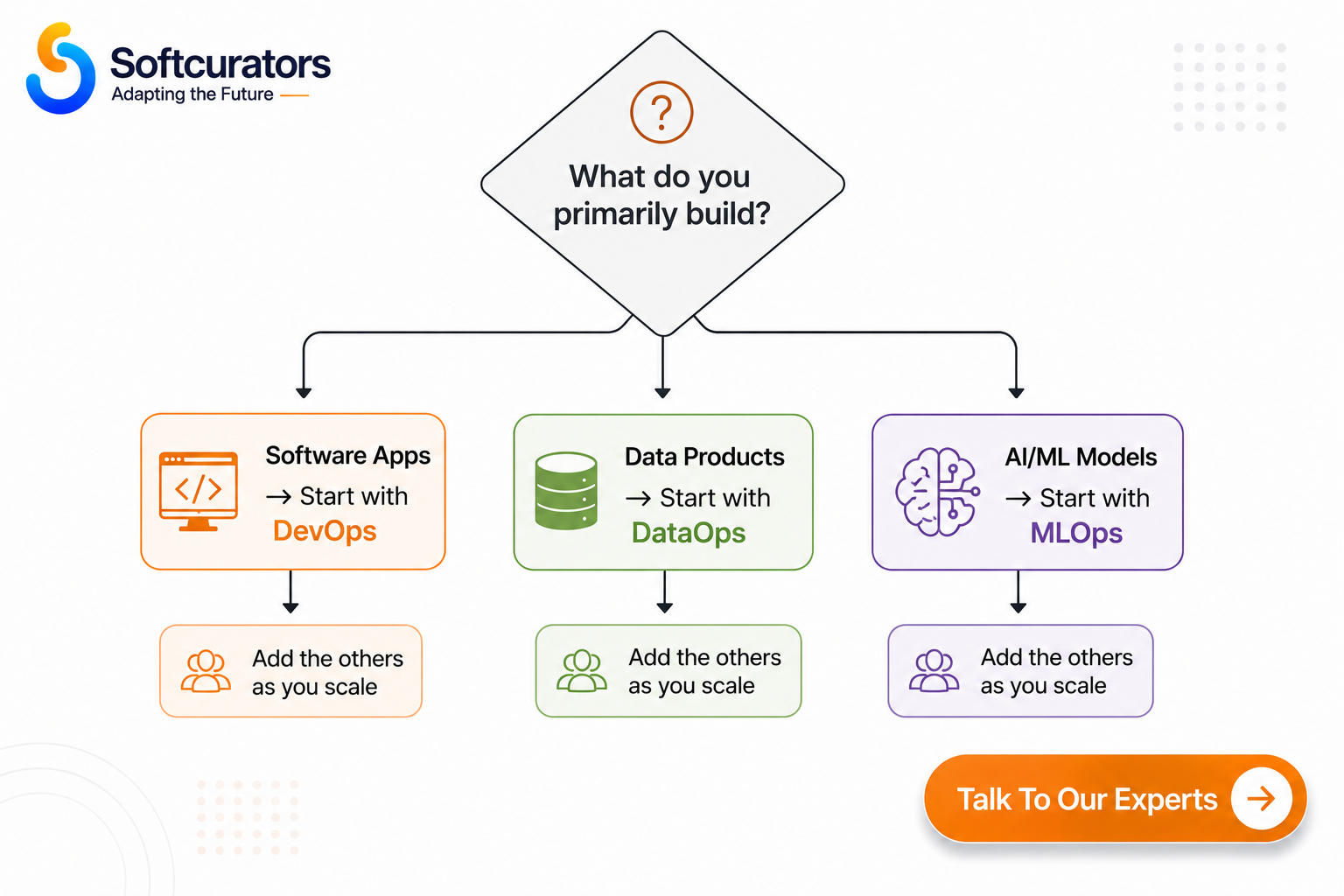
9. How to Choose Between DataOps vs DevOps vs MLOps for Your Business
Choosing which framework to prioritize comes down to four key questions. Answer them honestly and your path becomes clear.
1st Question : What Is Your Core Product?
- Software applications → Start with DevOps
- Data products, analytics, BI dashboards → Start with DataOps
- AI/ML models or AI-powered features → You need MLOps as the primary focus
2nd Question : What Is Your Biggest Pain Point Right Now?
- Slow or unreliable software deployments → DevOps
- Bad data quality or unreliable data pipelines → DataOps
- AI models degrading in production or never reaching production → MLOps
3rd Question : What Does Your Team Look Like?
- Primarily software engineers → Easier to start with DevOps
- Mix of data engineers and analysts → DataOps will have immediate ROI
- Data scientists struggling to deploy models → MLOps is urgent
4th Question : What Industry Are You In?
Industry context heavily influences which frameworks matter most. High-stakes industries like finance, healthcare, and logistics typically need all three at a high level of maturity. Consumer apps and media companies often start with DevOps and DataOps, adding MLOps as personalization becomes a competitive differentiator.
Not sure where to start? The team at Softcurators offers AI consulting services and architecture reviews to help you identify the right operational framework for your stage and industry.
10. How Softcurators Helps You Implement DataOps, DevOps, and MLOps
Softcurators is not just a mobile app and web development company. We are a technology partner that helps businesses build the operational infrastructure they need to compete in a data-driven world.
Here is what we bring to each framework:
Our DevOps Capabilities
Our software development team implements CI/CD pipelines, containerized microservices, and infrastructure-as-code frameworks. We help engineering teams go from weekly releases to multiple deployments per day without sacrificing stability.
- CI/CD pipeline setup with GitHub Actions, GitLab CI, or Jenkins
- Docker and Kubernetes deployment architectures
- Infrastructure as Code with Terraform or Pulumi
- Monitoring and alerting with Datadog, Grafana, and Prometheus
- DevSecOps integration for secure software delivery
Our DataOps Capabilities
From raw data ingestion to clean, reliable data products, Softcurators builds end-to-end DataOps pipelines. Our team has deep expertise in data engineering for fintech apps, healthcare apps, real estate apps, and more.
- Data pipeline design and implementation with Apache Airflow and dbt
- Real-time data streaming with Apache Kafka
- Data warehouse implementation on Snowflake, BigQuery, or Redshift
- Data quality frameworks using Great Expectations
- Data observability and monitoring setup
Our MLOps and AI Capabilities
Through our dedicated AI development and AI app development services, Softcurators builds end-to-end MLOps infrastructure. We also offer specialized AI automation services and AI avatar development for companies building AI-native products.
- MLflow and Kubeflow pipeline implementation
- Feature store design and implementation
- Model serving APIs using BentoML or TorchServe
- Model monitoring and drift detection systems
- Automated retraining workflows
- Integration of AI models into mobile and web applications
Our Mobile and Web Development Services
Our operational expertise sits on top of a strong foundation in mobile app development, iOS app development, Android app development, React Native app development, and Flutter app development. When we build your application, we build it with DevOps, DataOps, and MLOps best practices baked in from the start.
Talk to Softcurators: Whether you are starting your DevOps journey or scaling enterprise MLOps, our team is ready to help. Visit softcurators.com/contact to schedule a free consultation.
11. The Future of DataOps, DevOps, and MLOps and Beyond
The boundaries between DataOps vs DevOps vs MLOps are blurring. Here are the key trends shaping all three frameworks.
Trend #1: Platform Engineering Is Unifying All Three
Platform engineering teams are building internal developer platforms (IDPs) that provide self-service infrastructure for software delivery, data pipelines, and ML workflows all in one place. Tools like Backstage (by Spotify) are enabling this unified approach. Expect more companies to have a single internal platform that handles DevOps, DataOps, and MLOps workflows under one roof.
Trend #2: AI Is Automating the Operations Themselves
AI is now being applied to automate DataOps and MLOps tasks themselves. Intelligent data quality monitoring tools automatically detect and flag anomalies without human configuration. ML pipeline optimization tools automatically tune hyperparameters and select the best model architectures. The operational frameworks are becoming self-maintaining.
Trend #3: LLMOps Is Emerging as a New Discipline
With the explosion of large language models (LLMs) in production, a new subset of MLOps called LLMOps is emerging. LLMOps addresses the unique challenges of deploying, monitoring, and fine-tuning large language models including prompt version control, RAG pipeline management, and hallucination monitoring. Softcurators is already working on LLMOps architectures for clients building AI-native products.
Trend #4: Regulatory Compliance Is Driving DataOps and MLOps Adoption
The EU AI Act, GDPR, HIPAA, and financial regulations are requiring companies to document their data lineage and model decisions. This is driving enterprises to adopt DataOps and MLOps frameworks not just for efficiency but for compliance. Softcurators helps clients build security compliance into their data and AI infrastructure from the ground up.
Trend #5: Real-Time MLOps Is Becoming Standard
Batch-based ML training and deployment is giving way to real-time, streaming ML systems. Leading companies deploy models that update in near-real time based on streaming data. This requires tight integration between DataOps streaming pipelines (Apache Kafka, Flink) and MLOps serving infrastructure.
Trend #6: Mobile-First AI Is Creating New MLOps Challenges
As AI capabilities move onto mobile devices via on-device inference (using tools like Core ML and TensorFlow Lite), MLOps must extend to manage model updates on millions of mobile devices. This is a challenge Softcurators is uniquely positioned to address, combining deep mobile app development expertise with MLOps infrastructure knowledge.
12. Key Metrics for DataOps, DevOps, and MLOps Success
How do you know if your DataOps, DevOps, or MLOps implementation is working? Track these metrics.
DevOps Key Metrics (DORA Metrics)
- Deployment Frequency: How often you deploy to production (elite teams deploy multiple times per day)
- Lead Time for Changes: Time from code commit to production deployment
- Change Failure Rate: Percentage of deployments that cause production failures
- Mean Time to Recovery (MTTR): How quickly you recover from failures
DataOps Key Metrics
- Data Pipeline Reliability: Percentage of pipeline runs that complete successfully
- Data Freshness: Latency between data creation and data availability for consumers
- Data Quality Score: Percentage of data records passing quality validation checks
- Pipeline Deployment Frequency: How often data pipeline changes are deployed
- Data Incident Rate: Number of data quality incidents per month
MLOps Key Metrics
- Model Deployment Frequency: How often new model versions are deployed
- Model Accuracy in Production: Performance of deployed models against business KPIs
- Data Drift Rate: Rate at which incoming data distribution diverges from training data
- Retraining Time: Time from drift detection to new model deployment
- Inference Latency: Time taken by the model to generate predictions in production
13. Getting Started: A Practical Roadmap for Each Framework
Getting Started with DevOps: 4-Step Roadmap
- Audit your current software delivery process identify your biggest bottlenecks
- Implement version control with Git if you have not already done so
- Set up a basic CI pipeline that runs automated tests on every code push
- Gradually extend automation to include deployment, monitoring, and infrastructure provisioning
Softcurators can accelerate every one of these steps through our software development and maintenance and support services.
Getting Started with DataOps: 4-Step Roadmap
- Map your current data pipelines identify where data quality issues originate
- Implement version control for your data transformation code (start with dbt)
- Add automated data quality testing at each pipeline stage
- Set up pipeline monitoring and alerting with a data observability tool
Getting Started with MLOps: 4-Step Roadmap
- Establish experiment tracking ensure every model training run is logged with MLflow or W&B
- Containerize your model serving code using Docker and deploy via a simple API
- Set up model performance monitoring in production using Evidently or Arize
- Build an automated retraining trigger when model performance drops below a threshold
Our dedicated AI consulting services team at Softcurators has helped companies across multiple industries implement these roadmaps efficiently and cost-effectively.
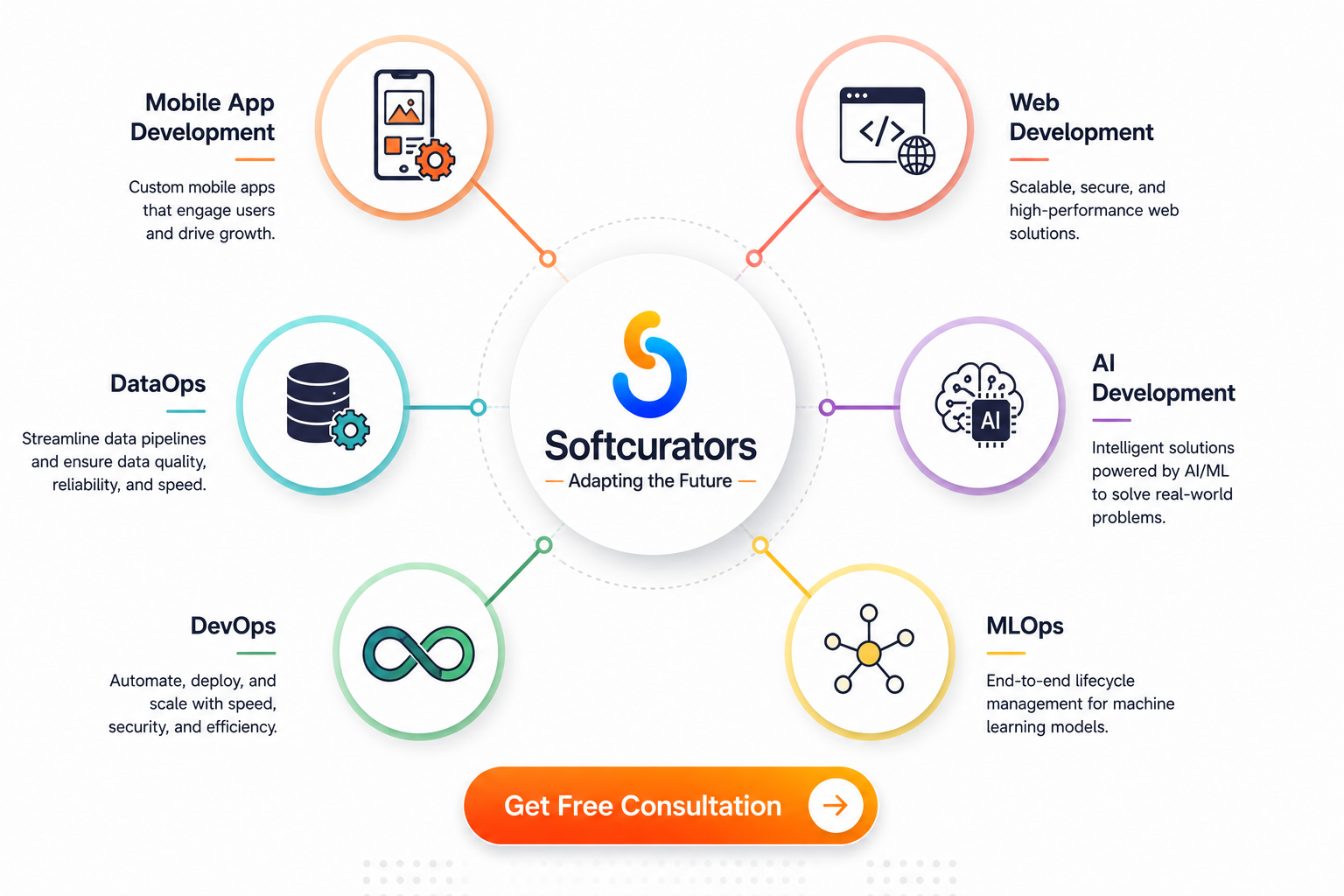
14. Why Choose Softcurators for Your DataOps, DevOps, and MLOps Needs?
Softcurators (www.softcurators.com) is a full-service mobile app and web development company with deep expertise in modern operational frameworks. Here is why clients choose us:
- Full-Stack Expertise: From mobile apps to data pipelines to AI models we handle the full technology stack
- Industry Experience: We have built production systems for fintech, healthcare, real estate, education, and more
- Framework-Agnostic: We recommend the right tools for your specific situation, not the tools we are most comfortable with
- Startup to Enterprise: Our team scales with your needs, from MVP development to enterprise-grade infrastructure
- Transparent Process: We work collaboratively, keeping you informed at every stage
- Proven Track Record: Explore our work at softcurators.com/portfolio
Whether you need cross-platform app development, progressive web app development, or a full AI-powered platform with DataOps and MLOps infrastructure Softcurators has the team and the expertise to deliver.
Conclusion: DataOps vs DevOps vs MLOps The Bottom Line
The conversation around DataOps vs DevOps vs MLOps is no longer academic. It is one of the most important strategic conversations happening in technology organizations.
Each framework addresses a real and significant problem. DevOps makes software delivery fast and reliable. DataOps makes data delivery accurate and trustworthy. MLOps makes AI models deployable, maintainable, and production-ready.
They are not competing approaches they are complementary layers of a modern technology organization. The most competitive companies implement all three in a way that works for their scale, industry, and team structure.
At Softcurators, we help businesses at every stage implement these frameworks effectively. Whether you are building your first mobile app, scaling a fintech platform, or deploying enterprise AI, we have the expertise to guide you through.
The question is not which framework you need. The question is: where do you start?
FAQs
Can a small startup benefit from DevOps, DataOps, or MLOps?
Absolutely. Even a 10-person startup can implement basic DevOps practices like CI/CD pipelines and benefit enormously. DataOps and MLOps can be introduced incrementally as your data and AI ambitions grow. Starting early is always easier than refactoring later.
Which came first DevOps, DataOps, or MLOps?
DevOps came first, emerging around 2009. DataOps followed around 2014 as the data engineering discipline matured. MLOps emerged around 2015-2017 as machine learning in production became a real challenge for engineering teams.
Is MLOps the same as AIOps?
No. MLOps is about managing the lifecycle of machine learning models. AIOps is about applying AI to IT operations tasks like using AI to detect and respond to infrastructure incidents. They are related but serve very different purposes.
What programming languages are most common in DataOps and MLOps?
Python dominates both. SQL is essential for DataOps data transformations. Scala is widely used in DataOps for Apache Spark workloads. For MLOps model serving, Python remains primary, though Go and Rust are used for high-performance inference.
Do I need a separate team for each framework?
In large organizations, yes separate DataOps, DevOps, and MLOps teams often make sense. In smaller companies, a single platform engineering team can handle all three. The key is ensuring someone owns each domain clearly.
How does DataOps relate to data governance?
DataOps and data governance are complementary. DataOps provides the technical infrastructure for reliable data pipelines. Data governance provides the policies, ownership rules, and compliance frameworks for how data is used and protected. You need both.
What is the relationship between MLOps and LLMOps?
LLMOps is an emerging subset of MLOps specifically focused on the operational challenges of large language models. Traditional MLOps handles classical ML models. LLMOps extends this to handle prompt engineering, RAG pipelines, token cost management, and hallucination monitoring.
How does Softcurators help with DataOps implementation?
Softcurators helps clients design and implement DataOps pipelines from scratch. We use tools like Apache Airflow, dbt, Apache Kafka, and Snowflake to build robust, automated data infrastructure. We also integrate data quality frameworks and monitoring. Contact us at softcurators.com/contact to discuss your needs.
Is Kubernetes required for MLOps?
Kubernetes is widely used in MLOps for orchestrating model training jobs and serving infrastructure. However, it is not strictly required especially for smaller workloads. Managed cloud services like AWS SageMaker, Google Vertex AI, and Azure ML provide MLOps capabilities without requiring you to manage Kubernetes yourself.
What is a feature store in MLOps?
A feature store is a centralized repository that stores, manages, and serves the engineered features used to train and serve machine learning models. It ensures consistency between training and serving environments and enables feature reuse across different models. Popular feature stores include Feast, Tecton, and Hopsworks.
How does DataOps differ from traditional ETL?
Traditional ETL is a technical process for extracting, transforming, and loading data from one system to another. DataOps is a methodology it encompasses ETL but also includes data quality testing, pipeline monitoring, version control, collaboration practices, and agile iteration. DataOps makes ETL processes reliable, observable, and scalable.
What is data drift in MLOps and why does it matter?
Data drift occurs when the statistical properties of the data your model receives in production differ from the data it was trained on. This causes model accuracy to degrade over time without any obvious engineering failure. MLOps monitoring detects data drift early so models can be retrained before performance degrades significantly.
Can DevOps and MLOps share the same CI/CD pipeline?
Partially. The same underlying CI/CD tools (like GitHub Actions or GitLab CI) can be used. However, ML pipelines include steps like model training, evaluation, and registration that do not exist in traditional software CI/CD. Most organizations extend their existing DevOps CI/CD platforms with ML-specific stages and plugins.
What is the difference between a data lake and a data warehouse in a DataOps context?
A data lake stores raw, unprocessed data in any format. A data warehouse stores structured, processed, query-optimized data. In a DataOps context, raw data often lands in a data lake first, then DataOps pipelines transform and load it into a data warehouse for analytical consumption.
How does MLOps handle model explainability?
MLOps platforms increasingly include explainability components that track why a model made a particular prediction. Tools like SHAP, LIME, and Fiddler AI integrate into MLOps pipelines to provide feature attribution scores for model predictions. This is especially critical for regulated industries like finance and healthcare.
What is shadow deployment in MLOps?
Shadow deployment is a technique where a new model version runs in parallel with the existing production model receiving the same inputs but not serving its outputs to users. This allows teams to compare the performance of the new model against the existing one in real production conditions before actually switching traffic.
What is the role of a data engineer in DataOps?
Data engineers are the primary owners of DataOps infrastructure. They design, build, and maintain data pipelines, implement data quality checks, manage data warehouse schemas, and operate data streaming systems. In a DataOps culture, they also collaborate closely with data analysts and business stakeholders to understand data requirements.
How do I measure the ROI of implementing DevOps?
The DORA (DevOps Research and Assessment) metrics are the industry standard for measuring DevOps ROI: deployment frequency, lead time for changes, change failure rate, and mean time to recovery. Elite DevOps teams deploy 973x more frequently and have 6570x faster recovery times than low performers.
What is the difference between batch inference and real-time inference in MLOps?
Batch inference runs a model against a large dataset periodically (for example, generating product recommendations overnight for all users). Real-time inference serves model predictions on demand, typically within milliseconds (for example, a fraud detection model scoring every transaction as it occurs).
Is DataOps relevant for companies that do not use AI?
Absolutely. DataOps is relevant for any company that uses data to make decisions which is essentially every modern business. Even if you have no AI ambitions, reliable data pipelines that provide accurate, timely data to your analysts and business intelligence tools are enormously valuable.
How does MLOps handle multiple models in production?
MLOps platforms like MLflow, Kubeflow, and Seldon Core support multi-model management through model registries that track versions, metadata, and deployment status for every model. Model serving platforms route traffic between multiple models, enable A/B testing, and support canary deployments where a new model gradually receives more traffic.
What is the connection between DataOps and real-time analytics?
DataOps enables real-time analytics by building the streaming data pipelines that process and deliver data with low latency. Technologies like Apache Kafka, Apache Flink, and Materialize are common DataOps tools for real-time data scenarios. Without proper DataOps practices, real-time data pipelines become unreliable and difficult to maintain.
How does Softcurators approach AI development for clients?
Softcurators takes a full-stack approach to AI development. We start with data architecture and DataOps pipeline design, then build and train ML models, and finally deploy them using MLOps best practices. Our AI development services cover the entire journey from data to production AI, not just model building. We also offer AI consulting services for organizations that want strategic guidance before committing to infrastructure investments.
What are the biggest challenges in implementing MLOps?
The five biggest MLOps implementation challenges are: (1) organizational resistance from data scientists who prefer notebook-based workflows, (2) lack of standardized tooling across the growing MLOps ecosystem, (3) the difficulty of reproducing model training environments across development and production, (4) data lineage complexity when models depend on many upstream data sources, and (5) model governance and compliance requirements in regulated industries.
Can DevOps teams handle DataOps and MLOps as well?
DevOps teams can handle DataOps with relatively modest upskilling the core principles are familiar. MLOps requires deeper knowledge of machine learning concepts, which most DevOps engineers do not have. Most organizations end up with a platform engineering team that includes members with backgrounds in both DevOps and data science.
What is GitOps and how does it relate to DevOps?
GitOps is an evolution of DevOps that uses Git as the single source of truth for both application code and infrastructure configuration. Changes to infrastructure are made by pushing to a Git repository, and an automated system reconciles the actual infrastructure state with the desired state declared in Git. GitOps principles are increasingly being adopted in DataOps and MLOps as well.
How important is documentation in DataOps vs DevOps vs MLOps?
Documentation is critical in all three frameworks but often neglected. In DevOps, runbooks and architecture diagrams prevent knowledge silos. In DataOps, data dictionaries and pipeline documentation enable data discovery and trust. In MLOps, model cards (documenting a model's intended use, training data, and limitations) are becoming a regulatory requirement.
What is the role of cloud providers in DataOps vs DevOps vs MLOps?
Cloud providers like AWS, Google Cloud, and Azure provide managed services that accelerate all three frameworks. AWS offers CodePipeline for DevOps, Glue and Redshift for DataOps, and SageMaker for MLOps. However, cloud-native tools are not a substitute for the underlying cultural and process changes that make these frameworks effective.
How does Softcurators stay current with evolving frameworks?
Softcurators invests heavily in continuous learning and has dedicated technology practice leads for DevOps, DataOps, and MLOps. Our team regularly contributes to open-source projects, attends industry conferences, and partners with leading cloud providers. Explore our blog for regular insights on the latest developments in mobile app development, AI, and data engineering.
What is the best tool to get started with MLOps as a small team?
For small teams just getting started with MLOps, MLflow is the most recommended starting point. It is open-source, lightweight, and handles experiment tracking, model registry, and basic model serving covering the most critical MLOps capabilities without the operational overhead of a full platform like Kubeflow.
How does DataOps support GDPR and data privacy compliance?
DataOps supports GDPR compliance in several ways: data lineage tracking shows where personal data comes from and where it flows, automated data quality checks can flag personally identifiable information (PII) that should be masked or encrypted, and version-controlled pipeline code provides an audit trail for compliance documentation.
