
How Much Does It Cost to Build a Music Streaming App Like Spotify ?
You open Spotify. A song starts in under a second. The app already knows what you want to hear next. That experience feels simple. But behind it sits one of the most technically complex consumer apps ever built.
The good news? You do not need Spotify’s 5,000-person engineering team to build a competitive music streaming app. The infrastructure, tools, and frameworks available today make it genuinely possible for a well-funded startup to build a high-quality streaming platform at a fraction of what it cost five years ago.
The real question is not whether it can be done. The question is: how much does it actually cost? And what are you paying for?
At Softcurators, we build music streaming apps, audio and media applications, and AI-powered platforms for startups and growth-stage companies. We have seen this question from every angle. So in this guide, we break down the real costs. We cover every feature, every technology decision, and every pricing variable. By the end, you will know exactly what drives the number and how to get the best outcome for your budget.
Want a quote for your specific idea? Book a free 30-minute call with Softcurators. Our senior architects respond within 24 hours.
The Music Streaming Market in 2026: Why Now Is a Smart Time to Build
The global music streaming market crossed $38 billion in 2025. It is projected to reach $103 billion by 2030. That growth is not slowing down. However, here is what most people miss. The opportunity in 2026 is not about building another general Spotify competitor. That ship has largely sailed. Instead, the real commercial opportunity lies in three underserved directions:
1. Niche Music Communities
Independent jazz artists. Regional folk scenes. Classical music for students. Bollywood outside India. Gospel in emerging markets. These communities are massive in aggregate and completely underserved by the big three platforms.
A music streaming app built for a specific genre or community can build a devoted, paying user base. Furthermore, it can charge what general platforms cannot. That is a better business model for a startup than trying to license every song ever recorded.
2. Creator-First Platforms
Artists are frustrated with Spotify’s royalty model. They earn fractions of a cent per stream. As a result, a generation of independent musicians is actively looking for better platforms.
Creator-first streaming apps where artists keep more revenue, connect directly with fans, and control their distribution are attracting both artists and the fans who follow them. This model is growing fast. Bandcamp, Patreon, and Tidal have all validated parts of it.
3. Podcast and Audio-First Platforms
Music streaming and podcast listening are converging. Spotify paid $1 billion for podcast companies because it saw this coming. In 2026, audio-first platforms that combine music, podcasts, audiobooks, and live audio can serve a user need that no single platform fully owns yet.
The bottom line? The market is large and still fragmented at the edges. Softcurators has helped founders identify their niche entry point before writing a single line of code. Our startup app development service and MVP development methodology are specifically designed for exactly this kind of focused market entry.
What Actually Makes Spotify Expensive to Build?
Before we talk numbers, let us be honest about what Spotify actually is. It is not just a music player. Spotify is a real-time audio delivery network, a content licensing machine, a social discovery platform, and an AI recommendation engine all bundled into one app.
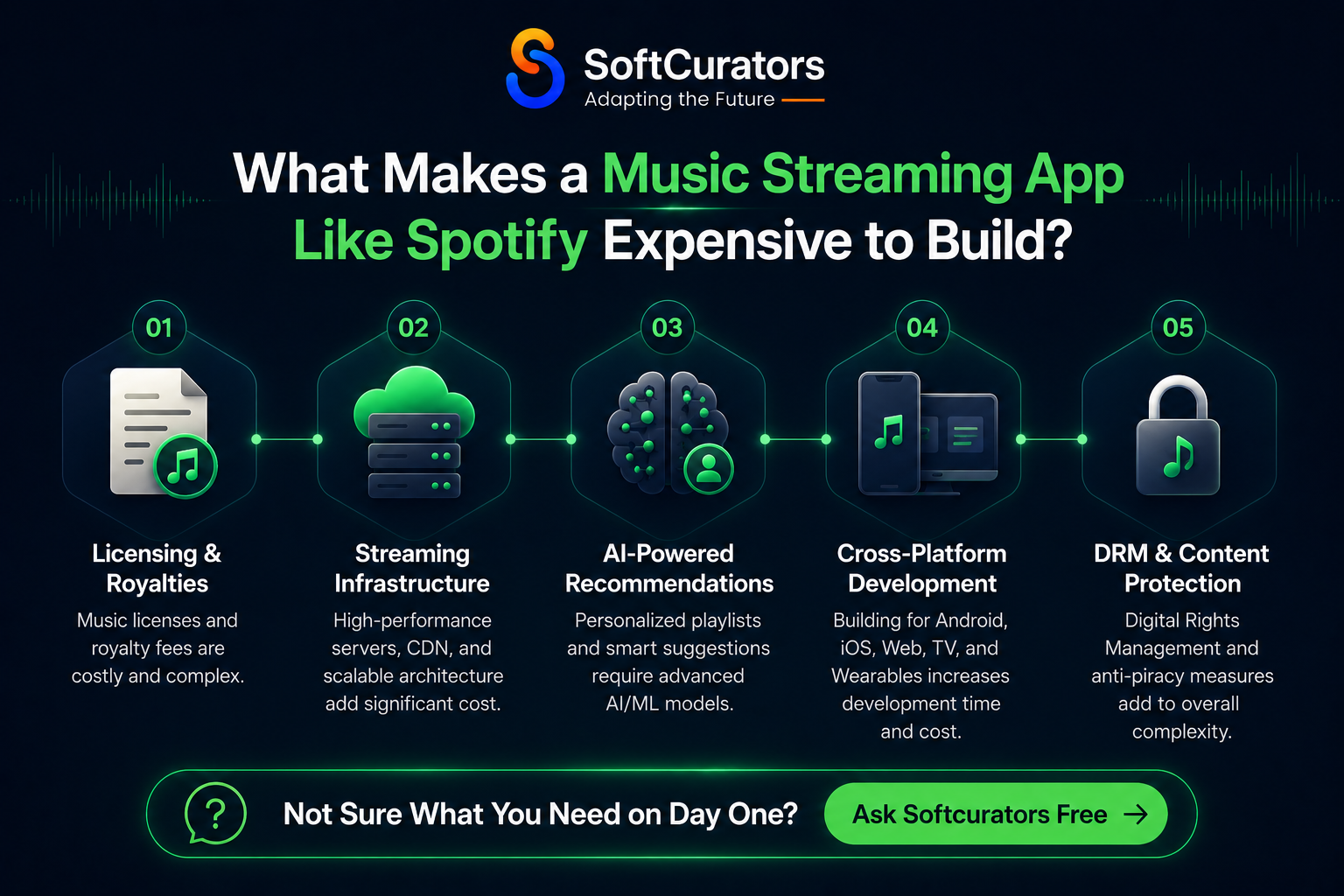
That combination is what makes building Spotify-at-scale expensive. Specifically, there are five areas where the complexity and cost concentrate:
1. Music Licensing and Royalty Infrastructure
Spotify pays approximately $3–4 billion annually in royalty payments. To stream licensed music, you need agreements with major labels (Universal, Sony, Warner) and independent distributors. You also need a royalty calculation and payment engine that tracks every play and calculates every payment.
This is the single biggest cost variable for any music streaming startup. However, there are legal paths that avoid the full complexity of direct licensing and Softcurators discusses these strategic options with every music app client before development begins.
2. Audio Streaming Infrastructure
Delivering audio that starts in under two seconds, never buffers, adjusts quality based on connection speed, and handles millions of simultaneous listeners requires serious infrastructure. Specifically, it requires CDN distribution, adaptive bitrate streaming, and edge caching. This infrastructure costs money to build and significant ongoing money to run.
3. The Recommendation Engine
Spotify’s recommendation engine Discover Weekly, Daily Mixes, Release Radar is built on years of listening data and some genuinely sophisticated machine learning. You cannot replicate it on day one. But you can build a simpler version that improves over time. Our AI development team and AI app development practice have built ML recommendation systems that grow more accurate as the user base grows.
4. Cross-Platform Consistency
Spotify works on iOS, Android, Mac, Windows, Web, smart TVs, car dashboards, and game consoles. Each platform has different audio APIs, different UI conventions, and different performance characteristics. Building for all of them simultaneously is extremely expensive. Starting with two or three is not.
5. Offline Listening and Sync
Downloaded tracks must be stored securely on-device. They must sync with the user’s account. They must expire when a subscription lapses. And they must be protected from copying. This DRM (Digital Rights Management) layer adds both development complexity and licensing cost.
The key strategic insight? You do not need all five of these on day one. Softcurators helps founders identify which of these investments are necessary at launch and which can wait until the business has traction. That sequencing decision is where most of the cost optimization happens.
The 7 Core Feature Layers of a Music Streaming App
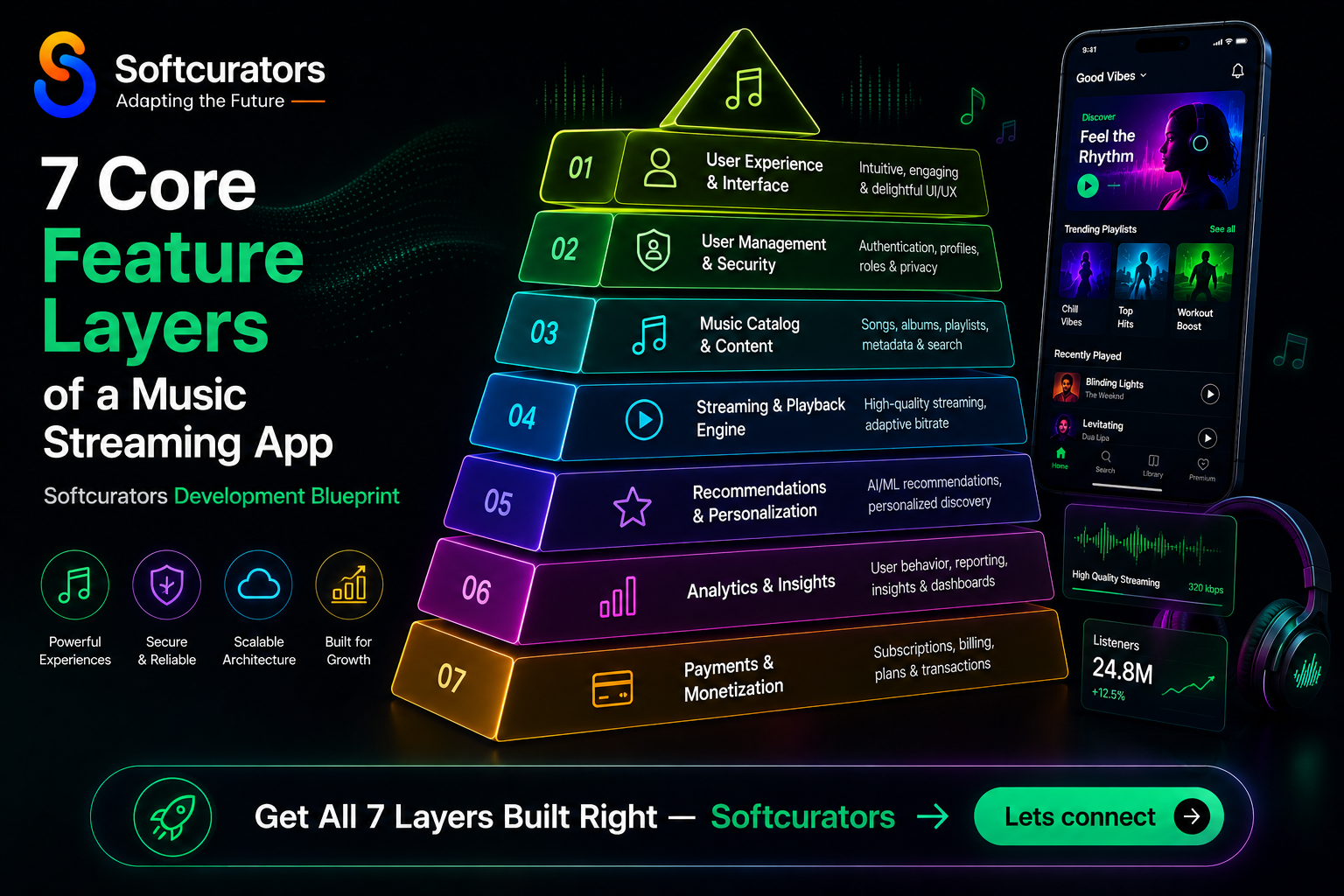
Every music streaming app regardless of budget is built from seven functional layers. Understanding what each one involves is essential for interpreting any cost estimate you receive.
Layer 1: User Registration and Profile System
Users need a way to sign up, log in, and manage their profile. This sounds straightforward. In practice, it involves:
- Email and social login (Google, Apple, Facebook)
- Multi-device session management same account on phone, desktop, and tablet
- Profile preferences favourite genres, artists, explicit content settings
- Subscription tier assignment and management
- Parental control settings for family plans
Estimated cost for this layer: $2,000–$6,000
Our UI/UX design team handles the onboarding flow with particular care. First impressions drive retention. A clunky sign-up flow loses users before they ever hear a song. Our mobile app UI/UX best practices guide informed every onboarding pattern we use.
Layer 2: Music Library and Content Management
This is where tracks, albums, artists, and playlists live. It needs to handle:
- Track metadata title, artist, album, genre, BPM, key, release date
- High-resolution album artwork storage and delivery
- Explicit content tagging and filtering
- Content ingestion pipeline for new releases
- Artist and label profile pages
- Search with typo-tolerance, phonetic matching, and real-time results
Estimated cost for this layer: $5,000–$12,000
Layer 3: Audio Streaming Engine
This is the most technically demanding layer. It must deliver:
- Adaptive bitrate streaming (128kbps, 256kbps, 320kbps based on connection)
- Gapless playback between tracks
- Crossfade transitions
- Audio normalization (no jarring volume jumps between songs)
- Background playback that survives app switching and screen lock
- Equalizer and audio enhancement controls
- Car mode and speaker mode optimizations
Estimated cost for this layer: $10,000–$25,000
This layer is where Softcurators‘s engineering depth matters most. A poorly built audio engine creates buffering, crashes, and dropouts the exact problems that make users delete apps. Our software development team has built real-time audio pipelines for multiple media application clients.
Layer 4: Playlist and Queue Management
Users organize their listening experience through playlists and queues. This layer covers:
- Create, edit, rename, and delete playlists
- Add and remove tracks, reorder via drag-and-drop
- Collaborative playlists (multiple users can add tracks)
- Smart queue ‘Up Next’ with manual and algorithmic additions
- Auto-generate playlists from mood, activity, or artist
- Import playlists from other platforms
Estimated cost for this layer: $4,000–$9,000
Layer 5: Discovery and Recommendation Engine
This is what separates a music player from a music streaming platform. Discovery features include:
- Personalized home feed based on listening history
- Weekly recommendation playlists (Discover Weekly equivalent)
- Radio mode infinite queue from a seed track or artist
- New releases from followed artists
- Charts global, country, genre-specific
- Mood-based and activity-based playlist curation
- Related artists and listeners-also-like suggestions
Estimated cost for this layer: $7,000–$20,000
The AI complexity in this layer scales with your ambitions. A rule-based recommendation engine (users who liked X also liked Y) is far cheaper than a full collaborative filtering ML model. Softcurators‘s AI development and AI automation services let us scale this layer from simple rules to genuine machine learning as your user base and budget grow.
Layer 6: Social and Community Features
Music is inherently social. The platforms with the best retention are those that build community alongside listening. Social features include:
- Follow artists and other users
- Share tracks, albums, and playlists to social media
- See what friends are listening to (activity feed)
- Collaborative playlists and group listening sessions
- Comments on tracks and playlists
- Artist-to-fan direct messaging for creator-first platforms
Estimated cost for this layer: $5,000–$12,000
Our work on social media apps feeds directly into this layer. The mechanics of social graphs, activity feeds, and notification systems are patterns we have implemented many times across different product contexts.
Layer 7: Payments and Subscription Management
If you are building a paid platform, this layer is critical. It covers:
- Free tier vs. premium tier feature gating
- Subscription billing (monthly and annual) with auto-renewal
- In-app purchases for iOS (App Store) and Android (Play Store)
- Family plan and student plan management
- Coupon and promotional pricing support
- Refund handling and cancellation flow
- Revenue reporting and subscription analytics
Estimated cost for this layer: $6,000–$12,000
Our experience with e-wallet app development, BNPL platforms, and fintech applications gives Softcurators deep expertise in payment integration and subscription architecture. These are patterns we implement regularly, not occasionally.
Advanced Features That Create Competitive Moats
Once the core platform is live and stable, these advanced features are what separate a music app people use from one they love. Softcurators recommends planning for at least two or three of these in the initial architecture even if they launch in V2 to avoid expensive retrofits.
AI-Powered Personalization Beyond ‘You Might Like’
True personalization in 2026 goes beyond genre matching. It includes mood detection from listening patterns, time-of-day listening behavior adaptation, and real-time context switching (workout mode, focus mode, wind-down mode). Our AI consulting services and AI app development teams build these systems as separate ML services that plug into the main platform.
Additional cost: $7,000–$20,000
Offline Download with DRM
Offline listening is the feature that converts free-tier users to paying subscribers more reliably than almost any other. However, it requires DRM (Digital Rights Management) implementation. This protects licensed content from being extracted and shared. The implementation varies by platform – FairPlay on iOS, Widevine on Android and Web.
Additional cost: $6,000–$15,000
Podcast and Audiobook Integration
Adding non-music audio content is the single biggest TAM expansion move for a music streaming platform. The infrastructure for podcast delivery differs from music streaming. Consequently, it requires a separate content ingestion pipeline, episode-level tracking, and chapter navigation.
Additional cost: $10,000–$15,000
Artist and Creator Dashboard
For creator-first platforms, the artist-facing side of the product is just as important as the listener side. A full artist dashboard includes stream analytics, royalty calculations, direct fan messaging, promotional tools, and merch integration. This mirrors the complexity of building a second product alongside the listener app.
Additional cost: $12,000–$25,000
Live Streaming and Virtual Concerts
Live audio and video streaming for concerts, listening parties, and artist Q&As is a growing feature category. The infrastructure for live streaming differs substantially from on-demand audio delivery. Consequently, it requires real-time video encoding, CDN live streaming, and low-latency audience interaction tools.
Additional cost: $15,000–$30,000
Smart Device and Voice Integration
Alexa, Google Home, Apple HomePod, Sonos, car dashboards smart speaker and connected device integration expands the platform’s reach significantly. Each integration follows different SDK requirements. As a result, it adds both development time and ongoing maintenance overhead.
Additional cost: $6,000–$15,000
Full Tech Stack for a Production-Grade Music Streaming App
Technology choices have a direct impact on cost, performance, and maintainability. Softcurators selects every component based on three criteria: performance under streaming load, developer ecosystem maturity, and total cost of ownership. Here is what a production-grade music streaming stack looks like :
| Layer | Technology | Why Softcurators Chooses It |
| iOS App | Swift + AVFoundation | Native audio performance, AirPlay support, precise playback control |
| Android App | Kotlin + ExoPlayer | Industry-standard media player, adaptive streaming built-in |
| Cross-Platform Option | Flutter + just_audio | Single codebase, near-native performance, 40% cost saving vs dual-native |
| Web App | React.js + Web Audio API | Excellent ecosystem, PWA support, desktop browser streaming |
| Backend API | Node.js (NestJS) + Go | Node for REST APIs, Go for high-throughput audio metadata queries |
| Real-Time Features | WebSockets + Redis Pub/Sub | Live activity feeds, collaborative playlists, now-playing sync |
| Audio Storage | AWS S3 + CloudFront CDN | Global edge delivery, adaptive bitrate, low-latency first byte |
| Database | PostgreSQL + Redis + Elasticsearch | Relational data + caching + sub-50ms music search |
| Audio Processing | FFmpeg (server-side) | Transcoding to multiple bitrates, normalization, waveform generation |
| Streaming Protocol | HLS (HTTP Live Streaming) | Industry standard, adaptive bitrate, DRM-compatible |
| DRM | Apple FairPlay + Google Widevine | Required for licensed content on iOS and Android |
| Recommendations (V1) | Collaborative filtering (Python) | User-based and item-based CF, improves with every listen |
| Recommendations (V2) | Azure ML / TensorFlow | Deep learning models for advanced personalization |
| Push Notifications | FCM (Android) + APNs (iOS) | New releases, friend activity, playlist updates |
| Payments | Stripe + App Store / Play Store IAP | Global subscriptions + platform-native in-app purchases |
| Analytics | Mixpanel + custom event pipeline | Listening behaviour analytics, funnel tracking, retention metrics |
| Infrastructure | AWS EKS + Terraform + GitHub Actions | Auto-scaling containers, infrastructure-as-code, CI/CD |
This stack reflects Softcurators‘s hands-on experience across mobile app development technologies, React Native, Flutter development, and iOS and Android native engineering. We also evaluate cross-platform vs native for every client because the right answer depends on your budget, timeline, and performance requirements.
Music Streaming App Development Cost Breakdown
Here is where most guides either over-simplify or deliberately vague. Softcurators prices on fixed scope, not open-ended hours. All ranges below are based on real project history. All figures are in USD.
Tier 1: MVP Music Streaming App
Target: Startups validating the concept, raising seed funding, or launching in a niche market. Web and one mobile platform. Licensed or user-uploaded content only (no major label deals needed). Play and basic discovery , no AI recommendations yet.
| Module | Hours Estimate | Cost (USD) |
| User Auth + Profile System | 50–60 hrs | $2,000–$5,000 |
| Music Library + Search | 60–80 hrs | $3,000–$5,000 |
| Core Audio Player (iOS or Android) | 80–100 hrs | $5,000–$7,000 |
| Basic Playlist Management | 40–60 hrs | $2,000–$4,000 |
| Simple Rule-Based Discovery Feed | 40–60 hrs | $2,000–$4,000 |
| Free vs Premium Tier + Stripe Billing | 50–60 hrs | $2,000–$5,000 |
| Admin / Content Management Panel | 50–70 hrs | $3,000–$4,000 |
| UI/UX Design (All Screens) | Included | $3,000–$5,000 |
| QA, DevOps, Deployment | 50–60 hrs | $3,000–$4,000 |
| Project Management + Documentation | Included | $1,000–$2,000 |
| TOTAL MVP RANGE | 350–600 hrs | $20,000–$35,000 |
Tier 2: Full-Featured Music Streaming Platform
Target: Funded startups launching a production platform with both iOS and Android apps, AI-powered recommendations, offline download, social features, and a full subscription engine.
| Module | Hours Estimate | Cost (USD) |
| Everything in Tier 1 | 350–600 hrs | $20,000–$35,000 |
| iOS + Android Native Apps (both) | 240–310 hrs | $12,000–$20,000 |
| AI Recommendation Engine (V1) | 100–150 hrs | $6,000–$8,000 |
| Offline Download + DRM | 120–160 hrs | $7,000–$10,000 |
| Full Social Features + Activity Feed | 80–100 hrs | $5,000–$7,000 |
| Artist Dashboard + Analytics | 100–150 hrs | $6,000–$8,000 |
| Podcast / Audiobook Integration | 100–150 hrs | $6,000–$9,000 |
| Advanced Search + Filters | 50–60 hrs | $3,000–$5,000 |
| Security Audit + Pen Testing | 40–60 hrs | $2,000–$4,000 |
| TOTAL TIER 2 RANGE | 1,200–1,800 hrs | $40,000–$60,000 |
Tier 3: Enterprise-Scale / Creator Economy Platform
Target: Well-funded companies building a full creator economy platform with live streaming, advanced AI, white-label capabilities, or integration with physical ticketing and merchandise.
| Module | Hours Estimate | Cost (USD) |
| Everything in Tier 2 | 1,200 – 1,800 hrs | $40,000–$60,000 |
| Live Streaming + Virtual Concerts | 150–250 hrs | $10,000–15,000 |
| Advanced ML Recommendation (V2) | 150–250 hrs | $8,000–$15,000 |
| Smart Device + Voice Integration | 100–150 hrs | $6,000–$10,000 |
| White-Label Platform Config Engine | 120–150 hrs | $7,000–$10,000 |
| Ticketing + Merch Integration | 100–150 hrs | $6,000–$10,000 |
| Multi-Region CDN + 99.99% SLA Infra | 80–100 hrs | $5,000–$7,000 |
| TOTAL TIER 3 RANGE | 2,000 – 3,030 hrs | $60,000–$100,000+ |
Hidden Costs That Catch Most Music App Founders Off-Guard
Development costs are only part of the picture. These ongoing and one-time costs are consistently underestimated and sometimes not mentioned at all by agencies that want to keep the headline number low.
Music Licensing Costs
To stream commercially released music, you need performance and mechanical licences. In the US, this means licensing through PROs (ASCAP, BMI, SESAC) and through direct label deals or aggregators. Annual licensing costs for even a modest catalogue start at $10,000–$50,000+ depending on your markets and deal structure.
The alternative: build a platform for independent artists who upload their own content, or partner with a white-label music API service like Napster’s B2B offering, Audius (Web3), or 7Digital. Softcurators maps the right licensing strategy for your specific business model before development begins.
CDN and Audio Delivery Infrastructure
Serving audio at scale costs real money. AWS CloudFront charges approximately $0.008–$0.085 per GB depending on region. A platform with 10,000 active users streaming 2 hours/day at 256kbps generates roughly 2.3 TB of data transfer per day. At $0.02/GB average, that is $46/day or $1,380/month, just for data delivery. Plan for this in your unit economics from Day 1.
App Store Fees
Apple charges 30% of subscription revenue in year one (reduced to 15% after year one for subscribers who stay). Google Play charges the same. For a music streaming app where subscriptions are the primary revenue model, this is not a rounding error it is a structural cost that affects your pricing model. Softcurators discusses App Store economics in every pricing strategy conversation.
Music Metadata and Rights Database
Accurate metadata ISRC codes, composer credits, sync rights information is expensive to maintain. Services like MusicBrainz offer free community databases. Commercial providers like Gracenote (Nielsen) charge $10,000–$50,000+ annually for high-volume API access.
Ongoing Engineering and Maintenance
Production music apps require continuous engineering attention. OS updates break audio APIs. New device types need optimization. User feedback drives rapid iteration. Budget for ongoing maintenance at 18–22% of your initial build cost annually. Alternatively, engage Softcurators on our dedicated maintenance and support retainer for priority-access engineering with defined SLA response times.
| Ongoing Cost Category | Monthly Estimate | Annual Estimate |
| AWS / Cloud Infrastructure | $800–$8,000 | $10,000–$96,000 |
| CDN Audio Delivery (10K users) | $1,000–$3,500 | $12,000–$42,000 |
| Music Licensing Fees | Variable | $15,000–$100,000+ |
| Music Metadata API (Gracenote) | $500–$2,000 | $6,000–$24,000 |
| Push Notifications (FCM/APNs) | $0–$300 | $0–$3,600 |
| Analytics + Monitoring Tools | $300–$1,500 | $3,600–$18,000 |
| App Store Revenue Share (30%) | Per Revenue | 30% of subscription revenue |
| Engineering Maintenance Retainer | $3,000–$8,000 | $36,000–$96,000 |
For broader cost context, our mobile app development cost guide explains how infrastructure and maintenance costs are typically structured across different app categories.
How Softcurators Builds Music Streaming Apps: Our Step-by-Step Process
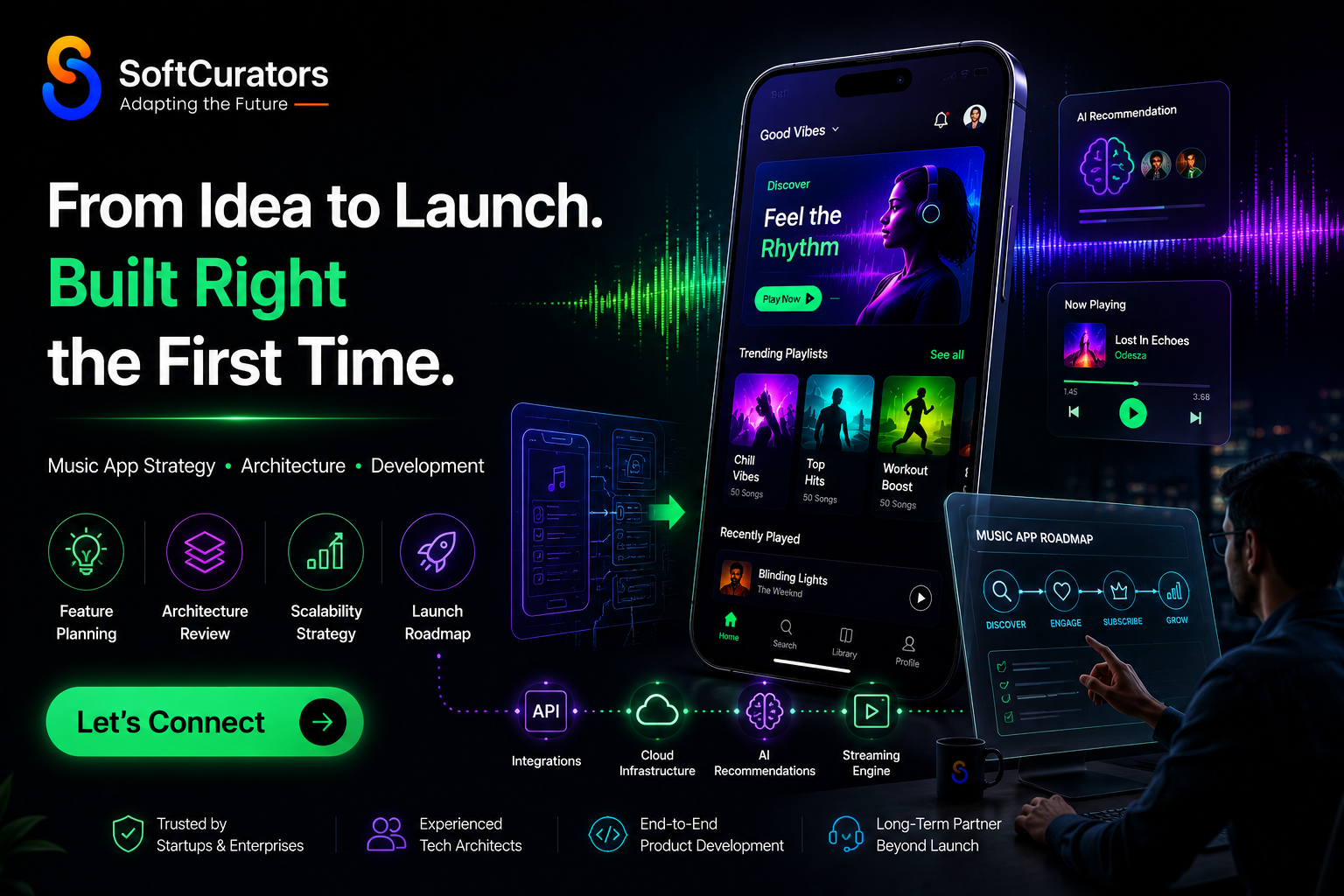
Building a music streaming app is genuinely complex. Therefore, the process matters as much as the technology. Here is exactly how Softcurators approaches every music app engagement from first call to live platform:
- Discovery and Strategy Session (Week 1): We map your target market, content strategy, licensing approach, and monetization model. We define the exact feature set for V1 not by guessing, but by evaluating competitive gaps and your specific user acquisition strategy. Output: a Technical Specification Document and confirmed cost estimate.
- Licensing Strategy Consultation (Week 1, parallel): Before design begins, we connect you with the right licensing approach for your business model. This decision significantly affects architecture choices particularly around DRM, rights tracking, and royalty calculation infrastructure.
- UI/UX Design Sprint (Week 2–3): Our UI/UX design team creates wireframes and Figma prototypes for every user flow. We test with real users before development begins. Music app design requires particular attention to the playback interface it is the most-touched screen in the product. Our mobile app UI/UX best practices guide every design decision.
- Backend Architecture and Audio Infrastructure Setup (Week 3–5): Cloud infrastructure, CDN configuration, audio processing pipeline, and database schema all built before the first feature sprint begins. This parallel workstream prevents backend bottlenecks from slowing frontend development.
- Feature Development Sprints (Week 4–12+): Two-week Agile sprints, each delivering testable feature increments. Daily standups. Weekly demos on the staging environment. Transparent sprint boards. Clients attend every sprint review and influence prioritization. No surprises.
- Audio Quality and Performance Testing (Week 6–12): Music apps require specialized QA that general-purpose testing does not cover: playback continuity testing across network conditions, bitrate switching validation, gapless playback testing, background playback edge cases, and Bluetooth device compatibility. Our app testing and deployment approach includes these audio-specific test scenarios as standard.
- App Store Submission and Launch (Week 12–15): App Store Review for music apps can be more scrutinized than average apps. We handle the full submission process including App Store optimization, screenshots, preview videos, and metadata to maximize approval speed and first-impression conversion.
- Post-Launch Hypercare and Iteration (Week 15+): Softcurators provides 30 days of on-call support post-launch as standard. User feedback in the first 30 days is gold. We plan and execute the first iteration sprint based on real user behaviour data, not assumptions.
Development Timelines: What to Realistically Expect
| Project Type | Timeline | Key Milestones |
| MVP – One platform, basic features, no DRM | 6–8 weeks | Design Wk3, Backend Wk6, Alpha Wk11, QA Wk14, Launch Wk16 |
| Full Platform – iOS + Android + AI recs + DRM | 8–14 weeks | Design Wk4, Core Dev Wk10, AI Layer Wk18, QA Wk24, Launch Wk28 |
| Enterprise / Creator Economy Platform | 15–21 weeks | All above + Live Streaming Wk20, ML V2 Wk28, Smart Device Wk34, Scale Wk40 |
| White-Label Reskin of Softcurators Framework | 3–5 weeks | Design Wk2, Config Wk5, QA Wk8, Store Submission Wk9 |
| Web-Only MVP (PWA) | 4–6 weeks | Design Wk2, Dev Wk4, QA Wk10, Launch Wk12 |
These timelines assume a dedicated Softcurators team: 2 backend engineers, 2 mobile engineers (iOS + Android), 1 frontend engineer, 1 QA, 1 designer, 1 PM. Timelines compress by 20–30% with a larger team allocation. Our cross-platform development approach using Flutter can further compress timelines when native iOS and Android are not required separately.
How to Cut Music App Development Costs Without Cutting Corners
Cost optimization is not about finding the cheapest developer. It is about making the right architectural and strategic choices that minimize waste. Here are the six most effective cost-reduction strategies Softcurators recommends to music app founders:
- Start with one mobile platform: Build iOS first if your target market skews premium (US, UK, Western Europe). Build Android first if you are targeting India, Southeast Asia, or Latin America. Adding the second platform in V2 after you have user feedback from the first saves $15,000–$30,000 in initial development. Our analysis of native apps vs hybrid apps explains when this tradeoff makes sense.
- Use cross-platform with Flutter: If you genuinely need both iOS and Android from day one, Flutter app development delivers both platforms from a single codebase at roughly 60–70% of the cost of separate native builds. The performance gap for audio applications has largely closed.
- Defer AI recommendations to V2: A simple rule-based discovery feed (‘users who liked X also liked Y’) at launch costs $5,000–$8,000. A full collaborative filtering recommendation engine costs $12,000–$20,000 more. Importantly, the ML version only improves once you have a significant volume of listening data. Launch with rules. Add ML once you have 10,000+ active users.
- Use a white-label music API for licensed content: Services like Napster B2B, 7Digital, or Audius provide licensed music catalogues via API avoiding the need to negotiate direct label deals. This approach trades a higher per-stream cost for zero upfront licensing negotiation time and significantly reduced legal expense.
- Build on Softcurators’ music app framework: Softcurators has pre-built modules for audio player architecture, playlist management, and subscription billing that accelerate development by 30–40% compared to building from scratch. This is not a generic template it is an engineering foundation that still delivers a fully custom product.
- MVP before full investment: Our MVP development service is purpose-built for exactly this scenario. A $30,000–$50,000 MVP that proves user engagement and subscription conversion gives you the data to raise funding for the full build rather than asking investors to fund a $200,000 platform based on a pitch deck alone.
Why Softcurators Is the Right Partner to Build Your Music Streaming App
There is no shortage of development companies claiming to build music apps. Most are generalists who have never shipped a production audio streaming product. Softcurators is different and the difference is grounded in specific capabilities, not marketing language.
- Dedicated music streaming service: Our music streaming app development service is a specialist practice, not a side capability. We have built audio applications that handle real-time streaming, complex playlist logic, and subscription management at scale.
- Full mobile depth all platforms: From iOS development to Android, Flutter, and React Native we cover every mobile platform with senior engineers who know audio APIs at the implementation level.
- AI-first approach to recommendations: Our AI development and AI app development practices are embedded into every music app engagement from the architecture phase ensuring recommendation systems are built into the data model from Day 1, not bolted on later.
- UX that creates retention, not just installs: Our UI/UX design team designs music apps from the user’s listening experience backward. Retention in music apps is driven by the quality of the listening experience and quality UX design is the primary lever.
- Honest advice before you commit: We tell clients when their budget does not match their ambition and we propose a phased approach that gets them to market quickly and scales as the business grows. Read why businesses choose Softcurators and how we approach choosing the right development partner.
- Post-launch partnership: Our maintenance and support service keeps your platform competitive, secure, and performant long after launch. Apps are products, not projects and Softcurators partners with clients for the long run.
Explore our portfolio of delivered apps, learn more on our about us page, or browse our full services directory.
The Music App You’ve Been Thinking About – Here Is How to Build It
Building a music streaming app is genuinely achievable at startup scale. The infrastructure is accessible. The frameworks are mature. The market has clear niches that the big platforms are not serving well.
However, the difference between a music app people delete after three sessions and one they use every day comes down to execution quality. Audio reliability. Discovery intelligence. UX that makes finding the next great song feel effortless.
That execution quality is what Softcurators delivers. We bring specialist music streaming development, AI-powered personalization, cross-platform mobile expertise, and user experience design to every music app engagement. We have navigated the licensing questions, the audio infrastructure decisions, and the subscription economics before.
The first call is free. The estimate takes 12 hours. The roadmap is specific to your idea not templated.
Talk to Softcurators today and let’s figure out exactly what your music app needs and what it will cost to build it right.
FAQs
How long does it take to build a music streaming app?
An MVP takes 6–12 weeks. A full-featured iOS and Android platform with AI recommendations and DRM takes 11–15 weeks. Enterprise-scale platforms with live streaming and advanced ML take 15–18 weeks. A web-only PWA can be delivered in 4–8 weeks. Softcurators uses a parallel workstream approach — design, backend setup, and frontend development run simultaneously — to compress timelines without compromising quality.
Do I need music licences to build a music streaming app?
Yes, if you plan to stream commercially released music. In the US you need performance licences from PROs (ASCAP, BMI, SESAC) and mechanical licences from rights holders or aggregators. The alternative — which Softcurators often recommends for early-stage products — is to build a platform for independent artists who upload their own content, or to use a white-label music API that handles licensing on your behalf.
What is the cheapest way to build a music streaming app?
The most cost-effective path is a Flutter-based cross-platform MVP (iOS + Android from one codebase), launching with user-uploaded or licensed-via-API content to avoid direct label deals, deferring AI recommendations to V2, and using Softcurators' pre-built music app framework for the core audio player and playlist modules. This approach can deliver a production-quality MVP for $55,000–$80,000 — roughly 30% cheaper than a dual-native build.
Can Softcurators build a Spotify clone?
Softcurators builds original music streaming apps inspired by Spotify's functionality — not literal clones of Spotify's code or design. We build custom apps with your branding, your feature set, and your specific market positioning. The Softcurators music streaming app development service covers everything from audio engine architecture to AI recommendations and subscription billing. Contact us to discuss your specific requirements.
What technology does Spotify use that I should use too?
Spotify uses a microservices backend, HLS-based adaptive streaming, AWS for infrastructure, PostgreSQL and Cassandra for data storage, Python-based ML for recommendations, and native iOS and Android apps. For a new platform in 2026, Softcurators recommends a similar but more cost-appropriate stack: NestJS/Go microservices backend, HLS streaming via CloudFront, AWS infrastructure with Kubernetes, PostgreSQL and Redis, and either native iOS/Android or Flutter depending on budget.
What is DRM and do I need it for my music app?
DRM (Digital Rights Management) prevents downloaded tracks from being extracted and shared outside your app. It is required by all major labels as a condition of licensing. Apple FairPlay handles DRM on iOS. Google Widevine handles DRM on Android and Web. If you are building a platform with major label content or licensed catalogue content, DRM is non-negotiable. If you are building a platform for independent artists who own their content, DRM is your choice, not a requirement.
How does music recommendation work in a streaming app?
Recommendation systems in music apps operate in layers of sophistication. The simplest layer is content-based filtering — recommending tracks with similar metadata (genre, BPM, key). The next layer is collaborative filtering — recommending what users with similar listening histories enjoy. The most sophisticated layer is deep learning on audio features and contextual signals (time of day, device, recent listening patterns). Softcurators builds V1 with collaborative filtering and scales to deep learning models as the user base and data volume grow.
Should I build a native iOS and Android app or use Flutter?
For music streaming apps, Softcurators generally recommends Flutter for budget-conscious launches — the performance gap for audio applications has largely closed, and you save 35–40% on development cost. However, if your target market is premium iOS users and audio quality differentiation is a core value proposition, native iOS development using Swift and AVFoundation gives you finer control over the audio stack. We walk through this decision in our analysis of native apps vs hybrid apps.
What is adaptive bitrate streaming and why does it matter for a music app?
Adaptive bitrate streaming (ABR) automatically adjusts audio quality based on the user's current network conditions. When the connection is strong, the app streams at 320kbps. When it weakens, it drops to 128kbps to prevent buffering. Without ABR, users on variable connections experience constant interruptions. With ABR, the transition is seamless — users often do not notice the quality change. HLS (HTTP Live Streaming) is the standard protocol for ABR in audio apps and is what Softcurators implements by default.
How does Softcurators handle audio storage and delivery at scale?
Softcurators uses AWS S3 for audio file storage and AWS CloudFront as the CDN for global edge delivery. Audio files are transcoded into multiple bitrates (128, 256, 320kbps) using FFmpeg before storage, so the CDN delivers the right quality tier instantly without server-side processing on each request. This architecture handles millions of simultaneous streams without performance degradation.
Can I add podcasts and audiobooks to my music streaming app?
Yes. Softcurators builds multi-format audio platforms that combine music, podcasts, and audiobooks in a single unified experience. Podcast delivery requires a separate content ingestion pipeline (RSS feed processing, episode-level metadata), chapter navigation, and playback speed controls. Adding podcasts to a music app typically costs $20,000–$45,000 in additional development and is a strong V2 feature for expanding your TAM.
What payment options should a music streaming app support?
Softcurators recommends supporting: monthly and annual subscriptions via Stripe for web platforms, in-app purchases via App Store and Play Store for mobile (required by Apple and Google for digital subscriptions), gift cards as a conversion tool, and family plan pricing to increase ARPU. The 30% App Store revenue share is unavoidable for in-app subscription purchases on iOS. Web-based subscription management through Stripe avoids this fee, which is why many platforms encourage web sign-up.
How does offline listening work technically?
Offline listening works by downloading encrypted audio files to the device and storing them in a protected local database. The encryption key is tied to the user's active subscription — when a subscription lapses, the keys are revoked and the downloaded files become unplayable. On iOS this uses FairPlay. On Android it uses Widevine Level 1 (hardware-backed) or Level 3 (software). Softcurators implements the full DRM stack as part of every platform that requires offline capability with licensed content.
What makes a music streaming app retain users long-term?
The three biggest retention drivers in music apps are: personalization quality (does the app surface music the user actually wants to hear?), discovery freshness (does the app reliably introduce them to new music they love?), and social connection (are their friends using it and sharing within it?). Softcurators designs music apps with all three retention mechanics in mind from the architecture phase — because retention is far cheaper to design for than to retrofit.
How much does it cost to run a music streaming app per month after launch?
For a platform with 10,000 active monthly users, expect $1,000–$3,000/month in infrastructure and CDN costs, $1,000–$2,000/month in music licensing fees depending on your deal structure, $500–$1,000/month in monitoring, analytics, and tooling, and $1,000–$3,000/month in engineering maintenance. Total operational costs at 10,000 active users typically run $3,000–$15,000/month before staff costs.
What analytics should I track in a music streaming app?
The most important metrics for a music streaming app are: Daily Active Users (DAU) and Monthly Active Users (MAU), streams per session and session length, playlist creation and save rate (strong engagement signal), free-to-premium conversion rate, monthly churn rate by cohort, and track completion rate (which tracks are causing users to skip — a direct quality signal). Softcurators builds an event tracking pipeline from Day 1 so these metrics are available from the first day of user activity.
Can Softcurators build a music app for independent artists?
Yes — and this is one of our most recommended business models for new music platforms. An independent artist platform avoids major label licensing entirely (artists upload their own content and retain all rights), supports a higher royalty rate than Spotify (a key selling proposition to artists), and can serve a passionate niche community. Softcurators has built creator-first platforms across multiple entertainment verticals, including the full artist dashboard, fan engagement tools, and royalty calculation infrastructure.
What is the App Store review process like for a music streaming app?
Apple's App Store review typically takes 24–72 hours. Music apps that include subscription billing, user-generated content, or mature content require particular attention to metadata and review guidelines. Common rejection reasons for music apps include: subscription terms not clearly disclosed in the app, explicit content not properly gated, or IAP pricing not matching what is described in the app. Softcurators manages the full App Store submission process and handles responses to review rejections as standard.
How do I compete with Spotify, Apple Music, and YouTube Music?
You do not compete with them directly — and you should not try to. The winning strategy for a new music streaming platform in 2026 is depth over breadth: serve a specific artist community, genre, or use case better than any general platform can. Niche music communities are loyal, vocal, and willing to pay. General platforms are optimized for the median listener, not for you. Softcurators helps founders identify and validate their niche before building — our startup development service is specifically designed for this kind of focused market entry.
Does Softcurators offer a white-label music streaming app solution?
Yes. Softcurators has a pre-built music streaming framework covering core audio player architecture, playlist management, user authentication, and subscription billing. This framework can be fully branded, configured, and extended for your specific use case — delivering a production-ready platform in 6–10 weeks at significantly lower cost than a ground-up build. Contact us at softcurators.com/contact to see a demo.
What is the best monetization model for a new music streaming app?
Softcurators recommends a freemium subscription model for consumer music apps — free tier with ads and limited skips, premium tier at $7–$12/month with unlimited listening, downloads, and ad-free experience. Additionally, creator platforms can layer in: artist subscription tiers (fans pay a monthly fee to support a specific artist), virtual tip jars, live event ticketing, and exclusive content access tiers. The right model depends on your specific community and positioning, which is why Softcurators includes monetization strategy in every discovery session.
How do I get started with building my music streaming app through Softcurators?
The first step is booking a free 30-minute discovery call at softcurators.com/contact. Our senior product architect will review your concept, ask targeted questions about your target market and content strategy, and deliver a ballpark cost range within 24 hours — followed by a detailed scoped proposal within 3–5 business days. No obligation. No generic response. A real architect who has built music apps before, thinking about your specific business.
