
Car Wash App Development Company
Car wash app development is the design and engineering of a dedicated booking and dispatch platform for fixed-location wash centers, mobile/on-demand detailing businesses, and multi-outlet chains, covering real-time bay or technician availability, route optimization for mobile fleets, and integrated payments. What’s actually at stake for a car wash business isn’t the booking form itself, it’s what manual scheduling and dispatch cost in practice: double-booked technicians, inefficient routing that wastes drive time between mobile jobs, no real-time visibility into job status, and after-hours bookings lost to a competitor whose mobile app made booking instant. This page works through when a dedicated app is worth building against continuing with generic scheduling tools, POS software, or a listing on an existing on-demand services marketplace, since that decision determines whether the investment actually pays off. The underlying dispatch and routing problem here has real parallels to other on-demand categories we build for, including taxi and ride-hailing, logistics, and on-demand services more broadly.

Car Wash App Development
The Business Case for a Dedicated Car Wash App
Manual scheduling and dispatch create costs that compound as a car wash or detailing business grows: double-booked technicians damage trust, inefficient routing for mobile services wastes paid drive time between jobs, and staff lack real-time visibility into job status without constant phone check-ins. A booking system that can’t show real-time bay or technician availability also loses after-hours bookings outright, since a customer who wants to book a wash for tomorrow morning won’t wait for a callback if a competitor lets them book immediately online.
Relying entirely on generic scheduling tools or a third-party on-demand marketplace carries a related but different cost: you don’t own the customer relationship, your brand competes for visibility inside someone else’s listings, and margins erode to marketplace commissions in a way that gets more expensive as booking volume grows. A handful of signals indicate a business has outgrown manual or spreadsheet scheduling: multiple locations or a mobile fleet needing centralized visibility, high enough booking volume that manual errors carry real cost, a genuine need for route optimization across mobile jobs, and a strategic reason to own customer data directly. A single fixed-location wash bay with low volume rarely meets that bar — simpler scheduling tools remain the more efficient choice until scale or routing complexity genuinely justify custom software.
Build vs. Buy: Custom App, Generic Scheduling Software or Marketplace Listing
|
Approach
|
Upfront Cost
|
Time to Market
|
Control & Differentiation
|
Long-Term Ownership
|
|---|---|---|---|---|
|
Generic Scheduling/POS Software
|
Lowest
|
Fastest
|
Limited or no route-optimization capability, generic booking flow
|
Ongoing subscription fees, often per-seat or per-location
|
|
On-Demand Marketplace Listing
|
Low
|
Fast
|
No brand control, listed alongside competitors, no direct customer data
|
Ongoing commission per booking, which scales with volume
|
|
Custom Development
|
Highest
|
Longest
|
Full control over branding, booking flow, and route-optimization logic
|
No recurring platform fees, but you own ongoing maintenance cost
|
The right approach depends on your business model, how much route-optimization and brand control you need, and how much ongoing platform cost you’re willing to accept, since custom development, generic scheduling/POS tools, and on-demand marketplace listings trade these off very differently. Generic scheduling or POS software makes sense for a single fixed-location wash with straightforward, non-mobile bookings, where the ongoing subscription cost stays manageable and route optimization simply isn’t relevant to the business model. A marketplace listing can work as a low-effort acquisition channel for a small mobile operation just starting out, though the commission cost and lack of customer ownership become harder to justify as volume grows. Custom development earns its cost once you’re running a mobile fleet that needs real route optimization, operating multiple locations needing centralized visibility, or managing fleet/corporate accounts with requirements a generic tool doesn’t support at that point, a prototype of the core booking and dispatch flow is a reasonable way to validate the custom build before committing to full development, and our UI/UX design process ensures that flow is tested with real technicians and customers before engineering begins.
Who Actually Needs a Dedicated Car Wash App
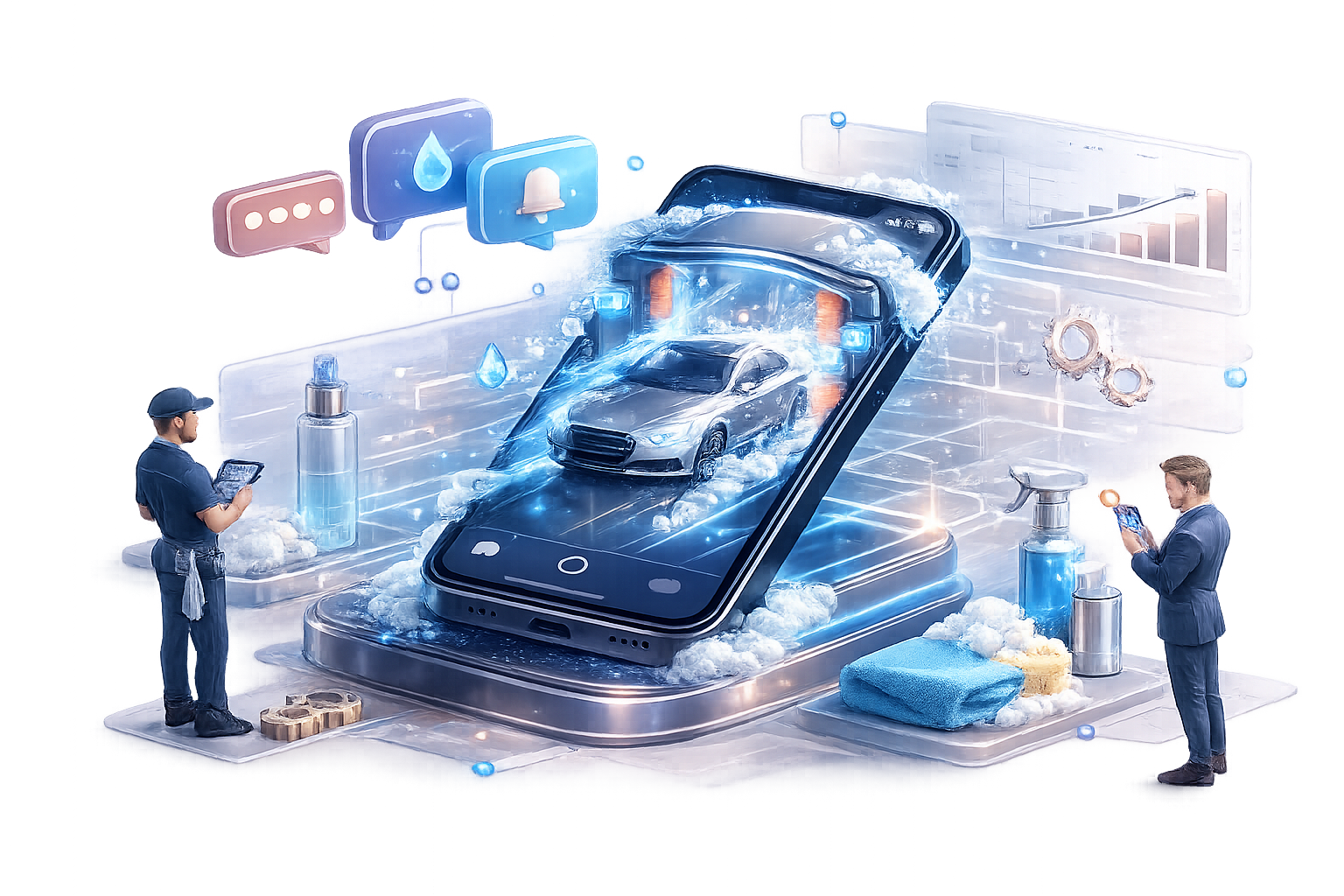
A dedicated app makes sense for businesses with real dispatch or multi-location complexity, not for every wash center looking to modernize booking.
- Fixed-location wash centers with high volume needing real-time bay availability and online booking to reduce phone-based scheduling load.
- Mobile/on-demand detailing fleets where technicians travel to customers, requiring real-time route optimization and dispatch a dispatch problem structurally similar to what we solve for taxi and ride-hailing, food delivery, and fuel delivery
- Multi-outlet wash chains needing centralized booking, staffing, and reporting visibility across locations.
- Fleet and corporate car care providers managing recurring service contracts and multi-vehicle scheduling for business clients, a use case with real parallels to the account-management complexity in logistics app development.
- Booking-and-dispatch businesses with a comparable operational shape home-service beauty (beauty salon app development) or on-demand laundry (laundry app development) face many of the same build-vs-buy and dispatch decisions covered on this page.
Solution Readiness Assessment: Is Your Car Wash Business Ready to Build?
Mobile fleet or multiple locations.
You run a mobile detailing fleet needing route optimization, or operate multiple wash locations needing centralized visibility.
High enough booking volume that manual errors carry real cost.
Double-bookings or scheduling mistakes are frequent enough to measurably affect revenue or customer trust.
A genuine route-optimization or dispatch need.
Your mobile technicians’ routing efficiency directly affects how many jobs they can complete per day.
A clear reason to own the customer relationship.
You can articulate why direct booking and customer data matter more than a marketplace listing’s convenience.
Fleet/corporate account requirements a generic tool doesn’t support.
You need recurring contracts, multi-vehicle scheduling, or reporting that off-the-shelf software doesn’t handle well.
Types of Car Wash Apps We Build
Standalone Car Wash Center App
Ideal for single-location service providers digitize bookings, payments, and staff management.
On-Demand Mobile Car Wash App
Send detailers to customer locations with real-time GPS tracking and automated job assignments
Multi-Outlet Car Wash Chain App
Run multiple branches from a unified dashboard with location-wise analytics & service optimization
Subscription/ Membership-based Car Wash App
Offer monthly & yearly plans, unlimited washes, and exclusive discounts with automated renewals
Car Detailing & Vehicle Care Apps
Add specialized services like waxing, ceramic coating, interior cleaning, and more.
Fleet Car Wash & Corporate Car Care Apps
Serve companies with vehicle fleets and track servicing digitally
Start Your Travel Tech Journey with
SoftCurators
SoftCurators is your trusted partner in creating scalable, feature-rich, and user-friendly car wash apps that boost customer satisfaction and accelerate business growth
Route Optimization and Real-Time Dispatch for Mobile Detailing
Route optimization means algorithmically assigning and sequencing mobile detailing jobs to minimize drive time and maximize the number of jobs a technician can complete per shift, rather than assigning jobs in the order they were booked. This depends on real-time location data from technicians, integration with a mapping and routing service such as the Google Maps Platform for distance and travel-time calculation, and a dispatch algorithm that balances route efficiency against technician availability and job priority.Real-time dispatch also needs explicit handling for the edge cases that come up constantly in production: a job running long and pushing back the technician’s next appointment, a customer cancellation opening a routing gap that could be filled by a nearby waiting job, and walk-in or last-minute bookings that need to slot into an already-optimized route without breaking it. AI-powered route suggestions can improve dispatch efficiency over time by learning from historical job duration and travel-time patterns, though this is worth scoping only once you have enough real dispatch data to train it meaningfully AI consulting is a reasonable first step if you’re unsure whether your data volume justifies it yet.
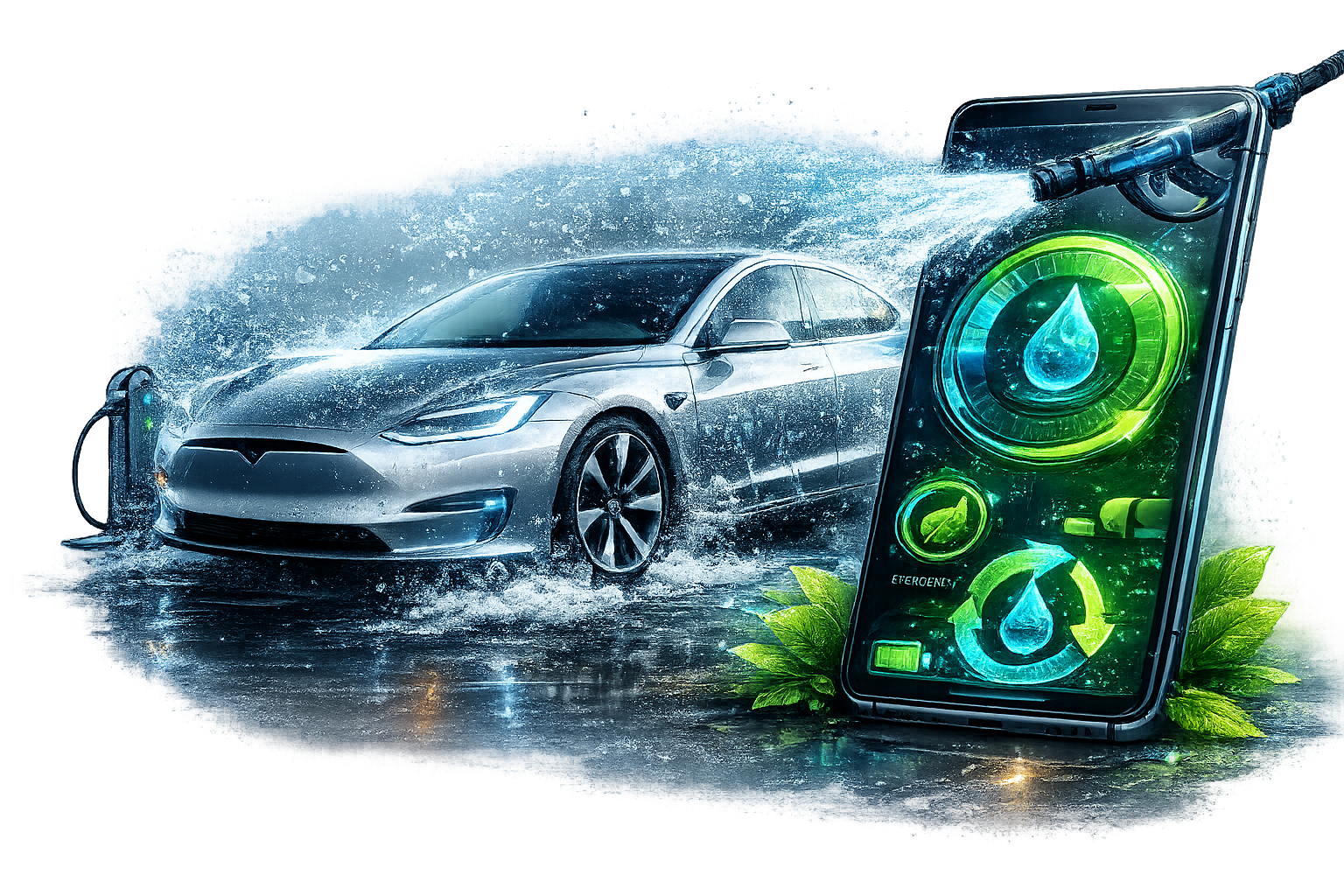

Water Usage and Environmental Considerations for Mobile Car Wash Operations
Mobile car wash and detailing operations generate wastewater runoff that is regulated in many jurisdictions, since water containing soap, oil, and vehicle residue running into storm drains or open ground is treated differently than water discharged at a fixed facility with proper drainage infrastructure. Requirements for water reclamation, permitted discharge methods, and runoff containment vary significantly by state, municipality, and country, so this is genuinely not an area where generic platform guidance is a substitute for confirming local requirements directly. At a platform level, this consideration matters because compliance documentation whether a technician uses a reclamation system, what runoff method is used at a given job site can be tracked in the technician app and admin panel, giving a business a record it may need for local compliance without the platform itself making legal determinations. Businesses operating mobile fleets across multiple jurisdictions should treat this as a genuine operational planning item alongside route optimization, not an afterthought resolved informally by individual technicians.
Core Features of Car Wash App Solutions
- User Registration & Social Login
- Browse Wash Packages & Detailed Service Descriptions
- Real-Time Slot Availability
- Book, Reschedule, or Cancel Appointments
- GPS Tracking for Mobile Detailers
- In-App Payments (UPI, Wallet, Cards, Net Banking)
- Service Progress Updates & Notifications
- Order History & Invoices
- Ratings & Reviews
- Saved Locations & Favourite Packages
- Job Requests & Real-Time Notifications
- Route Optimization & GPS Navigation
- Available Time Slots & Schedule Management
- Service Start/Stop & Job Completion Updates
- Upload Before/After Images
- Earnings Dashboard
- Commission & Tips Tracking
- Customer & Service Provider Management
- Booking Calendar & Slot Management
- Pricing, Packages & Add-On Control
- Real-Time Analytics & Revenue Reports
- Fleet Management (if applicable)
- Automated Invoicing & Tax Management
- Promo Codes, Cashback & Offers
- Complaint & Feedback Management
Advanced & Trendy Features We Offer
AI-Based Suggestions
Geo-Fencing
Real-Time Chat Support
Automated Invoicing & Tax Calculation
Multi-Language Support
Multi-Currency Support
IoT Integration
NFC-Based Loyalty Rewards
Voice-Enabled Booking
Car Wash App Monetization Models
Service Fees
Commissions
Subscription Plans
Surge Pricing
Promotional Listing
Advertisements
Our Car Wash App Development Process
Requirements and fixed-location vs. mobile-fleet planning.
We define whether the business is fixed-location, mobile, or hybrid before any technical design begins, since this decision shapes the entire architecture.
Technician/route architecture design.
Real-time availability sync and route-optimization logic get architected explicitly for mobile operations, including how walk-ins and cancellations are handled.
Payment integration
Payment processing gets scoped and built against your actual operational needs, including any existing POS system it needs to work alongside.
Core platform build
Customer app, technician app, and admin panel along with a web-based admin dashboard where useful for multi-location reporting are developed against the architecture established earlier.
Testing and Phased location rollout
The platform gets tested against real scheduling edge cases overlapping bookings, route disruptions, last-minute cancellations not just a standard functional pass. Launch at one location or with a smaller technician group first to validate scheduling and routing accuracy, with ongoing maintenance and support scoped from launch rather than treated as an afterthought
Tech Stack for Car Wash Apps
- Flutter
- React Native
- Swift
- Kotlin
- Node
- Laravel (PHP)
- Python / Django
- Java / Spring
- MongoDB
- PostgreSQL
- Firebase
- Stripe, PayPal, Razorpay, Braintree
- Bank APIs
- AWS / Google Cloud / Azure
- Cloud-based backups
Contact Us
Ready to Build Your On Demand Car Wash App ?
Book a project scoping call and bring your location count, staff size, and current booking setup we’ll tell you honestly what it takes to build and launch it.
Data Migration and Client History Onboarding
Migrating existing customer and booking history from a prior system means transferring contact details, service history, and vehicle information, and this rarely maps cleanly from a spreadsheet or legacy scheduling tool without real data cleanup. Inconsistent or incomplete customer records carry directly into the new platform if not audited first, which affects both personalization and staff ability to serve returning customers well from day one. Change management for staff and technicians adopting a new digital dispatch system matters as much as the technical migration teams used to phone-based scheduling need training and a transition period, rather than a single hard cutover that risks lost bookings or missed jobs during the switch. This is especially true for mobile fleets, where technicians also need to trust that route assignments generated by the new system are actually more efficient than their own informal routing habits.
Cost and Timeline Planning
Cost and timeline depend heavily on business model and path a single fixed-location app, a mobile fleet app with route optimization, and a multi-outlet chain platform represent meaningfully different scopes. A single fixed-location app typically takes around 10 to 14 weeks for core booking, staff, and admin functionality, while a mobile fleet app with real route optimization takes meaningfully longer given the added dispatch-algorithm and mapping-integration work. A multi-outlet chain or fleet/corporate platform represents the largest scope of the three, given the added architecture for cross-location visibility, permissions, and account management.
Questions to Ask Before Starting Your Project
Why Choose SoftCurators for your Car Wash App Development ?
Common Mistakes We See in Car Wash App Projects
|
Mistake
|
Why It Hurts
|
What To Do Instead
|
|---|---|---|
|
Underestimating route-optimization complexity
|
Naive routing logic (booking-order dispatch) leaves real efficiency gains on the table and frustrates technicians who see obviously inefficient routes
|
Architect dispatch and route optimization explicitly, including edge cases, before development starts
|
|
Ignoring water/environmental considerations for mobile operations
|
Overlooking local wastewater or runoff requirements creates real compliance exposure that’s expensive to address after the fact
|
Build compliance-tracking capability into the technician workflow and confirm local requirements early
|
|
Skipping technician onboarding and training planning
|
Technicians resistant to a new dispatch system slow adoption regardless of how well the routing algorithm performs
|
Plan technician training and a transition period, especially for mobile fleets used to informal routing
|
|
Choosing custom development without a clear cost case
|
Custom software costs more to build and maintain than generic tools, and without route-optimization or scale genuinely justifying it, that cost is hard to recover
|
Confirm generic tool or marketplace costs at your actual scale before committing to custom development
|
|
Migrating customer data without a cleanup pass
|
Inconsistent records carry directly into the new platform, affecting personalization and service quality from day one
|
Audit and clean customer and booking data before migration
|
|
Underbuilding multi-location or fleet account reporting
|
Chains and fleet operators end up doing manual reporting work outside the platform when admin tooling is underbuilt
|
Scope multi-location and account reporting as a core admin-panel requirement, not an afterthought
|
Lets Connect
Ready to Build a High Performing Car Wash App?
Frequently Asked Questions
Generic scheduling or POS software is generally the better choice for a single fixed-location wash with straightforward, non-mobile bookings, where ongoing subscription costs stay manageable. Custom development becomes worth it once you’re running a mobile fleet needing real route optimization, managing multiple locations, or handling fleet/corporate accounts with requirements generic tools don’t support.
Route optimization algorithmically assigns and sequences mobile jobs to minimize drive time and maximize completed jobs per shift, using real-time technician location data and a mapping/routing service like the Google Maps Platform for distance and travel-time calculation. The system also needs explicit handling for edge cases like job overruns, cancellations, and last-minute bookings that need to slot into an already-optimized route.
Cost depends primarily on whether you’re building for a single fixed location, a mobile fleet with route optimization, or a multi-outlet chain, since each represents meaningfully different technical complexity.
A single fixed-location app typically takes around 10 to 14 weeks for core functionality, while a mobile fleet app with real route optimization or a multi-outlet chain platform takes meaningfully longer given the added dispatch and cross-location architecture.
Wastewater and runoff from mobile car washing is regulated in many jurisdictions, and requirements for reclamation and discharge vary significantly by state, municipality, and country.
An MVP needs real-time booking against bay or technician availability, basic payment processing, and core admin scheduling oversight — for mobile fleets, this also includes basic route assignment from day one. Advanced route optimization, fleet/corporate account management, and membership tiers are reasonable to defer to later phases.
Yes — AI-powered route suggestions can improve efficiency by learning from historical job duration and travel-time patterns, though this depends on having enough real dispatch data to train the model meaningfully. AI consulting is a reasonable first step if you’re unsure whether your current data volume justifies investing in this yet.
Yes, though it’s rarely a clean import — customer and booking records from a spreadsheet or prior system typically need a data-quality audit before migration, since inconsistent records carry directly into the new platform. Planning this as a dedicated step avoids carrying data problems into your new system.
Usually not — for a single low-volume location, generic scheduling software is almost always more efficient than custom software, since subscription costs stay low and route optimization isn’t relevant without a mobile fleet. Custom development becomes worth considering once volume, multi-location needs, or mobile dispatch complexity genuinely justify the added cost.
Yes, POS integration is scoped as a specific part of the project based on which system you’re already running, since compatibility and integration complexity vary meaningfully by provider. We recommend identifying these integration requirements during initial planning rather than after development has started.
Yes, we build for both models and for hybrids that operate a fixed location alongside a mobile fleet, since the two models have genuinely different architecture needs — fixed-location apps center on bay scheduling, while mobile apps center on route optimization and real-time dispatch. Deciding which model (or hybrid) you’re building for happens during initial requirements planning, since it shapes the entire technical architecture.
Yes, ongoing support and maintenance covers monitoring booking and dispatch system reliability, applying security and platform updates, and adjusting routing logic as your business grows or adds locations. This is scoped as a distinct, ongoing engagement rather than a one-time deliverable.
Our Latest Blogs
Somewhere along the way, adding a chatbot got treated like adding a newsletter signup form , a small checkbox item...
If you use Salesforce, or you’re evaluating whether to, you’ve probably noticed the product names keep changing. Sales Cloud is...
“Why ‘How Much Does AI Cost’ Is the Wrong First Question ?” Founders ask this question expecting a single number,...
Ask ten AI vendors which tool your business needs and you’ll get ten different answers, each conveniently pointing at their...