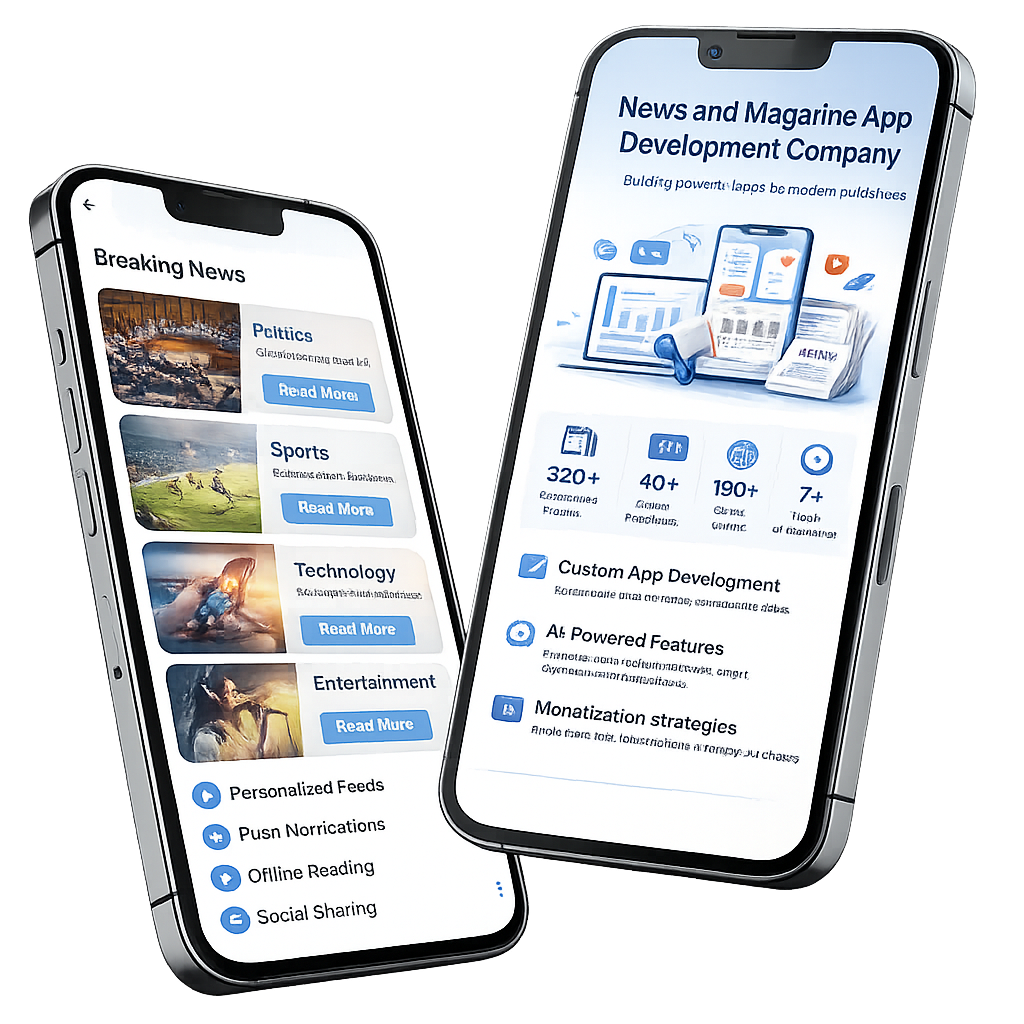










News and Magazine App Development Company

News and magazine app development is the design and engineering of a dedicated reading platform for publishers, covering content ingestion from a CMS, subscription and paywall logic, advertising integration, and reader delivery through a channel a publisher owns and controls rather than rents from a distribution platform. What’s actually at stake for a publisher relying entirely on social media distribution or aggregator apps for reach isn’t just algorithm dependency, it’s the reader relationship itself: no first-party data for personalization or ad targeting, no direct push-notification channel for re-engagement, and revenue share that erodes margin on every reader a third-party platform delivers instead of a channel you control. The underlying subscription and content-delivery problem here has real parallels to other categories we build for, including music streaming platforms on the subscription side and social media apps on the content-distribution side; if you’ve already decided to build, our mobile app development page covers the underlying engineering process in more depth.

Our Clients

Why ?

Why Invest in News and Magazine App Development ?

The publishing industry is rapidly shifting to digital platforms. Print is declining mobile readership is growing. Professional news and magazine app development helps you:

Increase digital subscriptions

Deliver real-time breaking news

Monetize through ads & paywalls

Improve reader engagement

Build brand loyalty

Analyze reader behavior

News & Magazine App Development

The Business Case for a Dedicated Publishing App

  • Relying entirely on third-party platforms – social media distribution, aggregator apps like Apple News or Google News – for reach means accepting algorithm dependency, revenue-share erosion, and no direct reader relationship, all of which limit how much control a publisher actually has over its own audience. A mobile-web-only or generic CMS-based approach often underperforms a dedicated app on reader retention and subscription conversion specifically, since app users typically engage more frequently and convert to paid subscriptions at higher rates than web-only visitors who arrive from a search or social link and rarely return through the same path.

  • The operational impact of not owning the reader relationship shows up directly in what a publisher can and can’t do: no first-party data for ad targeting or personalization, and limited push-notification or re-engagement capability compared to a dedicated app. The business risk of delaying a dedicated app investment is losing subscribers to competitors offering a better reading experience and missing direct-subscription revenue that a strong app experience measurably improves. A handful of signals indicate a publisher has outgrown a generic CMS/website-only approach: an established readership worth investing in retention for, a need for a direct subscription or paywall relationship, and a strategic desire for first-party reader data. A very small or early-stage publication rarely meets that bar yet – a strong mobile website or an existing publishing SaaS platform remains the more efficient choice until readership and revenue genuinely justify a dedicated app.

Build vs. Buy: Custom App, Publishing Platform or Hybrid

Approach
Upfront Cost
Time to Market
Control & Monetization
Long-Term Reader-Data Ownership
Publishing CMS/Platform Provider
Lower upfront, ongoing subscription
Fastest
Limited to the platform’s existing workflow and reporting logic
Reader data often stays partially with the platform provider
Custom Development
Highest
Longest
Full control over paywall logic, ad integration, and reader experience
You own reader data and the direct relationship outright
Hybrid (platform core, custom layer)
Moderate
Moderate
Selective control over the specific reader experience that matters most
Partial ownership, with dependency on the underlying platform remaining

The right approach depends on your publisher size, how much monetization control and reader-data ownership you need, and how much recurring platform cost you’re willing to accept, since custom development and established publishing CMS/platform providers trade these off very differently.An existing publishing platform makes sense when you need to launch quickly, don’t yet have the readership to justify custom investment, or don’t need monetization logic beyond what the platform already supports – the speed and lower upfront cost are a reasonable trade for accepting someone else’s paywall and personalization constraints. Custom development earns its cost once your readership is large enough that direct reader-data ownership and custom monetization logic genuinely improve subscription conversion and retention, or once ongoing platform fees at your scale start approaching what custom infrastructure costs to build and maintain. A prototype of the core reading and subscription flow is a reasonable way to validate a custom build’s case before committing to full development, and our UI/UX design process ensures that flow is tested with real readers before engineering begins.

Reader Tracking, Ad Revenue, and Privacy: Navigating the Tension

Ad-supported publishing depends on reader data to power the programmatic advertising that generates revenue, while privacy regulations increasingly constrain how that tracking can work – a tension that shapes real technical architecture decisions, not just a legal checkbox. Consent management, how granular tracking permissions are, and what data can be shared with advertising partners all need to be designed into the platform from the start, since retrofitting consent infrastructure after a platform is already collecting reader data is more disruptive than building it in from day one. Industry standards from bodies like the IAB (Interactive Advertising Bureau) are commonly referenced in how publishers structure consent and ad-tech integration, though specific compliance requirements vary by jurisdiction and depend on where your readers are located. The practical trade-off publishers navigate is real: more permissive tracking generally supports higher programmatic ad revenue per reader, while privacy-respecting defaults protect trust and reduce regulatory risk but can reduce addressable ad revenue – there’s no universally correct answer, and the right balance depends on your specific revenue model, reader base, and risk tolerance. Building consent and tracking infrastructure as a configurable, auditable system rather than a fixed default gives a publisher room to adjust this balance as regulations or business priorities change, rather than requiring a platform rebuild every time the trade-off shifts.

Content Licensing and Syndication Considerations

Content licensing and syndication involve legal agreements and copyright considerations distinct from original-content publishing, since aggregating wire-service content or syndicated articles from other publishers requires rights that original journalism you produce in-house doesn’t. Wire services and syndication partners typically license content under specific terms covering usage rights, attribution requirements, and sometimes geographic or platform restrictions, and a publishing app needs to respect those terms technically – not just editorially – which can mean building rights-aware content tagging so licensed content is handled correctly across regions or subscription tiers. DMCA and copyright considerations become more complex once a platform aggregates content from multiple sources, since a publisher is responsible for ensuring content displayed through their app is properly licensed, and this is genuinely an area where platform architecture and legal agreements need to work together rather than being treated as separate concerns. Publishers producing entirely original content avoid most of this complexity, which is worth factoring into an honest assessment of how much syndicated content a platform genuinely needs to support versus how much complexity that support adds.

Who Actually Needs a Dedicated News or Magazine App

A dedicated app makes sense for publishers with real readership and monetization complexity, not for every publication looking to modernize distribution.

  • Independent and niche publications with an established, engaged readership wanting a direct subscription relationship rather than continued dependence on social/aggregator reach.
  • Magazines with visually rich content and a subscription model that benefits from an app-native reading experience beyond what a responsive website provides.
  • Breaking-news outlets needing infrastructure that reliably handles major traffic spikes without the app becoming unusable exactly when readership is highest.
  • Multi-region media companies needing localized content delivery, currency, and language handling across markets.
  • Vertical or industry-specific content platforms serving a specialized readership where direct subscriber relationships and first-party data matter more than broad reach.

Solution Readiness Assessment: Is Your Publication Ready to Build?

Established readership exists.

You have real, current readership worth investing in retention and direct-relationship infrastructure for.

A clear subscription or direct-monetization case exists.

You can articulate specifically how a dedicated app improves subscription conversion or ad revenue beyond your current approach.

Editorial workflow can support publishing to app alongside web.

Your editorial team has, or can build, a process for content that needs to reach both channels without duplicated effort.

Content licensing and rights are understood.

You know which content you own outright versus license or syndicate, and how that affects what the platform needs to support.

You have a realistic infrastructure plan for traffic spikes.

Breaking-news traffic patterns are accounted for in your scaling and cost planning, not just average-day traffic.

News and Magazine App Development Services We Offer

Our news and magazine app development services are tailored for media companies, publishing houses, bloggers, and online magazines.

Real Estate

Custom News App Development

We build fully customized news applications designed around your publishing model local news, global media, niche journalism, or industry-specific content.

ecommerce

Subscription & Paywall Development

Secure subscription models, premium content access, in-app purchases, and recurring billing systems.

Email Marketing

Digital Magazine App Development

Interactive magazine apps with multimedia content, digital editions, and subscription features.

Real Estate

AI-Powered Content Personalization

Smart recommendation engines based on reader preferences and browsing behavior.

Real Estate

CMS Integration & Content Management Solutions

Seamless integration with WordPress, Drupal, custom CMS, and enterprise content management systems.

Real Estate

Advertising & Monetization Integration

Google Ad Manager, banner ads, native ads, and sponsored content integration.
80+

Happy Clients

50+

Team Members

10+

Years Experienced Team

100+

Projects Completed

Types of News & Magazine App Solutions We Provide

Different publisher types carry different technical and monetization requirements, so we scope each type against its actual content and revenue model rather than one generic reading-app template.

Breaking News Apps

Real-time push notifications and instant content updates.


Digital Newspaper Apps

Online newspaper platforms with categorized content and archives.


Magazine Publishing Apps

Interactive digital magazine editions with multimedia support.


Niche Content Apps

Apps focused on specific industries like finance, sports, tech, or lifestyle.


Subscription-Based News Platforms

Premium content models with recurring revenue systems.


Multi-Region & Multi-Language News Apps

Global publishing platforms with localization support.

Contact Us

Ready to Build a Publishing App That Actually Fits Your Readership?

Book a project scoping call and bring your readership size, current CMS, and monetization model – we’ll tell you honestly what it takes to build and launch it.

Key Features of Our News & Magazine Applications

A news or magazine app is built as three connected layers, each serving a different user and operational need. Apps across iOS and Android can be built natively or with Flutter or React Native – our cross-platform app development page covers how we help decide which approach fits a reader-facing publishing app specifically.

  • Personalized news feed
  • Category-based browsing
  • Bookmark & save articles
  • Offline reading mode
  • Push notifications
  • Social media sharing
  • Subscription management
  • Article publishing
  • Multimedia uploads
  • Draft & schedule posts
  • Content performance analytics
  • User & subscription management
  • Content moderation
  • Revenue & ad management
  • Analytics dashboard
  • Role-based access control

Advanced Technologies We Use in News & Magazine App Development

We leverage modern technologies to build scalable news software development solutions.

Artificial Intelligence (AI) & Data Analytics


AI-driven content recommendations, trend detection, sentiment analysis, and reader personalization improve engagement and retention.

Big Data & Analytics


Detailed insights into reader behavior, subscription trends, and ad performance.

Cloud Computing & Scalable Infrastructure


High-performance cloud systems that handle traffic spikes during breaking news events.

Progressive Web App (PWA) Technology


Fast-loading web experiences with offline access and app-like performance.

Content Delivery Network (CDN) Integration


Optimized global content delivery with reduced latency.

Cybersecurity & Data Protection


Secure login systems, data encryption, and compliance with privacy regulations.

Whether you are launching a local campaign, managing national outreach, or building a public engagement platform our expert political app developers are ready to support your mission.

The catalysts driving digital transformation. Book your free consultation today.

Our News and Magazine App Development Process

A publishing app build runs through six phases, sequenced around the CMS-integration and content-architecture decisions that constrain everything else.

image

Requirements and CMS-integration planning

We map how your existing CMS and editorial workflow need to connect to the app before any technical design begins, since this decision shapes ongoing editorial operations.
image

Content-architecture design

Real-time CMS-to-app content sync gets architected explicitly, including how breaking-news content is prioritized and pushed to readers quickly.
image

Subscription/ad-monetization integration

Paywall, subscription billing, and ad-tech integration get scoped and built together, since these systems need to work in coordination rather than as separate add-ons.
image

Core platform build

Reader app, editor panel, and admin panel - along with a web-based admin dashboard for publisher-side reporting - are developed against the architecture established earlier.

image

Load testing for breaking-news traffic & Phased rollout.

The platform gets load-tested against realistic breaking-news traffic spikes before launch, since this is exactly when infrastructure failure is most visible and costly to reader trust. Launch to a subset of readers or one content vertical first to validate content sync accuracy and subscription flow, with ongoing maintenance and support scoped from launch rather than treated as an afterthought.


Tech Stack for News and Magazine Apps

We build high-performance news and magazine app development solutions using modern frameworks.

  • Flutter
  • HTML5
  • CSS3
  • JavaScript
  • jQuery
  • Ajax
  • Node
  • Laravel (PHP)
  • Python or Django
  • Java or Spring
  • MySQL
  • PostgreSQL
  • MongoDB
  • Firebase Realtime Database
  • Redis
  • Amazon Web Services (AWS)
  • Microsoft Azure
  • Google Cloud Platform (GCP)
  • DigitalOcean
  • Cloudflare
  • TensorFlow
  • PyTorch
  • Scikit-learn
  • OpenAI APIs
  • Apache Mahout

OAuth, JWT, SSL Encryption

Data Migration and Subscriber Onboarding

Migrating existing content and subscriber data from a prior system means transferring article archives, subscriber accounts, and billing history, and this rarely maps cleanly from a legacy CMS or platform without real data cleanup. Inconsistent subscriber records or incomplete content metadata carry directly into the new platform if not audited first, which affects both subscription billing accuracy and content discoverability from day one. Subscriber onboarding to a new app also benefits from a transition period where existing subscribers are guided to the new experience gradually rather than forced into an abrupt cutover, since subscription businesses are particularly sensitive to friction that could trigger cancellations during a migration.

Cost and Timeline Planning

Cost and timeline depend heavily on scope and path – a single-publication custom app, a multi-region media platform, and an existing-platform deployment represent meaningfully different scopes of work. A full-featured custom platform with subscription billing, ad-tech integration, and breaking-news-ready infrastructure typically takes around 2 to 5 months, with complexity scaling based on how many monetization models and content sources the platform needs to support. A deployment on an existing publishing CMS/platform provider moves faster, since core reading and subscription infrastructure already exists and the work centers on configuration and branding.

What’s your honest recommendation - custom, existing platform, or hybrid - for my readership size?
A vendor recommending custom development without asking about your current readership and revenue is optimizing for project size over your actual needs.
Have you reviewed our guide on “How to Choose a Mobile App Development Company: Benefits & Tips”?
A broader vendor-evaluation framework is worth applying regardless of which company you ultimately choose.

Questions to Ask Before Starting Your Project

Have you built breaking-news-ready infrastructure before, not just standard content apps?
Traffic-spike handling is a distinct technical problem from steady-state content delivery.
How do you approach the reader-tracking-and-privacy balance for ad-supported publishing?
A vendor should have a specific, configurable approach, not a one-size-fits-all default.
What’s your experience with content licensing and rights-aware content tagging?
Relevant if your platform aggregates syndicated or wire-service content alongside original journalism.
How do you handle CMS-to-app content sync in real time?
This should be a described, specific architecture, not a vague assurance about integration.
curators

Why Choose SoftCurators as Your News and Magazine App Development Company?

We blend innovation with precision to build digital products that truly stand out. As a globally trusted app development partner, we craft high-performing, future-ready solutions that keep your business agile, scalable, and ahead of evolving market demands.

Common Mistakes We See in Publishing App Projects

Mistake
Why It Hurts
What To Do Instead
Underestimating traffic-spike infrastructure needs
A platform sized for average-day traffic fails exactly during breaking news, when readership and reputational stakes are highest
Load-test against realistic breaking-news traffic scenarios before launch, not average-day assumptions
Ignoring the ad-tech/privacy tension until a compliance issue forces the fix
Retrofitting consent and tracking infrastructure after a platform is already live is more disruptive and costly than designing for it from the start
Build configurable, auditable consent and tracking infrastructure into the platform architecture from day one
Skipping a real CMS-to-app content sync strategy
Manual or unreliable content sync creates editorial friction and inconsistent reader experience across web and app
Architect real-time CMS-to-app sync explicitly as a core technical requirement, not an assumed integration
Choosing custom development without a clear readership case
Custom platforms cost more to build and maintain than an existing publishing platform, and without readership genuinely justifying it, that cost is hard to recover
Confirm existing-platform costs at your actual readership scale before committing to custom development
Treating syndicated and original content identically
Licensing and rights terms often differ meaningfully between syndicated and original content, and treating them the same creates real compliance risk
Build rights-aware content tagging that respects the specific terms of each content source
Migrating subscriber data without a cleanup pass
Inconsistent subscriber records affect billing accuracy and can trigger support issues or unwanted cancellations
Audit and clean subscriber and content data before migration

Lets Connect

Ready to Launch Your Digital Publishing Platform?

    Frequently Asked Questions

    An existing publishing CMS/platform provider is generally the better choice if you need to launch quickly or don’t yet have the readership to justify custom investment, since the speed and lower upfront cost are a reasonable trade for accepting platform constraints. Custom development becomes worth it once your readership is large enough that direct reader-data ownership and custom monetization logic genuinely improve conversion and retention.

     Breaking-news traffic handling relies on auto-scaling cloud infrastructure and CDN caching, tested against realistic spike scenarios before launch rather than assumed to work based on average-day performance. This is one of the most commonly underestimated infrastructure needs in publishing apps, since traffic spikes are exactly when platform failure is most visible and damaging to reader trust.

    Cost depends primarily on how many monetization models (subscription, advertising, or both) and content sources the platform needs to support, since each adds real integration and architecture complexity.

    A full-featured custom platform with subscription billing and ad-tech integration typically takes around 2 to 5 months, with an existing-platform deployment moving faster since core infrastructure already exists. Complexity scales with how many monetization models and content sources the platform needs to support.

     Yes, where readers are located in jurisdictions with GDPR-style requirements, consent management for reader tracking and advertising becomes a real compliance requirement, not just a best practice.

     An MVP needs content browsing, real-time CMS sync, and basic subscription or ad-supported access - offline reading, advanced personalization, and multi-region support are reasonable to defer to later phases. The core reading and monetization loop needs to work reliably before additional features add real value.

     Yes, syndicated and wire-service content typically requires specific licensing agreements covering usage rights and attribution, distinct from content you produce originally.

     Yes - AI models can personalize content recommendations based on reading history and engagement patterns, though this depends on having enough reader data to train the model meaningfully. A newer publication typically gets more practical value from editorially curated recommendations initially, moving to AI-driven personalization once enough engagement data accumulates.

    Yes, though it’s rarely a clean import - content archives and subscriber records from a legacy CMS or platform typically need a data-quality audit before migration, since inconsistent records carry directly into the new platform. Planning a gradual subscriber transition rather than an abrupt cutover also reduces the risk of migration-triggered cancellations.

     Usually not yet - for a small or early-stage publication, a strong mobile website or an existing publishing SaaS platform is almost always more efficient than custom software, since the readership needed to justify owned infrastructure typically isn’t there yet. Custom development becomes worth considering once an established readership and direct-monetization case genuinely justify the added cost.

    This is a genuine trade-off without a universally correct answer - more permissive tracking generally supports higher programmatic ad revenue, while privacy-respecting defaults protect reader trust and reduce regulatory risk, and the right balance depends on your specific revenue model and reader base. Building consent infrastructure as configurable rather than fixed gives you room to adjust this balance over time as priorities or regulations change.

    Yes, ongoing support and maintenance covers monitoring content-sync and subscription-system reliability, applying security and platform updates, and scaling infrastructure as readership or traffic patterns grow. This is scoped as a distinct, ongoing engagement rather than a one-time deliverable.

    Our Latest Blogs