
Beauty Salon App Development Company
Beauty salon app development is the design and engineering of a dedicated booking and management platform for salons, spas, and beauty professionals, covering real-time staff scheduling, customer booking, payments, and for multi-location or home-service businesses the operational layer that generic booking tools don’t handle well. What’s actually at stake for a salon business isn’t the booking form itself, it’s what manual or fragmented scheduling costs in practice: no-shows that go unmanaged, double-bookings that damage trust, staff time spent on the phone instead of with clients, and after-hours bookings lost simply because no one was available to answer. This page works through when a dedicated app is worth building against continuing with an existing booking platform, since that decision not the feature list is what actually determines whether the investment pays off. If you’ve already decided to build and want the broader technical picture, our mobile app development page covers the underlying engineering process in more depth, and our UI/UX design page covers how we approach the booking-flow research and interface work specifically.


Why ?
Why Build a Beauty Salon App ?
The beauty & wellness industry has shifted entirely toward digital convenience. Customers prefer online bookings, cashless payments, and customized beauty plans all powered through mobile apps
24/7 Online Appointment Booking
Showcase Services & Pricing Transparently
Loyalty Rewards & Memberships
Enable Cashless Payments for Faster Checkout
Personalized Beauty Packages with AI
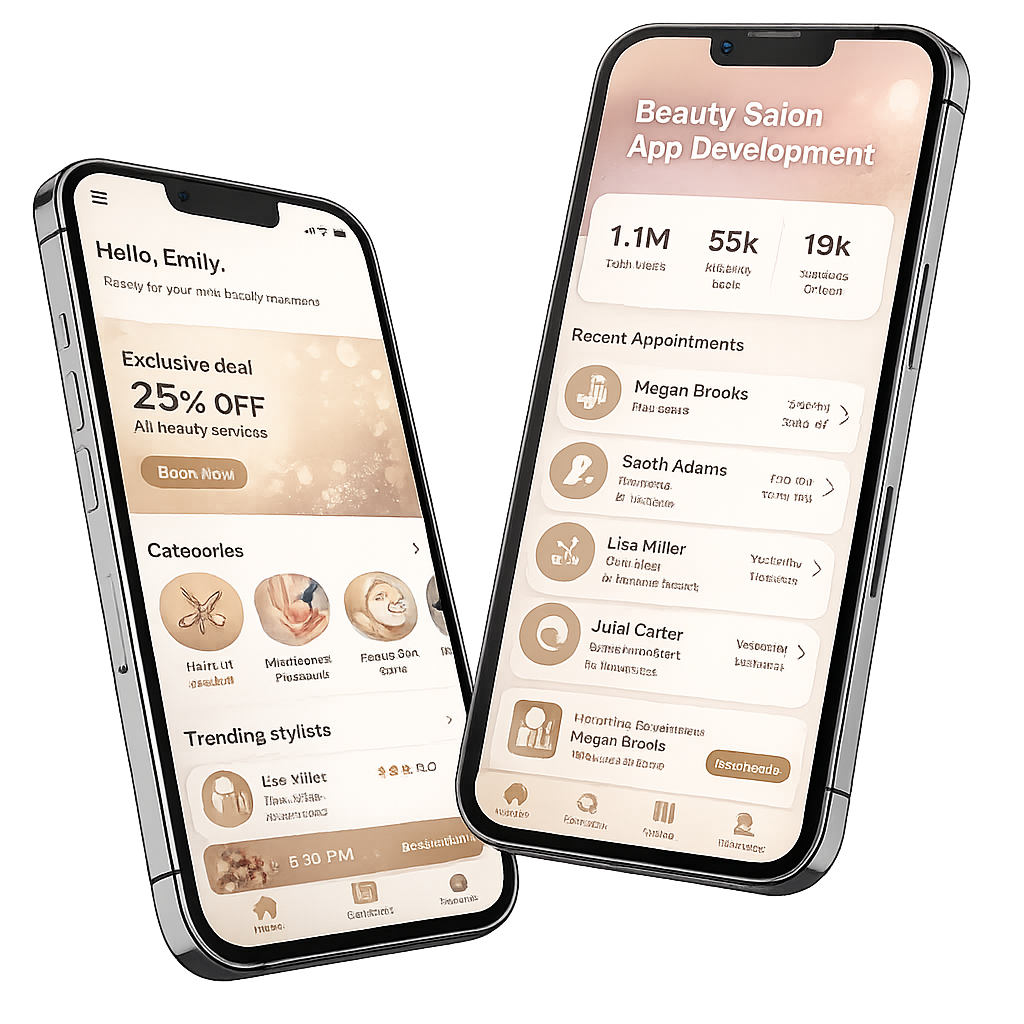
Beauty Saloon App
The Business Case for a Dedicated Salon Booking App
Manual or phone-based booking creates costs that compound as a salon grows: no-shows go unmanaged without an enforced policy, double-bookings happen when staff calendars aren’t synced in real time, and staff time goes into scheduling calls instead of billable service time. A booking system that can’t show real-time stylist availability across locations also loses after-hours bookings outright, since a client who wants to book at 9pm won’t wait until morning if a competitor’s app lets them book immediately.
Relying entirely on a generic third-party booking marketplace carries a related but different cost: you don’t own the customer relationship, your brand competes for visibility inside someone else’s app, and margins erode over time to marketplace commissions in a way that becomes more expensive as your booking volume grows. A handful of signals indicate a salon business has outgrown spreadsheets, generic scheduling tools, or a booking marketplace: multiple locations needing centralized visibility, high enough booking volume that manual scheduling has real error costs, a need for brand differentiation beyond a marketplace listing, and a strategic reason to own client data directly. A single independent stylist rarely meets that bar for them, an established booking SaaS platform is almost always the more efficient choice, and custom software becomes worth considering only once scale or differentiation needs genuinely justify it.
Build vs. Buy: Custom App, Booking SaaS, or Hybrid
|
Approach
|
Upfront Cost
|
Time to Market
|
Control & Differentiation
|
Long-Term Ownership
|
|---|---|---|---|---|
|
Booking SaaS (e.g. established platforms like Vagaro or Fresha)
|
Lowest
|
Fastest
|
Limited to the platform’s branding and feature set
|
Ongoing per-seat/subscription fees that scale with staff and locations
|
|
Custom Development
|
Highest
|
Longest
|
Full control over branding, features, and customer experience
|
No recurring platform fees, but you own ongoing maintenance cost
|
|
Hybrid (SaaS core, custom layer)
|
Moderate
|
Moderate
|
Selective control over the customer-facing experience
|
Moderate — SaaS fees continue for the underlying platform
|
The right approach depends on your scale, how much brand control and feature ownership you need, and how much recurring per-seat cost you’re willing to accept long-term, since custom development and established booking SaaS platforms trade these off very differently. Booking SaaS platforms make sense for a single salon or small chain where per-seat fees stay manageable and the platform’s existing feature set covers your operational needs the speed and lower upfront cost are a legitimate trade for accepting someone else’s branding and feature roadmap. Custom development earns its cost once per-seat SaaS fees across multiple locations and growing staff counts start approaching or exceeding what custom software costs to build and maintain, or once you need multi-location management, franchise-specific features, or a home-service operational model that established platforms don’t handle well. A hybrid approach keeping a SaaS platform for core scheduling while building a custom customer-facing app or franchise dashboard is worth considering when brand differentiation matters most at the customer touchpoint without rebuilding scheduling infrastructure from scratch. If you’re not yet sure which path fits, a prototype of the custom experience can validate the case before committing to a full build.
Who Actually Needs a Dedicated Salon App

A dedicated app makes sense for businesses with real operational complexity or a genuine differentiation need, not for every salon looking to modernize booking.
- Multi-location salon chains needing centralized staff and appointment visibility across locations, which most booking SaaS platforms handle poorly beyond a handful of locations.
- Franchise operators needing standardized booking and reporting across independently run locations while preserving some local flexibility.
- Independent freelance beauty professionals with an established client base wanting a branded booking experience rather than a generic marketplace listing though for many at this stage, an existing SaaS platform remains more efficient.
- On-demand home-service beauty businesses where staff travel to clients, requiring real-time location and availability logic that standard salon booking platforms aren’t built for the underlying dispatch and matching problem is similar to what we cover on our on-demand app development page, and specifically comparable to laundry and car wash on-demand service models.
- Spa and wellness businesses with service bundling, package pricing, and membership models complex enough to outgrow generic scheduling tools
Solution Readiness Assessment: Is Your Salon Business Ready to Build?
Multi-location or high booking volume.
You operate multiple locations, or booking volume is high enough that manual scheduling errors carry real cost.
You can articulate specifically why owning the booking experience and client data matters beyond what a SaaS platform provides.
A clear differentiation or ownership case exists.
Your current or projected staff count makes ongoing subscription fees comparable to or higher than custom software’s maintenance cost.
Per-seat SaaS costs are becoming a real constraint.
You have integration requirements a generic platform doesn’t support.
POS, inventory, or CRM integrations you need aren’t well supported by existing booking SaaS platforms.
Staff are ready to adopt new digital workflows.
Your team can realistically transition from manual or SaaS-based scheduling to a new system without major operational disruption.
Types of Beauty Salon Apps We Develop
Beauty Salon Appointment Booking Apps
Perfect for salons looking to digitize bookings, payments, and client management.
On-Demand Beauty Service Apps (Home Services)
Allow users to book beauticians at home with real-time availability & location tracking.
Multi-Outlet Salon Apps
Manage multiple salon branches from a centralized system with location-wise analytics.
Spa & Wellness Center Apps
Built for spas offering massages, wellness treatments, therapies & premium services.
Freelance Makeup Artist & Beauty Expert Apps
Personalized apps for independent beauty professionals to manage bookings & portfolios.
Beauty Subscription/ Membership Apps
Offer unlimited monthly packages, prepaid plans, and discounted beauty bundles.
Core Salon App Features
- Simple Registration & Login (Email, Mobile, Social Login)
- Browse Services, Pricing, & Offers
- Real-Time Stylist & Beautician Availability
- Slot Booking, Rescheduling & Cancellations
- Cashless Payments (UPI, Wallets, Cards)
- Track Appointment Status in Real-Time
- Service Reviews & Ratings
- Personalized Recommendations (AI-driven)
- Service History & Invoices
- In-App Chat Support
- Saved Stylists, Services & Locations
- Appointment Alerts & Job Assignment
- Manage Availability & Time Slots
- Start/End Service Timer
- View Daily/Weekly Schedule
- Upload Before/After Images
- In-App Earnings Tracking
- Tips & Commission Dashboard
- Customer Feedback & Ratings
- Customer & Staff Management
- Real-Time Booking Calendar
- Service & Pricing Management
- Promotional Offers & Discounts
- Inventory & Product Management
- Automated Billing & GST Support
- Branch-Wise Business Performance
- Marketing Tools: Push Notifications / Coupons
- Advanced Analytics Dashboard
- Payroll & Commission Management
Contact Us
Ready to Build Your Beauty Saloon Platform ?
Book a project scoping call and bring your location count, staff size, and current booking setup we’ll tell you honestly what it takes to build and launch it.
Advanced & Trendy Features We Offer
AI-Based Recommendation
Beauty Packages & Combo Offers
AI Skin Analysis
Digital Consultation
Virtual Try-On for Hairstyles & Makeup (AR Integration)
Smart Mirror/IoT Integration
QR Code Check-In for Walk-In Clients
Multi-Language & Multi-Currency Support
Live Chat & Video Consultation
Security & Compliance
End-to-End Data Encryption
Secure Authentication & OTP
Payment Security (PCI DSS )
GDPR-Compliant User Data Handling
Role-Based Access & Permissions
Regular Security Audits & Updates
Our Salon App Development Process
Requirements and multi-location/franchise planning.
We define how scheduling, reporting, and branding need to work across locations or franchise units before any technical design begins.
Staff/calendar architecture design.
Real-time multi-staff calendar sync gets architected explicitly, including how walk-ins, cancellations, and double-booking prevention are handled.

Payment and POS integration.
Payment processing and any existing POS or inventory system integrations get scoped and built against your actual operational tools, not assumed to connect automatically.
Core platform build
Customer app, staff app, and admin panel are developed against the calendar and integration architecture established earlier.

Testing and Phased location rollout
The platform gets tested against real scheduling edge cases — overlapping bookings, last-minute cancellations, multi-service appointments not just a standard functional pass. For multi-location businesses, launch at one location first to validate scheduling accuracy and staff adoption before rolling out organization-wide, with ongoing maintenance and support scoped from launch rather than treated as an afterthought.
Tech Stack for Salon and Spa Apps
- Flutter
- React Native
- Swift
- Kotlin
- Node
- Laravel (PHP)
- Python / Django
- Java / Spring
- MongoDB
- PostgreSQL
- Firebase
- Stripe, PayPal, Razorpay, Braintree
- Bank APIs
- AWS / Google Cloud / Azure
- Cloud-based backups

Data Migration and Client History Onboarding
Migrating existing client and appointment history from spreadsheets or a prior booking system means transferring not just contact details but service history, preferences, and where relevant staff notes, and this rarely maps cleanly from a spreadsheet or legacy system without real data cleanup. Inconsistent or incomplete client records carry directly into the new platform if not audited first, which affects both personalization quality and staff ability to serve returning clients well from day one. Change management for staff adopting a new digital system matters as much as the technical migration itself staff used to a paper book or basic spreadsheet need training and a transition period where the old and new systems may run in parallel briefly, rather than a single hard cutover that risks lost bookings during the switch. Planning this transition deliberately, especially across multiple locations, is one of the more commonly underestimated parts of a salon platform launch.
Cost and Timeline Planning
Cost and timeline depend heavily on path and scale a single-salon custom build, a multi-location platform, and a booking SaaS deployment represent meaningfully different scopes. A single-salon custom app typically takes around 10 to 14 weeks for core booking, staff, and admin functionality, while a multi-location platform with centralized reporting and franchise-level features takes meaningfully longer given the added architecture for cross-location visibility and permissions. Booking SaaS deployment is the fastest path by far, since core scheduling functionality already exists and the work centers on configuration and staff onboarding rather than development.

Questions to Ask Before Starting Your Project
Why Choose SoftCurators as your Saloon App Development Partner ?
Common Mistakes We See in Salon App Projects
|
Mistake
|
Why It Hurts
|
What To Do Instead
|
|---|---|---|
|
Underestimating multi-staff calendar complexity
|
Double-bookings and sync errors under real usage damage client trust quickly, especially across multiple locations
|
Architect real-time calendar sync explicitly, including walk-ins and cancellations, before development starts
|
|
Skipping no-show and cancellation policy design
|
Without enforced policy logic, no-shows continue at the same rate a paper booking system had, undermining the platform’s core value
|
Build configurable no-show and cancellation policies into the platform from the start
|
|
Ignoring at-home service liability planning
|
Unverified staff or unclear liability coverage creates real legal and trust exposure for home-service models
|
Build staff verification and credential tracking into the platform, resolved alongside legal counsel
|
|
Choosing custom development without a clear cost case
|
Custom software costs more to build and maintain than SaaS, and without per-seat costs genuinely justifying it, that cost is hard to recover
|
Confirm SaaS costs at your actual scale before committing to custom development
|
|
Migrating client data without a cleanup pass
|
Inconsistent records carry directly into the new platform, affecting personalization and service quality from day one
|
Audit and clean client and appointment data before migration
|
|
Treating staff app adoption as automatic
|
Staff resistance to a new digital system slows adoption regardless of how well the customer-facing app performs
|
Plan staff training and a transition period, especially across multiple locations
|
Lets Connect
Ready to Build a High Performing Beauty Saloon App?
Frequently Asked Questions
Established booking SaaS platforms are generally the better choice for a single salon or small chain where per-seat fees stay manageable and existing features cover your needs. Custom development becomes worth it once per-seat costs across multiple locations and staff start approaching what custom software costs to build and maintain, or once you need multi-location, franchise, or home-service features SaaS platforms don’t handle well.
Cost depends primarily on whether you’re building for a single salon, a multi-location chain, or an on-demand home-service model, since each represents meaningfully different scheduling and architecture complexity.
A single-salon custom app typically takes around 10 to 14 weeks for core functionality, while a multi-location platform with centralized reporting takes meaningfully longer given the added cross-location architecture. Booking SaaS deployment is much faster since it’s configuration rather than development.
Beautician certification and licensing requirements vary significantly by jurisdiction and service type, and verifying staff credentials before they can accept home-service bookings is a genuine platform and legal requirement.
An MVP needs real-time booking against staff availability, basic payment processing, and core admin scheduling oversight — for home-service models, this also includes basic staff verification workflows from day one. Membership tiers, advanced reporting, and multi-location features are reasonable to defer to later phases.
Double-booking prevention depends on real-time calendar sync architecture that locks a time slot the moment a booking is confirmed, rather than checking availability only at the start of the booking process. This needs explicit handling for edge cases like simultaneous booking attempts and walk-ins added alongside scheduled appointments.
Yes, though it’s rarely a clean import — client and appointment records from spreadsheets or a prior system typically need a data-quality audit before migration, since inconsistent records carry directly into the new platform. Planning this as a dedicated step, not an afterthought, avoids carrying data problems into your new system.
This is fundamentally a business and legal decision — whether staff carry their own coverage, the platform business carries coverage, or both — that we support with clear documentation and verification workflows built into the platform rather than resolving on the technical side alone. Working through this with legal counsel alongside the technical build is worth doing before launch, not after.
Usually not — for a single stylist, an established booking SaaS platform is almost always more efficient than custom software, since per-seat costs stay low and the existing feature set typically covers what one person needs. Custom development becomes worth considering only once an established client base and a genuine differentiation or ownership need justify the added cost.
We integrate with established payment processors like Stripe, PayPal, Razorpay, and Braintree, chosen based on your region and any existing business relationships with a specific processor. Integration is scoped to your actual payment needs rather than assumed to work identically across every region and processor — the same payment-integration approach we use across other on-demand and booking-based solutions like laundry app development.
Yes, POS and inventory integration is scoped as a specific part of the project based on which systems you’re already running, since compatibility and integration complexity vary meaningfully by provider. We recommend identifying these integration requirements during initial planning rather than after development has started.
Yes, ongoing support and maintenance covers monitoring booking and payment system reliability, applying security and platform updates, and adjusting scheduling logic as your business grows or adds locations. This is scoped as a distinct, ongoing engagement rather than a one-time deliverable.
Our Latest Blogs
Somewhere along the way, adding a chatbot got treated like adding a newsletter signup form , a small checkbox item...
If you use Salesforce, or you’re evaluating whether to, you’ve probably noticed the product names keep changing. Sales Cloud is...
“Why ‘How Much Does AI Cost’ Is the Wrong First Question ?” Founders ask this question expecting a single number,...
Ask ten AI vendors which tool your business needs and you’ll get ten different answers, each conveniently pointing at their...