
Music Streaming App Development Company
Music streaming app development is the design and engineering of a dedicated platform for distributing and monetizing audio content music, podcasts, or spoken-word programming that an artist, label, broadcaster, or content brand owns and controls, rather than relying entirely on third-party platforms. The real decision most founders face isn’t “how do we build a streaming app,” it’s whether owning the platform is worth the licensing complexity, infrastructure cost, and audio-specific technical work it requires instead of continuing to distribute through existing services. This page works through that decision directly when owning a platform genuinely makes sense, when it doesn’t, and what building one actually involves rather than assuming custom development is automatically right. If you’ve already decided to build, our mobile app development page covers the underlying engineering process in more general depth, and our UI/UX design page covers how we approach the listener and creator experience research specifically.

Why Invest in Music Streaming App Development?
Always-Available Audio Content
Seamless Use Across Devices
Predictable Revenue Through Subscriptions
Reach Beyond Local Markets
Direct Earnings for Artists and Labels
Listening habits have changed. People no longer wait to download or own music they expect it to be available instantly, on any device, at any time. This shift has opened new opportunities for businesses, creators, and platforms to reach users directly. A dedicated music streaming app gives you control over distribution, audience engagement, and revenue, while removing the limits of traditional delivery models.
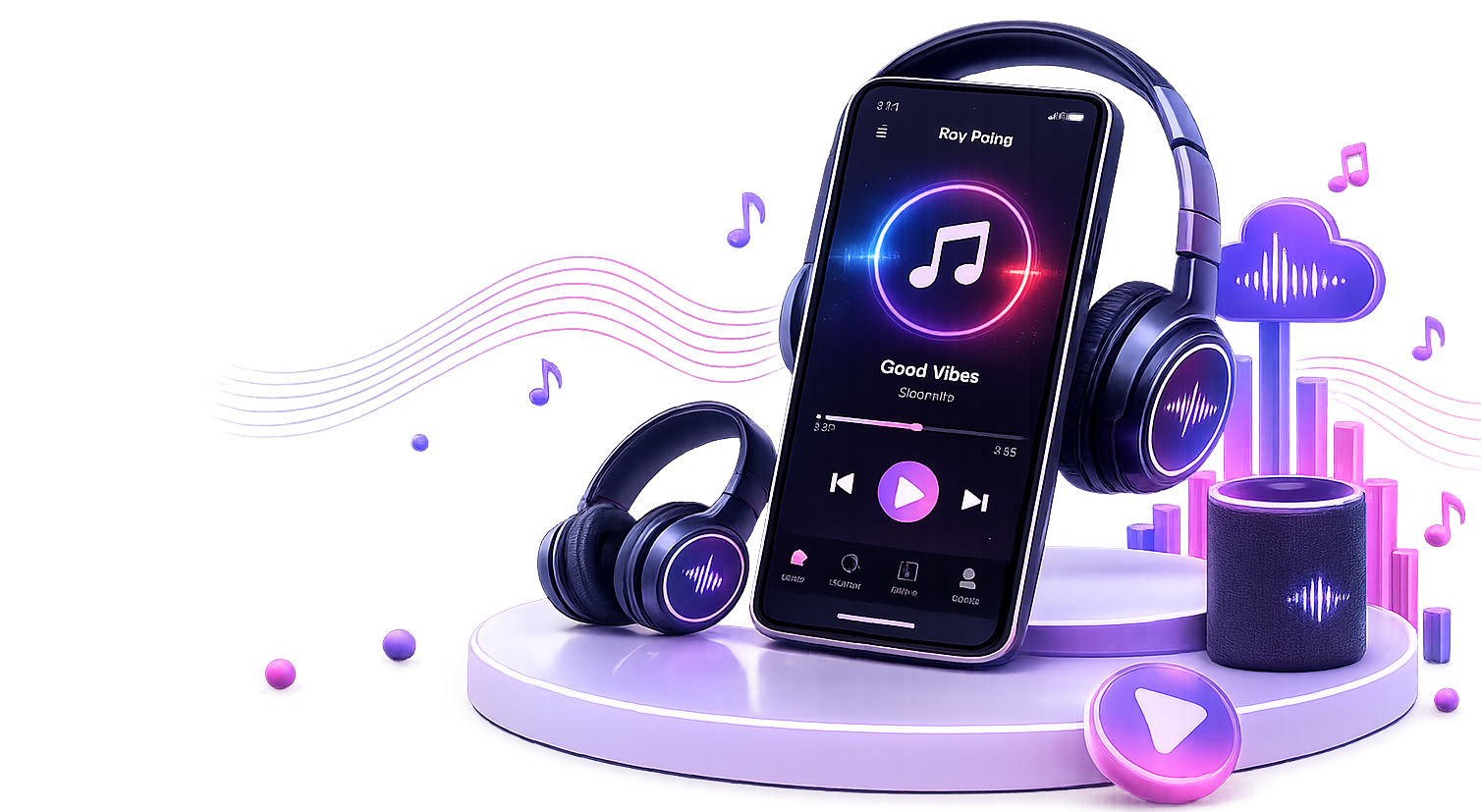
Music Streaming App
The Business Case for Owning Your Streaming Platform
- Relying entirely on third-party streaming platforms means giving up direct access to your own listener data, accepting whatever revenue share the platform sets, and staying dependent on algorithmic discovery you don’t control — limitations that become more costly as your audience grows. A label or artist distributing only through existing platforms never learns who’s actually listening beyond aggregated, delayed reporting, which limits marketing and pricing decisions a first-party listener relationship would otherwise inform directly.
- The operational cost compounds over time: you can’t run direct promotions to your actual listener base, can’t set your own pricing, and your visibility depends on an algorithm you don’t control that can change without notice. The risk of delaying a platform investment is that competitors serving the same niche audience can capture the direct relationship first, and “just distribute everywhere” becomes harder to walk back once listeners are used to your content living exclusively elsewhere.
- That said, this only matters once there’s a real audience worth owning infrastructure for. Signals a business has genuinely outgrown third-party-only distribution: an established catalog or subscriber base, a clear need to monetize directly, a strategic reason to own listener data, and a differentiation goal a generic third-party listing can’t achieve. A solo artist with a few hundred monthly listeners almost never meets that bar yet existing platforms remain the more efficient choice until the audience and monetization case are real.
Build vs. Buy: Custom Platform, White-Label Solution or Hybrid
|
Approach
|
Cost
|
Time to Market
|
Control & Differentiation
|
Long-Term Ownership
|
|---|---|---|---|---|
|
Custom Development
|
Highest upfront
|
Longest
|
Full control over features, branding, and monetization
|
You own the platform and its economics outright
|
|
White-Label/SaaS Streaming Platform
|
Lower upfront, ongoing subscription cost
|
Fastest
|
Limited to the provider’s feature set and branding flexibility
|
Ongoing dependency on the provider, including their pricing and roadmap
|
|
Hybrid (white-label core, custom layer)
|
Moderate
|
Moderate
|
Selective control over the experience that matters most to your brand
|
Partial ownership, with dependency on the underlying provider remaining
|
The right approach depends on how much differentiation and long-term ownership you need against how much cost and time-to-market you can absorb, since custom development, white-label SaaS, and hybrid trade these off very differently. White-label solutions make sense when you need to launch quickly, don’t yet have proof a fully custom experience will pay for itself, or don’t need deep differentiation beyond branding the subscription cost and feature constraints are a reasonable trade for speed and lower risk. Custom development earns its cost once your catalog or audience is large enough that platform-specific monetization genuinely differentiates your business, and once a white-label subscription’s ongoing cost at your scale would exceed what custom infrastructure costs to build and run. A hybrid approach a white-label or open-source core with a custom listener-facing layer is worth considering when you need brand differentiation at the user experience layer without rebuilding the entire streaming and licensing infrastructure. If you’re not yet certain which path fits, a prototype of the custom listener experience can validate the case before you commit to a full build.
Music Licensing 101: What You Need Before You Launch
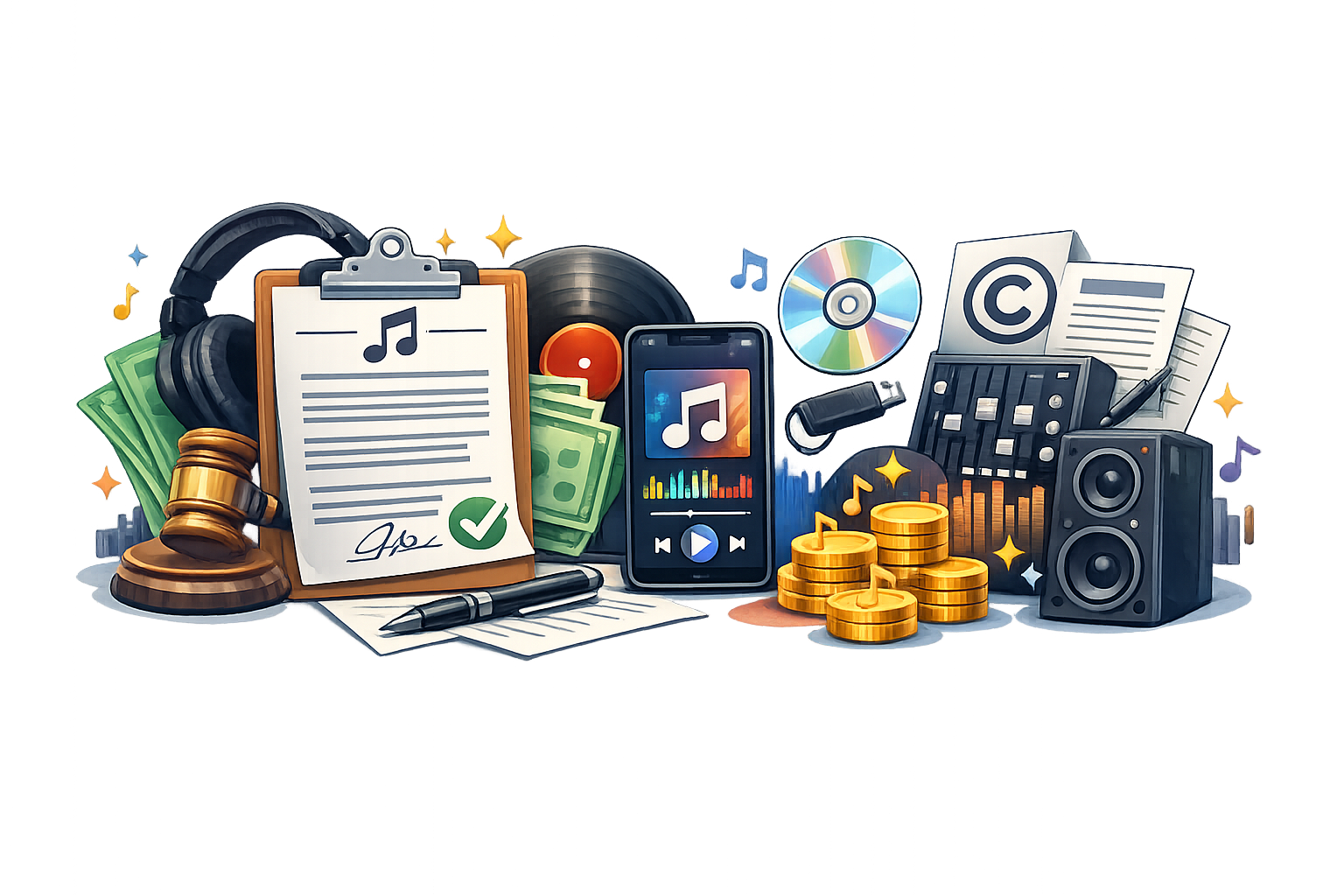
Music licensing determines whether you have the legal right to stream the content on your platform, and getting this wrong exposes a streaming business to real legal and financial risk, so it needs resolving before development, not after. Requirements depend on what you’re streaming original content you fully own requires no third-party licensing, while streaming other artists’ recorded music typically requires both a mechanical/reproduction license and a performance license, often through performing rights organizations such as ASCAP or BMI in the U.S., or equivalent bodies elsewhere. Royalty structures and licensing costs vary significantly by content type, region, and business model, and this is genuinely not an area where generic guidance substitutes for a music licensing specialist or entertainment attorney. Licensing clearance timelines are often the slowest part of a launch, frequently longer than development itself, so starting licensing conversations in parallel with technical planning not after development is underway is one of the most consistently underestimated steps in this category.
How Adaptive Streaming and Audio Delivery Actually Work
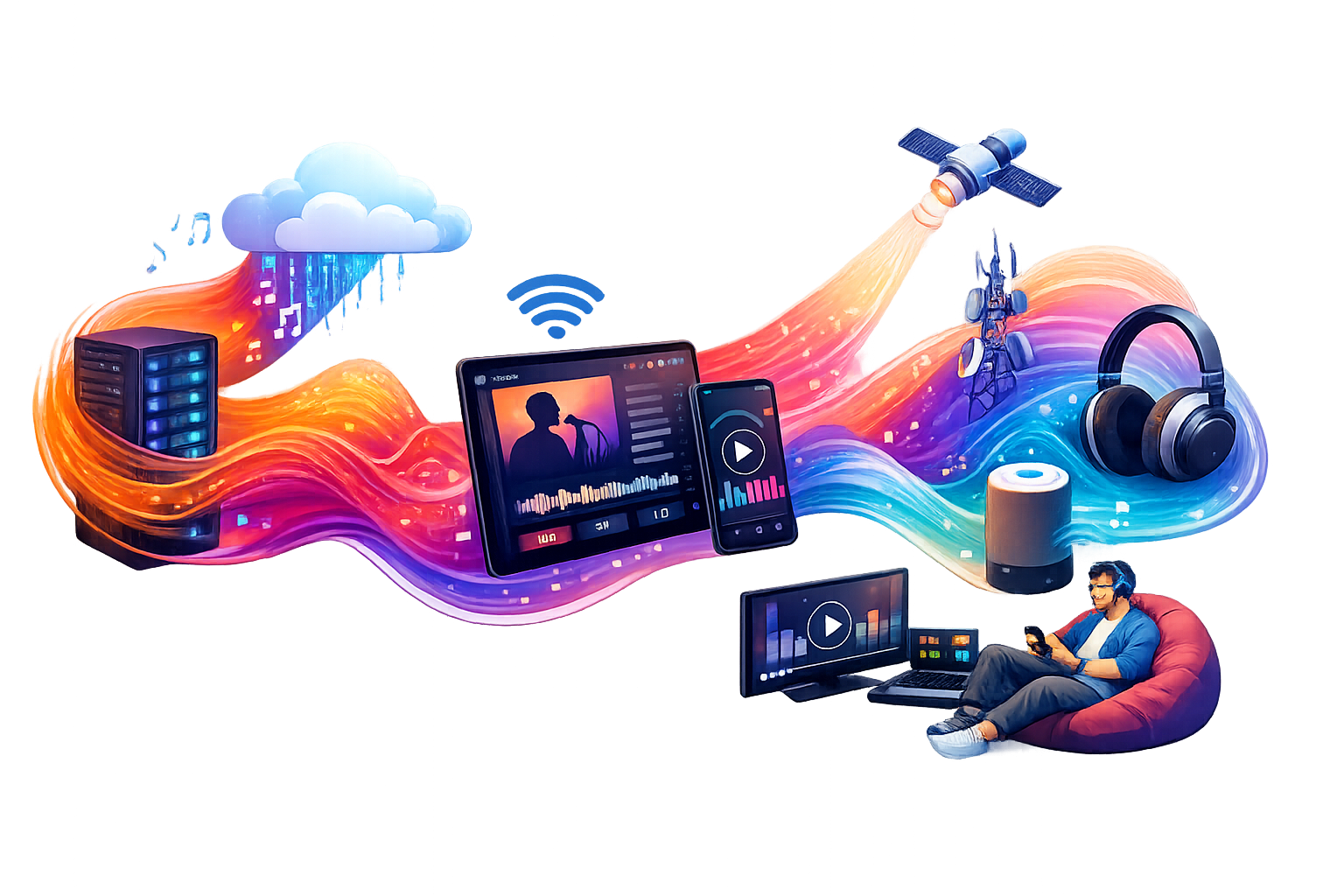
Adaptive bitrate streaming means the platform automatically adjusts audio quality in real time based on a listener’s available bandwidth, so playback continues smoothly on a poor connection instead of buffering or failing. This works by encoding audio at multiple bitrates in advance and having the player switch between them dynamically as network conditions change, standard practice for any platform expecting listeners on variable mobile connections. Content delivery relies on a CDN to serve audio from servers geographically close to each listener, which matters for both latency and infrastructure cost CDN costs scale with usage in a way that’s easy to underestimate and worth modeling against realistic listener-growth projections rather than launch-day traffic alone. DRM and encrypted streaming protect licensed content from unauthorized redistribution, typically a licensing requirement rather than optional once you’re streaming licensed third-party content. Offline playback sync adds real complexity around encrypted local storage and periodic license revalidation, worth scoping deliberately rather than assuming it’s a simple “download button” feature.
Types of Music Streaming Apps We Develop
On-Demand Music Streaming Apps
You can offer users to search for what they want, and start listening instantly. We focus on fast loading, clean navigation, and a seamless listening experience so users do not feel any friction.
Live Radio Streaming Apps
Radio streaming solutions recreate the traditional listening experience in a digital format. We provide world-class apps that work well for live stations, curated channels, and scheduled shows.
Podcast & Audio Streaming Apps
Not every listener wants only music. We create a music streaming app for audio, combining podcasts, shows, and talk content in one place. Users can choose a variety without switching platforms.
Live Audio Streaming Apps
Live music apps bring audiences closer to artists. From concerts to exclusive sessions, we provide live music platforms focused on real-time listening and interaction that create a sense of presence and excitement.
Music Discovery Apps
Discovery apps help users find music they did not know they would love. Our experts design a music discovery app around exploration, mood-based listening, and smart suggestions for better user retention.
DJ & Remix Sharing Apps
Niche platforms for DJs to stream or upload remixes, mashups, and live sets
Music Learning Apps
Our music streaming app development services provider offers music learning apps designed for practice and skill development. With structured lessons and interactive tools, these solutions help users stay motivated and improve consistently.
Artist-Focused Music Apps
These apps are built for artists who want a direct connection with their fans. They create space for exclusive content, updates, and deeper engagement without relying on third-party platforms.
Multi-Vendor Music Marketplace
Enable independent artists, music labels & creators to upload, sell & distribute music.
Karaoke Music Streaming App
Apps with karaoke versions, real-time pitch detection, and scoring for singing enthusiasts.
Meditation & Wellness Audio Streaming App
Apps with calming music, nature sounds, binaural beats & guided meditations.
AI-Generated Music App
We provide AI-generated music solutions for platforms looking to go beyond traditional streaming. These solutions focus on smart music creation, personalization, and adaptive listening experiences.
Voice-Controlled Music Streaming App
As the best music streaming app development company, we develop a voice-controlled music streaming app that enables hands-free listening through simple voice commands. This makes music access faster and more intuitive across devices.
Children’s Music Streaming App
Kid-safe music and rhymes with parental controls and curated playlists.
Event-Based Music Streaming App
Apps for live concerts, music festivals & virtual performances with ticketing.
Social Music Apps
Music becomes more powerful when it is shared. Social music apps allow users to collaborate, share playlists, and interact around what they are listening to. This turns music into a community experience.
Ad-Supported Music Streaming Apps
Free music apps work best when ads do not interrupt the experience. We build ad-supported platforms where monetization feels balanced and keeps users engaged while still generating steady revenue.
Subscription-Based Music Apps
Subscription music solutions are built for long-term revenue. Users pay monthly or yearly to unlock premium access. As a top music streaming app development company, we aim to make upgrading feel simple, valuable, and worth the price, with a focus on retention.
Turn Your Music Streaming Concept into a Smart, Future-ready Platform
Work with our expert team to shape a next-generation music streaming solution customized to your goals.
Core Platform Features: Listener App, Artist/Creator Tools and Admin Panel
- Easy Onboarding (Email, Social, Mobile OTP)
- Personalized Homefeed
- Search by Song, Artist, Genre, Language
- Lyrics Display (Synced & Static)
- AI-Based Playlists (Daily Mix, Recently Played, Discover Weekly)
- Follow Artists, Albums & Friends
- Create & Share Playlists
- Offline Downloads
- Sleep Timer
- Cross-Platform Sync (Mobile, Web, Desktop, TV)
- High-Quality Audio (128kbps – 320kbps)
- Dark & Light Theme Modes
- Social Media Sharing
- Upload Music, Albums & Podcasts
- Manage Metadata (Genre, Mood, Tags)
- Royalty Tracking Dashboard
- Listener Demographics & Analytics
- Revenue Stats (Streams, Downloads, Engagement)
- Promotional Tools (Push notifications, Banners)
- Advanced Music CMS
- User & Artist Management
- Playlist Management
- Usage Analytics (MAU/DAU, Streams, Retention)
- Monetization Controls
- Advertisement Management
- Subscription Plans Setup
- Royalty Distribution System
- Multi-Language & Multi-Region Support
- In-App Banner & Promotional Tools
Advanced Features That Drive Engagement and Set Your Music App Apart
AI & ML-Powered Features
• AI-Generated Playlists
• Mood Detection Music
• Voice Search (Alexa/Google Assistant)
• Predictive User Recommendations
• Audio Fingerprinting & Song Recognition (Like Shazam)
Contextual Music Intelligence
● Time-Based Playlists
● Location-Aware Suggestions
● Activity Recognition
● Weather-Based Mood Mixes
● Dynamic Queue Updates
● Context History Tracking
Immersive Visual Playback
● Animated Track Visuals
● Full-Screen Player Mode
● Theme-Based UI Sync
● Dynamic Album Motion
● Playback Visual Effects
● Visual Refresh Cycles
Smart Content Management
● Smart Download Rules
● Storage Optimization
● Auto Cache Clearing
● Network-Aware Downloads
● Offline Sync Controls
● Download Priority Settings
Cutting-Edge Streaming Technology
• Adaptive Bitrate Streaming
• DRM-Protected Content
• Lossless Audio (Hi-Fi / FLAC Support)
Social & Community Features
• In-App Chat & Group Listening Rooms
• Live Concert Streaming
• User Profiles with Activity Feed
• Collaborative Playlists
Artist Monetization Tools
• Subscription Marketplace
• Direct Fan Support / Tipping
• Pay-Per-Listen Features
• In-App Merchandise Store
Advanced Engagement Insights
● Listening Pattern Analysis
● Skip & Replay Tracking
● Completion Rate Metrics
● Session Duration Reports
● Engagement Scoring
● Behavior Trend Insights
Smart Listening Experiences
• Live Group Sessions
• Real-Time Sync
• Session Host Controls (AWS, GCP, Azure)
• Join via Link
• Background Listening
• Multi-Device Playback
Who Actually Needs a Dedicated Music Streaming Platform
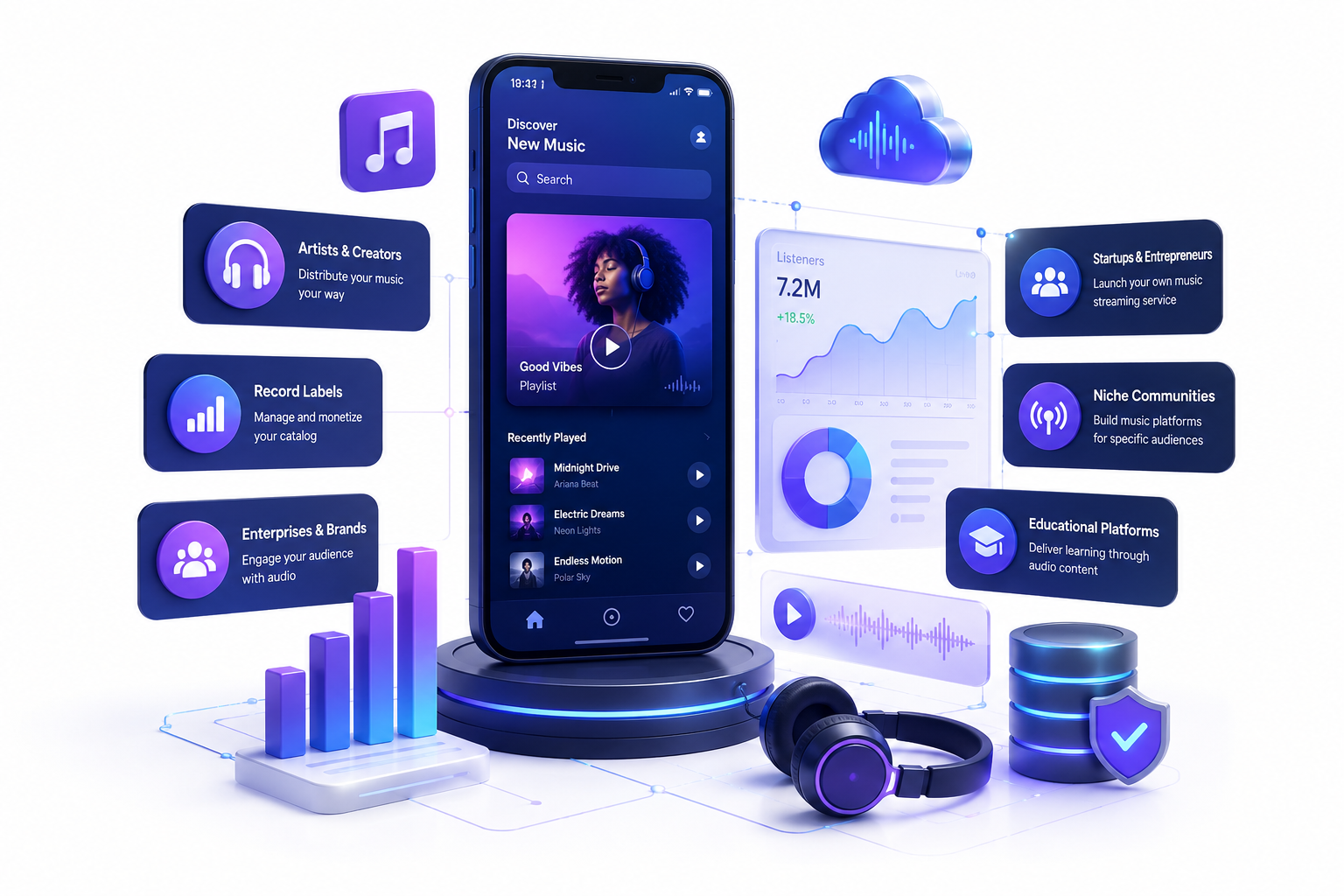
A dedicated platform makes sense for a specific set of businesses with an established audience and a real reason to own the relationship directly, not for anyone simply looking to distribute audio content.
- Independent labels and artist collectives with an established catalog and fanbase looking to capture more direct revenue and listener data than third-party royalty splits provide.
- Podcast networks wanting to move beyond third-party podcast apps to control monetization, exclusive content gating, and listener analytics directly.
- Radio broadcasters extending a live or on-demand audio product beyond broadcast, where owning the digital experience supports retention and new monetization the live-delivery infrastructure question here parallels what we cover on our on-demand app development
- Fitness, meditation, and wellness audio brands building branded audio experiences tightly integrated with their broader product rather than distributed generically, often alongside a progressive web app for lightweight, installable access.
- Karaoke and community audio platforms where the interactive or community layer is the differentiator, not just content distribution.
Solution Readiness Assessment: Is Your Business Ready to Build?
Audience or catalog is established, not speculative.
You have a real, current audience, not a future one you’re hoping to grow into after launch.
A clear direct-monetization case exists.
You can articulate specifically how owning the platform improves monetization beyond third-party distribution.
Licensing conversations have started, or your content is fully owned
You’ve begun discussions with rights holders, or your catalog needs no third-party licensing.
You have or can access rights-management capability.
Someone can manage ongoing licensing compliance and royalty reporting, not just initial clearance.
You have a realistic infrastructure budget beyond initial development.
DN, storage, and licensing costs scale with usage as an ongoing cost, not a one-time expense.
What Most Music Streaming Founders Overlook
What Most Founders Overlook: the specific gaps that most commonly turn a music streaming launch into a difficult one.
Underestimating licensing clearance timelines.
Licensing negotiations often take longer than development, and starting them after development begins is one of the most common causes of launch delays.
Treating catalog metadata quality as a later-phase concern.
Poor metadata causes real discovery, royalty-reporting, and licensing-compliance problems expensive to clean up after launch.
Underestimating CDN cost scaling.
Infrastructure cost reasonable at launch can grow faster than expected as listener hours accumulate.
Assuming a “download and go” approach to offline playback.
Offline listening involves real licensing and DRM considerations, not just a technical toggle.
Monetization Strategies
Freemium model with premium upgrades
Audio & video ads with programmatic ad integration
In-app purchases and subscriptions
Sponsored playlists and artist features
Merchandise, ticketing, and live show integrations
Affiliate links or brand partnerships
Compliance-Driven Music App Development You Can Trust
At Soft Curators, we create a high-performing music streaming app that meets industry standards from day one. With compliance and security built in, your solution is ready to scale confidently and earn lasting user trust.
DRM (Digital Rights Management)
Encrypted Audio Streams
Secure Login & MFA
GDPR & DMCA Compliance
Copyright Protection System
Role-Based Admin Access
Our Music Streaming App Development Tech Stack
SoftCurators builds high-performance music streaming apps with the right tech and the right expertise. Here’s the core tech stack behind our solutions.
Flutter, React Native, Swift, Kotlin
Node.js, Django, Spring
HLS/DASH adaptive streaming, AWS CloudFront, Cloudflare, Akamai
PostgreSQL, MongoDB, Elasticsearch
- SoundCharts
- Spotify API
- AcrCloud
- NeuMeta
- Payment Gateways
- KYC APIs
AWS, GCP, Azure
Licensing/rights-management systems, audio fingerprinting (e.g. ACRCloud)
Contact Us
Ready to Build Your Music Streaming Platform ?
Book a project scoping call and bring your catalog size, licensing status, and target audience we’ll tell you honestly what it takes to build and launch it.
SoftCurators Brings Advanced Technology to Your Music Streaming App
As the best music streaming app development company, SoftCurators creates a modern, reliable music app designed for growth. We combine practical design with advanced technology to create experiences that users enjoy, and businesses can scale.
Artificial Intelligence
Cloud Computing
Advanced Search Engine
Content Pre-processing & Transcoding
Multi-Language Support
Multi-Currency Support
Big Data Analytics
Machine Learning
Screen Sharing
Introducing Our Solution
Take a closer look at how our mobile app development solution works and what makes it different. Built with modern technology and clear thinking, it’s designed to solve real problems and support what’s coming next.
Our Music Streaming App Development Process
Licensing and rights strategy.
Requirements and rights-management approach are defined and clearance conversations started early, typically the slowest-moving dependency in the project.
Catalog ingestion architecture
The system for ingesting and managing catalog metadata is designed around your actual content structure and rights complexity, not a generic template.
Streaming infrastructure and CDN selection.
Adaptive bitrate encoding, CDN provider, and DRM approach are selected based on expected listener geography and licensing requirements.
Core platform build
Listener app, artist/creator tools, and admin panel are developed against the catalog and licensing architecture established earlier.
Load testing for streaming and concurrency & Phased rollout
The platform is tested against realistic concurrent-listener scenarios, since streaming performance under real load differs from functional testing. Launch with an initial catalog segment where feasible, validating streaming performance and royalty-reporting accuracy before a full-catalog rollout.

Data Migration and Catalog Onboarding
Migrating an existing catalog and listener base to a new platform means transferring not just audio files but metadata, rights records, and where possible listener account data, rarely a simple bulk file transfer. Catalog metadata quality directly affects discovery and royalty-reporting accuracy on the new platform, so a metadata audit and cleanup pass before migration is worth the time, since migrating inconsistent metadata just relocates the same problems to the new system. Listener account migration depends heavily on what data your current distribution setup gives you access to most third-party platforms provide limited or no listener-level data export, itself one of the ownership limitations discussed earlier, so planning for a gradual audience transition is usually more realistic than expecting a clean one-time migration. Change management for a label or broadcaster moving an existing audience benefits from a transition period where content remains available in both places, giving listeners time to adopt the new platform before retiring the old channel.
Cost and Timeline Planning
Cost and timeline differ substantially by path a white-label deployment, a custom single-catalog platform, and a custom multi-label aggregator platform represent meaningfully different scopes. A white-label or hybrid approach is fastest and least expensive, since core streaming infrastructure and licensing-compliance tooling already exist within the provider’s platform.A fully custom platform costs more and takes longer, since catalog management, streaming infrastructure, licensing/royalty logic, and DRM all need building rather than configuring, with a multi-label aggregator platform the largest scope given added rights and royalty-split complexity.

Questions to Ask Before Starting Your Project
Why Choose SoftCurators as Your Music Streaming App Development Company?
We work on music streaming products with a clear focus on real business needs. As a music streaming app development company, we partner with clients who come in with an idea, a broad concept, or a particular challenge around the platform. Our role is to help shape and build future-ready music streaming app development solutions that fit those needs.
Post-launch, ongoing maintenance and support keeps scoring, streaming performance, and licensing-compliance systems running as your catalog and audience grow, and our digital marketing services team can support listener acquisition separately once the platform itself is stable.
Common Mistakes We See in Music Streaming Platform Launches
|
Mistake
|
Why It Hurts
|
What To Do Instead
|
|---|---|---|
|
Starting development before licensing conversations begin
|
Licensing often takes longer than development, leaving a launch-ready platform with no cleared content
|
Start licensing conversations in parallel with technical planning, not after
|
|
Migrating catalog metadata without a cleanup pass
|
Inconsistent metadata causes discovery and royalty-reporting problems that carry over to the new system
|
Audit and clean catalog metadata before migration
|
|
Underestimating CDN cost scaling
|
Infrastructure costs reasonable at launch can grow faster than expected as listener hours accumulate
|
Model CDN cost against realistic growth projections, not launch-day traffic
|
|
Choosing custom development without a monetization case
|
Custom infrastructure costs more to build and maintain than white-label, hard to justify without a clear reason
|
Confirm a specific monetization case before committing to custom development
|
|
Treating the artist/creator side as lower priority
|
Labels evaluate a platform partly through their own tools, and weak creator tools can hurt catalog acquisition
|
Design artist/creator tools with the same attention as the listener app
|
|
Underbuilding royalty reporting and payout transparency
|
Unclear royalty reporting damages trust with the artists and labels supplying your catalog
|
Scope transparent royalty reporting as a core admin-panel requirement
|
Frequently Asked Questions
A white-label solution is generally better if you need to launch quickly or don’t need deep differentiation beyond branding. Custom development is worth the added cost once your catalog or audience is large enough that platform-specific monetization genuinely justifies it, and once a white-label subscription’s ongoing cost would exceed custom build-and-run costs.
If you’re streaming content you don’t fully own, you typically need both a mechanical/reproduction license and a performance license, often through performing rights organizations like ASCAP or BMI or regional equivalents. Requirements and royalty structures vary significantly by content type and region, so confirming your exact obligations with a music licensing specialist is essential before development begins.
Cost depends primarily on whether you’re pursuing a white-label deployment, a custom single-catalog platform, or a custom multi-label aggregator platform, since each represents meaningfully different licensing and technical complexity
An MVP needs catalog browsing and playback, adaptive-bitrate streaming, basic subscription handling, and core royalty-reporting infrastructure if distributing licensed content. Offline playback and multi-label royalty-split logic are reasonable to defer to later phases.
Adaptive bitrate streaming automatically adjusts audio quality in real time based on a listener’s available bandwidth, encoding content at multiple bitrates in advance so the player can switch dynamically as conditions change. This keeps playback smooth on variable connections instead of buffering.
If you’re streaming licensed third-party content, DRM and encrypted streaming are typically a licensing requirement rather than optional, since rights holders generally require protection against unauthorized redistribution. Platforms streaming only fully owned content have more flexibility here.
A white-label or hybrid deployment moves fastest since core infrastructure already exists, while a fully custom platform takes meaningfully longer given the catalog, licensing, and DRM systems that need building. Licensing clearance timelines often extend the project independently of development speed, since they frequently take longer than the build itself.
Yes, though it’s rarely a simple bulk transfer — catalog metadata typically needs a quality audit before migration, and listener account migration depends on what your current distribution setup gives you access to. Most third-party platforms provide limited listener-level data export, so a gradual audience transition is usually more realistic than a one-time migration.
Subscription models generate recurring revenue and require the most robust royalty-tracking infrastructure, ad-supported models monetize free access through advertising, and pay-per-download models sell ownership of individual tracks, technically simpler for licensing in some jurisdictions. The right model depends on audience willingness to pay directly and the licensing terms available for your catalog.
Usually not yet — a dedicated platform makes sense once you have an established audience and a clear reason to own the listener relationship directly, and existing platforms remain the more efficient choice before that point. It’s worth revisiting once your audience and monetization case are real; our guide for startups building their first product covers how to think about that timing more broadly.
Royalty logic gets built into the admin panel as core infrastructure, configured around your rights and revenue-split structure, with reporting transparency built in for accurate, timely payout information. Multi-label platforms require handling royalty splits across contributors, meaningfully more complex than single-catalog tracking.
Yes, ongoing support and maintenance covers monitoring streaming performance and CDN cost scaling, maintaining licensing-compliance systems as rights records change, and platform updates as content and audience grow. This is scoped as a distinct, ongoing engagement, since a content-critical platform needs continuous technical and compliance monitoring.
Lets Connect
Ready to Build the Next Big Music Streaming App?
Our Latest Blogs
Somewhere along the way, adding a chatbot got treated like adding a newsletter signup form , a small checkbox item...
If you use Salesforce, or you’re evaluating whether to, you’ve probably noticed the product names keep changing. Sales Cloud is...
“Why ‘How Much Does AI Cost’ Is the Wrong First Question ?” Founders ask this question expecting a single number,...
Ask ten AI vendors which tool your business needs and you’ll get ten different answers, each conveniently pointing at their...