
Turn your dating app idea into a product people open every day
Dating App Development Company
A dating app has one job a shopping cart or a fitness tracker never has to do: convince two strangers it’s safe enough to talk to each other. That trust is fragile one wave of fake profiles, one slow response to a harassment report, one match that turns out to be a bot running a crypto scam, and users leave for good. Building matching logic that surfaces good matches is the easy half of the brief. The harder half verification, moderation, abuse reporting, monetization that doesn’t feel predatory is what separates a dating app that survives its first year from one that doesn’t. As a dating app development company, SoftCurators builds the trust-and-safety layer alongside the matching engine from week one, not as a patch after the first bad headline.

Dating
Why Dating App Development Looks Different
Broad swipe-first apps are losing ground to platforms built around a specific audience or activity. Match Group’s flagship products have reported slowing growth while activity-based and niche community apps are expanding faster, especially among younger daters who are tired of sorting through low-effort matches on general-purpose platforms. For a founder scoping a new dating app development project, that shift changes the brief: the winning move increasingly isn’t “build a bigger Tinder,” it’s picking a specific community faith-based, LGBTQ+, professional, pet owners, fitness and building the matching and moderation experience around what that group actually needs.
Trust has also become a harder engineering problem, not just a policy statement. A recent industry survey found 58% of users worry about AI-generated fake profiles, pushing platforms toward layered verification photo checks, liveness detection, and in some cases ID confirmation instead of a simple email sign-up. Regulators and app stores are catching up too: Google Play now requires apps that facilitate dating to use its “Restrict Declared Minors” setting and publish child-abuse prevention standards under its Child Safety Standards policy. Several US states have also passed App Store Accountability Acts requiring age verification and parental-consent signals to be built into the app itself, not just the app store listing.
On top of verification, discovery is shifting away from static photo grids. Video-first profiles, voice intros, and live or activity-based discovery are becoming standard requests from clients who’ve watched static swiping produce match fatigue and ghosting. Any dating app development company scoping a 2027 launch has to plan for camera and media performance, not just a chat feature, from the architecture stage.
Types of Dating App Solutions We Offer
Which Dating App Model Fits Your Business – Choose based on two things: how differentiated your target audience is from what an app like Bumble or an app like Grindr already serves, and how much moderation capacity human or automated you can realistically fund at launch. A niche community app with 5,000 engaged users and active moderation outperforms a broad swipe app with 5,000 users and no moderation, because trust, not volume, is what keeps daters coming back.
Swipe-Based Dating Apps
Algorithm-Based Matchmaking Apps
Location-Based Dating Apps
Video Dating Apps
Niche Dating Apps
Community-Based Dating Apps
Celebrity Dating Applications
Dating Apps for Women
Smart Matchmaking Apps
Hookup Apps
Speed Dating Apps
Anonymous Dating Apps
Elite or Premium Dating Apps
LGBTQ+ Dating Apps
Matrimonial Dating Apps
Senior and Divorced Dating Apps
Metaverse & Virtual Dating Apps
Modern & AI-Powered Dating Apps
Essential Features of a Dating Application
- Advanced Profile Customization
- Preference-Based Discovery Filters
- Smart Match Recommendations
- Profile Visibility Controls
- Real-Time Chat & Media Sharing
- Voice & Video Interaction
- Icebreaker & Prompt Suggestions
- Safety Tools like Block, Report, and Unmatch
- Match History & Interaction Timeline
- Subscription & In-App Purchases
- Privacy & Account Controls
- Connection Insights & Activity Status
- Profile Verification Review
- Photo & Media Authenticity Checks
- User Report Management
- Chat & Behavior Monitoring
- Spam & Fake Profile Detection
- Warning & Penalty Actions
- Temporary or Permanent Ban Controls
- Shadow Restriction Management
- Safety Rule Enforcement Logs
- Escalation to Admin Workflow
- Abuse Pattern Detection
- Trust Score Adjustment Tools
- User & Account Management
- Operator Role & Permission Control
- Match Algorithm Configuration
- App Content & Policy Management
- Subscription & Revenue Dashboard
- Feature Enable or Disable Controls
- Engagement & Retention Analytics
- System Performance Monitoring
- Notification & Campaign Management
- App Settings & Global Rules
- Data Export & Compliance Tools
- Platform Security & Audit Logs
Core Capabilities Every Dating App Needs |
Matching and recommendation engine
scores compatibility using stated preferences, behavioral signals, and (for niche apps) community-specific criteria, built with the same AI development discipline we apply across other product lines, not just proximity and age range.
Profile verification
photo verification and liveness checks as a baseline, with optional ID verification for platforms serving higher-risk categories like matchmaking or in-person meetups.
In-app chat with safety controls
message-request limits, keyword-based abuse flagging, and the ability to block or report without leaving the conversation.
Geolocation-based discovery
distance filtering and location-aware suggestions, built with battery and privacy trade-offs considered upfront.
Reporting and blocking tools
a reporting flow simple enough that users actually use it, feeding directly into a moderation queue rather than a support email inbox.
Fake-profile and bot detection
device fingerprinting, image-reuse detection, and behavioral pattern analysis to catch scripted accounts before they reach real users.
Content moderation pipeline
automated screening for images and text, backed by human review for anything flagged or appealed.
Subscription and monetization layer
boosts, super-likes, and premium tiers structured so paying doesn’t feel like the only way to be seen.
Push notifications
tuned for re-engagementtimed around actual behavior (a new match, an unread message) rather than generic daily reminders that train users to ignore them.
Tech Stack for Dating Apps
As a prominent dating app development company, we help you turn your dating app idea into a reliable, market-ready product by choosing the right technologies from the start. Our dedicated development team focuses on performance, scalability, and smooth integrations so your app can handle real users, real traffic, and real growth.
- Flutter
- JavaScript / TypeScript
- React Native
- HTML5 / CSS3
- Kotlin (for Android)
- Swift (for iOS)
- Node
- Python (Django, Flask)
- Java Script
- Java (Spring Boot)
- PHP (Laravel)
- Ruby on Rails
- MongoDB
- PostgreSQL
- Redis
- Firebase Realtime Database
- MySQL
- Firebase Authentication & Social Login APIs
- RESTful APIs
- Twilio (SMS/chat/video calling)
- GraphQL
- Stripe & PayPal (payment integration)
- Docker
- Google Cloud
- Kubernetes
- AWS
- Jenkins
- Microsoft Azure
- TensorFlow
- Scikit-learn
- GPT
- OpenCV
- NLP tools
Secure, Compliance-Ready Dating App Development You Can Rely On
At SoftCurators, we design AI-powered dating apps that are built to perform in real-world conditions. From privacy safeguards to platform policies, we handle it early so your app can launch smoothly, grow without friction, and gain user confidence from the very beginning.
GDPR, CCPA, and local data laws compliant
Two-Factor Authentication (2FA)
End-to-End Chat Encryption
Photo & Identity Verification
Real-Time Moderation & Reporting Tools
Secure Payment Gateways & SSL Encryption
Contact Us
Ready to Build a Dating App People Actually Trust?
Talk to SoftCurators about scoping your matching model, verification flow, and moderation tooling before a single screen gets designed , reach out directly to start the conversation.
Monetization Strategies For Dating Apps
Freemium Model: Basic access free, with paid upgrades
Premium Subscriptions: Monthly/annual plans for exclusive features
In-App Ads: Banner, native, or video ads
Chat Unlocks or Profile Views
Event Ticketing Live Dating Rooms
Merchandise or Gift Stores
AI & ML Use Cases in Dating Apps

Smart Matchmaking Algorithms
Profile Scoring & Compatibility Index

Real-Time Moderation

Image Recognition & Verification
Conversation Insights
Our Build Process for Dating Apps
Before any screens are designed, we decide what “a good match” actually means for this specific audience — shared interests, verified compatibility signals, geographic proximity, or a curated human review step.
Signup, photo verification, and any age-assurance requirements get mapped together, since app store rules now tie these together directly rather than treating verification as an optional add-on.
The reporting flow, moderation dashboard, and fake-profile detection are built alongside the swipe or discovery interface — not scheduled for a “phase two” that tends to arrive after the first trust incident.
We map which features stay free (enough to keep the pool active) versus paid (enough to fund moderation and growth), testing pricing against retention rather than defaulting to a generic freemium template.
Chat infrastructure, geolocation services, and the matching engine get built and load-tested for concurrent usage, since dating apps see sharp usage spikes at predictable times of day.
Rather than a global release, we launch in a single geography or community first, watch match quality and gender/user ratio, and tune the algorithm before wider rollout — a cold-start dating app with no local density fails no matter how good the code is.
Post-launch, matching weights, notification timing, and moderation thresholds all get recalibrated against actual behavior, not launch-day assumptions — teams without in-house data science bandwidth often lean on AI consulting services for this stage rather than guessing.
Common Mistakes We See in Dating App Builds
|
Mistake
|
Why It Hurts
|
What To Do Instead
|
|---|---|---|
|
Launching without a moderation pipeline
|
Reports pile up with no workflow to act on them, and trust erodes within weeks
|
|
|
Ignoring fake-profile detection until scale exposes it
|
Bot and scam accounts accumulate quietly, then surface all at once in user complaints or press coverage
|
|
|
Monetizing too aggressively before proving match quality
|
Users churn before they ever see the product’s value, so paywalls just accelerate the drop-off
|
Prove match quality and retention first, then layer in premium tiers
|
|
Skipping a soft-launch in a defined community
|
A global release with no local user density produces a cold-start experience with almost no matches
|
Launch in one city or community, tune the algorithm, then expand
|
|
Treating age and identity verification as a checkbox
|
New state laws and app store policies expect enforced, ongoing compliance, not a one-time signup field
|
Build verification as an integrated flow tied to app store age-signal APIs
|
Feel the difference
Industries and Use Cases Where Dating App Development Drives Results
Mainstream dating
broad-audience swipe or discovery apps competing on scale and algorithm quality.
Niche and community dating
Niche and community dating
cultural, faith-based, LGBTQ+ dating platforms (see what already works well among the best LGBTQ+ dating apps), professional networking-adjacent dating, and interest-based communities like pet owners or fitness enthusiasts, where shared context reduces mismatch rates.
Video-first and live discovery apps
platforms built around real-time video or voice interaction instead of static profile browsing, appealing to daters fatigued by traditional swiping.
Risk Mitigation, QA and Launch Strategy
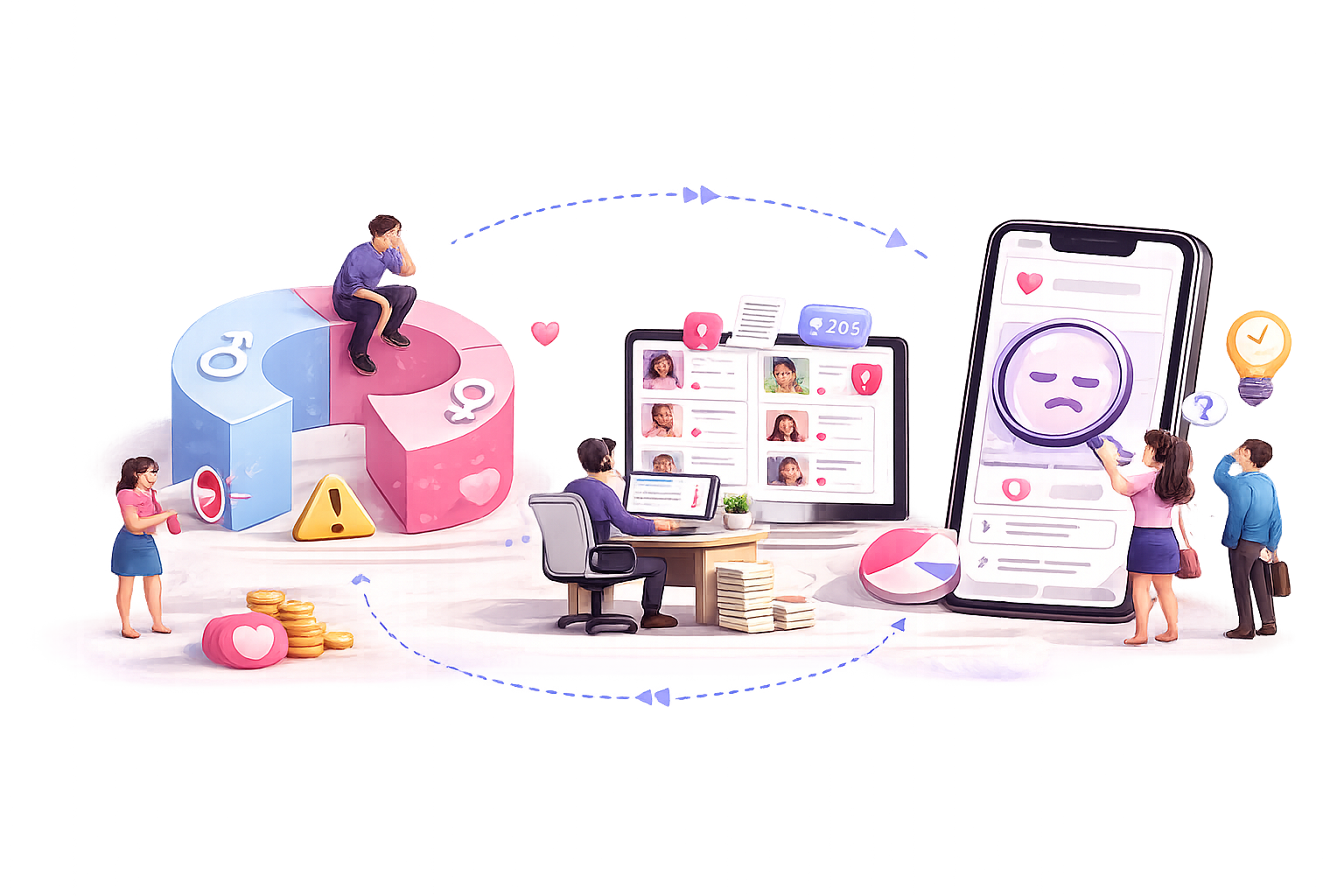
Three failure modes show up almost every time a dating app launches without planning for them. Uneven gender or user ratios in a new market can make the app feel dead even with a reasonable total user count this needs deliberate marketing and onboarding sequencing, not just a bigger ad budget. Moderation queues backing up faster than expected happens when report volume is underestimated relative to user growth; test your moderation team’s throughput against a realistic report-rate projection before launch, not after the backlog builds. And the matching algorithm’s cold-start problem too few users in a new market for the algorithm to produce good matches is why a phased, single-city or single-community launch consistently outperforms a broad release for a new dating app development project.

Deployment, Maintenance and Performance
Real-time chat means message delivery latency has to stay low even as concurrent users spike during predictable high-traffic windows evening hours dominate usage for most dating apps, and infrastructure needs to be provisioned for that pattern specifically. Media storage and CDN costs grow steadily as photo and video volume increases, and this is often underestimated relative to compute costs. And because dater behavior shifts constantly, the matching algorithm needs continuous retraining a model that performed well at 10,000 users can misfire at 100,000 without ongoing tuning against fresh engagement data. This is the kind of work we cover under mobile app testing, deployment, and maintenance, typically through an ongoing maintenance and support services arrangement rather than a one-time handoff.
Why Choose SoftCurators as your Dating App Development Company
As a trusted dating app development company, SoftCurators works with both startups and established businesses to build modern dating platforms. Our expert developers focus on creating secure, engaging, and scalable solutions that align with your goals. With strong attention to user experience and innovation, we help transform your concept into a dating app that competes confidently in the market.
Lets Connect
Ready to Build your Own Dating App ?
Frequently Asked Questions
Through a combination of device fingerprinting, reverse image search to catch reused photos, behavioral pattern analysis that flags scripted or bot-like activity, and liveness checks during verification that a static photo can’t fake.
A soft-launch-ready MVP core matching, verification, chat, and basic moderation tooling takes meaningfully less time than a full-scale platform, since MVP development intentionally defers features like advanced monetization tiers or ML-based matching until real usage data justifies them.
Not universally, but it’s becoming close to expected. Several US states now require app stores to pass age-category signals to developers, and Google Play requires dating apps specifically to restrict declared minors from access — which pushes most platforms toward layered verification even where full ID checks aren’t mandated.
Yes, and this is increasingly the stronger strategy — niche and community-based platforms are the fastest-growing segment of the category, since shared context between users reduces mismatch and increases retention compared to broad, undifferentiated platforms.
Automated screening catches the bulk of clear violations in images and text at upload time, while anything ambiguous or flagged by users routes into a human review queue with escalation rules — the goal is catching most problems before a human ever needs to look.
Google Play requires apps that facilitate dating to use its “Restrict Declared Minors” setting and to publish child-abuse prevention standards under its Child Safety Standards policy, while several state laws now require age-verification signals to be built into onboarding rather than left to self-declaration.
Most platforms combine a free tier generous enough to prove value with paid boosts, super-likes, or premium subscriptions — the design challenge is making sure free users still get a fair shot at matches, so paying feels like an enhancement, not a requirement to be seen at all.
It depends on positioning. Fully automated matching works well for volume-driven, broad-audience apps; a human or AI-assisted curation layer works better for premium, relationship-focused positioning where users are paying specifically for higher-quality vetting.
Swipe-based apps are largely built around static profile data and a scoring algorithm; video-first apps require real-time media infrastructure, more demanding moderation (video is harder to screen than text or photos), and generally higher app performance expectations for camera and streaming features.
By load-testing moderation throughput against a realistic report-rate projection before launch, and building tiered escalation so low-risk flags get automated resolution while only genuinely ambiguous cases require human review time.
Two things dominate: retraining the matching algorithm as usage data accumulates, since a model tuned at launch drifts as behavior shifts, and keeping verification and moderation logic current as app store and state-law requirements around age assurance continue to change.
Yes — this is a common path for brands with an existing engaged community, though it requires the same verification and moderation infrastructure as a standalone app; treating it as a lightweight bolt-on to a broader social media app development product usually underestimates the safety tooling required.
Distance-based discovery typically uses fuzzed or approximate location data rather than precise coordinates, giving users proximity-based matches without exposing their exact location to other users.
Our Latest Blogs

Somewhere along the way, adding a chatbot got treated like adding a newsletter signup form , a small checkbox item...

If you use Salesforce, or you’re evaluating whether to, you’ve probably noticed the product names keep changing. Sales Cloud is...
“Why ‘How Much Does AI Cost’ Is the Wrong First Question ?” Founders ask this question expecting a single number,...
Ask ten AI vendors which tool your business needs and you’ll get ten different answers, each conveniently pointing at their...