
AI in music streaming platforms now goes far beyond song recommendations. It powers personalized discovery, generative music tools, conversational search, royalty and fraud analytics, and adaptive audio quality. For most companies, the practical path isn’t building every AI capability from scratch it’s combining licensed AI infrastructure (recommendation engines, generative APIs, content moderation) with a small set of custom features that create real product differentiation. The right mix depends on your data maturity, budget, and how central AI is to your competitive positioning.
Introduction
If you’re evaluating AI in music streaming platforms for a product you’re building or rebuilding, you’ve probably noticed the term gets used to describe a dozen different things a recommendation feed, a chatbot that finds songs by mood, a tool that writes backing tracks, or a system that flags royalty fraud. They’re all real, and they’re not interchangeable. Treating “add AI” as a single line item on a roadmap is one of the fastest ways to burn budget on the wrong capability.
This guide is written for the person who actually has to make that call a founder scoping an MVP, a CTO deciding what to build in-house versus license, or a product manager trying to justify an AI feature to a board. We’ll walk through how the major categories of AI actually work under the hood, what they cost to build or buy, where teams commonly go wrong, and how to decide which capabilities are worth pursuing for your specific stage and audience. For readers weighing this against the platform’s other feature areas, our essential features of a music streaming app guide and our list of best music streaming apps are useful companion reading for benchmarking against what’s already live in the market.
We won’t pretend every music streaming company needs a custom recommendation engine or a proprietary generative model. Most don’t. What most need is a clear-eyed view of which AI capabilities move a business metric retention, session length, licensing cost, catalog growth and which are expensive theater.
Consultant’s Tip: Before your team writes a single spec, define which business metric the AI feature is supposed to move. “Better recommendations” isn’t a metric. “Increase 30-day retention by reducing skip rate” is. Every section below ties back to a metric like this.
What “AI in Music Streaming” Actually Means Today
AI in music streaming platforms refers to machine learning systems that personalize content discovery, generate or assist in creating audio, detect fraud and rights violations, and enable natural-language search and voice interaction within a listening app. It is not one technology but a set of distinct systems, each with its own data requirements, vendors, and risk profile.
Five distinct categories cover most of what’s currently in production across major and independent platforms:
- Recommendation and personalization AI – the engines behind “Discover Weekly”-style playlists and home-screen ordering.
- Generative AI – models that compose, arrange, or fully produce music and audio, used both by platforms and by independent creators uploading to them.
- Rights, royalty, and fraud AI – systems that detect streaming fraud, attribute plays for royalty calculation, and identify unlicensed or infringing content.
- Conversational and voice AI – natural-language search (“play something for a rainy Sunday morning”) and voice assistant integration.
- Audio processing AI – mastering, loudness normalization, adaptive bitrate decisions, and increasingly, source separation (isolating vocals or instruments).
Who needs this, and who doesn’t: A platform with a large existing catalog and real engagement data (thousands of active users generating listening signals) gets meaningful value from recommendation AI almost immediately. A brand-new platform with a small catalog and no listening history won’t there’s no data to learn from yet, and a simpler rules-based or curated approach will outperform a machine learning model that has nothing to train on. This is one of the more common misjudgments founders make: assuming AI personalization is a day-one feature rather than something that becomes valuable once you have data volume.
Business Insight: The AI category that matters most in year one is rarely the one that gets the most attention in press coverage. Recommendation engines get the headlines; royalty and fraud detection AI is often what actually protects margin, especially on platforms that pay out to independent artists.
For a broader view of what a modern platform needs beyond AI specifically, our music streaming app development guide covers the full feature and architecture picture.
How AI Recommendation Engines Really Work
Music recommendation AI predicts what a listener wants to hear next by analyzing listening history, audio characteristics, and behavior from similar users, typically combining several modeling approaches rather than relying on one. Understanding the mechanics matters because it directly affects what data you need to collect from day one.
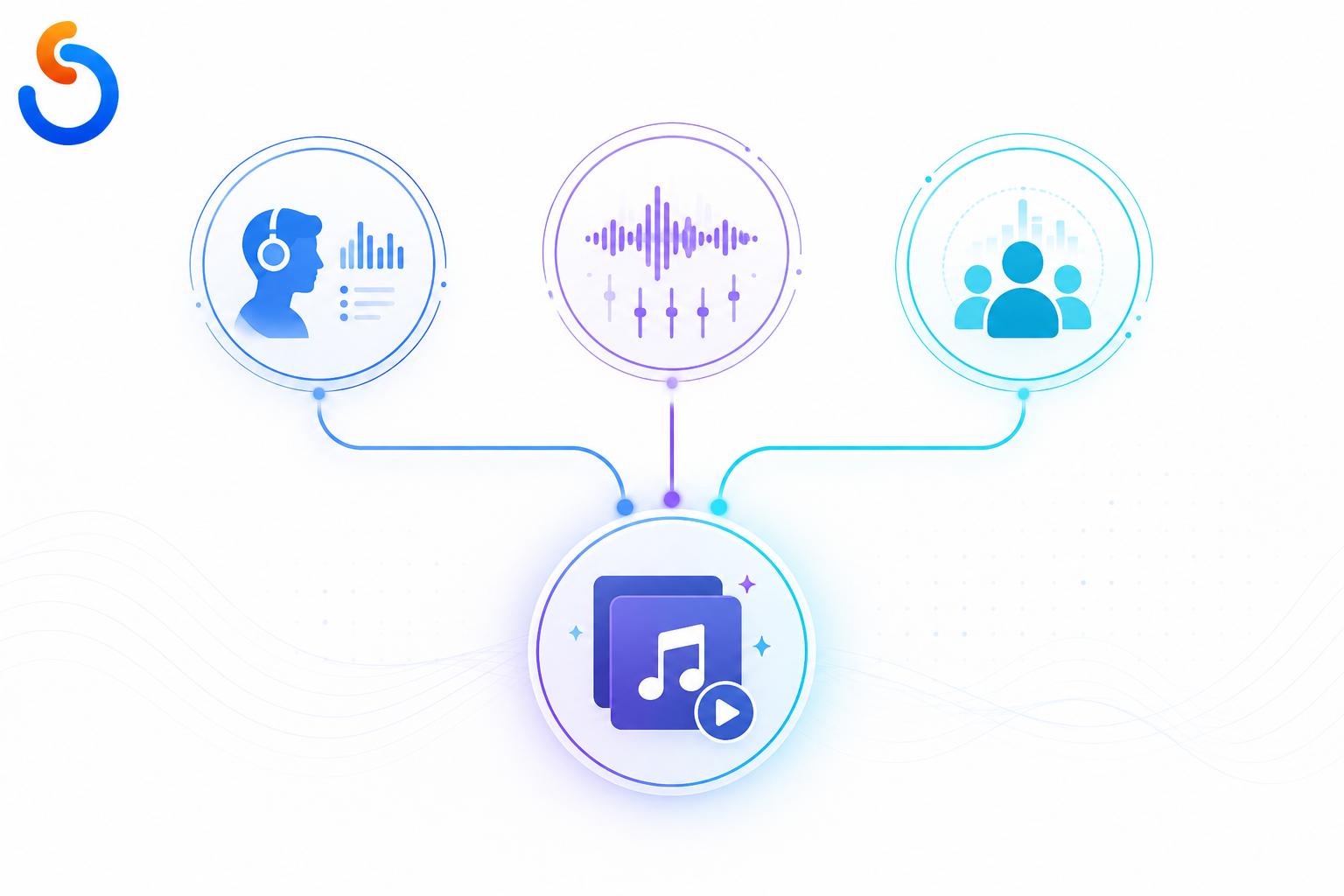
There are three modeling approaches in common use, usually blended:
- Collaborative filtering – recommends based on patterns across users (“listeners who played X also played Y”). It needs a large user base and dense interaction data to work well; it’s close to useless with a small, new user base because there isn’t enough overlapping behavior to find patterns in.
- Content-based filtering – analyzes the audio itself (tempo, key, timbre, genre tags, lyrical themes) and recommends songs with similar characteristics. This works from day one because it doesn’t depend on other users’ behavior, which is why most new platforms lean on it early.
- Context-aware and sequence models – increasingly, deep learning models (often transformer-based, the same architecture family behind large language models) predict the next track in a session rather than just similar tracks, accounting for time of day, device, and recent skip behavior.
Technical Note: “Skip” data is one of the highest-value and most underused signals in music recommendation. A completed listen and a 10-second skip carry very different weight, but many early-stage platforms log only play counts, not skip timing – which quietly limits recommendation quality later even after the modeling is upgraded. Instrument your event tracking for skip position and replay behavior before you need it, not after.
Business Perspective: Recommendation quality is directly tied to retention. Platforms that get this right see it in session length and 30-day return rate rather than in any single vanity metric. It rarely shows up as a single dramatic jump – it shows up as a slow, compounding improvement over months as the model has more data to work with.
Operational Perspective: A recommendation system is not “build once, done.” It needs ongoing monitoring for feedback loops a known failure mode where the model over-recommends already-popular tracks because they generate more engagement data, which then reinforces the model’s confidence in them, gradually narrowing catalog diversity. Someone on the team needs to own catalog diversity as an explicit metric, not just engagement.
Future Perspective: Session-based sequence models are edging out pure collaborative filtering because they adapt faster to a specific listening session rather than a user’s long-term average taste, which better matches how people actually use music apps. This is a genuine trend, not settled practice teams should evaluate it against their own data volume rather than assume it’s automatically better.
Common Mistake: Building a custom recommendation model before the platform has enough listening data to train it meaningfully. A content-based or curated-editorial approach, paired with a licensed recommendation API, is usually the right starting point; a fully custom model becomes worth the investment once there’s a real, sizeable interaction dataset.
Generative AI and the Rise of AI-Created Music
Generative AI in music streaming refers to models capable of composing original audio – full tracks, backing instrumentals or stems from text prompts or musical inputs, and it now affects streaming platforms in two separate ways: as a creator-facing tool and as a source of catalog content that platforms must decide how to handle. These are genuinely different product and policy decisions, and conflating them is a common early mistake.
As a creator tool: Platforms like Suno and Udio popularized text-to-music generation, letting anyone produce a finished track from a prompt. Some streaming platforms now offer generation tools directly (for playlist backing tracks, podcast intros, or fully original creator content); others simply have to decide whether AI-generated tracks are permitted for upload at all. If you’re specifically exploring this kind of feature, we’ve covered the practical build path in how to develop an AI music generation app like Suno AI, and a landscape view in Suno AI alternatives.
As a catalog and policy question: A platform doesn’t need to build generative AI to be affected by it. Every platform accepting third-party or independent-artist uploads needs a stated policy on AI-generated content disclosure requirements, royalty eligibility, and detection of undisclosed AI tracks are now genuinely operational concerns, not hypothetical ones.
Decision Checklist before adding any generative feature:
- Do you have the licensing clarity to offer generation at all? (Training data provenance for third-party generative APIs varies significantly and is under active legal dispute in multiple jurisdictions.)
- Is generation a creator tool (for people making content) or a listener tool (for people consuming it)? These require different UX and different risk review.
- Who owns the output – the platform, the prompt-writer, or is it disputed? This should be answered in your terms of service before launch, not after a dispute.
- Do you have a moderation plan for AI-generated content that infringes on an existing artist’s style, voice, or likeness?
Risk Alert: The legal landscape around training data used by generative music models is unsettled and actively litigated as of early 2026. Any platform integrating a third-party generative music API should have its legal counsel review the vendor’s data provenance and indemnification terms specifically this is not a general software licensing question, and it changes faster than most technical documentation.
Technical Perspective: Most platforms that want a generative feature without building a model from scratch integrate via API from an existing generative music provider, similarly to how an app might integrate a large language model API rather than train one. The engineering work is mostly around prompt design, output moderation, licensing attribution, and fitting generation into a normal upload/publish pipeline not model training.
Future Perspective: Expect generative features to shift from “full track generation” toward assistive tools stem separation, arrangement suggestions, mastering assists used by human artists rather than replacing them, since platforms have strong commercial reasons to keep human artists as the primary content source. This is a reasonable read of current momentum, not a certainty.

AI-Powered Discovery Beyond the Recommendation Feed
Beyond the standard recommendation feed, AI now drives mood- and activity-based playlisting, automatic tagging of untagged catalog audio, and cross-catalog similarity matching that helps smaller or newer platforms compete on discovery without a decade of listening data. This category is where independent and mid-size platforms often find the most realistic competitive opening.
Automatic audio tagging uses models trained to classify tempo, mood, instrumentation, and genre directly from the audio file valuable for platforms with large catalogs of independent or unsigned artist content that arrives with inconsistent or missing metadata. This is a genuinely practical, lower-risk AI investment: it improves search and discovery without touching recommendation modeling or generative content policy at all.
Mood and activity-based discovery (“music for deep focus,” “workout warm-up”) increasingly blends audio analysis with usage-context signals rather than relying purely on editorial curation. This is more approachable to build than full sequence-model recommendation and is a common middle step for platforms not ready to invest in a full personalization engine.
Common Mistake: Treating discovery AI as purely a listener-facing feature and ignoring its back-office value. Automatic tagging, for instance, materially reduces the manual metadata cleanup burden on the content operations team a cost saving that’s easy to overlook when the feature is scoped only as a user experience improvement.
Operational Perspective: Automatic tagging models still make errors, particularly on genre-blending or non-Western music traditions where training data is thinner. Plan for a human review step on tagging confidence scores below a set threshold rather than trusting fully automated tagging for the entire catalog.
For platforms weighing which of these discovery features actually influence user behavior, our music streaming app monetization models piece is useful context, since discovery quality is one of the more direct levers on subscription conversion and ad engagement.
AI in Royalty Distribution, Rights Management, and Fraud Detection
AI is used in music streaming’s back office to detect streaming fraud (bots, click farms, and artificially inflated play counts), attribute plays correctly for royalty payouts, and identify unlicensed or infringing uploads through audio fingerprinting. This is the least visible AI category to end users and, on platforms with independent-artist payouts, often the one with the clearest direct financial impact.
Streaming fraud detection models look for anomalous patterns implausible listening velocity, repeated micro-plays engineered to trigger royalty payouts without genuine engagement, and coordinated account behavior. This matters commercially because royalty pools are typically shared: fraudulent streams on one artist’s catalog dilute the payout pool for everyone else on the platform.
Rights and content-ID matching uses audio fingerprinting (a well-established technique, not new AI, though increasingly paired with ML-based similarity detection) to identify unlicensed tracks or samples at upload time, rather than relying solely on after-the-fact takedown requests.
Business Perspective: For any platform with an open or semi-open upload model, rights and fraud AI isn’t optional it’s a legal and financial exposure question. Skipping it to save budget at MVP stage is a common and costly mistake once the catalog grows past a size where manual review is feasible.
Technical Perspective: Fraud detection is typically built as an ongoing anomaly-detection pipeline rather than a one-time model, since fraud patterns adapt as bad actors learn to evade detection. This means it carries real ongoing operational cost, not just a one-time build cost budget for it as a recurring line item.
Consultant’s Tip: If you’re licensing content from independent artists directly rather than aggregating through a distributor, fraud and rights AI should be scoped into your MVP, not deferred to a “phase two.” The cost of retrofitting fraud detection after a platform has scaled and been exploited is consistently higher than building it in from the start.
Conversational AI and Voice Search in Music Apps
Conversational AI in music streaming lets users search and control playback using natural language “play something upbeat for a workout” rather than exact song, artist, or playlist titles, typically built on the same large language model technology used in general-purpose AI assistants, connected to the platform’s catalog metadata and audio tagging. This is one of the more accessible AI features for a mid-size platform to add, since it can be built largely on top of existing metadata and third-party language model APIs rather than requiring proprietary model training.
How it typically works technically: A natural-language query is interpreted by a language model to extract intent (mood, genre, activity, era) and mapped against the catalog’s tagged metadata the same tagging discussed in the discovery section above. This is why automatic tagging and conversational search are often built together: conversational search is only as good as the metadata it searches over.
Platforms integrating voice surfaces directly should also account for platform-specific requirements for example, Apple’s SiriKit documentation and Google’s Assistant developer documentation both define the specific intents, permissions, and integration patterns required for third-party media apps, and these requirements change independently of your own product roadmap.
Business Perspective: Voice and conversational search particularly benefits smart-speaker and in-car use cases, where typing isn’t practical. If your platform has meaningful usage on those surfaces, this feature has a clearer ROI case than it does for a purely mobile-app, screen-based product.
Common Mistake: Building conversational search before catalog tagging is solid. A natural-language front end over poorly tagged metadata produces confidently wrong results, which erodes user trust in the feature faster than having no conversational search at all.
Decision Checklist:
- Is a meaningful share of your usage happening on voice-first surfaces (smart speakers, car integrations)?
- Is your catalog metadata and tagging accurate enough to support natural-language matching?
- Do you have budget for ongoing language model API costs, which scale with usage volume rather than being a one-time build cost?
AI-Driven Audio Quality and Adaptive Streaming
AI also operates below the user-facing layer, handling adaptive bitrate decisions, loudness normalization, and increasingly, source separation isolating vocal or instrumental stems from a mixed recording which supports both accessibility features (karaoke/sing-along modes) and remix or sampling tools. This category gets far less attention in market coverage than recommendation or generative AI, but it directly affects perceived audio quality and data cost.
Adaptive bitrate and network-aware streaming uses predictive models to adjust audio quality in real time based on network conditions, balancing perceived quality against buffering risk and data consumption a genuine technical differentiator in markets with inconsistent mobile connectivity.
Source separation (isolating vocals from instrumentals within an existing mixed track) has improved substantially in accuracy in recent years and now underlies features like sing-along modes, practice tools for musicians, and some remix/DJ tools. It also raises a rights question: separating and redistributing stems from a licensed recording may exceed what the original license permits, so this is a feature to scope with legal review, not just engineering.
Technical Perspective: Both of these are typically implemented via well-established audio processing libraries and models rather than novel proprietary research this is a category where licensing an established solution is almost always more sensible than building from scratch, since the underlying technology is mature and not a meaningful differentiator on its own.
Future Perspective: Expect adaptive, AI-tuned audio personalization (adjusting EQ or spatial audio processing to a listener’s device and even hearing profile) to become more common as a differentiator, particularly on platforms competing on audio quality as a premium tier feature. This is an emerging direction worth watching rather than a current standard.
Build vs. Buy: The Central Decision Framework
This is the decision almost every reader of this guide is actually trying to make: should you build custom AI capabilities, license them from a vendor, or do some combination? There’s no universally correct answer – it depends on your data maturity, budget, timeline, and how central AI is to your competitive story.
Choose to build custom AI when:
- AI personalization or discovery is your core differentiator, not a supporting feature.
- You already have a substantial, real interaction dataset (not a hypothetical future one) to train against.
- You have or can hire ML engineering capacity for ongoing model maintenance, not just initial build.
- Your growth timeline allows for iteration custom models improve over months, not overnight.
Choose to license/buy when:
- You’re pre-launch or early-stage with limited or no listening data yet.
- AI is a supporting feature, not your primary competitive wedge.
- Time-to-market matters more than owning the underlying model.
- You want to avoid the ongoing operational burden of monitoring and retraining models in-house.
Cost implications: Licensed AI services typically carry usage-based or subscription pricing with lower upfront cost but ongoing per-user or per-request fees that scale with growth. Custom-built AI has higher upfront engineering cost but no per-request licensing fee though it replaces that with ongoing infrastructure and retraining cost, which is easy to underestimate.
Maintenance implications: A licensed AI service shifts model maintenance to the vendor; a custom model puts it on your team indefinitely. This is frequently underweighted in build-vs-buy decisions teams budget for the initial model build and forget that a production ML system needs ongoing monitoring, retraining, and drift detection for as long as it’s in use.
Scalability implications: Licensed services generally scale predictably (at a cost) with your growth. Custom infrastructure scales well technically but requires proactive investment in engineering capacity as usage grows it doesn’t scale itself.
Risk factors: Custom builds carry model-performance risk and key-person risk. Licensed services carry vendor dependency risk (pricing changes, feature deprecation, and in the case of generative AI specifically, unresolved legal exposure around training data that could affect vendor availability).
Time-to-market impact: Licensing is almost always faster to launch. Custom builds pay off over a longer horizon if and only if AI is genuinely central to how you compete.
Expert Recommendation: A hybrid approach is the most common pattern in practice: license mature, well-understood capabilities while investing custom engineering effort specifically in the one or two AI-touched features that are genuinely unique to your product’s positioning. Spreading custom-build effort evenly across every AI category listed in this guide is rarely a good use of an early-stage budget.

Comparison Table: AI Approaches for Music Streaming Platforms
| AI Category | Typical Cost Model | Time to Launch | Best Fit When | Weaker Fit When |
| Recommendation engine (licensed) | Usage/subscription-based | Weeks | Pre-launch to early growth, limited data | AI personalization is core differentiator |
| Recommendation engine (custom) | High upfront, ongoing eng. cost | Months+ | Large dataset, AI is core to positioning | Small catalog, limited ML capacity |
| Generative music (API-integrated) | Usage-based, per-generation | Weeks | Creator tools, supporting feature | Uncertain legal/licensing risk tolerance |
| Content tagging / classification | License or one-time build | Weeks-months | Large catalog, inconsistent metadata | Small, well-curated catalog |
| Fraud & rights detection | Ongoing subscription/custom pipeline | Months (ongoing) | Independent-artist payouts, open uploads | Fully licensed, closed catalog |
| Conversational/voice search | API-based (LLM + metadata) | Weeks-months | Strong voice usage, solid metadata | Poor tagging, low voice usage |
| Adaptive audio/source separation | License established libraries | Weeks-months | Audio quality as premium differentiator | Non-differentiated basic tier |
Note: Timelines and costs vary significantly by vendor, catalog size, and team composition treat this as a relative comparison, not a fixed quote, and verify current vendor pricing directly.
Common Mistakes When Adding AI to a Music Streaming Product
- Building recommendation AI before there’s data to train on. A content-based or editorial approach almost always outperforms a premature custom model.
- Treating generative AI as purely an engineering decision. The legal and licensing review matters as much as the technical integration.
- Deferring fraud and rights detection to “phase two.” This becomes exponentially harder and more expensive to retrofit once a catalog and user base have scaled.
- Building conversational search on top of weak metadata. The feature will feel broken even if the language model itself works well.
- Underestimating ongoing ML operations cost. Teams frequently budget for model build but not for ongoing monitoring, retraining, and drift detection.
- Chasing every AI category at once. Picking the one or two categories that map to your actual differentiation performs better than spreading effort thin.
- Ignoring feedback loops in recommendation systems. Without monitoring, popular content gets over-recommended, narrowing catalog diversity in a way that’s hard to reverse.
Cost and Timeline Considerations
Costs vary enormously depending on which AI categories you pursue, whether you license or build, catalog size, and team composition so treat any number here as a directional planning input, not a quote. As a general pattern: licensed AI integrations tend to be the fastest and lowest-upfront-cost path to a working feature, with cost shifting to ongoing usage-based fees as you scale. Custom model development carries meaningfully higher upfront engineering cost and a longer timeline, with the payoff coming from not paying per-request licensing fees indefinitely a trade-off that only makes sense at meaningful scale.
For platforms scoping the AI-adjacent portion of a build against the rest of the product, our detailed cost to develop a music streaming app guide and our specific breakdown of cost to build a music streaming app like Spotify both cover the non-AI cost baseline this sits on top of.
Technical Note: Ongoing inference costs (the cost of actually running a model in production, as opposed to building it) are frequently missing from early cost estimates. This applies especially to conversational AI and generative features, where cost scales directly with usage a feature that looks affordable in a demo can carry a materially different cost profile at scale.
Where AI in Music Streaming Is Headed Next
The following are directional trends based on current momentum, not settled fact verify against current vendor documentation and market coverage before treating any of these as a firm roadmap input. For a broader look at where the category is trending beyond AI specifically, see our music streaming app trends overview.
- Session-based, real-time recommendation models are likely to keep displacing long-term taste-profile models, since they better match how listening actually varies within a single session.
- Generative tools shifting toward assistive use (arrangement, mastering, stem separation) rather than full autonomous track generation.
- Tighter integration between fraud detection and royalty attribution, as regulatory and industry pressure around fair payout to independent artists increases.
- AI-personalized audio processing (device- and even listener-adjusted EQ/spatial audio) emerging as a premium-tier differentiator on some platforms.
- Increased regulatory attention on AI-generated content disclosure, which will likely require platforms to build clearer labeling and detection systems for AI-generated uploads.
Final Summary and Next Steps
AI in music streaming is not a single feature to check off it’s five distinct capability areas, each with different data requirements, costs, and risk profiles. The decision that matters most isn’t whether to use AI at all, but which of these categories genuinely map to your product’s differentiation and your current data maturity, and whether to build or license each one.
The most consistent pattern among platforms that get this right: they license mature, well-understood AI infrastructure for the categories where they don’t need to differentiate, and reserve custom engineering effort for the one or two capabilities that are actually core to how they compete. They also treat rights, fraud, and legal review as first-class parts of the AI roadmap not an afterthought bolted on once a problem surfaces.
If you’re at the point of deciding which of these capabilities belongs in your next release, a structured conversation about your specific data, catalog, and competitive position will get you further than another article.
Consultant’s Tip: Before your next planning cycle, write down which single AI capability from this guide would move a specific business metric for your platform in the next two quarters. If you can’t name one clearly, that’s a sign to prioritize data collection and metadata quality before any AI feature build.
Next Step
If you’re weighing which AI capabilities are worth building into your music streaming platform or whether an existing platform is ready for them a Technology Consultation with Softcurators is a practical way to work through your specific data maturity, catalog structure, and budget against the decision framework in this guide, before committing engineering time to any one direction. Softcurators works across mobile app development, AI consulting services, and custom software engineering, and can help scope exactly which of these capabilities fits your platform’s current stage. You can review examples of related work on the music streaming app development solutions page or get in touch directly to start that conversation.
Frequently Asked Questions
What's the difference between AI recommendation and AI-generated music?
Recommendation AI selects existing tracks a listener is likely to enjoy; generative AI creates new audio content from scratch or from a prompt. They're built differently, serve different purposes, and carry different licensing and legal considerations.
How much data do I need before a custom recommendation model is worth building?
There's no fixed number, but as a rule of thumb, collaborative filtering approaches need a meaningfully large and active user base generating consistent interaction data before they outperform simpler content-based or curated approaches.
Can I add AI features to an existing music streaming app, or do I need to rebuild it?
Most AI categories in this guide can be added to an existing platform via API integration or a modular service, without a full rebuild, provided the underlying data pipeline and metadata are in reasonable shape.
Is generative AI music legally risky to integrate?
The legal landscape around training data provenance for generative music models is still unsettled and under active litigation in several jurisdictions as of early 2026. Any integration should go through legal review of the specific vendor's terms.
Do I need my own AI/ML engineering team to add these features?
Not necessarily. Licensed APIs for recommendation, generative music, and fraud detection can be integrated by a general product engineering team. A dedicated ML team becomes more important if you're building custom models.
What's the biggest hidden cost in AI music streaming features?
Ongoing inference and usage-based API costs, plus the operational cost of monitoring and retraining custom models — both are commonly underestimated relative to the initial build cost.
How does AI affect royalty payouts to independent artists?
AI-based fraud detection protects the shared royalty pool by identifying artificially inflated play counts; AI-based rights matching helps ensure uploaded content doesn't infringe on existing catalog rights.
Should conversational/voice search be a priority feature?
It's a stronger priority if a meaningful share of your usage happens on voice-first surfaces like smart speakers or in-car systems, and weaker if usage is primarily touch-based mobile.
What is audio fingerprinting, and is it AI?
Audio fingerprinting is a well-established content-identification technique (not itself new AI, though increasingly paired with machine learning-based similarity detection) used to detect unlicensed or duplicate content at upload.
Can smaller or independent platforms compete with major platforms on AI?
Yes, particularly in discovery and metadata quality. Automatic tagging, mood-based discovery, and conversational search are accessible via licensed services and don't require years of proprietary data to implement well.
How long does it take to add an AI recommendation feature to a music app?
A licensed recommendation API integration is typically a matter of weeks; a custom-built model, including data pipeline work and ongoing tuning, is typically a matter of months.
What happens to recommendation quality if I don't monitor it after launch?
Recommendation systems are prone to feedback loops where popular content gets recommended more, generates more engagement data, and gets recommended even more — narrowing catalog diversity unless actively monitored.
Does adding AI features increase our compliance and privacy obligations?
Often yes — personalization and voice features typically process behavioral and sometimes voice data, which may bring additional obligations under the General Data Protection Regulation depending on your operating jurisdictions. This is specific to your markets, so flag it for counsel rather than assuming a single standard applies.
Is it worth building AI-powered audio mastering or source separation in-house?
Rarely, at least initially. These are mature technical capabilities generally available through established libraries and vendors; licensing is usually more sensible than custom development.
What's the realistic ROI case for AI personalization?
The most common, measurable ROI signal is improved retention and session length over a period of months, rather than an immediate spike.
Do I need a data science team to license these AI capabilities?
No - licensed AI services are designed to be integrated by general engineering teams via API. A dedicated data science or ML team becomes more relevant if you move toward custom model development.
