

Custom AI Agent Development & Integration

At SoftCurators, we design, build and deploy secure AI agents that connect to your CRM, ERP and data, with human approval where it matters. Each solution is designed around your specific needs, with the flexibility to grow, integrate with your existing systems and keep you in control as your business evolves.

Consult Our AI Agent Experts →

Artificial Intelligence

When You Need Custom AI Agents

Business leaders quickly realize that pasting a standard ChatGPT wrapper onto a corporate website yields minimal operational efficiency. While simple generative AI is acceptable for drafting emails, it often fails when asked to execute actual work. Off-the-shelf bots lack persistent memory, they hallucinate when missing context, and they possess no secure mechanism to trigger actions inside your internal systems.

You need custom AI agent development when:

  • Workflows Require Deep Reasoning:You need a system that can read an ambiguous client request, query their historical billing data from your CRM, determine refund eligibility based on a 50-page PDF policy, and securely process the credit via a payment gateway.
  • Data Privacy is Non-Negotiable:You operate in healthcare, finance, or enterprise SaaS and absolutely cannot send sensitive internal data through consumer-grade LLM interfaces.
  • Traditional Automation Breaks:Standard rule-based automation (like Zapier) often fails when an incoming email deviates slightly from a predefined template. You need semantic understanding to route unpredictable inputs correctly.
  • The Cost of Waiting: Competitors are deploying agentic workflows that reduce their back-office overhead by approx. 30%, allowing them to aggressively undercut your pricing while maintaining higher profit margins.

SoftCurators advises against custom AI agent development when your workflow requires zero semantic reasoning and can be solved with a simple, deterministic Python script. We do not over-engineer simple problems.

Production-Grade RAG Architecture:

We build retrieval systems that strictly limit the LLM's answers to your vetted data, significantly reducing hallucinations by grounding answers in your vetted data.

Secure API Integration Layer:

The agent is wired directly into your existing infrastructure, utilizing secure authentication to interact with Enterprise AI Agents via AWS Bedrock or your on-premise servers

Evaluation & Telemetry Dashboards:

You receive full visibility. We deploy monitoring tools allowing your operations team to audit exactly why an AI agent made a specific decision, track token usage costs per department, and monitor API latency.

What We Deliver: The SoftCurators Method

SoftCurators starts every custom AI agent engagement with a rigorous Use-Case and Data Audit, because building an agent on unstructured, fragmented data often guarantees failure. Our delivery methodology focuses heavily on evaluation (evals) rather than rapid prototyping, acting as a true AI consulting services partner.

Client Requirements:

We require a dedicated Subject Matter Expert (SME) from your organization who understands the exact human workflow we are automating, access to clean sample data, and API documentation for your existing software.

SoftCurators Expertise

Core Technologies

Python, LangChain, LlamaIndex, Pinecone, pgvector, AWS Bedrock, Azure AI, OpenAI API, Anthropic Claude, Guardrails AI.

Engagement Models

Dedicated Team, Fixed-Scope MVP, White-label for Agencies.

Typical Team

Solution Architect, Data Engineer, AI/ML Engineer, QA Automation Engineer, DevOps Specialist.

Deliverables

Architecture Blueprints, RAG Pipelines, Hardened Agent Codebases, Telemetry Dashboards.

Digital Projects Delivered
90 +
Technology Specialists
40 +
Global Businesses Served
70 +
Years of Combined Experience
5 +

Is your workflow ready for Agentic AI?

Schedule a secure Architecture Review where our senior engineers evaluate your current data pipelines and recommend the most cost-effective orchestration framework for your AI goals.

Lets Connect with Experts →

The AI Agent Technology Stack

We do not force clients into a single vendor ecosystem. We choose the orchestration framework based entirely on your constraints: vendor commitment, programming language (Python vs. TypeScript), and the necessity for durable state (long-running processes).

Component
Tool / Technology
Why It Fits Here
When Not to Use It
Foundation Models
OpenAI GPT-4o, Anthropic Claude 3.5
Superior reasoning capabilities for complex, multi-step logic and routing.
When strict on-premise air-gapped data isolation is legally required.
Open-Source Models
Llama 3, Mistral
Absolute data privacy; hosted directly within your own secure AWS/Azure VPC.
When you lack the cloud infrastructure budget to host heavy models.
Orchestration
LangChain, LlamaIndex
Connects the raw LLM to your databases, external tools, and memory stores.
For simple, single-prompt classification tasks where raw API calls suffice.
Vector Database
Pinecone, pgvector
Stores your company's unstructured documents as mathematical vectors for instant retrieval.
If your data is entirely structured (SQL rows and columns) rather than text.
Cloud Infrastructure
AWS Bedrock, Microsoft Azure AI
Enterprise-grade security, SOC2 compliance, and dedicated throughput.
Small hobbyist projects where simple API keys are faster to deploy.

Delivery Approach: From Discovery to Production

We do not prototype directly in production. We follow a rigorous, phased engineering lifecycle tailored for AI app development.

Workflow Discovery & Threat Modeling

We map the human workflow exactly as it happens today. We identify edge cases, access requirements, and potential data leakage risks.

Data Engineering & Vectorization

AI is only as smart as the data it accesses. We sanitize your unstructured data, chunk it appropriately, and embed it into a vector database to fuel the RAG pipeline.

Agent Orchestration

We write the code that equips the LLM with its "tools." We program the agent to know exactly when to query a database, when to trigger a webhook, and when to halt and ask a human for help.

Red Teaming & Guardrails

We actively attack the agent. We test for prompt injection vulnerabilities, data leakage, and logic loops. We implement semantic routers ensuring the agent never executes unauthorized API calls.

Deployment & Telemetry

We deploy to your cloud environment, configure CI/CD pipelines, and set up cost-monitoring dashboards so you can track precise token spend.

Already Have an AI Prototype?
Take It to Production.

If your team already has an internal AI prototype that struggles with hallucinations, reliability or scalability, SoftCurators can audit its architecture, improve its underlying systems or take over development to help move it into production.

Discuss Your AI Project →

Cost and Timeline Drivers

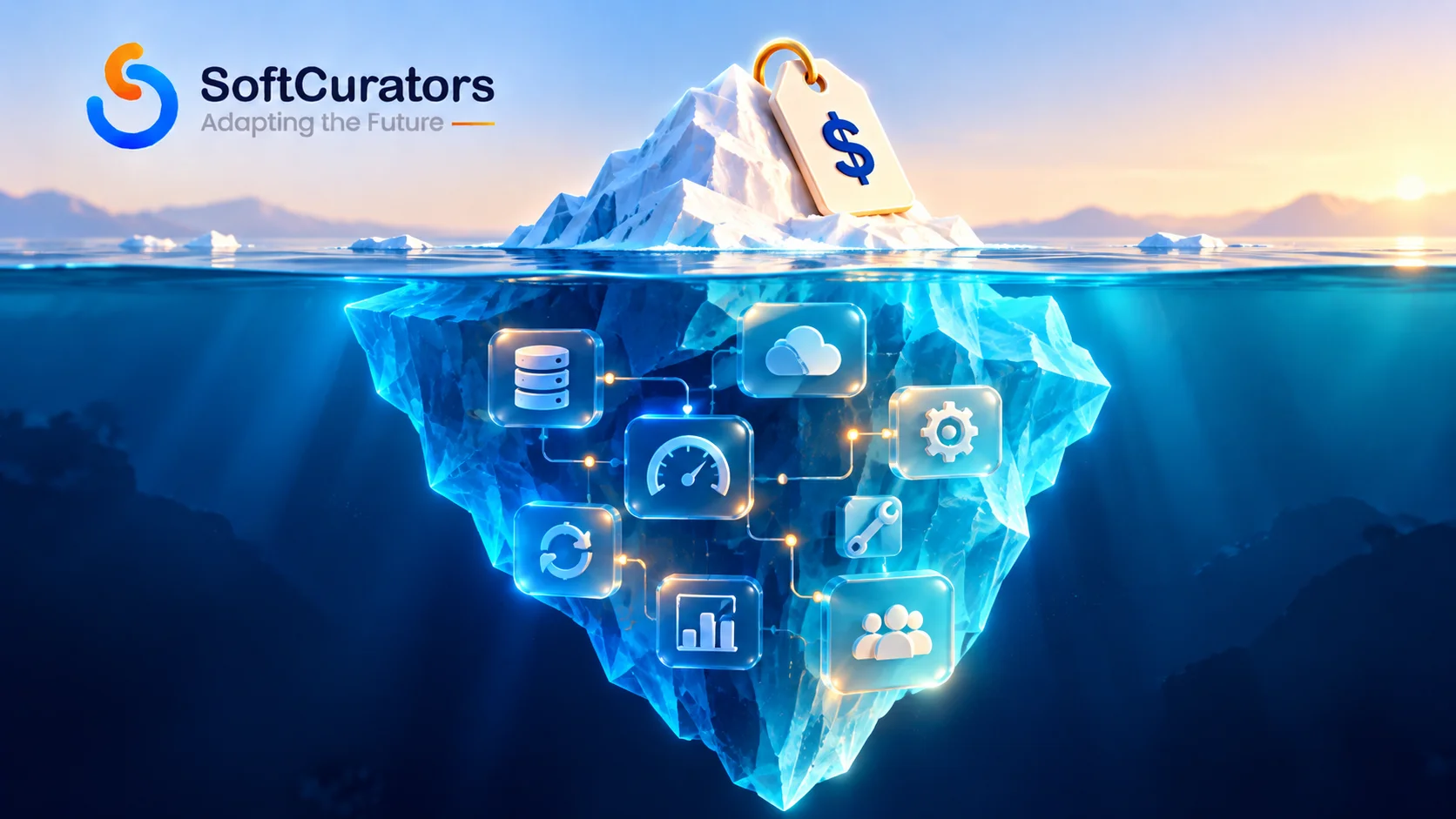
Custom AI development costs are dictated by integration depth and data readiness, not merely by the cost of the LLM. For a startup validating an AI feature, SoftCurators usually recommends launching a focused MVP development phase restricting the agent to a single data source. For an enterprise with strict compliance constraints, the better route is a comprehensive Phase 1 focusing entirely on data sanitation and local model deployment.

Data Readiness


Scattered databases, scanned documents and unstructured information can increase development effort.

How to manage it: Organize your data and establish API access before development begins.

Integration Complexity

Connecting multiple platforms, databases and business applications requires additional integration, authentication and testing.

How to manage it: Prioritize essential integrations in your initial release.

Accuracy Requirements

Agents handling business-critical tasks need proper evaluation, fallback mechanisms and safeguards.

How to manage it: Introduce human approval for sensitive actions and test performance before expanding automation.

Common Mistakes in Enterprise AI

Relying on "Prompt Engineering" alone

Ignoring Data Privacy

Assuming AI fixes broken processes

What Most Businesses Overlook: The "Human in the Loop"

The goal of an enterprise AI agent in its first year is rarely 100% autonomy. The highest ROI and lowest risk is found in a "Human in the Loop" (HITL) architecture.

If an AI agent is tasked with auditing supplier invoices, it should autonomously approve and process the 80% of invoices that perfectly match the purchase orders. For the 20% that present discrepancies, the agent should draft a summary of the error, link the relevant documents, and pause the workflow, pushing a notification to a human manager for a final click of approval. This lets the agent handle the routine majority of invoices while humans review only exceptions

The Market Lens: Now and Next

Now

Businesses are moving past generic chatbots and implementing highly scoped, RAG-powered agents for internal knowledge retrieval and document drafting. Partnering with an AI app development company to secure data pipelines is the standard.

Next (12-24 Months)

The rise of "Multi-Agent Systems." Instead of one massive AI trying to execute every task, enterprises will deploy networks of specialized micro-agents. A "Researcher Agent" gathers data, hands it to an "Analyst Agent" for computation, which hands it to a "Writer Agent" for formatting, all overseen by a "Manager Agent."
The AI Effect

AI can now write a basic script in minutes. What businesses still need an engineering partner for is hardening AI-generated code, securing integrations, and defending against prompt injection in production.

Questions to Ask Any AI Vendor

How exactly do you prevent the model from hallucinating company policy?

Who owns the intellectual property and the final orchestration code?

How will you handle PII (Personally Identifiable Information) within the data pipeline?

How do we monitor and control the API token costs once the system is live ?

Can multiple AI agents work together to handle complex business workflows?

What happens when our business requirements change or the AI technology evolves?

Why SoftCurators?

Architecture Over Hype:

We treat LLMs as a single component in a larger software architecture, wrapped in traditional, rigorous software engineering tests.

Cloud-Native Security:

We deploy secure, scalable AI environments on AWS and Azure, ensuring compliance with strict enterprise data policies.

Technology Agnostic:

We do not force you into a proprietary wrapper platform; we build independent systems that allow you to swap models as the technology evolves.

Full-Cycle Delivery:

From initial data engineering to long-term monitoring and UI/UX design, we handle the entire product lifecycle in-house.

Explore The Live Demo

See custom AI agents in action. Explore interactive demos to experience how intelligent automation, AI-powered workflows and integrations can streamline business operations and solve real-world challenges.

Ready to architect your Custom AI agent?

Let’s define your core workflow. Book a Free Scoped Estimate Call with our senior solution architects to map out your integrations, security requirements, and project timeline.

    Frequently Asked Questions

    Have questions about custom AI agent development, integrations, security or implementation? Find answers to common questions about building, deploying and scaling AI agents for your business with SoftCurators.

    Custom AI agent development is the software engineering process of building an autonomous system where an LLM is used as a reasoning engine. The developer writes orchestration code that gives the LLM access to specific tools (like a database query or an email API) to solve complex, multi-step business problems.

    A chatbot passively waits for a user prompt, retrieves information, and generates text. An AI agent is proactive; it is given a goal, reasons through a plan, and uses external tools to take actions in your actual software systems to achieve that goal.

    The cost varies heavily based on the cleanliness of your data, the number of legacy integrations required, and the depth of evaluation testing needed. The actual LLM token cost is usually the smallest expense; the majority of the budget goes toward secure software engineering and data pipelining.

    A focused, single-use-case MVP that reads from one clean data source can be piloted in 6 to 8 weeks. A complex, multi-agent system that writes data back into secure legacy ERPs typically requires 4 to 6 months of rigorous development and red-teaming.

    It depends on the inputs. If your process follows fixed rules and structured data, workflow automation (Zapier, n8n, Make) is usually cheaper and faster. If it involves unstructured inputs like emails, PDFs or free-text requests, or decisions that need judgment, an AI agent fits better. Many production systems combine both: automation handles the predictable steps and an agent handles the exceptions.

    Yes, provided they are architected correctly following guidelines like the OWASP Top 10 for LLM Applications. By utilizing enterprise-tier APIs (which guarantee zero data retention for training) or privately hosting open-source models within your own cloud VPC (Virtual Private Cloud), your data never leaks to public models.

    No. We build the system using standard software engineering principles. While we offer maintenance and support services, your existing software engineering or DevOps team can typically manage the infrastructure post-launch.

    The EU AI Act requires transparency; users must be informed they are interacting with an AI system (Article 50). Depending on the use case (e.g., processing HR resumes or biometric data), the agent may be classified as "High-Risk," which requires rigorous human oversight, logging, and risk management systems.

    Yes, utilizing open-source models (like Llama 3) hosted on your private cloud infrastructure ensures data never leaves your country, satisfying data residency laws in the UAE, Saudi Arabia, and Europe. SoftCurators sign an NDA before any data is shared. Under our standard contract, you own the orchestration code, prompts, evaluation sets and your data.

    If your entire workflow exists natively inside the Microsoft 365 or Salesforce ecosystems, using their proprietary platform agents is often the fastest route. You should build custom when the workflow is your core competitive advantage, handles highly sensitive data, or requires deep integration with obscure, custom-built internal software.

    Our Latest Blogs