

Property management is, at its absolute core, an exercise in high-velocity data reconciliation and workflow execution. It is a business of margins, not just a business of physical buildings. When a real estate enterprise relies on disconnected spreadsheets for financial ledgers, separate third-party portals for maintenance requests, fragmented email threads for lease renewals, and manual banking checks for rent collection, the operational ceiling becomes aggressively low. The core business problem here is not simply administrative inefficiency; it is dangerous margin compression and scalable liability.
Consider the operational reality of scaling a portfolio from 1,000 units to 5,000 units. If your technology infrastructure requires you to hire one new property manager for every 150 units you acquire simply to handle the manual data entry, your overhead costs will scale linearly or even exponentially alongside your revenue. This destroys the economies of scale that make large real estate portfolios profitable.
The symptoms of a fragmented technology stack are usually felt before they are financially measured. They appear as missed lease escalations (where a 3% annual rent bump is forgotten because it was buried in a PDF rather than an automated ledger), duplicated data entry across accounting and marketing systems, slow unit turnovers due to poor vendor communication, and ultimately, frustrated tenants who refuse to renew their leases. In commercial real estate, this fragmentation is even more punitive, often resulting in inaccurate Common Area Maintenance (CAM) reconciliations that directly bleed net operating income (NOI).
This guide evaluates the absolute best property management apps and software for real estate businesses operating in today’s environment. We will bypass surface-level feature lists and instead focus on the underlying architecture. You will learn the profound database differences between commercial and residential platforms, analyze the true, long-term financial cost of leading off-the-shelf software vendors, and apply a strict consultant’s decision framework to determine if your firm should subscribe to an existing SaaS platform or partner with an engineering firm to create a custom real estate app. The goal is to ensure your software infrastructure functions as a competitive moat rather than an operational bottleneck.
What Is Property Management Software? (And What It Isn’t)
Quick Answer: Property management software is a highly specialized, centralized database and workflow automation platform that unifies strict financial accounting, tenant communications, maintenance tracking, and the entire lease lifecycle into a single system of record. It is designed to replace fragmented legacy software, CRM tools, and general-purpose accounting tools like QuickBooks.
Understanding the Infrastructure
To make a sound technology decision, executives must understand what this software actually is under the hood. At its core, property management software (PMS) is an Enterprise Resource Planning (ERP) system adapted specifically for the physics of real estate. It is fundamentally different from a Customer Relationship Management (CRM) tool. While a CRM (like Salesforce or Hubspot) tracks leads, marketing touchpoints, and sales pipelines, a PMS handles the strict, regulated execution of the asset’s lifecycle after the contract is signed.
When you evaluate a PMS, you are primarily evaluating its General Ledger (GL) and its ability to handle trust accounting. Real estate commission regulations strictly prohibit the commingling of operating funds and tenant security deposits. Therefore, a true PMS operates on a rigid double-entry accounting framework designed specifically to isolate and manage multi-entity corporate structures (e.g., a master management company overseeing 50 different properties, each held in a separate LLC with its own distinct bank accounts).
The Four Perspectives of Property Management Software
-
Business Perspective (Cost & ROI)
- Implementing a unified system directly attacks overhead bloat. By automating rent collection cycles, instantly applying late fees according to complex lease logic, and auto-generating standard owner reports, the software allows property managers to transition away from being data-entry clerks. They become relationship managers and asset optimizers. The ROI is measured through reduced administrative headcount requirements, faster rent realization, and the ability to provide real-time, transparent portfolio performance metrics to institutional stakeholders or individual owners.
-
Technical Perspective (Architecture & Security)
- Modern platforms rely on scalable cloud architecture, such as Amazon Web Services (AWS), Microsoft Azure, or Google Cloud Platform (GCP), to ensure high availability and disaster recovery. The technical foundation usually involves a strictly governed relational database (like PostgreSQL) to handle the absolute precision required for financial ledgers. This is often paired with unstructured data storage (like Amazon S3 buckets) to house scanned lease documents, insurance certificates, and heavy inspection photos. Security is paramount; the system must employ row-level security so that Property Owner A’s database queries absolutely never bleed into Property Owner B’s financial data.
-
Operational Perspective (Daily Workflows)
- Operationally, a PMS shifts the company posture from reactive to proactive. Instead of a property manager tracking lease expirations on a whiteboard, the system automatically emails a renewal offer 90 days before expiration, complete with a dynamically calculated rent increase based on current market algorithms. Maintenance workflows shift from chaotic phone calls to tracked digital tickets, allowing the business to measure exactly how many hours a specific vendor takes to resolve an HVAC failure versus a plumbing issue, directly informing future vendor negotiations.
-
Future Perspective (Scalability & The IoT Edge)
- A PMS cannot just solve today’s problems; it must serve as the foundational digital layer for the next decade. As Internet of Things (IoT) devices like smart locks, digital thermostats, and connected water-leak detectors become standard installations in modern buildings, the PMS must have the API (Application Programming Interface) capabilities to ingest and act on that hardware data. A forward-thinking software choice ensures you do not have to rip and replace your entire system when you want your software to automatically issue a temporary smart-lock code to a painter during a unit turnover.
Consultant’s Tip: Do not confuse property management software with facility management software. Facility management software focuses heavily on the physical maintenance of complex building systems (HVAC lifecycle, elevator compliance, structural maintenance schedules) for large commercial spaces. Property management software heavily indexes on the financial, legal, and tenant lifecycle. While there is overlap, understanding your primary operational pain point dictates which category of software requires the bulk of your investment.
Commercial vs. Residential Property Management Architecture
Quick Answer: Residential property management software optimizes for high-volume, standardized workflows (like rent collection and templated leases) with rigid database schemas. Commercial software requires immense architectural flexibility to handle custom CAM reconciliations, multi-year tiered leases, percentage rent formulas, and highly specialized corporate accounting across mixed-use spaces.
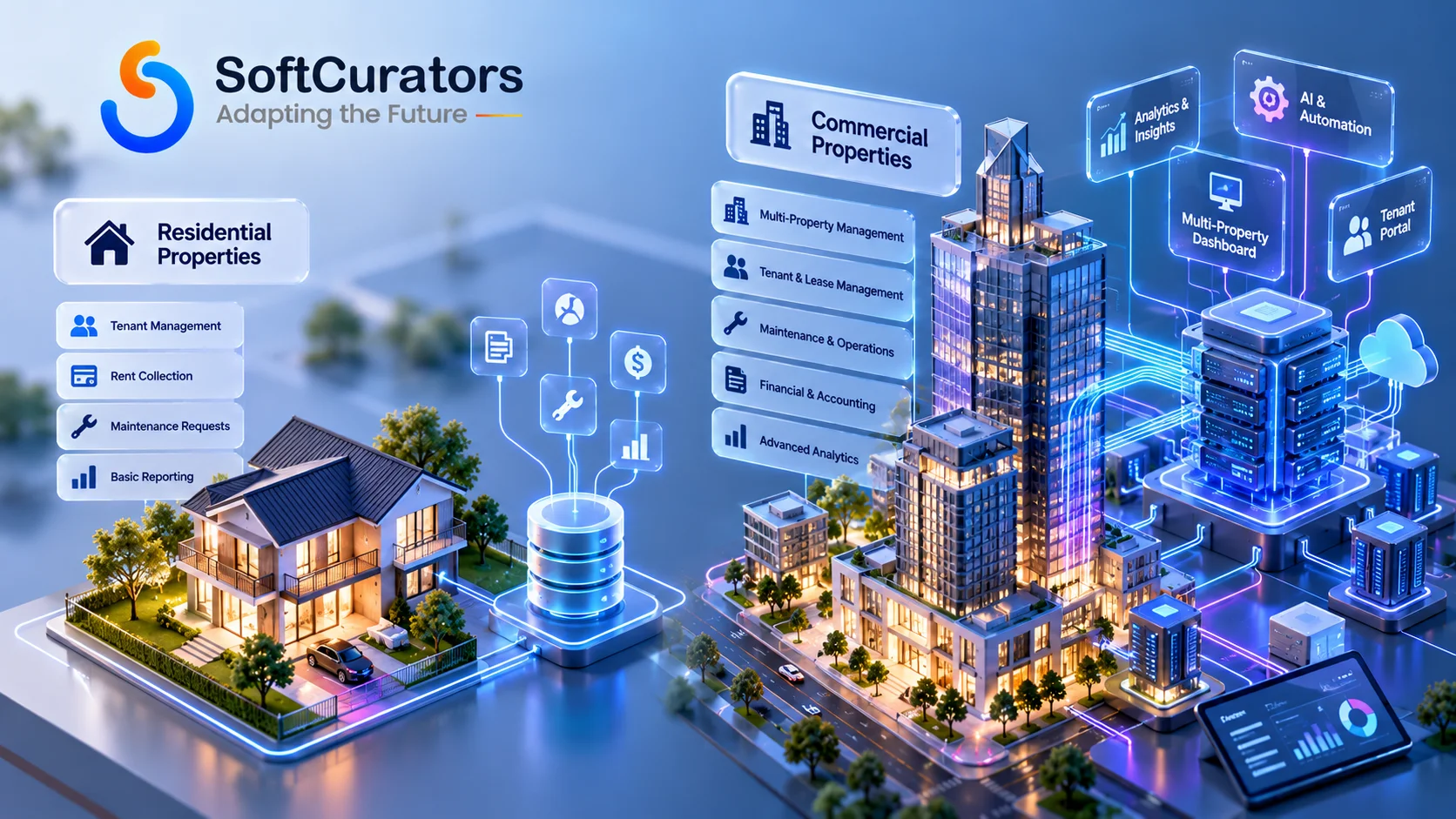
It is a common and highly expensive mistake to assume that a platform built to manage 10,000 apartments can also efficiently manage a 50-tenant retail shopping center. The fundamental data models required for residential and commercial real estate are wildly divergent.
The Physics of Residential Software
Managing residential properties whether it is a portfolio of scattered single-family homes or large multi-family high-rises requires software built for high automation applied to low-margin, high-volume tasks.
- The Database Architecture: The schema for residential software is relatively rigid and predictable. The entity relationships are standard: A tenant occupies a unit, pays a fixed monthly rent amount, signs a standard 12-month lease, and submits occasional maintenance tickets.
- The Feature Focus: Because the financial math is simple, engineering efforts in residential platforms are heavily concentrated on the user experience (UX) and volume management. The focus is on frictionless tenant mobile applications, integrated digital background checks (interfacing with Equifax or TransUnion APIs), automated rent reminders via SMS, and streamlined maintenance ticketing. The goal is to minimize human interaction to preserve margins. Ensure the tenant UI meets W3C Web Accessibility Guidelines for fair housing compliance.
The Complexity of Commercial Software
Commercial real estate encompassing retail centers, office high-rises, and industrial logistics parks involves entirely different financial physics. Standardized automation takes a back seat to extreme mathematical flexibility.
- The Database Architecture: A commercial database must support hyper-customization at the ledger level. Commercial leases are rarely identical. They are complex mathematical agreements. A retail tenant might pay a base rent, plus “percentage rent” (where the landlord takes 4% of the tenant’s gross sales over a $500,000 breakpoint). Furthermore, the software must handle complex Common Area Maintenance (CAM) reconciliations. If the landlord replaces the shopping center’s roof, the software must be able to distribute that cost proportionally across 30 different tenants based on their specific square footage, accounting for individual lease caps and exclusion clauses. A rigid residential database simply cannot compute this without breaking.
- The Feature Focus: Commercial platforms focus heavily on robust, institutional-grade financial reporting, custom dashboarding for REIT (Real Estate Investment Trust) investors, complex document abstraction, and tracking critical dates (like lease options to expand or termination penalties).
Expert Recommendation: If your firm manages a mixed portfolio (e.g., 70% residential, 30% commercial), you must prioritize software with a strong commercial accounting backend. It is infinitely easier to manage standard residential units on a complex commercial platform than it is to attempt forcing complex commercial CAM reconciliations and percentage rent logic into software built for single-family homes. Forcing commercial data into a residential system inevitably leads to manual workarounds in Excel, completely defeating the purpose of the software.
The Build vs. Buy Dilemma in PropTech
Quick Answer: Buy an off-the-shelf software license if your portfolio is standard, your processes are conventional, your unit count is relatively low, and your primary goal is immediate operational stabilization. You must build a custom property management application if software is your competitive differentiator, you require deep proprietary API integrations, you manage complex alternative assets, or you are seeking to modernize legacy applications to escape compounding per-unit SaaS fees.
This is the most critical technology decision a real estate CEO, CTO, or Founder will make. It dictates the firm’s capital expenditure, operational flexibility, and ultimate valuation for the next decade. Firms must choose between subscribing to Software-as-a-Service (SaaS) or investing in proprietary engineering.
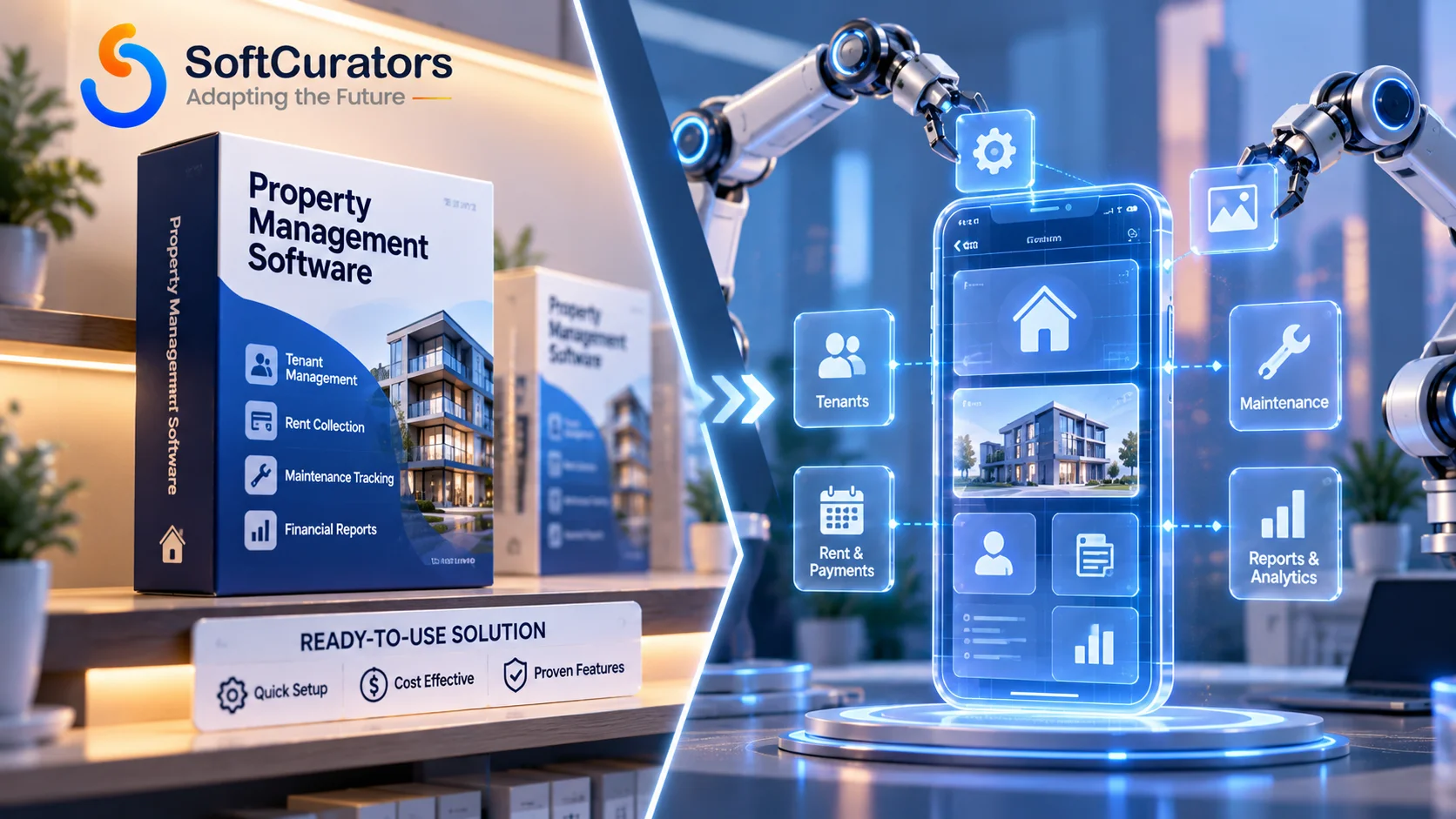
Scenario A: Buying Off-the-Shelf SaaS
This involves purchasing a monthly or annual license for an established platform like AppFolio, Buildium, or Yardi.
- The Business Advantages: Rapid deployment is the primary benefit. A standard platform can be implemented and stabilized within weeks or a few months, assuming clean data migration. It requires zero internal engineering overhead, offers predictable initial monthly costs, and comes with built-in compliance standards for trust accounting and data security.
- The Business Disadvantages: You do not own the underlying code; you are merely renting access to it. You are entirely subject to the vendor’s pricing roadmap, which typically involves per-unit price hikes. If the vendor decides not to support an integration with a specific smart-home technology or alternative payment gateway you wish to use, you are permanently locked out of that workflow.
- Operational Impact: When you buy SaaS, your business processes must adapt to how the software works. The software will not adapt to your unique proprietary processes. If your firm has a unique way of processing vendor payouts, you will likely have to abandon it in favor of the vendor’s hardcoded workflow.
Scenario B: Building Custom Real Estate Software
This involves partnering with an engineering firm specializing in custom software development to build a platform from the ground up, precisely mapped to your business model.
- The Business Advantages: Complete, unadulterated ownership of your Intellectual Property (IP). There are absolutely no per-unit licensing fees; whether you manage 5,000 units or 50,000 units, your software costs are limited to predictable cloud hosting and maintenance. It allows for hyper-tailored workflows and the ability to seamlessly integrate emerging technologies, such as utilizing agentic AI for property operations to automate complex leasing negotiations. Furthermore, proprietary technology is a tangible asset on your balance sheet, directly increasing the enterprise valuation of your company during a future sale or fundraising round.
- The Business Disadvantages: It requires a significantly higher upfront Capital Expenditure (CapEx). It demands a structured MVP development phase, intense planning, and necessitates ongoing maintenance, server management, and security patching.
- Operational Impact: The software is mapped precisely to your distinct operational advantages. If your competitive edge is a unique, lightning-fast maintenance dispatch protocol, the software is engineered exclusively to facilitate that exact protocol, drastically reducing onboarding friction for new employees.
Strict Decision Framework: When to Build vs. Buy
Do not make this decision based on preference; make it based on mathematical and operational realities.
- Choose to Buy When:
- You manage fewer than 2,000 standard residential units.
- Your standard operating procedures are highly conventional and identical to industry averages.
- You have limited upfront capital and prefer predictable Operating Expenses (OpEx).
- You do not have an internal technical product owner to guide an engineering team.
- Speed to stabilization is your only immediate priority.
- Choose to Build When:
- You manage 5,000+ units where monthly SaaS per-unit fees become exorbitant and exceed the annualized cost of a custom engineering team.
- You have a highly specialized or alternative business model (e.g., complex co-living spaces, fractured multi-family ownership, short-term rental arbitrage, or niche commercial syndications).
- You view technology not as an expense, but as your primary competitive moat in a crowded market.
- You are a PropTech startup building a new product to commercialize and sell to other property managers.
Top Off-the-Shelf Property Management Software Evaluated
Quick Answer: The market is dominated by several highly capitalized SaaS players, each optimizing for a different slice of the market. Buildium is excellent for small-to-midsize residential managers prioritizing owner reporting. AppFolio offers a strong balance of workflow automation for mid-market portfolios. Yardi Voyager remains the absolute, undisputed enterprise standard for massive, complex commercial and mixed-use portfolios, though it requires significant specialized training to operate. Entrata dominates the student housing and large multi-family space, while newer entrants like DoorLoop focus strictly on user experience for smaller operators.
If your decision framework from Section 4 points you toward licensing SaaS, your next step is vendor selection. As a consulting firm, we evaluate these platforms not on their marketing material, but on their database constraints, API openness, and total cost of ownership at scale.
1. AppFolio Property Manager
AppFolio is a cloud-native platform heavily focused on process automation and artificial intelligence applied to both residential and light commercial portfolios.
- The Business Perspective: AppFolio attacks administrative bloat aggressively. Features like “Smart Bill Entry” (which uses AI to read vendor invoices and automatically populate the ledger) and automated leasing flows significantly reduce the hours required to run a back office.
- The Technical Perspective: While it boasts a modern cloud infrastructure, AppFolio historically operated as a “walled garden.” They have recently opened their API (AppFolio Stack), but accessing it often requires specific enterprise pricing tiers, integration fees, and developer approvals. You cannot just plug any third-party app into AppFolio without their consent.
- Best Fit For: Aggressively growing portfolios ranging from 1,000 to 10,000 units that want a sleek, modern UI and are willing to adapt their processes to AppFolio’s “best practices.”
- The Risk Factor: Pricing minimums. AppFolio charges a minimum monthly onboarding and subscription fee that prices out smaller landlords, and their per-unit pricing increases predictably over time.
2. Buildium
Buildium focuses heavily on property managers who manage residential properties on behalf of other owners (third-party fee management) rather than owner-operators.
- The Business Perspective: Because third-party managers survive on client retention, Buildium indexes heavily on owner reporting. It allows property managers to easily distribute funds, generate 1099s, and publish transparent financial statements to individual property owners through a dedicated portal.
- The Technical Perspective: Buildium has a rock-solid core accounting engine and standardized, highly functional mobile applications for both tenants and owners. Its open API (via the RealPage developer network) is generally accessible for standard integrations.
- Best Fit For: Third-party residential property management companies and community associations (HOAs) managing 500 to 3,000 units.
- The Risk Factor: Buildium lacks the deep, granular commercial real estate customization found in enterprise systems. Attempting to run a 50-tenant retail shopping center with percentage-rent clauses through Buildium will require extensive manual workarounds in Excel.
3. Yardi (Voyager and Breeze)
Yardi is the heavyweight incumbent of the real estate software industry. Their lightweight solution is Yardi Breeze, for smaller portfolios, while Yardi Voyager is their flagship enterprise ERP.
- The Business Perspective: Yardi Voyager offers the unparalleled, highly granular reporting capabilities legally required by institutional investors, private equity firms, and publicly traded REITs. If you are syndicating a $100M commercial acquisition, your institutional investors will likely demand that the asset is managed on Yardi.
- The Technical Perspective: Voyager is a deeply complex, massive relational database environment. It is not “plug and play.” It requires significant specialized training often requiring the hiring of dedicated, full-time “Yardi Administrators” to operate, configure, and maintain.
- Best Fit For: Enterprise organizations, highly complex commercial portfolios, and institutional real estate operators managing 10,000+ units or millions of square feet of commercial space.
- The Risk Factor: The user interface often feels dated and clunky compared to modern PropTech startups. Furthermore, implementation is not measured in weeks; migrating to Voyager can take 6 to 12 months and hundreds of thousands of dollars in consulting fees.
4. Entrata
Entrata positions itself less as a simple accounting tool and more as a comprehensive Platform-as-a-Service (PaaS) specifically for large multifamily property management.
- The Business Perspective: Entrata’s core philosophy is revenue generation. It consolidates marketing, website hosting, lead tracking, leasing, and accounting into one unified dashboard, focusing heavily on maximizing tenant acquisition and reducing vacancy days.
- The Technical Perspective: Entrata is built on a genuinely open-API architecture, making it highly extensible. They embrace third-party PropTech integrations (like smart home tech and alternative security deposit platforms) much more openly than legacy competitors.
- Best Fit For: Large multi-family housing operators, student housing complexes, and Class-A apartment developers.
- The Risk Factor: Pricing is highly complex and modular. Because you pay separately for the core accounting, the marketing module, the resident portal, and the lead tracker, costs can escalate rapidly as modules are added.
5. DoorLoop
A newer, highly funded entrant, DoorLoop focuses on an incredibly intuitive user experience, rapid onboarding, and global accessibility (supporting multiple currencies).
- The Business Perspective: DoorLoop lowers the barrier to entry for smaller portfolios. It offers transparent pricing, no massive mandatory implementation fees, and a UI that requires almost zero training.
- The Technical Perspective: DoorLoop boasts a modern tech stack with a very fast, modern API, allowing easy integrations with tools like Zapier, meaning a technically savvy landlord can automate workflows without writing custom code.
- Best Fit For: Portfolios under 1,000 units, DIY landlords, or managers who want a modern UI without the immense bloat of enterprise systems.
- The Risk Factor: It is a newer platform. While evolving rapidly, it currently lacks the deep, complex accounting and multi-layered corporate structuring required for institutional commercial portfolios.
Essential Features of a Modern Property Management Application
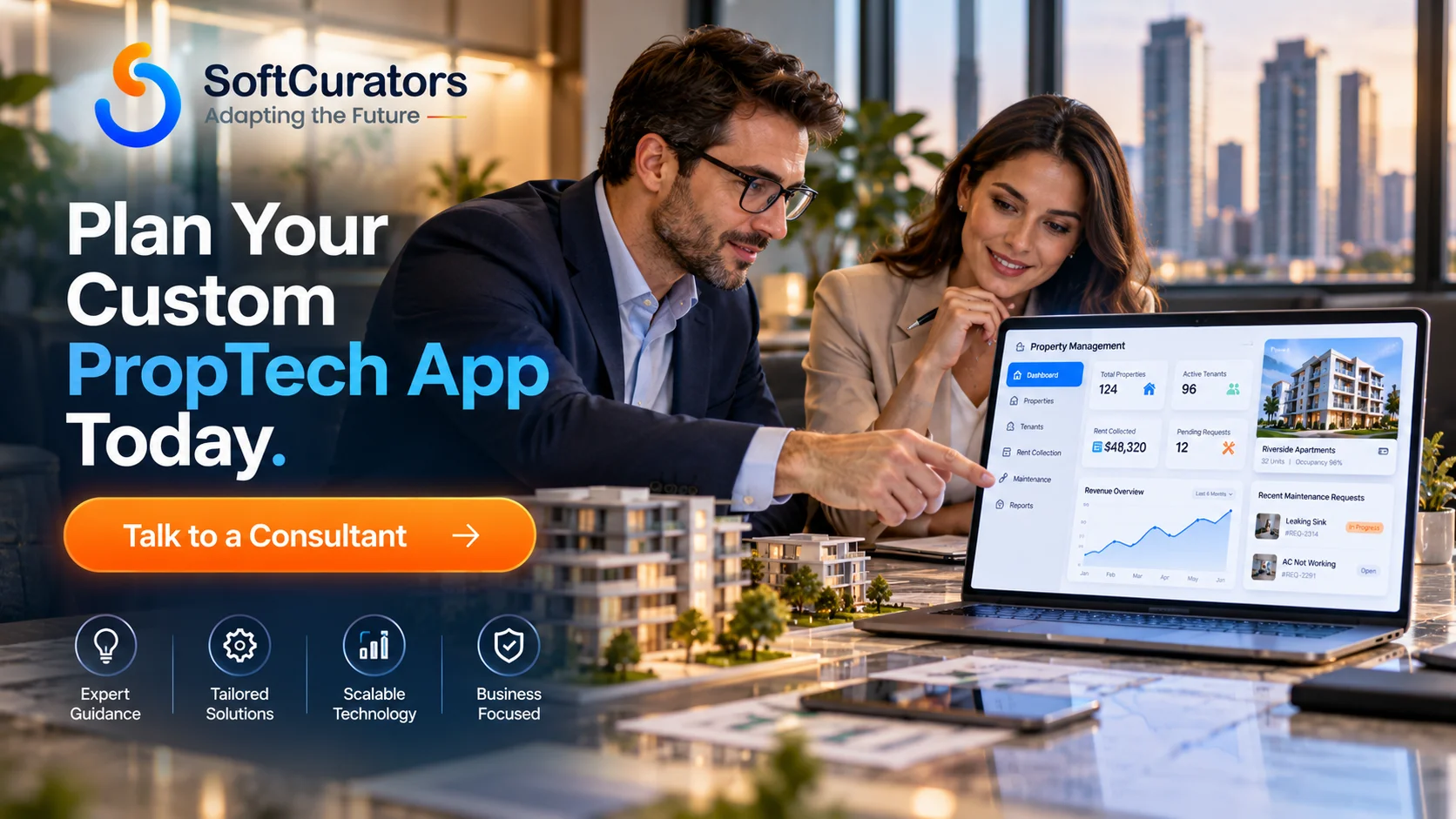
Whether you are evaluating a vendor from the list above or planning a custom build with an engineering firm, a modern system must include specific, non-negotiable core features to deliver an actual return on investment. Do not settle for “basic tracking.” Demand workflow automation.
Automated Rent Collection and True Financial Reconciliation
- The Requirement: The system must natively process ACH, credit cards, and digital wallets (Apple Pay/Google Pay). However, capturing the payment is only step one. The critical requirement is that it must automatically reconcile these payments against individual tenant ledgers and the master corporate bank account via direct bank API integration.
- Common Mistake: Relying on basic payment gateways (like a standard Stripe or PayPal account) without a ledger backend. If a tenant’s rent is $1,000, and they pay $800, a standard payment gateway just deposits $800. A property management ledger, however, must know how to allocate those funds legally (e.g., automatically applying the $800 to outstanding late fees first, utility chargebacks second, and base rent last, leaving $200 in base rent arrears for eviction court purposes).
Tenant Portals and Maintenance Request Workflows
- The Requirement: A centralized mobile-first hub where tenants can submit maintenance tickets with mandatory photo uploads and categorized issue types. The system should read the category (e.g., “Plumbing – Leak”) and automatically route the ticket to your preferred plumbing vendor, bypassing the property manager entirely for emergency triage.
- Business Insight: A robust, frictionless tenant portal directly increases tenant retention. Tenants rarely leave because of the physical building; they leave because communication regarding repairs is poor.
Lease Lifecycle Management and Automated Renewals
- The Requirement: True digital lease generation. The software must dynamically pull tenant data, unit data, and custom clauses into a PDF template, trigger an integrated e-signature flow (via DocuSign or HelloSign APIs), and store the executed contract. Furthermore, it must trigger automated 90-day, 60-day, and 30-day renewal nudges via email and SMS.
- Future Perspective: While standard digital signatures are the current norm, smart contracts built on blockchain technology are beginning to emerge in commercial real estate, ensuring immutable records of lease execution and automatic, algorithmically enforced rent escalations.
Strict Core Accounting and General Ledger (GL)
- The Requirement: A strict, GAAP-compliant double-entry accounting system. It must seamlessly track accounts payable (vendor invoices), accounts receivable (rent), and handle massive multi-entity structures seamlessly.
- Technical Note for Custom Builds: If you are building custom software, engineering a compliant, bug-free double-entry accounting ledger from scratch is highly complex and mathematically perilous. Integrating specialized financial ledger APIs (like Modern Treasury or building on top of a Stripe API architecture) is often a much safer and faster architectural choice.
Custom Real Estate App Development: Engineering a Proprietary Platform
Quick Answer: Building custom software requires massive strategic decisions regarding the tech stack: choosing between web applications, native mobile apps, or cross-platform solutions. Most importantly, it demands rigorous, flawless database architecture to handle multi-tenant data isolation and secure API integrations to connect financial ledgers with physical hardware endpoints.
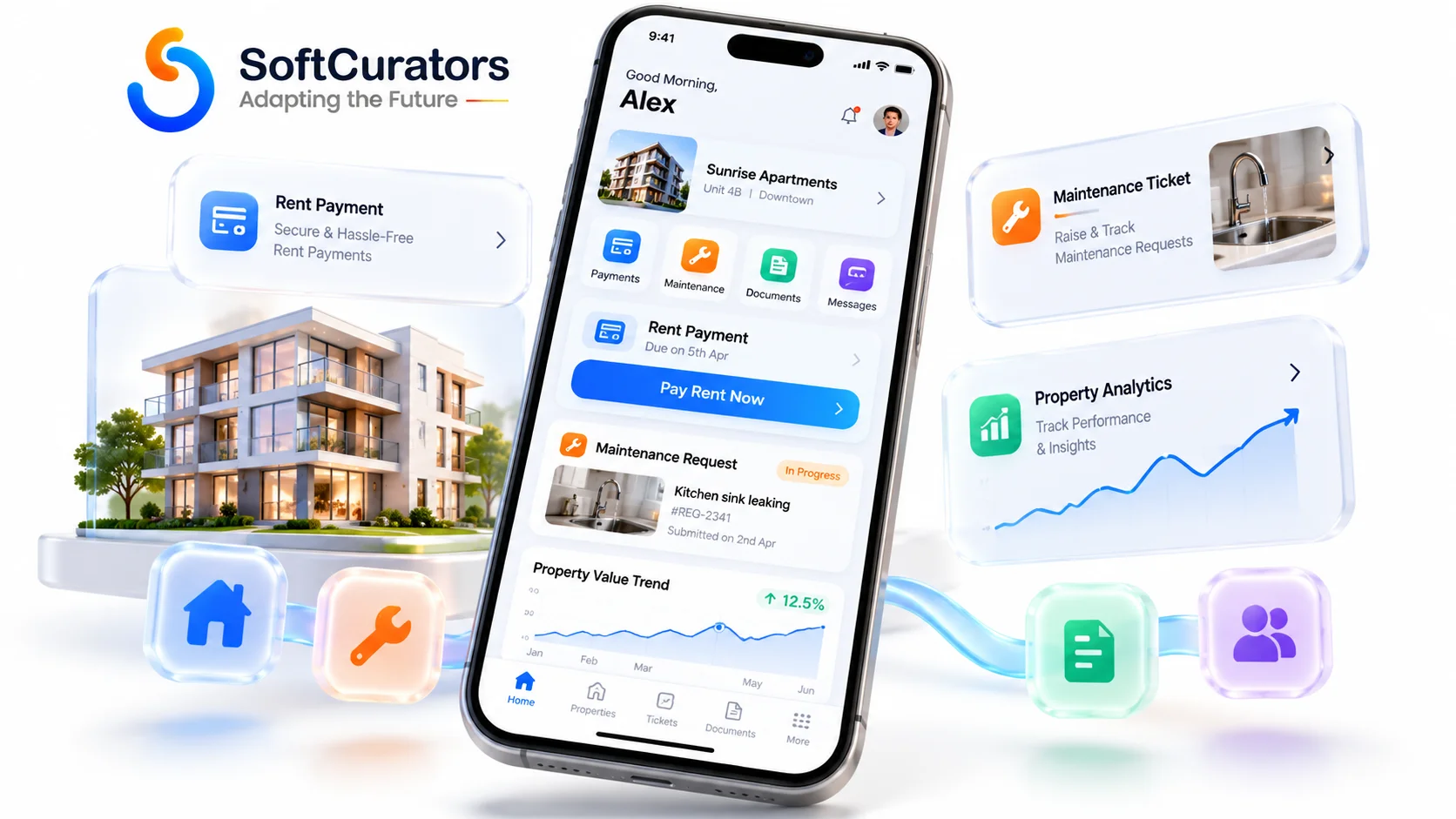
When an enterprise outgrows off-the-shelf software because SaaS fees are bleeding margins or because their unique operational model is unsupported custom engineering becomes the only viable path. Here is how consultants approach the architecture of a custom PropTech build.
1. Web Platforms vs. Mobile Apps (The Interface Layer)
A custom property management system is rarely just “an app.” It is typically a complex web-based dashboard (React, Angular, or Vue.js) for the back-office administrative staff, complemented by mobile applications for tenants, leasing agents, and maintenance workers in the field.
- Native vs. Cross-Platform: When developing the mobile components, businesses must evaluate native apps vs hybrid apps. Native development (writing in Swift specifically for iOS and Kotlin specifically for Android) offers maximum hardware performance. This is crucial if the app processes heavy 3D media, relies on continuous background location tracking for maintenance fleets, or integrates virtual property tours.
- The Consultant’s Choice: For the vast majority of tenant-facing portals (where the user simply pays rent and submits text-based maintenance tickets), cross-platform frameworks like React Native or Flutter are the optimal choice. They reduce time-to-market significantly and allow your engineering team to maintain a single codebase that deploys to both iOS and Android simultaneously.
2. Database Architecture and Data Isolation (The Foundation Layer)
This is where custom builds succeed or fail.
- Technical Perspective: Property management software is essentially a massive multi-tenant architecture. The database (e.g., PostgreSQL) must isolate data perfectly. If you manage properties for 50 different owners, Property Owner A must never, under any circumstances, be able to query the ledger or view the tenant data of Property Owner B. Implementing strict row-level security (RLS) and rigid schema designs at the database level not just the application level are non-negotiable engineering requirements to prevent catastrophic data breaches.
3. API Integrations (The Connectivity Layer)
No custom platform exists in a vacuum. A successful custom build focuses engineering hours strictly on core proprietary business logic, while integrating specialized third-party APIs for commoditized functions:
- Financial APIs: Integrating Plaid API for instant bank account verification and balance checks during tenant screening, and Stripe Connect or Dwolla for complex, multi-party ACH payment routing (e.g., tenant pays $1,000; API automatically routes $100 to the property manager’s operating account and $900 to the property owner’s trust account).
- Background Checks: Integrating TransUnion, Experian, or specialized PropTech APIs for instant, automated criminal and credit screening.
- IoT & Hardware Access: Integrating with smart lock APIs (e.g., Latch, Brivo, or Salto) so that when a leasing agent schedules a showing in the custom app, the software automatically generates a temporary, 1-hour access code and pushes it to the prospect’s phone.
Decision Checklist for Custom Builds:
Before writing a single line of code or signing an engineering contract, executive teams must verify:
- Do we have a highly detailed, explicitly mapped-out process flow for every single operational task (from lease signing to eviction filing)?
- Have we defined the exact, quantifiable pain points that current SaaS platforms cannot solve?
- Do we have a dedicated internal Product Manager (not just a CEO) who understands both real estate operations and agile software development to guide the engineering team daily?
- Are we financially prepared to fund the ongoing maintenance, cloud hosting, and security patching costs post-launch?
The Role of AI and Automation in Property Management
Quick Answer: Artificial Intelligence is shifting property management from a reactive, labor-intensive industry to a predictive, automated one. AI is actively deployed today for automated lease abstraction (reading PDFs to update ledgers), predictive maintenance scheduling based on historical failure data, and algorithmic dynamic pricing that adjusts rental rates daily based on micro-market demand signals.

AI is no longer a fringe concept in real estate; it is a baseline expectation for modern operations. Organizations looking to integrate these features should evaluate AI real estate software development costs to understand the CapEx requirements.
Predictive Maintenance
- Explanation: Instead of waiting for an HVAC unit to fail in the middle of summer triggering a costly emergency vendor dispatch and frustrating the tenant machine learning models analyze historical repair data across your portfolio, real-time weather patterns, and manufacturer lifespans to predict equipment failures before they happen.
- Business Impact: This shift drastically reduces catastrophic capital expenditures, prevents tenant displacement, and allows property managers to negotiate bulk, non-emergency rates with HVAC vendors.
Intelligent Tenant Screening and Recommendation
- Explanation: Utilizing AI-powered property recommendation systems matches prospective tenants with suitable units based on their digital search behavior, financial profiles, and historical preferences. This goes far beyond basic credit checks, analyzing a tenant’s likelihood to renew a lease based on demographic and behavioral clustering.
- Operational Impact: Increases conversion rates for leasing agents and statistically reduces the likelihood of future evictions by mathematically prioritizing high-quality applicants based on data, not gut feeling.
Automated Document Abstraction
- Explanation: Commercial leases are often complex, 50-plus-page legal PDFs. Historically, an analyst would spend hours reading each lease to manually input critical dates and financial obligations into the ERP. Today, AI models utilizing Natural Language Processing (NLP) can instantly read a PDF lease and extract critical dates, escalation clauses, and complex CAM caps directly into the database.
- Risk Alert: AI extraction is notoriously prone to hallucination (inventing data that sounds plausible). A “human-in-the-loop” operational process is completely mandatory. An analyst must verify the extracted financial data before it hits the live ledger. Relying 100% on automated extraction will inevitably cause severe accounting errors.
Budgeting, Cost Considerations, and ROI
Quick Answer: Off-the-shelf software typically costs between $1 to $3 per unit monthly, plus substantial implementation fees. Conversely, custom real estate app development cost generally requires an initial capital expenditure ranging from $50,000 for a highly focused MVP to well over $250,000 for complex, enterprise-grade platforms with mobile companion apps.
Understanding the Total Cost of Ownership (TCO) over a 5-to-10-year horizon is vital to making the right Build vs. Buy decision.
The Cost of SaaS Licensing (Operating Expenditure – OpEx)
- Implementation Fees: Most enterprise platforms charge a one-time onboarding fee. Depending on the complexity of your data migration and team training needs, this ranges from $1,000 to upwards of $20,000.
- Monthly Minimums and Per-Unit Fees: Platforms typically charge a base fee (e.g., $250 to $400 per month) regardless of your unit count, plus a per-unit fee (e.g., $1.50 per residential unit). As your portfolio grows, your software cost grows linearly.
- Hidden Costs: Always budget for payment processing fees (ACH and credit card percentage fees), digital background check fees, e-signature fees, and upcharges for API access or advanced custom reporting modules.
The Cost of Custom Development (Capital Expenditure – CapEx)
When calculating the true cost of building proprietary software, businesses must factor in three distinct phases:
- The MVP Phase: Building the core financial ledger, the tenant portal, and integrating the payment gateway. This is your largest upfront cost.
- Infrastructure Costs: Monthly AWS/Azure hosting fees, third-party API usage fees (like Twilio for SMS or Plaid for banking), and secure database storage. These costs are generally low but scale with active usage.
- Ongoing Maintenance: Software is never “finished.” A general rule of thumb is to budget 15% to 20% of the initial development cost annually for ongoing maintenance, bug fixes, security patching, and server management.
ROI Modeling for Custom Platforms
The Return on Investment for custom software is realized in several distinct ways:
- Eliminated SaaS Fees: You stop paying compounding per-unit fees.
- Reduced Headcount: Hyper-tailored automation allows a single property manager to handle 500 units instead of 200 units, drastically reducing payroll as the portfolio scales.
- Increased Asset Valuation: Proprietary technology acts as a tangible Intellectual Property (IP) asset on your balance sheet, directly increasing the multiple at which your company is valued during an acquisition or capital raise.
Common Mistakes in PropTech Implementation
Even with the perfect software selection, the implementation phase can fail catastrophically if poorly managed. These are the most common pitfalls consultants see in the field.
- Migrating Bad Data: This is the most common failure point. If your current spreadsheets are inaccurate or incomplete, importing them into a pristine new cloud system simply digitizes the chaos. Consultant’s Tip: Dedicate 4 to 6 weeks strictly to data cleansing, lease auditing, and ledger reconciliation before touching the new software.
- Ignoring User Experience (UX): If the custom tenant portal is confusing or requires too many clicks to pay rent, tenants will simply revert to mailing paper checks or texting the property manager. A failure of UX is a failure of automation. Design for simplicity.
- Over-Customizing SaaS: Trying to force a standard residential SaaS platform to handle complex commercial leases using custom fields, notes, and manual spreadsheet workarounds. This completely breaks the reporting functionality and guarantees systemic ledger errors. If you must use manual workarounds for core operations, you chose the wrong software.
- Skipping the MVP Phase (Custom Builds): When building custom software, companies often fall into the trap of trying to build 100% of their “wish list” features before launching. This leads to massive budget overruns and delayed launches. Build the core financial ledger and tenant portal first; add the advanced AI analytics and predictive maintenance features in Phase 2.
Final Recommendations and Next Steps
Choosing the right property management technology is not merely an IT decision; it is a fundamental margin decision that dictates the scalability of your enterprise. Fragmented systems leak revenue through missed rent escalations, duplicated data entry, and painfully slow unit turnovers.
For mid-sized, highly standardized operations, market-leading SaaS solutions provide rapid stabilization and predictable costs. However, for rapidly scaling enterprises, operators with complex commercial or multi-family strategies, or forward-thinking PropTech startups, off-the-shelf software inevitably becomes a severe growth bottleneck.
Investing in custom architecture ensures that your technology serves as an operational moat. It allows the software to map perfectly to your proprietary business processes, giving you absolute ownership of your data layer and completely insulating you from arbitrary, profit-destroying per-unit fee increases.
Take a hard look at your operational bottlenecks, evaluate your 5-year unit growth projections, and base your decision on a simple question: Does your software need to adapt to you, or are you willing to force your business to adapt to it?
Take the Next Step
Are you currently evaluating whether to migrate to a massive enterprise SaaS platform or build a proprietary real estate application? Softcurators specializes in engineering highly scalable, secure technology specifically for the PropTech industry.
Let’s map out your technical architecture. Schedule a Technical Architecture Review with our senior consulting team to analyze your database structure, define your exact MVP requirements, and model the true, long-term ROI of a custom platform versus an off-the-shelf license.
Frequently Asked Questions
Can property management software handle both commercial and residential properties?
Yes, but with caveats. True enterprise systems like Yardi Voyager handle both effectively. However, lightweight residential platforms often struggle immensely with the complex CAM reconciliations, triple-net lease structures, and percentage-rent formulas legally required by commercial real estate.
How long does it take to build a custom property management application?
A basic core ledger and tenant portal MVP typically takes 3 to 4 months of rigorous engineering. A fully featured, enterprise-grade system with custom AI integrations, complex commercial accounting logic, and native mobile applications can take 6 to 12 months of active development.
What is the difference between property management software and real estate CRM?
A CRM (like Salesforce, HubSpot, or Follow Up Boss) focuses on the top-of-funnel sales pipeline: tracking prospect leads, marketing emails, and closing a sale or lease. Property management software (an ERP) focuses on the execution of the asset lifecycle: rigorous double-entry accounting, rent collection, and physical maintenance after the lease is signed.
Are custom property management apps secure?
Yes, provided they are built using modern, strict security protocols. Custom development allows for rigorous architectural control, including row-level database security, end-to-end encryption for sensitive payment data, and strict OWASP Secure Coding Practices compliance measures to protect tenant PII (Personally Identifiable Information).
Why do property managers eventually move away from QuickBooks?
QuickBooks is excellent for general corporate accounting but lacks real estate-specific workflow automation. It cannot handle tenant maintenance ticketing, automated late fee rules based on lease logic, unit-by-unit tracking without incredibly complex "class" workarounds, or digital lease execution. It tracks money, but it does not manage the property.
How does AI fit into property management apps?
AI is used to automate data extraction from long legal leases, power tenant-facing chatbots for immediate 24/7 maintenance troubleshooting, predict HVAC/equipment failures based on historical data, and mathematically optimize rental pricing based on real-time market trends.
What is an open API, and why does it matter for real estate software?
An open API (Application Programming Interface) allows different, independent software systems to communicate and share data. It matters because it allows you to connect your core accounting system to highly specialized third-party tools, like smart locks, specialized marketing CRMs, or niche background check providers, preventing data silos.
Is it cheaper to build or buy property management software?
Buying is almost always cheaper in the short term (the first 1 to 3 years). Building is significantly cheaper in the long term for large portfolios, as the company escapes the compounding per-unit subscription fees charged by SaaS vendors as the business scales from 2,000 to 10,000 units.
Do property management apps integrate with smart home devices?
Yes. Modern software—especially custom-built platforms—can integrate deeply with IoT APIs to control smart thermostats (to aggressively reduce vacant unit energy costs) and manage smart locks (for seamless, secure vendor access during repairs).
What happens to my data if I switch SaaS vendors?
Most SaaS vendors allow you to export your core structured data (tenant lists, rent rolls, general ledger balances) via CSV. However, historical notes, custom attachments, PDF lease documents, and proprietary reporting formats are often lost or incredibly difficult to map cleanly to a new system.
Should I choose a native app or cross-platform framework for a tenant app?
Cross-platform frameworks (like React Native or Flutter) are almost always recommended for standard tenant apps. They require only one codebase, deploy to both iOS and Android simultaneously, and easily handle the relatively lightweight tasks of rent payment and ticket submission, saving significant engineering budget.
How do property apps handle trust accounting?
Trust accounting is highly regulated by state real estate commissions. Software handles this by enforcing strict double-entry ledgers that physically prevent the commingling of operating funds and tenant security deposits, ensuring total compliance and preventing severe legal liability.
Can property management software automate evictions?
Software cannot legally execute an eviction, but it can automate the prerequisite administrative workflows: auto-generating "Pay or Quit" notices, assessing late fees exactly according to the mathematical lease terms, and instantly compiling the precise financial ledger required for court proceedings.
What is the role of a Product Manager in custom real estate app development?
The Product Manager is the critical bridge. They translate the complex business operations (e.g., exactly how the accounting team reconciles percentage rent) into highly technical "user stories" for the software engineers, ensuring the final code perfectly matches the real-world operational workflow.
