

Why Valuation Apps Carry More Weight Than Most Real Estate Products
A recommendation engine that suggests the wrong listing wastes a user’s time. A valuation app that produces the wrong number can affect a mortgage decision, a refinance, an insurance premium, or a homeowner’s sense of their own net worth. That difference in stakes changes almost everything about how this category of product should be built.
AI property valuation apps sit at an unusual intersection: they’re consumer products competing on user experience, and they’re financial instruments subject to federal quality control regulation the moment their output touches a mortgage decision. A team that treats this purely as a machine learning problem, or purely as a UX problem, tends to miss the constraint that actually shapes the build.
This guide covers how these systems work technically, what data and infrastructure they require, the regulatory landscape that governs their use in lending contexts, and a clear framework for deciding between building a custom model, licensing a data and valuation provider, or combining both. We also cover where valuation apps most often go wrong, from misleading confidence claims to compliance gaps that surface only after a lender integration is already underway. If you’re scoping the broader platform this feature sits inside, our guide on how to build a real estate app like Zillow is a useful companion, since Zillow’s Zestimate remains the most widely recognized example of this category.
It’s worth naming upfront who tends to underestimate this build. Teams with strong mobile and web development experience but no background in mortgage or valuation regulation often scope this as a data science and UX project, budgeting accordingly, only to discover midway through development that a lending partner expects documented model testing and audit trails they never planned for. This guide is written to surface that constraint early, before it becomes an expensive late-stage surprise.
What Is an AI Property Valuation App (AVM)?
An automated valuation model is software that estimates a property’s market value using statistical or machine learning analysis of data, rather than a licensed appraiser’s in-person inspection and professional judgment. The term AVM predates the current wave of AI products by decades – lenders have used basic statistical AVMs since the 1990s – but the modern generation applies considerably more sophisticated machine learning to larger, richer datasets.
This distinction between old and new generations of AVM matters for a founder evaluating the space. Early AVMs were often simple regression models built on limited, infrequently updated data, and their reputation for inconsistent accuracy still shapes how skeptically some lenders and consumers approach the category today. A modern AVM built on richer data and validated rigorously can meaningfully outperform that legacy reputation, but it has to actively earn that trust rather than assume it.
It’s worth being precise about what an AVM is not. It is not an appraisal in the legal or professional sense, and it doesn’t involve a human inspecting the property, verifying its condition, or exercising professional judgment about factors a model can’t observe. This distinction isn’t semantic – the Uniform Standards of Professional Appraisal Practice (USPAP), administered by The Appraisal Foundation, governs what qualifies as a professional appraisal in the United States, and an AVM output doesn’t meet that bar regardless of how accurate it is.
Consider a simple illustration: two nearly identical three-bedroom homes sit on the same street. One sold eight months ago after a full kitchen renovation; the other hasn’t sold in over a decade and shows visible deferred maintenance in its listing photos from a prior sale. A model relying purely on square footage, bedroom count, and location will estimate both at a similar value, since none of that structural data captures the renovation or the maintenance gap. This is exactly the blind spot that separates a genuinely useful AVM from one that quietly misleads its users, and it’s a theme this guide returns to repeatedly.
Who Actually Needs This, and Who Can Skip It
Consumer real estate portals, lenders and mortgage technology platforms, iBuyers making instant cash offers, insurance underwriters, and investment platforms valuing rental portfolios all have legitimate reasons to build or integrate an AVM. A small brokerage or single-market listing site, by contrast, usually gets more value from displaying licensed comparable sales data clearly than from building a proprietary valuation model – the engineering and compliance investment only pays off at meaningful scale or when valuation is a core product differentiator.
Consultant’s Tip
Before scoping this as a machine learning project, clarify what your valuation output will actually be used for. A directional estimate shown to a curious homeowner carries a completely different regulatory and engineering bar than a value feeding into an underwriting decision. Get this answer in writing before architecture decisions get made, since it changes your data requirements, your confidence-reporting obligations, and potentially whether the interagency AVM rule applies to you at all.
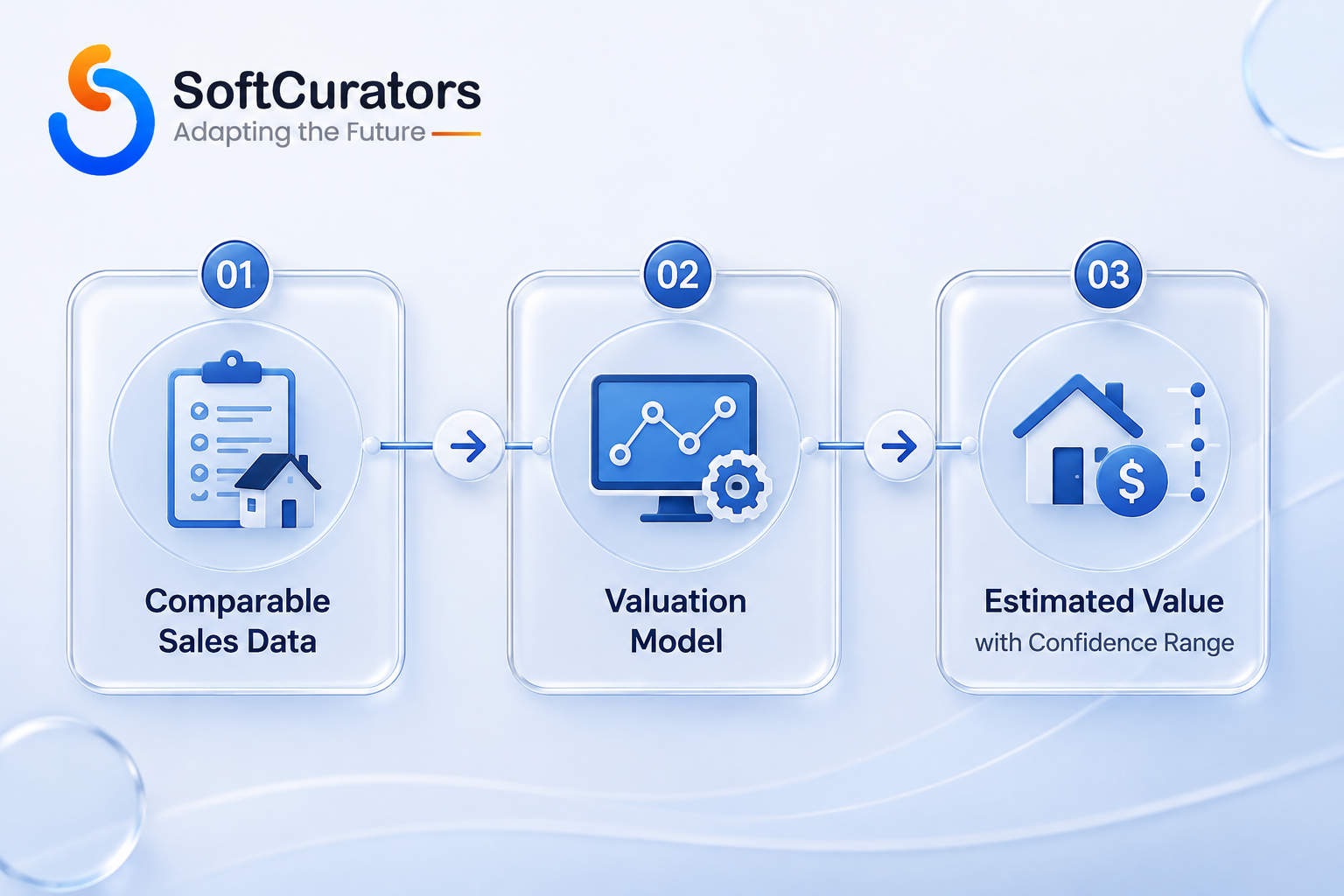
How AI Property Valuation Models Actually Work
Most production AVMs blend more than one modeling approach, and understanding each helps you evaluate a vendor’s claims or scope a custom build with realistic expectations.
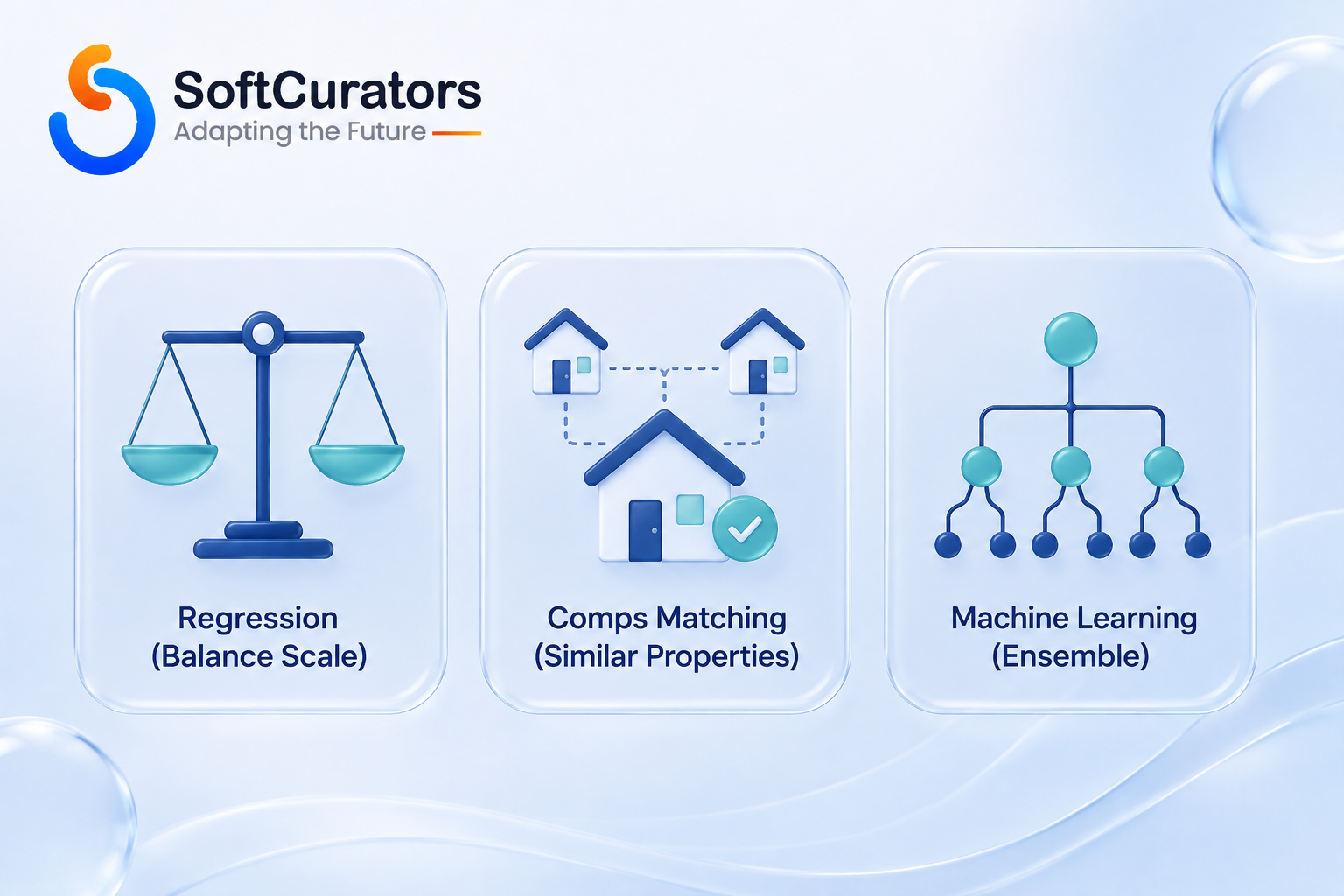
Hedonic Regression Models
A hedonic model treats a property’s value as the sum of its individual characteristics – square footage, bedroom count, lot size, location, age, condition – each weighted by how much it historically contributes to sale price in that specific market. This is the classical statistical approach and remains a defensible, explainable baseline, since each input’s contribution to the final number can be shown directly.
Comparable Sales (Comps) Approach
The comps approach, familiar from traditional appraisal practice, estimates value by finding recently sold properties with similar characteristics and location, then adjusting for differences. Modern AVMs typically automate comp selection using similarity scoring across dozens of features simultaneously, rather than the smaller manual comp sets a human appraiser would review.
Machine Learning and Ensemble Methods
Gradient boosting models (such as XGBoost or LightGBM) and ensemble methods combine many weaker predictive signals into a stronger overall estimate, and they generally outperform simple hedonic regression on raw accuracy, particularly in markets with complex, non-linear pricing patterns. Technical trade-off: this accuracy gain comes at the cost of explainability – a gradient boosting model’s output is harder to break down into “this feature added this much value” than a hedonic model’s, which matters directly for the transparency expectations covered in the compliance section below.
Computer Vision and Condition Assessment
A meaningful blind spot in most AVMs is property condition – two structurally identical homes can differ enormously in value based on renovation quality, deferred maintenance, or curb appeal, none of which shows up in tax assessor records. Newer systems increasingly apply computer vision to listing photos or street-level imagery to infer condition signals, though this remains a genuinely developing capability rather than a fully solved problem, and results vary meaningfully by data availability and image quality.
| Methodology | Explainability | Typical Accuracy Pattern | Best Fit When |
| Hedonic regression | High – each feature’s contribution is directly visible | Solid baseline; weaker in markets with non-linear pricing | Compliance-sensitive use cases needing clear explainability |
| Automated comps matching | High – mirrors familiar appraisal logic | Strong when comp inventory is dense and recent | Consumer-facing tools where users expect to see ‘similar homes’ |
| Gradient boosting / ensemble ML | Lower – harder to decompose a single prediction | Generally highest raw accuracy with sufficient data | High-volume platforms where accuracy gains justify explainability trade-offs |
| Computer vision condition scoring | Moderate – depends on how signals are surfaced | Improves accuracy on renovation/condition variance specifically | Platforms with access to current listing photos or imagery data |
Business Insight
It’s tempting to market a valuation product purely on model sophistication, but the more defensible differentiator in this category is disciplined uncertainty reporting – showing a realistic confidence range rather than a single number presented with false precision. Homeowners and lenders alike lose trust fast when a point estimate turns out to be significantly wrong, even if the underlying model was reasonable.
Evaluating Model Accuracy Before Launch
Before any valuation model reaches production, it needs rigorous backtesting against historical sale prices it wasn’t trained on. The standard metrics here are median absolute percentage error (how far off the typical estimate is, as a percentage of actual sale price) and the share of estimates falling within a defined accuracy band, commonly five or ten percent of the eventual sale price.
Technical note: these accuracy metrics need to be segmented by geography and property type, not reported as one blended national number, since a model can look strong in aggregate while performing poorly in rural markets, condo-heavy submarkets, or unique property types that simply have less comparable data to learn from. Consultant’s tip: publish your own accuracy methodology transparently, even in simplified form, since this is precisely the kind of disclosure that separates a trustworthy valuation product from one that invites skepticism the first time a user’s own sale contradicts the estimate.
The Data Layer: What an AVM Actually Needs to Function
This is the layer that determines real-world accuracy, and it consistently receives less attention in planning than the model architecture itself. A sophisticated model trained on sparse or stale data will underperform a simple model trained on rich, current data almost every time, which is why experienced teams in this space treat data sourcing as the primary engineering investment rather than a supporting task.
Comparable Sales and Listing Data
Recent sale prices, active listing prices, and days-on-market data form the backbone of any valuation model. Where this comes from an MLS feed, it typically follows the RESO Data Dictionary standard, which normalizes field names and formats across hundreds of MLS systems and meaningfully reduces the data-cleaning burden compared with building your own schema from raw, inconsistent feeds.
Public Records and Tax Assessor Data
County tax assessor records provide structural details (square footage, lot size, year built, prior sale history) for properties that haven’t sold or listed recently, which matters enormously since most homes aren’t actively for sale at any given time. Operational perspective: assessor data formats vary by county and update on inconsistent schedules, making this one of the more tedious, unglamorous data engineering problems in the entire build – and one that’s easy to underestimate in an initial project timeline.
Market Trend and Macroeconomic Data
Local price trend indices, inventory levels, and mortgage rate data help a model account for market-wide movement between the last comparable sale and today’s estimate. Future perspective: models that ignore rapid market shifts (a sudden rate change, a local economic shock) tend to lag reality noticeably during volatile periods, which is exactly when users most need an accurate number and least forgive a stale one.
Property Condition and Feature Data
Renovation status, recent permits, and physical condition meaningfully affect value but are the hardest data category to source reliably at scale, since this information typically isn’t captured in structured public records at all. This is precisely the gap that photo-based computer vision approaches, mentioned above, are attempting to close, alongside self-reported homeowner updates on consumer-facing platforms.
Data Freshness and Governance
A valuation is only as credible as the recency of the data behind it. Risk alert: displaying an estimate built on stale comps or an outdated market index is one of the fastest ways to produce a number that’s confidently wrong, and it’s worth defining an explicit maximum acceptable data staleness as a product requirement, not an implementation detail left to individual engineers.
Geographic Coverage and Market Density Trade-offs
Valuation accuracy isn’t uniform across a coverage area, and it’s worth deciding early whether your product will attempt broad national coverage or focus on markets where your data access and comp density genuinely support confident estimates. Business perspective: a product that quietly performs poorly outside its strongest markets, without communicating that variance to users, accumulates trust damage slowly and invisibly until it surfaces all at once in negative reviews or lost partner confidence. Practical recommendation: consider explicitly limiting your confident-estimate coverage area at launch and expanding deliberately as data quality allows, rather than offering uniform-looking estimates of wildly uneven underlying reliability.
Confidence Intervals: Why a Single Number Is Misleading
One of the most consequential decisions in building a valuation app is how to communicate uncertainty, and it’s also one of the most commonly skipped.
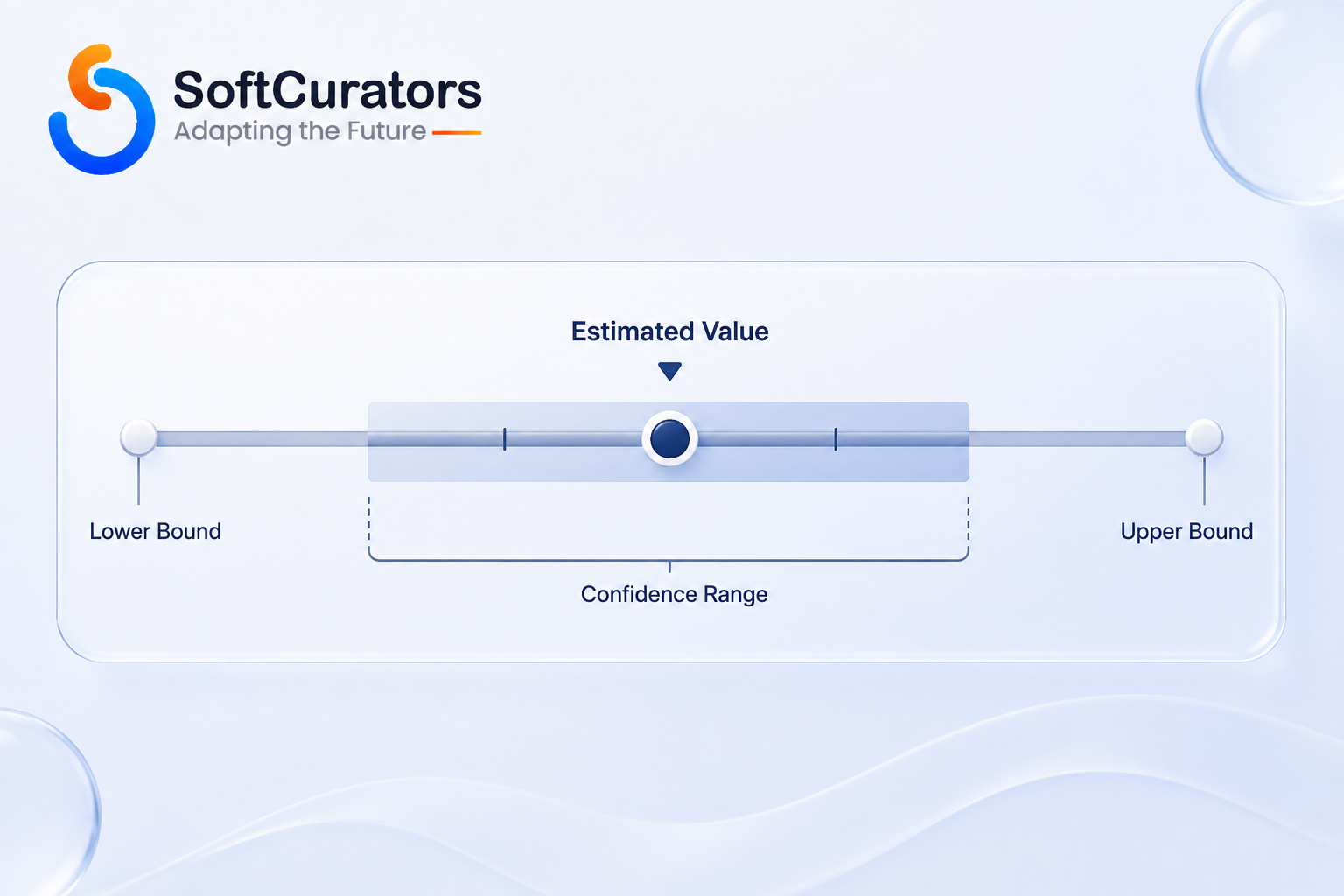
Every AVM estimate carries a margin of error, often expressed as a forecast standard deviation or confidence range, reflecting how much comparable data was available and how consistent that data was. A property in a subdivision with dozens of recent, near-identical sales can be estimated with real precision; a unique property in a thin market cannot, no matter how sophisticated the underlying model is.
Common mistake: presenting a single point estimate without any indication of confidence, which implies a level of precision the underlying data usually can’t support. Practical recommendation: show a value range alongside the point estimate, and consider surfacing a plain-language confidence indicator (“low,” “medium,” “high” data confidence) rather than a raw statistical term most users won’t parse correctly. This is also directly relevant to the compliance section below, since regulators explicitly expect institutions to understand and account for the confidence level behind any AVM they rely on.
Future perspective: as your model matures and you accumulate more outcome data (actual sale prices compared against prior estimates), your confidence-range calculations should become more precise and market-specific over time, rather than relying on a fixed, generic margin applied uniformly everywhere. Treating this as a continuously improving component of the product, not a static launch-time calculation, is part of what separates a mature valuation platform from an early-stage one.
The Regulatory Landscape: What Changed in 2024
This section matters more for AVMs than for almost any other AI product category covered in real estate technology, and it’s worth reading closely even if you’re building a purely consumer-facing tool, since regulatory scope can expand as a product’s use case evolves.
The Interagency AVM Quality Control Rule
In 2024, six federal agencies – including the Consumer Financial Protection Bureau, which finalized quality control standards for automated valuation models – jointly issued a rule implementing Section 1125 of the Dodd-Frank Act. The rule applies to mortgage originators and secondary market issuers using AVMs to value collateral for loans secured by a consumer’s principal dwelling, and it requires institutions to adopt policies ensuring their AVMs meet five quality control factors: a high level of confidence in estimates, protection against data manipulation, avoidance of conflicts of interest, random sample testing and review, and compliance with applicable nondiscrimination laws.
Technical note: this rule places the compliance obligation on the institution using the AVM (the lender or issuer), not necessarily on the software vendor building it – but any team selling into that market needs to build a product the lender can actually demonstrate compliance with, which means your model needs to support the auditability and testing the rule expects, even if your company itself isn’t the directly regulated entity.
How This Relates to Fannie Mae’s Valuation Modernization
Separately from the interagency rule, the government-sponsored enterprises have been expanding automated and hybrid valuation options through programs like Fannie Mae’s value acceptance and valuation modernization initiative, which increasingly allows certain eligible transactions to rely on data and analytics in place of a traditional appraisal. This is a genuinely evolving area of mortgage policy, not a settled standard – the specific eligibility criteria and loan-to-value thresholds are updated periodically, and any team building for the lending market should verify current requirements directly against GSE guidance rather than relying on a snapshot description.
USPAP and the Limits of AVM Authority
Because USPAP governs what constitutes a professional appraisal, an AVM output generally cannot substitute for a licensed appraisal in transactions that require one, even if the AVM’s estimate happens to be highly accurate. Decision guidance: if your product roadmap includes any path toward lender or GSE integration, build your compliance and audit-trail infrastructure early – retrofitting it after a lending partner asks for evidence of your quality control process is a materially harder position to be in.
It’s also worth understanding that state-level regulation adds another layer here. Appraisal practice is licensed and regulated at the state level in the U.S., with the federal Appraisal Subcommittee overseeing state licensing boards, which means a product operating across many states may encounter some degree of jurisdictional variation in how AVM outputs can be presented or used alongside licensed appraisal services, particularly in any workflow that brings the two together.
Risk Alert
AVM and mortgage valuation regulation is a genuinely active area of federal rulemaking, and the specifics described here reflect the 2024 interagency rule and current GSE guidance as of this writing. Consult legal counsel familiar with mortgage lending regulation and verify current requirements directly against the CFPB, GSE, and relevant agency documentation before building any product that touches a lending decision.
Bias and Fair Lending: A Regulatory Requirement, Not Just an Ethics Concern
Unlike some AI fairness discussions that sit in a legal gray area, AVM nondiscrimination is written directly into the federal quality control rule itself, which makes this section a compliance requirement rather than a best-practice suggestion.
How Valuation Bias Enters a Model
Historical sale price data can encode decades of discriminatory patterns in housing markets, including the effects of past redlining and unequal access to credit. A model trained on this data without deliberate mitigation can reproduce undervaluation patterns in historically marginalized neighborhoods, even without race or any protected characteristic as a direct model input, because location itself often correlates strongly with those characteristics.
This concern gained substantial policy attention through the federal Interagency Task Force on Property Appraisal and Value Equity, formed specifically to address documented disparities in both human appraisals and automated valuations. The interagency AVM rule’s nondiscrimination requirement is a direct regulatory response to this body of concern, not an abstract precaution.
Operational perspective: meeting this requirement in practice means building bias testing into your regular model validation cycle, not running it once at launch and considering the obligation satisfied. As a model retrains on new data over time, its bias characteristics can shift even if the original launch testing looked clean, which is exactly why the interagency rule’s random sample testing factor calls for ongoing review rather than a one-time certification.
Practical Mitigation Steps
- Exclude race, ethnicity, and other protected characteristics from model features entirely, and carefully evaluate location-granular variables that could function as proxies.
- Run regular outcome audits comparing model accuracy and value patterns across neighborhoods with different demographic compositions, not just aggregate accuracy metrics.
- Maintain documented model testing and validation processes that a lending partner or regulator could review, consistent with the random sample testing factor in the interagency rule.
- Build override and dispute pathways so a homeowner or appraiser can flag a valuation that appears to undervalue a property, and route these signals back into model monitoring rather than treating them as one-off support tickets.
This is conceptually related to the automated-decision-making principles in the European Union’s GDPR Article 22, which requires meaningful oversight of significant automated decisions – a useful design reference even for a U.S.-only lending product, since the underlying principle of maintaining human oversight and explainability over consequential automated decisions applies regardless of jurisdiction.
Data Privacy and Security for Valuation Platforms
Property records are frequently public data, but a valuation app typically combines that public data with account information, saved properties, and behavioral data that isn’t public at all, which puts privacy obligations squarely in scope.
- GDPR and CCPA compliance – applies the moment EU or California users interact with the platform, covering consent, data access, and deletion rights for any personal data layered on top of public property records.
- API security – valuation platforms commonly expose their estimate as an API to partners (lenders, insurers, other proptech products); following the OWASP API Security Top 10 guidelines for authentication, authorization, and rate limiting reduces the most common attack surfaces on that integration layer.
- Data licensing terms – MLS, assessor, and third-party data sources typically carry their own usage and redistribution restrictions, and displaying licensed comp data in a consumer-facing valuation tool without confirming those terms is a common, avoidable legal exposure.
- Audit logging – given the regulatory testing and review requirements described above, maintaining a clear, queryable log of what data and model version produced a given estimate is both a compliance need and a genuine engineering requirement, not an afterthought.
For a broader view of these obligations across mobile and web products generally, see our guide on mobile app security and compliance.
Technical note: it’s also worth distinguishing between the public property record itself and the derived valuation output your model produces. The former is generally public information; the latter, particularly once it’s tied to a specific user’s search history or saved properties, becomes personal data subject to the privacy obligations above the moment it’s associated with an identifiable individual.
Decision Framework: Build a Custom Model or License an AVM Provider?
This is the central strategic decision most teams face, and it deserves an explicit framework rather than a default assumption in either direction. It’s also a decision worth revisiting periodically rather than treating as permanent – a platform that starts by licensing a provider to validate demand may reasonably graduate to a custom model once usage and differentiation needs justify the investment.
When to build a custom model: valuation accuracy is a genuine competitive differentiator for your business (an iBuyer making cash offers, for instance, where pricing accuracy directly affects margin), you have access to strong proprietary data, and you can sustain an ongoing data science function to maintain and retest the model.
When not to: your valuation feature is a supporting tool rather than a core business driver, your data access is limited to standard public and MLS sources available to everyone, or your team lacks the compliance and model-risk-management capacity the regulatory landscape above requires.
Cost implications:
Building and maintaining a compliant, accurate AVM is a sustained investment, not a one-time build – ongoing data licensing, model retraining, and compliance testing are recurring costs that scale with your ambitions in this space.
Maintenance implications: models need periodic retraining as market conditions shift, and the regulatory rule’s random sample testing requirement means ongoing validation isn’t optional for any lending-facing use case.
Scalability implications: a licensed AVM data provider scales predictably with usage-based pricing, while a custom model’s scaling cost depends heavily on your data infrastructure choices.
Risk factors:
Custom models carry the full weight of the compliance burden directly; licensed providers shift some of that burden contractually, though the lender or platform integrating the output typically retains ultimate regulatory responsibility.
Time-to-market impact: licensing a data and valuation provider is measured in weeks to a few months of integration work; a fully custom model, done properly with compliance infrastructure included, realistically takes considerably longer.
| Approach | Best Fit When | Weaker Fit When | Key Consideration |
| Fully custom AVM | Valuation accuracy is core to your business model and you have strong proprietary or licensed data | Team lacks data science and compliance capacity to sustain ongoing model risk management | Highest control and differentiation; highest ongoing compliance burden |
| Licensed AVM data/API provider | You need a credible estimate feature without becoming a valuation-modeling company | Estimate accuracy or explainability is a core differentiator you can’t outsource | Faster to market; less control over methodology and update cadence |
| Hybrid: licensed data, custom scoring layer | You want differentiation on top of a reliable underlying data foundation | Budget doesn’t support maintaining even a lightweight custom model | Balances speed and differentiation; still carries meaningful data engineering cost |
| Comps display without a proprietary model | Valuation is a supporting feature, not the core product | Users expect an instant single-number estimate as a baseline UX pattern | Lowest cost and lowest regulatory exposure; less impressive UX |

Use Cases Across the Industry
The right architecture and compliance posture differ meaningfully depending on how the valuation output will actually be used. It’s worth reading through all four use cases below even if only one applies to your immediate roadmap, since platforms in this space frequently expand from one use case into another as they grow, and the compliance posture you need can change substantially when that happens.
Consumer Estimate Tools
Zestimate-style consumer tools prioritize engagement and directional usefulness over lending-grade precision, and they typically face lighter regulatory obligations since the output isn’t directly feeding a credit decision. Product perspective: these tools succeed largely on trust-building UX – transparent confidence ranges, visible comps, and clear disclaimers about what the number does and doesn’t represent. Operational perspective: even without direct lending regulation, a consumer estimate tool that becomes influential enough in a local market can attract public and media scrutiny of its accuracy, which is worth planning for as a reputational risk even absent a formal compliance obligation.
Lender and Mortgage Technology AVMs
AVMs feeding underwriting or collateral decisions sit squarely inside the interagency rule’s scope and require the full compliance infrastructure described above: documented testing, nondiscrimination review, and audit trails a lending partner can verify. This is the highest-stakes, highest-compliance-burden use case in the category. If you’re supporting a lending platform more broadly, our guide on AI in credit scoring covers a closely related compliance and modeling discipline worth reviewing alongside this one.
iBuyer and Instant Offer Platforms
Platforms making direct cash offers on homes depend on valuation accuracy for their actual business margin, not just user trust, which typically justifies heavier investment in custom modeling and rapid retraining cycles tied to local market conditions. Risk factor specific to this use case: valuation error here has direct financial consequences to the platform itself, not just to a downstream lending decision, which changes the risk-tolerance calculus considerably. Business perspective: iBuyer economics are also unusually sensitive to holding costs and market timing, meaning the valuation model needs to account for expected time-to-resale, not just current market value, adding a forecasting dimension most other use cases in this guide don’t require.
Insurance and Investment Portfolio Valuation
Insurers use property valuation for underwriting and claims, while investment platforms use it for portfolio-level asset tracking across many properties simultaneously. Both use cases tend to prioritize consistency and batch-processing efficiency over the polished single-property consumer experience that a Zestimate-style tool needs, and both typically care more about relative accuracy across a large portfolio than pinpoint accuracy on any single property.
Product Features That Build (or Break) User Trust
Beyond the model itself, several product decisions determine whether users trust a valuation tool enough to keep coming back. These features matter as much as raw accuracy in shaping how users perceive the product, since most users have no way to independently verify a model’s underlying statistics and instead judge trustworthiness through the interface itself.
- Visible comparable sales – showing the actual comps behind an estimate gives users a way to sanity-check the number themselves, which builds more trust than a black-box figure.
- Value history and trend charts – tracking a property’s estimated value over time turns a one-time lookup into a reason to return, particularly for homeowners monitoring equity.
- Homeowner claim and correction features – letting a verified owner update details (recent renovations, corrected square footage) improves both accuracy and engagement, though it requires fraud-resistant verification to avoid manipulation.
- Confidence and data-quality indicators – as covered above, this is both a trust feature and, in lending contexts, a compliance expectation.
- API access for partners – lenders, insurers, and other proptech platforms are common downstream consumers of a valuation API, and designing clean, well-documented API access from the start avoids costly retrofitting once partnership demand appears.
Common mistake:
Treating the estimate itself as the entire product and under-investing in the surrounding explanatory UI. In practice, the comps display, the confidence indicator, and the correction pathway do as much to earn user trust as the model’s raw accuracy – a moderately accurate model presented transparently often earns more durable trust than a highly accurate model presented as an unexplained black box.
Consultant’s tip: consider what happens the first time a user’s own home sells for meaningfully more or less than your estimate suggested. This is inevitable at scale, and the products that survive it gracefully are the ones that framed the estimate honestly from the start – as a data-driven approximation with a stated margin of error, not a promise.
Cost, Timeline, and Team Requirements
Costs vary substantially based on whether you’re licensing data and a valuation engine, building custom modeling on top of licensed data, or pursuing a fully proprietary approach with your own data acquisition. Rather than quoting a number likely to go stale, it’s more useful to understand what drives the estimate.
- Data acquisition and licensing – MLS, public records, and market trend data licensing costs vary by geographic coverage and are often the largest recurring cost, not a one-time expense.
- Model development and validation – building a defensible, testable model (and documenting that testing process for regulatory purposes if lending-facing) is a substantially larger effort than a basic proof-of-concept model.
- Compliance infrastructure – audit logging, nondiscrimination testing pipelines, and documentation processes are frequently underscoped in early estimates for lending-facing products specifically.
- Ongoing retraining and monitoring – market conditions shift, and a model’s accuracy degrades without regular retraining, making this an operational cost that continues well past initial launch.
For a broader framework on estimating a real estate platform build overall, see our guides on AI real estate software development cost and real estate app development cost, and our mobile app development cost and pricing guide for cross-industry cost drivers. Our mobile app cost calculator is also a useful starting point for a rough early estimate before a detailed scoping conversation.
Business insight: it’s worth framing this investment against the specific business outcome a valuation feature enables – reduced friction in a lending funnel, faster iBuyer pricing decisions, or stronger consumer engagement – rather than treating “add an AVM” as an undifferentiated feature request. If your existing data infrastructure is fragmented across legacy systems, our piece on why enterprises need to modernize legacy applications is worth reading first, since valuation modeling tends to expose the limits of outdated data infrastructure quickly.
Team and Skill Requirements
A realistic build needs a data engineer to manage comp, assessor, and market trend data pipelines – consistently the largest and most underestimated piece of the project. A data scientist or machine learning engineer handles model development and validation, while backend engineers build the serving infrastructure and API layer partners will integrate against.
For any product with a plausible path toward lending integration, a compliance advisor familiar with mortgage lending regulation and fair lending law should be involved from the design phase, not brought in only before a partner audit. Our guide on mobile app development for businesses and startups covers team-scoping considerations for growing platforms more broadly, and our overview of how Power BI transforms raw data into actionable insights is a useful adjacent read for internal reporting on model performance and data quality over time.
Native vs. Cross-Platform for Valuation-Heavy Real Estate Apps
Valuation logic itself is backend-driven and platform-agnostic, so this decision comes down to the surrounding consumer experience rather than the model itself. Features like interactive value-history charts, map-based comp visualization, and smooth photo browsing for condition context all benefit from native performance, particularly on lower-end devices where a laggy chart undermines trust in the number it’s displaying.
When cross-platform is a reasonable fit: an early-stage product prioritizing speed to market, particularly a B2B tool consumed primarily through a web dashboard or API rather than a polished native mobile experience. Our comparison of native apps vs. hybrid apps and our guide on mobile app development technologies cover this trade-off in more general depth.

How to Pilot a Valuation Model Before a Full Launch
Launching a valuation estimate to an entire user base or partner network before validating it against real-world outcomes carries real reputational and, in lending contexts, regulatory risk. A staged approach limits exposure while producing the evidence needed to expand with confidence.
Backtest Against Held-Out Historical Sales
Before any live exposure, validate the model against a set of actual historical sales it never saw during training, segmented by geography and property type as described earlier. This step alone catches a meaningful share of model weaknesses before they ever reach a real user.
Launch in a Limited Geographic Market First
Rather than enabling estimates everywhere at once, most teams get a clearer read by launching in one or two markets with strong data density, then comparing model estimates against actual closing prices as those homes sell in the following months. This keeps the blast radius of any systematic error contained while producing genuine, real-world accuracy evidence rather than backtested confidence alone.
Track Estimate-to-Sale-Price Accuracy Continuously
Once live, every property that sells after receiving an estimate becomes a natural accuracy checkpoint. Operational perspective: building this feedback loop into your data pipeline from day one, rather than adding it later, gives you a continuously improving accuracy picture instead of a single point-in-time validation that grows stale.
Expand Coverage Deliberately, Not Automatically
Once a market clears your accuracy threshold, expand to adjacent markets one at a time, applying the same validation discipline each time rather than assuming a model that works well in one region will generalize automatically. Market structure, comp density, and pricing dynamics vary enough across regions that this assumption is a common, avoidable source of quietly degraded accuracy in newly added markets.
Measuring Success: KPIs for a Property Valuation App
A valuation product needs its own success metrics, distinct from general app engagement numbers, since a popular feature isn’t necessarily an accurate or trustworthy one.
| Metric | What It Measures | Why It Matters |
| Median absolute percentage error | How far off the typical estimate is from actual sale price | The core accuracy metric regulators and partners will ask about directly |
| Percent of estimates within accuracy band | Share of estimates falling within a defined range (e.g., 5-10%) of sale price | Gives a practical sense of reliability beyond a single average error figure |
| Confidence-range calibration | Whether stated confidence ranges actually contain the real outcome as often as claimed | Validates that your uncertainty reporting is honest, not just present |
| Estimate dispute/correction rate | How often users flag or dispute a valuation | Early signal of data quality gaps or systematic bias in specific segments |
| Data staleness distribution | How current the underlying comps and market data are across your coverage area | Operational health metric directly tied to accuracy risk |
Future perspective: as your platform matures, segmenting these metrics by market, property type, and price tier reveals accuracy gaps a single blended number would hide entirely – and those gaps are exactly what a regulator, lending partner, or skeptical user will eventually find on their own if you don’t find them first.
Common Mistakes When Building AI Property Valuation Apps
- Presenting a single number without a confidence range. This implies false precision and erodes trust the first time the estimate turns out to be significantly off.
- Underestimating the assessor and public records data engineering effort. Inconsistent county-level data formats are consistently more time-consuming than teams initially budget for.
- Treating fair lending compliance as a legal afterthought. For any lending-facing use case, nondiscrimination testing needs to be built into model development, not added before a partner audit.
- Assuming a highly accurate AVM can substitute for an appraisal. USPAP and lending regulations draw a real distinction that a good model doesn’t erase.
- Skipping ongoing model monitoring and retraining. A model tuned to one market cycle degrades as conditions shift, particularly during periods of rapid rate or price movement.
- Ignoring property condition entirely. Two structurally similar homes can differ enormously in value, and a model that only uses structural and locational data will systematically miss this variance.
- Building the API layer as an afterthought. Lender, insurer, and partner integrations are common in this category, and retrofitting a clean, documented API onto a consumer-first product is more expensive than designing for it from the start.
- Publishing uniform-looking estimates across markets of wildly different data quality. Without communicating coverage-area confidence differences, users in thinly covered markets get a false sense of reliability.
- Failing to build a feedback loop from actual sale outcomes back into model monitoring. Every property that sells after receiving an estimate is a free accuracy data point, and platforms that don’t capture this systematically are leaving their best validation signal unused.

Final Summary: Where to Start
The clearest path into building an AI property valuation app starts with a precise answer to one question. What decision will this estimate actually inform? A directional number for a curious homeowner and a value feeding a mortgage underwriting decision are fundamentally different products wearing the same UI. And the regulatory, data, and compliance requirements diverge sharply between them.
Once that’s clear, prioritize data quality and honest uncertainty reporting over chasing marginal model accuracy gains, since a transparent, well-explained estimate with a realistic confidence range builds more durable trust than a black-box number that occasionally impresses and occasionally embarrasses. For any product with a plausible path toward lender integration, build compliance and audit infrastructure in parallel with the model itself, not as a follow-up phase – retrofitting it later is a materially harder position. As your platform matures, our guides on mobile app UI/UX design best practices and mobile app testing, deployment, and maintenance are useful next reads for the surrounding product and operational work, and our piece on AI-powered property recommendation systems is a natural companion if your platform combines valuation with personalized property discovery.
Decision Checklist
Before committing to a build approach, confirm: you have a precise answer for what decision your valuation output will inform; your comp, assessor, and market data pipeline is scoped realistically, not treated as an afterthought; your confidence-range reporting approach is defined before launch; a fair lending and nondiscrimination review process is documented if any lending use case is plausible; and your team includes compliance expertise proportional to your regulatory exposure, not just data science and engineering.
Whichever path you choose, treat this less as a single launch and more as an ongoing discipline. Market conditions shift, comparable sales data updates constantly, and regulatory guidance in this space continues to evolve as agencies gain more experience overseeing AVMs in practice. A valuation product that stays trustworthy is one your team revisits deliberately on a recurring cadence, not one calibrated once at launch and left to run unmonitored.
Next Step: Talk Through Your Valuation Architecture
Valuation products succeed or fail based on decisions made before a single model is trained. Data sourcing, confidence reporting, and a clear-eyed read on your actual regulatory exposure. Softcurators offers a Technical Audit for teams evaluating an AI property valuation build, working through data readiness, methodology trade-offs, and compliance exposure before any development commitment is made. Learn more about our approach on our why choose Softcurators page, or reach out directly to schedule a session.
Frequently Asked Questions
How accurate are AI property valuation models?
Accuracy varies significantly by market and data density - homes in areas with many recent, similar comparable sales tend to be estimated more precisely than unique properties in thin markets, which is exactly why transparent confidence-range reporting matters more than chasing a single accuracy statistic.
Do I need to comply with the interagency AVM rule if I'm building a consumer app?
The 2024 interagency rule specifically covers AVMs used by mortgage originators and secondary market issuers to value collateral for loans on a consumer's principal dwelling - a purely informational consumer estimate tool generally falls outside that scope, but the obligation can apply the moment your output starts feeding an actual lending decision, so it's worth legal review before any lender integration.
Can an AVM replace a licensed appraiser?
Not for transactions that legally require a USPAP-compliant appraisal, though the industry is genuinely moving toward more automated and hybrid valuation options for certain eligible transactions through programs like Fannie Mae's valuation modernization initiative - this is an evolving area, and current eligibility rules should be verified directly with the relevant GSE guidance.
Should I build a custom valuation model or license a data provider?
License a provider if valuation isn't a core differentiator for your business and you want a credible estimate feature without becoming a valuation-modeling company; build custom if pricing accuracy directly affects your margin (as with an iBuyer) and you can sustain the ongoing data science and compliance investment.
How do I prevent bias in a property valuation model?
Exclude protected characteristics and carefully evaluate location-based proxies, run regular outcome audits across neighborhoods with different demographic compositions, maintain documented testing processes, and build a dispute pathway for flagged undervaluations - all of which map directly to the nondiscrimination factor in the federal AVM quality control rule.
What's a forecast standard deviation, and why does it matter?
It's a statistical measure of an AVM's likely margin of error for a given estimate, reflecting how much reliable comparable data was available; showing this alongside a point estimate, even in simplified plain-language form, gives users a much more honest picture than a single confident-looking number.
How often should a valuation model be retrained?
This depends on market volatility and your platform's risk tolerance, but many production AVMs retrain on a regular cadence (commonly monthly or more frequently in fast-moving markets) and supplement that with continuous monitoring for accuracy drift rather than relying on a fixed schedule alone.
What is USPAP, and why does it matter for AVM builders?
USPAP is the Uniform Standards of Professional Appraisal Practice, administered by The Appraisal Foundation, and it defines what qualifies as a professional appraisal in the United States - understanding this boundary helps a product team correctly position an AVM as a supporting tool rather than a legal substitute for appraisal in contexts where one is required.
Can AVMs be used for property tax appeals or insurance underwriting?
Yes, though the acceptance and weight given to an automated estimate varies by jurisdiction and by insurer, and neither use case carries the same specific federal quality control obligations as the mortgage-lending context described in this guide - verify local and company-specific requirements separately.
How do iBuyer platforms use AVMs differently than consumer portals?
iBuyers use valuation output to make direct cash purchase offers, so pricing error affects their own financial margin directly rather than just user trust, which typically justifies heavier investment in custom modeling, faster retraining cycles, and tighter integration with local market condition signals.
What team roles do I need to build an AVM?
A typical team includes a data engineer for comp, assessor, and market data pipelines, a data scientist or ML engineer for model development and validation, backend engineers for the serving and API layer, and a compliance advisor with mortgage lending familiarity for any product with a plausible path to lender integration.
Is computer vision necessary for an accurate valuation model?
Not necessary as a starting point, but it addresses a genuine blind spot - property condition - that structural and locational data alone can't capture; it's reasonable to launch without it and add it as a later accuracy improvement once your core data pipeline and model are stable.
How do I handle a homeowner disputing their valuation estimate?
Build a clear correction pathway that lets a verified owner update property details and flag concerns, and route disputes into your model monitoring process rather than treating each one as an isolated support request, since patterns in disputes can reveal genuine data quality or bias issues worth investigating.
What's the difference between fair housing law and fair lending law as it applies to AVMs?
Fair housing law generally governs housing-related advertising and access, while fair lending law (and the interagency AVM rule specifically) governs nondiscrimination in credit and collateral valuation decisions - both are relevant to real estate AI products, but the AVM quality control rule specifically targets the lending and valuation context.
Can a startup realistically compete with Zillow's Zestimate?
Direct competition on broad national coverage is a considerable data and infrastructure undertaking, but startups can compete effectively by focusing on a specific niche - a particular property type, a regional market with strong local data access, or a specific B2B use case like lender or insurer integration - rather than attempting broad national consumer coverage from the start.
Do AVM regulations apply outside the United States?
The specific interagency rule described in this guide is U.S.-specific, but many jurisdictions have their own valuation, lending, and automated-decision-making regulations (GDPR's automated decision-making provisions being one relevant example for EU markets), so any international expansion should include separate regulatory review for each target market.
How do I backtest a valuation model before launch?
Validate estimates against a set of actual historical sales the model never saw during training, segmented by geography and property type, and track median absolute percentage error alongside the share of estimates falling within a defined accuracy band rather than relying on a single blended accuracy figure.
What should I do if a homeowner disputes their estimate and turns out to be right?
Treat it as a data signal, not just a customer service resolution - log the correction, investigate whether it reflects a systematic data gap (missing renovation records, stale comps in that area) that could be affecting other nearby estimates, and feed confirmed corrections back into your model monitoring process.
Do valuation models need to account for seasonality?
In many markets, yes - sale prices and inventory levels can shift meaningfully by season, and a model that doesn't account for this can systematically over- or under-value properties depending on when comparable sales occurred relative to the current estimate date.
How is valuation different for condos versus single-family homes?
Condos often have denser, more directly comparable sales data within the same building or complex, which can support tighter confidence ranges, but they also carry HOA fees, building-specific factors, and unit-position variables (floor, view, layout) that a model needs to capture separately from single-family home features.
What happens to my valuation model's accuracy during a fast-changing market?
Accuracy typically degrades during rapid market shifts, since recent comparable sales lag current conditions by weeks or months; models that incorporate current market trend indices and mortgage rate data tend to adapt faster than those relying purely on historical comps, though some lag is unavoidable in any comps-based approach.
Should a valuation estimate include renovation or repair cost estimates?
This is a distinct feature from the core valuation itself and is typically built as a separate module, since it requires different data (contractor cost data, project scope estimates) than comparable-sales-based valuation and carries its own accuracy and disclosure considerations worth scoping separately
Where should I start if I only have time to focus on one phase carefully right now?
Discovery, in almost every case. A well-scoped discovery phase reduces risk and rework across every phase that follows it, which makes it the single highest-leverage place to invest careful attention earl
