
Why Enterprises Need to Modernize Legacy Applications : The Complete Strategy Guide
There is a quiet crisis running through the backbone of global enterprise technology. It sits inside outdated ERP systems that take 45 seconds to load a customer record. Lives inside monolithic banking platforms that cannot be deployed without a weekend maintenance window. Hides inside healthcare databases that store patient records in formats no modern API can read without a custom translation layer.
These are legacy applications and according to a McKinsey Global Survey, they account for up to 80% of IT budgets in large enterprises, while simultaneously blocking the digital transformation initiatives that same leadership team is trying to fund. The cost of doing nothing, in other words, is dramatically higher than the cost of modernization.
At Softcurators, we modernize enterprise applications with cloud-native solutions, optimized architectures, and AI-driven automation that transform operational bottlenecks into competitive advantages. We’ve done this for fintech companies, healthcare platforms, on-demand services, and banking institutions — and the results are consistent: faster systems, lower costs, and organizations that can finally build what their customers are actually asking for.
This guide covers everything enterprise technology leaders, CTOs, and digital transformation decision-makers need to understand about legacy application modernization in 2026 from the real cost of legacy systems, to the six modernization strategies, to the exact process Softcurators uses to deliver transformation without disruption.
Ready to start? Book a free legacy assessment with Softcurators and we’ll audit your current architecture and present a modernization roadmap within 5 business days.
The True Cost of Legacy Systems: Why ‘Good Enough’ Is Costing More Than You Think
Every enterprise leader who has delayed modernization has used one of three justifications: “It still works.” “We can’t afford the disruption.” “We’ll do it next year.” All three are understandable. All three are also dangerously incomplete ways to assess the real cost of inaction.
Legacy applications don’t just cost money to maintain — they cost money in every dimension of your business operations:
- Maintenance cost spiral: Gartner estimates that enterprises spend 60–80% of their IT budget maintaining legacy systems rather than building new capabilities. That ratio inverts the entire purpose of a technology function.
- Security exposure: Legacy systems running on outdated OS versions, unsupported databases, or deprecated frameworks are sitting targets for ransomware, data breaches, and compliance violations. Our guide on mobile app security and compliance illustrates how modern architectures bake security in structurally — not as an afterthought.
- Integration impossibility: Modern SaaS tools, mobile applications, and third-party APIs speak REST, GraphQL, and event-driven protocols. Legacy monoliths speak none of these natively — forcing expensive middleware layers that themselves become technical debt.
- Talent drain: COBOL programmers average 60+ years old. Developers who know how to work with 15-year-old custom Java monoliths are retiring faster than they’re being replaced. The knowledge risk alone is catastrophic.
- Speed penalty: Competitors running on microservices and cloud-native infrastructure deploy new features in hours. Enterprises constrained by legacy systems measure deployment cycles in weeks. That gap is a market share gap.
- Scalability ceiling: Legacy architectures were designed for predictable, linear load. Modern business events — product launches, viral campaigns, seasonal spikes — create nonlinear load patterns that legacy systems simply cannot absorb without expensive, manual intervention.
At Softcurators, our first step with every enterprise client is a legacy cost audit — mapping the full financial and operational cost of the current state. In every engagement, this audit reveals that the total cost of legacy significantly exceeds the cost of a well-executed modernization program. The question is never really “can we afford to modernize?” — it’s “can we afford not to?”
For context on how modern software development approaches compare to legacy maintenance patterns, and how AI-driven automation is now changing the economics of enterprise software entirely, explore our specialist service pages.
7 Critical Warning Signs Your Enterprise Application Needs Modernization Now
Not every legacy system needs emergency modernization. But these seven signals indicate that your current architecture is actively harming your business and that the damage compounds every month you delay:
Warning Sign 1: Deployment Windows Are Measured in Days, Not Hours
If your release process requires a scheduled weekend maintenance window, a room full of engineers on standby, and a rollback plan that takes 4 hours to execute — your architecture is not compatible with modern competitive velocity. Softcurators implements CI/CD pipelines and blue-green deployment architectures that make deployment a non-event, not a crisis.
Warning Sign 2: Your System Can’t Talk to Modern Tools Without a Custom Adapter
When your CRM can’t integrate natively with your mobile app, or your ERP requires a custom connector to push data to your analytics platform, or every new SaaS tool requires a 3-month integration project — you’re paying a legacy integration tax on every piece of software your business adopts. Our web development and software development teams redesign integration architectures to be API-first from the ground up.
Warning Sign 3: You Can’t Build a Mobile App Without Rebuilding the Backend
If your product team has been asking for a mobile app for two years and the answer is always “the backend isn’t ready” — your legacy system is holding your customer experience hostage. Softcurators‘s modernization approach specifically prioritizes API exposure so that mobile application development, iOS apps, and Android apps can be built on top of modernized infrastructure without a full rebuild.
Warning Sign 4: Security Patches Require Testing the Entire System
In a monolithic architecture, a change to any component can theoretically break any other component — which is why security patches in legacy systems require full regression testing before deployment. This creates a dangerous lag between vulnerability disclosure and patch deployment. Modern microservices architectures isolate changes so patches can be applied and tested independently in hours.
Warning Sign 5: Your Data Is Siloed and Analysts Can’t Access It in Real Time
If your BI team is working from CSV exports pulled weekly because real-time data access isn’t possible, or if building a new report requires a database team ticket with a 2-week queue your data architecture is a legacy liability. Softcurators modernizes data layers with event streaming, real-time OLAP databases, and AI-powered analytics that give decision-makers live access to business intelligence.
Warning Sign 6: Onboarding a New Developer Takes Weeks of Knowledge Transfer
When institutional knowledge about how a system actually works exists only in the heads of 3 senior engineers who’ve been there for 10 years your architecture is a retention and scaling risk. Documentation-poor, tightly-coupled legacy codebases make onboarding prohibitively slow and make those senior engineers irreplaceable in a dangerous way.
Warning Sign 7: Your Competitors Are Shipping Features You’ve Had on the Roadmap for 18 Months
This is the market-share warning sign. When competitors who launched after you are releasing product capabilities faster than your team can, and the root cause traces back to technical architecture limitations rather than strategy or talent — modernization is no longer an IT conversation. It’s a board-level competitive survival conversation.
The 6 Modernization Strategies and How to Choose the Right One
Legacy modernization is not a single action it is a spectrum of interventions, each with different cost profiles, risk levels, and transformation depth. Softcurators evaluates every enterprise through all six lenses before recommending an approach, because the wrong strategy can be as costly as doing nothing.
Strategy 1: Rehost (Lift-and-Shift)
Move the existing application to cloud infrastructure without changing the code or architecture. This is the fastest and cheapest modernization move — typically 30–50% cheaper than re-architecture — and delivers immediate benefits in infrastructure cost, scalability, and disaster recovery.
When Softcurators recommends it: Applications with solid business logic that simply need cloud economics. A strong starting point before deeper modernization phases.
Limitation: Does not resolve technical debt, integration limitations, or deployment bottlenecks. A rehost is a platform upgrade, not an architecture transformation.
Strategy 2: Replatform (Lift-Tinker-and-Shift)
Move to cloud while making targeted optimizations — switching from a self-managed database to a managed cloud database (e.g., PostgreSQL to AWS RDS), containerizing the application with Docker, or migrating from on-premise message queues to managed services like AWS SQS.
When Softcurators recommends it: Applications that need cloud-native operational benefits but can’t justify a full re-architecture investment in the current planning cycle.
Strategy 3: Refactor / Re-architect
Decompose the monolith into microservices, implement event-driven communication between services, and rebuild integrations using modern API standards. This is the most impactful transformation — and the most complex to execute correctly.
This is Softcurators‘s primary specialization. Our software development team and web development architects have decomposed monolithic systems in fintech, banking, healthcare, and ecommerce contexts — each with unique domain complexity and regulatory constraints.
When Softcurators recommends it: Applications where deployment bottlenecks, integration limitations, or scalability ceilings are actively costing revenue or customers.
Strategy 4: Rebuild
Retire the legacy application entirely and build a replacement from scratch using modern architecture, technology stack, and UX. Highest cost and risk, but delivers the cleanest outcome with no inherited technical debt.
When Softcurators recommends it: Applications where the business logic itself has evolved so significantly that the existing codebase is more constraint than foundation — or where security and compliance requirements are incompatible with the legacy architecture at a structural level. Our MVP development service and prototype-first approach reduce rebuild risk significantly by validating new architecture before full investment.
Strategy 5: Replace
Retire the custom legacy system and adopt a best-in-class SaaS or off-the-shelf solution. Relevant for commodity functions like HRMS, basic CRM, or expense management — where custom-built systems have higher maintenance cost than the differentiation they provide.
When Softcurators recommends it: Non-differentiated systems where the TCO of a SaaS replacement is lower than the ongoing maintenance and opportunity cost of the custom legacy system.
Strategy 6: Retain (Deliberate Deferral)
Not every legacy system needs modernization today. Some are stable, low-risk, and low-change — and the investment required to modernize them exceeds the value created. Softcurators always includes honest “retain” recommendations in our modernization roadmaps. Prioritizing the right systems for modernization is as important as the modernization itself.
| Strategy | Cost | Risk | Transformation Depth | Best For |
| Rehost | Low | Low | Minimal | Quick cloud migration, cost savings |
| Replatform | Low-Med | Low | Moderate | Cloud-native ops without code changes |
| Refactor/Re-architect | Med-High | Medium | High | Scalability, deployment velocity, integrations |
| Rebuild | High | Med-High | Maximum | Obsolete codebase, major business logic change |
| Replace | Medium | Low | Full | Commodity functions with strong SaaS alternatives |
| Retain | Minimal | Low | None | Stable, low-change, low-risk systems |
Cloud-Native Transformation: What It Actually Means and Why It Changes Everything
“Cloud-native” has become one of the most overused terms in enterprise technology. Every vendor claims to be cloud-native. Every migration project promises cloud-native outcomes. But the term has a precise architectural meaning — and the gap between genuine cloud-native architecture and “application running on a cloud server” is enormous.
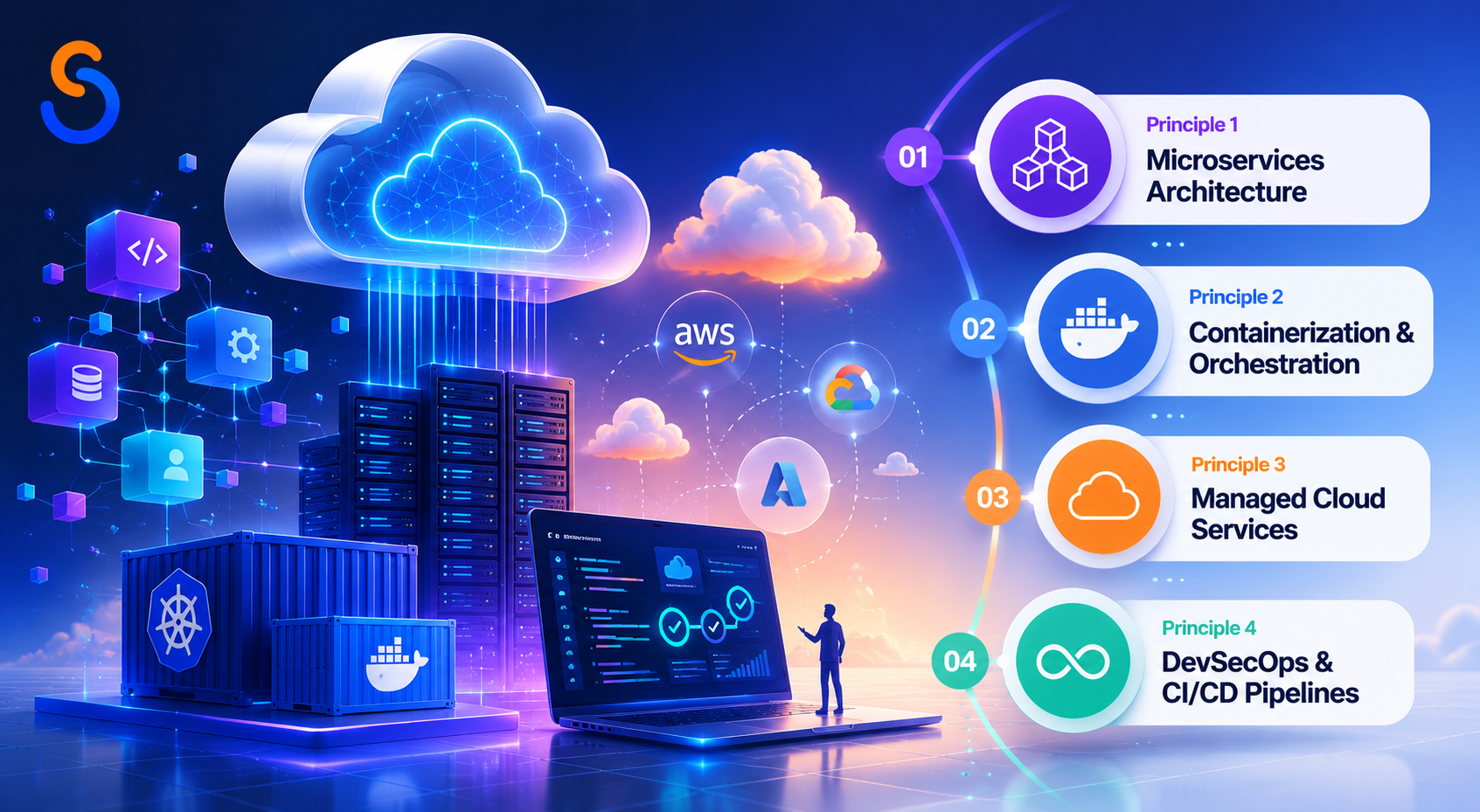
True cloud-native architecture is defined by four principles that Softcurators implements in every modernization engagement:
Principle 1: Microservices Architecture
Instead of a single, tightly-coupled application, the system is decomposed into independently deployable services, each owning its own data store and communicating via well-defined APIs. A change to the payment processing service doesn’t require testing the user profile service. A failure in the notification service doesn’t cascade to the order management service.
Softcurators designs microservices boundaries using Domain-Driven Design (DDD) principles ensuring service decomposition maps to business capabilities, not arbitrary technical divisions. This is why our modernized architectures stay maintainable as the business evolves, rather than accumulating new forms of the same technical debt.
Principle 2: Containerization & Orchestration
Each microservice runs in a Docker container a self-contained, portable unit that behaves identically in development, staging, and production. Kubernetes orchestrates these containers: automatically scaling them up when load increases, restarting failed instances, and managing zero-downtime deployments.
For enterprise clients, containerization delivers a specific commercial benefit: infrastructure cost optimization. Instead of provisioning servers for peak load 24/7, Kubernetes scales resources precisely to demand — dramatically reducing cloud infrastructure costs compared to legacy on-premise or basic cloud deployments.
Principle 3: Managed Cloud Services
Cloud-native applications replace self-managed infrastructure components (databases, message queues, caching layers, search engines) with managed equivalents (AWS RDS, SQS, ElastiCache, OpenSearch). This eliminates entire categories of operational burden database patching, cluster management, backup orchestration — freeing engineering teams to build product instead of maintaining infrastructure.
Principle 4: DevSecOps & CI/CD Pipelines
Modern software deployment should be continuous, automated, and reversible. Softcurators implements CI/CD pipelines (GitHub Actions, GitLab CI, ArgoCD) that automate testing, security scanning, and deployment — transforming releases from high-risk events into routine, auditable operations.
Our mobile app testing, deployment and maintenance guide explains the principles we apply across mobile and backend deployments. For enterprises, we extend these principles to the full application portfolio — aligning with our maintenance and support service for long-term operational health.
AI-Driven Automation: How Softcurators Embeds Intelligence Into Modernized Systems
Legacy application modernization used to be purely a technology upgrade exercise. In 2026, Softcurators takes a fundamentally different approach: we treat every modernization project as an opportunity to embed AI-driven intelligence into the application architecture — transforming not just how the system performs, but what it is capable of doing.
Our AI development and AI app development practices contribute directly to every modernization engagement through five concrete automation layers:
1. Intelligent Process Automation (IPA)
Manual, rule-based workflows that live inside legacy systems — loan approval queues, document classification, invoice matching, compliance reporting — are prime targets for AI-driven automation. Softcurators‘s AI automation services replace these manual steps with ML models that handle routine cases automatically, routing only exceptions to human reviewers.
The results are consistent: 60–80% reduction in processing time, dramatic reduction in error rates, and the ability to handle volume spikes without headcount increases. Our application of AI in loan lending and AI in credit scoring demonstrates what this looks like in high-stakes financial contexts.
2. Predictive Analytics & Real-Time Dashboards
Once data is flowing through a modern event-driven architecture, Softcurators can layer predictive models that surface business intelligence proactively — churn risk scores before customers cancel, inventory demand forecasts before stock-outs, fraud probability scores before transactions clear. Legacy systems produce data in batch reports. Modernized systems with AI layers produce insights in real time.
3. Natural Language Interfaces
Legacy enterprise systems are notorious for their intimidating, non-intuitive interfaces — interfaces that require weeks of training and generate significant support ticket volume. Softcurators integrates LLM-powered natural language interfaces (via our AI consulting services) that allow employees to query systems, generate reports, and trigger workflows using plain English — dramatically reducing training costs and improving adoption.
4. Automated Code Modernization Assistance
For large legacy codebases, Softcurators uses AI-assisted code analysis tools to accelerate the modernization process itself — automatically mapping dependencies, identifying dead code, flagging security vulnerabilities, and suggesting refactoring patterns. This reduces the manual discovery phase of a modernization engagement by 40–60%.
5. Intelligent Monitoring & Self-Healing Infrastructure
Post-modernization, Softcurators deploys AI-powered monitoring (Datadog with ML-based anomaly detection, custom alert models) that identifies performance degradation patterns before they become outages — and can trigger auto-remediation for common failure modes. This is the operational promise of our AI automation capabilities applied to infrastructure reliability.
To see how AI-driven automation specifically transforms financial services applications, read our detailed analysis of what is fintech and how fintech app development has evolved in the era of AI-native architectures.
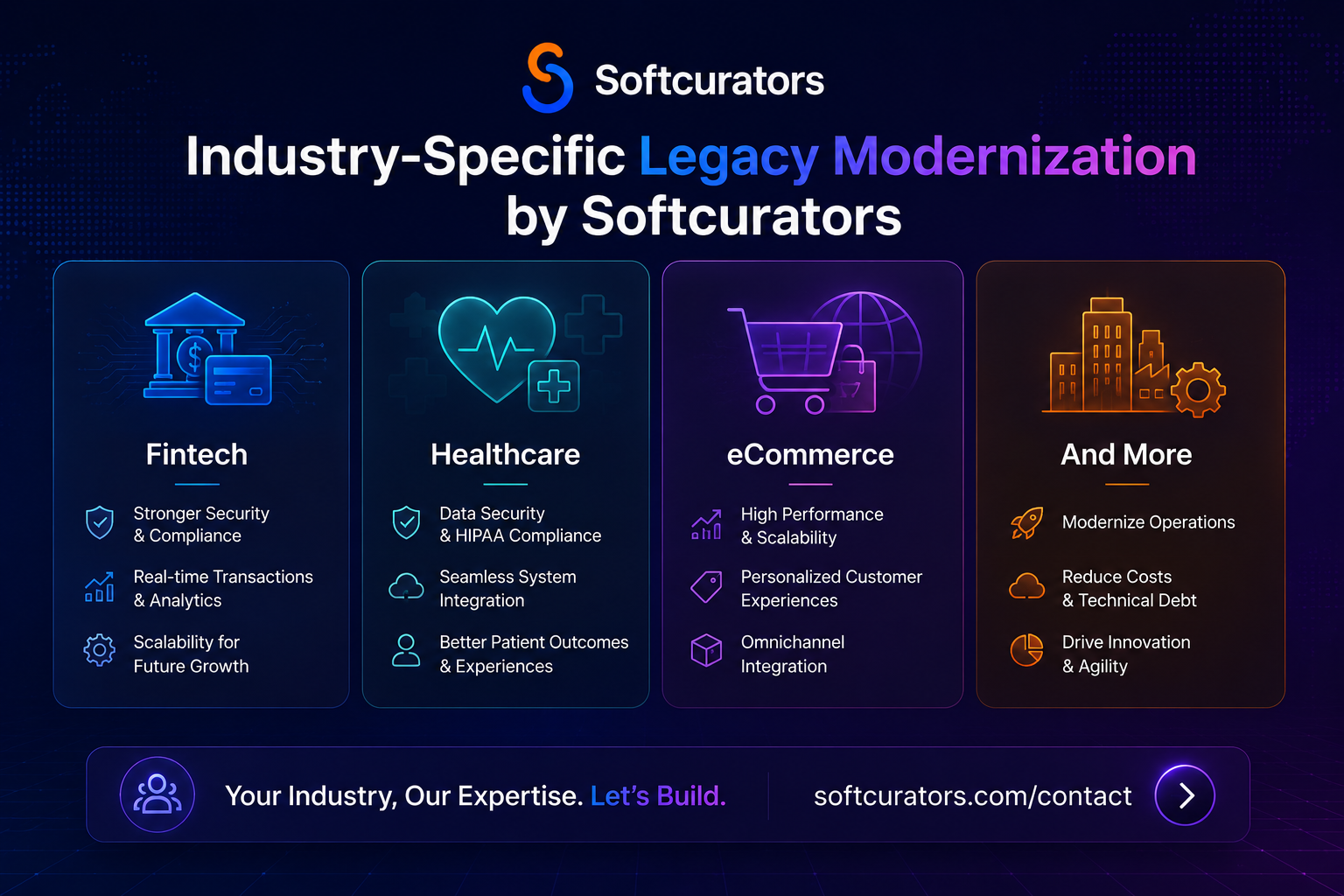
Industry-Specific Legacy Modernization: Where Softcurators Has Deep Domain Expertise
Legacy modernization is not a generic exercise. The technical decisions, compliance requirements, data sensitivity, and business continuity constraints vary enormously across industries. Softcurators brings domain-specific modernization playbooks to every engagement — not generic cloud migration templates.
Financial Services & Fintech
Legacy core banking systems, monolithic lending platforms, and outdated payment processing infrastructure are the most common modernization targets in financial services. The stakes are uniquely high: regulatory compliance (PCI-DSS, SOX, GDPR), transaction integrity, and 99.99% uptime requirements mean that a poorly executed modernization can create systemic risk.
Softcurators’ fintech app development and banking app development practices have modernized systems across loan lending platforms, BNPL services, e-wallet applications, and investment platforms. Our security compliance expertise for digital lending ensures that modernized financial systems meet all regulatory requirements from Day 1.
Healthcare & Life Sciences
Healthcare legacy systems carry some of the highest modernization stakes of any industry: HIPAA compliance, HL7/FHIR interoperability standards, clinical workflow dependencies, and patient safety implications if systems fail. Softcurators‘s healthcare app development practice and our healthcare app development guide document our approach to modernizing clinical and administrative systems without disrupting care delivery.
eCommerce & Retail
Monolithic eCommerce platforms built on decade-old frameworks struggle with peak load events, personalization requirements, and the microservices composability that modern headless commerce demands. Softcurators‘s ecommerce development team has migrated platforms from monolithic architectures to composable, headless systems — enabling independent scaling of catalog, cart, checkout, and search services.
On-Demand & Logistics
On-demand service platforms and logistics systems built on early-generation architectures buckle under real-time matching, route optimization, and live tracking demands. Softcurators‘s on-demand app development and logistics app development practices modernize these systems with event-driven architectures, real-time data streaming, and geospatial processing capabilities.
Real Estate & Property Technology
Property management systems, MLS integrations, and real estate transaction platforms often run on legacy stacks that cannot support modern buyer expectations for real-time listings, digital transactions, and AI-powered property recommendations. Softcurators‘s real estate app development team modernizes these systems with API-first architectures that can power web, iOS, and Android experiences simultaneously.
Education Technology
Legacy LMS platforms, student information systems, and assessment tools built before mobile-first and AI-personalization were requirements are being replaced by modernized platforms capable of adaptive learning, real-time analytics, and multi-device delivery. Softcurators‘s education app development practice brings these capabilities to institutional and edtech clients.
Softcurators’ 7-Stage Legacy Application Modernization Process
Legacy modernization fails most often not because of bad technology decisions, but because of inadequate discovery, unrealistic scope, and poor change management. Softcurators has developed a 7-stage process that eliminates the most common failure modes — built on lessons from real enterprise modernization engagements:
- Stage 1 — Legacy Audit & Technical Debt Mapping (Week 1–3): We perform a comprehensive audit of your existing application portfolio: architecture diagrams, dependency mapping, security vulnerability scanning, performance profiling, and business impact assessment. Output: a Technical Debt Register with prioritized modernization candidates and a preliminary cost-benefit analysis for each.
- Stage 2 — Modernization Strategy & Roadmap Design (Week 3–5): Based on the audit, our architects design a phased modernization roadmap — applying the right strategy (rehost, replatform, refactor, rebuild, replace, or retain) to each system. The roadmap is sequenced to deliver quick wins early while building toward the strategic target architecture. Our software development and AI consulting teams collaborate on this stage to embed AI opportunities into the target architecture.
- Stage 3 — Target Architecture Design & Proof of Concept (Week 4–7): Before any migration begins, Softcurators designs the full target architecture — microservices boundaries, data model, API contracts, cloud infrastructure specification, and CI/CD pipeline design. A prototype of the highest-risk architectural decisions is built and validated before the main migration effort begins, reducing downstream risk.
- Stage 4 — Strangler Fig Migration (Ongoing, Module by Module): We execute migration using the Strangler Fig pattern — gradually replacing legacy functionality with modern services while the legacy system continues running in production. Each new module is deployed behind a routing layer that progressively shifts traffic from legacy to modern. No “big bang” cutover. No business disruption. Just steady, measurable progress toward the target architecture.
- Stage 5 — Data Migration & Validation (Parallel): Data migration is often the highest-risk phase of any modernization project. Softcurators runs data migration in parallel with application modernization — using ETL pipelines, data quality validation, reconciliation testing, and dual-write strategies to ensure zero data loss and full audit traceability throughout the migration.
- Stage 6 — Performance Testing, Security Audit & Compliance Review (Week N-3 to N): Comprehensive load testing (simulating 3–5× peak historical load), penetration testing against the modernized architecture, OWASP Top 10 compliance review, and industry-specific compliance validation (HIPAA, PCI-DSS, GDPR as applicable). Our approach to security and compliance is thorough and documented for regulatory audit purposes.
- Stage 7 — Cutover, Hypercare & Continuous Improvement (Post-Launch): Staged cutover with legacy system standby, then a 30-day hypercare period with on-call Softcurators engineering support. Post-hypercare, clients transition to our maintenance and support service for ongoing performance monitoring, security patching, and feature velocity delivery.
Legacy Modernization Cost Guide: What to Budget and Why
The cost of modernization depends on four primary variables: the size and complexity of the legacy system, the chosen modernization strategy, the required compliance and security posture, and the speed of delivery. Softcurators prices modernization engagements on fixed-scope deliverables for cost certainty — never open-ended time-and-materials billing.
| Modernization Scope | Strategy | Timeline | Est. Cost (USD) |
| Single microservice extraction from monolith | Refactor | 3–5 weeks | $8,000–$20,000 |
| Cloud rehost (lift-and-shift) of full app | Rehost | 2–4 weeks | $6,000–$15,000 |
| Replatform to managed cloud services | Replatform | 4–7 weeks | $10,000–$35,000 |
| Full monolith decomposition (mid-size app) | Re-architect | 10–15 weeks | $40,000–$80,000 |
| Full monolith decomposition (enterprise app) | Re-architect | 14–25 weeks | $75,000–$100,000+ |
| Complete application rebuild (mid-size) | Rebuild | 12–20 weeks | $50,000–$150,000+ |
| AI layer addition to modernized system | AI Integration | 4–8 weeks | $15,000–$40,000 |
| CI/CD pipeline + DevSecOps implementation | DevOps | 2–4 weeks | $7,000–$15,000 |
| Data migration & warehouse modernization | Data | 5–10 weeks | $15,000–$50,000 |
These ranges reflect Softcurators‘s actual engagement history. For precise scoping of your specific modernization project, our free legacy assessment produces a detailed cost estimate within 5 business days — backed by a full technical audit and architecture review, not a template quote.
For general reference on how software development costs are structured, our mobile app development cost and pricing guide and fintech app development cost analysis provide useful context on how Softcurators approaches cost estimation across different project types.
The 8 Most Common Legacy Modernization Mistakes and How Softcurators Avoids Them
Enterprise modernization projects have a well-documented failure rate. Gartner estimates that 70% of digital transformation projects fail to achieve their objectives. The root causes are almost always the same eight mistakes:
- Migrating technical debt to the cloud: Moving a poorly-architected application to cloud infrastructure without re-architecting it produces a cloud application with all the same problems plus higher infrastructure bills. Softcurators’ audit phase identifies and addresses architectural debt before migration begins.
- “Big bang” cutover planning: Attempting to replace an entire legacy system in a single deployment event is the highest-risk modernization approach. Softcurators uses the Strangler Fig pattern exclusively for production system migrations — gradual, reversible, and continuously validated.
- Neglecting data migration complexity: Teams that underestimate data migration consistently hit the largest project delays and cost overruns. Softcurators treats data migration as a parallel, dedicated workstream with its own timeline and validation framework.
- Under-investing in testing at every stage: Modernization changes the fundamental behavior of systems. Without comprehensive testing — unit, integration, performance, security, and user acceptance — the modernized system inherits legacy bugs while adding new ones. Our app testing and deployment approach is built into every modernization sprint.
- Choosing microservices where a modular monolith is sufficient: Microservices add operational complexity. For teams without strong DevOps maturity, a well-structured modular monolith is often the right intermediate architecture. Softcurators recommends the right architecture for your team’s current capability, not the most technically sophisticated one.
- Skipping the mobile layer: Enterprises often modernize backend systems without simultaneously designing for mobile access. This forces a second expensive project to expose mobile APIs later. Softcurators designs API contracts for mobile app development, progressive web apps, and cross-platform applications in the target architecture from Day 1.
- Treating security as a post-modernization activity: Security must be embedded throughout — in architecture design, code review, CI/CD scanning, and infrastructure configuration. Legacy systems that are modernized without security-first thinking often trade old vulnerabilities for new ones. Our mobile app security and compliance framework applies to every modernization engagement.
- Ignoring change management and user adoption: A modernized system that employees don’t use is a failed investment. Softcurators’ UI/UX design practice ensures that modernized applications are genuinely easier to use than their legacy predecessors — with design validated through user research, not internal assumption. Our UI/UX best practices guide the interface design of every system we modernize.
Why Softcurators Is the Enterprise Modernization Partner That Delivers
Enterprise legacy modernization is a high-stakes discipline. The wrong partner produces a cloud bill larger than the on-premise costs it replaced, a new system with the same integration limitations, or a modernization project that stretches 3 years and delivers half the promised outcomes.
Softcurators is different — and the difference is substantive, not marketing language:
- Full-Stack Engineering Depth: We cover the complete modernization stack: backend software development, web development, mobile development, AI and automation, UI/UX design, and DevSecOps. No subcontracting. No single-dimension cloud-only firms.
- Domain Expertise Across Industries: From fintech and banking to healthcare, ecommerce, on-demand services, and real estate — Softcurators brings industry-specific modernization playbooks to every engagement, not generic frameworks.
- AI-Native Approach: We don’t add AI as a feature after modernization. Our AI development, AI app development, and AI automation services are embedded into modernization architecture design from the very first discovery session.
- Transparent, Fixed-Scope Delivery: Modernization engagements are scoped, priced, and delivered with defined deliverables and timelines. No open-ended retainers. No scope creep surprises. Read why enterprises choose Softcurators for technology transformation.
- Startup Velocity in Enterprise Contexts: Our startup app development DNA means we move fast without sacrificing quality. Enterprise timelines without enterprise bureaucracy — that’s the Softcurators operating model.
- Portfolio of Proven Deliveries: Our portfolio documents the breadth of complex applications we’ve built and modernized. Our about us page explains the team and values behind the work.
Not sure if Softcurators is the right fit? Read our guide on how to choose the right app development company — we wrote it to help you make the best decision for your business, even if that means recommending someone else for specific needs. That kind of honesty is part of why our clients stay with us long-term.
The Modernization Moment Is Now – Here Is How Softcurators Makes It Happen
Every quarter that passes without modernizing a critical legacy application is a quarter of compounding technical debt, rising maintenance cost, widening competitive gap, and growing security exposure. The organizations that will dominate their markets in the next five years are the ones making modernization investments today — not the ones waiting for the perfect moment that never arrives.
Softcurators brings the full combination that enterprise modernization demands: cloud-native architecture expertise, AI-driven automation capability, mobile-first design thinking, UI/UX craft, industry-specific domain knowledge, and a delivery model built on transparency and accountability.
You don’t need a 12-month discovery phase or a $50,000 consulting engagement before work begins. You need a free legacy assessment, a clear roadmap, and a partner who can execute — phase by phase, with measurable outcomes at every milestone.
That is exactly what Softcurators delivers. The first step takes 30 minutes.
FAQs
How do I know if my application qualifies as a 'legacy system' that needs modernization?
Common indicators include: high and rising maintenance costs, inability to integrate natively with modern SaaS tools, deployment requiring scheduled downtime, mobile access not possible without a separate project, security patches requiring full regression testing, and competitors shipping features faster than your team. If three or more of these apply, a Softcurators legacy audit will confirm the severity and priority.
Can Softcurators build a Polymarket-style decentralized prediction market?
Yes. Softcurators has the blockchain engineering capability to build Polymarket-style platforms with Polygon/Ethereum smart contracts, USDC liquidity pools, AMM-based trading, and Chainlink oracle resolution. Our blog post on how to create an app like Polymarket (softcurators.com/blog/create-a-app-like-polymarket/) covers the full architecture. Contact us to discuss your specific requirements.
How long does enterprise legacy modernization take?
Timeline depends on system size and chosen strategy. A single microservice extraction from a monolith takes 6–10 weeks. A full monolith re-architecture for a mid-size enterprise application takes 20–32 weeks. Large enterprise system rebuilds can take 28–52 weeks. Softcurators uses phased delivery to produce value at every stage rather than asking clients to wait for a single big-bang cutover.
What is the difference between cloud migration and true legacy modernization?
Cloud migration (lift-and-shift) moves an existing application to cloud infrastructure without changing its architecture. True legacy modernization re-architects the application — decomposing monoliths into microservices, implementing event-driven communication, rebuilding integrations as APIs, and embedding AI/ML capabilities. Softcurators always clarifies this distinction upfront, because lift-and-shift alone rarely delivers the transformation outcomes enterprises expect.
What is the Strangler Fig pattern and why does Softcurators use it?
The Strangler Fig pattern is a migration strategy where new services are built alongside the existing legacy system, and traffic is progressively shifted from the old system to the new one — module by module, feature by feature. It eliminates the need for a high-risk 'big bang' cutover, allows continuous production operation throughout the migration, and enables rollback at any point if issues arise. Softcurators uses this approach for all production system migrations.
How much does legacy application modernization cost?
Softcurators' modernization engagements range from $12,000 for a cloud rehost to $400,000+ for a full enterprise re-architecture. Most modernization ROI analyses show payback within 12–24 months through reduced maintenance costs, infrastructure savings, and new revenue enabled by improved time-to-market. Softcurators provides detailed cost estimates within 5 business days of a free legacy audit. Q:
Should I rehost (lift-and-shift) or re-architect my legacy application?
This depends on the root cause of your pain points. If your primary issue is infrastructure cost, disaster recovery, or compliance — rehosting delivers quick wins at low cost. If your issues are deployment velocity, integration limitations, scalability, or developer productivity — re-architecture is required. Softcurators evaluates all six modernization strategies (rehost, replatform, refactor, rebuild, replace, retain) and recommends the right combination for each system in your portfolio.
What is technical debt and how does it relate to legacy modernization?
Technical debt is the accumulated cost of shortcuts, outdated dependencies, undocumented code, and architectural decisions that made sense historically but now constrain the system's evolution. Legacy modernization is fundamentally a technical debt reduction program. Softcurators' initial audit phase produces a Technical Debt Register that quantifies the business cost of existing debt and prioritizes the highest-impact items for remediation.
Can legacy modernization be done without disrupting business operations?
Yes — when executed correctly using the Strangler Fig pattern, parallel data migration, and phased cutover strategies. Softcurators' 7-stage modernization process is specifically designed to maintain full business continuity throughout the migration. We have never caused a production outage during a legacy modernization engagement.
What role does AI play in legacy application modernization?
AI plays three distinct roles in Softcurators' modernization engagements: (1) AI-assisted code analysis accelerates the discovery and dependency-mapping phase; (2) AI-driven automation replaces manual workflows in the modernized system (intelligent process automation, predictive analytics, natural language interfaces); and (3) AI-powered monitoring provides ongoing operational intelligence post-modernization. We treat every modernization as an AI-embedding opportunity, not just a technical upgrade.
How does Softcurators handle data migration in a modernization project?
Softcurators treats data migration as a dedicated parallel workstream with its own timeline, team, and validation framework. We use ETL pipeline design, data quality validation, reconciliation testing, and dual-write strategies (writing to both old and new systems during transition) to ensure zero data loss and full audit traceability. Data migration is consistently the most underestimated risk in enterprise modernization — we over-invest in it deliberately.
What is cloud-native architecture and why does it matter for enterprise modernization?
Cloud-native architecture is defined by four principles: microservices decomposition, containerization and orchestration (Docker + Kubernetes), managed cloud services (AWS RDS, SQS, etc.), and CI/CD pipeline-driven deployment. Applications built on cloud-native architecture can scale horizontally to any load, deploy continuously without downtime, and integrate with any modern tool via APIs. This is the architecture Softcurators targets in every re-architecture engagement.
Does Softcurators modernize mobile applications as well as backend systems?
Yes. Softcurators modernizes full application stacks including mobile front-ends. Our mobile development practices cover iOS app development, Android app development, React Native, Flutter, cross-platform apps, and progressive web apps — ensuring modernized backend systems are immediately accessible through modern, well-designed mobile experiences. We also apply our UI/UX best practices to ensure modernized interfaces are superior to their legacy predecessors.
How does Softcurators ensure security in modernized applications?
Security is embedded throughout our modernization process: architecture design uses defense-in-depth principles; CI/CD pipelines include automated SAST/DAST scanning; infrastructure is configured with least-privilege IAM policies; all APIs implement OAuth 2.0/JWT authentication; and pre-launch penetration testing covers the OWASP Top 10. For regulated industries (healthcare, financial services), we additionally validate against HIPAA, PCI-DSS, and GDPR requirements as applicable.
What is the risk of staying on a legacy application without modernizing?
The risks compound over time: increasing security exposure (legacy systems are primary ransomware targets), growing maintenance cost (every year adds more technical debt), widening competitive gap (competitors on modern stacks ship features faster), talent risk (developers who know legacy systems are retiring), and regulatory risk (outdated systems increasingly fail compliance audits). Softcurators' cost audits consistently show that the 3-year cost of inaction exceeds the cost of modernization by 200–400%.
Can Softcurators modernize applications built on specific legacy technologies like COBOL, older Java versions, or Oracle databases?
Yes. Softcurators has experience modernizing applications built on COBOL, Java EE/J2EE, .NET Framework (pre-Core), Oracle Forms, PHP monoliths, older Ruby on Rails, and various custom enterprise frameworks. Our approach is technology-agnostic — the modernization strategy is driven by business outcomes, not by our technology preferences. We document the source system thoroughly before beginning any transformation.
What does a Softcurators legacy audit include and how long does it take?
A Softcurators legacy audit covers: architecture diagram reconstruction, codebase analysis (size, complexity, test coverage, dependency mapping), security vulnerability scan, performance profiling, integration inventory, data model assessment, business process mapping, and cost-of-inaction analysis. The audit takes 2–4 weeks depending on system complexity and produces a Technical Debt Register, Modernization Options Analysis, and Recommended Roadmap. We offer a free initial assessment — book it at softcurators.com/contact.
How does Softcurators ensure knowledge transfer so our internal team can maintain the modernized system?
Knowledge transfer is a first-class deliverable in every Softcurators engagement. We produce comprehensive architecture documentation, API reference documentation, runbook documentation for operational procedures, and CI/CD pipeline documentation. We also conduct structured handover sessions with your internal engineering team, and our maintenance and support service provides a backstop while your team builds familiarity with the new architecture.
What makes Softcurators different from a large systems integrator (SI) for legacy modernization?
Large SIs bring deep resourcing but often deliver slow, expensive, process-heavy engagements with significant offshore delivery risk. Softcurators delivers SI-quality architecture and domain expertise with startup velocity, transparent fixed-scope pricing, and direct access to senior architects throughout the engagement — not just during pre-sales. Our client relationship model is built on outcomes, not billable hours.
Can legacy modernization improve application performance measurably?
Yes — and typically dramatically. Common performance improvements Softcurators delivers through modernization: 60–90% reduction in API response time through architectural optimization and caching; 80–95% reduction in deployment time through CI/CD implementation; 40–70% reduction in infrastructure cost through right-sized cloud services and auto-scaling; 3–5× increase in developer productivity through improved tooling, testing, and modular architecture.
What industries does Softcurators specialize in for legacy modernization?
Softcurators has deep modernization experience across: financial services and fintech, banking, healthcare and life sciences, ecommerce and retail, on-demand services and logistics, real estate and proptech, and education technology. Each industry practice brings domain-specific compliance knowledge, data architecture patterns, and integration playbooks that accelerate delivery and reduce risk compared to generalist modernization approaches.
Does Softcurators offer ongoing support after the modernization is complete?
Yes. Softcurators' maintenance and support service provides post-modernization engineering support with defined SLAs — including 4-hour P1 incident response, monthly security patching, performance monitoring, and ongoing feature development. Many Softcurators modernization clients transition to long-term engineering partnerships where we operate as an extension of their internal team.
What makes Softcurators different from other development companies for prediction market apps?
Large SIs bring deep resourcing but often deliver slow, expensive, process-heavy engagements with significant offshore delivery risk. Softcurators delivers SI-quality architecture and domain expertise with startup velocity, transparent fixed-scope pricing, and direct access to senior architects throughout the engagement — not just during pre-sales. Our client relationship model is built on outcomes, not billable hours
Can legacy modernization improve application performance measurably?
Yes and typically dramatically. Common performance improvements Softcurators delivers through modernization: 60–90% reduction in API response time through architectural optimization and caching; 80–95% reduction in deployment time through CI/CD implementation; 40–70% reduction in infrastructure cost through right-sized cloud services and auto-scaling; 3–5× increase in developer productivity through improved tooling, testing, and modular architecture.
What industries does Softcurators specialize in for legacy modernization?
Softcurators has deep modernization experience across: financial services and fintech, banking, healthcare and life sciences, ecommerce and retail, on-demand services and logistics, real estate and proptech, and education technology. Each industry practice brings domain-specific compliance knowledge, data architecture patterns, and integration playbooks that accelerate delivery and reduce risk compared to generalist modernization approaches.
Does Softcurators offer ongoing support after the modernization is complete?
Yes. Softcurators' maintenance and support service provides post-modernization engineering support with defined SLAs — including 4-hour P1 incident response, monthly security patching, performance monitoring, and ongoing feature development. Many Softcurators modernization clients transition to long-term engineering partnerships where we operate as an extension of their internal team.
How do I get started with Softcurators for a legacy modernization project?
The first step is booking a free legacy assessment at softcurators.com/contact. Our senior architects will review your current architecture, conduct a structured discovery session with your technical and business stakeholders, and deliver a preliminary modernization roadmap with cost estimates within 5 business days — at no obligation. From there, you decide whether and how to proceed.
Can Softcurators modernize our system while we continue building new features on the legacy platform?
Yes. The Strangler Fig approach that Softcurators uses is specifically designed to run parallel to ongoing development. New features can continue to be built on the legacy system while modernized services are progressively deployed alongside it. We coordinate closely with your internal development team to ensure the modernization timeline and ongoing development roadmap don't conflict.
What happens if our legacy system has no documentation?
This is extremely common — and Softcurators' discovery phase is designed for exactly this scenario. Our AI-assisted code analysis tools, combined with structured stakeholder interviews and production monitoring analysis, reconstruct the system's behaviour documentation from first principles. We treat undocumented legacy systems as the default, not the exception.
