
Open Zillow right now. Type any US city. Within two seconds, you see hundreds of property listings photos, prices, square footage, school ratings, and a mortgage calculator built right into the screen.
That experience was meticulously engineered. And yet the real estate technology market is still wide open.
The global PropTech market is projected to reach $86.5 billion by 2032, according to Grand View Research. The National Association of Realtors reports that 97% of homebuyers use the internet at some point in their home search. And yet most real estate apps outside the US and a handful of Western markets are still clunky, slow, and built on decade-old architecture. The gap between what buyers and sellers want and what existing platforms deliver is enormous and it is widening every year.
At Softcurators, we build real estate app development solutions, AI-powered property platforms, and PropTech products for founders and established property companies. This guide covers everything about building a real estate app like Zillow from the features that drive engagement to the tech stack that scales, the development process, real cost numbers, and the strategic mistakes that sink most property platforms before their first 1,000 active users.
Ready to start building? Book a free strategy call with Softcurators. Our architects respond within 24 hours.
Why Building a Real Estate App Like Zillow Is Still a Smart Move
Zillow dominates the US market. But it does not dominate every market, every niche, or every user type. That is exactly where the opportunity lives for founders entering real estate app development.
Consider what remains genuinely underserved: regional real estate platforms in developing markets, niche property categories (commercial, agricultural, student housing, co-living), AI-first platforms that go well beyond Zillow’s Zestimate algorithm, and platforms built for investors rather than homebuyers. Each represents a real product opportunity.
Three Forces Creating Market Openings
First, AI has matured to the point where genuinely intelligent property matching, automated valuation, and predictive market analytics are accessible to platforms without Zillow’s infrastructure budget. Second, inventory tightness in most Western markets has created an enormous demand for off-market property discovery tools a gap that Zillow does not serve well. Third, commission transparency regulations and buyer-agent agreement requirements in the US and UK have disrupted traditional agent-portal relationships, creating space for new platform models.
Together, these forces create the exact brief that Softcurators receives from PropTech founders every month. The technology gap between what buyers, sellers, and agents actually want and what today’s real estate apps deliver is still wide. That is precisely where your platform can win.
How Zillow Makes Money and How Your Real Estate App Can Too
Before a line of code is written, you need a revenue model. Every architectural decision from your database schema to your API structure flows from how you plan to generate revenue.
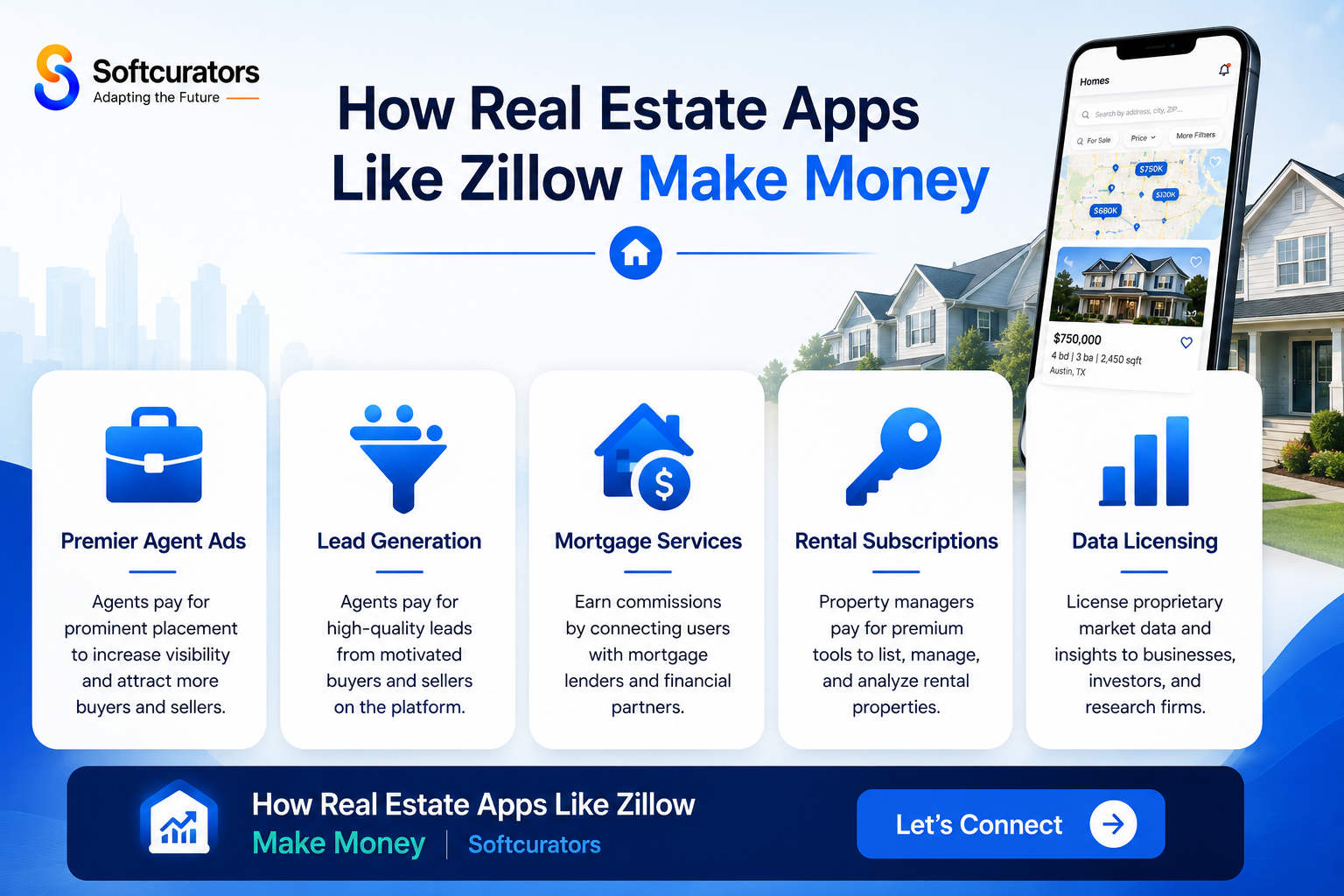
Premier Agent Advertising
This is Zillow’s primary revenue engine. Agents pay to appear as ‘Premier Agents’ on listing pages in their target ZIP codes. Zillow earned over $1.7 billion in 2023 from this model alone. For your platform, this translates to: agent profile promotion, featured placement on listing search results, priority lead routing, and enhanced agent profile pages all as paid tiers.
Lead Generation and Referral Fees
When a buyer contacts an agent through a Zillow-style platform, that is a lead. Platforms charge agents either a flat monthly fee for exclusive territory access or a pay-per-lead model. Referral fee models where the platform takes 25–40% of the agent’s commission on any deal that closes from a platform lead are growing rapidly, particularly in the US and UK markets.
Mortgage and Financial Services
Zillow Home Loans and mortgage marketplace models generate significant revenue from buyers at the highest-intent moment in their journey. A buyer who just found their target property is the ideal mortgage customer. Building a mortgage comparison or lead generation module within your property search app creates a high-value ancillary revenue stream. Softcurators’ fintech app development experience informs how we architect financial service integrations within property platforms.
Rental Listing Fees and Subscription Tiers
Property managers and private landlords pay to list rental units on platforms with strong tenant traffic. Tiered listing packages basic free listings, featured paid placements, and analytics subscriptions for portfolio managers create predictable recurring revenue alongside transaction-based income.
Data Licensing and B2B Integrations
At scale, your property data pricing trends, listing velocity, neighbourhood demand signals becomes a valuable commercial asset. License property market data to mortgage lenders, insurance companies, hedge funds, and urban planning consultancies. This B2B data licensing model becomes meaningful at approximately 500,000 active listings.
Core Features of a Real Estate App Like Zillow
This is where most founders get it wrong. They either build too little and lose users in the first session, or they build too much and run out of runway before launch. At Softcurators, we start every real estate app development project by mapping the minimum feature set that creates a complete property search experience.
Property Search With Advanced Filters
Search is the product. Your search engine must handle location-based queries (city, ZIP code, neighbourhood, school district), price range, property type (single-family, condo, townhouse, multifamily, land), bedroom and bathroom count, square footage range, lot size, year built, and listing status (for sale, for rent, recently sold, off-market). Map-based browsing is not optional it is how buyers actually look for properties. Draw-a-search functionality (user draws a custom boundary on the map) significantly increases time on site.
Property Listing Pages
Each listing page must function as a complete property dossier. High-resolution photo galleries (with virtual tour embed support), full property details and description, floor plan viewer, listing history (previous sales, price changes), estimated monthly payment calculator, neighbourhood statistics (walkability, transit score, school ratings, crime index), nearby amenities, and a clear agent contact or inquiry form. Buyers make decisions worth hundreds of thousands of dollars based on what they see on this page.
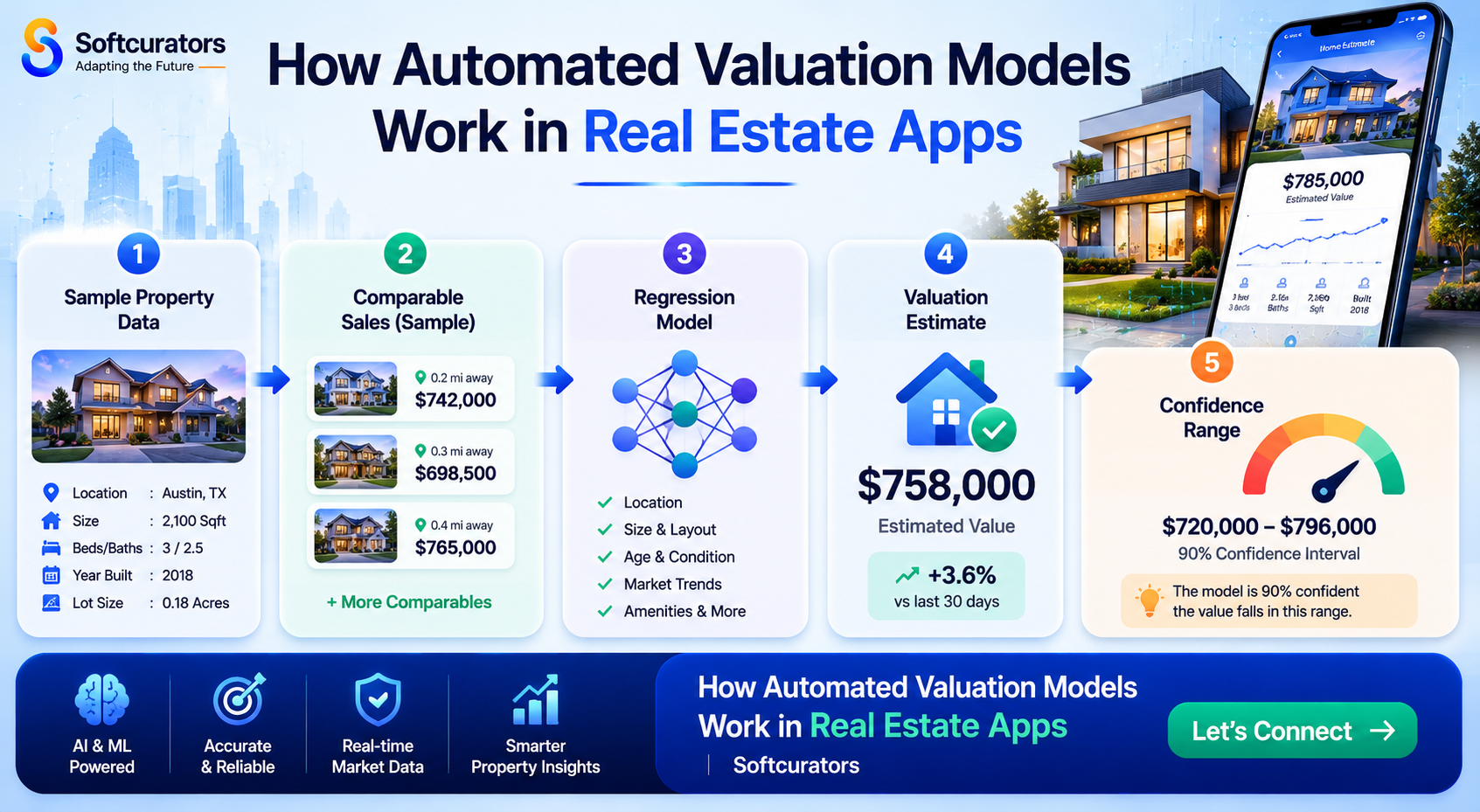
AI-Powered Automated Valuation Model
The Zestimate is Zillow’s most famous feature and the most powerful. An Automated Valuation Model (AVM) estimates a property’s current market value using comparable sales data, property characteristics, location data, and market trend algorithms. Building a basic AVM from day one requires access to property transaction data (MLS feeds or public records) and a regression or gradient boosting model trained on local comps. Softcurators’ AI development and AI app development teams build AVM models as a modular layer that improves continuously as the platform accumulates transaction data.
Agent and Broker Profiles
Every listing connects to an agent. Agent profile pages must show transaction history, active listings, client reviews, response time statistics, and service area maps. Strong agent profiles build buyer trust and agent loyalty simultaneously making them one of the highest-ROI features in the initial build.
Save, Favourite, and Comparison Tools
Buyers research for months before making a decision. Save searches, saved listings, and side-by-side property comparison tools dramatically increase return visit rates and session depth. An email alert system that notifies saved-search users when new matching listings appear is the single most effective retention mechanism in property search apps driving daily active usage from an inherently low-frequency purchase category.
Mortgage Calculator and Affordability Tools
Integrated mortgage calculators that estimate monthly payments based on property price, down payment, interest rate, and loan term dramatically reduce buyer drop-off. Extending this to affordability filters (show me properties where the monthly payment is under $2,500) turns the calculator from a static tool into a core search filter significantly improving search relevance and user satisfaction.
Virtual Tours and 3D Walkthroughs
Virtual tours are no longer a premium feature. They are an expectation. Integration with Matterport 3D tour embeds, Google Street View for neighbourhood walkthroughs, and 360-degree photo galleries for properties without full 3D scans creates a multi-format property viewing experience. Our mobile app UI/UX design best practices guide covers how to present these media-rich pages without compromising load performance.
Market Trends and Neighbourhood Intelligence
Buyers and sellers want to understand the market, not just a property. Neighbourhood-level data median list price trends, average days on market, price-per-square-foot movement, inventory levels, and recent sold comps transforms your app from a listing directory into a market intelligence platform. This data is what makes buyers bookmark your app and return weekly during their search process.
Advanced Features That Separate Fundable PropTech Platforms
Basic features get you to launch. Advanced features get you to Series A and beyond. These are the capabilities that signal to investors and to users that your platform understands where real estate technology is heading.
AI-Powered Property Recommendations
A collaborative filtering recommendation engine surfaces properties that match a buyer’s behaviour patterns properties similar to what they viewed and saved, in price ranges and locations that match their engagement history. As search data accumulates, content-based filtering adds audio and image feature analysis to surface visually similar properties. Softcurators’ AI consulting services team designs this recommendation architecture as a modular system that starts with rule-based matching in V1 and evolves toward machine learning in V2.
Predictive Market Analytics
Predict price movement at the neighbourhood level using macroeconomic signals (interest rates, employment data, migration trends), local market data (listing velocity, days on market, price reduction frequency), and seasonal patterns. This turns your platform from a listing search tool into a market timing advisor a capability that buyers, sellers, investors, and agents are all willing to pay premium subscription fees to access. See our guide on how to develop an AI real estate website for the full technical architecture behind predictive analytics in property platforms.
Off-Market Property Discovery
Off-market listings properties that owners are willing to sell but have not yet listed publicly represent a massive untapped inventory. Building tools that enable agents or investors to identify potential off-market sellers (using public records, tax delinquency data, estate activity signals, and length-of-ownership analysis) creates a unique data advantage that no generic MLS-pull platform can replicate.
Investment Analysis Tools
Real estate investors use different metrics than homebuyers: cap rate, cash-on-cash return, gross rent multiplier, net operating income, and cash flow projection. Building an investment analysis overlay on your existing property search showing these metrics automatically for rental properties based on local rent data opens a lucrative investor audience. Our how to create an investment platform guide covers the financial calculation architecture behind these tools.
AR Property Preview and Digital Staging
Augmented Reality features that allow buyers to visualise furniture placement, renovation potential, or interior colour changes within a real property photo dramatically improve emotional engagement with listings. Digital staging tools that replace empty-room photos with furnished renderings increase listing click-through rates significantly making them a strong upsell to agents and developers.
Smart Home Integration and IOT Data
Properties equipped with smart home systems (energy management, security, HVAC) can share verified performance data actual energy bills, security system uptime, maintenance records with prospective buyers through the listing page. This verified data layer reduces information asymmetry and builds buyer confidence in a way that agent-written descriptions cannot.
Real Estate App Development: The Right Tech Stack
Choosing the right technologies at the start of a real estate app like Zillow build saves months of painful refactoring later. Here is the stack Softcurators recommends for scalable PropTech platforms.
Mobile Platform Strategy
For most real estate app budgets, Flutter app development delivers iOS and Android from a single codebase at 35–40% lower cost than two separate native builds. Flutter’s map integration (Google Maps and Mapbox both have mature Flutter SDKs), camera support for property photo capture, and AR capabilities make it well-suited for real estate apps. However, if deep Apple Maps integration, Core Location features for geofencing, or native iOS widgets are core to the product, iOS app development with Swift provides finer platform control. Our guide on native apps vs hybrid apps covers this decision in full. React Native app development is a strong alternative for teams with existing JavaScript expertise.
Web Frontend
Next.js with React is the standard for property listing web platforms. Server-side rendering is critical individual listing pages must rank on Google, and there are potentially millions of them. Our web development team builds property listing web apps with sub-2-second initial load times, server-side rendered listing pages for SEO, and interactive map search built on Google Maps API or Mapbox. Progressive Web App capability is a strong addition for markets where app store friction reduces mobile adoption.
Backend and API Architecture
Node.js with Express handles real-time search queries, saved search alert delivery, and user activity events well. Python (FastAPI or Django) powers the AVM model, predictive analytics, and recommendation engine. A GraphQL API allows the web and mobile frontends to query exactly the property data they need without over-fetching. REST APIs handle MLS feed ingestion, third-party data integrations, and agent CRM connections.
Database and Geospatial Architecture
PostgreSQL with PostGIS extension is the standard choice for property listing databases it handles geospatial queries (properties within X miles of a point, properties within a drawn polygon) natively and efficiently. MongoDB stores flexible listing content, agent profiles, and search metadata. Redis caches hot search results and AVM estimates for sub-100ms response times on popular queries. Elasticsearch powers the full-text and faceted search layer handling multi-filter property searches across millions of listings without performance degradation.
| Layer | Technology Options | Softcurators Recommendation |
| Mobile (iOS) | Swift / CoreLocation / MapKit | Native for geofencing and Apple Maps features |
| Mobile (Android) | Kotlin / Google Maps SDK | Native for best Android maps performance |
| Cross-Platform Mobile | Flutter, React Native | Flutter preferred 35–40% cost saving |
| Web Frontend | React.js, Next.js | Next.js SSR essential for listing page SEO |
| Backend | Node.js, Python (FastAPI) | Node.js for real-time; Python for AVM + AI |
| Database (primary) | PostgreSQL + PostGIS | Geospatial queries, property data integrity |
| Database (search) | Elasticsearch | Multi-filter search across millions of listings |
| Database (cache) | Redis | Hot search results, AVM estimates < 100ms |
| Maps | Google Maps API, Mapbox | Google Maps for reliability; Mapbox for custom styles |
| Cloud | AWS (EC2, S3, CloudFront, RDS) | Global reliability, auto-scaling for peak search loads |
| Payments | Stripe, regional gateways | Agent subscriptions, listing fees, mortgage referrals |
How to Build a Real Estate App Like Zillow: Step-by-Step Development Process
Building a successful property platform is a structured process not just a sequence of feature builds. At Softcurators, we follow a proven software development methodology that minimises risk and maximises launch speed for every real estate app like Zillow project.
Step 1: Market Research and Geographic Focus
Before design begins, define your geographic focus and user segment. Are you building for buyers in a specific metropolitan area? For rental property investors nationwide? For commercial real estate agents in a specific sector? Talk to 20 real buyers, sellers, and agents in your target market. Understand what specific pain points they have with existing platforms. These conversations shape every subsequent product decision.
Step 2: Data Strategy and MLS Access
Real estate apps need property data. In the US, this means Realtor MLS Board membership and RETS or RESO Web API access. In other markets, it means identifying the equivalent data sources land registry APIs, municipal assessment databases, or commercial data aggregator partnerships. Securing your data access strategy before development begins prevents the most common cause of real estate app launch delays.
Step 3: UX/UI Design
Great mobile app UI/UX design for a real estate app starts with the search-to-listing-page flow. The buying decision is the most significant financial transaction most people ever make. Every screen must build confidence, reduce friction, and surface exactly the information buyers need at each stage of their decision. Map user journeys for three personas: first-time buyer, experienced investor, and listing agent. Build wireframes and test prototypes with real users before any frontend code is written. Our UI/UX design team runs this as a dedicated pre-development phase.
Step 4: MVP Scoping and Prioritisation
A real estate app MVP is not a full Zillow clone. It is the minimum feature set that creates a complete property search experience: map search, listing pages, saved searches, and agent contact. Ship that. Get real user data. Then add AVM, investment tools, and AI recommendations in subsequent releases. Our MVP development and prototype development services help founders define and validate exactly this scope before committing to a full development budget.
Step 5: Backend and Data Pipeline Development
Build the property data ingestion pipeline first. This is the critical path everything else depends on having clean, structured, up-to-date property data. Simultaneously build core APIs: user authentication (with social login), saved search and alert systems, agent profile management, and the initial property search index in Elasticsearch.
Step 6: Mobile and Web Frontend Development
Build the buyer-facing mobile app and web platform in parallel. Our mobile app development team and startup app and web development company service are structured for exactly this kind of parallel workstream. You do not lose six weeks waiting for backend completion before mobile development starts both progress simultaneously.
Step 7: AVM and AI Layer Development
The Automated Valuation Model is a separate data science workstream. Build the property transaction dataset, train the initial regression model, validate against known recent sales, and integrate the API endpoint with the listing page display. Softcurators’ AI development team builds AVM models as a modular service starting with comparable sales regression and scaling toward gradient boosting and deep learning models as transaction data volume grows.
Step 8: Testing, QA, and Compliance
Real estate app testing must cover: search performance under high concurrency (simulate 10,000 simultaneous search queries), map rendering across 20+ device/OS combinations, MLS data feed validation (ensuring listing data accuracy and freshness), payment flow end-to-end testing, and security and compliance testing for user data handling and fair housing compliance requirements.
Step 9: Launch and Agent Acquisition
Launch in one market or one geographic area first. Seed the platform with listings before public launch an empty property search app creates no value and no return visits. Partner with local brokerages to import their active listings directly. Offer agents a free premium listing period. You need property data before you need users this is the same supply-first logic that applies to all two-sided marketplaces.
Step 10: Post-Launch Iteration
After launch, mobile app maintenance and support becomes the primary focus. Monitor search-to-listing-page conversion (the first drop-off point), listing-to-agent-contact conversion (the monetisation trigger), and saved search creation rate (the strongest retention signal). Ship updates every two to four weeks. Platforms with consistent release cadences grow 3x faster than those with quarterly cycles.
Real Estate App Development: Legal and Compliance Requirements
Legal and compliance requirements for real estate apps are more complex than most other app categories. Mobile app security and compliance in PropTech involves fair housing law, MLS data licensing, financial services regulation, and data privacy often simultaneously.
Fair Housing Act Compliance
In the US, the Fair Housing Act prohibits discrimination in housing based on race, colour, national origin, religion, sex, disability, and familial status. Real estate apps must ensure their search algorithms do not filter, recommend, or present listings in ways that effectively steer users toward or away from neighbourhoods based on protected characteristics. This is not just an ethical obligation it is a federal legal requirement, and Zillow itself has faced regulatory scrutiny on this issue. Softcurators designs fair housing compliance into recommendation algorithm architecture from the initial design phase.
MLS Data Licensing and IDX Rules
Using Multiple Listing Service data requires MLS Board membership or an IDX (Internet Data Exchange) data licence. IDX rules govern how MLS listing data can be displayed including required attribution, listing update frequency, accuracy standards, and prohibitions on certain data uses. Violations result in data access termination. Softcurators builds MLS integration architecture that maintains ongoing IDX compliance automatically.
Mortgage and Financial Services Regulation
If your platform includes mortgage referral, lead generation for lenders, or integrated financial products, RESPA (Real Estate Settlement Procedures Act) in the US governs referral fee arrangements. Similar regulations apply in the UK (FCA) and other markets. Get legal counsel on your specific financial service integration before building mortgage features.
Data Privacy: GDPR, CCPA, and State Law
Real estate search apps collect highly sensitive data income information (from affordability calculators), location history, family composition (from bedroom filters), and financial profile signals. GDPR, CCPA, and state-specific privacy laws all apply. Build data privacy architecture at the database schema level explicit consent collection, granular data retention policies, and one-click data deletion from day one.
How Much Does Building a Real Estate App Like Zillow Cost?
Here is a realistic cost breakdown based on Softcurators’ experience across real estate app development projects. For a detailed breakdown, also see our guides on real estate app development cost, cost to develop a property listing app, and AI real estate software development cost.
| Development Component | Cost Range (USD) | Notes |
| UX/UI Design | $2,000 – $5,000 | Map search, listing pages, agent profiles, comparison tools |
| Property Data Pipeline (MLS + ETL) | $3,000 – $8,000 | MLS feed ingestion, normalisation, daily refresh logic |
| Mobile App (iOS + Android) | $12,000 – $35,000 | Flutter cross-platform recommended for budget efficiency |
| Web Frontend (Next.js SSR) | $3,000 – $10,000 | Buyer web app + server-side rendered listing pages |
| Backend + Search (Elasticsearch) | $5,000 – $15,000 | APIs, PostGIS geo-search, saved alerts, auth, admin |
| AVM / AI Valuation Layer | $4,000 – $15,000 | Comparable sales regression, API endpoint, listing display |
| Agent Portal and Dashboard | $3,000 – $8,000 | Listing management, lead tracking, analytics, payments |
| Payment Integration | $1,000 – $4,000 | Stripe subscriptions, agent billing, listing fee collection |
| Admin Panel | $1,000 – $5,000 | Content moderation, user management, data quality tools |
| QA, Security, and Compliance | $2,000 – $6,000 | Fair housing audit, MLS compliance, performance testing |
| TOTAL (MVP) | $10,000 – $35,000 | Core search, listings, AVM, agent contact, saved searches |
| TOTAL (Full Platform) | $30,000 – $50,000+ | All features including AI recommendations, investor tools |
For broader context on mobile app development cost drivers, see our detailed pricing guide. Our startup app and web development company service is structured for phased development delivering a real, searchable property MVP at the lower end of the cost range, then scaling features as the platform validates.
How Long Does It Take to Build a Real Estate App Like Zillow?
| Phase | Duration | Key Output |
| Discovery and Data Strategy | 2 – 3 weeks | Feature scope, MLS access plan, tech stack selection |
| UX/UI Design | 3 – 5 weeks | Wireframes, prototypes, map search UI, listing pages |
| Data Pipeline and Backend | 6 – 10 weeks | MLS ingestion, Elasticsearch index, core APIs |
| AVM / AI Valuation | 4 – 6 weeks | Comparable sales model, API endpoint, validation |
| Mobile + Web Frontend | 8 – 14 weeks | Buyer app, web platform, agent portal |
| Testing, QA, Compliance Audit | 3 – 4 weeks | Fair housing, MLS compliance, performance, security |
| Launch and App Store Submission | 2 – 3 weeks | App store review, staged rollout, data seeding |
| TOTAL (MVP) | 2 –3 months | Core search, listing pages, AVM, agent contact live |
| TOTAL (Full Platform) | 3 – 6 months | All features, AI recommendations, investment tools |
Working with Softcurators compresses this timeline through parallel workstreams. You see working property search with real listings every two weeks, not a finished platform after twelve months. See our guide on mobile app development for startups for more on timeline planning.
Common Mistakes That Kill Real Estate App Projects
Most property platforms fail for predictable and entirely avoidable reasons. Here is what Softcurators sees most consistently and how we help clients sidestep each one.
Mistake 1: Launching Without Clean Property Data
A property search app with stale, incomplete, or inaccurate listings destroys user trust within the first session. If a buyer contacts an agent about a property that sold three months ago, they never return. Invest in a robust data ingestion, normalisation, and refresh pipeline before the first user sees a listing page.
Mistake 2: Ignoring Map Performance
Map-based property search requires rendering thousands of markers simultaneously with smooth zoom and pan performance. This is a technically demanding mobile challenge. Using the wrong map SDK, failing to implement clustering for high-density markets, or not caching map tile data leads to poor performance that users attribute to ‘the app being slow’ when the real issue is an engineering oversight. Softcurators implements map clustering and tile caching from the first build.
Mistake 3: Skipping the AVM from Day One
Founders often defer the AVM to a future phase. The problem: training an effective AVM requires transaction history data from your platform’s geographic focus. If you do not collect property transaction events from day one, building a credible AVM in V2 requires sourcing expensive third-party transaction databases. Softcurators designs the transaction data collection pipeline into the initial backend architecture even before the AVM model is trained.
Mistake 4: Building for Buyers Without a Supply Strategy
A property search app with no listings has zero value. Before launching to buyers, you need agent partners who will actively add listings to your platform. The agent acquisition strategy is as important as the technology build. Most successful PropTech platforms launch in a single market and personally onboard the first 50 agent partners before opening to public users.
Mistake 5: Choosing a Development Partner Without PropTech Experience
Real estate apps have unique requirements MLS API integration, geospatial database architecture, AVM data science, fair housing compliance that most general development agencies have never built. Softcurators has delivered real estate app development projects with all of these requirements. Check our portfolio and read why companies choose Softcurators. Then contact us to discuss your specific project.
Marketing Your Real Estate App: Getting Your First 1,000 Active Users
Building the app is only half the challenge. Driving qualified buyer and agent traffic to a new property platform requires a deliberate, two-sided acquisition strategy.
Agent Acquisition: Your Supply Side
Start with direct outreach to independent agents and boutique brokerages in your target market. Offer free premium listing placement for the first year. Provide agents with detailed analytics on how many buyers viewed their listings through your platform even before paying to demonstrate value before asking for commitment. Partner with real estate investor associations, mortgage broker networks, and property management companies for bulk listing imports.
Buyer Acquisition: Your Demand Side
Use Google Ads targeting high-intent searches like ‘homes for sale in [city]’ and ‘[neighbourhood] real estate.’ Facebook and Instagram ads targeting life-event audiences (recently engaged, expecting parents, recent graduates) reach buyers at exactly the right moment. Build an SEO content strategy around local neighbourhood guides, school district analyses, and market condition reports. Our digital marketing services team helps property platforms build and execute these growth strategies alongside the development project.
Retention: The Metrics That Predict Long-Term Growth
Real estate search is inherently low-frequency until a buyer reaches high purchase intent. The metrics that predict long-term retention are: saved search creation rate (highest-signal engagement action), email alert open rate (the primary return visit driver), and session depth on listing pages (time spent reading details, viewing photos, and checking the mortgage calculator). Track these weekly from day one.
Emerging Trends Shaping Real Estate App Development
Generative AI for Property Search
Natural language property search ‘find me a three-bedroom home near good schools with a big garden under $400,000’ is rapidly moving from concept to production feature. Generative AI models convert conversational queries into structured search parameters, dramatically reducing search friction for first-time buyers. Softcurators’ AI development team builds natural language search interfaces as a modular API layer on top of existing Elasticsearch search infrastructure.
Blockchain-Based Property Transactions
Smart contract-based property transactions are beginning to reduce title transfer timelines from weeks to days in pilot markets. Tokenised real estate fractional ownership through blockchain tokens is creating new investment access models, particularly for high-value commercial properties. Building a platform that supports tokenised property investment requires specific financial services regulatory compliance alongside the technical architecture.
Climate Risk Scoring
Flood risk, wildfire proximity, heat island intensity, and sea level rise projections are becoming standard buyer research requirements particularly for long-term investments. Integrating climate risk data into listing pages (sourced from providers like First Street Foundation or ClimateCheck) is transitioning from differentiator to expected feature in premium real estate platforms. See our mobile app development trends guide for broader PropTech trend context.
Hyper-Local Market Intelligence
Buyers want neighbourhood-level intelligence that goes beyond school ratings and walkability scores restaurant opening rates, business licence applications (a leading indicator of neighbourhood vitality), construction permit trends, and demographic shift data. Platforms that surface this hyper-local intelligence create a data advantage that generic MLS-pull apps cannot replicate.
Why Softcurators for Your Real Estate App Development
Understanding how to build a real estate app like Zillow is one thing. Building a platform that actually captures a specific market is another. Softcurators approaches every PropTech project with an architecture-first, market-aware philosophy.
PropTech-Specific Architecture Philosophy
Most development agencies build apps that happen to display property listings. Softcurators builds property search platforms that happen to run as apps. The distinction is in how we treat the search-to-listing-page conversion flow as the primary product surface, not a feature. Every decision, from PostGIS index design to Elasticsearch query structure, is evaluated through the lens of: does this make the property search experience better or worse for a buyer at high purchase intent?
Full-Stack PropTech Capability
Softcurators covers the complete real estate development stack. Our iOS app development team handles CoreLocation, MapKit, and ARKit for augmented reality property previews. Android app development team handles Google Maps SDK and Android geofencing. Flutter app development practice delivers cross-platform apps at 35–40% lower cost. Our web development team builds SSR listing pages for SEO. Our AI development and AI app development teams build AVM models and recommendation engines. Everything in one engagement.
From MVP to Full PropTech Platform
Not every client needs an AI-powered investment analytics suite in V1. Our MVP development and prototype development services help founders define the minimum feature set that validates their specific PropTech hypothesis. AI automation services layer automates listing refresh, agent lead routing, and buyer nurture sequences as the platform scales. Our maintenance and support services keep the platform fast, secure, and evolving post-launch.
Your Next Step: Building a Real Estate App Like Zillow Starts With One Conversation
The opportunity to build a real estate app like Zillow is real, specific, and growing. The technology is accessible. The niches that Zillow underserves regional markets, investor tools, off-market discovery, AI-first search are large and undermonetised. And the founders who build property platforms designed for a specific segment with the right architecture from day one will have a compounding advantage over those who iterate on a platform not built to support where the market is going.
Softcurators builds from the buyer’s decision backward. We design V1 with V2 and V3 in mind. Embed the transaction data pipeline before the AVM model is trained. Architect the search index before the first listing is ingested. We build the agent monetisation infrastructure before the first agent subscribes.
Book a free strategy call with Softcurators today and let us map out exactly how to build your property platform for where the real estate market is heading.
Further reading: Real Estate App Development | How to Create a Real Estate App | AI Real Estate Website Development | Flutter App Development | Mobile App Development Technologies | Our Portfolio
FAQs
How much does it cost to build a real estate app like Zillow?
A focused MVP with core search, listing pages, AVM integration, agent contact, and saved searches costs between $10,000 – $35,000. A full platform with AI recommendations, investment analysis tools, mortgage integration, and advanced agent tools ranges from $30,000 – $50,000+ or more. For detailed breakdowns, see our real estate app development cost guide and cost to develop a property listing app guide. Softcurators provides exact scoped estimates within 48 hours of a free discovery call.
How long does it take to build a real estate app?
A focused MVP takes five to seven months. A full platform with all advanced features requires ten to sixteen months. Softcurators uses parallel development workstreams backend, mobile, and web development progressing simultaneously to compress this timeline. You see working property search with real listings every two weeks, not a finished product after twelve months.
What technology stack is best for a real estate app like Zillow?
For most budgets: Flutter for cross-platform mobile, Next.js for the web frontend, Node.js for the backend, PostgreSQL with PostGIS for geospatial property data, Elasticsearch for multi-filter search, Redis for caching, and Google Maps API or Mapbox for map functionality. Python handles the AVM and AI recommendation layer. Stripe handles agent subscription billing. Softcurators evaluates this stack against each client's specific requirements and adjusts accordingly.
What is an AVM and do I need one?
An Automated Valuation Model (AVM) estimates a property's current market value using comparable sales data, property characteristics, and location signals. Zillow's Zestimate is the most famous example. An AVM transforms your platform from a passive listing directory into an active market intelligence tool dramatically increasing user engagement and return visit rates. Softcurators builds AVM models as modular services that improve continuously as transaction data accumulates.
Do I need MLS access to build a real estate app?
In the US, accessing MLS listing data requires either MLS Board membership (direct access) or an IDX data licence (indirect access through an approved aggregator). Both require compliance with IDX display rules. Outside the US, equivalent data sources include land registry APIs, municipal assessment databases, and commercial property data aggregators. Softcurators helps clients identify and secure the right data access pathway for their target market before development begins.
What is the difference between building for buyers vs. investors?
Buyer-focused apps optimise for emotional engagement beautiful photos, school ratings, neighbourhood lifestyle data, mortgage calculators. Investor-focused apps optimise for financial decision support cap rate calculators, cash flow projections, rental yield analysis, comparable transaction data. Many successful platforms serve both, but investors and buyers have fundamentally different search behaviours, data needs, and session patterns. Softcurators designs feature sets that serve each persona distinctly within a single platform.
Can I build a real estate app without a technical background?
Yes. You need a product vision, a revenue model, and the right development partner. Softcurators has helped multiple non-technical founders launch successful PropTech platforms managing the complete technical workstream while keeping founders informed and in control at every milestone.
What is IDX and why does it matter?
IDX (Internet Data Exchange) is the system that allows real estate websites and apps to display MLS listing data under specific licensing rules. IDX rules govern attribution requirements, data refresh frequency (typically every 24 hours minimum), accuracy standards, and display format requirements. Violating IDX rules results in data access termination. Softcurators builds MLS integration architecture that maintains automated IDX compliance on an ongoing basis.
How does Zillow make money, and can my app use the same model?
Zillow's primary revenue stream is Premier Agent advertising agents pay for featured placement and lead routing in their target ZIP codes. Secondary revenue comes from mortgage services, rental listing fees, and StreetEasy (New York City market). Your app can adopt the same commission and advertising model, or differentiate with subscription tiers, referral fee models, investor data subscriptions, or direct transaction facilitation fees. The right model depends on your market and user segment.
How do I handle fair housing compliance in my real estate app?
Fair housing compliance requires that your search algorithms, recommendation engine, and listing display do not steer users toward or away from neighbourhoods based on protected characteristics (race, religion, national origin, sex, disability, familial status). In practice, this means auditing your recommendation model for demographic bias, ensuring neighbourhood labelling uses geographic rather than demographic descriptors, and documenting your algorithm design for regulatory review. Softcurators designs fair housing compliance into recommendation architecture from the initial design phase.
What makes a great property listing page?
A great listing page combines comprehensive property information with trust-building design. Specifically: high-resolution photo gallery with virtual tour embed, full property details and description, listing history (previous prices, days on market), automated valuation estimate with confidence range, monthly payment calculator, school ratings and nearby amenities, neighbourhood market trend data, a clear agent profile with response time data, and a frictionless contact or inquiry form. Each element reduces a different buyer uncertainty.
How do I build map-based search for a real estate app?
Map-based search requires: a mapping SDK (Google Maps or Mapbox), property marker clustering for high-density markets (to avoid performance collapse when zooming out on a city), draw-a-search polygon tool, saved map area alerts, and performance optimisation for rendering thousands of markers simultaneously on mobile. Softcurators implements clustering, tile caching, and progressive loading as standard in every property map build.
Should I build native iOS and Android apps or use Flutter?
For most real estate app budgets, Flutter delivers both platforms at 35–40% lower cost than separate native builds. Flutter's Google Maps and Mapbox SDKs are mature enough for production property search apps. Native iOS (Swift) is preferred when CoreLocation geofencing, ARKit property preview, or native iOS widgets are core features. Native Android (Kotlin) is preferred for markets with high Android share and apps requiring deep Google Maps integration. Our native apps vs hybrid apps guide covers this decision in full.
How do I monetise a real estate app without charging buyers?
Buyers should never pay for basic property search. Monetise through the supply side: agent premium placement fees and lead subscriptions, listing upgrade fees for enhanced photo galleries or featured placement, mortgage referral commissions, rental listing packages for property managers, and investor data subscriptions for market analytics access. This model free for buyers, paid for professionals is the standard across all major real estate platforms.
What data sources do I need to build a real estate app?
Core data sources include: MLS or equivalent property listing feed, property transaction history (for AVM training), school ratings (GreatSchools API or equivalent), walkability and transit scores (Walk Score API), crime data (local authority APIs or third-party providers), demographic and neighbourhood statistics (US Census API or equivalent), and mortgage rate feeds for calculator integration. Softcurators manages data source identification and integration contract negotiation as part of the discovery phase.
How does an Automated Valuation Model work?
An AVM estimates property value by: identifying comparable recent sales within a geographic radius and similarity threshold, applying regression or gradient boosting models that weight comps by recency, proximity, and similarity, adjusting for property-specific characteristics (size, age, condition, features), and incorporating local market trend signals (price movement direction, days on market trends). The model improves in accuracy as it accumulates more training data from local transactions. Softcurators builds AVM models from comparable sales regression (V1) and scales toward gradient boosting as data volume grows.
How do I handle rental listings in a real estate app?
Rental listings require separate data flows and distinct user journeys from sale listings. Key rental-specific features include: monthly rent display with utility inclusion status, lease term flexibility filters, pet policy and deposit requirements, application management tools for landlords, tenant screening integration (credit check and background check APIs), and lease document management. Softcurators builds rental and sale listing management as parallel but distinct workflows within a unified platform architecture.
What analytics should a real estate app track from launch?
From day one, track: search-to-listing-page conversion (primary search quality signal), listing-to-agent-contact conversion (primary monetisation signal), saved search creation rate (strongest return-visit predictor), email alert open and click rates (retention quality measure), AVM estimate accuracy vs. final sale price (model quality signal), and agent response time from the platform (user experience quality measure). These six metrics provide a complete picture of platform health in the first six months.
How do I integrate mortgage tools into a real estate app?
Basic integration is a client-side calculator (JavaScript function using property price, down payment, interest rate, and loan term inputs). Advanced integration involves mortgage lead generation (passing qualified buyer information to partner lenders for a referral fee), live mortgage rate feeds from financial data providers, and pre-qualification tools that help buyers understand their purchasing power before searching. RESPA compliance review is required before any referral fee arrangement is implemented.
Can I add AI property recommendations to a real estate app?
Yes and it significantly improves retention. Collaborative filtering (users who viewed X also viewed Y) works from approximately 10,000 active users. Content-based filtering (properties similar to what you saved, based on visual and metadata features) works from day one. Natural language search (convert conversational queries into structured search parameters) works with any data volume. Softcurators designs recommendation architecture that starts with content-based filtering and scales toward collaborative filtering and deep learning as user data grows.
How do virtual tours work in a real estate app?
Virtual tours are typically implemented by embedding third-party 3D tour providers Matterport being the most common within listing pages. The embed displays the full 3D walkthrough within the app or web page without requiring a separate app download. For properties without a Matterport scan, 360-degree photo galleries (using equirectangular photos and a WebGL viewer) provide a lower-cost alternative. Google Street View integration provides neighbourhood context. Softcurators implements all three formats based on listing availability and host preferences.
How do I scale a music streaming app from launch to one million users?
Zillow's advantages are: data scale (largest MLS-pull listing database in the US), Zestimate brand recognition (buyers trust the number even with its limitations), agent advertising network effects (agents pay Zillow because buyers use Zillow), and cross-platform consistency (the mobile app, web app, and email alert experience are seamless). Competitors win by focusing on specific niches where Zillow's generic approach underserves users investors, off-market buyers, luxury properties, and regional markets outside the US.
How do I scale a real estate app from launch to one million listings?
Scaling requires: PostgreSQL read replicas for high-query-volume listing pages, Elasticsearch index sharding for large listing counts, CDN-distributed photo delivery for fast image loading globally, microservices separation for search, valuation, and agent management workloads, automated MLS feed refresh with error handling and alerting, and load testing simulating 50,000 simultaneous search queries before each major release. Softcurators designs scaling architecture into the initial infrastructure build avoiding the expensive re-architecture that growing platforms typically face at 100,000 listings.
What is the best way to onboard the first agents to a new real estate platform?
The most effective approach is direct personal outreach to independent agents and boutique brokerages in your launch market. Offer free premium placement for the first 12 months. Provide weekly performance reports showing how many buyers viewed their listings through your platform even during the pre-revenue phase. Partner with local real estate investor associations, mortgage broker networks, and title companies who can refer agents. One partnership with a 50-agent brokerage seeds the platform faster than individually recruiting 50 agents.
How do I build a real estate app for a market outside the US?
Building outside the US requires: identifying the local equivalent of MLS data sources (land registry APIs, municipal property databases, commercial aggregators), understanding local fair housing and data privacy laws, integrating local mapping providers where Google Maps coverage is limited, supporting local currency and language throughout the platform, and adapting the AVM model to local market characteristics. Softcurators has built real estate platforms for UK, UAE, South Asian, and Southeast Asian markets with all of these local adaptations.
How do I handle artist royalty payments in a music streaming app?
Royalty payment infrastructure requires: per-stream royalty calculation (based on each artist's contractual rate and the platform's total stream count), monthly or quarterly payout processing (typically via Stripe Connect or a similar marketplace payment platform), tax form collection from artists (W-9 for US artists, W-8 for international), and detailed royalty reporting that artists can access through their dashboard. Softcurators builds this infrastructure drawing on our fintech app development experience with complex payment distribution systems.
Can I add AI music generation to my streaming app?
Yes and it creates a unique capability that catalogue licensing alone cannot replicate. AI music generation allows users to create personalised mood tracks, workout soundtracks, or ambient audio that fits their precise requirements. Softcurators has specific experience building AI music generation features see our guide on how to develop an AI music generation app like Suno AI for the technical architecture. Integration adds $5,000–$15,000 to a standard music platform build.
What is PropTech and how does my app fit in?
PropTech (Property Technology) encompasses all digital technology applied to real estate property search platforms (Zillow, Rightmove), transaction management tools (DocuSign, SkySlope), investment platforms (Fundrise, RealPage), smart home technology (Nest, Ring), and construction technology (PlanGrid, Procore). A real estate search app like Zillow sits in the property search and discovery category the highest consumer traffic segment of PropTech. Softcurators builds across multiple PropTech categories see our real estate app development industry page for the full scope.
Q: Should I include school ratings in a real estate app?
School ratings (typically sourced from GreatSchools in the US) are one of the highest-engagement data points on property listing pages particularly for family buyers. However, fair housing advocates have raised concerns that presenting school ratings by neighbourhood may indirectly incorporate racial or socioeconomic bias. The industry standard is to display school ratings as factual data provided to buyers while avoiding using school performance as a recommendation or ranking factor in search algorithms. Consult legal counsel on the specific implementation approach for your target market.
How important is SEO for a real estate app?
SEO is critically important for property listing platforms. Individual listing pages 'homes for sale in [neighbourhood]', '[address] property details' drive enormous organic traffic if properly structured. This requires server-side rendering (Next.js), unique and automatically generated meta titles and descriptions for each listing, structured data markup (Schema.org RealEstateListing), fast page load times, and a comprehensive internal linking strategy between listings, neighbourhood pages, and market report content. Softcurators builds SEO architecture into every real estate web platform from the first backend sprint.
How do I get started building a real estate app like Zillow with Softcurators?
The first step is booking a free 30-minute strategy call at softcurators.com/contact. Our senior architect will review your concept, discuss your target market and geographic focus, assess your data access strategy, and evaluate which features are essential for V1 versus V2. We deliver a scoped cost estimate within 24 hours followed by a detailed proposal within three to five business days. No obligation. No generic template. A real architect who has built property platforms, thinking specifically about your market.
