

Real estate has always been a data-heavy industry hiding behind a visual, emotional product. Every listing is a photo gallery and a price tag, but underneath it sits square footage, comparable sales, tax records, and increasingly, AI in real estate mobile apps that quietly decides what a buyer sees first, what a home is probably worth, and whether a chat message gets answered by a person or a model.
This guide is written for the founder, CTO, or product manager deciding what AI actually belongs in a real estate app, and how to build it without underestimating the data and compliance work sitting underneath the visible features. If you’re earlier in the process and scoping the app itself, our guide to how to create a real estate app covers the broader product foundation this article builds on.
Consultant’s Tip: Before scoping any AI feature covered in this guide, ask where the underlying data comes from and who’s responsible for its accuracy. Nearly every AI feature in real estate – recommendations, valuations, market predictions – is a data problem wearing an AI feature’s clothing, and the data question deserves as much planning attention as the model itself. Keep that question in front of you as you work through each section below.
What Does AI Actually Do Inside a Real Estate App Today?
AI in a real estate mobile app refers to machine learning systems that personalize property discovery, estimate value, automate buyer and tenant communication, analyze listing photos, enhance virtual tours, and forecast market trends – each a distinct capability with its own data requirements and technical approach, not a single unified “AI feature.”
The six capabilities covered in this guide are:
- Property recommendations – surfacing listings matched to a buyer’s behavior and stated preferences.
- Automated valuation models (AVMs) – estimating a property’s market value from comparable data.
- Chatbots and virtual assistants – automating buyer, tenant, and lead qualification conversations.
- Computer vision – analyzing listing photos, detecting rooms and features, and supporting virtual staging.
- AI-enhanced virtual tours – combining 3D capture with AI-guided navigation and highlights.
- Predictive market analytics – forecasting price trends and investment potential from historical data.
Who needs this: Any platform with a meaningful listing volume and real user traffic benefits from at least basic recommendation and search personalization, since even simple filtering improvements measurably affect engagement in a visually driven, high-consideration purchase category like real estate.
Who doesn’t: A small, hyper-local brokerage app with a handful of listings and a tight-knit client base gets little from AI personalization – there isn’t enough inventory or traffic volume to meaningfully differentiate recommendations, and a simple, well-organized listing browser will outperform a personalization layer with nothing to learn from.
Business Insight:
The AI feature that gets the most marketing attention – recommendations – is rarely the one with the clearest return. Automated valuation and lead-qualifying chatbots tend to have a more direct, measurable link to conversion and agent productivity, since they touch the transaction funnel more directly than a better-sorted listing feed. Keep this distinction in mind when marketing claims and actual measured impact start to diverge.
For the industry context behind this feature set, our real estate app development industry page and our real estate marketplace app development guide both cover the broader product landscape these AI features sit inside.
How Do AI-Powered Property Recommendations Actually Work?
AI property recommendation systems rank listings for a specific buyer by combining stated preferences (price range, bedrooms, location) with behavioral signals (which listings they viewed, saved, or dismissed), then continuously refine that ranking as more behavioral data accumulates – a more advanced approach than static filters alone.

We’ve covered the technical mechanics of this specifically in AI-powered property recommendation systems explained, which goes deeper into the modeling approaches than we can here. At a high level, most systems blend explicit filters with a lighter-weight behavioral layer, rather than relying on pure collaborative filtering the way a media app might, since real estate transactions are infrequent and high-stakes – there’s rarely enough repeat behavior from a single user to train a purely behavioral model well.
Technical Note: Real estate recommendation differs from retail or media recommendation in one structural way worth understanding early: inventory disappears. A recommended listing can go under contract within days, which means the system needs to handle inventory churn gracefully – surfacing similar active listings when a saved favorite disappears – rather than assuming stable inventory the way a product catalog might.
This churn-handling requirement is easy to overlook during initial design, since a recommendation demo built on a static dataset won’t reveal it, but it becomes immediately visible once the system runs against a live, constantly changing listing feed.
Common Mistake: Over-personalizing search results to the point that a buyer can no longer see the full available inventory in their stated criteria. Real estate buyers, more than most e-commerce shoppers, want confidence that they’re seeing everything relevant, not just what a model thinks they’ll like – recommendation should augment a complete, filterable listing view, not replace it.
How Do Automated Valuation Models (AVMs) Estimate a Property’s Worth?
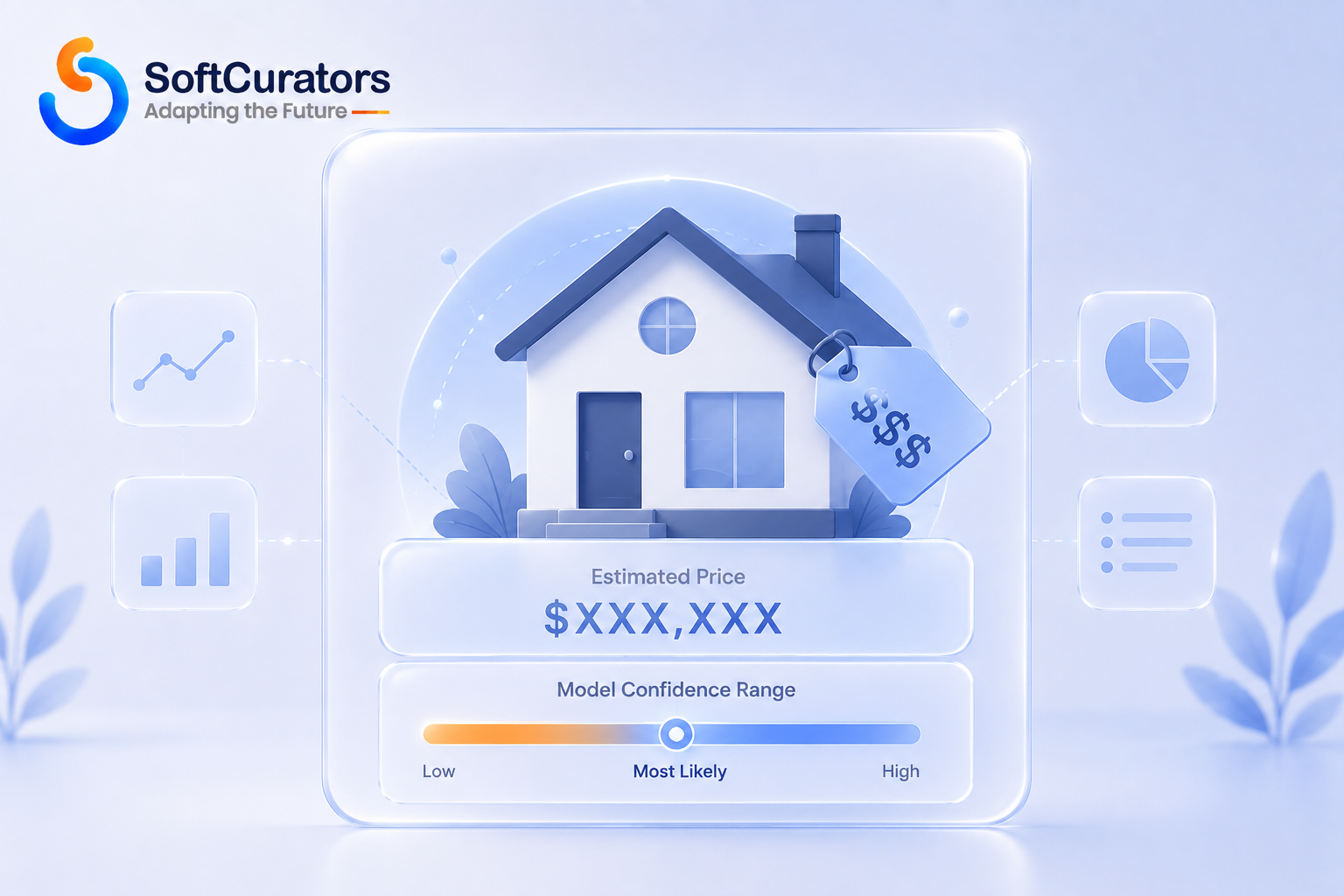
An automated valuation model, or AVM, estimates a property’s market value by analyzing comparable recent sales, property characteristics, and location data through a statistical or machine learning model, producing an estimate without a human appraiser’s on-site inspection.
What an AVM Actually Needs to Work Well
AVM accuracy depends heavily on the depth and freshness of comparable sales data in a given market – a well-covered urban market with frequent transactions produces a meaningfully more reliable estimate than a rural area with sparse recent sales. This is a data coverage problem before it’s a modeling problem, and it’s worth being explicit with users about estimate confidence rather than presenting every AVM output with equal certainty.
AVMs Are Estimates, Not Appraisals
Risk Alert: An AVM is a statistical estimate, not a substitute for a licensed appraisal, and presenting it without that distinction creates both a user-trust problem and, depending on your jurisdiction and use case, potential regulatory exposure. This is not financial or legal advice, and any platform using AVM output to influence lending, insurance, or transaction decisions should have that specific use case reviewed by qualified counsel, since appraisal-adjacent regulation varies by market.
Business Perspective: A well-communicated AVM – showing a confidence range rather than a single number, and clearly labeling it as an estimate – builds more long-term user trust than a precise-looking figure that turns out to be significantly off. Precision theater is a common and avoidable mistake in this specific feature, and it tends to erode trust faster than a transparently uncertain estimate ever would.
Our breakdown of AI real estate software development cost covers what building or licensing AVM capability typically involves from a budget standpoint.
How Do AI Chatbots and Virtual Assistants Fit Into a Real Estate App?
AI chatbots in real estate apps handle initial buyer or tenant inquiries, qualify leads by asking structured questions, schedule showings, and answer common questions about a listing or the buying process – freeing agents to focus on qualified conversations rather than repetitive initial contact.
For a more advanced, persona-driven virtual assistant experience – a consistent AI-presented agent personality that greets and guides users – our AI avatar development work covers how this is typically built beyond a basic text chatbot.
Operational Perspective: A chatbot’s value depends heavily on a clean handoff to a human agent at the right moment. The most common failure mode isn’t a bad answer from the bot – it’s a buyer stuck in an automated loop with no clear path to a real person once their question exceeds the bot’s scope. Define and test that handoff explicitly, rather than treating it as an edge case.
Common Mistake: Deploying a chatbot trained on generic real estate knowledge rather than your specific listing inventory and local market details. A chatbot that can’t answer basic questions about the exact property a user is asking about does more damage to trust than not having a chatbot at all.

How Does Computer Vision Analyze Property Photos and Support Virtual Staging?
Computer vision models analyze listing photos to automatically detect room types, identify features (fireplace, hardwood floors, updated kitchen), flag low-quality or non-compliant images, and support virtual staging – digitally furnishing an empty room in photos to help buyers visualize the space.
Automatic Photo Tagging and Quality Checks
Automatically tagging photos by room and feature reduces manual listing entry work and improves search and filtering (“homes with a fireplace”) without requiring an agent to tag every image by hand. Quality checks – flagging blurry, poorly lit, or watermarked images – help maintain listing presentation standards at scale across a large inventory.
Virtual Staging: What It Can and Can’t Replace
Virtual staging helps buyers visualize an empty or dated space, but disclosure matters – most markets and listing platforms require virtually staged images to be clearly labeled as such, since an unlabeled digitally staged photo can be considered misleading. Build this disclosure into the feature from the start rather than treating it as a policy add-on.
Common Mistake: Offering virtual staging without a clear, consistent labeling convention across every image where it’s used. Inconsistent disclosure is both a trust problem with buyers and a compliance risk with listing platforms and real estate boards that have specific rules about staged image disclosure.
How Are AI and Virtual Tours Combined in Modern Real Estate Apps?
AI-enhanced virtual tours combine 3D or 360-degree property capture with AI-guided navigation, automatic room labeling, and sometimes conversational narration, letting a remote buyer explore a property in more depth than a static photo gallery without requiring an in-person visit.
Teams building native AR-supported tour features work directly with each platform’s augmented reality framework – Apple’s ARKit documentation on iOS and Google’s ARCore documentation on Android – both of which define how a device captures and renders spatial data, and both are worth reviewing early since they materially affect what’s technically feasible on a given device generation.
Technical Note: AR-capable virtual tour features depend on device hardware that varies significantly across your user base’s phones. Plan a graceful fallback – a standard photo gallery or simpler 360-degree viewer – for devices or browsers that don’t support the full AR experience, rather than making the AR path a hard requirement to view a listing.
Future Perspective: Combining virtual tour navigation with a conversational AI layer – letting a user ask “what’s the kitchen like” while touring a space and get a spoken or text response drawing on the listing’s photo and feature data – is an emerging direction worth watching rather than a current standard, and it depends heavily on the computer vision and chatbot capabilities covered above already being solid.
How Does Predictive Analytics Support Market Trend Forecasting?
Predictive market analytics uses historical pricing, inventory, and transaction data to forecast trends – price direction in a given neighborhood, seasonal demand patterns, or investment potential for a specific property type – giving buyers, investors, and agents a forward-looking view beyond current listing data.
Our AI-powered business intelligence guide covers the broader analytics and forecasting techniques this feature category draws on, applicable beyond real estate specifically.

Risk Alert: Market predictions are probabilistic estimates based on historical patterns, not guarantees of future performance, and presenting them as anything more definitive creates both a trust problem if the market moves differently than predicted and potential liability if the platform is perceived as giving investment advice. Clear, consistent disclaimers on any forward-looking market content are worth building into the UI itself, not just the terms of service.
Business Perspective: Predictive analytics tends to matter most for investor-focused platforms and less for typical owner-occupant buyer apps, where current listing accuracy and a smooth transaction experience matter more than forward-looking market forecasts. Scope this feature based on your actual user base’s investment orientation, not as a default addition.
How Is AI Used in Document Processing and Transaction Workflows?
AI-assisted document processing extracts and validates data from leases, purchase agreements, and mortgage documents, flags missing or inconsistent information, and can route documents through an approval workflow automatically – reducing manual data entry in a transaction process that’s traditionally paper- and PDF-heavy.
For platforms handling mortgage or lending-adjacent workflows alongside property search, our what is fintech overview and cost to develop a loan lending app guide cover the adjacent lending technology landscape, and our AI automation services page covers how document workflow automation is typically approached as its own capability.
Risk Alert: Document processing that touches financial or lending information inherits the compliance requirements of that adjacent industry, not just general app security. Our overview of security and compliance for digital lending platforms addresses what changes when a real estate workflow extends into financial document handling specifically.
Why Does Real Estate AI Depend So Heavily on Data Quality?
Every AI capability covered so far – recommendations, valuations, market predictions – is only as accurate as the property data feeding it, which makes data sourcing and pipeline design a foundational decision that determines the ceiling on every AI feature built on top of it.
MLS Feeds and Industry Data Standards
Most real estate platforms in the US source listing data from a Multiple Listing Service (MLS) feed, structured according to standards maintained by the Real Estate Standards Organization (RESO), which defines common data fields and formats so listing data can move between systems consistently. Understanding which data standard your data provider uses, and how current your feed refresh cycle is, directly affects how reliable your AI features will be – stale or inconsistent data quietly degrades every model built on top of it.
Building a Reliable Data Pipeline
Our AI-powered DataOps guide covers the broader practice of building and maintaining reliable data pipelines that AI features depend on, which applies directly to a real estate platform pulling from MLS feeds, public records, and possibly multiple regional data sources at once.
Technical Note: Data pipeline reliability is rarely a visible feature, which makes it easy to under-invest in relative to its actual impact – a recommendation or valuation model built on a well-designed pipeline with monitoring for stale or missing data will consistently outperform a more sophisticated model sitting on an unreliable feed.
Public Records and Alternative Data Sources
Beyond MLS feeds, county tax assessor records, permit filings, and flood zone or hazard data all feed into a more complete property profile, supporting features like AVM accuracy and risk-aware recommendations. These sources are typically fragmented across jurisdictions with inconsistent formats, which is part of why a well-designed data pipeline – one that normalizes and reconciles multiple sources – matters as much as the AI model built on top of it.
Business Perspective: Coverage of public records data varies significantly by county and state, and this variability directly affects feature quality in a way that’s easy to overlook when evaluating a data provider primarily on price. Ask specifically about coverage in your target markets, not just aggregate national coverage claims.

Should You Build Custom AI or License Third-Party Real Estate AI and Data Providers?
This is the central technical decision behind almost every feature in this guide: should you build your own AI models on your own data pipeline, or license AI capability and data access from an established third-party real estate data or AI provider? Getting this decision right for your specific stage matters more than any individual feature choice.
Choose to build custom AI when:
- You already have substantial proprietary listing or transaction data that a generic third-party model wouldn’t have access to.
- AI-driven personalization or valuation accuracy is genuinely your core competitive differentiator, not a supporting feature.
- You have or can build dedicated data engineering and ML capacity for ongoing model maintenance.
Choose to license third-party providers when:
- You’re early-stage without a large proprietary dataset to train meaningful models on.
- Established providers already cover your specific market with data quality you couldn’t easily replicate.
- Time-to-market matters more than owning the underlying model or data pipeline.
Cost implications: Licensed data and AI services typically carry ongoing subscription or usage-based fees but lower upfront engineering cost; building custom models requires significant upfront investment in data engineering and ML capacity, with the payoff coming only if you reach a scale where owning the pipeline is genuinely more cost-effective than paying per-use fees indefinitely.
Maintenance implications: A licensed provider handles data freshness and model maintenance as part of the service; a custom-built pipeline puts that ongoing responsibility, including monitoring for data quality issues, on your own team indefinitely.
Scalability implications: Licensed providers generally scale coverage across markets more easily, since they’ve already built the data relationships; custom pipelines scale well technically but require your team to establish new data sourcing relationships for every new market you expand into.
Risk factors: Custom builds carry model-accuracy risk, especially in markets with thin data coverage, and key-person risk if only a small team understands the pipeline; licensed providers carry vendor dependency risk, including pricing changes and potential data coverage gaps in less-served markets.
Time-to-market impact: Licensing is almost always faster to a working feature, since it avoids the data-sourcing and pipeline-building work that has to happen before a custom model can even begin training on reliable data.
Expert Recommendation: A hybrid approach is common in practice: license established data providers for baseline listing and comparable-sales data, while building custom logic specifically for the personalization or matching layer that reflects your platform’s particular user base and positioning – rather than treating “build” or “license” as an all-or-nothing choice across every AI feature in this guide.
Comparison Table: Build Custom AI vs. License Third-Party Providers
| Factor | Build Custom AI | License Third-Party Providers |
| Upfront cost | High – data engineering and ML capacity required | Lower – subscription or usage-based |
| Time to first working feature | Months, dependent on data pipeline readiness | Weeks to a couple of months |
| Ongoing responsibility | Your team owns data quality and model maintenance | Provider maintains data freshness and model accuracy |
| Market expansion | Requires new data sourcing per market | Provider coverage often already spans multiple markets |
| Best fit | Proprietary data advantage, AI as core differentiator | Early-stage, standard feature set, faster launch priority |
Note: Treat this as a relative planning comparison – actual cost, timeline, and provider coverage vary by market and vendor, and should be verified directly before committing to either path.
Comparison Table: AI Feature Categories by Cost, Timeline, and Data Dependency
Beyond the build-versus-license decision, the six feature categories in this guide differ meaningfully in cost, timeline, and how dependent they are on data quality – worth comparing side by side when prioritizing a roadmap.
| Feature Category | Relative Cost | Typical Time to First Version | Data Dependency |
| Property recommendations | Moderate | Weeks to a couple of months | High – needs behavioral and listing data |
| Automated valuation (AVM) | Moderate–High | Months | Very high – needs dense comparable sales data |
| Chatbots / virtual assistants | Low–Moderate | Weeks | Moderate – needs accurate listing content |
| Computer vision (photo tagging, staging) | Moderate | Weeks to months | Low – mostly needs image data, not market data |
| AI-enhanced virtual tours | Moderate–High | Months | Low – depends more on capture hardware than data |
| Predictive market analytics | High | Months | Very high – needs historical trend data |
Note: Ranges are directional planning inputs, not quotes – actual cost and timeline depend on market coverage, vendor selection, and whether features are built or licensed.

What Team Roles and Skills Are Needed to Build These AI Features?
Understanding who actually builds and maintains real estate AI features makes both a build-versus-license decision and a vendor conversation more concrete, since “AI development” spans several distinct disciplines that rarely live in one person for anything beyond a very small MVP.
| Role | Primary Responsibility | Most Relevant To |
| Data Engineer | Builds and maintains pipelines pulling MLS, public records, and third-party data | Recommendations, AVMs, predictive analytics |
| ML Engineer / Data Scientist | Designs, trains, and tunes recommendation and valuation models | Recommendations, AVMs, predictive analytics |
| Backend Developer | Builds APIs connecting AI services to the mobile app | All AI features |
| Mobile Developer | Implements AI-driven UI, AR tour experiences, and chatbot interfaces | Chatbots, virtual tours, computer vision display |
| Compliance / Legal Reviewer | Reviews models for fair housing and data privacy exposure | Recommendations, AVMs, predictive analytics |
| QA Engineer | Tests AI feature accuracy, edge cases, and device compatibility | All AI features |
Business Insight: Licensing established data and AI providers reduces the need for dedicated data engineering and ML capacity in-house, which is a major part of why licensing tends to reach a working feature faster for teams without existing data science capacity. The compliance and legal review role, however, remains necessary regardless of build-versus-license, since the platform deploying the feature carries the regulatory exposure either way.
Common Mistake: Assuming a general mobile development team can absorb data engineering and ML responsibilities without dedicated expertise. This often works for basic photo tagging or simple filtering, but tends to produce unreliable results for recommendation ranking or valuation modeling, where data pipeline discipline and model tuning genuinely require specialized skill.
How Do You Localize AI Features for Different Real Estate Markets?
Real estate AI features that work well in one market don’t automatically translate to another, since language, measurement conventions, and local regulatory context all affect how these features need to be built and presented.
Language and Conversational Interfaces
Chatbot and conversational search quality varies by language, and a language model performing well in English may perform noticeably worse in another language without dedicated tuning. If your platform serves multiple language markets, budget for market-by-market quality testing rather than assuming uniform performance from a single underlying model.
Measurement Units and Local Market Conventions
Square footage versus square meters, local price-per-unit conventions, and regional norms around what counts as a “comparable” property for valuation purposes all need to be reflected in both the data pipeline and the user-facing presentation. These are easy to overlook when a product is first built for a single home market and later expanded.
Common Mistake: Assuming a recommendation or valuation model trained primarily on one country’s data will generalize cleanly to a new market. Local pricing dynamics, typical property characteristics, and data availability all differ enough that meaningful retuning, not just translation, is usually required.
How Does AI Affect Real Estate Agent Productivity and Workflow?
Every AI feature covered so far has focused on the buyer or tenant-facing experience, but a meaningful share of real estate AI value shows up on the agent and brokerage side – lead scoring, automated follow-up sequencing, and CRM integration that reduces manual administrative work agents would otherwise handle by hand.
Lead Scoring and Prioritization
AI-based lead scoring analyzes buyer behavior – search activity, saved listings, response time to messages – to help agents prioritize which inquiries are most likely to convert, rather than treating every lead as equally worth immediate attention. This is a genuinely different use of the same underlying behavioral data that powers buyer-facing recommendations, applied to an internal workflow instead.
Automated Follow-Up and CRM Integration
Operational Perspective: Automated, AI-assisted follow-up sequences – a scheduled check-in message after a showing, a nudge when a saved listing changes price – reduce the manual coordination burden on agents managing many active leads simultaneously. This tends to have a clearer, more immediately measurable ROI for brokerages than buyer-facing personalization, since it directly affects agent capacity and response time.
Business Insight: If your platform serves agents and brokerages directly, rather than only end buyers and renters, agent-facing AI tools are worth evaluating with equal priority to buyer-facing features – and in many cases, they show a more direct and easier-to-measure return, since agent time saved translates fairly directly into agent capacity and, ultimately, more transactions handled.

What Compliance and Bias Risks Are Specific to Real Estate AI?
Real estate AI carries a regulatory risk that most general mobile AI content doesn’t address: algorithmic bias in recommendations or valuations can create fair housing exposure if a model, even unintentionally, produces discriminatory patterns based on protected characteristics or their close proxies, such as neighborhood demographics correlated with race.
Fair Housing Considerations for AI Features
In the US, the Fair Housing Act prohibits discrimination in housing-related activities based on protected characteristics, and this applies to algorithmic systems, not just human decision-making. A recommendation or valuation model trained on historical data can inadvertently learn and reproduce past discriminatory patterns even without anyone intending that outcome, which is why this deserves specific review, not an assumption that “it’s just math, so it’s neutral.”
Risk Alert: This is not legal advice, and fair housing and anti-discrimination regulation is genuinely complex and jurisdiction-specific. Any platform building recommendation or valuation models on real estate data should have that specific model reviewed by qualified legal counsel for fair housing compliance, ideally before launch rather than after a complaint surfaces the issue.
General Data Privacy Compliance
Beyond fair housing, standard data privacy obligations apply as they would for any app handling personal and behavioral data, including regulations such as the General Data Protection Regulation for EU/EEA users, and general mobile app security practices following frameworks like OWASP Mobile Application Security. Our overview of mobile app security and compliance covers the general mobile security foundation this sits on top of.
Common Mistake: Treating fair housing compliance as a legal afterthought handled through a terms-of-service disclaimer rather than something reviewed during model design itself. By the time a biased pattern surfaces in production, it’s already affected real users and created real exposure – review needs to happen before launch, at the design stage.
How Do You Test and Monitor Real Estate AI Features After Launch?
Shipping an AI feature isn’t the finish line – recommendation, valuation, and predictive models all need ongoing measurement, and the right metric differs meaningfully by feature rather than following one universal engagement number.
Choosing the Right Metric Per Feature
Recommendation quality is best tracked through saved-listing rate and inquiry conversion over weeks, not a single session’s engagement. AVM accuracy should be tracked against actual sale prices once transactions close, giving a genuine accuracy benchmark rather than relying on user-reported confidence alone. Chatbot performance is best measured by successful handoff rate and resolved-without-human-escalation rate, since raw message volume says little about whether the bot is actually helping.
Monitoring for Data and Model Drift
Operational Perspective: Real estate markets shift, sometimes quickly, and a valuation or recommendation model accurate at launch can drift out of alignment with current conditions if not periodically reviewed. Schedule a recurring accuracy check against real outcomes – closed sale prices for AVMs, actual buyer behavior for recommendations – rather than treating a launch validation as sufficient indefinitely.
Risk Alert: Bias monitoring deserves the same recurring cadence as accuracy monitoring, not a one-time pre-launch check. A model that passed fair housing review at launch can still develop biased patterns over time as underlying data shifts, particularly in markets experiencing rapid demographic or pricing changes.
Consultant’s Tip: Build a simple internal dashboard tracking accuracy and fairness metrics side by side for every AI feature in production, reviewed on a fixed schedule by both a technical owner and someone accountable for compliance. Treating these as separate, disconnected review processes is a common and avoidable gap.
Common Mistakes When Adding AI to a Real Estate App
- Building recommendation or valuation models without reviewing fair housing exposure. This is one of the more consequential and industry-specific risks in this entire guide.
- Presenting AVM estimates without a confidence range or clear “estimate, not appraisal” labeling. This creates both a trust problem and potential regulatory exposure depending on how the estimate is used downstream.
- Under-investing in the data pipeline while over-investing in the model itself. A sophisticated model on unreliable data consistently underperforms a simpler model on a well-maintained pipeline.
- Deploying a chatbot without a clear, tested handoff to a human agent. Buyers stuck in an automated loop with no escape path is one of the most common sources of user frustration with real estate chatbots.
- Offering virtual staging without consistent, clear disclosure. Inconsistent labeling is both a trust issue and a compliance risk with listing platforms and real estate boards.
- Over-personalizing search results until buyers can’t see full available inventory. Real estate buyers want confidence they’re seeing everything relevant, not just an algorithm’s curated subset.
- Presenting market predictions as guarantees rather than probabilistic estimates. This creates a trust problem if the market moves differently than predicted, and potential liability if perceived as investment advice.
- Expanding an AI model into a new market without retuning it. Local pricing dynamics and data availability differ enough that translation alone rarely produces reliable results in a new market.
- Overlooking agent-facing AI tools in favor of only buyer-facing features. Lead scoring and automated follow-up often deliver a more directly measurable return for brokerage-serving platforms specifically.
How Should You Prioritize Which AI Feature to Build First?
With six feature categories and two structural decisions (build vs. license, and how to handle compliance) covered in this guide, the practical question most readers actually face is sequencing – what to build first, given limited budget and engineering time.
A Simple Prioritization Framework
Weigh each candidate feature against three questions: how directly does it affect a core business metric (conversion, agent productivity, retention), how dependent is it on data quality you don’t yet have confidence in, and how much compliance review does it require before launch. Features that score well on business impact but poorly on data readiness are worth deferring, not abandoning – they’re simply not first.
Expert Recommendation: For most platforms without an existing AI feature set, a reasonable sequence starts with computer vision-based photo tagging (low data dependency, low compliance risk, clear operational value), followed by basic recommendation filtering, then chatbots for lead qualification, with AVMs and predictive analytics – the most data- and compliance-intensive categories – sequenced later once the data pipeline and compliance review process are both proven out on lower-risk features first.
Decision Checklist:
- Which feature most directly affects a metric your business already tracks and cares about?
- Which features can launch on your current data pipeline without additional data sourcing work?
- Which features require compliance review before launch, and is that review process already established or still being built?
What Does It Cost to Add AI Features to a Real Estate App?
Cost varies significantly depending on which AI features you pursue, whether you build or license the underlying data and models, and how many markets you need to cover, so treat any figure as a directional planning input rather than a quote.
Our dedicated breakdowns of AI real estate software development cost and real estate app development cost cover this specifically, and our cost to develop a property listing app guide addresses the non-AI baseline these features typically sit on top of.
Technical Note: Ongoing data licensing fees are one of the more commonly underestimated costs in real estate AI specifically – unlike a one-time model build, MLS and comparable-sales data access is typically an ongoing subscription cost that scales with the number of markets you cover, and it’s worth budgeting as a recurring line item from the start.

What Do Real-World Real Estate AI Implementations Look Like?
Seeing how these AI capabilities play out in specific, real product categories makes the framework in this guide easier to apply. We’ve published detailed breakdowns across several real estate app categories, each touching different combinations of the AI features covered here.
- How to build a real estate app like Zillow, covering a listing-and-valuation-heavy product where AVM accuracy and recommendation quality are central to the experience.
- How to build a property rental app like Airbnb, where recommendation and search personalization carry more relative weight than valuation.
- Real estate marketplace app development, covering the broader marketplace mechanics AI features sit inside.
- How to develop an AI real estate website, for teams considering a companion web experience alongside the mobile app.
Where Is AI in Real Estate Apps Headed Next?
The following are directional trends based on current product and market momentum, not settled fact – verify against current market conditions before treating any of these as a firm planning assumption. Our broader mobile app development trends overview covers adjacent shifts worth factoring into a longer-term roadmap.
- Conversational search over structured filters – letting buyers describe what they want in natural language rather than adjusting filter sliders – is gaining ground as language model integration becomes more accessible.
- Tighter integration between virtual tours and computer vision, enabling AI-guided navigation and feature highlighting within a single tour experience rather than as separate capabilities.
- Growing regulatory attention on algorithmic fairness in housing-related decisions, likely increasing the compliance review burden on recommendation and valuation models over time.
- More granular, hyperlocal predictive analytics as data providers improve coverage in previously thin markets, gradually narrowing the accuracy gap between well-covered urban markets and less-covered ones.
Final Summary and Next Steps
AI in real estate mobile apps isn’t a single feature – it’s six distinct capabilities, each depending on a reliable data foundation and, in several cases, carrying compliance considerations that are specific to housing and don’t show up in general mobile AI guidance. Recommendations, valuations, chatbots, computer vision, virtual tours, and predictive analytics each deserve their own deliberate build-or-license decision, rather than a blanket “add AI” line item on a roadmap.
The platforms that get this right treat data quality and fair housing review as foundational work, not afterthoughts bolted on after a feature is already built. They also resist the instinct to add every AI capability at once, instead prioritizing the one or two features that most directly support their specific user base and transaction model.
Consultant’s Tip: Before your next roadmap review, list every AI feature under consideration and note, for each one, where its underlying data comes from and whether it’s been reviewed for fair housing exposure. Gaps in either column are exactly what a focused technical review should address before development starts.
One closing point worth carrying forward: the sequencing question matters as much as the feature list itself. Starting with lower-risk, lower-data-dependency features and building organizational muscle around data quality and compliance review before tackling AVMs or predictive analytics tends to produce a more reliable outcome than attempting every capability in this guide simultaneously.
Risk Alert: None of the frameworks in this guide are a one-time exercise. Data provider coverage, AI model capabilities, and fair housing enforcement priorities all continue to evolve, and a decision that was sound at launch can need revisiting within a year. Build a recurring review of your AI feature set into your regular product planning cadence, rather than treating this guide as a single reference consulted only once.
Next Step
If you’re evaluating which AI features actually make sense for your real estate platform – and how to structure the data pipeline underneath them – an Architecture Review with Softcurators is a practical way to work through your specific data sources, feature priorities, and build-versus-license trade-offs before committing development time. Softcurators works across AI app development, AI consulting services, and mobile app development. You can review our real estate app development industry page, browse our broader solutions overview, or get in touch directly to start the conversation.
Frequently Asked Questions
How accurate are AI-powered property valuations (AVMs)?
Accuracy depends heavily on data coverage in a given market - well-covered urban markets with frequent recent sales produce more reliable estimates than markets with sparse transaction data. AVMs should always be presented as estimates, not substitutes for a licensed appraisal.
Is it legal to use AI for property recommendations?
Yes, but recommendation and valuation models carry fair housing compliance considerations in the US specifically, since biased outcomes can create legal exposure even without intentional discrimination. This should be reviewed by qualified legal counsel during model design, not treated as a general software question.
What's the difference between a chatbot and a virtual assistant in a real estate app?
A chatbot typically handles structured, text-based Q&A and lead qualification; a virtual assistant often adds a consistent AI-presented persona and broader conversational range, sometimes including voice. Both depend on being trained on your specific listing data, not just generic real estate knowledge.
Do I need my own data pipeline, or can I rely entirely on a third-party provider?
Many platforms start entirely on licensed third-party data and add proprietary data pipelines later as they accumulate their own listing or transaction history. This is a legitimate build-vs-license decision to make deliberately rather than defaulting to either extreme.
How does MLS data affect AI feature quality?
AI features are only as accurate as the underlying data feed. A current, well-structured MLS feed following RESO data standards produces meaningfully better recommendation and valuation results than a stale or inconsistently formatted feed, regardless of how sophisticated the model itself is.
Can virtual staging mislead buyers?
It can, if not clearly disclosed. Most markets and listing platforms require virtually staged images to be labeled as such, since an unlabeled digitally staged photo can misrepresent the property's actual condition.
Should predictive market analytics be a priority feature?
It depends on your audience. Investor-focused platforms benefit more directly from market forecasting than typical owner-occupant buyer apps, where current listing accuracy and transaction experience usually matter more to the average user.
What happens if an AI recommendation model produces biased results?
This creates genuine fair housing exposure in the US specifically, since algorithmic discrimination is treated the same as human discrimination under the law. Models should be reviewed for this risk during design and monitored on an ongoing basis after launch, not just checked once before launch.
How much does it cost to add AI features to an existing real estate app?
It varies significantly based on which features you add and whether you build or license the underlying data and models - licensed approaches generally cost less upfront but carry ongoing subscription fees, while custom builds cost more upfront with potentially lower long-term per-market cost at scale.
Do AI features work the same across different real estate markets?
Not necessarily. Data coverage varies by market, which directly affects the accuracy of valuation and recommendation features. A model performing well in a data-rich urban market may perform noticeably worse in a market with thinner data coverage.
Is computer vision necessary, or is it a nice-to-have?
Automatic photo tagging and quality checks provide real operational value by reducing manual listing entry work, even for platforms not pursuing more advanced features like virtual staging. It's a reasonably accessible entry point into computer vision for many platforms.
How do AR-based virtual tours differ from standard 360-degree tours?
AR-based tours use device-level augmented reality frameworks to enable more interactive, spatially aware navigation, while standard 360-degree tours are typically simpler panoramic image viewers. AR features also depend more heavily on device hardware capability, requiring a fallback experience for unsupported devices.
Should a real estate chatbot fully replace human agents for initial inquiries?
Generally not entirely. Chatbots work best handling structured initial qualification and common questions, with a clear, tested handoff to a human agent once a conversation exceeds the bot's scope - full replacement tends to frustrate buyers with more complex or nuanced questions.
What's the biggest hidden cost in real estate AI features?
Ongoing data licensing fees are commonly underestimated, since MLS and comparable-sales data access is typically a recurring subscription cost that scales with market coverage, unlike a one-time model development cost.
Can a small real estate startup realistically compete on AI features against larger platforms?
Yes, particularly by licensing established data and AI providers rather than trying to build proprietary infrastructure from scratch. Larger platforms' advantage often comes from data scale and market coverage more than from proprietary AI technique, both of which are increasingly available through third-party providers.
How often should an AVM or recommendation model be reviewed for accuracy?
On a recurring, scheduled basis rather than only at launch. Real estate markets shift, and a model that was accurate at launch can drift out of alignment with current market conditions if not periodically reviewed and, where needed, retrained.
Does adding AI features increase our data privacy obligations?
Often yes - personalization and behavioral tracking features process user data that may bring additional obligations depending on your operating markets, including regulations like the GDPR for EU/EEA users. This is jurisdiction-specific and worth reviewing with legal counsel for your exact markets.
Is it worth building a custom AI model instead of licensing one?
Only if AI is genuinely core to your competitive positioning and you have, or can build, the data engineering capacity to maintain it. For most early-stage platforms, licensing established providers reaches a working feature faster and with less ongoing operational burden.
What should I ask a vendor before licensing a real estate AI or data provider?
Ask specifically about data refresh frequency, market coverage in your target areas, what data standard they follow (such as RESO), and how model accuracy is monitored and maintained over time - these questions reveal more about actual quality than a general capability pitch.
How do AI features affect app performance and load times?
Cloud-based AI features like recommendations and chatbots generally have minimal direct impact on app performance, since processing happens server-side. Computer vision and AR-based tour features can be more resource-intensive on-device, making performance testing across a range of hardware worthwhile before launch.
Can AI help with rental applications and tenant screening?
AI can assist with document processing and structured data extraction from rental applications, but tenant screening decisions carry the same fair housing considerations as sales-side recommendation models, and should be reviewed with the same regulatory care.
Do I need a dedicated data science team to maintain real estate AI features?
Not necessarily if you're licensing third-party providers, which typically handle data and model maintenance as part of the service. A dedicated data science capability becomes more relevant if you're building and maintaining custom models on your own data pipeline.
How long does it typically take to add a basic AI recommendation feature to an existing app?
Licensing an established provider and integrating it into existing search and listing infrastructure is typically a matter of weeks to a couple of months; building a custom model, including data pipeline work, typically takes considerably longer.
What's a reasonable first AI feature for a real estate app team to prioritize?
For most platforms, automatic photo tagging and basic recommendation filtering deliver clear value with comparatively low complexity and risk, making them a reasonable starting point before more complex or compliance-sensitive features like AVMs or predictive analytics.
What team roles are actually needed to build AI features for a real estate app?
At minimum, a data engineer to manage the data pipeline, a backend developer to connect AI services to the app, and a compliance reviewer for fair housing exposure. Recommendation and valuation models specifically also benefit from a dedicated ML engineer or data scientist.
How often should a real estate AI model be reviewed after launch?
On a recurring, scheduled basis, not just at launch. Both accuracy (comparing AVM output to actual closed sale prices, for instance) and fairness metrics should be reviewed on a fixed cadence, since markets shift and models can drift out of alignment with current conditions.
Does public records data matter as much as MLS data for real estate AI?
It matters for different things. MLS data drives current listing and comparable sales information, while public records - tax assessments, permits, hazard data - add depth for valuation and risk-aware features. Both benefit from a well-designed pipeline that reconciles inconsistent formats across sources.
Can I license real estate AI features without hiring any data science staff?
Yes, for most licensed provider relationships. The provider typically handles model training and data maintenance as part of the service, though you'll still want a compliance reviewer on your side regardless of build-versus-license, since regulatory exposure sits with the platform deploying the feature.
Is it expensive to add fair housing compliance review to an AI feature?
It's a meaningfully smaller investment than the cost of retrofitting a biased model after it's already affected users, or the potential legal exposure from an unreviewed model in production. Treating it as a standard part of model design, not a separate expensive audit, keeps the cost proportionate.
Do AI features benefit real estate agents directly, or just buyers?
Both. Lead scoring and automated follow-up tools reduce agents' administrative burden and help prioritize the leads most likely to convert, often with a more directly measurable return than buyer-facing personalization alone.
Can the same AI model be used across multiple countries or languages?
Rarely without meaningful adaptation. Local pricing dynamics, measurement conventions, and language all affect model performance, so expanding into a new market typically requires retuning, not just translating the existing model.
What's the difference between AI-based lead scoring and general CRM automation?
General CRM automation follows predefined rules; AI-based lead scoring analyzes actual behavioral patterns to rank leads by likely conversion probability, adapting as more data accumulates rather than relying on a fixed rule set.
Which AI feature should a real estate app team build first?
For most teams without an existing AI feature set, starting with lower data-dependency, lower-compliance-risk features like photo tagging or basic recommendation filtering is more practical than starting with AVMs or predictive analytics, which require more mature data and compliance processes.
Do I need to rebuild my whole app to add these AI features, or can they be added incrementally?
Most of these features can be added incrementally to an existing app through API integration, provided the underlying listing data and metadata are in reasonable shape. A full rebuild is rarely necessary purely to add AI capability.
How do I evaluate whether a real estate AI vendor's data coverage is good enough for my target markets?
Ask specifically about coverage in your target counties or regions, not just aggregate national numbers, and ask how frequently the feed refreshes. A vendor with broad national coverage can still have meaningful gaps in specific markets that matter to your platform.
Is there a risk in launching an AI feature before your data pipeline is fully mature?
Yes - a feature launched on an immature data pipeline tends to produce inconsistent or inaccurate results that can damage user trust before the underlying data problem is fixed. It's generally better to delay a data-dependent feature than launch it on an unreliable foundation.
Should a real estate platform build its own computer vision model or use an existing image recognition API?
For most platforms, an existing image recognition API is more practical than training a custom computer vision model from scratch, since photo tagging and quality detection are relatively standard capabilities available through established providers.
What's the realistic ROI timeline for AI features in a real estate app?
It varies by feature, but agent-facing tools like lead scoring often show measurable impact on agent productivity within a few months, while buyer-facing personalization typically shows its effect more gradually, through retention and engagement trends over a longer period.
Should a startup real estate app invest in AI before or after reaching product-market fit?
Generally after establishing basic product-market fit with core listing and search functionality. AI features, particularly data-dependent ones like recommendations and AVMs, perform better once there's real usage data to work with, and early-stage teams often get more value from nailing the fundamentals first.
