

Ninety-seven percent of home buyers now use the internet during their property search. Yet the vast majority of real estate websites still offer little more than a filtered list, some photos, and a contact form. That gap between what buyers expect and what most platforms deliver is exactly why building an AI real estate website is one of the most lucrative opportunities in PropTech today.
Zillow, Redfin, and Rightmove are not just property portals. They are AI-powered platforms that know what you want before you do. They predict pricing, recommend listings by behaviour, flag undervalued properties, and answer buyer questions around the clock. Building a platform that competes or carves its own niche requires understanding exactly how to develop an AI real estate website from the ground up.
At Softcurators, we build AI-powered real estate platforms for founders, agencies, and enterprises. We have built Zillow-style listing platforms, AI valuation tools, virtual tour websites, and property investment portals. This guide is built on that hands-on experience not theory.
By the end of this guide, you will know: exactly what features define a world-class AI real estate website, the step-by-step development process, the right tech stack, realistic cost ranges, and the mistakes that kill real estate platforms before they gain traction. Let us get into it.
What Is an AI Real Estate Website and Why Build One?
An AI real estate website is a property platform that uses artificial intelligence, machine learning, and data science to deliver experiences that static listing sites simply cannot. Rather than showing all users the same filtered results, an AI platform learns, personalises, predicts, and automates.
According to the National Association of Realtors, 97% of home buyers use the internet in their property search and 76% use a mobile device. The opportunity is enormous. But so is the competition.
What Makes an AI Real Estate Platform Different
Traditional real estate websites do three things: list properties, filter search, and display agent contact info. An AI-powered platform does far more:
- Predicts which listings a specific user will want before they search for them
- Estimates property valuations in real time using comparative market analysis powered by ML models
- Answers buyer and renter questions 24/7 through trained conversational AI
- Identifies investment opportunities by analysing yield, appreciation potential, and neighbourhood trends
- Qualifies leads automatically routing serious buyers to agents and nurturing less-ready prospects
- Generates property descriptions, marketing copy, and neighbourhood reports automatically
The Market Opportunity for AI Real Estate
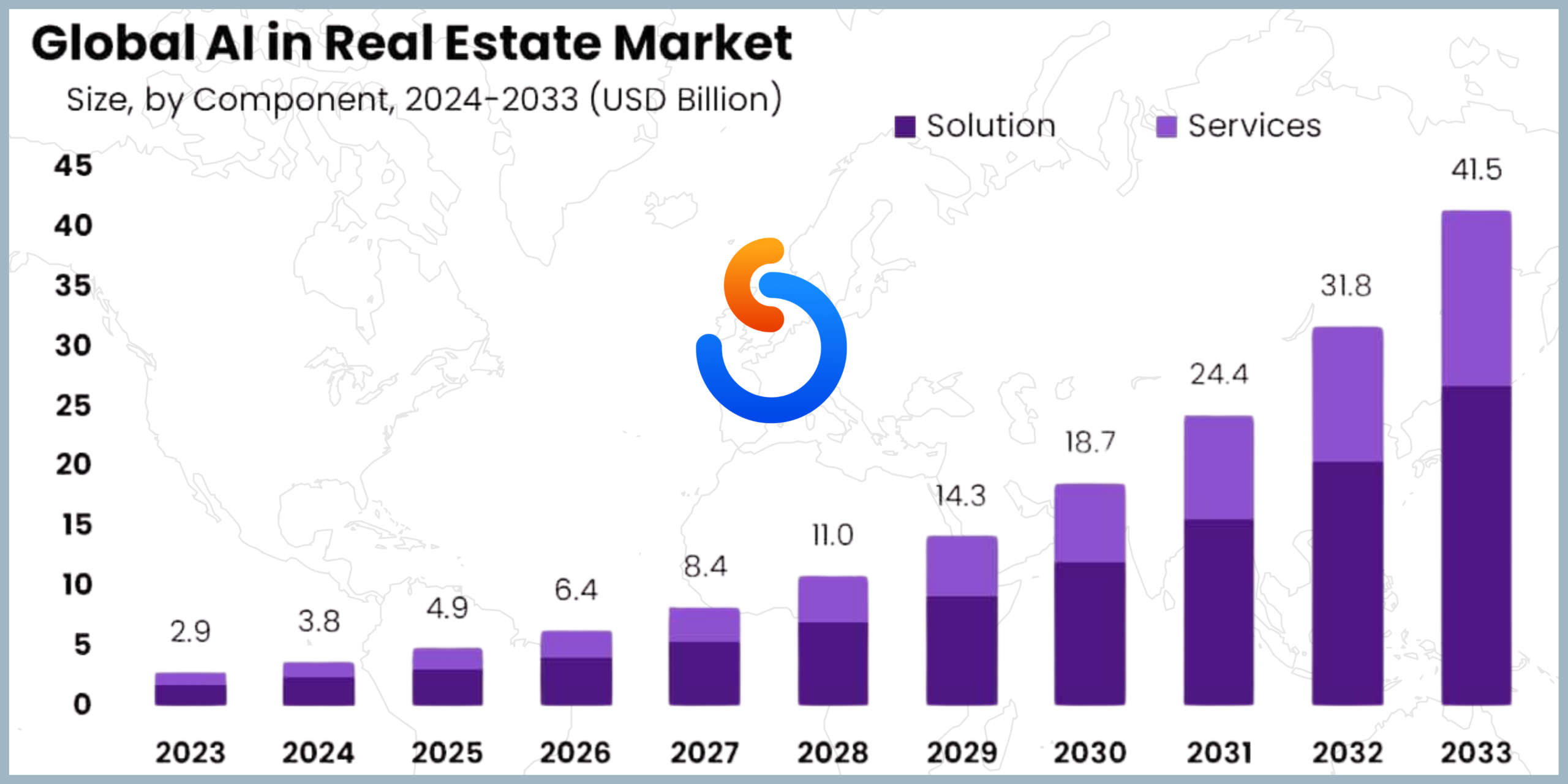
The global real estate technology market reached $15.3 billion in 2024 and is growing at a CAGR of 16.8% through 2030. AI within that market is the fastest-growing segment. Venture capital poured over $2.1 billion into PropTech AI startups in 2024 alone.
Three specific trends make the right time to build. First, generative AI has made property description writing, virtual staging, and conversational search commercially viable for the first time. Second, computer vision has reached the quality threshold needed for reliable automated property inspection and virtual tours. Third, large language models now enable natural language property search users can type “3-bed house with a garden under £400k in walking distance to a tube station” and get precise results.
For more context on why this space is growing, see our guide on real estate app development and the complete real estate marketplace app development guide.
Types of AI Real Estate Websites You Can Build
Not every AI real estate platform is the same. Before writing a line of code or brief, choose your platform type. This decision determines your feature set, revenue model, licensing requirements, and competitive positioning.
| Platform Type | Primary Users | AI Feature Focus | Revenue Model | Examples |
| Listing & Discovery Portal | Buyers, renters, sellers | Personalised search, price prediction | Subscription, lead gen, ads | Zillow, Rightmove, Redfin |
| Agent & Brokerage CRM Platform | Agents, brokers | Lead scoring, nurturing, automated follow-up | SaaS subscription | Follow Up Boss, kvCORE |
| Property Investment Analyser | Investors, asset managers | ROI prediction, yield analysis, risk scoring | Subscription, commission | Mashvisor, PropStream |
| AI Valuation Tool | Sellers, lenders, appraisers | AVM (Automated Valuation Model) | API per-call, subscription | Zestimate, HouseCanary |
| Virtual Tour & Staging Platform | Agents, developers, sellers | Computer vision, 3D modelling, AI staging | Per-listing fee, SaaS | Matterport, Virtual Staging AI |
| Proptech Marketplace | Multiple stakeholders | Matching buyers to sellers, AI contract review | Transaction commission | Opendoor, Purplebricks |
| Commercial Real Estate Platform | Investors, occupiers, brokers | Market analytics, tenant demand prediction | Enterprise subscription | CoStar, VTS |
Each type has a different development complexity and market maturity. The Softcurators team helps clients evaluate which type best fits their target market before starting any development. Our AI consulting services include exactly this type of strategic scoping.
Essential Features of an AI Real Estate Website
Features make or break real estate platforms. Too few and you cannot compete. Too many at launch and you dilute focus and blow your budget. Here is how to think about it categorised by priority:
Core Features (MVP Must Build First)
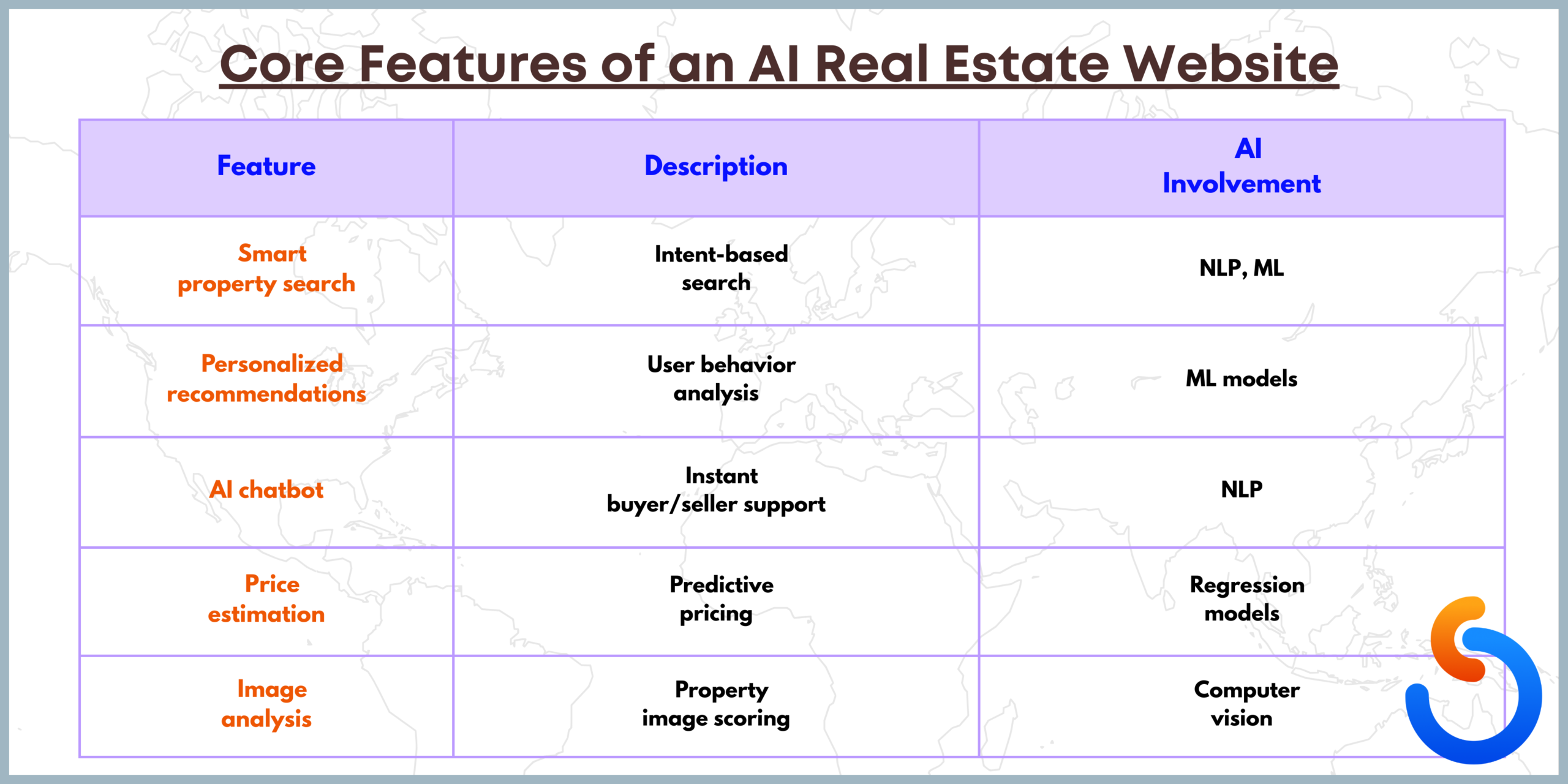
- AI-Powered Property Search and Filtering The search experience is the heart of your platform. AI search goes far beyond keyword matching. It learns from user behaviour: which listings they click, how long they spend, what they bookmark, what they ignore. Over time, it surfaces listings that match intent not just specification.
- Automated Valuation Model (AVM) An AVM estimates property values using machine learning trained on historical sale prices, property characteristics (size, age, bedrooms, bathrooms), school catchment areas, crime rates, transport links, and recent comparable sales. A good AVM provides not just a value estimate but a confidence interval and the key factors driving the estimate.
- Natural Language Search Instead of dropdown filters, users type what they want in plain English (or their local language). “3-bed house with parking near a good primary school, under £350k” should return refined results without the user touching a single filter. This requires NLP integration with your search engine.
- AI Chatbot and Virtual Assistant A trained chatbot handles buyer and renter queries 24/7: available viewings, neighbourhood questions, mortgage calculations, process queries. It captures leads outside business hours and qualifies prospects before passing them to agents.
- User Accounts and Saved Searches Users save searches, shortlist properties, and set alert preferences. Your AI uses this data as training signal to personalise recommendations progressively. Without accounts, personalisation is nearly impossible.
- Interactive Maps with Data Layers Property maps with overlaid data: transport links, school ratings, flood risk, walkability scores, crime statistics, planning applications, and development pipeline. AI processes multiple data layers to surface insights that a static map cannot.
- Property Listing Management (CMS) Agents and sellers need to upload, manage, and update listings efficiently. AI auto-generates property descriptions from uploaded specs and photos, standardises data, and flags missing information.
Growth Features (Phase 2 Add After Validation)
- AI Investment Analysis For portals targeting investors: rental yield projections, capital appreciation forecasts, comparison against local and national benchmarks, and risk scoring for buy-to-let or development opportunities.
- Virtual Staging and AI Interior Visualisation Upload a photo of an empty room and AI fills it with furniture and decor appropriate to the property style and target buyer. This dramatically increases engagement on new-build and vacant properties.
- Smart Alerts and Personalised Notifications AI determines which new listings a specific user is most likely to want and alerts them immediately. Unlike blanket email alerts, AI-driven alerts have dramatically higher open rates because they are genuinely relevant.
- Mortgage and Affordability Calculator Integrated mortgage calculators that connect to real lender rates via API. AI can suggest financing scenarios based on the property and the buyer profile.
- Lead Scoring and CRM Integration Every visitor generates behavioural signals: pages visited, listings viewed, time on site, questions asked. AI scores leads from cold to hot and routes them appropriately to agents.
Differentiation Features (Phase 3 Competitive Moat)
- Predictive Market Analytics Dashboard Show agents and investors where the market is heading not just where it is. Price trend forecasts, demand-supply analysis, emerging neighbourhood heat maps, and market cycle indicators.
- Document Intelligence and Contract Analysis AI reads, summarises, and flags risks in tenancy agreements, sale contracts, title deeds, and survey reports. This reduces legal friction and positions your platform as a genuine transaction tool rather than just a discovery tool.
- Generative Property Reports On demand, AI generates a full neighbourhood report for any given address: local schools (with Ofsted ratings), nearby amenities, transport options, planning history, market performance, comparable properties sold. These reports are valuable to both buyers and sellers.
The Right Technology Stack for an AI Real Estate Website
Technology choices made at the start are hard to reverse later. Choosing the wrong database for geospatial queries, for example, can require a complete data layer rebuild when you start scaling. Here is what we recommend based on our actual builds at Softcurators:
| Layer | Recommended Technology | Why This Choice | Alternative |
| Frontend Framework | Next.js (React) | SSR for SEO, fast page loads, excellent ecosystem | Nuxt.js (Vue) |
| Mobile (if app included) | React Native or Flutter | Code reuse, fast development, strong performance | Native Swift/Kotlin |
| Backend Framework | Node.js + Express or NestJS | Real-time capability, strong NPM ecosystem, fast | Django (Python), Laravel (PHP) |
| Database (property data) | PostgreSQL + PostGIS | Geospatial queries, ACID compliance, mature | MySQL with spatial extensions |
| Database (user/session data) | Redis | In-memory speed for sessions and caching | Memcached |
| Search Engine | Elasticsearch or Typesense | Full-text search, geospatial, faceted filtering | Algolia (SaaS option) |
| AI/ML Infrastructure | Python + FastAPI microservice | Separate ML from web logic, Python AI ecosystem | AWS SageMaker endpoints |
| LLM / NLP | OpenAI GPT-4o API or Llama 3 (self-hosted) | Natural language search, chatbot, description gen | Anthropic Claude API |
| Computer Vision | AWS Rekognition or Google Vision AI | Photo tagging, virtual staging classification | Azure Computer Vision |
| AVM Model | scikit-learn / XGBoost + custom training | Price prediction, feature importance, interpretability | TensorFlow for deep learning |
| Map & Geospatial | Mapbox GL or Google Maps Platform | Property maps, radius search, data layer overlays | OpenStreetMap + Leaflet |
| Cloud Infrastructure | AWS or Google Cloud | Scalability, managed ML services, CDN | Azure |
| CDN | Cloudflare | Image delivery speed, security, DDoS protection | AWS CloudFront |
| Authentication | Auth0 or Supabase Auth | OAuth social login, multi-role permissions | Firebase Authentication |
| Payment (if needed) | Stripe | Subscription billing, marketplace payments | Paddle, Braintree |
| CI/CD | GitHub Actions + Docker + Kubernetes | Automated deployment, scaling, containerisation | GitLab CI, CircleCI |
Key Architecture Decision: Microservices vs Monolith
For an AI real estate website, we recommend a modular monolith approach for the MVP not full microservices from day one. A modular monolith is:
- Faster to build and deploy initially
- Easier to reason about and debug with a small team
- Structured so that individual modules (search, AVM, chatbot) can be extracted into microservices as traffic demands it
- Less expensive to run than Kubernetes-orchestrated microservices at low traffic volumes
The AI components (AVM model, NLP search, chatbot) should be separate Python microservices from day one because the ML runtime (Python) is different from your web runtime. Everything else starts as a modular monolith and scales from there.
Softcurators tip: We typically build the AI inference layer as a FastAPI Python service with its own database and deploy it independently from the main web application. This makes model updates, A/B testing, and retraining entirely independent of frontend releases.
Step-by-Step Guide to Developing an AI Real Estate Website
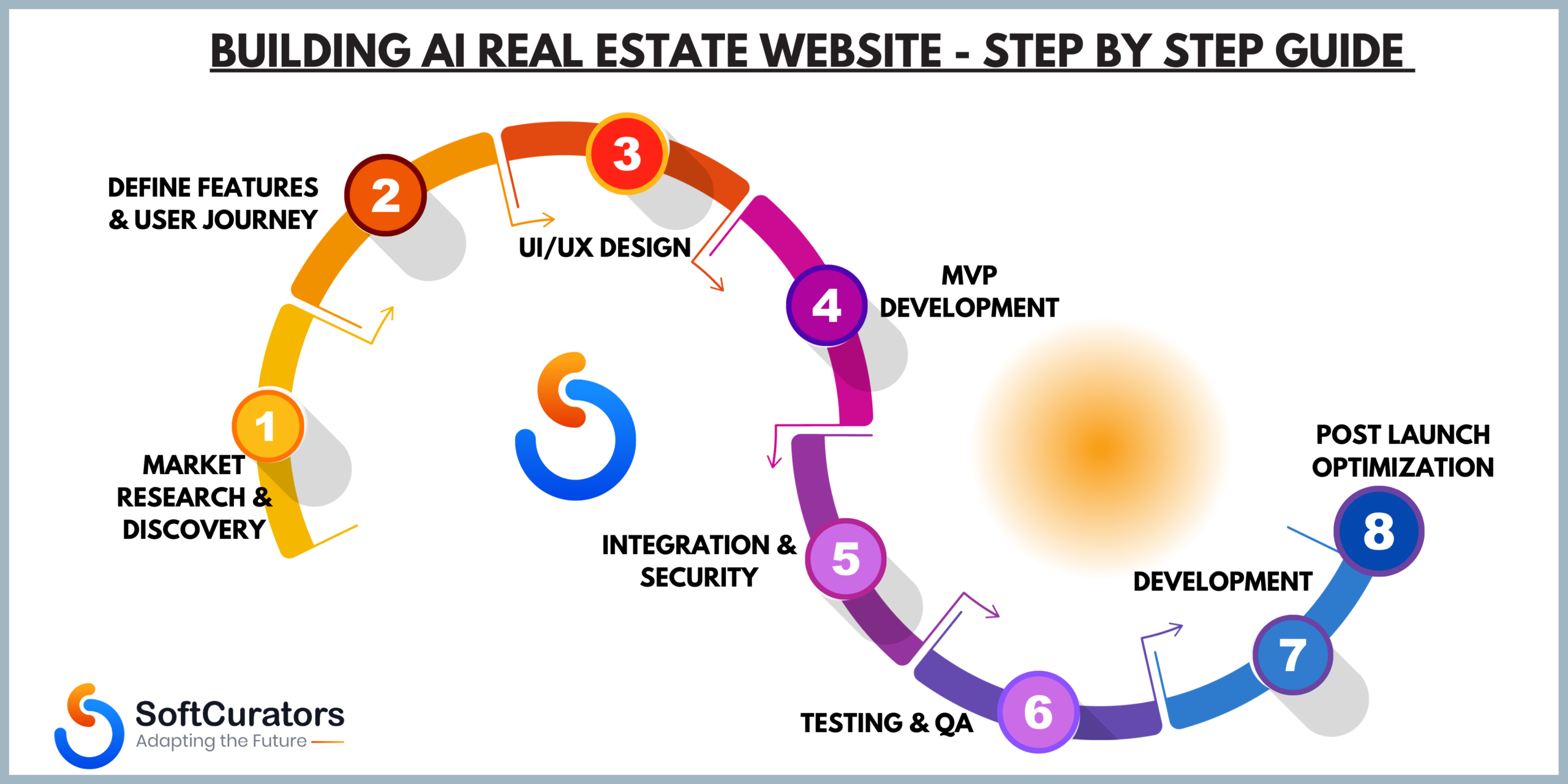
This is the exact process Softcurators follows on every real estate platform build. We have refined it across multiple projects to eliminate the common failure points.
Step 1: Discovery and Market Validation (Weeks 1–3)
This is the phase that most development agencies skip. It is also the phase where the most important decisions get made. Before designing a single screen, you need to answer:
- Who is your primary user buyer, renter, investor, agent, or developer?
- What geography are you targeting? Geospatial data availability varies enormously by market.
- Who are the top 3 competitors in your target market and what are their weakest points?
- What specific problem will your AI solve that current platforms handle poorly?
- How will you acquire your first 1,000 listings and your first 1,000 users?
The output of Discovery is a Product Requirements Document (PRD) that defines the problem, the user, the MVP feature set, and the success metrics. Without this, development becomes expensive iteration without direction.
Softcurators Discovery Deliverables: Competitor analysis matrix, user persona documents, MVP feature list with prioritisation rationale, initial sitemap, and a rough development timeline and budget estimate all before a single wireframe is drawn.
Step 2: Data Strategy and Property Data Acquisition (Weeks 2–4)
This is the step that is unique to real estate and the one that trips up teams without domain experience. Your AI is only as good as your training data. You need a data strategy before you build anything.
Where does your property data come from? The options are:
| Data Source | What You Get | Cost | Limitations |
| MLS (Multiple Listing Service US) | Near-complete active listings in a geography | Access fee + IDX license | Geographic scope limits, US only |
| Land Registry / Cadastre APIs (UK/EU) | Transaction history, title data | Often free or low cost via gov APIs | Historical only, no current listings |
| Scraping + partnerships | Active listings from portals | Development cost + legal complexity | ToS risk, data freshness |
| Direct agent submissions | Fresh listings with rich media | Free but requires network effect | Chicken-and-egg problem initially |
| Third-party data aggregators | Structured property data at scale | $500–$5,000/month depending on geography | Cost, potential duplication |
| OS/Cadastral open data | Boundaries, addresses, building footprints | Free (most countries) | No transaction or listing data |
The most reliable early-stage strategy is to combine direct agent partnerships (for quality listings), a land registry or public transaction API (for pricing history), and a third-party data provider (for comprehensive coverage). Plan your data licensing costs into your budget from day one they are often forgotten and then cause nasty surprises.
Critical: Never scrape property data from Rightmove, Zillow, or similar platforms without explicit permission. Their ToS forbid this, they actively detect it, and legal action is not uncommon. Build data partnerships instead.
Step 3: UI/UX Design and Prototyping (Weeks 3–7)
Good real estate UX is deceptively hard. Users are making the most expensive purchase of their lives. The design must communicate trust, simplicity, and authority simultaneously. At Softcurators, we use a user-first design process that starts with user flows not visual design:
- User Flow Mapping: Map every journey buyer searching, seller listing, agent managing leads, investor analysing before opening Figma
- Wireframing: Low-fidelity wireframes for all core screens. Focus on information hierarchy, not aesthetics.
- High-Fidelity Mockups: Detailed visual design with your brand identity, typography system, and component library.
- Interactive Prototype: Clickable Figma prototype for user testing. Stakeholders can walk through the experience before a line of code is written.
- Usability Testing: Test with 5–8 real target users. This typically uncovers 80% of major UX issues before development begins saving significant rework cost.
Key real estate UX principles that Softcurators applies on every project:
- Search results must load in under 1.5 seconds real estate users are impatient and comparison shopping
- Property photos must be large, full-width, and swipeable photos drive 80% of purchase intent
- Maps must be interactive and integrated into search results not a separate view
- Mobile-first design is non-negotiable over 60% of property searches start on mobile
- Trust signals (agent verification badges, review counts, response time) must be visible throughout
For UI/UX best practices that apply across all platforms, see our guide on mobile app UI/UX design best practices.
Step 4: Backend Infrastructure Development (Weeks 5–14)
The backend is where your AI real estate website earns its competitive advantage or where it quietly falls apart at scale. There are five critical backend subsystems:
- Property Listing Database and API Your core data layer. PostgreSQL with PostGIS extension handles geospatial queries that standard databases cannot. Every listing needs: address (geocoded), property details, media (images, floor plans, videos), pricing history, listing status, and agent details. Your API layer exposes this data to both your frontend and any third-party integrations.
- Search Engine Property search has specific requirements: radius search from a point, bounding box search on a map, polygon search (user draws an area on the map), combined geospatial + text + facet filtering. Elasticsearch with its geospatial query support handles all of these efficiently. Configure your indices carefully a poorly indexed Elasticsearch cluster will be slow and expensive.
- User Management and Authentication Multi-role user system: buyers, sellers, agents, agency admins, and platform admins all need different permissions and dashboards. JWT-based authentication with role-based access control (RBAC). OAuth social login (Google, Facebook) dramatically improves registration conversion.
- Notification System Email alerts, push notifications, and in-app notifications. AI-driven notification logic determines when and what to send based on user engagement signals. A poorly designed notification system is one of the fastest ways to drive users to unsubscribe or uninstall.
- Analytics and Data Pipeline Every user interaction is a training signal for your AI models. Build your analytics pipeline from day one user events, search queries, listing views, click-through rates, time on page, conversion events. This data feeds your personalisation engine and improves your AVM over time.
Step 5: AI and Machine Learning Development (Weeks 7–18)
This is the most technically complex and most competitively differentiating part of your platform. The AI layer comprises several independent models and systems:
Automated Valuation Model (AVM)
Your AVM is a supervised regression model trained to predict property prices from property features. Here is how to build it correctly:
- Data Preparation: Collect 3–5 years of historical transaction data for your target geography. Include: address, sale price, transaction date, property type, size (sqm/sqft), number of bedrooms/bathrooms, age of property, land size, and proximity to key points of interest.
- Feature Engineering: Derived features often improve model accuracy more than raw data: distance to nearest school (weighted by school rating), distance to transport hubs, price per square metre for comparable properties sold in last 12 months within 500m, neighbourhood price trend (12-month delta), floor level (for apartments), renovation indicator (based on age vs appearance discrepancy).
- Model Selection: XGBoost gradient boosting is the industry standard for AVM tasks it handles mixed data types, missing values, and non-linear relationships well. Compare against Random Forest and LightGBM. For large datasets, neural networks may outperform tree methods.
- Validation: Use Mean Absolute Percentage Error (MAPE) as your primary metric. A well-trained AVM should achieve MAPE under 8% for residential property. Separate your train/test split by time not randomly to prevent data leakage.
- Explainability: Use SHAP (SHapley Additive exPlanations) to show users why the AI estimated a specific price. “Your property is valued 12% above the local average primarily because of its school catchment rating and recent comparable sales” this builds trust that a black-box number cannot.
- Continuous Retraining: Property markets change. Schedule monthly retraining with new transaction data. Monitor for model drift when prediction accuracy starts declining, it is usually because market conditions have shifted.
Personalised Recommendation Engine
Your recommendation engine predicts which listings a specific user will engage with. Two approaches, used in combination.
Cold-start is the hardest problem: new users have no behavioural history. Handle this with a brief onboarding quiz (3-5 questions about must-haves, preferred areas, and budget) that seeds the recommendation engine before the user browses.
Natural Language Search with LLM Integration
Natural language property search requires an LLM to parse user intent from free text and translate it into structured search parameters. The workflow: user types a query → LLM extracts entities (location, price, bedrooms, property type, lifestyle preferences) → extracted parameters are passed to your Elasticsearch search layer → results are returned.
The critical implementation detail: do not send search queries directly to the LLM and ask it to return results. LLMs hallucinate property listings that do not exist. Instead, use the LLM solely as a query parser it extracts search intent into JSON, which your deterministic search engine then executes against real data.
AI Chatbot and Conversational Assistant
Your chatbot serves multiple roles: lead capture, question answering, viewing scheduler, mortgage calculator, and process guide. Build it on top of an LLM with a comprehensive knowledge base that includes:
- All property listings on your platform (updated in real time)
- Neighbourhood data for each location you serve
- Buying, selling, and renting process guides for your specific market
- Agent availability calendars (for viewing scheduling)
- FAQ library built from real queries your target users ask
Implement a clear handoff protocol: when the chatbot detects high purchase intent or a question it cannot confidently answer, it offers immediate connection to a human agent. The worst chatbot experience is one that loops on questions it cannot handle without ever offering a way out.
Automated Property Description Generation
Agents spend 15-30 minutes writing each property description. AI can produce a high-quality first draft in seconds. Your description generator takes structured property data (type, size, features, location) and any agent-provided notes, then generates a description in a configurable tone (professional, warm, luxury, budget-friendly). Agents review, edit, and publish rather than writing from scratch.
This feature alone typically saves active agents 3-5 hours per week. It is also an excellent entry point for agent adoption on your platform they experience immediate, concrete value that makes them advocates. For more on AI applications like this, see our AI development services and AI app development capabilities.
Step 6: Frontend Development (Weeks 10–20)
Frontend development for an AI real estate website is more complex than a standard website because of the data density, map integration, and real-time AI features involved. Key components:
Search Results Page (SRP): The most important page on your platform. Dual-view: list view and map view. Infinite scroll or pagination. AI-personalised sorting (“Best Match” powered by your recommendation engine). Filter persistence across sessions. Real-time results as map is panned.
Property Detail Page (PDP): Full media gallery (photos, floor plans, 360° tours, video). AVM value widget with explanation. Neighbourhood data cards. AI chatbot embedded. Mortgage calculator. Lead capture form. Similar properties carousel (AI-recommended). Agent profile and contact.
User Dashboard: Saved searches and alerts management. Shortlisted properties. Search history. AI recommendations feed. Mortgage pre-qualification progress (if offered).
Agent/Seller Dashboard: Listing management. AI description generator. Lead inbox with AI scoring. Analytics on listing performance. Viewing calendar integration.
Admin Panel: Content moderation. User management. Data quality monitoring. AI model performance monitoring. Revenue and subscription management.
Performance is critical: real estate users are highly impatient. Our Next.js implementations consistently achieve Core Web Vitals scores in the “Good” range LCP under 2.5s, FID under 100ms, CLS under 0.1. This directly impacts both user experience and Google SEO rankings.
Step 7: Integration Development (Weeks 14–22)
Real estate platforms live or die by their integrations. Here are the key third-party integrations your AI real estate website needs:
| Integration | Purpose | Recommended Provider | Complexity |
| Property data feed | Listing syndication, data import | MLS via RETS/RESO Web API, Land Registry API | Medium–High |
| Geospatial / Maps | Interactive map, radius search | Mapbox GL JS, Google Maps Platform | Medium |
| Mortgage calculator API | Real lender rates, affordability | Mortech, Polly, or direct lender API | Medium |
| Property photos storage | CDN-served images at scale | AWS S3 + CloudFront | Low |
| School data | School ratings per postcode / zip | Ofsted API (UK), GreatSchools API (US) | Low |
| Crime data | Safety scores per area | Police.uk API (UK), SpotCrime API (US) | Low |
| Transport data | Transit links, walk scores | TfL API (London), Walk Score API | Low |
| CRM integration | Lead syncing to agent CRMs | Salesforce, HubSpot, Zapier webhooks | Medium |
| Email marketing | Drip campaigns, alerts | Mailchimp, SendGrid, or Postmark | Low |
| Analytics | User behaviour tracking | Mixpanel + Google Analytics 4 | Low |
| Payment processing | Subscriptions, lead packages | Stripe | Low |
| E-signature (if transacting) | Digital contract signing | DocuSign API, HelloSign | Medium |
Step 8: Testing and Quality Assurance (Weeks 18–24)
Real estate websites handle sensitive personal data, financial information, and high-value decisions. QA cannot be an afterthought. Our testing approach at Softcurators covers four layers, as described in detail in our mobile app testing, deployment, and maintenance guide.

AI Real Estate Website Development Cost Breakdown
Cost is always context-dependent. There is no universal answer to “how much does it cost to build an AI real estate website?” But there is a range for every scope level. For a deep dive, see our detailed AI real estate software development cost guide and real estate app development cost breakdown.
| Scope Level | What It Includes | Typical Cost Range | Timeline |
| MVP / Concept Validator | Basic listing portal, simple search, user accounts, contact form no AI | $10,000 – $20,000 | 2–4 months |
| AI-Enhanced MVP | Listings + basic AVM + AI chatbot + saved search + map view | $25,000 – $50,000 | 3–5 months |
| Full Consumer Platform | All MVP features + NLP search + recommendation engine + smart alerts + agent dashboard | $50,000 – $80,000 | 5–6 months |
| Enterprise / Marketplace | Full platform + investment analytics + document AI + third-party integrations + white-label | $80,000 – $100,000+ | 6–8 months |
| Zillow-scale platform | Complete feature parity with major portals, multi-market, high availability | $80,000 – $100,000+ | 8–10 months |
Cost Breakdown by Development Component
| Component | % of Total Budget | What Drives Cost | Notes |
| Product Discovery & Architecture | 8–12% | Complexity of stakeholder requirements | Do not skip this saves more than it costs |
| UI/UX Design | 10–15% | Number of unique screen templates, design system | Invest here it directly drives conversion |
| Frontend Development | 20–25% | Screen count, map complexity, real-time features | Next.js significantly reduces cost vs alternatives |
| Backend API Development | 20–25% | Data model complexity, integration count | Plan your data model carefully upfront |
| AI / ML Development | 15–25% | Models required, training data quality, accuracy targets | Most variable component AVM alone can cost $30K+ |
| Third-party Integrations | 5–10% | Number and complexity of data providers | Data costs are ongoing, not just one-time |
| QA & Testing | 8–12% | Scope, automation coverage | Cutting this creates expensive post-launch bugs |
| DevOps & Infrastructure Setup | 5–8% | Cloud architecture complexity | Microservices cost more to set up |
| Post-Launch Support & Iteration | Ongoing budget 15–20%/yr of dev cost | Bug fixing, feature additions, model retraining | Essential a platform is never “finished” |
Softcurators works with clients on fixed-scope, phased, and retainer engagement models depending on their stage and budget. Whether you are building an MVP or a full enterprise platform, we provide transparent pricing before any commitment. Explore our portfolio to see what we have delivered at different budget levels.
Realistic Development Timeline for an AI Real Estate Website
| Phase | Duration | Key Activities | Deliverables |
| Phase 1: Discovery | Weeks 1–3 | Stakeholder interviews, competitor analysis, data strategy, tech architecture | PRD, sitemap, architecture diagram, project plan |
| Phase 2: Design | Weeks 3–7 | User flows, wireframes, high-fidelity mockups, usability testing | Figma prototype, design system, UI specification |
| Phase 3: Data & Infrastructure | Weeks 5–10 | Database setup, data pipeline, property data ingestion, DevOps | Running DB, CI/CD pipeline, staging environment |
| Phase 4: Core Backend | Weeks 6–14 | API development, search engine, user auth, listing management | Functional API, search working, user system live |
| Phase 5: AI Development | Weeks 8–18 | AVM training, chatbot development, NLP search, recommendation engine | Deployed AI microservices, model documentation |
| Phase 6: Frontend | Weeks 10–20 | All screens developed, map integration, AI features wired to UI | Fully functional frontend connected to backend |
| Phase 7: Integration | Weeks 14–22 | Third-party APIs connected, data feeds live, payment if required | All integrations tested and documented |
| Phase 8: QA & Testing | Weeks 18–24 | Functional, performance, security, and UAT testing | QA report, resolved issues, launch-ready build |
| Phase 9: Launch & Monitoring | Week 24+ | Production deployment, monitoring setup, performance tuning | Live platform, monitoring dashboards, incident response |
These timelines assume a dedicated team of 6–8 people (project manager, 2 backend developers, 1 AI/ML engineer, 1–2 frontend developers, 1 designer, 1 QA engineer). Smaller teams extend timelines proportionally.
Softcurators Insight: The phases overlap by design. We start backend development while design is still being finalised, and we begin AI development while the core backend is being built. This parallel-track approach typically saves 4–6 weeks compared to sequential development.
Legal, Compliance, and Data Considerations for AI Real Estate Websites
Legal compliance in AI real estate website development is not optional it is existential. Get this wrong and you face regulatory fines, lawsuits, or forced shutdown. Here is what you need to address:
Data Protection and Privacy
Fair Housing and AI Bias
In the United States, the Fair Housing Act prohibits discrimination based on race, colour, national origin, religion, sex, familial status, or disability. AI recommendation and pricing systems can inadvertently encode these patterns if trained on biased historical data. You must:
- Audit your training data for demographic bias before deploying any recommendation or pricing model
- Test your recommendation engine to confirm it does not systematically exclude protected demographic areas
- Document your AI decision processes for regulatory scrutiny
- Implement human oversight for any AI system that influences credit or lending decisions
Property Listing Accuracy and Liability
- AVM valuations must be clearly labelled as estimates not professional appraisals with displayed confidence intervals
- Property listing information (square footage, features, planning restrictions) must be verified or carry clear disclaimers
- Energy Performance Certificate (EPC) data in the UK and equivalent data in other markets has specific display requirements
- If you facilitate financial transactions (mortgage referrals, rent collection), you may require financial services regulation seek legal advice early
Intellectual Property
- Property photography is owned by the photographer. Get explicit licensing rights before hosting images on your platform
- MLS data has specific terms about how it can be displayed, updated, and cached read the IDX agreement carefully
- AI-generated property descriptions should be reviewed to ensure they do not reproduce copyrighted marketing text from other platforms
For a broader perspective on compliance in technology projects, see our guide on mobile app security and compliance.
8. Mistakes That Kill AI Real Estate Websites (And How to Avoid Them)
In our experience building real estate platforms, the same mistakes appear repeatedly. Most of them are avoidable with the right planning:
Mistake 1: Starting With AI Before Having Data
You cannot train an AVM without historical transaction data. You cannot personalise recommendations without user behaviour data. Founders sometimes spend months building AI infrastructure before they have solved the data acquisition problem. Solve data first. Build AI second.
Mistake 2: Underestimating the Chicken-and-Egg Problem
A listing portal with no listings has no value to buyers. A portal with no buyers attracts no agents. Every successful real estate platform had an explicit strategy for solving this bootstrapping problem. Common solutions: geo-focus (dominate one city before expanding), anchor partnerships (secure 3-5 major agencies before launch), or supply-side subsidy (offer free listing for the first year to build inventory).
Mistake 3: Building AVM Before Securing Training Data
Building an AVM requires minimum 3-5 years of transaction data for your target geography. Teams that skip due diligence on data availability discover this problem mid-build at significant cost. Always confirm data availability and licensing before committing to AVM development.
Mistake 4: Over-Engineering the AI at MVP Stage
The temptation to build a perfect AI from day one leads to projects that never launch. An AVM that achieves 15% MAPE but is live is infinitely more valuable than a perfect 5% MAPE model that is still in development 18 months later. Ship a working model, then improve it iteratively with real-world feedback.
Mistake 5: Ignoring Mobile
Over 60% of property searches now start on mobile. Building desktop-first and then retrofitting mobile is one of the most expensive development mistakes in real estate platforms. We always design and develop mobile-first. For the mobile dimension of your real estate platform, consider our mobile app development services alongside the website build.
Mistake 6: Building an App Instead of Solving a Problem
Many real estate platform founders focus on features rather than the specific problem they are solving. “We need Zillow features” is not a product strategy. “We give first-time buyers the data transparency they need to make a confident first purchase in London” is a product strategy and it leads to very different feature prioritisation decisions.
Mistake 7: Skipping Security in the Rush to Launch
Real estate websites handle passport copies, proof of funds, rental applications, and financial information. A breach is catastrophic for user trust and legally serious. Never launch without a security audit. See our mobile app security and compliance guide for the checklist we use on every project.
Mistake 8: No Post-Launch Plan
Launching is not the finish line. It is the starting line. Too many teams exhaust their budget on development and have nothing left for the first three months of iteration, marketing, and user acquisition. Budget at minimum 20% of your development cost for the first six months post-launch. And partner with a team like Softcurators that offers ongoing maintenance and support, not just a one-and-done build.
AI Real Estate Website Development Checklist
Use this checklist before you start development. It covers the decisions and preparations that determine whether your platform succeeds:
Discovery & Strategy
- Define your primary user persona and their single most important job to be done on your platform
- Confirm your target geography and verify property data availability for that market
- Conduct competitor analysis identify the top 3 platforms in your niche and document their weaknesses
- Define your monetisation model before building (subscription? lead generation fees? transaction commission?)
- Set your success metrics what does “winning” look like at 3 months, 12 months, 24 months?
Data & Legal
- Identify your property data sources and confirm licensing terms before build starts
- Engage a PropTech-experienced solicitor to review your data agreements and terms of service
- Confirm GDPR/CCPA compliance requirements for your specific market and user base
- Conduct a Fair Housing Act / equivalent local regulation review if your AI will make recommendations
- Plan your data governance model what data do you collect, how long do you keep it, who can access it?
Product & Design
- Create detailed user flows for every primary user journey before design starts
- Wireframe and test all core screens with real target users before development begins
- Define your mobile-first design approach every screen should be designed for mobile before desktop
- Establish your component design system to ensure consistency and reduce frontend development cost
- Define your SEO architecture (URL structure, schema markup, sitemap) from the start not retrofitted later
Technical
- Document your chosen tech stack with rationale before any development begins
- Set up your data pipeline and property data ingestion before building AI features
- Define your AI model performance benchmarks (target MAPE for AVM, target accuracy for chatbot intent) upfront
- Plan your infrastructure for scale how will the system handle 10× your launch traffic?
- Set up CI/CD pipeline, staging environment, and monitoring before first feature goes live
Launch Readiness
- Security penetration test completed and critical vulnerabilities resolved
- Performance test completed Core Web Vitals in “Good” range, load time under 2 seconds
- GDPR cookie consent management implemented and tested
- AVM accuracy validated against held-out test data (MAPE benchmark achieved)
- Chatbot tested against 100+ real user query samples handoff to human agent working correctly
- Legal disclaimers on AVM estimates and property descriptions reviewed by solicitor
- Monitoring and alerting configured you need to know immediately if something breaks after launch
- Post-launch iteration plan and budget confirmed the product will need improvement based on real user feedback
Why Real Estate Founders Choose Softcurators to Build Their AI Platform
At Softcurators, real estate app and website development is not a generic service it is a domain we have invested in deeply. Our team understands PropTech-specific challenges: data licensing, AVM development, geospatial search, Fair Housing compliance, and the chicken-and-egg problem of marketplace bootstrapping. These are not challenges you want to learn about during an expensive development engagement.
Our Full Development Stack
We deliver the complete development lifecycle: UI/UX design, web development, mobile app development, AI development, software development, and maintenance and support. We serve clients in the US, UK, Qatar, and globally. Whether you need a startup-focused MVP build or an enterprise platform, we scale to fit.

Conclusion: Building an AI Real Estate Website That Actually Competes
Developing an AI real estate website is one of the most technically demanding and potentially lucrative projects in the software world today. The combination of geospatial data complexity, AI feature requirements, data licensing challenges, and the life-significance of property decisions creates a project that rewards careful planning and deep domain expertise.
The platforms that win in this market are not the ones that copy Zillow feature-for-feature. They are the ones that identify a specific underserved user, deliver an AI-powered experience that legacy platforms cannot easily replicate, and execute with enough speed and discipline to build a defensible position before competition intensifies.
The step-by-step process in this guide from discovery and data strategy through AVM development, chatbot integration, and launch readiness gives you the framework to build correctly. The checklist prevents the most expensive mistakes. And the cost and timeline benchmarks give you realistic expectations for stakeholder alignment.
At Softcurators, we are ready to be your development partner for this build. We bring the AI expertise, PropTech domain knowledge, and full-stack development capability needed to turn your real estate platform vision into a live, competitive product.
Frequently Asked Questions About AI Real Estate Website Development
How much does it cost to develop an AI real estate website?
Cost ranges from $15,000–$20,000 for an AI-enhanced MVP (with basic AVM, chatbot, and personalised search) up to $25,000–$50,000+ for a full consumer platform with investment analytics, document AI, and comprehensive third-party integrations. A traditional listing portal without significant AI typically costs $5,000–$15,000. For detailed cost breakdowns by feature and scope, see our AI real estate software development cost guide.
How long does it take to build an AI real estate website?
Timeline depends heavily on scope. An AI-enhanced MVP typically takes 2–5 months with a dedicated team. A full consumer platform takes 3–6months. Enterprise or marketplace-scale platforms take 6–8 months. The AI development component (particularly AVM training and chatbot development) is usually the most time-consuming phase and the one most affected by data availability.
What is an Automated Valuation Model (AVM) and how does it work?
An AVM is a machine learning model trained to predict property values from property characteristics and market data. It analyses factors like location, size, number of bedrooms and bathrooms, property age, school ratings, transport links, and comparable recent sales to generate a price estimate with a confidence interval. A well-trained AVM for residential property should achieve Mean Absolute Percentage Error (MAPE) under 8%. The best AVMs also use SHAP explainability to show users why a property is valued at a specific price.
What data do I need to build an AI real estate platform?
You need four types of data: (1) Property listing data active listings with photos, specifications, and pricing. (2) Transaction history historical sale prices, dates, and property details for AVM training (minimum 3-5 years in your target geography). (3) Points of interest data schools, transport, amenities for neighbourhood scores. (4) User behaviour data which listings users view, click, save, and convert on (this accumulates after launch and trains your recommendation engine). The biggest constraint is usually transaction history data for your specific market.
Which technology stack is best for an AI real estate website?
Our recommended stack: Next.js (frontend, for SEO + performance), Node.js/NestJS (backend API), PostgreSQL + PostGIS (geospatial property database), Elasticsearch (search engine), Python FastAPI (AI/ML microservices), XGBoost (AVM model), OpenAI GPT-4o or Llama 3 (natural language search and chatbot), Mapbox GL (interactive maps), and AWS or Google Cloud (infrastructure). This stack balances developer availability, performance, AI ecosystem support, and long-term scalability.
Do I need property data licensing to build a real estate platform?
Yes, in most cases. If you want to display active listings, you need to either generate listings organically through direct agent partnerships, license data from an MLS (in the US via IDX), partner with a third-party data aggregator (who hold the necessary licenses), or use publicly available transaction data for historical pricing only. Each route has different costs and limitations. Never scrape data from established portals without permission it exposes you to significant legal risk.
How do I solve the chicken-and-egg problem for a new listing portal?
This is the hardest challenge in launching a real estate marketplace. Proven strategies include: geo-focus (launch in one city and build density before expanding), direct agency partnerships (secure 3-5 agencies who commit to listing exclusively or simultaneously on your platform), supply-side subsidy (offer free listings for the first 12-18 months to build inventory), niche focus (serve a specific property type student lets, commercial, luxury where existing portals have less coverage), and content-first (build the highest-quality neighbourhood guides and property market data for your target geography so buyers come for the content and agents list to reach them).
Can I build an AI real estate website as a startup on a limited budget?
Yes but you need disciplined scope management. The key is to build your AI-enhanced MVP (not the full vision) and validate your core hypothesis before investing in more complex AI features. A $60,000–$90,000 budget can build a genuinely competitive AI-enhanced property portal for a single city: quality listings, basic AVM, AI chatbot, and personalised search. Expand from there based on what users actually use. Our MVP development service is designed exactly for this type of focused, cost-efficient launch.
What is natural language property search and how does it work?
Natural language search lets users type queries in plain English rather than selecting dropdown filters. "2-bed flat with a balcony near good schools in South Manchester under £250k" gets processed by a large language model (LLM) that extracts search parameters (property type: flat, bedrooms: 2, features: balcony, area: South Manchester, price ceiling: £250,000, school proximity: true) and passes them to your property search engine. The LLM acts as an intent parser your deterministic search engine still does the actual querying against real data.
How do AI chatbots improve a real estate website?
A well-implemented AI chatbot on a real estate platform serves multiple functions: answering property questions 24/7 (neighbourhood, process, mortgage, availability), capturing leads outside business hours, qualifying buyer intent before routing to agents, scheduling viewings, guiding users through complex processes (first-time buyer guide, rental application), and providing immediate answers to repetitive questions that would otherwise consume agent time. Platforms with good chatbots typically see 30-40% more leads captured outside business hours compared to those with only contact forms
What are the Fair Housing implications of AI recommendation systems?
The Fair Housing Act (US) and equivalent legislation in other markets prohibits real estate platforms from discriminating in property recommendations, advertising, or pricing based on protected characteristics (race, religion, sex, disability, familial status, national origin, and in many states colour and sexual orientation). AI recommendation systems can inadvertently encode historical discrimination patterns if trained on biased data. You must audit your training data for demographic bias, test your recommendation outputs across geographic areas to ensure no systematic exclusion of protected areas, and document your AI decision processes for potential regulatory review.
Should I build a real estate mobile app alongside the website?
Yes eventually. Over 60% of property searches now start on mobile. However, building a native mobile app from day one significantly increases your development budget. The recommended approach is to launch with a mobile-optimised (ideally PWA) website first, validate your concept, and then build a native app once you have proven user demand and revenue. When you are ready, our mobile app development team and iOS app development / Android app development specialists can build your mobile companion app.
How do I monetise an AI real estate website?
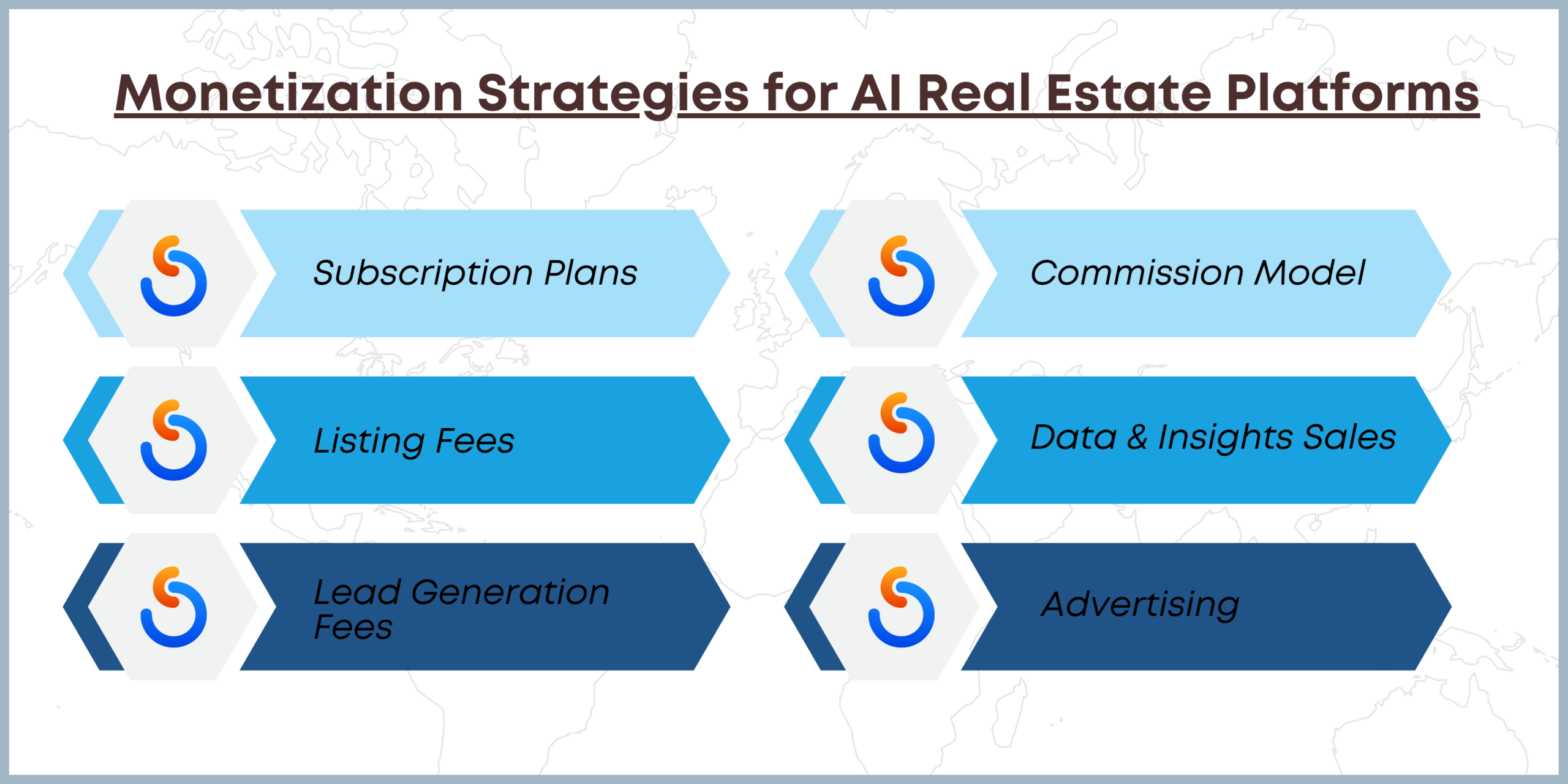
Real estate platforms have multiple monetisation models: (1) Agent subscription agents pay monthly/annually for lead access and listing management tools. (2) Featured listings premium placement fees for highlighted listings. (3) Lead generation charge per qualified lead delivered to agents. (4) Transaction commission earn a percentage of property transactions facilitated through your platform. (5) Mortgage referral partner with lenders and earn referral fees when users arrange mortgages through your platform. (6) AVM API license your valuation model to lenders, insurers, and other proptech companies via API. Most successful portals combine 2-3 of these models.
What is virtual staging and should I include it in my real estate platform?
Virtual staging uses AI computer vision and generative AI to digitally furnish empty or unfurnished properties in property photos. Studies show that virtually staged photos generate 73% more buyer enquiries than empty room photos. It is particularly valuable for new-build and vacant properties. Virtual staging can be built into your platform as a service for agents (they upload empty room photos, pay a per-room fee, and receive staged images within minutes) or used internally to enhance listing photography. It is a Phase 2 feature for most platforms revenue-generating but not required at MVP.
How should I approach competitor research before building a real estate platform?
Systematic competitor research should answer: What are the top 3 platforms in my target geography? What features do they have that users love (check their App Store reviews and Trustpilot)? What do users complain about? Where are the gaps property types, geographies, user segments they underserve? What is their monetisation model and pricing? How long has it taken them to achieve their current scale? Your product strategy should be built on their weaknesses and underserved segments, not a feature-by-feature copy of their strengths.
What is the difference between a property portal and a PropTech marketplace?
A property portal primarily displays listings and connects buyers/renters with sellers/agents it facilitates discovery but not transactions. A PropTech marketplace facilitates end-to-end transactions: offer, negotiation, contract, payment, and completion all on-platform. Marketplaces generate higher revenue per transaction but are significantly more complex to build (requiring legal, financial, and identity verification infrastructure) and take longer to gain liquidity. Most new entrants start as portals and evolve towards marketplace functionality as they scale.
How do I handle property photography and media on my platform?
Property media is one of the most bandwidth-intensive aspects of a real estate platform. Best practices: Store all images on AWS S3 with CloudFront CDN for global, fast delivery. Implement automatic image compression and WebP conversion to reduce file sizes without quality loss. For 360° tours and videos, use a managed provider (Matterport, YouTube, or Vimeo) rather than hosting raw video files yourself. Implement lazy loading for images on search results pages loading all photos for all results simultaneously will destroy your page performance. Generate multiple image sizes (thumbnail, medium, full) automatically on upload.
Can I use AI to generate property descriptions automatically?
Yes this is one of the most immediately practical AI applications for a real estate platform. Your AI description generator takes structured property data (type, size, location, key features, agent-provided notes) and generates a professional property description in a configurable tone. Implementation uses an LLM (GPT-4o or similar) with a carefully engineered prompt template that includes your brand voice guidelines, local property market context, and mandatory elements (EPC rating, tenure, key features). Agents review and lightly edit rather than writing from scratch typically saving 15-20 minutes per listing.
What is RESO Web API and do I need it?
RESO (Real Estate Standards Organization) Web API is the modern data standard for MLS property data exchange in the US. If you are building a platform that needs access to US MLS listing data, you will need to become a licensed IDX provider and consume data via the RESO Web API or its predecessor RETS (Real Estate Transaction Standard). This requires an MLS membership or IDX license agreement and technical integration with each MLS you want data from which can be complex since each MLS has slightly different implementations. RESO Web API is the current standard; RETS is being phased out.rn more about how we work.
How does AI improve lead quality for estate agents on my platform?
AI improves lead quality in three ways. First, lead scoring: AI analyses user behaviour (pages visited, listings viewed, search frequency, engagement depth, questions asked) to score each user from cold to hot prospect. Second, lead qualification: the AI chatbot asks qualifying questions (budget, timeline, mortgage pre-approval status) and routes qualified leads to the right agents based on geography and property type. Third, lead timing: AI identifies optimal contact moments when a user has viewed a property multiple times, saved it, and then returned again and triggers immediate agent alerts for highest-intent moments.
Should I build my AI real estate website or use a SaaS platform?
This depends on your ambition and budget. SaaS white-label platforms (like Placester, Showcase IDX, or custom solutions from enterprise providers) are faster and cheaper to launch but give you limited differentiation and platform control. Building custom gives you a competitive moat, full data ownership, and the ability to create proprietary AI features but at higher initial cost and longer time to market. If you are building a direct competitor to Zillow or Rightmove, custom is the only path. If you are building a local agency website with AI-enhanced features, a SaaS platform may be sufficient.
What ongoing costs should I budget for after launch?
Post-launch ongoing costs include: Cloud infrastructure (typically $500–$5,000/month depending on traffic and AI compute); Property data licensing ($200–$5,000/month depending on providers and geography); Developer time for bug fixes, feature additions, and security updates (budget 15-20% of initial dev cost annually); AI model retraining (quarterly or monthly for AVM, with new transaction data); Marketing and user acquisition; Customer support tooling; and App Store fees if you have mobile apps. Many founders underestimate these ongoing costs they are often 40-60% of the initial development cost annually.
How do I handle map data for my real estate platform?
You have three main options. Google Maps Platform is the most familiar but costs escalate quickly at scale and terms can change. Mapbox GL JS is our recommended choice it is performant, highly customisable, supports vector tiles for smooth user experience, and has predictable pricing. OpenStreetMap with Leaflet.js is free but requires more development effort and has less rich built-in styling. Whichever you choose, plan your map architecture from the start switching map providers later is a significant development effort.
How does predictive pricing work on an AI real estate website?
Predictive pricing goes beyond current AVM valuation to forecast future property values. It uses time-series modelling on historical price data combined with leading indicators: planning application approvals (new developments affecting area values), infrastructure investment announcements (new transport links, regeneration projects), employment and income growth forecasts, and interest rate projections. These models are typically less accurate than current-value AVMs because they predict future uncertainty always display confidence intervals and underlying assumptions to maintain user trust.
What search engine should I use for property search?
Elasticsearch is the most widely used search engine for property platforms it supports full-text search, geospatial queries (radius search, bounding box, polygon), faceted filtering (bedrooms, price range, property type), and real-time indexing of new listings. Typesense is an emerging alternative that is easier to self-host and has excellent developer experience. Algolia is a managed SaaS option that removes infrastructure complexity at the cost of higher per-query fees. Avoid basic SQL LIKE queries for property search they will not scale beyond a few thousand listings.
How should I structure the SEO of my AI real estate website?
Real estate SEO is highly competitive you are competing against Zillow, Rightmove, and Redfin for head terms. Your SEO strategy should focus on: Location-specific landing pages (each city, borough, postcode district, or neighbourhood you cover); Property type landing pages (2-bed flats for sale in Manchester); Long-tail informational content (neighbourhood guides, first-time buyer guides, market reports); Structured data markup (Schema.org RealEstateListing, BreadcrumbList, FAQPage); Core Web Vitals optimisation; and programmatic SEO for property addresses (individual property pages optimised for address-based searches). Build this SEO architecture into your URL structure and sitemap from day one.
Can Softcurators build a real estate platform for international markets?
Yes. Softcurators has built real estate platforms for clients in the UK, Middle East, and South Asia. Key considerations for international markets include: local property data source availability (each country has different land registry and listing data infrastructure), currency and language localisation, local regulatory compliance (property law, data protection, estate agency regulation varies significantly by country), and local payment method support. Our UAE/Qatar real estate experience and UK market expertise are directly applicable to PropTech builds in those regions.
What is the difference between an AVM and a professional property appraisal?
An AVM (Automated Valuation Model) is a statistical estimate generated by machine learning from data it is fast, cheap, and scalable but lacks the nuanced judgement of a human expert. A professional appraisal involves a qualified surveyor physically visiting the property, assessing its condition, and applying local market knowledge to produce a formal valuation with legal weight. AVMs are appropriate for initial estimates, price guidance for sellers, and portfolio screening for investors. Professional appraisals are required for mortgage applications, legal disputes, and formal property transactions. Always make this distinction clear on your platform AVMs are indicative estimates, not professional advice.
How does Softcurators approach AI integration differently from other agencies?
Most development agencies treat AI as an add-on they build the website and then bolt on an AI chatbot. At Softcurators, we design the AI architecture alongside the data model from day one. This means: your database schema is designed to generate good training features for your AVM; your user behaviour tracking is designed to feed your recommendation engine; your property data ingestion is designed to continuously improve model quality over time. The result is AI that gets smarter as your platform grows, rather than a static feature that never improves. See our AI app development and AI development services for more on our approach.
Should I use a pre-built AVM solution or build a custom one?
Pre-built AVM solutions (HouseCanary, CoreLogic, Zestimate API) are faster to integrate and require no ML expertise but they are expensive per-call, cover limited geographies, and give you no competitive differentiation. A custom AVM is more expensive to build initially but gives you: control over accuracy improvement, full coverage of your specific geography, the ability to incorporate unique data signals your competitors do not have, and a proprietary asset that increases the value of your platform. For most platforms targeting a specific geography at scale, a custom AVM is worth the investment. For early-stage MVPs, starting with a licensed AVM API and building custom later is a pragmatic approach.
How do I get started with Softcurators on an AI real estate website project?
The best starting point is a free discovery call with our team. We will review your concept, share relevant experience and portfolio work, provide an initial scope and cost estimate, and outline a phased development approach. We are straight-talking if your idea has a fundamental problem (data availability, market size, competitive dynamics), we will tell you in the discovery call, not 6 months into development. Visit softcurators.com/contact to book your call, or explore our real estate app development industry page and AI consulting services to learn more about how we work.
