
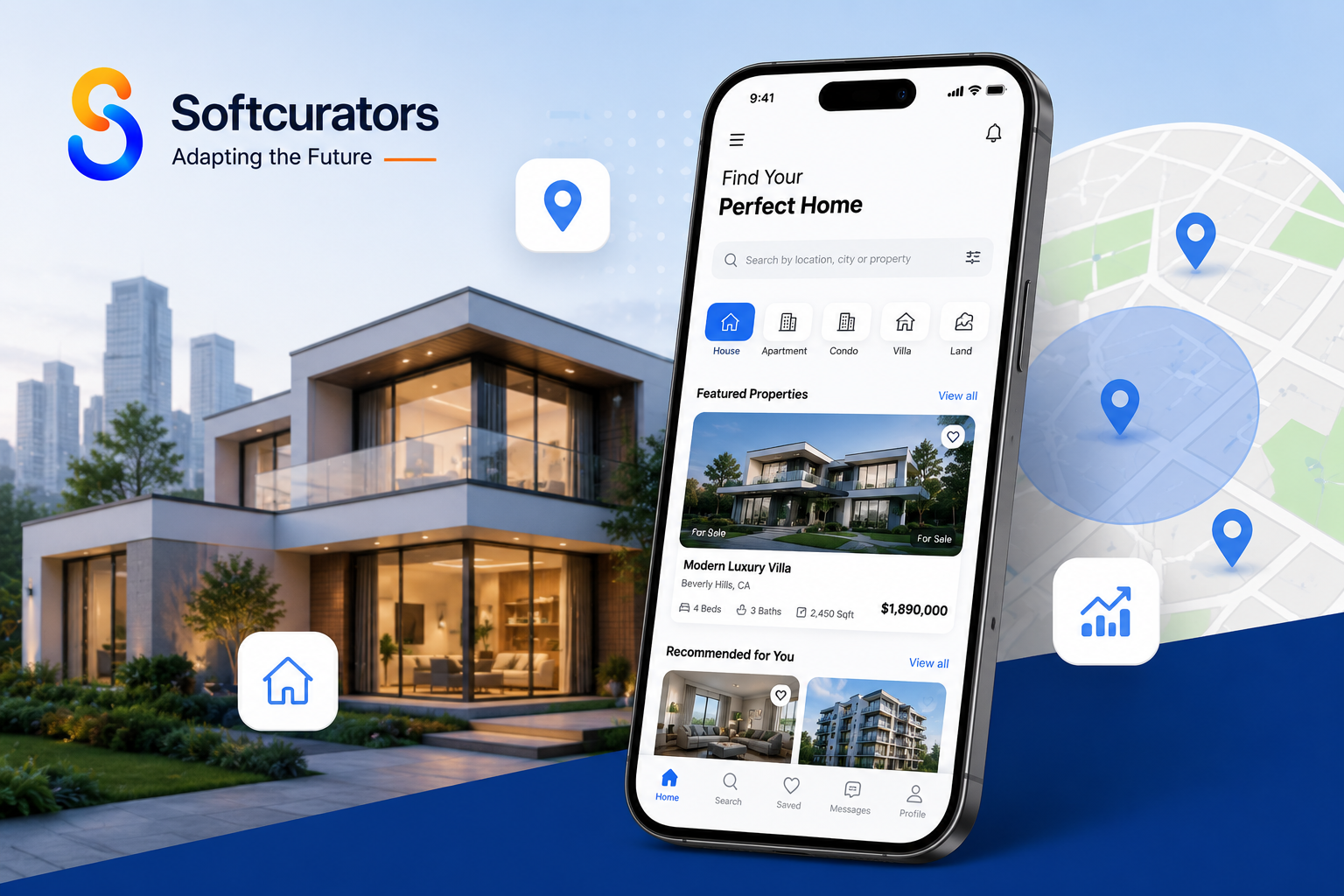
Three decades ago, buying a property meant driving past For Sale signs, calling agents, and attending open houses on their schedule. Today, a buyer in Mumbai can shortlist properties in Dubai, schedule virtual tours, and submit a purchase inquiry all before breakfast.
That shift happened because someone built the platform that connected buyers, sellers, and agents in one digital space. That platform is a real estate marketplace app. And the market for new, better, more specialised versions of that platform has never been larger.
According to Grand View Research, the global PropTech market is projected to reach $86.5 billion by 2032, growing at a CAGR of 16.8%. The National Association of Realtors reports that 97% of home buyers now use the internet during their property search. The demand is validated. The technology is accessible. The opportunity is specific: build a real estate marketplace app that serves a segment or geography better than existing platforms do.
At Softcurators, we build real estate app development solutions, AI-powered property platforms, and PropTech products for founders and established property companies. This guide covers everything about building a real estate marketplace app features, tech stack, compliance, cost, timeline, and the strategic mistakes that sink most property platforms before their first 10,000 users.
Ready to start? Book a free strategy call with Softcurators. Our architects respond within 12 hours.
Real Estate Marketplace App vs Listing Portal: Why the Distinction Matters
The terms are often used interchangeably but the distinction shapes your entire revenue model, architecture, and go-to-market strategy.
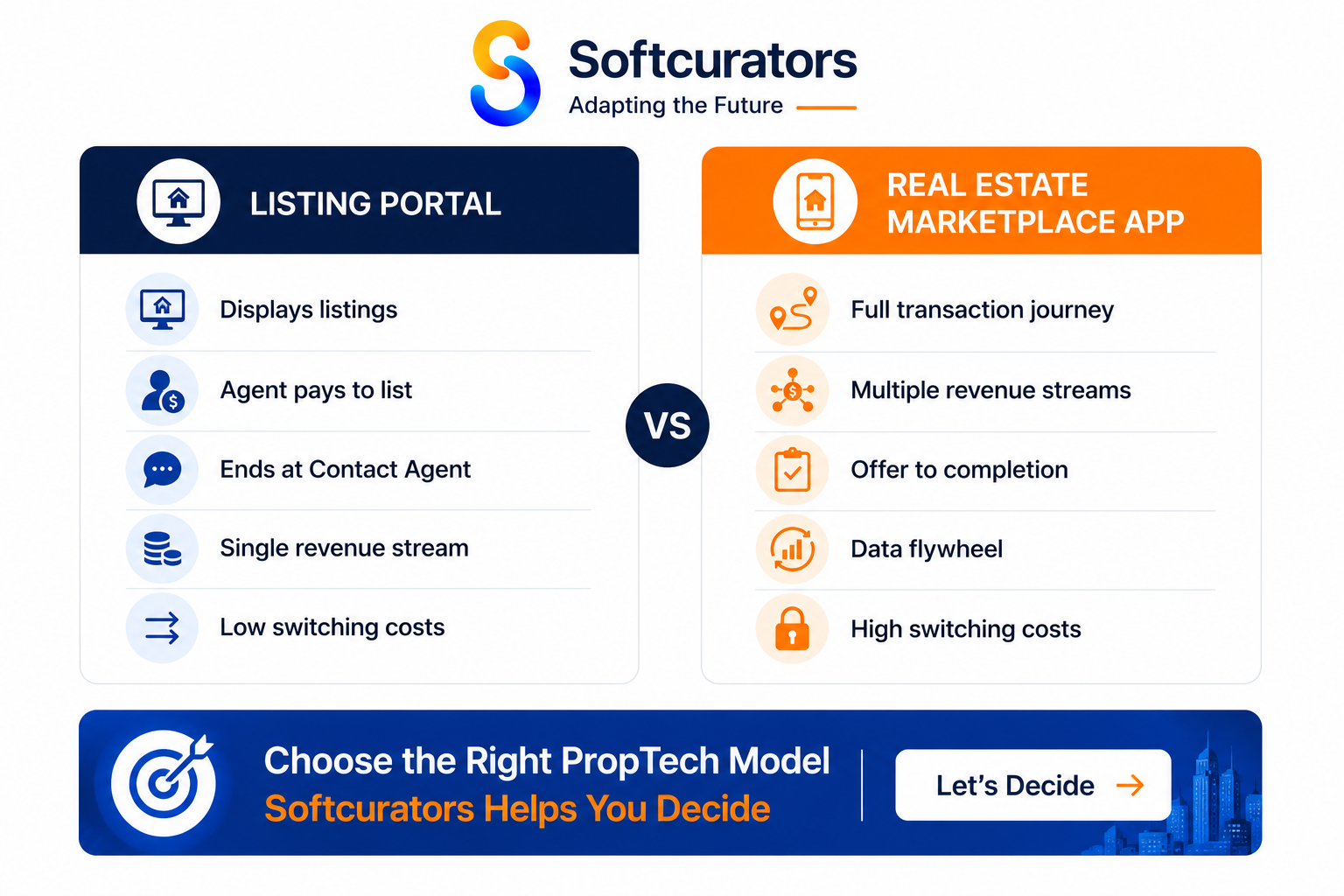
A listing portal (Rightmove, MagicBricks) aggregates and displays properties. Agents pay to list. The platform’s job ends at ‘contact agent.’ A real estate marketplace app is a two-sided transaction platform. It supports the full property journey: search, discovery, shortlisting, virtual tour, offer submission, negotiation, document management, and payment. Revenue comes from transaction commissions, subscription tiers, mortgage referrals, and data licensing.
The marketplace model is harder to build. It is also far more valuable, far more defensible, and far better at generating the qualified leads that agents and developers actually need.
Which Model Is Right for Your Project?
If you are launching in 3–4 months with a tight budget, start with a listing portal MVP. If you have 6–9 months and a funded runway, build the marketplace model from day one because retrofitting transaction infrastructure onto a portal later costs more than building it correctly from the start. Softcurators helps clients make this architecture decision before design begins, not after development starts.
Why It Is the Right Time to Build a Real Estate Marketplace App
According to Statista, global online real estate transaction volume will surpass $5 trillion annually by 2030. Zillow dominates the US. Rightmove dominates the UK. REA Group dominates Australia. But none of these platforms dominate every segment, every region, or every use case. That gap is the opportunity.
Underserved Segments That Need a Better Platform
Specifically, these niches remain genuinely underserved : commercial real estate marketplaces that understand investor metrics (cap rate, NOI, DSCR), fractional ownership platforms for high-value properties, student housing marketplaces near universities, agricultural and rural land platforms, industrial and warehouse property portals, co-living platforms for digital nomads, and regional platforms in markets where dominant portals are poorly localised.
Three Forces Making This time the Right Window
First: AI-powered AVMs and natural language property search are now accessible to platform builders without Zillow’s infrastructure budget. Second: The 2024 NAR commission settlement in the US disrupted traditional agent-portal relationships, creating space for new platform models. Third: End-to-end digital transaction capability digital mortgage origination, e-signatures, and blockchain title transfers is now technically feasible for platform builders. These forces together create the exact brief that Softcurators receives from PropTech founders every month.
Real Estate Marketplace App Revenue Models: How to Actually Make Money
Most PropTech founders focus on features before revenue models. Every architecture decision from your database schema to your payment integration must flow from how you plan to monetise. Here are the five models that work for a real estate marketplace app.
Transaction Commissions
The most scalable model. The platform takes a percentage of every property transaction processed through it. This requires building offer submission, escrow integration, and closing coordination directly into the platform technically complex, but it creates the strongest competitive moat.
Agent Subscription Tiers
Agents and brokers pay monthly fees for lead access, featured listing placement, and CRM integration. This is Zillow’s Premier Agent model. It requires significant buyer traffic before agents see ROI. Softcurators recommends three tiers: free basic listing, paid featured placement, and premium lead routing with analytics.
Mortgage and Financial Services Referrals
When a buyer shortlists a property, they are at the highest-intent moment in their mortgage journey. Integrating mortgage comparison and lender referral generates revenue from the financial services ecosystem. RESPA (US) and FCA (UK) regulations require legal review before implementation. Softcurators’ fintech app development experience informs how we architect compliant financial integrations within property platforms.
Data Licensing and Market Intelligence
At meaningful scale (500,000+ listings), your property transaction data becomes a commercially valuable asset. Institutional investors, mortgage lenders, insurance companies, and urban planners all pay for reliable, granular property market data.
Developer and New Project Advertising
Property developers pay significantly more for featured placement than individual agents because new project launches generate large transaction volumes. A dedicated New Projects section commands 5–10x the CPM of standard listing placements.
Core Features Your Real Estate Marketplace App Must Have at Launch
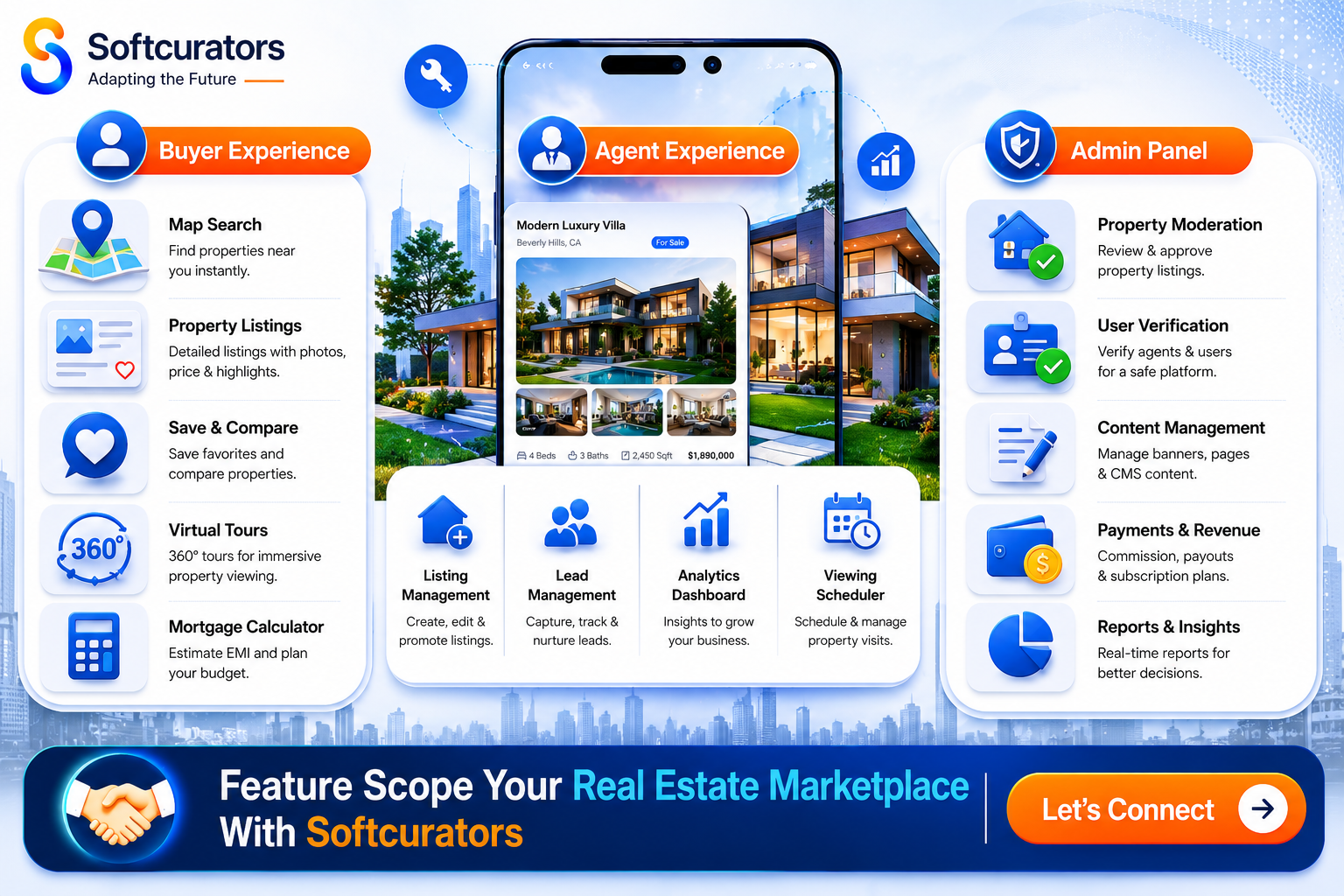
At Softcurators, we structure feature planning around three core user experiences. Each must feel complete and purposeful independently buyer, agent, and admin.
Buyer and Renter Experience
Advanced Map-Based Property Search. Search must support location queries at multiple granularities (city, postcode, neighbourhood, school district, commute time radius), price range, property type, bedroom count, and floor area. Draw-a-search functionality users draw a custom polygon on the map increases session depth significantly. PostGIS with Elasticsearch handles the geospatial query complexity at scale.
Rich Property Listing Pages. High-resolution photo gallery, virtual tour embed support (Matterport), full property specification, listing history (previous sale prices, days on market, price reductions), automated valuation estimate with confidence range, mortgage payment calculator, school ratings, walkability scores, and crime statistics. The quality of this page determines whether buyers contact agents.
Saved Searches and Price Alerts. Email and push alerts when matching new listings appear are the single highest-impact retention feature in property search. Side-by-side property comparison and price change tracking for saved listings create a research management system that buyers return to throughout a 3–12 month search process.
Virtual Tour and 3D Walkthrough Integration. Matterport 3D tour embeds, 360-degree photo galleries, drone photography, and Google Street View integration create a multi-format viewing experience. For off-plan developments, AI-powered digital staging tools that furnish empty room photos increase listing click-through rates by 15–25%.
Agent and Developer Experience
Listing Management Dashboard. Agents must create and publish a listing in under 10 minutes. A step-by-step wizard covering property details, photos (bulk upload with automatic EXIF stripping), pricing, and availability is essential. Mobile photo capture directly within the listing creation flow reduces friction for field agents.
Lead Management and CRM Integration. In-app messaging with read receipts, inquiry routing by property, lead scoring based on buyer engagement signals (multiple saves, repeated visits to the same listing), and export integration with Salesforce, HubSpot, and major real estate CRMs are essential for professional agent adoption.
Agent Analytics Dashboard. Listing views, contact rate, price comparison against comparable properties, and days-on-market data give agents actionable intelligence. Agents who see that their listing has 500 views but 0 contacts will update their photos or price. This data feedback loop improves platform-wide listing quality benefiting both agents and buyers.
Admin Panel Features
Content moderation and listing quality control, user verification and trust systems, agent licence verification, fraud pattern detection, subscription billing management, and financial reporting dashboards give platform operators complete visibility and control.
Advanced Features That Create Competitive Moats in Property Marketplace Platforms
AI-Powered Automated Valuation Model (AVM)
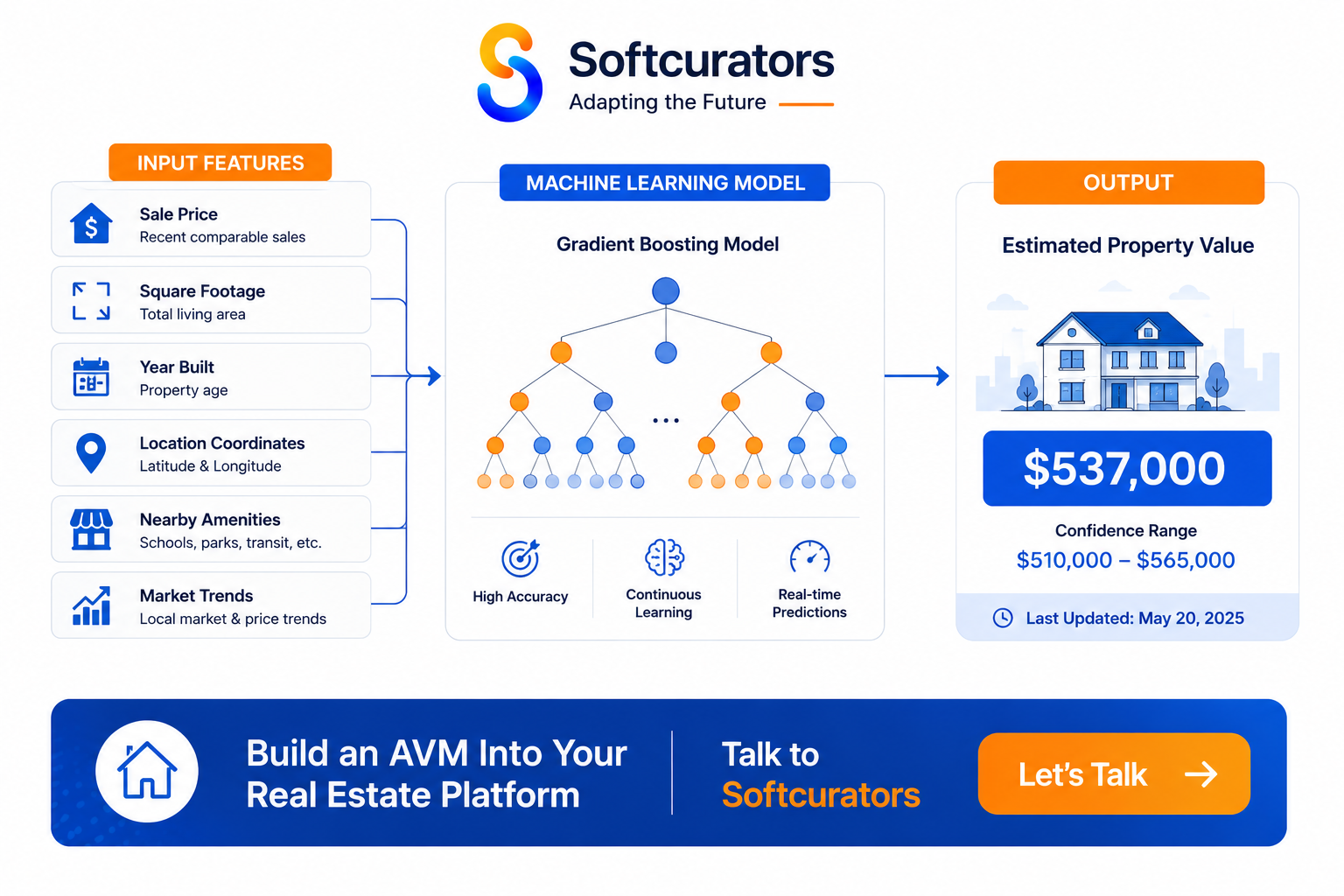
The AVM is the most strategically valuable feature in any real estate marketplace app. It estimates current market value by analysing comparable recent sales, property characteristics, location signals, and market trend data. Zillow’s Zestimate is the most famous example. Softcurators’ AI development and AI app development teams build AVM models as modular services starting with gradient boosting regression and scaling toward deep learning models as transaction data grows.
Generative AI Natural Language Search
Natural language search ‘find me a three-bedroom garden flat within 30 minutes of central London, under £600,000, near a good primary school’ converts conversational queries into structured search parameters using LLM-based NLP. This dramatically reduces search friction for first-time buyers. Softcurators’ AI consulting services team evaluates where generative AI creates genuine buyer value versus engineering complexity.
Predictive Market Analytics
Neighbourhood-level price prediction using macroeconomic signals, local listing velocity, and seasonal patterns transforms the platform from a search tool into a market timing advisor. See our guide on how to develop an AI real estate website for the full technical architecture behind predictive analytics.
Fractional Ownership and Investment Tools
Investment analysis overlays (cap rate, cash-on-cash return, rental yield), investor portfolio management, and digital share distribution infrastructure require combined real estate and fintech capabilities. Softcurators covers both through our real estate app development and fintech app development practices. See our guide on how to create an investment platform for the architecture behind fractional property investment.
AR Property Preview and Digital Staging
AR tools allowing buyers to visualise furniture placement or renovation potential within real property photos create stronger emotional engagement. Digital AI staging increases listing click-through rates meaningfully. Both features are buildable using ARKit (iOS), ARCore (Android), and AI image synthesis APIs. Softcurators’ iOS app development and Android app development teams have implemented both.
Real Estate Marketplace App Technology Stack
The technology stack for a real estate marketplace app requires geospatial query capability, MLS data feed integration, document management, and payment architecture that handles commission splits. At Softcurators, here is the stack we recommend.
Mobile Platform
For most property marketplace budgets, Flutter app development delivers iOS and Android at 35–40% lower cost than two separate native builds. Flutter’s Google Maps SDK, camera support, and AR plugin ecosystem suit real estate apps well. When deep CoreLocation geofencing or native ARKit is core, iOS app development with Swift provides finer control. Our guide on native apps vs hybrid apps covers this decision in full. React Native app development is a strong alternative for teams with existing JavaScript expertise.
Web Frontend
Next.js with React is essential not optional. Server-side rendering is critical because individual property listing pages must rank on Google at scale. Our web development team builds SSR listing pages with sub-2-second load times, automatically generated meta titles, Schema.org RealEstateListing markup, and Progressive Web App capability for offline browsing.
Backend and Database Architecture
Node.js handles real-time search, alerts, and messaging. Python (FastAPI) powers the AVM and AI layer. PostgreSQL with PostGIS is the correct database choice for property data it handles geospatial queries natively and efficiently. MongoDB stores flexible listing content. Redis caches hot search results for sub-100ms response times. Elasticsearch powers multi-filter search across millions of listings. Our software development team designs the full architecture from the first sprint.
| Layer | Technology | Softcurators Recommendation |
| Mobile Cross-Platform | Flutter (primary) | One codebase, 35–40% cost saving, mature Maps SDK |
| Mobile iOS Native | Swift / ARKit / CoreLocation | When AR preview or geofencing are core features |
| Mobile Android Native | Kotlin / Google Maps SDK | Best Android performance for geo-heavy features |
| Web Frontend | Next.js + React (SSR) | SSR essential for listing page SEO at scale |
| Backend Primary | Node.js + Express | Real-time search, messaging, alert delivery |
| Backend AI Layer | Python FastAPI | AVM model, predictive analytics, NLP search |
| Database Primary | PostgreSQL + PostGIS | Geospatial queries, property data integrity |
| Database Search | Elasticsearch | Multi-filter search across millions of listings |
| Database Cache | Redis | Sub-100ms search results, AVM estimate caching |
| Maps | Google Maps API / Mapbox | Google for reliability; Mapbox for custom styling |
| Cloud | AWS (EC2, S3, RDS, CloudFront) | Auto-scaling, global CDN for listing photos |
| Payments | Stripe + regional gateways | Subscriptions, commission splits, escrow flows |
How to Build a Real Estate Marketplace App: Step-by-Step Process
Building a real estate marketplace app is a structured process not just a sequence of feature builds. At Softcurators, we follow a proven software development methodology that manages product strategy, data acquisition, go-to-market, and compliance simultaneously.
Phase 1: Discovery Market, Data, and Business Model
Discovery is the phase most founders rush and the phase where the most expensive mistakes are prevented. Our discovery phase typically runs 2–3 weeks and delivers: a validated geographic and segment focus, a documented data access strategy (MLS membership, API licensing, or public records), a defined revenue model with modelled unit economics, and a feature prioritisation framework. The single most common cause of real estate app failure is launching without a solved data problem. Softcurators helps clients identify and secure the right data access pathway before a line of code is written.
Phase 2: UX/UI Design
Great mobile app UI/UX design for a property marketplace starts with the search-to-listing-page conversion flow. Our UI/UX design team maps three user journeys: first-time buyer discovering the platform through Google, repeat investor returning to track saved listings, and agent managing active listings. High-fidelity prototypes are tested with real users before any frontend code is written.
Phase 3: MVP Development
A real estate marketplace MVP is the minimum feature set that creates a complete property search experience and validates the core product hypothesis. For buyers: map search, listing pages, saved search alerts, agent contact. Agents: listing creation, inquiry inbox, basic analytics. For admin: listing moderation. Everything else is V2. Our MVP development and prototype development services help founders define and validate exactly this scope.
Phase 4: Backend and Data Pipeline
Build the property data ingestion pipeline first. The listing display, search functionality, and AVM all depend on clean, structured, current property data. Simultaneously, build core APIs: user authentication, Elasticsearch search indexing, saved search and notification system, agent profile management, and initial payment integration.
Phase 5: Mobile and Web Frontend
Build the buyer-facing mobile app, the agent dashboard, and the web platform across parallel development streams. Our mobile app development team, startup app and web development service, and cross-platform app development practice are structured for parallel delivery backend completion does not block mobile development.
Phase 6: AVM and AI Layer
Build the property transaction dataset, train the initial regression model against known recent sales, validate prediction accuracy, and integrate the AVM API endpoint with the listing page display. Softcurators’ AI development team builds AVM models starting with gradient boosting regression and scales toward deep learning as platform data grows.
Phase 7: Testing, QA, and Compliance Audit
Testing must cover geospatial search accuracy, map rendering performance across 20+ device/OS combinations, MLS data feed validation, payment flow testing, and mobile app security and compliance testing including a fair housing algorithm audit. Our mobile app testing and deployment practice includes specific test suites for PropTech compliance requirements.
Phase 8: Market Seeding and Phased Launch
Launch in one market or segment first. Before opening to buyers, seed the platform with listing supply through agent partnerships. Sign 20–50 active agents before public launch. You need property data before you need users.
Phase 9: Post-Launch Growth and Iteration
After launch, mobile app maintenance and support becomes the primary focus. Monitor search-to-listing-page conversion, listing-to-contact conversion, and saved search creation rate. Ship updates every 2–4 weeks. Platforms that iterate consistently grow 3x faster than those with quarterly release cycles.
Legal and Compliance Requirements You Cannot Skip
Compliance is an architectural constraint not a post-launch consideration. Softcurators addresses the following requirements at the system design phase.
Fair Housing and Anti-Discrimination Law
In the US, the Fair Housing Act prohibits discrimination based on protected characteristics. Real estate marketplace apps must ensure that search algorithms, neighbourhood labelling, and recommendation systems do not steer users based on protected characteristics. Softcurators conducts algorithmic fairness audits during the QA phase as standard.
MLS and IDX Data Licensing
Using MLS listing data in the US requires Board membership or an IDX data licence. IDX rules specify required attribution, data refresh frequency, and accuracy standards. Violations result in immediate data licence termination. Softcurators builds MLS integration architecture that maintains automated IDX compliance on an ongoing basis.
Data Privacy: GDPR, DPDP, and CCPA
Property search behaviour reveals sensitive information about users’ personal circumstances. GDPR, India’s DPDP Act, and CCPA all apply depending on user geography. Build data privacy architecture from the first database schema: explicit consent flows, granular retention policies, and automated deletion workflows.
Agent Licensing Verification
In most markets, only licensed agents may list properties for commission. Your platform must verify agent licences during onboarding using national register integration. Softcurators integrates licence verification systems for US, UK, UAE, and South Asian markets as part of the standard agent onboarding flow.
Real Estate Marketplace App Development Cost: Realistic Budget Ranges
Here is a breakdown based on Softcurators’ actual project experience. For detailed breakdowns, also see our guides on real estate app development cost, cost to develop a property listing app, and AI real estate software development cost.
| Development Component | Cost Range (USD) | Notes |
| Discovery and Strategy | $2,000 – $5,000 | Market validation, data strategy, revenue model design |
| UX/UI Design (All User Types) | $3,000 – $8,000 | Buyer, agent, developer, and admin panel design systems |
| Property Data Pipeline (MLS/ETL) | $4,000 – $10,000 | MLS integration, normalisation, daily refresh automation |
| Backend + Search (Elasticsearch + PostGIS) | $5,000 – $15,000 | APIs, geospatial search, alerts, auth, booking engine |
| Mobile App (iOS + Android Flutter) | $12,000 – $35,000 | Cross-platform recommended for marketplace budgets |
| Web Frontend (Next.js SSR) | $5,000 – $15,000 | Buyer web, SSR listing pages, agent portal, SEO architecture |
| AVM / AI Valuation Layer | $6,000 – $15,000 | Comparable sales model, training pipeline, API endpoint |
| Agent Portal and CRM Integration | $5,000 – $10,000 | Listing management, lead inbox, analytics, CRM export |
| Payment Integration (Subscription + Commission) | $1,000 – $4,000 | Stripe subscriptions, commission splits, escrow flows |
| Admin Panel and Moderation Tools | $2,000 – $6,000 | Listing QA, user management, fraud detection, reporting |
| QA, Security, and Compliance Audit | $3,000 – $6,000 | Fair housing audit, IDX compliance, performance testing |
| TOTAL MVP (Core Marketplace) | $15,000 – $30,000 | Validated core marketplace with AVM and agent portal |
| TOTAL Full Platform (All Features) | $30,000 – $50,000+ | AI, fractional ownership, full transaction infrastructure |
For broader context on mobile app development cost, see our detailed pricing guide. Softcurators provides fixed-price proposals with milestone billing no hourly billing surprises. We respond with a scoped estimate within 48 hours of a free discovery call.
Real Estate Marketplace App Development Timeline
| Phase | Duration | Key Output |
| Discovery and Strategy | 1 – 2 weeks | Product spec, tech stack, MVP scope, data access plan |
| UX/UI Design | 2 – 3 weeks | Wireframes, prototypes, design system, listing page design |
| Backend + Data Pipeline | 2 – 5 weeks | APIs, Elasticsearch index, MLS feed live |
| AVM Model Development (parallel) | 1 – 3 weeks | Trained regression model, API endpoint, validation |
| Mobile + Web Frontend | 3 – 6 weeks | Buyer app, agent portal, SSR web platform |
| Testing and Compliance Audit | 1 –2 weeks | Fair housing audit, IDX compliance, QA, app store prep |
| Market Seeding and Soft Launch | 1 – 2 weeks | First 50 agent listings live, soft launch to buyers |
| TOTAL MVP Platform | 2 – 3 months | Core marketplace live on all platforms |
| TOTAL Full Platform | 3 – 5 months | All features including AI and fractional ownership |
Softcurators runs backend, mobile, and AI workstreams simultaneously from Week 2 of development compressing the timeline without sacrificing quality. See our guide on mobile app development for businesses and startups for more detail on timeline planning.
7 Mistakes That Kill Real Estate Marketplace App Projects
Mistake 1: Launching Without Solving the Data Problem
A property marketplace with no listings, stale listings, or inaccurate listings creates no value. Secure your MLS licence or data partnership before design begins not after launch.
Mistake 2: Building for Buyers Before Recruiting Agent Supply
Without agents committed to listing on your platform, buyer traffic creates no revenue and no retention. Sign 20–50 agent partners before soft launch. Supply before demand every time.
Mistake 3: Deferring the AVM to Phase Two
Your AVM needs transaction data from day one. If you do not build the collection pipeline in V1, adding a credible valuation model later requires expensive third-party data. Softcurators designs the transaction data pipeline into the initial backend architecture as standard.
Mistake 4: Ignoring Map Performance at Scale
10,000 property markers without clustering collapses mobile performance. Build marker clustering and tile caching from the first map integration not after the first user complaint about the app being slow.
Mistake 5: Treating Fair Housing Compliance as a Legal Issue
Your search algorithm and recommendation engine must be audited for demographic steering before launch not after a regulatory inquiry. Compliance is an architecture requirement, not a legal checkbox.
Mistake 6: Trying to Launch Nationally From Day One
Thin supply in every market beats meaningful presence in none. Own one city or segment first. Density creates trust, which creates listings, which creates buyers. Then expand.
Mistake 7: Choosing a Development Partner Without PropTech Experience
MLS integration, PostGIS architecture, AVM model development, IDX compliance, and escrow payment design require specialist experience. Softcurators has delivered multiple real estate marketplace projects with all these requirements. Review our portfolio and read why companies choose Softcurators. Then contact us to discuss your project.
Emerging Trends Shaping Real Estate Marketplace Apps
AI-Native Conversational Property Search
Form-based filter stacks are giving way to conversational AI search. By 2026, platforms without natural language search will feel dated. Softcurators’ AI development team builds NLP search interfaces as modular additions to existing Elasticsearch infrastructure.
Climate Risk Intelligence as a Core Data Layer
Flood risk, wildfire proximity, and sea level projections are becoming standard listing data. Integrating climate risk scores into listing pages is transitioning from premium differentiator to expected baseline. Our mobile app development trends guide covers the broader PropTech technology context.
End-to-End Digital Transaction Capability
The full transaction process from offer to completion still involves 12–18 weeks and 20+ document exchanges in most markets. Platforms that digitise the entire chain (digital offer submission, e-signature, digital escrow, automated completion) create switching costs that listing portals cannot match.
Tokenised Fractional Property Ownership
Blockchain-based tokenisation of property ownership is moving from regulatory sandbox to regulated product in several jurisdictions. For platforms serving investors rather than homebuyers, tokenised ownership infrastructure is the highest-value technical investment for 2025–2027.
Why Softcurators for Your Real Estate Marketplace App Development
Understanding real estate marketplace app development is one thing. Building a platform that captures a specific market and generates qualified leads consistently is another. Softcurators approaches every PropTech project with three non-negotiable commitments.
Market-First Architecture
We do not start with a feature list. We start with a market hypothesis: which specific buyer segment, in which specific geography, with which specific unmet need is this platform designed to serve? Every architecture decision flows from that answer.
PropTech-Specialist Engineering
Real estate marketplace development requires capabilities absent in standard mobile teams: RESO Web API and MLS integration, PostGIS geospatial design, AVM model development, fair housing algorithm audit, and escrow-compatible payment architecture. Softcurators has delivered all of these in actual PropTech projects. Our iOS app development, Android app development, Flutter app development, web development, and AI development capabilities cover the complete real estate marketplace stack.
From MVP to Market Leadership
Our MVP development and prototype development services help founders launch faster at lower cost then layer advanced features as user data validates what drives retention and revenue. The digital marketing services team builds the SEO content strategy and agent acquisition campaigns that seed listing supply before launch. Our AI automation services automate listing refresh, lead routing, and buyer nurture sequences as the platform scales.
Explore more: Real Estate App Development | AI Real Estate Website | How to Create a Real Estate App | Real Estate App Cost | Property Listing App Cost | AI Real Estate Software Cost | Investment Platform Guide | Our Portfolio
Conclusion: The Real Estate Marketplace App You Build Today Defines Your Market Position in 2030
The real estate marketplace app opportunity is real, specific, and growing. The technology is accessible. The niches that Zillow, Rightmove, and existing portals systematically underserve are large, growing, and willing to adopt better-designed alternatives.
The platforms that win the next decade will not be the ones that launched the most features. They will be the ones that launched with the deepest understanding of a specific buyer’s journey, the most reliable property data pipeline, and the most credible AVM.
At Softcurators, we build those platforms. We design V1 with V2 in mind. Embed the transaction data pipeline before the AVM exists. We build the financial services integration before the first mortgage referral partner is signed.
Book a free strategy call with Softcurators today and let us map out how to build your real estate marketplace platform for where the property technology market is heading.
Further reading: Mobile App Security and Compliance | Mobile App UI/UX Best Practices | Mobile App Development Technologies | Mobile App Development Trends | Why Choose Softcurators
FAQs
How much does it cost to build a real estate marketplace app?
A focused MVP real estate marketplace app costs between $15,000 and $30,000. A full platform with AI recommendations, fractional ownership tools, mortgage integration, and advanced analytics costs $30,000 to $50,000+ or more. The primary cost drivers are team geographic location, feature scope, AVM model complexity, and MLS data licensing fees. Softcurators provides fixed-price proposals within 48 hours of a free discovery call.
Q: How long does it take to build a real estate marketplace app?
A focused MVP takes 2–3 months with Softcurators' parallel development approach. A full platform with all advanced features requires 3–6 months. Softcurators runs backend, mobile, and AI workstreams simultaneously from Week 2 so timeline compression does not sacrifice quality. Working features are demonstrated every two weeks throughout the build.
What is the difference between a real estate listing portal and a marketplace app?
A listing portal aggregates property listings and displays them for buyers to browse. Revenue comes from agent listing fees. A real estate marketplace app is a two-sided transaction platform supporting the full property journey: search, virtual tour, offer submission, negotiation, document management, escrow, and completion. Revenue comes from transaction commissions, subscription tiers, mortgage referrals, and data licensing creating a far more defensible and valuable business model.
Do I need MLS data access to build a real estate marketplace app?
In the US, yes for residential property. Accessing MLS listing data requires either MLS Board membership or an IDX data licence. Both have associated costs ($500–$5,000/month) and compliance requirements. In other markets, equivalent data sources include land registry APIs, municipal property databases, and commercial aggregators. Softcurators helps clients identify and secure the right data access pathway for their target market before development begins.
What technology stack is best for a real estate marketplace app?
Softcurators' recommended stack: Flutter for cross-platform mobile; Next.js for the web frontend (SSR essential for listing page SEO); Node.js for the primary backend; Python FastAPI for the AVM and AI layer; PostgreSQL with PostGIS for geospatial property queries; Elasticsearch for multi-filter search; Redis for sub-100ms search caching; Google Maps API or Mapbox for map browsing; Stripe for subscription billing and commission payments; AWS for cloud hosting and photo CDN delivery.
What is an AVM and how important is it for a real estate marketplace?
An Automated Valuation Model (AVM) estimates a property's current market value using comparable sales data, property characteristics, and location signals. Zillow's Zestimate is the most famous example. An AVM transforms a listing portal into a market intelligence platform dramatically increasing user trust, engagement, and return visit rates. Softcurators builds AVM models starting with gradient boosting regression and scales toward deep learning as platform transaction data grows.
What is PostGIS and why do I need it for a property marketplace?
PostGIS is a geospatial extension for PostgreSQL that enables efficient storage and querying of geographic data. For a real estate marketplace, PostGIS enables 'properties within this drawn polygon,' 'properties within 500m of this school,' and 'properties within a 30-minute commute radius.' Without PostGIS, these queries require complex workaround logic that is slow, inaccurate, and difficult to scale. Softcurators implements PostGIS as standard in every property marketplace backend.
Do I need separate iOS and Android apps for a real estate marketplace?
For most property marketplace budgets, Flutter delivers both iOS and Android from a single codebase at 35–40% lower cost than two separate native builds. Native iOS is preferable when CoreLocation geofencing, ARKit property preview, or Apple Maps integration are core features. Native Android is preferable for markets where Android has dominant share. Softcurators' guide on native apps vs hybrid apps covers this decision in detail.
What is IDX compliance and how does it affect my real estate app?
IDX (Internet Data Exchange) governs how licensed agents can display MLS listing data on third-party platforms. IDX rules specify required attribution (listing agent, brokerage name, MLS logo on every listing), data refresh frequency (typically every 24 hours minimum), accuracy standards, and prohibitions on certain data uses. Violating IDX rules results in immediate data licence termination. Softcurators builds MLS integration that maintains automated ongoing IDX compliance.
How does fair housing compliance affect real estate app development?
Fair housing law requires that real estate platforms do not discriminate based on protected characteristics. Search algorithms must not filter or rank properties based on neighbourhood demographics. Recommendation systems must be audited for geographic steering. Neighbourhood labels must use geographic rather than demographic descriptors. Softcurators conducts algorithmic fairness audits during the QA phase as a standard component of every real estate marketplace build.
How do I monetise a real estate marketplace app?
The most sustainable monetisation mix for a real estate marketplace is: (1) transaction commissions (% of property sale or rental value paid by agent), (2) agent subscription tiers (monthly fees for lead access, featured placement, CRM tools), (3) mortgage and financial services referrals, (4) developer and new project advertising (premium placement for property developer launches), and (5) data licensing (market trend data sold to institutional investors at scale).
What is the RESO Web API?
RESO (Real Estate Standards Organisation) Web API is the modern standard for exchanging MLS property data in the US. It replaced the older RETS protocol and is now required by the NAR for member MLSs. Understanding RESO data dictionaries standardised field names and value sets for property attributes across different MLS systems is essential for building a US property marketplace. Softcurators has built multiple RESO-compliant MLS integrations.
Can I build a real estate marketplace without a technical background?
Yes. You need a clear market hypothesis, a validated revenue model, and a development partner with genuine PropTech experience. You do not need to write code. Softcurators has helped multiple non-technical founders launch successful real estate marketplace apps managing the complete technical workstream while keeping founders informed and in control at every milestone.
How do I handle property data quality in a marketplace app?
Property data quality requires: automated duplicate detection, address standardisation and geocoding, photo quality scoring, listing freshness enforcement (auto-unpublishing stale listings), and agent verification. Softcurators builds data quality pipelines as an integral component of the property data ingestion architecture not as a post-launch addition.
What is fractional property ownership and how do I build it into an app?
Fractional property ownership allows multiple investors to hold fractional interests in a single property. Building fractional ownership features requires investor portfolio management, secondary market trading infrastructure (if allowing fractional share trading), regulatory compliance (fractional ownership is securities-regulated in most jurisdictions), and financial calculation tools. Softcurators builds fractional ownership infrastructure using its combined real estate and fintech app development expertise.
How important is map performance in a real estate marketplace app?
Map performance is critical and consistently underestimated. A map that renders poorly causes users to attribute the problem to 'the app being bad' regardless of listing quality. Specific requirements for production-grade map performance: marker clustering (client-side and server-side for high-density markets), tile caching (reducing map tile re-requests), progressive loading (loading markers in viewport priority order), and geofence alerting (push notification when a saved search area gets a new listing). Softcurators implements all four as standard.
How does offer submission and negotiation work in a real estate marketplace?
Offer submission infrastructure requires structured offer forms, conditions capture (finance, inspection, settlement date), buyer identity verification, digital signature integration (DocuSign or Adobe Sign), secure document storage (AWS S3 with encryption), and notification workflows (seller and agent notified of new offer, buyer notified of counter-offer or acceptance). This is one of the most technically complex features in a full marketplace build and one of the most commercially valuable.
What are the biggest PropTech trends ?
The five most significant trends in real estate marketplace development : (1) AI-native conversational property search replacing form-based filter stacks; (2) climate risk intelligence (flood, wildfire, heat) integrated as standard listing data; (3) end-to-end digital transaction capability from offer to completion; (4) tokenised fractional property ownership moving from sandbox to regulated product; and (5) hyper-local market intelligence content as both buyer experience feature and SEO strategy.
How should a real estate marketplace handle competing listings from multiple sources?
Multi-source listing integration requires a canonical property identifier system a unique ID linking the same property across different data sources. When the same property appears from multiple sources, deduplication logic must select the highest-quality, most recent version and suppress duplicates. Canonical property records also enable listing history aggregation showing all historical listings and sales for a specific property across its entire history. Softcurators designs canonical property identity systems as a core data architecture requirement.
Can I add AI property recommendations to a real estate marketplace?
Yes and it significantly improves buyer engagement and agent lead quality. Recommendation approaches: content-based filtering (properties similar to those the buyer saved), collaborative filtering (properties users with similar search behaviour contacted), and behavioural recommendation (surfacing listings the buyer visited multiple times without contacting high-interest signal warranting a price alert). The data pipeline for training these models must be built from the first day of platform operation.
What payment infrastructure does a real estate marketplace need?
A real estate marketplace payment infrastructure requires: subscription billing for agent tiers (Stripe Billing, with automatic renewal and failed payment retry), commission collection on transactions (Stripe Connect for marketplace payment splitting), deposit escrow on offer acceptance (compliant escrow API or third-party service), and regional payment methods for international platforms. Each has specific compliance and reconciliation requirements. Softcurators designs payment infrastructure as a dedicated architecture stream.
How do I attract agents to a new real estate marketplace platform?
Agent acquisition requires: (1) a compelling free-to-list offer for 12–24 months (remove friction from initial commitment), (2) performance data that demonstrates buyer intent, (3) lead quality that exceeds existing portals, (4) CRM integration that fits agents' existing workflows, and (5) personal relationship building in the target market. Agent supply is the most critical launch requirement for a two-sided property marketplace.
What should I prioritise for a real estate marketplace MVP?
A real estate marketplace MVP should contain: buyer-facing map search with core property filters, server-side rendered listing pages (for SEO), saved search with email alerts, agent-facing listing creation (completable in under 10 minutes), agent inquiry inbox and response tracking, basic AVM estimate display, and admin panel for listing moderation. Everything else belongs in V2 or V3, validated by actual user behaviour from the MVP launch.
How do rental listings differ from sales in a real estate marketplace app?
Rental listings require distinct data fields (monthly rent, lease term, utility inclusion, pet policy, deposit amount, available date), different search behaviours (tenants search by move-in date availability), separate agent tools (availability calendar management, tenancy application processing), and different legal compliance. Softcurators builds rental and sales listing management as parallel but distinct workflows sharing the same data infrastructure.
How does real estate marketplace SEO work at scale?
Real estate marketplace SEO requires: server-side rendered listing pages (Next.js SSR) for every property listing, automatically generated meta titles and descriptions, Schema.org RealEstateListing structured data markup, a neighbourhood and area page hierarchy with unique content at each level, fast page load times (under 2 seconds), and a consistent internal linking strategy. The SEO architecture must be built into the web frontend from sprint one it cannot be retrofitted.
What is the hardest technical challenge in real estate marketplace development?
From Softcurators' project experience, the hardest technical challenges are: (1) geospatial search performance at scale (polygon search across 1M+ listings without latency), (2) MLS data normalisation (different boards use different field names for the same property attributes), (3) AVM model accuracy in thin-data markets (areas with few comparable sales), and (4) real-time availability management (preventing the same property from receiving multiple simultaneous offers without a distributed lock mechanism).
How do I scale a real estate marketplace from launch to one million listings?
Scaling requires: database read replicas and connection pooling for concurrent listing page queries, Elasticsearch index sharding for large listing counts, CDN-distributed photo delivery (AWS CloudFront) for fast global image loading, microservices separation for search, AVM, and agent management workloads, daily automated MLS data refresh with error handling, and load testing simulating 50,000 simultaneous search queries before each major release. Softcurators designs scalable architecture from the first system design session.
What is the best first market for a new real estate marketplace app?
The best first market is the smallest specific geography or segment where you can achieve meaningful supply density within your agent acquisition budget. For most PropTech startups, this means one metro area, one property segment (luxury, student, commercial), or one specific use case (off-market discovery, fractional investment). Achieving genuine market density in one area creates the defensible position, transaction data, and revenue to fund the next expansion.
How does a real estate marketplace app handle international markets?
International property marketplace development requires: local data source identification (land registry APIs, municipal databases, commercial aggregators), local compliance law (fair housing, data privacy, agent licensing by country), multi-language and multi-currency support, local payment method integration, regional cloud infrastructure for fast page loading, and recommendation models trained on local market patterns rather than Western-optimised algorithms. Softcurators has built property platforms for US, UK, UAE, and South Asian markets with all local adaptations.
How do I get started building a real estate marketplace app with Softcurators?
The first step is booking a free 30-minute strategy call at softcurators.com/contact. Our senior architect reviews your concept, discusses your target market and geographic focus, assesses your data access strategy, and evaluates which features are essential for V1 versus V2. We deliver a scoped cost estimate within 24 hours followed by a detailed fixed-price proposal within 3–5 business days. No generic templates. No obligation. A real PropTech architect thinking specifically about your platform's market position.
