
Every day, your business generates thousands of data points. Sales figures, customer behavior patterns, supply chain signals, financial flows, marketing engagement the list never ends. Yet most companies are sitting on this goldmine completely blind. AI-powered business intelligence changes that entirely.
Think about this: a 2025 McKinsey report found that data-driven organizations are 23 times more likely to acquire customers, 6 times more likely to retain them, and 19 times more likely to be profitable. And yet, less than 30% of businesses have a working strategy to turn their data into real decisions.
At Softcurators, we work with founders, CTOs, and business owners who are tired of guessing. They want clarity and want dashboards that actually tell them something useful. They want AI that works in the real world not just in a boardroom slide. And that is exactly what modern AI-powered business intelligence delivers.
In this guide, we break down how AI-powered BI works, what it actually looks like inside a business, and how to start building it the right way without wasting months or millions of dollars on the wrong approach.
Quick Stat: Businesses that deploy AI-powered BI platforms report an average 28% improvement in operational decision-making speed within the first 6 months. (Gartner, 2025)
What Is AI-Powered Business Intelligence? A Plain-English Explanation
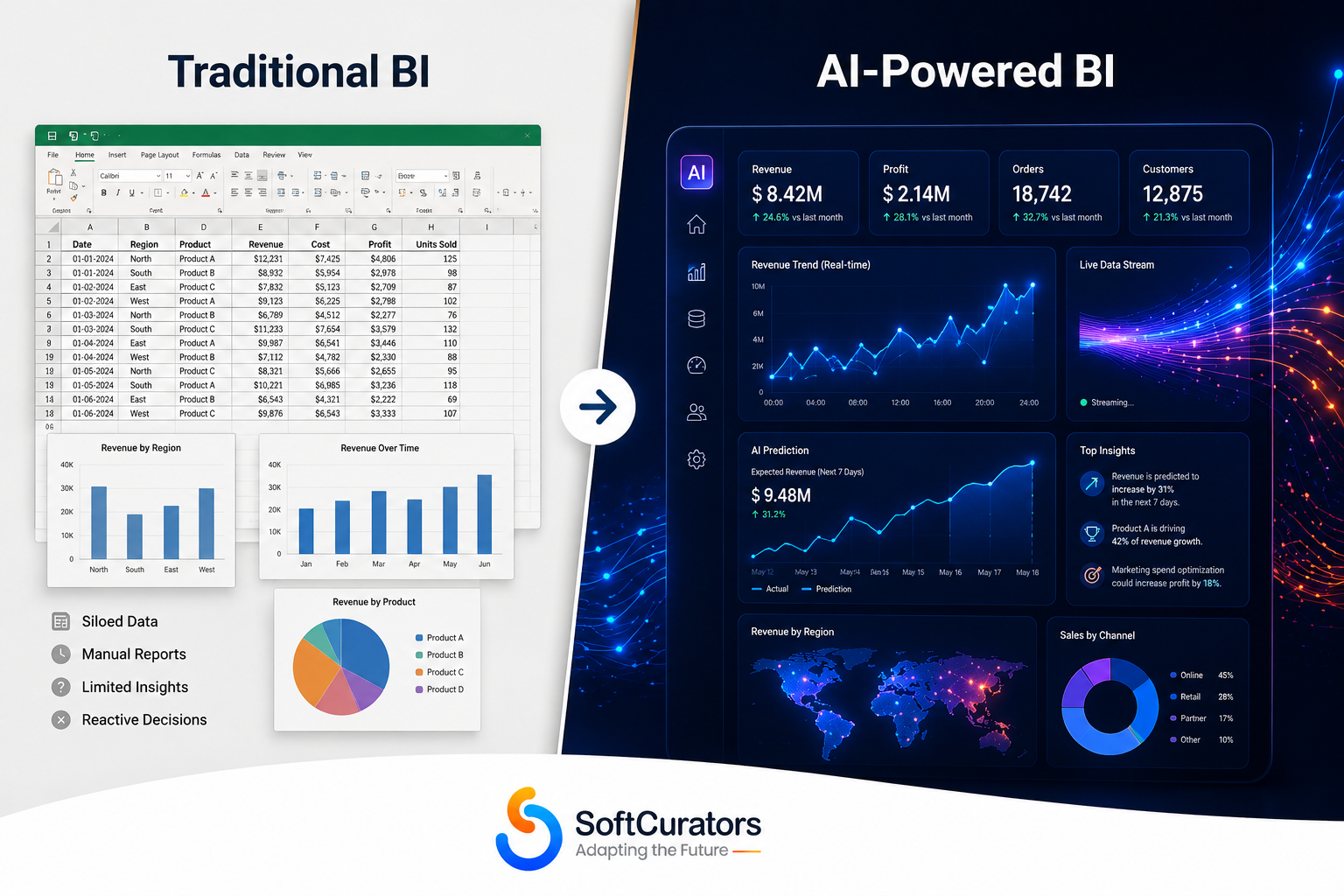
Business intelligence, at its core, is the process of collecting data, analyzing it, and using the results to make better business decisions. Traditional BI tools think old-school Excel dashboards, static reports, and manual data pulls did this reasonably well a decade ago. But the volume, variety, and velocity of data in 2026 have made those methods dangerously obsolete.
AI-powered business intelligence is the next evolution. Instead of simply showing you what happened (descriptive analytics), it tells you why it happened, what is likely to happen next, and what you should do about it.
The Three Layers of AI-Powered BI
- Descriptive Analytics – What happened? (Historical data reports, dashboards)
- Predictive Analytics – What will happen? (Machine learning forecasting models)
- Prescriptive Analytics – What should we do? (AI-driven recommendations and automation)
Most legacy BI tools stop at descriptive. AI-powered BI platforms integrate all three layers, often in real time. This is the fundamental shift that changes how businesses operate.
Softcurators specializes in building AI development solutions that embed all three analytics layers into a single, coherent platform customized to your industry, your data sources, and your actual business goals.
Why Traditional BI Tools Are Failing Modern Businesses
Legacy business intelligence systems were built for a world that no longer exists. Here is what they struggle with in 2026:
1. They Are Always Looking Backward
Traditional BI is reactive. You get a report about last quarter’s performance after the quarter is already over. By the time the insight reaches a decision-maker, the window to act has often closed. AI-powered BI processes data in real time and flags issues while you can still do something about them.
2. They Require Specialized Teams to Operate
Old BI tools often need data scientists, SQL analysts, and BI developers just to produce a basic report. That creates bottlenecks. AI-powered platforms use natural language processing (NLP), so a non-technical manager can type a question like ‘Which products had the highest return rate in Q1?’ and get an instant answer no coding required.
3. They Cannot Handle Unstructured Data
About 80% of enterprise data is unstructured emails, customer reviews, social media mentions, call transcripts, documents. Traditional BI completely ignores this. AI-powered BI platforms can process and analyze unstructured data using natural language processing and sentiment analysis, uncovering insights that were previously invisible.
4. They Do Not Scale Well
As your business grows, your data grows exponentially. Legacy BI systems buckle under this load. Modern AI-powered platforms built on cloud-native architecture scale automatically. At Softcurators, our software development team architects BI solutions designed to scale from startup to enterprise without rebuilding from scratch.
Core Components of an AI-Powered Business Intelligence Platform
Understanding what makes a BI platform truly AI-powered helps you ask better questions when evaluating vendors or building one. Here are the non-negotiable components:
Data Integration and ETL Pipeline
Every AI-powered BI system starts with data aggregation. This involves connecting to all your data sources your CRM, ERP, e-commerce platform, marketing tools, financial systems, logistics data, and more. An ETL (Extract, Transform, Load) pipeline cleanses this data, standardizes formats, removes duplicates, and loads it into a central data warehouse or data lake.
Softcurators builds robust data pipelines as part of our AI automation services, ensuring your raw data is clean, reliable, and ready for analysis before any AI touches it.
Machine Learning Models and Predictive Engines
This is where the intelligence lives. ML models learn from historical patterns in your data and generate predictions. Common use cases include sales forecasting, customer churn prediction, demand planning, fraud detection, and anomaly detection. The models improve continuously as more data flows in meaning your BI system gets smarter over time.
Natural Language Processing (NLP) Interface
NLP turns your BI platform into a conversational tool. Instead of building complex queries, users simply ask questions in plain language. The AI understands intent, pulls the relevant data, and presents results in clear visualizations or summaries. This dramatically increases adoption across non-technical teams.
Real-Time Dashboards and Visualization Layer
Data means nothing if people cannot understand it quickly. A well-designed BI dashboard turns complex analytics into visual stories charts, heat maps, KPI cards, trend lines, and alerts. Softcurators applies proven UI/UX design principles to BI dashboards, making them not just functional but genuinely easy to use for executives, managers, and frontline teams alike.
Prescriptive Recommendation Engine
The most advanced layer of AI-powered BI does not just show insights it recommends specific actions. ‘Increase inventory for Product X by 15% ahead of the holiday season.’ ‘This customer segment is likely to churn deploy this retention offer.’ ‘Your supply chain has a 72-hour disruption risk in Region B.’ These recommendations come from the AI, validated against your business rules.
Automated Reporting and Alerts
Manual report generation is eliminated. The platform automatically schedules and distributes reports to stakeholders. More importantly, intelligent alert systems notify the right people the moment a KPI moves outside acceptable thresholds no one needs to check a dashboard to know something needs attention.
Industry-Specific Applications: Where AI-Powered BI Creates the Most Value
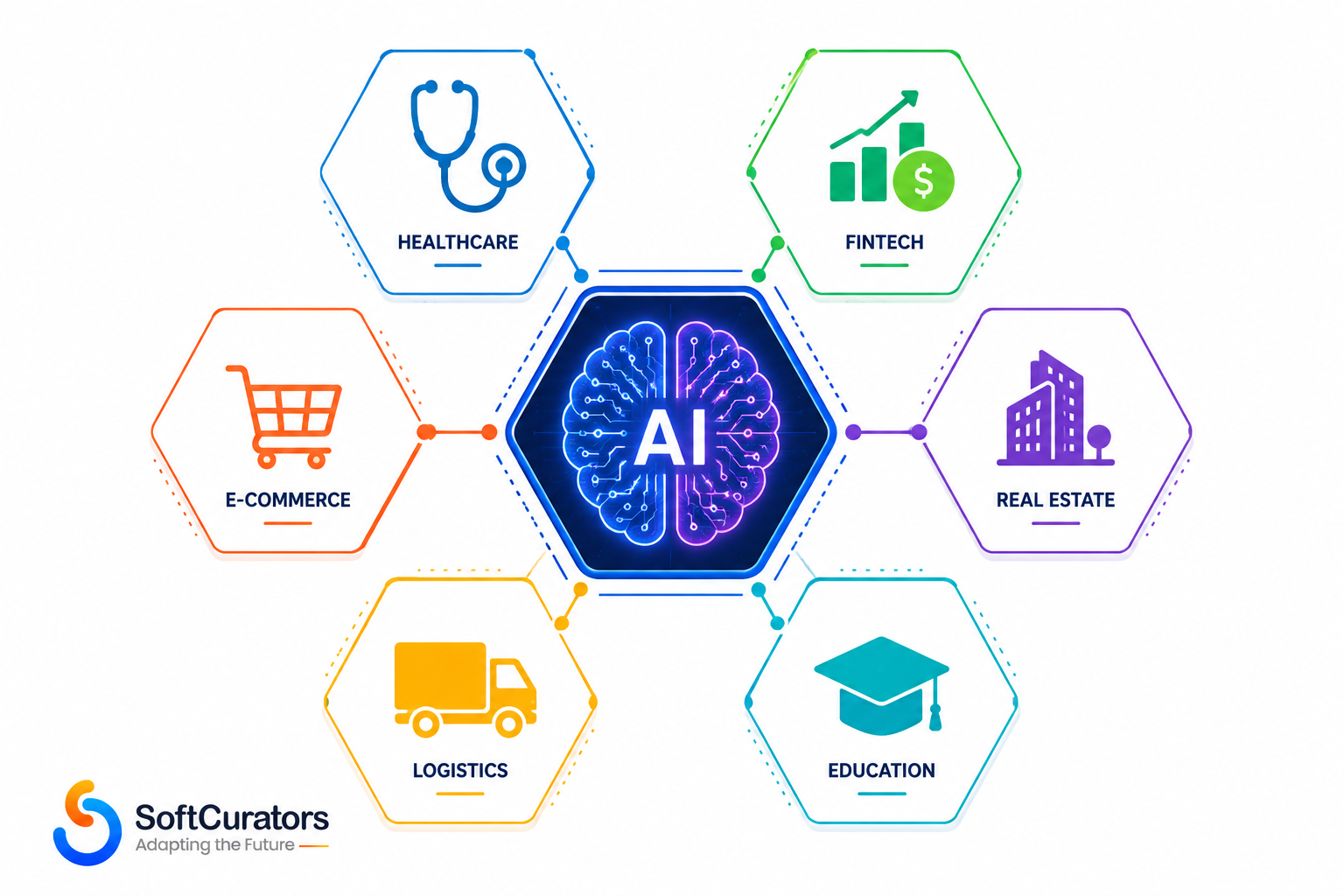
Fintech and Banking
In financial services, AI-powered BI is transforming credit decisions, fraud detection, and portfolio risk management. Models analyze thousands of data points per transaction in milliseconds. Softcurators has built advanced solutions in this space explore our AI in credit scoring and AI in loan lending blog posts for deeper context. Our fintech app development team integrates BI directly into lending platforms, giving loan officers real-time borrower risk scores.
Healthcare
Patient outcome prediction, resource allocation, readmission risk scoring, and operational efficiency healthcare organizations are using AI-powered BI to save both lives and costs. Our healthcare app development team at Softcurators builds HIPAA-compliant BI solutions that give hospital administrators and clinicians meaningful real-time intelligence.
Real Estate
Property valuation models, market trend analysis, rental yield forecasting, and buyer intent signals AI-powered BI is reshaping how real estate decisions are made. Softcurators brings this to life through our real estate app development capabilities. Learn more about how AI real estate software is transforming property investment decisions.
E-Commerce and Retail
Demand forecasting, personalized pricing, inventory optimization, cart abandonment prediction, and customer lifetime value modeling e-commerce businesses that deploy AI-powered BI consistently outperform competitors on margins. Softcurators’ ecommerce development practice integrates BI deeply into product recommendation engines and pricing algorithms.
On-Demand and Logistics
Route optimization, driver performance analytics, delivery time prediction, and fuel efficiency modeling are all powered by AI-driven BI in the logistics sector. Our logistics app development team builds BI-native platforms for on-demand businesses.
Education
Student performance prediction, course completion rates, engagement analysis, and administrative efficiency educational institutions use AI-powered BI to improve outcomes at scale. Explore our education app development services to see how Softcurators builds analytics into learning platforms.
How Softcurators Builds AI-Powered BI Solutions: Our Proven Process
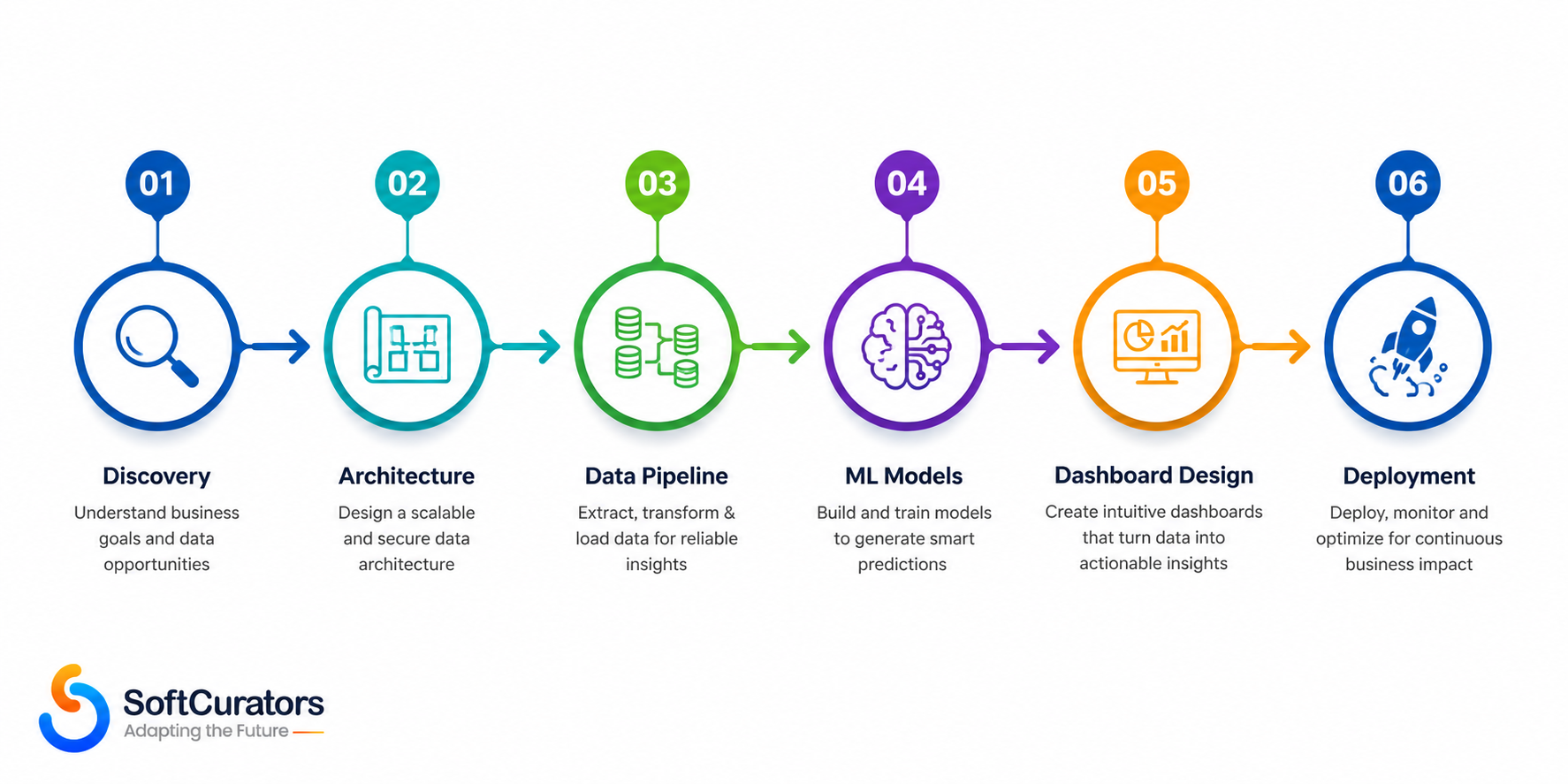
Phase 1: Discovery and Business Goal Mapping
We start by understanding your business not your data. What decisions do you need to make faster? At Night what keeps you up as a CEO or operations head? What does success look like in 12 months? This goal mapping ensures every data point we collect serves a purpose.
Phase 2: Data Audit and Architecture Design
We audit your existing data sources, assess data quality, identify gaps, and design a scalable architecture. This includes choosing between data warehouse solutions (Snowflake, BigQuery, Redshift), streaming platforms (Kafka, Kinesis), and storage strategies appropriate for your data volume.
Phase 3: Data Pipeline Development
Our engineers build the ETL/ELT pipelines that connect all your data sources. We handle APIs, databases, flat files, real-time streams, and third-party integrations. Our web development team ensures seamless data flow from source to insight layer.
Phase 4: AI and ML Model Development
This is where Softcurators’ AI app development expertise shines. We select, train, validate, and deploy ML models tuned specifically for your business context. We also implement explainability layers so decision-makers understand why the AI is recommending what it recommends.
Phase 5: Dashboard and UX Design
Beautiful data visualization is not vanity it is how people actually use insights. Our design team applies mobile app UI/UX best practices to BI dashboards, ensuring every chart, table, and alert is intuitive and actionable.
Phase 6: Deployment, Training, and Iteration
We deploy your BI platform, train your team, and set up ongoing maintenance cycles. Softcurators’ maintenance and support services ensure your platform stays current as your business evolves and as AI models need retraining.
The Role of Power BI and Modern BI Platforms in an AI-Driven Stack
While Softcurators builds fully custom AI-powered BI solutions, we also integrate with leading commercial platforms like Microsoft Power BI, Tableau, Looker, and Metabase where appropriate. We have written extensively about how Power BI transforms raw data into actionable insights that post is a great companion read to this guide.
The key principle is this: no single platform is right for every business. The right BI stack depends on your existing technology infrastructure, your team’s technical maturity, your data volume, your compliance requirements, and your budget. Softcurators’ AI consulting team evaluates all of these factors before recommending an approach.
Our AI consulting services team has delivered BI strategies for companies ranging from seed-stage startups to mid-market enterprises and the right answer is almost never ‘just plug in Tableau.’
Real Business Outcomes: What AI-Powered BI Actually Delivers
Let us move past theory and talk about what actually changes when a business deploys a proper AI-powered BI platform:
Faster Decision-Making at Every Level
When your CEO can pull up a live view of company performance in 30 seconds, decisions that used to take weeks of analysis happen in hours. When a regional sales manager gets an automatic alert that a key account has dropped engagement, they can intervene before the contract is lost not after the renewal is missed.
Significant Cost Reduction
Inefficiency hides in plain sight inside most organizations. AI-powered BI surfaces it ruthlessly. Procurement teams discover they are paying three different prices for the same component from five suppliers. Operations teams find that 20% of their logistics routes are 40% more expensive than alternatives. Marketing teams realize that 60% of their ad spend is generating less than 5% of their revenue.
Revenue Growth Through Precision Targeting
AI-powered customer analytics reveal which customer segments have the highest lifetime value, which products have the strongest cross-sell potential, and which marketing channels are driving real revenue (not just clicks). This precision allows businesses to reallocate resources toward what works and cut what does not.
Risk Identification Before It Becomes a Crisis
Whether it is a supplier about to miss a delivery, a customer churning, a compliance issue developing in your financial data, or a market shift signaling a pricing opportunity AI-powered BI catches it early. This is the difference between being proactive and reactive, and it consistently translates to millions of dollars saved.
Competitive Intelligence and Market Awareness
Advanced BI platforms can incorporate external data sources competitor pricing, market news, regulatory changes, economic indicators alongside your internal data. This gives you a 360-degree view of your competitive environment and helps you anticipate market moves rather than react to them.
AI-Powered BI vs Traditional BI: A Direct Comparison
| Feature | Traditional BI | AI-Powered BI |
| Data Processing | Batch (daily/weekly) | Real-time streaming |
| Analytics Type | Descriptive only | Descriptive + Predictive + Prescriptive |
| User Access | Requires SQL/technical skills | Natural language, self-service |
| Data Types Handled | Structured only | Structured + unstructured |
| Scalability | Limited, expensive to scale | Auto-scaling, cloud-native |
| Reporting | Manual, scheduled | Automated, alert-driven |
| Insights Quality | What happened | What happened + why + what next |
| Implementation Time | 6–18 months | 8–16 weeks (MVP) |
| ROI Timeline | 12–24 months | 3–6 months |
Key Technologies Powering AI-Powered Business Intelligence in 2026
The technology stack behind modern AI-powered BI is deep and constantly evolving. Here are the core components worth understanding:
Large Language Models (LLMs) for Data Querying
LLMs like GPT-4 and Claude are now being embedded directly into BI platforms, allowing users to query data in plain English, generate automated insight summaries, and even draft reports automatically. This dramatically reduces the barrier to using data insights across an entire organization.
Vector Databases and Semantic Search
Traditional databases search by exact match. Vector databases search by meaning which is essential when dealing with customer feedback, product descriptions, support tickets, and other unstructured text. Combining vector search with BI unlocks insights that keyword-based systems simply cannot find.
Graph Analytics
Graph databases model relationships between entities customers, products, suppliers, transactions, social connections. Analytics Graph reveals patterns invisible to traditional table-based analysis, such as fraud networks, influence chains in customer acquisition, or cascade risks in supply chains.
Federated Learning
For businesses operating across multiple geographies or entities with strict data residency requirements, federated learning allows AI models to be trained on distributed data without centralizing sensitive information. This is increasingly important in healthcare and financial services.
Augmented Analytics
Augmented analytics platforms use AI to automatically surface the most important insights from your data without requiring a human analyst to know what to look for. The system proactively identifies anomalies, trends, and correlations and presents them to the right stakeholder at the right time.
Softcurators stays at the forefront of all these technologies. Our CurateAI platform incorporates several of these approaches to deliver genuinely intelligent analytics to our clients.
Common Mistakes Businesses Make When Building BI Solutions
After working with dozens of companies on AI and BI initiatives, Softcurators has seen the same mistakes repeated. Knowing them in advance can save you months and serious budget:
Mistake 1: Starting With the Tool, Not the Problem
Many teams rush to buy a Tableau license or spin up a Power BI subscription before they have clearly defined what business questions they need to answer. Tools should follow strategy, not lead it. Start with your decisions, then find the data, then choose the tools.
Mistake 2: Ignoring Data Quality
Garbage in, garbage out. This is the most expensive lesson in BI. Companies invest heavily in dashboards and models only to discover their underlying data is riddled with duplicates, missing values, inconsistent formats, and stale records. Data quality should be the first investment, not an afterthought.
Mistake 3: Building for IT, Not for Business Users
If your BI platform requires a ticket to the data team every time a business user needs a report, it will not be used. Self-service capability and intuitive design are not optional features they are what determines whether your BI investment actually changes behavior inside the organization.
Mistake 4: Underestimating Change Management
Technology is the easy part. Getting people to trust, use, and make decisions based on data is the hard part. Successful BI deployments invest as much in training, communication, and organizational change as they do in the technical build.
Mistake 5: Treating BI as a One-Time Project
Business intelligence is not a project it is an ongoing capability. Your data changes, your business changes, your questions change. Your BI platform needs to evolve with you. This is why Softcurators’ maintenance and support services are built into every BI engagement from the start.
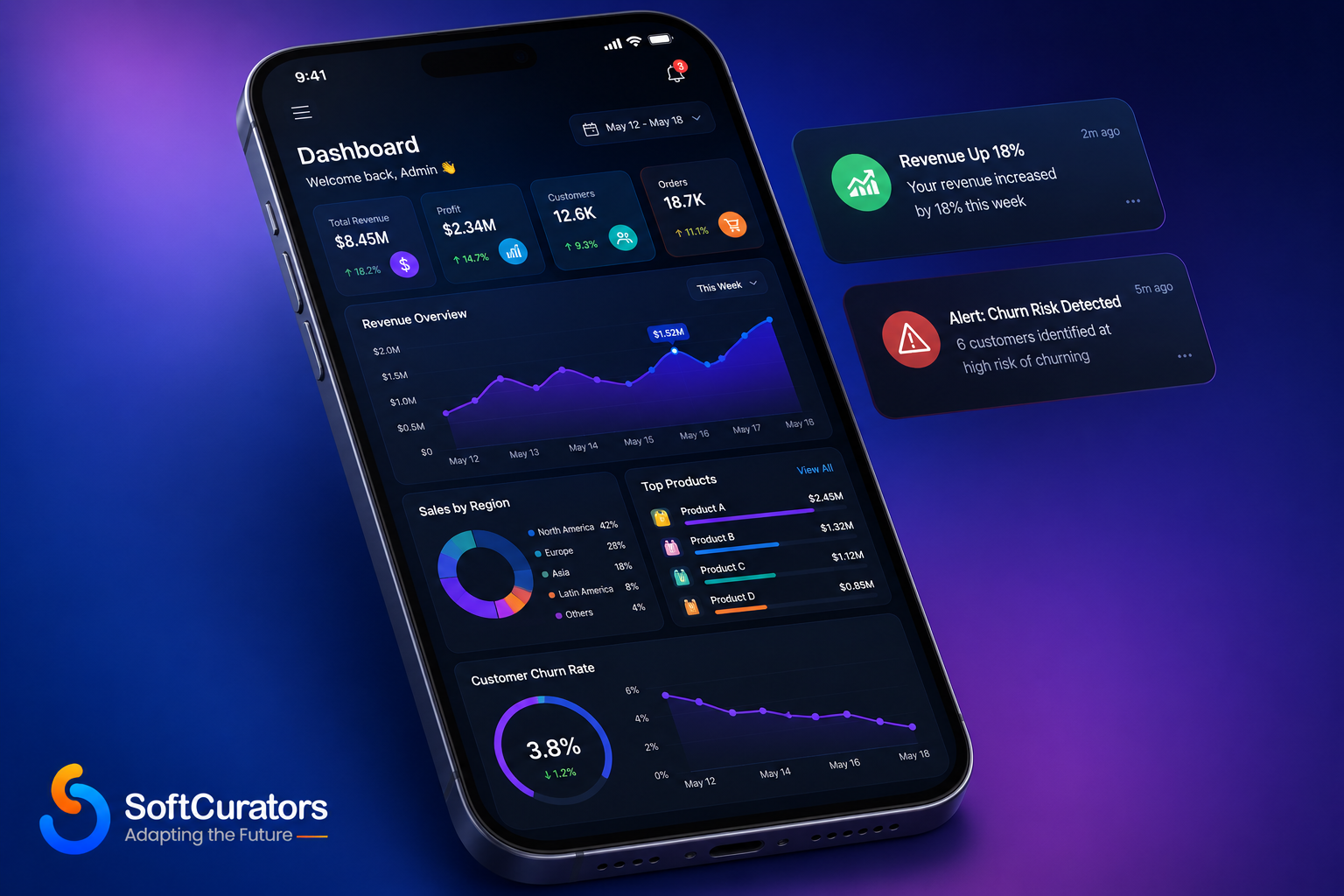
Mobile-First Business Intelligence: Insights on the Go
In 2026, executives and managers are rarely sitting at a desktop. Business decisions happen on the move. Mobile-first BI has moved from a nice-to-have to a genuine competitive requirement. At Softcurators, our mobile app development team builds BI experiences that work beautifully on any device.
A well-designed mobile BI app gives a CEO their morning performance brief before they finish their coffee. It alerts a sales director to a deal at risk during a flight. It shows a logistics manager a delivery exception the moment it occurs not when they get back to their desk.
Whether built natively for iOS and Android or developed using cross-platform frameworks, Softcurators’ approach to mobile BI prioritizes speed, offline capability, and security. Explore our iOS app development and Android app development capabilities for more.
Security, Compliance, and Governance in AI-Powered BI
Business intelligence platforms sit at the heart of your most sensitive business data. Getting security and governance right is not optional. Here is what a responsible BI platform must address:
Role-Based Access Control (RBAC)
Not everyone in your organization should see everything. Granular RBAC ensures that each user or user group sees only the data they are authorized to access a salesperson sees their own pipeline, not the company’s full financial exposure.
Data Encryption and Transmission Security
All data should be encrypted at rest and in transit. This is table stakes for any serious BI platform. Softcurators implements industry-standard encryption across all data layers in every BI solution we build.
Audit Trails and Data Lineage
For regulated industries, knowing where a piece of data came from, how it was transformed, and who accessed it is not just good practice it is a compliance requirement. AI-powered BI platforms should maintain complete data lineage and user access logs.
Regulatory Compliance
Depending on your industry, you may need to comply with GDPR, HIPAA, SOC 2, PCI-DSS, or other frameworks. Softcurators builds compliance into BI architecture from the beginning. Read our mobile app security and compliance guide for broader context on how we approach regulatory requirements.
Why Enterprises Must Modernize Legacy Data Infrastructure for BI Success
One of the most common blockers to successful AI-powered BI adoption is legacy application infrastructure. Organizations running on 10-year-old ERPs, siloed databases, and manual data processes simply cannot feed a modern BI platform with reliable data. Softcurators addressed this directly in our post on why enterprises need to modernize legacy applications and it is one of the most common conversations we have with new clients.
Modernization does not mean ripping and replacing everything overnight. A phased approach starting with data layer modernization, then integrating BI tooling, then gradually migrating core systems is often the most practical and cost-effective path.
Softcurators’ software development team has deep experience in legacy system modernization, API gateway design, and microservices architecture all of which are foundational to building a reliable BI data layer.
Getting Started: How to Begin Your AI-Powered BI Journey with Softcurators
You do not need a massive data science team or a multi-million-dollar budget to start your AI-powered BI journey. You need the right partner who understands both the technology and your business context.
Here is how Softcurators makes it easy to get started:
Step 1: Free Discovery Call
Start with a no-obligation 45-minute discovery call with Softcurators’ AI strategy team. We will ask about your business, your current data situation, and your most pressing decisions. By the end of the call, you will have a clear picture of where AI-powered BI could have the most immediate impact.
Step 2: BI Readiness Assessment
We audit your current data infrastructure, identify quick wins and longer-term opportunities, and prepare a clear roadmap with realistic timelines and investment ranges. No vague proposals concrete plans.
Step 3: MVP Development
Starting with an MVP allows you to see real results quickly without overcommitting. Our MVP development service delivers a working BI proof-of-concept in 8–12 weeks, giving you tangible evidence of ROI before full-scale investment.
Step 4: Scale with Confidence
Once your MVP validates the approach, Softcurators guides you through scaling adding more data sources, expanding to more user groups, training more sophisticated ML models, and integrating with additional business systems.
Conclusion: The Businesses That Win in 2026 Are Data-Intelligent
We are living in the age of data. Every industry, every function, every customer interaction generates signals that when properly captured and analyzed can dramatically improve business performance. The gap between businesses that harness this and businesses that ignore it is widening every year.
AI-powered business intelligence is not a luxury reserved for Fortune 500 companies with billion-dollar IT budgets. It is increasingly accessible to businesses of all sizes and the organizations that move now will establish data advantages that compound over time.
At Softcurators, we have built our reputation on delivering AI and data solutions that actually work in the real world not just on slides. From fintech intelligence platforms to healthcare analytics solutions to mobile-first executive dashboards, we build BI systems that change how businesses make decisions.
If you are ready to move from data overwhelm to data clarity, we are ready to help. The conversation starts with a single call.
FAQs
How is AI-powered BI different from traditional BI?
Traditional BI is retrospective it shows what happened. AI-powered BI is prospective it tells you what will happen and what you should do about it. It also processes data in real time, handles unstructured data like customer reviews and emails, and enables non-technical users to interact with data through natural language instead of complex queries.
How much does it cost to build an AI-powered BI platform?
Costs vary based on complexity, data volume, number of integrations, and level of AI sophistication. An MVP BI solution from Softcurators typically starts in the range of $10,000–$25,000. Enterprise-grade platforms with full ML pipelines and multiple integrations range from $25,000–$50,000+. Contact Softcurators for a detailed estimate based on your specific requirements.
How long does it take to implement an AI-powered BI solution?
A focused MVP can be delivered in 8–12 weeks. A full enterprise BI platform typically takes 2–5 months depending on complexity. Softcurators uses agile delivery so you see working components throughout the process, not just at the end.
Do I need a large data team to use AI-powered BI?
No. Modern AI-powered BI platforms are designed for self-service use. Business users can query data, generate reports, and receive AI-driven insights without technical skills. Softcurators also provides training and ongoing support to ensure adoption across your team.
What data sources can be integrated into a BI platform?
Virtually any data source CRM systems (Salesforce, HubSpot), ERP systems (SAP, Oracle), databases (MySQL, PostgreSQL, MongoDB), marketing platforms (Google Analytics, Meta Ads), financial systems, IoT devices, social media feeds, email platforms, and custom APIs. Softcurators handles all integration work.
Is my business data safe in an AI-powered BI system?
Yes, when built correctly. Softcurators implements end-to-end encryption, role-based access control, audit logging, and compliance with relevant regulations (GDPR, HIPAA, SOC 2, etc.). We can also deploy on-premise or in private cloud environments for organizations with strict data residency requirements.
Can small businesses afford AI-powered BI?
Absolutely. Softcurators has delivered AI-powered BI solutions for companies at various stages from funded startups to mid-market businesses. Our MVP approach means you can start small, validate ROI, and scale investment as you see results.
What industries benefit most from AI-powered BI?
Every data-generating industry benefits, but Softcurators has seen the strongest early ROI in fintech, healthcare, e-commerce, real estate, logistics, and SaaS. That said, the principles apply universally if your business makes decisions based on information, AI-powered BI makes those decisions better.
What is the difference between a BI dashboard and a BI platform?
A dashboard is a visualization layer it shows data in charts and graphs. A BI platform includes the full stack: data pipelines, warehousing, transformation, analytics engines, ML models, visualization, and reporting. A dashboard is one component of a platform. Softcurators builds the full platform, not just dashboards.
Can AI-powered BI replace data analysts?
No, but it changes their role significantly. Routine reporting and data extraction tasks are automated, freeing analysts to focus on higher-value interpretation, strategy, and experimentation. Companies that deploy AI-powered BI typically find they need fewer junior analysts but more strategic data professionals.
How do I know if my business is ready for AI-powered BI?
You are ready if you are making important decisions based on incomplete information, spending significant time on manual reporting, struggling to identify why key metrics are moving, or finding that different departments have different versions of the truth. Softcurators offers a free readiness assessment contact us to schedule one.
What is predictive analytics in the context of BI?
Predictive analytics uses machine learning models trained on your historical data to forecast future outcomes sales, churn rate, demand, resource needs, fraud risk, and more. It answers the question 'what is likely to happen?' rather than 'what happened?'
What is prescriptive analytics?
Prescriptive analytics goes beyond prediction it recommends specific actions to achieve a desired outcome. 'Based on current inventory levels and demand forecast, reorder 2,000 units of Product X by Thursday.' It is the most advanced layer of AI-powered BI and delivers the highest business value.
What is natural language querying in BI?
Natural language querying allows users to ask data questions in plain English 'What were our top 5 products by revenue last month in the Eastern region?' and receive instant answers in the form of charts, tables, or text summaries. No SQL or technical knowledge required.
How does AI-powered BI help with customer retention?
AI models identify early warning signals that a customer is likely to churn reduced usage, support tickets, payment pattern changes, declining engagement. The BI platform surfaces these signals to account managers or triggers automated retention campaigns before the customer actually leaves.
Can AI-powered BI help with supply chain management?
Yes significantly. AI-powered BI in supply chain provides demand forecasting, supplier risk assessment, inventory optimization, logistics route optimization, and real-time disruption alerts. Companies using AI BI in supply chain report 15–30% reductions in inventory costs.
What is the difference between BI and data analytics?
Data analytics is the broader discipline of analyzing data to find patterns. Business intelligence is specifically focused on using analytics to support business decision-making. All BI involves analytics, but not all analytics is BI. AI-powered BI combines both with the addition of predictive and prescriptive capabilities.
Do I need to move all my data to the cloud for AI-powered BI?
Not necessarily. Softcurators can build hybrid architectures where sensitive data stays on-premise while less sensitive data is processed in the cloud. We can also build fully on-premise solutions for organizations with strict data sovereignty requirements.
How does Softcurators approach data privacy in BI solutions?
Privacy is built into every solution from day one privacy by design. We implement data minimization (only collect what is necessary), pseudonymization, access controls, consent management where required, and full audit trails. Our team stays current with evolving data privacy regulations globally.
What is augmented analytics?
Augmented analytics uses AI and machine learning to automate data preparation, insight discovery, and insight sharing. Instead of analysts manually searching for patterns, the platform proactively surfaces the most relevant insights for each user. It is the future direction of all major BI platforms.
How do AI BI platforms handle real-time data?
Real-time BI platforms use streaming data architectures Apache Kafka, Amazon Kinesis, Google Pub/Sub to process data as it is generated. Dashboards update continuously, alerts fire the moment a threshold is crossed, and ML models can factor in the most current signals. Softcurators builds real-time BI capabilities for businesses where speed-to-insight matters.
Can AI-powered BI integrate with my existing CRM?
Yes. Softcurators integrates BI platforms with Salesforce, HubSpot, Pipedrive, Zoho CRM, and other major CRM systems through their APIs. Your sales data flows automatically into the BI platform, eliminating manual data exports and ensuring your sales analytics are always current.
How does live streaming differ from on-demand streaming in music apps?
On-demand streaming serves pre-encoded audio files through a CDN. Live streaming requires real-time audio or video encoding, ultra-low-latency delivery (sub-5 seconds for interactive, sub-10 for broadcast), and audience interaction infrastructure (live chat, reactions, virtual tips) that must perform under thousands of concurrent connections. The technical requirements are substantially different. Softcurators builds live streaming as a separate microservice that integrates with the main audio platform API.
What are the app store submission requirements for a music streaming app?
Apple App Store review requires: complete and accurate metadata, working demo account credentials for the review team, compliance with audio content guidelines, proper implementation of Apple IAP for subscription billing, and a clear privacy policy covering audio listening data. Google Play has similar requirements. Both platforms have specific guidelines for apps that stream third-party licensed content requiring proof of licensing rights. Softcurators handles the full app store submission process as part of our launch phase.
What is a data warehouse and do I need one for BI?
A data warehouse is a centralized repository for structured, processed data from multiple sources optimized for analysis rather than transaction processing. Most serious BI implementations require one. Common options include Snowflake, Google BigQuery, Amazon Redshift, and Microsoft Azure Synapse. Softcurators recommends and implements the right solution based on your specific needs.
How does machine learning improve BI accuracy over time?
Machine learning models are trained on historical data and make predictions based on learned patterns. As more data flows in, models can be retrained and refined, improving their accuracy. A churn prediction model deployed in month one will generally be more accurate by month six as it has processed more real outcomes. This continuous improvement is a key advantage of AI-powered BI over static reporting.
Can AI-powered BI work for startups or is it only for large enterprises?
Softcurators works with startups at all stages. In fact, startups that embed data intelligence early often gain significant competitive advantages. Our MVP development approach is ideal for startups you get real BI capability quickly without enterprise-scale investment. Many of our most innovative BI solutions have been built for seed and Series A companies.
What is the role of AI consulting in a BI project?
AI consulting shapes the strategy before a single line of code is written. It ensures you are solving the right problem with the right technology, that your data infrastructure can support your ambitions, and that your team is set up for success. Softcurators' AI consulting services are often the starting point for our BI engagements.
How do I measure the ROI of an AI-powered BI investment?
Common ROI metrics include: time saved on reporting (multiply hours saved by fully-loaded cost per hour), decisions improved (measure KPI changes in areas targeted by BI), revenue attributed to BI-driven actions (sales plays executed based on AI alerts), and cost reductions (waste and inefficiency identified by BI analytics). Softcurators helps clients establish a baseline and tracking framework at the start of every engagement.
What makes Softcurators different from other BI development companies?
Softcurators combines deep technical expertise in AI and data engineering with genuine business strategy thinking. We do not just build dashboards we help clients define what decisions need to be made, identify the data that drives those decisions, and build AI-powered systems that make decision-making consistently better. Our why choose Softcurators post covers this in more depth.
How do I get started with Softcurators on an AI BI project?
The easiest first step is to visit softcurators.com/contact and book a free discovery call. Alternatively, explore our AI development services or AI consulting services pages for more context on how we work. There is no commitment to the initial conversation just a focused discussion about your data challenges and what AI-powered BI could do for your business.
Does Softcurators build mobile BI applications?
Yes. Softcurators builds mobile BI apps for iOS and Android, giving executives and managers real-time business intelligence on their phones. Our mobile app development team has deep experience in building data-rich mobile applications with excellent performance and security.
What ongoing support does Softcurators provide after BI launch?
Softcurators provides comprehensive post-launch support through our maintenance and support services including model retraining, dashboard updates, new integration development, performance monitoring, and security patching. We treat every BI engagement as a long-term partnership, not a one-off project.
