

A prediction market isn’t a betting app with better branding, and treating it like one during a build is where a lot of technical debt and regulatory risk quietly starts. A prediction market is a pricing mechanism -the current price of a contract is a continuously updated, market-derived probability estimate for a real-world event, and that distinction shapes almost every engineering and legal decision that follows, from how you architect resolution to how you approach app store distribution.
This guide covers what an AI-powered prediction market app actually requires: the market mechanism decision that determines your platform’s core behavior, the five places AI genuinely adds value without taking on liability it shouldn’t, and the regulatory reality -specifically around event contracts in the US -that most content in this space either ignores or treats too lightly. We’ll be direct about our recommendations throughout, rather than leaving every choice as an open-ended trade-off for you to weigh alone.
If you’re specifically budgeting a project rather than scoping the architecture, our prediction market app development cost guide and our broader cost to develop a prediction app piece cover that question directly. This guide focuses on the product and technical decisions those budgets are built around.
Consultant’s Tip: Before designing a single screen, decide how your market resolves disputes -who has final authority when an outcome is ambiguous, and what role AI plays versus a human in that decision. This single design choice affects your legal exposure, your user trust, and your engineering architecture more than any feature covered later in this guide.
What Is an AI-Powered Prediction Market App, Actually?
A prediction market app lets users buy and sell contracts tied to the outcome of a real-world event -an election, an economic indicator, a sports result -where the contract’s price reflects the market’s aggregated, continuously updated probability estimate of that outcome. AI, in this category specifically, is applied to a defined set of supporting capabilities, not to replacing the market mechanism that actually produces the price.
The five AI capabilities this guide covers are:
- Assisted market resolution -using AI to gather and summarize evidence for an outcome, with a human making the final call.
- Pricing signal analysis -surfacing potential mispricing or unusual trading patterns for review.
- Content moderation -flagging manipulative, duplicate, or ambiguously worded proposed markets.
- Conversational market discovery -letting users find relevant markets through natural language rather than only browsing categories.
- Trend-driven market creation -identifying emerging topics worth turning into new tradeable markets.
Who needs this:
A platform with enough market volume and category breadth to benefit from automation in resolution research, moderation, and discovery -these capabilities earn their engineering cost once you’re running more markets than a small team can manually review and moderate on a consistent, reliable basis.
Who doesn’t:
A small, narrowly focused platform running a handful of curated markets doesn’t need most of this AI layer at launch -manual resolution and moderation by a small, trusted team is both simpler and more defensible early on than automating a process you haven’t yet proven at scale, and this remains true until real usage tells you otherwise.
Business Insight: The AI capability that gets the most attention in coverage of this category -pricing and odds prediction -is rarely the one with the clearest liability profile. Resolution and moderation carry more direct legal and trust consequences if handled poorly, and deserve at least as much design attention as anything pricing-related, even though they generate less marketing excitement.
The Core Architecture Decision: Automated Market Maker or Order Book?
This is the decision that shapes your platform’s core behavior more than any AI feature layered on top of it. Every prediction market needs a mechanism that turns trades into a price -and there are two real approaches, with genuinely different trade-offs, not a single obvious best answer.

Automated Market Makers (AMMs)
An automated market maker uses an algorithmic pricing formula -commonly a scoring-rule-based mechanism such as a logarithmic market scoring rule -to set a price automatically based on how much has been bought or sold, rather than matching individual buy and sell orders against each other. This means a market always has a price and can always execute a trade, even with only one participant, since the formula itself provides the counterparty on the other side of every transaction.
Order Books
A traditional order book matches buyers and sellers directly at prices they specify, the same mechanism used in traditional financial exchanges. This produces more organic, market-driven pricing and can support tighter spreads at high volume, but it requires enough participants actively placing orders on both sides for a market to function well -a market with too few traders can sit with no executable price at all, which is a materially worse experience than a slightly imprecise algorithmic price.
Our default recommendation: start with an AMM-based mechanism. Here’s the reasoning, stated directly rather than hedged.
Most new prediction market platforms launch with dozens or hundreds of simultaneous markets, and the large majority of those markets won’t have enough natural trading volume to sustain an order book on day one. An AMM guarantees a live, tradeable price on every single market regardless of how thin its actual trading interest is, which is the difference between a platform that feels functional at launch and one where most markets sit empty. Order books become the stronger choice once specific markets prove consistently high volume and benefit from tighter, more organic pricing than an algorithmic formula provides on its own.
Choose an order book when:
- You’re focused on a small number of genuinely high-volume markets rather than broad category coverage.
- Your user base includes sophisticated traders who value tighter spreads over guaranteed liquidity on long-tail markets.
- You have the capital or market-maker relationships to seed liquidity on order books manually.
Choose an AMM when:
- You’re launching with broad category coverage and many simultaneous markets, most without guaranteed high volume.
- You want every market to be immediately tradeable without needing to bootstrap liquidity manually.
- Simpler, more predictable engineering and less dependency on active market-maker participation matters more than pricing precision at this stage.
Cost implications: An AMM is generally less expensive to implement initially, since the pricing logic is a defined, self-contained formula rather than a full matching engine; an order book requires more complex matching engine infrastructure and, in practice, often requires capital or relationships to seed initial liquidity, which is a real cost beyond the engineering itself.
Maintenance implications: An AMM’s formula-driven pricing is relatively low-maintenance once implemented correctly; an order book requires ongoing operational attention to liquidity health, especially on newer or thinner markets, and may need active intervention to keep markets functional.
Scalability implications: AMMs scale well across a large number of simultaneous markets, since each one is independently priced by formula. Order books scale well in trading volume per market but need proportional growth in active traders per market to stay functional -scaling market count and scaling order book liquidity are two different challenges.
Risk factors: AMMs carry the risk of an algorithmic price that can lag genuinely fast-moving real-world information if the formula’s responsiveness isn’t well tuned. Order books carry the risk of illiquid, effectively non-functional markets if trading interest doesn’t materialize, which is a worse user experience than a slightly lagging AMM price.
Time-to-market impact: An AMM-based platform can launch with broad market coverage immediately, since every market is tradeable from creation. An order-book platform benefits from a narrower initial launch focused on markets where you can realistically seed enough trading interest to be functional from day one.
Comparison Table: Automated Market Maker vs. Order Book
| Factor | Automated Market Maker | Order Book |
| Liquidity on low-volume markets | Always tradeable, formula-priced | Can be effectively non-functional |
| Pricing precision at high volume | Algorithmic, can lag fast-moving info | Organic, tighter spreads possible |
| Engineering complexity | Lower -self-contained pricing formula | Higher -full matching engine required |
| Liquidity bootstrapping | Not required | Often requires capital or market-maker relationships |
| Best fit | Broad market coverage at launch, many simultaneous markets | Few high-volume markets, sophisticated trader base |
Note: This is a relative architectural comparison -many mature platforms run a hybrid, using AMM pricing for newer or thinner markets and transitioning to order-book mechanics once volume justifies it.
On-Chain vs. Off-Chain: A Second Decision With Real Regulatory Weight
Alongside the market mechanism, a prediction market platform has to decide whether trading and settlement happen on a public blockchain or entirely within your own private infrastructure -a decision that affects transparency, cost, and regulatory exposure independently of the AMM-versus-order-book choice.

On-Chain Architecture
An on-chain prediction market settles trades through smart contracts on a public blockchain, giving users independently verifiable proof that resolution and payouts followed the platform’s stated rules, without needing to trust the operator’s internal systems. This transparency is a genuine trust advantage, particularly for a user base skeptical of centralized platforms manipulating outcomes. Teams building this way work directly with the smart contract tooling documented in Ethereum’s official developer documentation, and should review it early since contract design decisions are difficult to change once deployed.
Off-Chain Architecture
An off-chain platform runs entirely on conventional infrastructure you control directly, which simplifies engineering, avoids blockchain transaction costs and confirmation delays, and gives you more direct operational control -at the cost of requiring users to trust your platform’s internal record-keeping rather than being able to verify it independently.
Expert Recommendation: This decision should follow from your target audience and regulatory strategy more than a technical preference. A crypto-native audience that values independent verifiability is better served on-chain, accepting the added engineering complexity; a mainstream audience less concerned with decentralization is often better served by the simpler, faster off-chain approach -and either way, this decision should be made alongside legal counsel, since on-chain, real-money event contracts carry their own specific regulatory considerations covered later in this guide.
How Do You Design the User Experience Around Uncertainty and Probability?
A prediction market’s core output is a probability, and how you present that number shapes whether users understand what they’re actually looking at -a design challenge with no direct equivalent in most other app categories.
Avoiding False Precision
Displaying a price as “67% likely” implies more precision than a thinly traded market genuinely supports, and presenting every market’s price with identical visual confidence -regardless of how much volume backs it -misleads users about how much to trust that number. Surfacing trading volume or liquidity depth alongside the probability gives users the context to judge how much weight the number deserves.
Explaining What a Price Actually Means
Business Perspective: Users new to prediction markets often read a price as a prediction or a guarantee rather than an aggregated market view that can and does change as new information arrives. Onboarding content that explains this plainly -without technical jargon -reduces both user confusion and the support burden of explaining after the fact why a price moved or a market resolved differently than the price seemed to suggest.
Common Mistake: Treating probability display as a purely visual design decision rather than a comprehension challenge. A polished percentage number that users misinterpret is a worse outcome than a slightly less polished display that’s genuinely well understood.

How Should Pricing Update Speed Interact With Fast-Moving Events?
A market tied to a live, rapidly developing event -an election night, a live sports result -needs pricing that updates fast enough to stay meaningful, which is a real-time infrastructure requirement layered on top of whichever market mechanism you’ve chosen.
Push-Based Updates, Not Polling
Technical Note: Use a push-based connection -commonly WebSockets -to update prices for actively viewed markets rather than having the app periodically poll for changes. Polling introduces both unnecessary latency during fast-moving events and unnecessary server load from repeated requests that mostly return unchanged data, a poor trade-off when the exact moments users care about most are the ones where prices are moving quickly.
AMM Responsiveness Tuning
For AMM-based markets specifically, the pricing formula’s sensitivity to new trades is a tunable parameter, and a formula tuned for slow-moving, low-volume markets can feel sluggish and unresponsive during a genuinely fast-developing event. Test your formula’s behavior specifically under rapid trading conditions, not just typical steady-state volume, before assuming it performs well across your full range of market types.
Common Mistake: Tuning and testing pricing responsiveness only against average trading conditions. The markets that matter most for user perception of your platform’s quality are often the fastest-moving ones, and that’s exactly where under-tuned pricing infrastructure becomes visible to users.
How Do You Handle Liquidity Incentives and Market Maker Programs?
Whichever mechanism you choose, new markets and thinly traded ones benefit from deliberate liquidity incentives -rewards for early participation or market-making activity -rather than assuming trading interest will simply appear once a market goes live.
Why This Matters More for Order Books
An order-book market with no orders on either side is effectively non-functional, which makes incentivizing early liquidity providers a real, deliberate program design decision, not an afterthought. Common approaches include fee rebates or reward tokens for market makers who maintain active orders, or targeted incentives on specific high-priority markets rather than a blanket program across every market equally.
AMMs Need This Less, But Not Zero
An AMM guarantees a tradeable price without external liquidity providers, but the underlying formula still typically needs seed capital to set an initial price and absorb early trading activity without excessive slippage. Budgeting this seed capital as a real, specific cost -not folded vaguely into general operating expenses -avoids an unpleasant surprise once real markets start trading.
Business Insight: Liquidity incentive design is as much a product and economics decision as an engineering one, and it’s worth involving whoever owns your unit economics early, not treating it as a pure backend implementation detail handed to engineering alone.
AI Feature 1: Assisted Market Resolution -Where Human Oversight Isn’t Optional
Resolving a market means determining, after the fact, which outcome actually occurred -and AI can meaningfully speed up the evidence-gathering part of that process without being handed the actual decision.

What AI Can Reasonably Do Here
An AI system can monitor news sources, official results feeds, and other relevant data, then summarize the available evidence for a human resolver to review -reducing the manual research burden on ambiguous or fast-developing events. This is a genuine, defensible use of AI: speeding up evidence-gathering, not making the final call.
Why Full Automation Is the Wrong Default
Risk Alert: A wrongly resolved market has direct financial consequences for real users, and an AI system can be confidently wrong in exactly the way that erodes trust fastest -summarizing conflicting or incomplete evidence as if it were conclusive. Keep a human resolver as the final decision-maker for every market, using AI to accelerate their research rather than to replace their judgment, at least until a resolution process has a long track record of accuracy that would justify more automation.
Common Mistake: Marketing a platform’s resolution process as “AI-powered” in a way that implies full automation, when the actual and more defensible design keeps a human in the loop. This is a case where accurate, specific language about what AI does protects both user trust and the platform’s own credibility.
AI Feature 2: Pricing Signal Analysis and Mispricing Detection
Beyond the core pricing mechanism, AI can analyze trading patterns and external data to flag markets where the current price looks meaningfully out of step with available information -a signal for review, not an instruction to override the market.
This typically means monitoring for unusual trading volume spikes, correlating market prices against relevant external news or data feeds, and surfacing markets where a gap between price and available evidence has opened up -useful both for the platform’s own market-quality monitoring and, potentially, as a feature shown to sophisticated users who want that signal.
Common Mistake: Treating an AI mispricing signal as evidence the market is “wrong” rather than as one input worth investigating. The market price is the aggregated view of everyone trading on it; an AI signal flags a discrepancy worth looking into, not an authoritative correction to defer to automatically.
AI Feature 3: Content Moderation and Market Quality Control
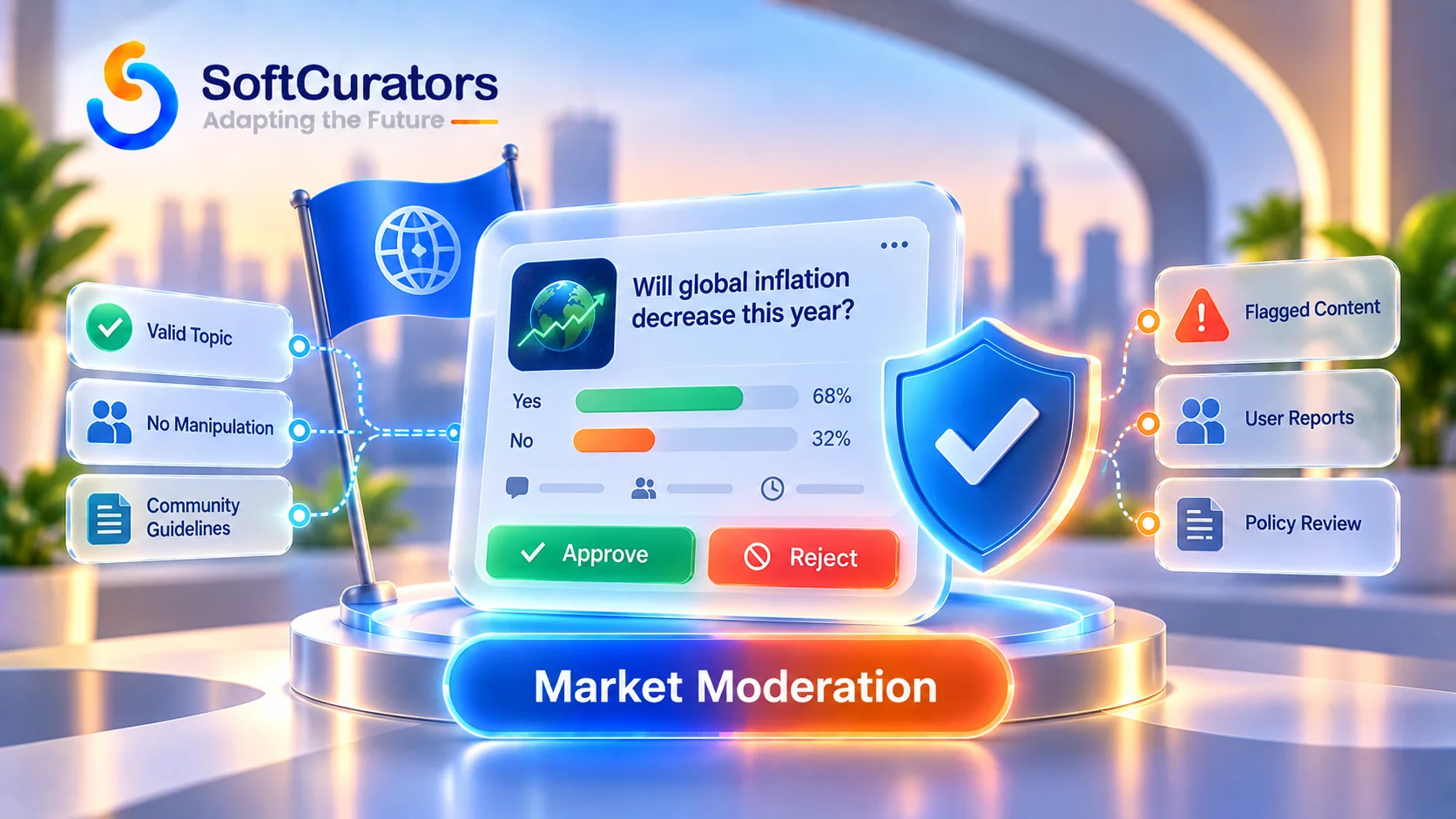
A platform accepting user-proposed markets needs a moderation layer to catch manipulative, duplicate, or ambiguously worded questions before they go live -since a poorly worded market (one where the resolution criteria are genuinely unclear) creates disputes that damage trust regardless of how good the underlying market mechanism is.
AI-assisted moderation can flag proposed markets with ambiguous or contradictory resolution criteria, detect near-duplicate markets already live on the platform, and identify language patterns associated with manipulation attempts -reducing the manual review burden on a human moderation team without removing them from the process entirely.
Business Insight: Market wording quality is an underrated product quality signal in this category. A platform known for precisely worded, unambiguous markets builds more trader trust over time than one with frequent resolution disputes, even if the second platform has more raw market volume -moderation quality is a competitive differentiator, not just a cost center.
AI Feature 4: Conversational Market Discovery
As a platform’s market catalog grows, category browsing and keyword search both become less effective at helping a user find what they actually want, which is where natural-language market discovery adds real value -letting a user ask for “markets about the upcoming interest rate decision” rather than guessing the right category and search terms.
For a more persona-driven discovery experience -a consistent AI-presented guide helping users navigate markets -our AI avatar development work covers how this goes beyond a basic search bar into a more guided, conversational interface.
Technical Note: Conversational discovery quality depends entirely on how well your markets are tagged and categorized in the underlying data -the same dependency covered in our broader guides on AI feature development. A natural-language interface over poorly structured market metadata will confidently return irrelevant results, which damages trust in the feature faster than not offering it at all.
AI Feature 5: Trend-Driven Market Creation
Beyond helping users find existing markets, AI can help identify which new markets are worth creating in the first place -surfacing emerging topics with enough public interest and genuine uncertainty to make a good prediction market, rather than relying entirely on manual editorial judgment.
This typically involves monitoring news and social discussion volume for emerging topics, then flagging candidates for a human team to evaluate and turn into properly worded markets -again, AI accelerating a research and identification process, with a human making the final call on what actually gets published, consistent with the resolution and moderation patterns covered above.
Common Mistake: Fully automating new market creation without human review of the proposed wording. A market created directly from an AI-generated draft, without a human checking that the resolution criteria are genuinely clear and unambiguous, is a common source of avoidable disputes down the line.
Why Aren’t Sports, Politics, and Finance Markets the Same Product?
A platform supporting multiple market categories is really running several distinct data and resolution workflows under one interface, since each category has fundamentally different data sources, resolution timelines, and evidence standards.
Different Categories Resolve on Different Timelines
A sports market typically resolves within hours of an event ending, against a clear, widely reported official result. A macroeconomic indicator market might not resolve for weeks after the underlying data release, and a political market can remain genuinely ambiguous for an extended period if a result is contested or delayed. Your resolution workflow and user communication both need to account for this variance rather than applying one resolution timeline expectation across every category.
Different Categories Need Different Data Sources
Business Perspective: Sports resolution typically draws on official league or scoring data feeds; political resolution often depends on officially certified results, which can lag informal media reporting significantly; financial market resolution depends on regulatory or exchange data releases. Each of these is a distinct data integration and reliability problem, and expanding into a new category is closer to adding a new resolution workflow than to adding a new tag to an existing system.
Common Mistake: Expanding into a new market category assuming your existing resolution and data infrastructure transfers directly. Validate the specific data sources and typical resolution timeline for each new category before launching it, the same way you’d validate a new blockchain integration before assuming it works like ones you’ve already built.
Why Does This All Depend on a Reliable Data Foundation?
Every AI capability in this guide -resolution research, mispricing detection, trend identification -depends on continuous, reliable access to news feeds, official data sources, and social discussion signals. A prediction market’s AI layer is only as good as the data pipeline feeding it, the same dependency that applies to AI features in any other industry.
Our AI-powered DataOps guide and DataOps vs. DevOps vs. MLOps comparison both cover the broader data pipeline discipline this depends on. If you’re weighing the underlying AI architecture decision -API-based versus custom model -beyond the specific features covered here, our how to build an AI-powered app guide covers that decision directly, and our AI integration costs guide addresses what it costs to add these capabilities to an existing platform specifically.
What Does US Regulation Actually Say About Prediction Markets?
This is the section most prediction market content either skips or treats too lightly, and it deserves direct treatment: in the United States, contracts based on the outcome of an event are frequently regulated as derivatives -commonly called event contracts -under the jurisdiction of the Commodity Futures Trading Commission, not treated as a gray area outside financial regulation entirely.

Event Contracts and CFTC Jurisdiction
The CFTC’s guidance on event contracts addresses how these instruments are regulated, including situations where a proposed contract touches on matters the CFTC has flagged as against the public interest, such as certain election- or gaming-adjacent contracts. This is a live, actively evolving area of regulatory interpretation, not a settled question, and it should be treated as such in any real planning process.
This Is Not a Gray Area to Route Around Casually
Risk Alert: Treating prediction markets as an unregulated novelty because the product is new is a mistake with real legal consequences -this category has drawn direct regulatory attention precisely because it resembles regulated derivatives trading. Any platform in this space needs specific legal counsel on event contract regulation for its exact market categories and target jurisdictions before launch, not a general assumption based on how other platforms have operated.
Our overview of security and compliance for digital lending platforms addresses adjacent regulated-fintech compliance discipline that shares some structural similarity, even though the specific regulatory regime for event contracts is its own distinct area.
Platforms that settle trades in cryptocurrency face an additional layer beyond event contract rules. FinCEN’s guidance on virtual currency businesses addresses when handling or transmitting value in virtual currency triggers money services business obligations, including anti-money-laundering program requirements. Whether your specific settlement design triggers those obligations depends on your custody model, which is the same question covered in our crypto wallet app development cost guide and worth confirming with qualified counsel before launch.
What Security Considerations Are Specific to Prediction Markets?
Beyond standard application security, a prediction market platform faces risks specific to how it resolves outcomes and prices markets -risks that don’t have a direct equivalent in most other app categories.
Oracle and Data Source Manipulation
A market that resolves based on an external data source or feed creates an incentive for someone to manipulate that source if the market’s value is high enough -a risk generally referred to as oracle manipulation in on-chain contexts, but relevant to any resolution process that depends on an external, potentially influenceable data source. Diversifying resolution evidence across multiple independent sources reduces this risk more effectively than relying on any single feed.
Prompt Injection in AI-Assisted Resolution
If your resolution research process uses a language model to summarize evidence from external content, that content is untrusted input, and it’s subject to the same prompt injection risk covered in the OWASP Top 10 for Large Language Model Applications -crafted content designed to manipulate the AI’s summary in a way that favors a particular outcome. This is a genuine, specific risk for this exact use case, not a generic security concern copied from elsewhere.
Our mobile app security and compliance overview and the NIST AI Risk Management Framework both offer useful structure for treating AI-specific risk in this platform as an ongoing, monitored practice rather than a one-time pre-launch review.
 What Do Apple and Google Actually Require for Prediction Market Apps?
Both major app stores apply real-money gaming and gambling-adjacent policies that prediction market apps frequently intersect with, and this has been a genuine, public friction point for platforms in this category, not a theoretical concern.
Reviewing Apple’s App Store Review Guidelines directly, specifically the sections covering real-money gaming, contests, and lotteries, is essential before committing to a mobile-first launch strategy, since these guidelines are applied to prediction markets in ways that have changed the available distribution options for platforms in this exact category. Google applies comparable scrutiny under its Google Play gambling policy, and both platforms’ current treatment of prediction markets specifically should be verified directly rather than assumed, since policy interpretation in this category has shifted meaningfully over recent years.
Common Mistake: Building a full native mobile experience before confirming app store distribution is actually viable for your specific market categories and jurisdictions. Several platforms in this category have had to rely partly or entirely on progressive web app distribution due to app store restrictions -worth planning for as a real possibility, not an edge case, from the earliest architecture discussions.
What Team Do You Actually Need to Build This?
Our view: a prediction market platform needs a specific combination of skills that a typical fintech or marketplace team doesn’t automatically have -market mechanism design, resolution process design, and, if on-chain, blockchain engineering, layered on top of standard mobile and backend development.
Roles Beyond Standard Mobile and Backend Development
Someone with genuine experience in market mechanism design -whether AMM formula tuning or order book matching engine design -is central to getting the core platform behavior right, since this isn’t a standard CRUD engineering problem. A dedicated resolution and moderation process owner, even on a small team, matters more than an additional generalist engineer, since resolution quality is what actually builds or destroys user trust over time.
Legal and Compliance From the Earliest Planning Stage
Given the regulatory reality covered earlier in this guide, legal counsel with specific experience in derivatives or event contract regulation should be engaged during initial architecture planning, not once the product is built -the market categories you choose to support and your resolution process design both have direct regulatory implications that are far cheaper to get right upfront than to redesign later.
Business Insight: For a first prediction market platform, working with a team that has specific experience in market mechanism design and event contract regulation is worth more than the time saved using a generalist team learning this domain for the first time on a live, real-money product.
What Testing Does a Prediction Market Platform Need Before Launch?
Standard application QA doesn’t cover the parts of a prediction market most likely to embarrass a platform publicly -a mispriced market, a botched resolution, or a matching engine that behaves unexpectedly under real trading conditions.
Simulate Trading Before Real Money Is Involved
Run simulated trading against your pricing mechanism -whether AMM formula or order book matching logic -using realistic volume patterns before any real-money market goes live. This catches formula tuning issues or matching engine edge cases in a controlled setting rather than in front of real users and real money.
Dry-Run Your Resolution Process on Past Events
Operational Perspective: Test your resolution process, AI-assisted research included, against real historical events with known outcomes before launch. This reveals gaps in your evidence-gathering approach and resolver decision criteria while the stakes are zero, rather than discovering them the first time a genuinely ambiguous real market needs resolving.
Common Mistake: Testing the trading interface thoroughly while treating resolution process testing as an afterthought. Resolution is where user trust is won or lost, and it deserves at least as much pre-launch testing rigor as the trading experience itself.
In-House vs. a Development Partner for a First Platform
Our view: for a first prediction market platform, working with a team that has already navigated market mechanism design and the app store distribution challenges specific to this category is worth more than the months it would take to build that experience internally from scratch. Bring this capability fully in-house once you have a validated platform and a long-term roadmap that justifies dedicated, permanent headcount in a genuinely specialized discipline.
Comparison Table: Relative Cost and Complexity by Component
Pulling the architecture and feature decisions from this guide together, here’s how the major components compare in relative cost and complexity -useful as a planning reference once your core architecture is settled.
| Component | Relative Engineering Cost | Ongoing Operational Burden |
| AMM pricing mechanism | Lower -self-contained formula | Low, plus periodic tuning |
| Order book matching engine | Higher -full matching infrastructure | Higher -liquidity health monitoring |
| On-chain settlement | Higher -smart contract development and audits | Ongoing gas and node costs |
| AI-assisted resolution research | Moderate -model integration plus data feeds | Ongoing data feed and monitoring cost |
| Content moderation AI | Moderate | Ongoing model tuning as manipulation patterns evolve |
| Conversational market discovery | Moderate -depends on catalog metadata quality | Low once metadata pipeline is solid |
Note: Relative comparison for planning purposes -actual cost depends on category scope, chain choice, and team composition.
Common Mistakes When Building an AI-Powered Prediction Market App
- Choosing an order book by default without enough expected volume to sustain it. This produces markets with no executable price, which is a worse experience than a simpler AMM.
- Marketing resolution as fully automated when a human should be making the final call. This creates both a trust problem and unnecessary liability exposure.
- Treating regulatory questions as a gray area rather than getting specific legal guidance. Event contracts have drawn direct, active regulatory attention -this isn’t a space to guess in.
- Committing to a full native mobile build before confirming app store distribution is viable. Real-money gaming and gambling policy has directly affected distribution options for platforms in this category.
- Automating new market creation without human review of resolution wording. Ambiguous market wording is a leading cause of avoidable resolution disputes.
- Relying on a single data source for market resolution. This creates a manipulation incentive that diversified sourcing meaningfully reduces.
- Ignoring prompt injection risk in AI-assisted resolution research. Content the AI summarizes is untrusted input, and crafted content can attempt to manipulate the outcome.
How Do You Monitor a Prediction Market Platform After Launch?
Launch isn’t the finish line for a platform whose core value depends on accurate pricing and trustworthy resolution -ongoing monitoring specific to this category catches problems standard application monitoring won’t surface.
What to Track Beyond Standard Uptime Metrics
Track resolution dispute rate as a direct signal of market wording and evidence-gathering quality, price anomaly frequency flagged by your mispricing detection layer, and liquidity health per market -how often a market sits with no executable price or excessive spread. None of these show up in standard error-rate or uptime dashboards, and all three directly reflect the parts of the product users judge you on most.
Risk Alert: A rising resolution dispute rate deserves immediate investigation, not a wait-and-see approach -it’s usually a symptom of a specific, fixable problem (ambiguous market wording templates, an unreliable data source for a particular category) rather than random noise, and addressing the root cause early prevents it from compounding across future markets in the same category.

What Does This Actually Cost, and Where Should You Look Next?
Cost varies significantly based on market mechanism choice, on-chain versus off-chain architecture, and how much of the AI layer covered in this guide you build at launch versus over time -deserving its own dedicated treatment rather than a single figure here.
Our prediction market app development cost guide and cost to develop a prediction app piece both cover this directly, and our broader cost to build a fintech app guide covers the regulated-fintech cost baseline this category shares some structure with. If your platform involves crypto-based settlement, our crypto wallet app development cost guide addresses the custody and key management considerations that would apply to an on-chain implementation specifically.
Where Is AI-Powered Prediction Market Development Headed Next?
The following are directional trends based on current market and regulatory momentum, not settled fact -verify against current regulatory guidance and platform policy before treating any of these as a firm planning assumption.
- Continued regulatory clarification around event contracts, likely producing more defined rules but not necessarily broader permitted market categories.
- Growing use of AI for resolution research specifically, while human final authority remains the standard, defensible practice rather than being displaced.
- Hybrid AMM and order-book mechanisms maturing further, letting platforms transition individual markets between mechanisms as volume develops rather than committing to one approach platform-wide.
- Persistent app store distribution friction for real-money prediction markets, likely keeping progressive web app and direct-download distribution relevant strategies for the category.
Final Summary and Next Steps
An AI-powered prediction market app is defined less by its AI layer than by two foundational architecture decisions -market mechanism and on-chain versus off-chain settlement -made deliberately before any AI capability enters the picture. AI then adds real value in five specific, scoped roles: resolution research, pricing signal analysis, moderation, discovery, and trend identification, always with a human retaining final authority on decisions that carry real financial consequences for users.
The platforms that get this right don’t lead with AI as the headline feature. They get the market mechanism right for their actual expected volume, take the regulatory reality around event contracts seriously from the earliest planning stage, and apply AI specifically where it genuinely accelerates human judgment rather than replacing it.
Consultant’s Tip: Before your next planning conversation, write down your platform’s resolution process in plain language -who has final authority, what evidence they’ll use, and where AI fits into gathering it. If you can’t describe this clearly in a paragraph, that’s the conversation to have before any further architecture or feature work.
One closing point worth carrying forward: none of the decisions in this guide are one-time settlements. Market conditions shift, categories you didn’t originally plan to support become worth adding, and regulatory interpretation continues to evolve around event contracts specifically. Build a recurring review of your architecture and compliance posture into regular planning, rather than treating this guide as a single reference consulted once at the start.
Next Step
If you’re scoping a prediction market platform and want to work through market mechanism choice, AI feature scope, and regulatory strategy for your specific product, a Product Strategy Session with Softcurators is a structured way to leave with a grounded architecture plan before committing engineering time. Softcurators works across AI app development, AI consulting services, and fintech app development. You can review our AI app development solutions page, browse our broader services overview, or get in touch directly to talk through your specific product.
Frequently Asked Questions
Should I use an automated market maker or an order book for my prediction market?
Start with an AMM if you're launching with broad market coverage and many simultaneous markets, since it guarantees a tradeable price on every market regardless of volume. Move toward an order book for specific high-volume markets once trading interest genuinely justifies it.
Can AI fully automate market resolution?
It's technically possible but not advisable. A wrongly resolved market has direct financial consequences for real users, and AI can be confidently wrong on ambiguous evidence. Keeping a human as the final decision-maker, with AI accelerating research, is the more defensible design.
Are prediction markets legal in the United States?
This depends heavily on the specific market categories and structure, and is an active, evolving area of regulatory interpretation under the CFTC's event contract framework. This requires specific legal counsel for your exact product, not a general assumption based on other platforms' operations.
Why do some prediction market apps struggle to stay on the App Store?
Real-money gaming and gambling-adjacent policy at both major app stores has created genuine friction for platforms in this category, and several have relied on progressive web app distribution partly or entirely as a result. This is worth planning for from the start.
What's oracle manipulation, and does it apply to my platform?
It refers to manipulating the external data source a market resolution depends on. It's relevant to any platform whose resolution process relies on an external, potentially influenceable feed, not just fully on-chain platforms -diversifying resolution sources reduces this risk.
Should my prediction market be on-chain or off-chain?
This should follow your target audience and regulatory strategy. A crypto-native audience values on-chain transparency and independent verifiability; a mainstream audience is often better served by the simpler, faster off-chain approach -and either decision should involve legal counsel given the regulatory considerations involved.
How does AI help with market discovery specifically?
Natural-language search lets users find relevant markets by describing what they're interested in, rather than navigating categories or guessing search terms -genuinely useful once a platform's market catalog grows large enough that browsing alone becomes inefficient.
What happens if a market's resolution criteria turn out to be ambiguous?
This is a leading cause of disputes and user trust problems, which is why AI-assisted moderation flagging ambiguous wording before a market goes live, combined with human review, matters more than it might initially seem for a feature that looks like a formality.
Do I need blockchain expertise to build a prediction market app?
Only if you choose an on-chain architecture. An off-chain platform can be built with standard mobile and backend engineering expertise, without blockchain-specific skills, though it trades away the independent verifiability an on-chain approach offers.
How much does market mechanism choice affect overall development cost?
Meaningfully. An AMM is generally simpler and less expensive to implement initially since it's a self-contained pricing formula; an order book requires a more complex matching engine and often capital or relationships to seed initial liquidity.
Can a small team realistically launch a prediction market platform?
Yes, particularly starting off-chain with an AMM-based mechanism and a narrow set of manually curated, carefully worded markets -this significantly reduces both engineering and regulatory complexity relative to a broad, on-chain, order-book-based launch.
What's the biggest hidden risk in this category most teams underestimate?
Regulatory exposure around event contracts specifically. Many teams treat this as a gray area to navigate informally, when it's an active area of direct regulatory attention that deserves specific legal guidance before launch, not after.
Should pricing signal AI ever override the actual market price shown to users?
No -treat an AI mispricing signal as an input worth investigating, not an authoritative correction. The market price reflects the aggregated view of everyone trading on it, and overriding it undermines the entire premise of the product.
How do I prevent AI-assisted resolution research from being manipulated?
Be aware that any external content an AI summarizes is untrusted input, subject to prompt injection risk, and diversify resolution evidence across multiple independent sources rather than relying on a single feed a bad actor could more easily target.
Is a hybrid AMM and order book approach realistic for a new platform?
Yes, and it's an increasingly common pattern -using AMM pricing for new or thinner markets and transitioning specific markets to order-book mechanics once they demonstrate enough sustained volume to support it.
What's the realistic cost difference between an AMM-based and order-book-based launch?
An AMM-based launch is generally less expensive upfront due to simpler pricing logic, while an order-book launch often carries additional cost in liquidity seeding -capital or market-maker relationships -beyond the engineering itself.
Does AI content moderation replace the need for human moderators?
No. It reduces the manual review burden by flagging likely problems, but human review remains part of a defensible moderation process, the same pattern that applies to resolution and market creation throughout this guide.
How important is market wording quality compared to the underlying technology?
More important than many teams initially assume. A platform known for precisely worded, unambiguous markets builds more long-term trader trust than one with more raw volume but frequent resolution disputes -this is a genuine product differentiator, not a formality.
What ongoing costs should I expect after launching a prediction market app?
Ongoing data feed costs for resolution and pricing signal research, continued legal and compliance monitoring given the evolving regulatory landscape, and, for order-book markets, potential ongoing liquidity support if organic volume doesn't sustain itself.
Can I start without any AI features and add them later?
Yes, and this is a reasonable sequencing choice for a smaller launch -manual resolution and moderation by a small, trusted team can work well early on, with AI capabilities added once volume genuinely justifies the additional engineering investment.
How does resolution speed affect user trust?
Users notice both wrongly resolved markets and slowly resolved ones. AI-assisted evidence gathering primarily helps with speed on complex or fast-developing events, while accuracy still depends on the human resolver's final judgment being sound.
Is it possible to support both real-money and play-money markets on one platform?
Yes, and some platforms use play-money markets specifically to sidestep the regulatory and app store distribution complexity of real-money event contracts, at the cost of different (generally lower) user engagement economics -a genuine trade-off worth evaluating for your specific goals.
What's a reasonable first step before committing to a full platform build?
A structured discovery process covering market mechanism choice, on-chain versus off-chain architecture, and regulatory scope for your specific target markets gives a far more grounded foundation than committing to a full build before these decisions are settled.
Does this guide's reasoning still apply if my platform focuses on sports or entertainment predictions rather than politics or finance?
The architecture, AI capability, and moderation reasoning applies broadly across categories. The regulatory analysis varies more by category and jurisdiction -sports-related event contracts specifically have their own regulatory nuances worth reviewing separately with counsel.
How fast do prices need to update during a live event?
Fast enough that users trust the number reflects current information, which typically means push-based updates via WebSockets rather than periodic polling. Polling introduces latency and unnecessary server load exactly when users care most about responsiveness.
Can I support sports, politics, and finance markets on the same platform from launch?
Technically yes, but each category is really a distinct resolution and data workflow, not just a different tag. Validate data sources and resolution timelines for each category individually rather than assuming your first category's infrastructure transfers directly.
Do I need to tune my AMM formula differently for fast-moving versus slow-moving markets?
Yes. A formula tuned for typical, slower-moving markets can feel unresponsive during a genuinely fast-developing event, so test pricing responsiveness specifically under rapid trading conditions, not just average volume.
How do liquidity incentive programs typically work for prediction markets?
Common approaches include fee rebates or reward incentives for market makers who maintain active orders on order-book markets, or targeted seed capital for AMM-based markets to absorb early trading activity without excessive price slippage.
Should probability be displayed the same way for every market regardless of volume?
No. Surfacing trading volume or liquidity depth alongside the probability number gives users context for how much confidence to place in it -displaying every market with identical visual certainty misrepresents thinly traded markets.
What should be tested before a resolution process goes live?
Dry-run the resolution process, including any AI-assisted research, against real historical events with known outcomes. This reveals gaps in evidence-gathering or decision criteria while the stakes are zero, rather than during a genuinely ambiguous live market.
How do I know if my recovery mechanism is actually good enough?
Test whether real users can successfully use it months after setup under realistic stress conditions, not whether they clicked through an onboarding screen. A recovery mechanism that looks complete during setup can still fail in practice if users didn't genuinely understand or correctly store what they were given.
How reliable does price data need to be for a crypto wallet?
Reliable enough to be trusted during high-volatility periods, when users check balances most often and price movement is fastest. A stale or unreliable price feed undermines confidence in the whole product even if the underlying transaction handling is flawless.
Is expanding into a new market category a simple configuration change?
No -it typically means validating and building a new resolution and data workflow, since different categories rely on different official data sources and resolve on different timelines. Treat it with the same care as adding a new blockchain integration.
What should I monitor after a prediction market platform launches?
Resolution dispute rate, price anomaly frequency from your mispricing detection layer, and per-market liquidity health -none of which show up in standard uptime or error-rate dashboards, but all of which directly reflect what users judge the platform on.
What does a rising resolution dispute rate usually indicate?
Usually a specific, fixable problem -ambiguous market wording templates or an unreliable data source for a particular category -rather than random variation. It deserves immediate investigation rather than a wait-and-see approach.
Should liquidity health be tracked per market or just platform-wide?
Per market. A healthy platform-wide average can mask individual markets sitting with no executable price or excessive spread, which is exactly the kind of problem that damages trust for the specific users affected even if aggregate numbers look fine.
Is it worth building custom infrastructure for resolution dispute tracking, or is this a manual process?
A simple, dedicated tracking system pays for itself quickly, since resolution disputes are a direct, measurable signal of product quality that's easy to lose track of informally as market volume grows beyond what a small team can monitor by memory.
How long after launch should I expect to keep actively tuning pricing responsiveness and resolution processes?
Ongoing, not a fixed period -market conditions, category mix, and user behavior all continue to evolve, and both pricing tuning and resolution process refinement are better treated as continuous practices than tasks with a defined end date.
Does app store distribution friction affect Android differently than iOS?
Both platforms apply real-money gaming and gambling-adjacent scrutiny, though the specific policy language and enforcement pattern differs between Apple and Google. Review both platforms' current policies directly for your specific market categories rather than assuming they treat prediction markets identically.
Can a play-money version of a prediction market help validate demand before a real-money launch?
Yes, and it's a reasonable way to test market mechanism behavior, category interest, and resolution process design with lower regulatory and app store distribution complexity, before committing to the full scope of a real-money launch.
What's the relationship between resolution quality and long-term user retention?
Direct and significant. Users who experience a fair, well-evidenced resolution -even on a market where they lost -are more likely to keep trading than users who experience an ambiguous or poorly justified resolution, regardless of how sophisticated the rest of the platform is.
Should conversational market discovery be prioritized in an early version of the platform?
Generally not for a small initial catalog. It earns its engineering cost once category browsing and keyword search genuinely become insufficient, which typically happens as market count and category breadth grow well past what a first launch usually includes.
Is it reasonable to launch with only one market category and expand later?
Yes, and it's often the more sensible sequencing -validating market mechanism behavior, resolution process quality, and user trust within one well-understood category before taking on the added data and resolution complexity of a second, distinct category.
What's a reasonable timeline expectation for a first version of this kind of platform?
It depends heavily on market mechanism choice, category scope, and on-chain versus off-chain architecture, but an off-chain, AMM-based launch with a narrow initial category is generally the fastest realistic path to a working, testable first version among the options covered in this guide, often measured in weeks rather than many months.
