
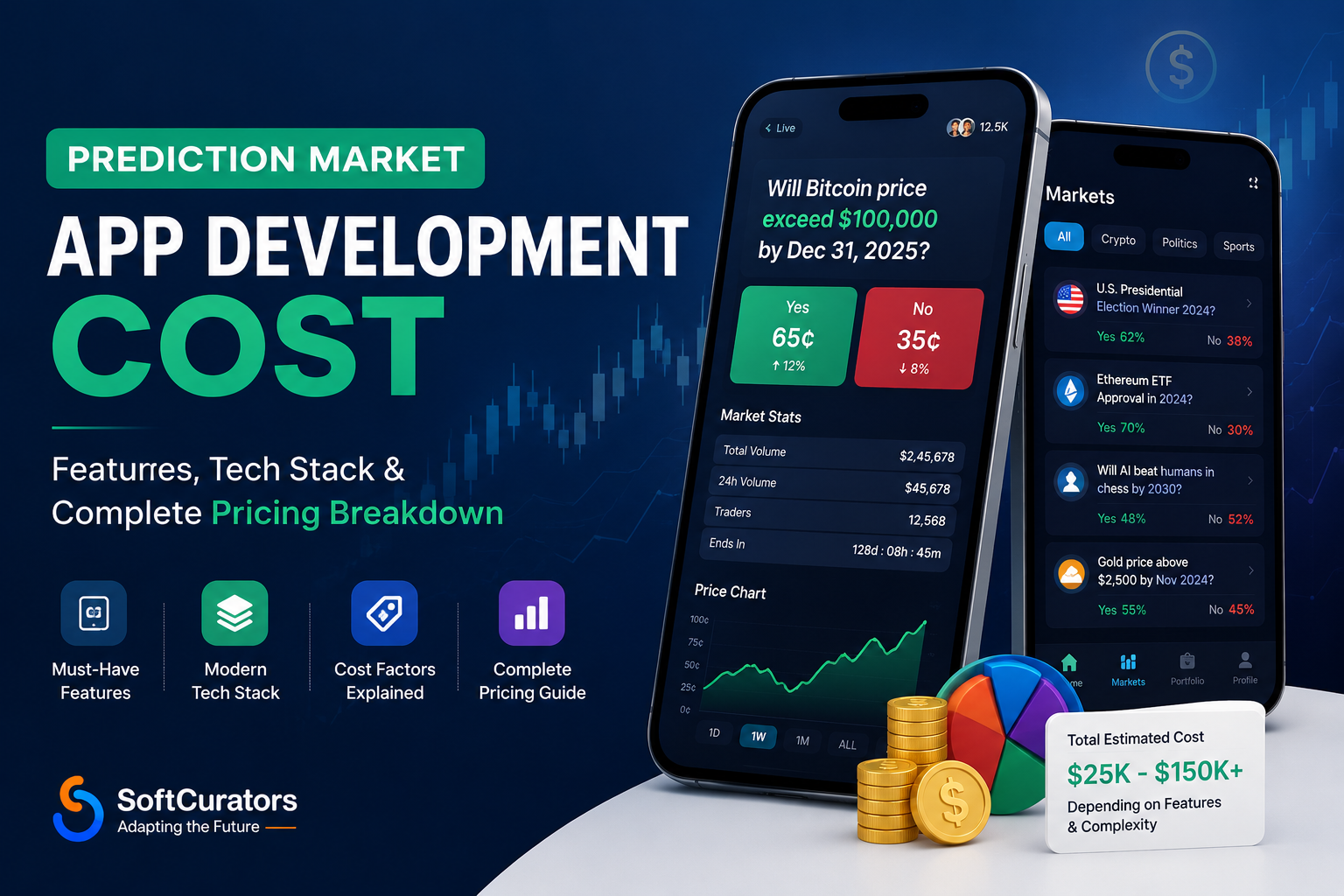
Prediction Market App Development Cost: Features, Tech Stack & Complete Pricing Breakdown
The prediction market industry is no longer a niche corner of speculative finance — it is a fast-maturing asset class with institutional credibility, regulatory pathways, and a user base hungry for real-money forecasting platforms. With Polymarket crossing $1 billion in monthly trading volume and Kalshi receiving CFTC approval for real-money event contracts in the US, the window for building a competitively positioned prediction market app has never been more commercially viable.
At Softcurators, we specialize in building fintech applications, AI-powered platforms, and high-stakes mobile and web applications for startups and growth-stage companies worldwide. Prediction market development sits at the intersection of all three — and it is one of the most technically demanding project categories we build.
The most common first question from founders in this space is simple: “How much does it cost to build a prediction market app?” The honest answer ranges from $15,000 for a lean MVP to $100,000+ for a full decentralized protocol. But that range is only meaningful when you understand exactly what drives each dollar of that investment.
This guide breaks everything down — every feature layer, every tech decision, every hidden cost, and every cost-optimization lever — so you can approach your first development conversation with full clarity. We’ll also show you how Softcurators has structured similar builds, with real pricing tables and timeline benchmarks drawn from our project history.
Already done your research and ready to get a precise cost estimate for your specific concept? Book a free 30-minute discovery call with Softcurators and our senior product architect will map out your exact development roadmap within 24 hours.
The Prediction Market Landscape: Why Smart Founders Are Building Now
A prediction market is a real-time exchange where participants buy and sell contracts tied to the outcome of future events — elections, sports results, economic indicators, crypto prices, or any verifiable occurrence. The price of each contract reflects the crowd’s collective probability estimate for that event, making prediction markets both a speculative trading instrument and a remarkably accurate forecasting tool.
The industry is converging around several powerful tailwinds:
- Regulatory momentum: The US CFTC’s approval of Kalshi as a licensed Designated Contract Market is the biggest green light the industry has received. The EU’s MiCA framework is similarly creating legal pathways for Web3 prediction protocols. If you want to understand how this space has evolved, read our deep-dive on how to create an app like Kalshi.
- DeFi infrastructure maturity: Polygon, Arbitrum, and Base have dramatically reduced gas costs, making on-chain prediction markets economically viable for retail traders. Our guide on how to create an app like Polymarket covers the full technical architecture of the leading decentralized model.
- Mobile-first financial behaviour: The demographic that grew up with Robinhood, Cash App, and DraftKings expects real-money financial products to be slick, fast, and mobile-native. Our mobile app development trends analysis shows prediction markets as one of the fastest-growing fintech subcategories in app stores.
- Enterprise demand for forecast data: Corporate clients are paying significant subscription fees for access to prediction market probability streams as decision-intelligence inputs — creating a B2B monetization layer beyond retail trading.
- Fantasy sports adjacency: The massive fantasy sports user base represents a natural conversion funnel for prediction market platforms. Our fantasy app development expertise gives Softcurators unique insight into building for this crossover audience.
If you’re building in this space, you’re competing with well-funded platforms — but the market is far from winner-take-all. Niche prediction markets (local politics, sports micro-events, industry-specific forecasts) present significant opportunities for focused founders. Our blog on how to develop a prediction app walks through niche market strategies in detail.
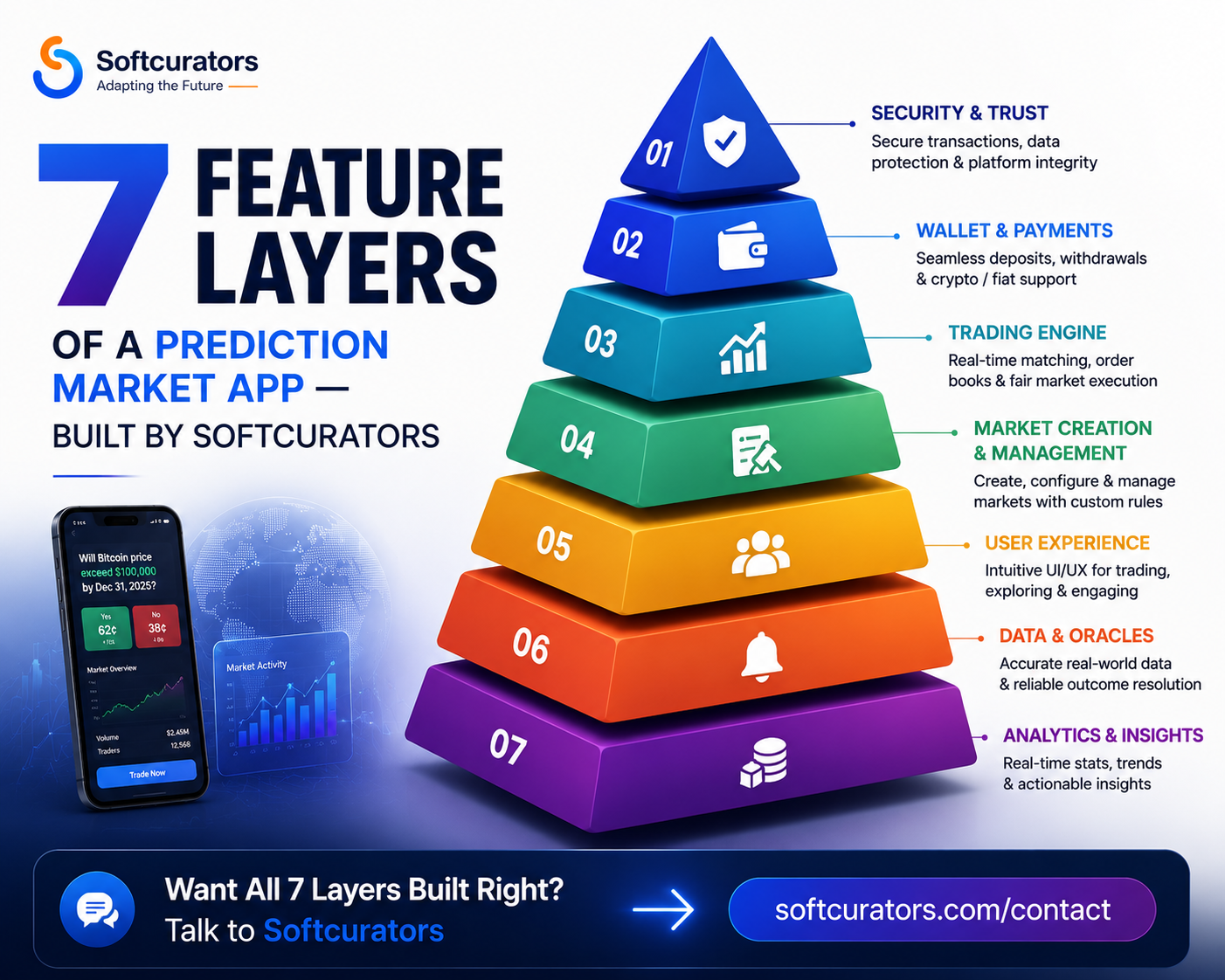
The 7 Core Feature Layers of a Prediction Market App
Before we talk dollars, you need to understand what you’re actually paying for. Prediction market apps are architecturally complex — they sit at the intersection of financial technology, real-time data processing, user engagement mechanics, and often blockchain infrastructure. Here are the seven non-negotiable feature layers:
Layer 1: User Onboarding & Identity Verification
Every prediction market app especially one involving real money needs a robust onboarding system. This isn’t just a signup form; it’s a compliance-grade user acquisition funnel that includes:
- Email/social login with multi-factor authentication (MFA)
- KYC (Know Your Customer) verification with document scanning and liveness detection
- AML (Anti-Money Laundering) screening against global watchlists
- Jurisdiction-based access control (geo-blocking restricted regions)
- Wallet creation or connection (for Web3 apps, MetaMask / WalletConnect integration)
Estimated Development Cost for This Layer: $2,000 – $10,000
KYC/AML integrations with providers like Onfido, Jumio, or Sum&Sub add both cost and time to your build. Softcurators‘s compliance-ready development approach ensures your onboarding meets regulatory requirements from Day 1, not as an afterthought.
Our in-depth guide on mobile app security and compliance covers the technical architecture behind KYC/AML integration in fintech applications. For related cost benchmarking, see our analysis of fintech app development costs.
Layer 2: Market Discovery & Browsing Interface
Users need to find markets quickly, filter by category, and assess liquidity and activity at a glance. This layer includes:
- Category-based market browsing (Politics, Sports, Crypto, Business, Entertainment)
- Search with semantic and filter-based query support
- Market cards showing current probability, trading volume, time to resolution
- Trending and “hot” market surfacing algorithms
- Personalized market recommendations (ML-powered for advanced builds)
- Watchlist and notification subscriptions per market
Estimated Development Cost for This Layer: $6,000 – $15,000
UI/UX quality here is make-or-break. Softcurators’ UI/UX design team follows the mobile app UI/UX best practices our team has documented — starting with wireframes and user-tested Figma prototypes before a single line of frontend code is written.
Layer 3: Real-Time Trading Engine
This is the beating heart of your platform and the most technically demanding component. A prediction market’s trading engine handles:
- Order book management (limit orders, market orders, conditional orders)
- Automated Market Maker (AMM) algorithms for liquidity in low-volume markets
- Real-time price discovery and probability calculation
- Position management (buy, sell, increase/reduce exposure)
- Slippage calculation and execution confirmation
- WebSocket-based live price feeds for instantaneous UI updates
Estimated Development Cost for This Layer: $12,000 – $25,000
This is where engineering depth matters most. Softcurators’ software development team has architected trading backends for both centralized fintech platforms and decentralized DeFi protocols — the same expertise that powers our banking app development and investment platform builds.
Layer 4: Wallet & Payment Infrastructure
Users need to deposit, withdraw, and manage their funds seamlessly. This layer covers:
- Fiat payment integration (Stripe, Braintree, bank transfers) for USD-denominated platforms
- Crypto wallet integration (USDC, USDT, ETH, SOL) for Web3 platforms
- Custodial vs. non-custodial wallet architecture decisions
- Transaction history and statement generation
- Withdrawal processing with fraud detection gates
- Real-time portfolio value calculation
Estimated Development Cost for This Layer: $6,000 – $18,000
Our team has deep experience with payment infrastructure, evidenced by our guides on e-wallet app development, money transfer app creation, and BNPL app development costs. For prediction markets, we apply the same fintech-grade payment architecture used in regulated financial applications.
Layer 5: Market Resolution & Oracle System
When an event concludes, the platform needs to resolve each market accurately and pay out winners. This is a critical trust component:
- Automated oracle integration for objective events (sports scores via API, crypto prices via Chainlink)
- Manual resolution workflow for subjective or complex markets
- Dispute resolution mechanism for contested outcomes
- Automatic payout calculation and fund distribution
- Resolution timeline management and user notification system
Estimated Development Cost for This Layer: $7,000 – $22,000
For blockchain-based platforms, Softcurators integrates Chainlink Data Feeds and UMA Optimistic Oracle for trustless, tamper-proof resolution — a critical feature for user trust and regulatory alignment.
Layer 6: Social & Community Features
The prediction markets with the strongest retention are those that build community. Social features drive DAU and organic growth:
- Public trader profiles with P&L history and accuracy scores
- Market comments and threaded discussion boards
- Leaderboards (weekly, monthly, all-time) segmented by category
- Social sharing of positions and market calls
- Following/follower system for top traders
- Community market creation (user-generated markets with approval workflow)
Estimated Development Cost for This Layer: $5,000 – $15,000
These features draw heavily from our experience building social media apps and fantasy sports platforms both of which demand the same blend of community mechanics and real-time data that prediction markets require.
Layer 7: Admin Dashboard & Operations Panel
Your operations team needs visibility and control. The admin dashboard includes:
- User management (KYC status, account suspension, tier management)
- Market management (creation, editing, resolution, emergency pause)
- Financial oversight (deposits, withdrawals, fee revenue, reserve monitoring)
- Risk management tools (exposure limits, liquidity health indicators)
- Compliance reporting (SAR filing support, transaction monitoring alerts)
- Analytics dashboard (DAU, volume, P&L by market category)
Estimated Development Cost for This Layer: $5,000 – $15,000
Advanced Features That Create Competitive Moats
Once your core platform is stable, these advanced features separate market-leading prediction apps from also-rans. If your budget allows, Softcurators recommends phasing at least 2–3 of these into your V2 roadmap:
AI-Powered Market Intelligence
- Sentiment analysis engine scanning news, Twitter, Reddit for market signals
- Predictive probability adjustments based on breaking news ingestion
- AI trading assistant that suggests positions based on historical accuracy
- Anomaly detection for wash trading and market manipulation
Additional Cost: $10,000 – $25,000
Softcurators’s AI development team and AI app development practice has built NLP sentiment pipelines and predictive models for financial applications. Our AI consulting services and AI automation capabilities mean these features aren’t theoretical — they’re proven components we deploy regularly.
Decentralized / Web3 Architecture
- Smart contract deployment on Ethereum, Polygon, Arbitrum, or Solana
- On-chain liquidity pool management
- DAO governance for market approval and resolution disputes
- NFT-based achievement and reputation system
- Cross-chain bridge integration for multi-chain liquidity
Additional Cost: $12,000 – $45,000
For founders interested in the full technical architecture of decentralized prediction markets, our blog post on how to build an app like Polymarket provides a comprehensive breakdown of smart contract design, oracle integration, and AMM liquidity mechanics.
B2B Data & API Monetization
- Developer API portal for probability data licensing
- Enterprise dashboard for institutional forecasting clients
- White-label platform with custom branding per enterprise client
- Webhook-based event streaming for real-time probability feeds
Additional Cost: $8,000 – $20,000
Live Streaming & In-Play Markets
- Real-time video integration for live event streaming
- In-play market creation and trading during live events
- Micro-prediction markets (next 5-minute outcome, next play result)
- Latency-optimized order processing for in-play scenarios
Additional Cost: $10,000 – $20,000
Gamification & Loyalty Engine
- Experience points (XP) and level progression system
- Achievement badges and milestone rewards
- Daily challenge markets with bonus rewards
- Referral tracking with tiered commission structure
- VIP tier system with fee discounts and exclusive market access
Additional Cost: $5,000 – $12,000
This feature set draws directly from our fantasy app development and on-demand app development experience, where gamification loops and loyalty mechanics are core retention drivers.
Full Tech Stack Breakdown for a Production-Grade Prediction Market App
Softcurators recommends battle-tested, scalable technologies chosen for their performance under high-concurrency trading loads, regulatory compliance support, and developer ecosystem maturity.
| Layer | Recommended Stack | Why We Choose It |
| Frontend Web | React.js + TypeScript + Vite | Component reusability, type safety, fast HMR |
| Mobile Apps | React Native / Flutter | Cross-platform with native performance |
| Backend API | Node.js (NestJS) + Go (trading engine) | Node for flexibility, Go for microsecond latency |
| Real-Time Layer | WebSockets (Socket.io) + Redis Pub/Sub | Live price feeds, <50ms update latency |
| Database | PostgreSQL + TimescaleDB + Redis | Relational integrity + time-series + caching |
| Blockchain | Solidity (EVM) / Rust (Solana) | Largest DeFi ecosystem / lowest-cost execution |
| Oracles | Chainlink + UMA Protocol | Tamper-proof, battle-tested resolution feeds |
| AI/ML | Python (FastAPI) + TensorFlow/PyTorch | Sentiment models, anomaly detection |
| Search | Elasticsearch / Algolia | Sub-50ms market search with faceting |
| DevOps / Cloud | AWS / GCP + Docker + Kubernetes | Auto-scaling for trading volume spikes |
| CI/CD | GitHub Actions + Terraform | Infrastructure-as-code, automated deployments |
| Monitoring | Datadog + Sentry + PagerDuty | Real-time alerting for P1 trading issues |
| KYC/AML | Onfido / Jumio / Sum&Sub | Regulatory-grade identity verification |
| Payments | Stripe + Circle (USDC) + Plaid | Fiat + crypto + bank ACH coverage |
This stack reflects Softcurators‘s accumulated experience across mobile app development technologies, web development, and AI application development. For a deeper look at how we make technology selection decisions, read our guide on how to choose the right app development company.
Complete Prediction Market App Development Cost Breakdown
Let’s get to the numbers. Softcurators prices projects based on three primary complexity tiers. These ranges reflect real project costs from our engagement history and account for global talent rates (our India-based engineering team combined with senior US/UK architects gives clients premium quality at 40–60% below pure Western agency rates).
Tier 1: MVP / Proof-of-Concept Prediction Platform
Target: Startups validating the concept, seeking seed or pre-seed funding, or launching in a single niche market (e.g., political predictions only, no real-money trading).
| Feature Module | Hours | Estimated Cost (USD) |
| User Auth & Basic KYC | 60–90 hrs | $3,000–$5,000 |
| Market Browsing & Discovery | 40–60 hrs | $2,000–$4,000 |
| Basic Trading Interface (No AMM) | 90–120 hrs | $4,000–$6,000 |
| Simple Wallet (Play Money Only) | 40–50 hrs | $2,000–$4,000 |
| Manual Market Resolution | 30–50 hrs | $2,000–$4,000 |
| Admin Dashboard (Basic) | 40–60 hrs | $2,000–$4,000 |
| QA, Deployment & DevOps Setup | 50–80 hrs | $2,000–$5,000 |
| Project Management & Design | Included | $2,000–$5,000 |
| TOTAL MVP RANGE | 320–500 hrs | $20,000–$35,000 |
Tier 2: Full-Featured Real-Money Prediction App
Target: Funded startups launching a production-grade, monetized prediction market with fiat or crypto payments, full KYC/AML, and regulatory readiness.
| Feature Module | Hours | Estimated Cost (USD) |
| Full KYC/AML Integration (Onfido/Jumio) | 100–140 hrs | $5,000–$7,000 |
| Advanced Trading Engine (AMM + Order Book) | 200–300 hrs | $5,000–$8,000 |
| Real-Time WebSocket Price Feeds | 60–80 hrs | $3,000–$6,000 |
| Fiat + Crypto Payment Integration | 100–150 hrs | $5,000–$8,000 |
| Oracle-Based Auto-Resolution | 60–120 hrs | $4,000–$6,000 |
| Social Features & Leaderboards | 50–140 hrs | $4,000–$6,000 |
| Mobile Apps (iOS + Android) | 250–350 hrs | $12,000–$15,000 |
| Full Admin + Risk Dashboard | 100–120 hrs | $6,000–$10,000 |
| Security Audits + Pen Testing | 50–80 hrs | $2,000–$8,000 |
| DevOps, CI/CD, Monitoring Setup | 80–120 hrs | $4,000–$7,000 |
| TOTAL TIER 2 RANGE | 1160–15,00 hrs | $40,000–$70,000 |
Tier 3: Decentralized / Web3 Prediction Protocol
Target: Web3 projects building a trustless prediction market on blockchain, with smart contracts, DAO governance, and DeFi liquidity mechanisms.
| Feature Module | Hours | Estimated Cost (USD) |
| All Tier 2 Features | 1160–15,00 hrs | $40,000–$70,000 |
| Smart Contract Development + Audit | 150–200 hrs | $10,000–$16,000 |
| Web3 Wallet Integration (MetaMask/WC) | 60–80 hrs | $3,000–$5,000 |
| On-Chain Liquidity Pool (AMM) | 150–250 hrs | $7,000–$12,000 |
| Chainlink + UMA Oracle Integration | 60–120 hrs | $4,000–$8,000 |
| DAO Governance Module | 100–120 hrs | $5,000–$8,000 |
| NFT Achievement System | 60–80 hrs | $3,000–$6,000 |
| Cross-Chain Bridge Integration | 100–150 hrs | $5,000–$9,000 |
| TOTAL TIER 3 RANGE | 1500–2580 hrs | $70,000–$100,000+ |
The Hidden Costs Most Development Agencies Don’t Mention
At Softcurators, we believe in radical cost transparency. Here are the ongoing and one-time costs that routinely surprise clients who got a quote from agencies that only scope “development hours”:
1. Regulatory Licensing & Legal Compliance
- US: CFTC-regulated DCM or SEF license for real-money forecasting — $25,000–$100,000+ in legal fees
- EU: MiCA registration or gambling license depending on product classification — €15,000–€150,000
- Offshore jurisdictions (Malta, Isle of Man, Gibraltar) — typically $7,000–$40,000 in licensing fees
- Ongoing compliance legal retainer — $1,000–$5,000/month
Our blog on security and compliance for digital lending platforms — which shares significant regulatory overlap with prediction markets — provides useful context on how Softcurators architects for compliance from Day 1
2. Third-Party API & Data Feed Costs
| Service | Purpose | Monthly Cost |
| Onfido/Jumio | KYC verification | $0.80–$3.00/user verified |
| Chainlink Data Feeds | Price oracles | $500–$5,000/month |
| Sports Data APIs (StatsPerform) | Event resolution | $500–$8,000/month |
| News/NLP APIs (GDELT, NewsAPI) | Sentiment analysis | $300–$2,000/month |
| Stripe/Circle | Payment processing | 0.3–2.9% per transaction |
| AWS/GCP Cloud Hosting | Infrastructure | $1,500–$15,000/month |
| Datadog Monitoring | Observability | $500–$3,000/month |
3. Smart Contract Security Audits
If you’re building a Web3 prediction market, a smart contract audit by firms like CertiK, Trail of Bits, or OpenZeppelin is non-negotiable. Audit costs typically run $15,000–$80,000 depending on contract complexity. Softcurators factors this into every blockchain project scope.
4. Post-Launch Maintenance & Feature Velocity
Production prediction market platforms require continuous engineering attention — market data integrations break, edge cases in trading logic emerge, and user feedback drives rapid iteration. Budget for ongoing support at 15–20% of initial development cost annually, or engage Softcurators on a dedicated retainer for seamless, priority-access engineering.
Learn more about our ongoing app maintenance and support packages designed specifically for high-stakes fintech platforms.
Softcurators’ Proven Development Process for Prediction Market Apps
Building a prediction market app isn’t just about writing code it’s about architecting a system that handles real money, real-time data, and real user trust. Here’s how Softcurators approaches every engagement:
|
Discovery & Architecture Workshop (Week 1–2) |
We run a structured discovery session with your product and business stakeholders to map user journeys, define MVP scope, identify regulatory requirements, and select the optimal tech stack. You receive a detailed technical specification document and cost confirmation. |
| UI/UX Design Sprint (Week 2–4) | Our UI/UX design team creates wireframes and high-fidelity Figma prototypes for all core user flows — onboarding, market browsing, trading, wallet management. User testing is conducted before a single line of code is written. |
| Backend Infrastructure Setup (Week 3–5) | DevOps engineers configure your cloud environment (AWS/GCP), CI/CD pipelines, database schemas, and API skeleton. This parallel workstream ensures backend is ready when frontend development begins. |
| Core Feature Development Sprints (Week 4–16+) | Two-week Agile sprints, each delivering shippable feature increments. Daily standups, weekly demos, and transparent sprint boards give you full visibility into progress. |
| Blockchain / Smart Contract Development (Parallel): | For Web3 builds, our Solidity/Rust engineers develop and test smart contracts in a sandboxed testnet environment alongside the main product build. |
| QA, Security Testing & Audit (Week 14–18): | Comprehensive manual QA, automated regression testing, load testing (simulating peak trading volume), penetration testing, and smart contract auditing before any production deployment. |
| Staged Launch & Monitoring (Week 18–22) | Soft launch to a limited beta user group, followed by performance monitoring and rapid iteration before full public launch. Softcurators remains on-call for 30 days post-launch. |
Development Timeline: What to Realistically Expect
| Project Type | Timeline | Key Milestones |
| MVP (Play Money, Web Only) | 5–7 Weeks | Design → Backend → Frontend → QA → Launch |
| Tier 2 (Real Money, Web + Mobile) | 10–14 Weeks | Discovery → Design → Core Dev → KYC → QA → Beta → Launch |
| Tier 3 (Web3 / Decentralized) | 14–20 Weeks | All Tier 2 + Smart Contract → Audit → Testnet → Mainnet |
| White-Label Reskin | 3–05 Weeks | Custom Design → Configuration → QA → Deploy |
These timelines assume a dedicated Softcurators team (2 backend engineers, 2 frontend engineers, 1 mobile engineer, 1 blockchain engineer, 1 QA, 1 designer, 1 project manager). Timelines can be compressed with larger team allocation.
Why Softcurators Is the Right Partner for Your Prediction Market App
There’s no shortage of development agencies willing to take your prediction market project. But Softcurators offers something few can match: deep domain specialization in financial application architecture combined with Web3 fluency — all delivered with the transparency and accountability of a long-term partner rather than a one-time vendor.
What Makes Softcurators Different
- Financial-Grade Engineering: We’ve built trading platforms, payment processors, and DeFi protocols — we understand the precision that real-money systems demand.
- Full-Stack Web3 Capability: From Solidity smart contracts to Chainlink oracle integration to DAO governance — our blockchain development team lives in this space.
- Regulatory Architecture Awareness: We design systems with compliance in mind from Day 1, not as a retrofit. This saves significant rework cost when you engage legal counsel.
- Transparent, Fixed-Scope Engagements: No “time and materials” surprises. Softcurators defines scope clearly, prices accordingly, and delivers what was promised.
- Post-Launch Partnership: Our relationship doesn’t end at deployment. We offer dedicated maintenance and growth engineering retainers to keep your platform competitive.
- Client Reviews & Case Studies: Explore our client success stories to see the quality and scale of platforms we’ve shipped.
Prediction Market App Types: Which One Fits Your Business Model?
Not all prediction market apps are built the same way. Softcurators has identified six dominant app types, each requiring a different development approach and budget consideration:
1. Political Forecasting Platforms
Focus on elections, referendums, and geopolitical events. Lower regulatory complexity in many jurisdictions when play-money only. Prime for ad revenue and media partnership monetization. Example: PredictIt, Good Judgment Open. Our dedicated political app development solution and blog guide on how to create an app like Kalshi provide the blueprint.
Softcurators Build Cost Estimate: $20,000–$40,000 (MVP to V2)
2. Sports Prediction Markets
High user engagement, large existing sports betting audience. Requires sports data API licensing, fast resolution, and possibly gambling licensing. Our fantasy app development practice and on-demand app expertise feed directly into sports prediction market builds.
Softcurators Build Cost Estimate: $30,000–$80,000
3. Crypto / Financial Prediction Markets
Trading on crypto prices, stock movements, or macro indicators. Can operate fully on-chain (Augur model) or custodially (centralized model). High Chainlink/oracle dependency. Relevant reading: our Polymarket clone development guide and fintech app development insights.
Softcurators Build Cost Estimate: $40,000–$60,000
4. Decentralized Prediction Protocols (DeFi)
Fully on-chain, trustless architecture. Smart contracts handle all funds. Governance via token voting. Highest development complexity and security audit requirements. Examples: Polymarket, Augur, Gnosis Conditional Tokens. Connects naturally to our investment platform development experience and AI development capabilities for DeFi analytics.
Softcurators Build Cost Estimate: $60,000–$80,000
5. Enterprise Forecasting Platforms (B2B)
Internal prediction markets for corporate decision-making, project estimation, or market research. Private, permissioned, no gambling license needed. High value per contract, lower user volume.Connects to our software development and banking and enterprise app experience.
Softcurators Build Cost Estimate: $30,000–$60,000
6. White-Label Prediction Market Solution
Leveraging Softcurators‘s pre-built prediction market framework, we can deliver a fully branded, production-ready platform in significantly less time and cost. Ideal for operators who want speed to market over full customization. Ideal for operators wanting MVP-speed development before investing in full customization. Pair with our startup app development service for the complete launch package.
Softcurators Build Cost Estimate: $15,000–$45,000
Curious which model fits your business? Our free app strategy consultation includes a 30-minute deep dive with a Softcurators senior product architect no obligation.
Proven Cost Optimization Strategies for Prediction Market Builds
Softcurators always works with clients to maximize product value within budget constraints. These strategies are based on lessons learned across dozens of fintech app builds:
- Start Web-Only, Add Mobile in V2: Skipping native mobile apps saves $25,000–$45,000 in initial costs while giving you web traction data to validate demand before mobile investment. Our analysis of mobile app development for businesses and startups explains when mobile-first is necessary vs. when web-first is strategically wiser.
- Launch Play-Money First: Removing real-money infrastructure (KYC, payments, compliance architecture) cuts your initial build cost by 30–40%. Monetize through advertising and subscriptions while building toward real-money regulatory readiness.
- Leverage Softcurators’ White-Label Framework: Our pre-built trading engine and core prediction market modules replace 400+ hours of custom development, significantly reducing cost for standard AMM and order-book functionality.
- Centralized Before Decentralized: Build a custodial centralized platform first. Migrate to on-chain architecture in V2 once you’ve proven product-market fit. This sequencing alone saves $80,000–$120,000 in initial investment and eliminates the smart contract audit requirement at launch.
- Phased Feature Roadmap: Identify the 20% of features driving 80% of your target user’s core engagement. Launch only those in V1. Every deferred feature is capital preserved for the period after you have real revenue. Our MVP development service is purpose-built for exactly this discipline.
- Cross-Platform vs Native: React Native or Flutter delivers iOS and Android simultaneously at approximately 60–70% of the cost of separate native builds. Our detailed analysis of native apps vs hybrid apps and our cross-platform app development service help you make this decision with full data.
The Bottom Line: Your Prediction Market App Investment
Building a prediction market app is one of the most technically demanding and commercially rewarding projects in the current fintech and Web3 landscape. The cost is real anywhere from $15,000 for a lean MVP to $100,000+ for a full decentralized protocol — but so is the opportunity.
The platforms winning in this space today share one thing in common: they were built with precision, by teams that understood the intersection of financial systems, user psychology, and regulatory constraints. That’s exactly what Softcurators brings to every engagement.
Whether you’re a first-time founder with a concept and a pitch deck, or a funded startup ready to build production infrastructure, Softcurators has the team, the experience, and the commitment to deliver a prediction market platform that competes at the highest level.
Why Softcurators Is the Right Partner for Your Prediction Market App
There are hundreds of development agencies willing to take your prediction market project. What Softcurators offers is something most cannot: a rare combination of financial application engineering depth, Web3 and DeFi protocol fluency, and AI/ML integration capability — packaged with the transparency and accountability of a genuine long-term partner.
What Sets Softcurators Apart
- Financial-Grade Engineering Depth: Our work spans banking apps, loan lending platforms, BNPL products, and P2P lending applications — giving us domain expertise in real-money systems that generalist agencies simply don’t have.
- Full-Stack AI Capability: Softcurators’s AI development, AI consulting, and AI automation services mean sentiment analysis, predictive modelling, and anomaly detection aren’t theoretical add-ons — they’re features we build and deploy regularly.
- Proven Cross-Platform Mobile Expertise: Our Flutter, React Native, iOS, and Android development teams deliver mobile experiences that convert and retain traders.
- Transparent, Fixed-Scope Engagements: No time-and-materials surprises. Softcurators defines scope clearly, prices accordingly, and delivers what was promised. Read our client case for why founders choose Softcurators.
- From MVP to Scale: Whether you need a rapid MVP build to hit a funding demo, or a full-scale production platform, our startup-focused development service has the right team configuration for your stage.
- Post-Launch Partnership: Our maintenance and support service ensures your platform stays competitive, secure, and performant long after launch day.
Explore our portfolio of delivered applications, read more on our about us page, or browse our full services directory to understand the full scope of what Softcurators builds

FAQs
How long does it take to develop a prediction market app?
MVPs take 5–8 weeks. Full-featured real-money platforms take 10–14 weeks. Decentralized Web3 protocols take 14–20 weeks. White-label deployments of the Softcurators framework take 3–5 weeks. Timelines can be compressed by 20–30% with dedicated larger team allocation
Can Softcurators build a Polymarket-style decentralized prediction market?
Yes. Softcurators has the blockchain engineering capability to build Polymarket-style platforms with Polygon/Ethereum smart contracts, USDC liquidity pools, AMM-based trading, and Chainlink oracle resolution. Our blog post on how to create an app like Polymarket (softcurators.com/blog/create-a-app-like-polymarket/) covers the full architecture. Contact us to discuss your specific requirements.
Can Softcurators build a Kalshi-like prediction market app?
Yes. Our team has documented the full technical and regulatory architecture of a Kalshi-style regulated prediction market on our blog at softcurators.com/blog/create-an-app-like-kalshi/. We build the compliance-ready architecture, KYC/AML integration, and trading infrastructure required for regulated real-money forecasting platforms
Do I need a gambling licence or regulatory approval to launch a prediction market?
It depends on your jurisdiction and product design. In the US, real-money prediction markets on future events may fall under CFTC oversight (Kalshi is the licensed example). Play-money platforms typically don't require gambling licences in most jurisdictions. Softcurators recommends engaging a fintech regulatory lawyer early. We can provide introductions to compliance counsel from our network.
What is an Automated Market Maker (AMM) and does my prediction market need one?
An AMM is an algorithm that provides liquidity and sets prices automatically without needing matched buyers and sellers. It's essential for markets with low trading volume where a traditional order book would have very wide spreads, making trading unattractive. Softcurators recommends AMM architecture for all prediction markets in early stages, with the option to introduce order books as liquidity grows.
What blockchain should I use for a Web3 prediction market app?
Polygon is the most popular choice due to its low gas fees and EVM compatibility with the Ethereum developer ecosystem. Arbitrum and Base are strong alternatives. Solana is ideal for high-frequency prediction markets requiring sub-second execution. Softcurators evaluates the optimal chain based on your target user geography, trading frequency, and tokenomics requirements.
How does oracle manipulation affect prediction market resolution, and how is it prevented?
Oracle manipulation occurs when an attacker temporarily distorts the data source used to resolve a market outcome. Mitigation strategies include using Chainlink's decentralized oracle networks (which aggregate multiple independent data sources), implementing UMA's Optimistic Oracle dispute window that allows stakeholders to challenge incorrect resolutions, and requiring multi-source consensus. Softcurators designs oracle architecture with manipulation resistance as a primary requirement.
How much does a smart contract audit cost for a prediction market platform?
Smart contract audits from reputable firms like CertiK, Trail of Bits, OpenZeppelin, or Consensys Diligence cost between $5,000 and $40,000 depending on contract complexity and line count. This is non-negotiable for any platform holding real user funds on-chain. Softcurators factors audit costs into every Web3 project scope from the initial proposal.
What KYC/AML solution does Softcurators recommend for prediction market apps?
Onfido is our top recommendation for consumer markets in the US, UK, and EU due to its comprehensive document verification and liveness detection. Jumio offers excellent global coverage. Sum&Sub is preferred for emerging markets including India, Southeast Asia, and Latin America. The right choice depends on your target geographies, expected verification volumes, and budget. Softcurators handles full integration of whichever provider best fits your requirements.
Can I launch without real-money trading to reduce initial cost and regulatory complexity?
Absolutely — and Softcurators often recommends this approach for first-time founders. Many successful platforms (Metaculus, Good Judgment Open) operate entirely on reputation and points systems. This cuts 30–40% from your initial build cost and eliminates KYC/AML requirements entirely. Your platform can be architected to add real-money capability as a modular upgrade when you're ready for compliance investment.
Does Softcurators offer white-label prediction market solutions?
Yes. Softcurators has a pre-built prediction market framework covering core trading engine, market browsing, basic user management, and resolution workflows — which can be branded and configured for your specific use case in 6–10 weeks at significantly lower cost than a custom build. Contact our team at softcurators.com/contact to see a live demo.
What ongoing costs should I budget for after launching my prediction market app?
Budget for: cloud hosting ($1,500–$15,000/month), third-party APIs and data feeds ($2,000–$20,000/month), KYC verification ($0.80–$3.00 per user verified), payment processing (0.3–2.9% per transaction), engineering maintenance (15–20% of build cost annually), compliance legal retainer ($2,000–$10,000/month), and customer support tooling ($500–$3,000/month).
Can Softcurators build both web and mobile versions simultaneously?
Yes. Softcurators delivers full-stack builds including web (React.js), iOS, and Android (React Native or Flutter) in parallel workstreams. To optimize budget, we typically recommend starting with a web platform MVP and adding mobile in V2 once you have user traction data. See our mobile app development service at softcurators.com/services/mobile-app-development/ for full details
What security practices does Softcurators implement for financial app development?
Softcurators implements: end-to-end encryption (TLS 1.3 in transit, AES-256 at rest), JWT authentication with refresh token rotation, Redis-based rate limiting, DDoS protection via Cloudflare, OWASP Top 10 compliance testing, penetration testing pre-launch, and comprehensive audit logging. For Web3 builds, all smart contracts undergo formal security audits before mainnet deployment. Our blog on mobile app security and compliance (softcurators.com/blog/mobile-app-security-compliance/) covers our full security framework.
How does Softcurators ensure the platform scales to high trading volumes?
Softcurators designs for scale from the architecture phase: horizontally-scalable microservices on Kubernetes, Redis caching for hot market data, read replicas for database query load distribution, CDN-distributed static assets, WebSocket connection pooling for real-time feeds, and load testing simulating 10× expected peak trading volume before launch. Our infrastructure designs have supported millions of concurrent users in financial applications.
What is the hourly rate for Softcurators' development team?
Softcurators offers competitive rates that deliver US/UK quality standards at 40–60% lower cost, made possible by our India-based senior engineering hub. We price projects on fixed-scope deliverables rather than pure time-and-materials billing to give clients cost certainty. Contact softcurators.com/contact for a detailed rate card and team structure proposal for your specific project.
Can prediction market apps support multiple currencies and crypto assets?
Yes. Softcurators can architect multi-currency support covering USD, EUR, GBP, and other fiat currencies, alongside USDC, USDT, ETH, MATIC, and SOL for crypto. Multi-currency wallet management, cross-currency settlement, and multi-currency reporting and tax exports are all buildable modules. Our experience with e-wallet (softcurators.com/blog/how-to-develop-an-e-wallet-app/) and money transfer platforms informs this architecture.
What AI features can Softcurators integrate into a prediction market platform?
Softcurators' AI team can integrate: NLP-based news and social media sentiment analysis, automated probability adjustment based on breaking news, AI trading assistant for position suggestions, anomaly detection for market manipulation, and ML-powered market recommendation personalisation. These are typically V2 features that we architect into the V1 system to avoid costly retrofits later. See our AI development capabilities at softcurators.com/ai-development/.
What are the most common and costly mistakes founders make when building prediction market apps?
The top mistakes Softcurators sees: (1) building without compliance architecture — expensive retrofit required when legal counsel engages; (2) over-engineering V1 with features users don't yet need; (3) choosing the wrong database architecture for time-series trading data; (4) underestimating oracle system complexity and resolution dispute scenarios; (5) neglecting smart contract security audits on Web3 builds; (6) launching mobile-first before validating web traction, adding $40,000+ in unnecessary initial cost.
Can I build a prediction market app with less than $50,000 budget?
Yes, within defined scope constraints. Softcurators can deliver a compelling, production-quality prediction market MVP (web-only, play money, core trading features, basic user management, admin dashboard) within a $15,000–$40,000 budget. This gives you a demonstrable, fundable product while preserving capital for the real-money, mobile, and compliance upgrade in V2 once traction is proven.
How does Softcurators handle post-launch support and emergency incidents?
Softcurators provides 30 days of hypercare support as standard post-launch, with on-call engineering available for P1 incidents (trading system outages, payment failures, security events). For ongoing support beyond the hypercare period, our maintenance and support packages (softcurators.com/services/maintenance-and-support-services/) offer defined SLAs with 4-hour P1 response times, monthly security patching, and proactive performance monitoring.
Is it possible to add real-money trading to an existing play-money platform?
Yes, and this is a common roadmap progression Softcurators has designed for multiple clients. The key is ensuring your V1 architecture is built with the real-money upgrade in mind — database schema, user permission system, wallet architecture, and API structure should all be designed with the future state in mind to minimize rework cost. Softcurators' initial builds always account for this upgrade path.
What makes Softcurators different from other development companies for prediction market apps?
Most generalist agencies lack the specific intersection of skills prediction markets demand: trading system architecture, Web3/DeFi protocol expertise, fintech compliance awareness, AI/ML integration capability, and high-availability infrastructure experience. Softcurators has built across all these domains — evidenced by our fintech industry page (softcurators.com/industries/fintech-app-development/), blockchain-informed builds, and AI service offerings. This breadth means fewer expensive mistakes, faster delivery, and a partner that can grow with your platform as complexity increases. Read why founders choose us at softcurators.com/blog/why-choose-softcurators/.
