
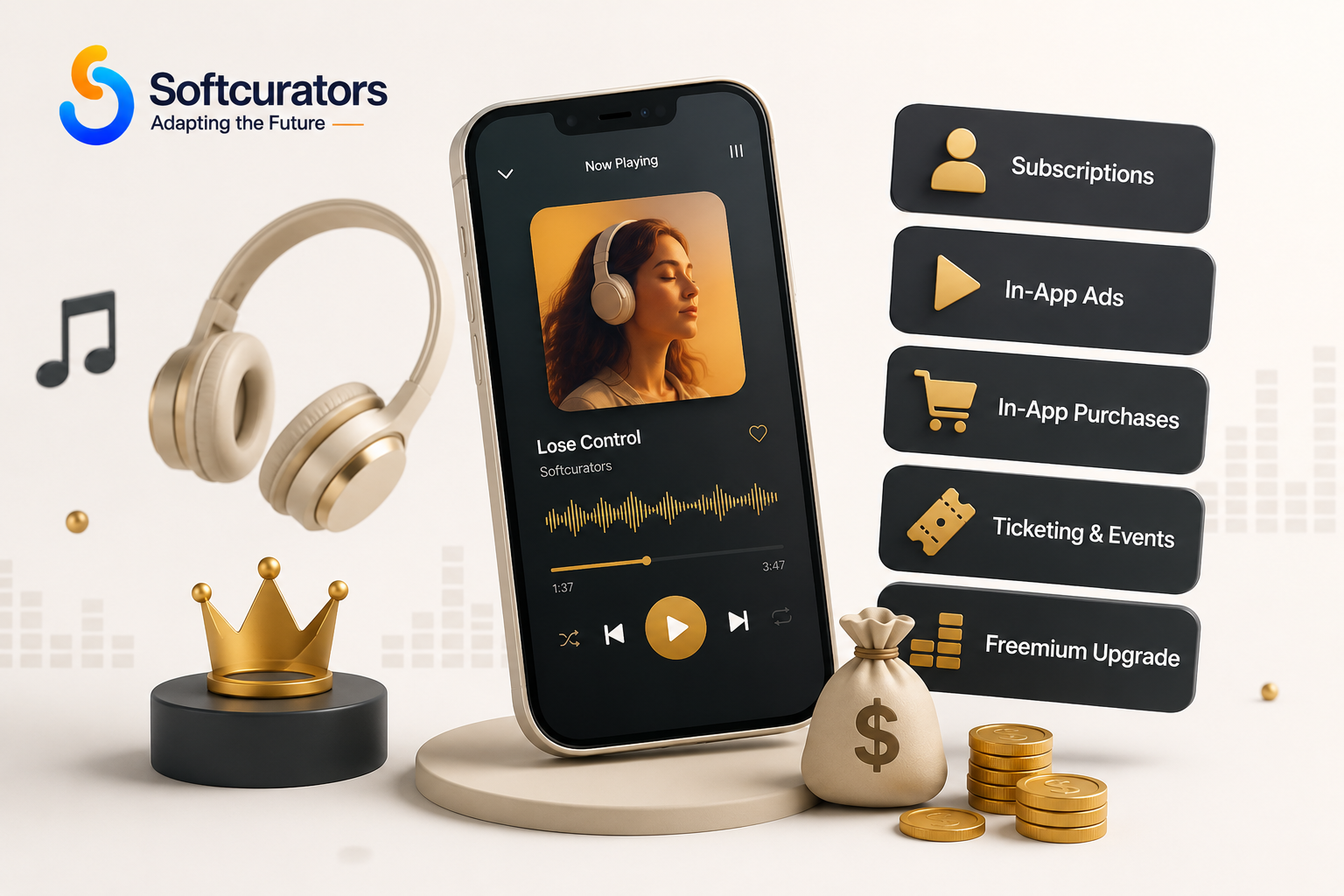
The global music streaming industry crossed USD 26.8 billion in 2023 and keeps growing. Yet choosing the wrong music streaming app monetization model is one of the fastest ways to turn a great product into a money-losing machine. The right model or the right blend of models is what separates platforms that scale from platforms that stall.
At Softcurators, we have helped founders, labels, and enterprises build and launch music streaming platforms across three continents. Every single project starts with the same critical question: how will this app make money? The answer shapes every technical and product decision that follows.
In this guide, we are pulling back the curtain on every viable music streaming app monetization model available. We cover the strategies that industry leaders use, the emerging models that challengers are deploying, and the hybrid frameworks that our own clients use to maximise revenue from day one. By the end, you will know exactly which model or combination fits your platform and your market. Let us start with the fundamentals and build from there.
Why Your Music Streaming App Monetization Model Defines Everything
Monetization is not something you bolt on after launch. It shapes your tech stack, your licensing negotiations, your UI/UX decisions, and your growth strategy. Build the wrong model in and you face expensive re-architecture later. Build the right one in from the start and revenue compounds.
The Three Core Problems Music Apps Face Without a Clear Model
- Licensing costs that outpace revenue music royalties are fixed obligations regardless of your income
- User acquisition costs that are too high for a thin-margin free tier
- Churn rates that outpace new sign-ups because the value proposition is unclear
Understanding music streaming app monetization models upfront is the only way to engineer solutions to all three problems simultaneously. The good news: there are now more viable revenue paths in music streaming than at any point in the industry’s history. Let us explore every one of them.
Model 1 The Freemium Subscription Model: The Industry Backbone
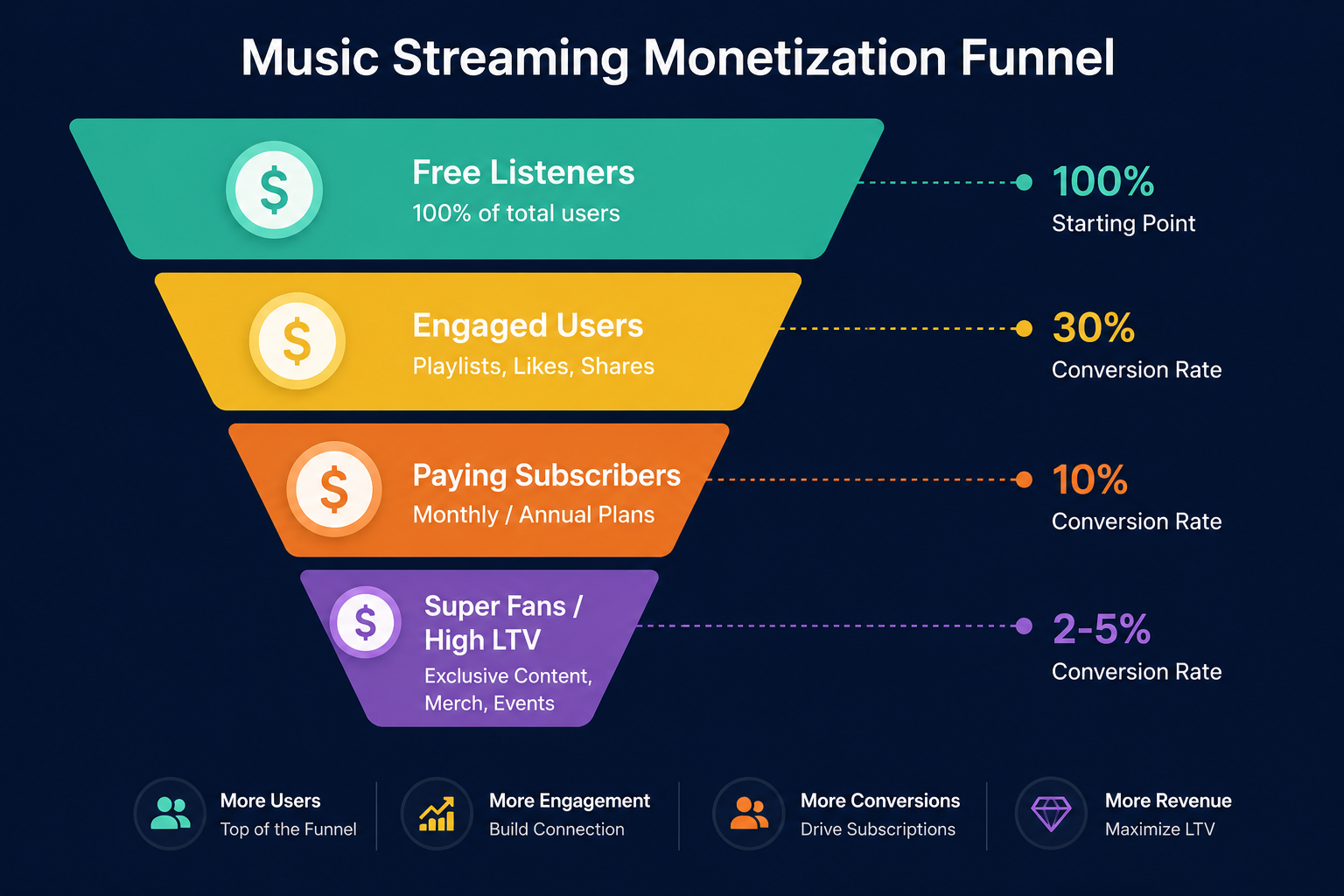
The freemium subscription model is the most widely adopted music streaming app monetization model. Spotify built its entire business on it. Apple Music uses a pure subscription variant. Tidal, Deezer, and Amazon Music all rely on subscription revenue as their primary income stream.
The freemium model works by offering two distinct tiers. The free tier is ad-supported and feature-limited. The premium tier is paid, ad-free, and fully featured. The design goal is simple: let free users experience just enough value to want more and then charge them for it.
How the Freemium Model Works in Practice
- Free tier: users get full music access with audio ads every 2-3 songs, limited skips, and no offline listening
- Premium tier: users pay a monthly or annual fee for an ad-free experience, unlimited skips, offline downloads, and higher audio quality
- Conversion trigger: friction is deliberately built into the free tier (ads, skip limits) to nudge users toward upgrading
- Retention mechanism: offline playlists and personalized features make it painful to downgrade
According to Statista, Spotify converted approximately 27% of its monthly active users into paying subscribers as of 2024 a free-to-paid conversion rate that is exceptional for a consumer product at this scale.
Revenue Mechanics of the Freemium Model
The math behind freemium is straightforward but requires disciplined execution:
- Average Revenue Per User (ARPU) from premium subscribers is typically USD 9.99/month in Western markets
- Free tier generates roughly USD 0.10–0.20 per monthly active user from ad revenue alone
- The goal is to convert enough free users to premium to cover the royalty costs of both tiers
Softcurators Insight: When we build freemium music apps, we engineer the ‘friction points’ carefully too much friction kills engagement, too little kills conversion. It is a precise balance that requires A/B testing from day one.
For a full breakdown of what this model costs to build, read our guide on cost to develop a music streaming app.
When to Choose the Freemium Model
- You are targeting a broad general audience (18-45, music fans across all genres)
- You have secured licensing for a large catalog and need high user volume to negotiate better rates
- You have the runway to sustain a large free user base while growing conversion
- Your market has existing freemium music app awareness (US, UK, EU, Australia, Canada)
Model 2 Pure Subscription: No Free Tier, Maximum Revenue Per User
Some platforms skip the free tier entirely. Apple Music launched without an ad-supported free tier and grew to 88 million subscribers through sheer ecosystem integration and exclusive content. YouTube Music Premium similarly pushes users directly to paid.
The pure subscription music streaming app monetization model makes sense when you have a strong pull factor that justifies asking users to pay immediately exclusive content, device integration, artist relationships, or a niche audience with high willingness to pay.
Pure Subscription Tier Structures That Work
Multi-tier subscription design is where the revenue potential lives. Instead of one price, build a pricing ladder:
| Tier | Price (USD/month) | Key Features |
| Individual | 9.99 | Ad-free, offline, standard quality |
| Student | 4.99 | All Individual features, student verification required |
| Duo | 12.99 | 2 accounts, same billing, separate libraries |
| Family | 14.99 | Up to 6 accounts, parental controls, family mix playlists |
| Annual | 99.99/year | 16% saving vs monthly, loyalty badge, priority support |
| Hi-Fi / Lossless Add-on | +4.99 | Lossless FLAC, spatial audio, HD radio quality |
Each tier serves a distinct user need and household configuration. Offering multiple tiers dramatically increases the chance that a visitor finds a plan that fits which directly increases conversion rates.
Annual vs Monthly Billing: The Retention Secret
Annual billing is one of the most underutilised levers in subscription apps. Here is why it matters:
- Annual subscribers churn at a fraction of the rate of monthly subscribers
- A 12-month commitment creates a psychological contract that reduces impulsive cancellation
- Discounting annual plans by 15-20% reduces short-term ARPU but dramatically improves LTV
- Annual billing improves cash flow you receive the full year’s revenue upfront
Our mobile app development for businesses and startups guide covers subscription architecture decisions in detail. Getting billing right is as important as getting the features right.
Model 3 In-App Advertising: Monetising Every Free Listener
Advertising is the financial engine of the free tier. Done well, it funds your royalty obligations for free users while delivering real value to advertisers. Done poorly, it drives users to competitors who offer an ad-free experience.
Music streaming app advertising monetization has matured significantly since the early days of simple banner placements. Today, platforms can run highly targeted, high-CPM ad formats that outperform traditional display advertising.
Audio Advertising: The Highest-Value Format
Audio ads 15 to 30 second spots played between songs are the premium format in music streaming advertising. They command higher CPMs than display because:
- The user is captured: they cannot scroll past the ad or close the tab
- Audio ads play in environments where display is invisible: driving, running, cooking
- Companion banners on the now-playing screen extend visual impact during the audio ad
- Completion rates for audio ads in music apps average 90%+, far above video pre-roll
CPMs for audio ads in premium markets range from USD 15 to USD 40 significantly higher than social media display. For context, Business of Apps reports that Spotify generates approximately USD 0.35 per free user per month in ad revenue.
Video Ads: The Opt-In Reward Mechanism
- Users voluntarily watch a 30-second video ad in exchange for 30 minutes of ad-free listening
- This format generates the highest CPMs on the platform often USD 25-50 in premium markets
- It also creates a positive brand association: the ad is experienced as a fair exchange, not an interruption
- Completion rates are near 100% because the user initiated the ad voluntarily
Display and Native Ads
- Homepage banners promoting new releases, artists, or playlist brands
- Sponsored playlist cards a brand pays to place its branded playlist in the discovery feed
- Artist-brand partnerships displayed within artist profiles
- Branded moments owning a genre category, a mood, or a time of day (e.g., ‘Powered by [Brand] Your Monday Morning Mix’)
Programmatic vs Direct Ad Sales
Most platforms start with programmatic (using platforms like Google Ad Manager or Triton Digital) and layer in direct sales as they scale. Direct brand deals offer 3-5x higher CPMs but require a dedicated sales team and minimum audience thresholds that most new platforms need time to reach.
Softcurators builds advertising infrastructure with privacy compliance built in GDPR and CCPA targeting limitations are handled architecturally, not as an afterthought.
Model 4 Data and Analytics Licensing: The Hidden Revenue Stream
One of the most underappreciated music streaming app monetization models is the licensing of anonymised, aggregated listener data to record labels, music publishers, brands, and market researchers. Your platform accumulates insights that are genuinely valuable to the music industry.
What Data Can Be Monetised Ethically
- Genre popularity trends by geography and demographic invaluable for labels planning tour routes
- Emerging artist signals which unknown artists are gaining disproportionate streams, indicating breakout potential
- Playlist culture data what types of playlists are growing, what contexts people listen in
- Brand affinity signals which music genres over-index among particular consumer segments
This data must be anonymised and aggregated you are selling market insights, not individual user profiles. GDPR and CCPA both permit this when done correctly, which is why technical implementation matters enormously.
Spotify famously offers a data analytics product called Spotify for Artists, and a broader label intelligence service. As your platform scales, this becomes a meaningful secondary revenue line. Our article on music streaming app trends covers the data economy angle in the broader industry context.
Audience Insights Products for Labels and Brands
- Monthly insights reports delivered to label clients showing streaming performance of their roster
- A&R intelligence identifying which emerging artists on your platform are growing fastest
- Brand-music affinity studies which brands resonate with which listener segments
- Campaign measurement did a label’s release strategy actually move streams?
Pricing for data products typically ranges from USD 500 to USD 10,000+ per month depending on scope and client size. This is a high-margin business that requires minimal incremental infrastructure.
Model 5 Artist and Creator Tools: B2B Revenue Within Your Platform
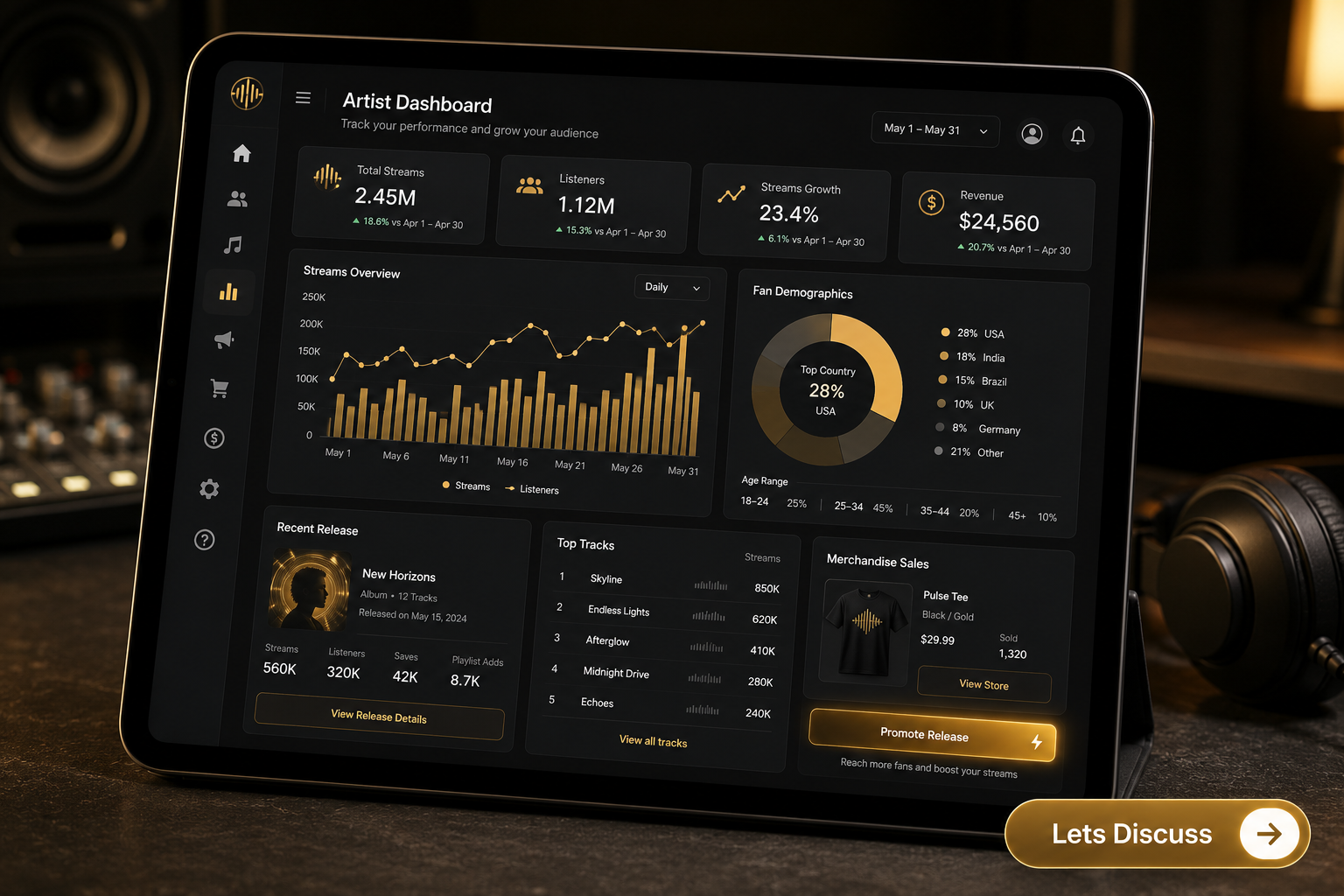
Building premium tools for artists and music creators is one of the fastest-growing music streaming monetization strategies. Artists need data, promotional tools, and fan connection features and they will pay for access to the right ones.
Paid Artist Promotion Features
- Promoted placement in discovery feeds pay to be featured in the ‘New Releases’ or ‘Trending’ sections
- Radio seeding guaranteed placements in algorithmically generated radio stations relevant to the artist’s genre
- Pitch-to-playlist tools a paid service that guarantees human editorial review of new releases
- New release boost temporary algorithmic promotion for the first 7 days of a release
Most independent artists spend money on music promotion. Capturing even a portion of that spend directly within your platform rather than letting it go to Facebook Ads or traditional PR is a significant revenue opportunity.
Artist Verification and Profile Enhancement
- Verified artist badge with enhanced profile capabilities (video headers, long-form bio, direct fan messaging)
- Priority customer support for verified artists
- Early access to new platform features for participating artists
- Co-branded merchandise integration within the artist’s profile
Fan Club and Direct-to-Fan Monetization
This is perhaps the most exciting innovation in music streaming monetization. Platforms that enable direct artist-to-fan economic relationships capture a percentage of transactions that would otherwise leave the platform entirely:
- Artist subscription clubs fans pay USD 3-10/month directly to an artist for exclusive content, early access, and private livestreams
- Fan badges purchasable status symbols that display on a fan’s profile in artist spaces
- Digital tip jars fans send micro-payments to artists they are watching live or listening to
- Exclusive merch drops within the app limited edition items sold only through your platform
This model has parallels in creator economy platforms. For inspiration on how this type of monetization is structured, read our analysis of best subscription-based content platforms. The parallels to music streaming are very instructive.
Model 6 Live Events and Ticketing: Bridging Digital and Physical
The smartest music platforms have figured out that their users do not just listen to music they also go to concerts. Building a bridge from your digital listening experience to live event ticketing creates a completely new revenue stream that no major platform has yet fully captured.
In-App Concert Discovery and Ticketing
- Surface concert listings for artists in each user’s library, filtered by their city or travel plans
- Partner with Ticketmaster, SeatGeek, Dice, or Eventbrite for in-app ticket purchasing
- Earn 5-15% commission on every ticket sold through your platform
- Create pre-show playlists that auto-generate in the days before a ticketed concert
According to the IFPI Global Music Report 2024, live music revenue rebounded strongly post-pandemic and now represents one of the largest revenue pools in the entire music industry. Your streaming platform is uniquely positioned to capture a share of this.
Exclusive Livestream Events
- Premium livestream concerts available only to your subscribers a powerful acquisition and retention tool
- Pay-per-view livestream tickets for non-subscribers a new revenue channel and conversion funnel
- Backstage and Q&A add-ons sold as premium upgrades to livestream tickets
- After-show VOD access sell replay access to the livestream after the event
Softcurators has built live event infrastructure into streaming platforms. The technical requirements real-time low-latency streaming, concurrent viewer scalability, in-app payment flows are complex but achievable with the right architecture from the start.
Model 7 Merchandise and Physical Products: High-Margin Fan Commerce
Merchandise integration is a growing monetization channel for music streaming platforms. When a user is in a deep listening session with their favourite artist, they are in a highly engaged, emotionally connected state exactly when merchandise purchase intent peaks.
In-App Merchandise Stores
- Integrated artist merch shops within each artist’s profile page
- Limited edition drops that create urgency (48-hour availability windows)
- Bundle deals buy an annual subscription and get an exclusive piece of merch
- Physical vinyl and CD integration for audiophile segments who want something tangible
Platform-Branded Merchandise
- Your platform’s own branded merchandise (hoodies, headphones, accessories) sold to power users
- Collaborative branded merchandise with artists co-designed products that both your brand and the artist promote
- Subscriber anniversary gifts premium subscribers receive exclusive merch after reaching annual milestones
Merchandise revenue is typically high-margin (40-70% gross margin on soft goods) and requires minimal platform-side infrastructure when handled through a fulfilment partner. Your role is the discovery and transaction platform; a 3PL partner handles manufacturing and shipping.
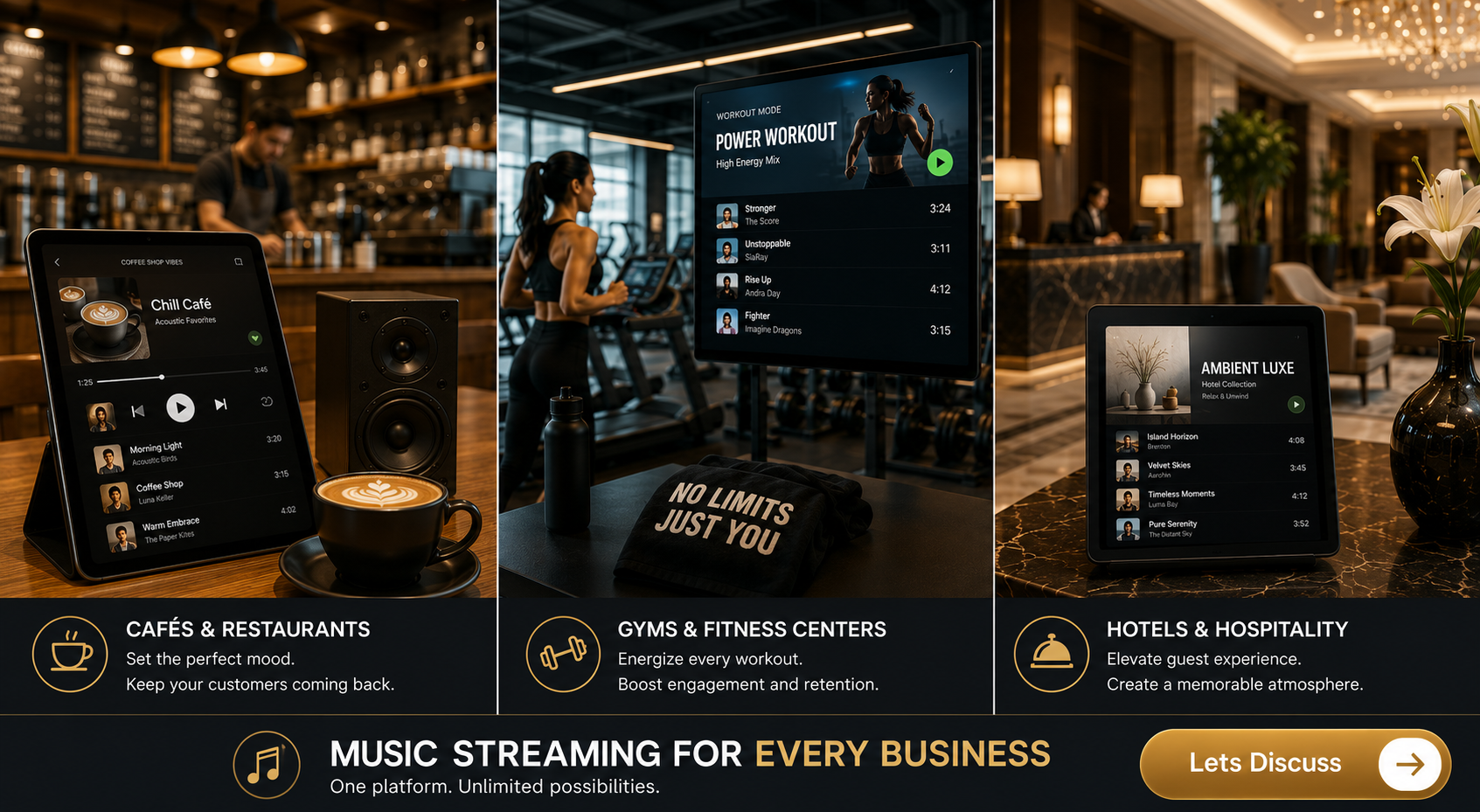
Model 8 B2B Licensing: Streaming Music to Businesses
Most music streaming apps focus exclusively on consumer (B2C) audiences. This creates a massive opportunity in the B2B space that is largely underserved. Businesses that play music publicly gyms, restaurants, retail stores, hotels, salons, corporate offices require a commercial music license.
Business Streaming License Tiers
| Business Type | Typical Monthly Fee (USD) | Value Proposition |
| Independent café / small restaurant | 24.99 – 49.99 | Licensed music, no copyright risk, mood-based playlists |
| Gym / fitness studio | 39.99 – 79.99 | High-BPM workout mixes, class scheduling integration |
| Retail chain (per location) | 49.99 – 149.99 | Brand-appropriate playlists, daypart scheduling |
| Hotel (per property) | 99.99 – 299.99 | In-room streaming, lobby ambience, event music |
| Enterprise (100+ locations) | Custom | White-label, API integration, centralized management |
The B2B licensing model delivers higher ARPU than consumer plans, lower churn (businesses do not cancel subscriptions the way consumers do), and no ad revenue dependency. It is a highly predictable, recurring revenue stream.
Building the B2B Product
- Business dashboard manage music across multiple locations from one login
- Daypart scheduling set different playlist moods for morning, afternoon, and evening automatically
- Explicit content blocking critical for retail and family-friendly environments
- Zone management play different music in different areas of the same venue simultaneously
- Offline fallback continue playing if internet connection drops, preventing embarrassing silence
If you are interested in how B2B music licensing intersects with the broader on-demand services economy, our on-demand app development industry page has relevant context on building service platforms at scale.
Model 9 White-Label and Platform Licensing
This is a music streaming app monetization model that most founders do not consider but it can be transformative at scale. Once you have built a mature streaming platform with solid infrastructure, you can license that platform to other businesses who want to launch their own branded streaming service without building from scratch.
Who Buys White-Label Music Platforms
- Airlines and cruise ships wanting in-flight and onboard entertainment systems
- Telecom carriers offering music streaming as a bundled value-add (e.g., carrier X offers unlimited music streaming to premium mobile plan subscribers)
- Fitness equipment manufacturers embedding streaming into treadmills and exercise bikes
- Smart home device makers wanting a native music experience for their ecosystem
- Regional media groups launching local-language streaming services in emerging markets
White-Label Revenue Structure
- Setup fee: one-time licensing fee for platform access (typically USD 50,000 – USD 500,000 depending on scope)
- Monthly platform fee: ongoing SaaS-style fee for hosting, maintenance, and updates
- Revenue share: a percentage (typically 5-15%) of the licensee’s subscriber revenue
Softcurators has extensive experience building white-label foundations. If you are exploring this model, our software development team can architect the multi-tenancy and branding flexibility needed from day one.
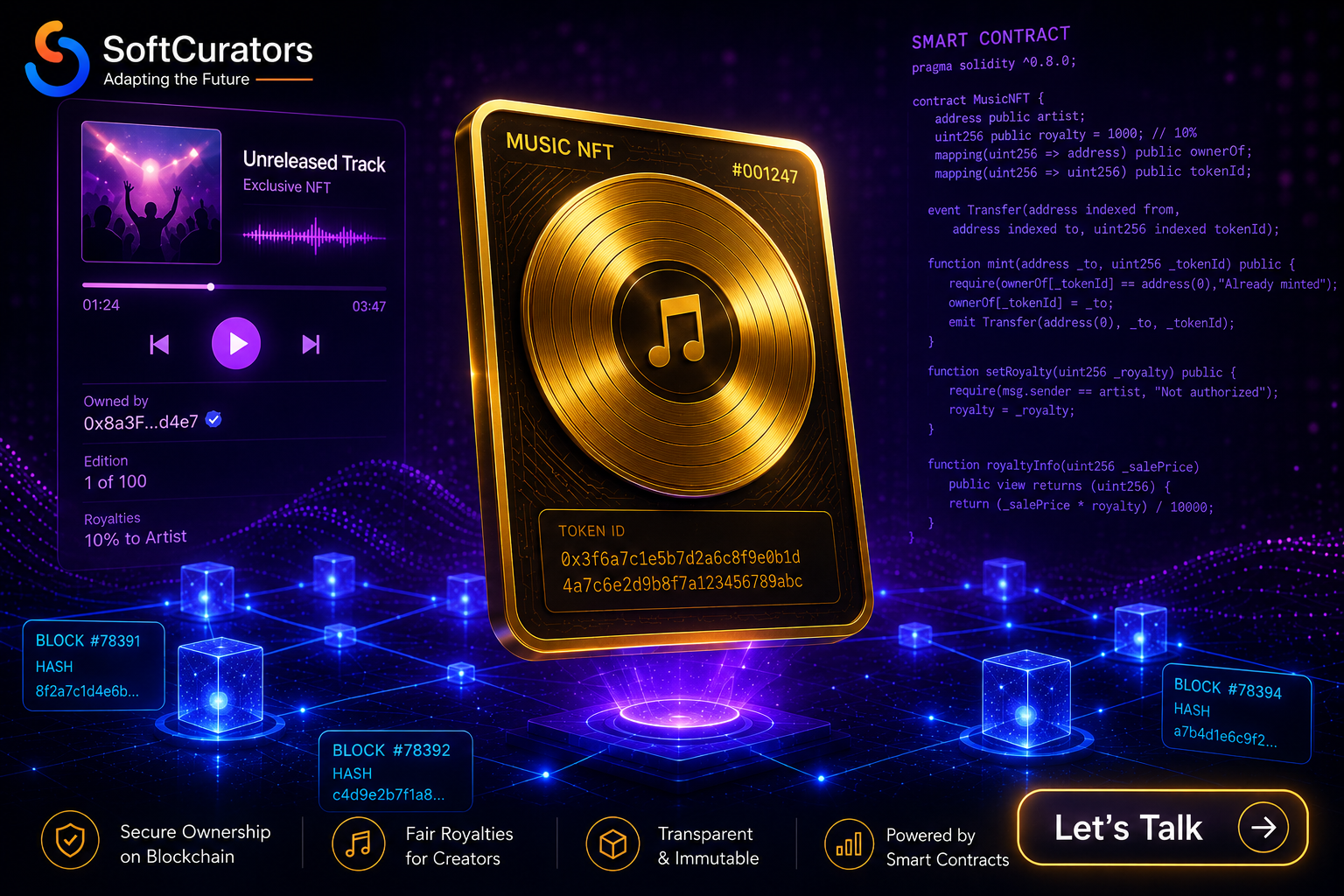
Model 10 Web3 and Blockchain Monetization: The Emerging Frontier
Web3 is reshaping the economics of music ownership and distribution. While mainstream adoption is still developing, forward-thinking platforms are building Web3 monetization models now to position themselves ahead of the curve. This is a genuinely differentiated music streaming app monetization model that legacy platforms cannot quickly replicate.
Music NFTs: Artist-Controlled Revenue
- Artists mint unique or limited edition tracks as NFTs purchasable directly within your platform
- NFT ownership grants exclusive access rights: early listening, backstage access, private concerts
- Secondary market royalties: every time an NFT resale occurs, the artist (and your platform) earn a percentage
- Fractional ownership NFTs fans co-own a share of a song’s royalties and earn passive income as it streams
Fan Tokens and Governance
- Platform-level fan tokens that give holders influence over platform decisions (which artists to feature, which events to host)
- Artist-specific fan tokens that unlock a tiered access system within that artist’s community
- Token-gated content: holders of a particular token unlock exclusive tracks, videos, or live sessions
Smart Contract Royalties
Smart contracts eliminate the opacity and delay in traditional music royalty distribution. When you build smart contract royalty architecture into your platform:
- Artists see royalty payments credited in near real-time rather than quarterly
- Royalty splits between composers, performers, and producers are enforced automatically by code
- Transparency builds trust with independent artists who have historically been shortchanged by opaque royalty systems
Our AI development team and AI consulting services both support Web3 integration projects. Building blockchain features requires specialist expertise this is not a domain for generalist developers.
Model 11 Podcast and Audio Content Monetization
Spotify’s strategic pivot into podcasting acquiring studios, shows, and creators was not just a content strategy. It was a monetization model expansion. Podcasts and audio content create new advertising inventory, new subscription tiers, and new distribution deals that purely music-focused platforms simply cannot access.
Podcast Advertising Revenue
- Host-read ads in partnered podcasts the highest-converting ad format in audio
- Programmatic pre-roll and mid-roll ad insertion in on-demand podcast episodes
- Sponsored series: brands fund entire podcast seasons in exchange for exclusive sponsorship
- Dynamic ad insertion: update ads in older episodes with fresh campaigns, monetising your entire back catalogue
Podcast Subscription and Gating
- Premium podcast subscriptions listeners pay a monthly fee for ad-free podcast listening, early access to episodes, and bonus content
- Creator subscription programmes: listeners support individual podcasters directly through your platform (take a 15-30% platform commission)
- Exclusive podcast content available only to music premium subscribers a compelling upsell
If you are considering adding podcast functionality to your music streaming app, our music streaming app development guide covers the technical architecture needed to support both audio formats efficiently.
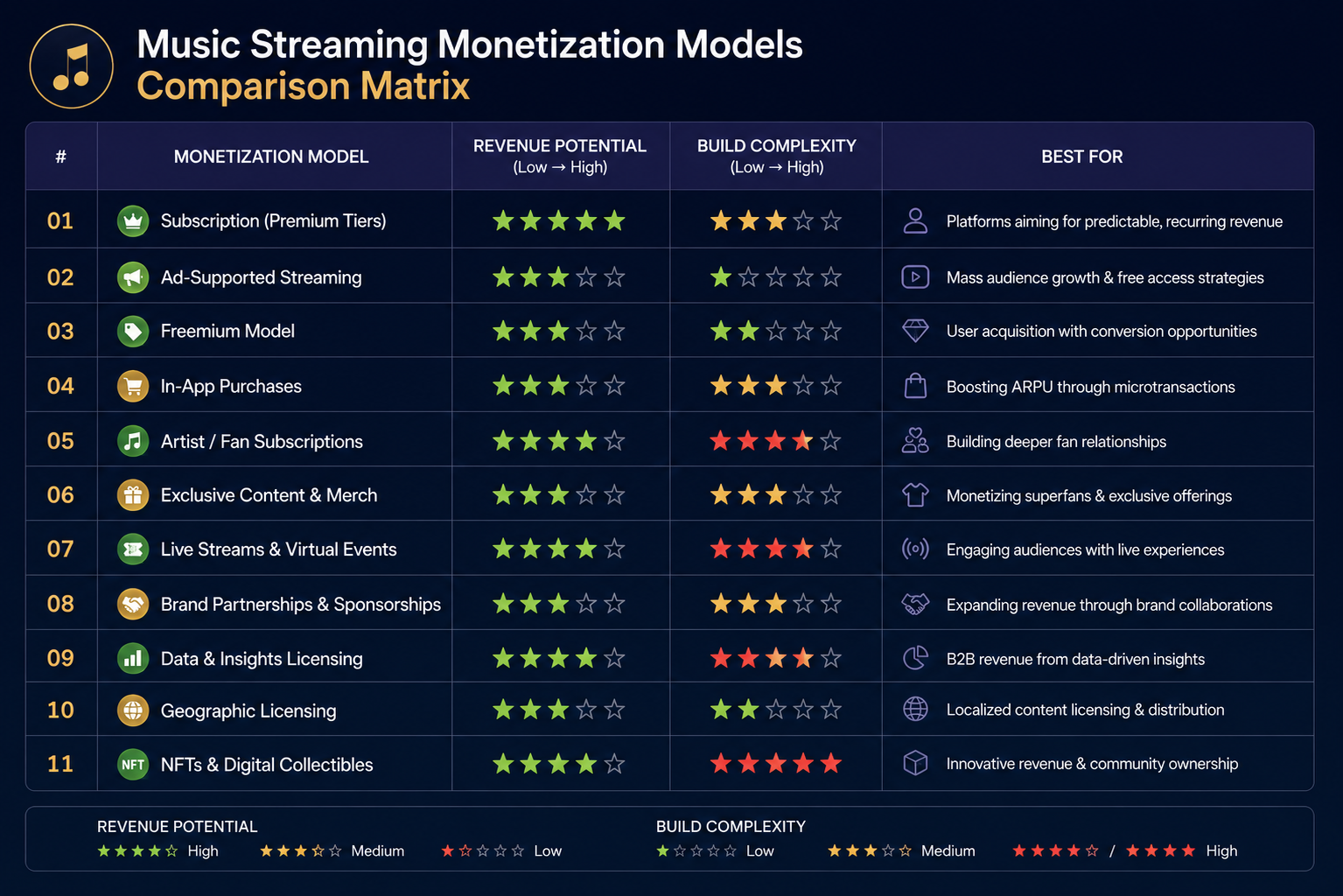
Comparing All Music Streaming App Monetization Models at a Glance
| Monetization Model | Revenue Potential | Build Complexity | Best For |
| Freemium Subscription | ★★★★★ | ★★★ | Mass market consumer platforms |
| Pure Subscription | ★★★★ | ★★ | Premium / niche / ecosystem plays |
| In-App Advertising | ★★★ | ★★★ | High-volume, free-tier-heavy platforms |
| Data Licensing | ★★ | ★★ | Scale platforms with 1M+ MAU |
| Artist Tools / B2B | ★★★ | ★★★ | Independent artist-focused platforms |
| Live Events / Ticketing | ★★★ | ★★★★ | Genre-focused / fan community apps |
| Merchandise | ★★ | ★★ | High-fan-loyalty, community apps |
| B2B Business Licensing | ★★★★ | ★★★ | Platforms targeting business customers |
| White-Label Licensing | ★★★★★ | ★★★★★ | Mature platforms with solid infra |
| Web3 / NFT | ★★★ | ★★★★★ | Innovation-first, crypto-native audiences |
| Podcast / Audio Content | ★★★★ | ★★★★ | All-audio super-app strategies |
The Hybrid Revenue Model: How Real Platforms Maximise Income
No successful music streaming platform relies on a single monetization model. The platforms that generate sustainable, growing revenue deploy a carefully sequenced portfolio of revenue streams. Here is how a realistic hybrid model is structured by growth stage:
1st Stage Launch (Months 1-6): Foundation Revenue
- Primary: Freemium subscription (individual and family tiers)
- Secondary: In-app advertising (programmatic, audio and display)
- Goal: Cover royalty costs for free users through ad revenue; convert 10-20% to paid
2nd Stage Growth (Months 7-18): Expanding Monetization
- Add: Artist promotion tools (paid promotional features)
- Add: Annual subscription tier with meaningful discount
- Add: Student and family plans to expand subscriber addressable market
- Add: Podcast content with its own advertising inventory
- Goal: Increase ARPU by 20-40% through tier diversification
3rd Stage Scale (Months 19-36+): Platform Economics
- Add: B2B business licensing
- Add: Data analytics products for labels
- Add: Live event ticketing partnerships
- Add: Merchandise integration
- Explore: White-label licensing to enterprise partners
- Goal: Build multiple high-margin revenue streams that compound
Softcurators builds monetization architecture that is extensible by design. You do not need to build every model on day one but the right architecture ensures adding new revenue streams is a feature addition, not a re-architecture.
For context on how the Spotify model specifically evolved, our detailed comparison at Spotify vs Apple Music app features compared shows how both platforms made different strategic monetization bets and what the results looked like.
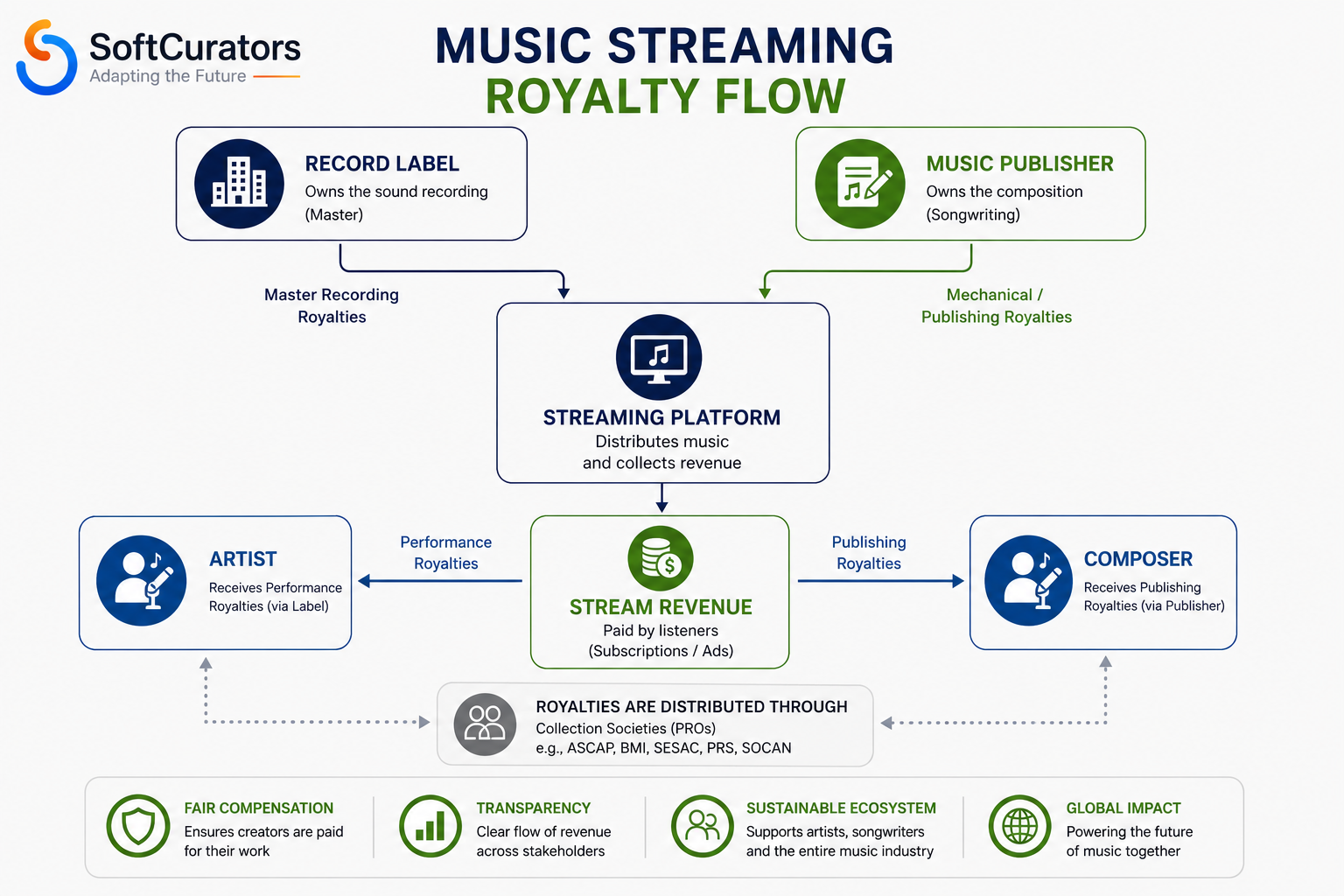
Music Licensing: The Foundation Every Monetization Model Sits On
Before any monetization model can generate a single dollar, your platform must be legally licensed to stream the music it distributes. This is non-negotiable and non-deferrable. Streaming music without proper licensing exposes you to litigation that can cost far more than any revenue you generate.
The Three Types of Licenses You Need
- Master recording license: obtained from the record label or rights holder for each specific recording
- Mechanical license: covers the underlying composition and is typically obtained through mechanical licensing bodies (Harry Fox Agency, Songfile, Music Reports)
- Performance license: obtained through performance rights organisations (ASCAP, BMI, SESAC in the US; PRS in the UK; SOCAN in Canada; PPL internationally)
Royalty Structures That Affect Your Monetization Math
Every monetization model must account for royalty obligations. The key rates:
- On-demand streams: typically USD 0.003-0.005 per stream paid to master rights holders
- Per-stream rates differ for free (lower) vs premium (higher) listening
- Mechanical royalties: 9.1 cents per track per download in the US (for offline/downloaded content)
- Performance royalties: 15% of net revenue is a common benchmark for independent platforms
Royalty accounting is complex and territory-specific. Our article on the cost to build a music streaming app like Spotify walks through how licensing costs factor into overall platform economics.
Working With Aggregators and Distributors
For early-stage platforms that cannot yet negotiate directly with major labels, music aggregators provide access to large catalogs:
- DistroKid, CD Baby, and TuneCore aggregate independent artist catalogs
- The Merlin Network provides access to a large independent label catalog
- Epidemic Sound, Artlist, and similar platforms offer royalty-free music for specific use cases
- Direct deals with Universal, Sony, and Warner are typically only achievable with significant user volume (1M+ MAU) as leverage
How Softcurators Builds Music Streaming Apps for Monetization Success
At Softcurators, building music streaming platforms is a specialty not a side project. Our clients come to us because they need a development partner who understands the nuances of audio streaming technology, music licensing, and revenue architecture all at once.
Our End-to-End Music App Development Services
We cover the full development lifecycle from UI/UX design through iOS app development, Android app development, React Native cross-platform development, and backend software development. We also integrate advanced AI features through our dedicated AI app development and AI development services.
Monetization Architecture Built From Day One
- Subscription billing infrastructure with Stripe or Paddle integration for global payment support
- Ad server integration (Google Ad Manager, Triton Digital, or custom) for programmatic advertising
- Artist analytics dashboards and promotion tool back-ends
- B2B licensing portal with multi-location management and business-specific features
- Data pipeline architecture that generates insight products from listener behaviour
From MVP to Full Platform
We offer flexible engagement models whether you need a rapid MVP to validate your concept or a startup-focused full build with everything from licensing consultation to App Store optimisation, we have done it before and we can do it for your platform.
Post-launch, our maintenance and support services team monitors, iterates, and A/B tests your monetization flows to continuously improve conversion and ARPU.
Explore More of Our Music App Expertise
- Music Streaming App Development Guide
- Cost to Develop a Music Streaming App
- Cost to Build a Music Streaming App Like Spotify
- Best Music Streaming Apps Market Analysis
- Music Streaming App Trends in 2025
- How to Develop an AI Music Generation App Like Suno AI
- Spotify vs Apple Music App Features Compared
Conclusion: Build a Music Streaming App That Makes Money From the Start
Choosing the right music streaming app monetization model is not a decision you make after launch. It shapes your architecture, your licensing strategy, your UX, and your growth playbook. The platforms that generate real, sustainable revenue treat monetization as a core product discipline not an afterthought.
The good news is it offers more monetization paths than at any previous point in streaming’s history. Freemium subscriptions, advertising, B2B licensing, artist tools, live events, merchandise, data products, and Web3 each represents a genuine, tested revenue opportunity. The smartest founders combine several of these models into a portfolio that compounds over time.
At Softcurators, we have helped clients navigate every one of these models. We know what works at launch, what works at scale, and what the technical requirements are to build each model correctly. Whether you are building your first music app or scaling an existing platform, we are the team that can make your monetization strategy real.
FAQs
How do music streaming apps make money without charging users?
Ad-supported streaming is the primary model for generating revenue without charging users. Free-tier listeners hear audio ads between songs, see display ads on the player interface, and may watch opt-in video ads. Additionally, free-tier listener data (anonymised and aggregated) can be licensed to labels and brands. The free tier is never truly free to operate it is funded by advertising CPM revenue, which must exceed the royalty cost per stream for each free user.
Which platform should I build my music streaming app for first iOS or Android?
Building a music streaming app with full subscription billing infrastructure (multiple tiers, annual/monthly billing, free trial flows, cancellation management) typically adds USD 15,000-40,000 to a base platform build depending on complexity and integration requirements. For full cost breakdowns, read our guide on music streaming app development costs.
Can a music streaming app survive on advertising revenue alone?
Theoretically yes, but it is extremely difficult at small scale. Audio advertising CPMs range from USD 6-40 depending on market and targeting, generating roughly USD 0.10-0.35 per monthly active free user. Royalty costs per stream typically exceed advertising revenue at low volume. Advertising-only models only become viable when you reach millions of monthly active users. Most platforms that start ad-only eventually add subscription tiers as they scale.
What percentage of free users convert to paid subscribers?
Industry benchmarks vary widely. Spotify's conversion rate sits around 26-29% globally, which is considered excellent. Most music streaming apps target 10-20% free-to-paid conversion as a realistic benchmark. Conversion rate is heavily influenced by the quality of the free-tier friction design, the compelling nature of premium features (especially offline listening), and pricing relative to local income levels.
How do I set the right subscription price for my music app?
Pricing should be calibrated to local purchasing power, competitor benchmarks, and your licensing cost floor. In the US and UK, USD/GBP 9.99/month for an individual plan is the market benchmark set by Spotify and Apple Music. In markets like India, Indonesia, or Brazil, pricing at 30-50% of that rate is often necessary for meaningful conversion. Annual plans should offer a 15-20% discount to justify the commitment. Always A/B test pricing even small changes can have large conversion impacts.
What is the role of family plan pricing in music streaming monetization?
Family plans are one of the most powerful revenue tools in subscription streaming. By charging USD 14.99 for up to 6 accounts (compared to USD 59.94 if all 6 subscribed individually), platforms appear to offer deep value while generating one committed, multi-year subscription that rarely churns. A family plan subscriber is typically 3-4x more valuable over a 3-year period than 6 individual subscribers because family churn is dramatically lower.
How do music streaming apps handle royalty payments?
Royalties are typically calculated on a pro-rata basis from a pool: total royalty obligations for the period are divided by total streams, then each rights holder is paid based on their share of total streams. Platforms pay royalties monthly or quarterly to aggregators, distributors, and directly to major labels under negotiated licensing agreements. The actual per-stream rate paid to artists after the label's cut is typically a fraction of the platform's gross royalty payment.
Can I build a music app without licensing from major labels?
Yes, but your catalog will be limited to independent artists and royalty-free music. Several successful niche platforms particularly in jazz, classical, and world music operate with independent catalogs. Platforms like Epidemic Sound and Artlist have built entire businesses on royalty-free catalogs for content creators. If your target audience is fine with an independent or curated catalog, this is a legitimate path that avoids the licensing cost and complexity of major label deals.
What is the best monetization model for a niche music streaming app?
For niche platforms (genre-specific, regional, artist-focused), a higher-priced pure subscription with deeper fan engagement features typically outperforms freemium. Niche audiences have higher willingness to pay for content that is genuinely relevant to them. Combined with artist tools, fan clubs, live event integration, and merchandise, niche platforms can generate 2-3x the ARPU of mass-market freemium platforms from a much smaller user base.
How do music streaming apps monetize podcasts differently from music?
Podcast monetization typically uses host-read advertising and dynamic ad insertion rather than CPM-based audio ads. Podcast ads command significantly higher rates (USD 18-50 CPM for host-read) compared to music streaming ads (USD 6-15 CPM for programmatic). Podcast subscription models (ad-free premium listening, bonus episodes) also work differently the paywall is content-based rather than feature-based.
What is dynamic ad insertion and why does it matter for monetization?
Dynamic ad insertion (DAI) is the technology that allows different advertisements to be inserted into audio content in real-time based on the listener's profile, location, and listening context. It enables you to update ads in older episodes of a podcast without re-uploading the audio file, effectively monetising your entire back catalog. DAI dramatically improves advertising CPMs because every ad served is targeted and relevant.
How does data licensing work in music streaming, and is it legal?
Data licensing in music streaming involves selling anonymised, aggregated insights derived from listener behaviour not individual user data. This is legal under GDPR and CCPA when users are informed (via your privacy policy) that anonymised data may be used for market research. You are selling insights like 'jazz listening increased 32% among 25-34 year olds in the Northeast this quarter', not individual identifiable data. The buyers are record labels, publishers, brands, and market research firms.
What are fan tokens in music streaming and how do they generate revenue?
Fan tokens are blockchain-based digital assets that give holders special privileges within an artist's community on your platform. Artists issue tokens (typically at a nominal price of USD 1-10 each), and token holders receive exclusive access rights: early listening, exclusive content, voting rights on setlists or album art, and priority concert tickets. Your platform earns revenue by taking a percentage of token issuance and secondary market trading fees.
How does the B2B music licensing model differ from consumer streaming?
B2B music licensing targets businesses that play music for public audiences cafes, gyms, retail stores, hotels, airlines, spas. These businesses require a commercial performance license that consumer subscriptions explicitly do not cover. B2B plans typically charge 3-5x higher monthly fees than consumer plans, offer multi-location management, daypart scheduling, and explicit content filtering. B2B subscribers have dramatically lower churn than consumers and represent a highly predictable recurring revenue stream.
How do I negotiate music licensing deals as a small streaming platform?
Early-stage platforms typically cannot negotiate directly with major labels (Universal, Sony, Warner) because labels require significant user volume as a condition of licensing talks. The practical path for small platforms is to start with independent label aggregators (Merlin, DistroKid, CD Baby partnerships), build user volume, and then approach major labels once you have demonstrated audience traction and the ability to pay royalties reliably. Engaging a music licensing attorney is essential before entering any negotiation.
What is a white-label music streaming platform and who needs one?
A white-label music streaming platform is a fully functioning streaming service that is licensed to another business to rebrand and deploy as their own. Airlines, telecom carriers, fitness equipment manufacturers, hotels, and regional media groups are the typical buyers. Building a platform that can be white-labeled requires multi-tenancy architecture, flexible branding systems, and robust API infrastructure. Softcurators has built white-label foundations for enterprise clients explore our software development services for more.
How do music streaming apps handle international monetization?
International monetization requires localised pricing, local payment method support, currency conversion, regional licensing agreements, and territory-specific content availability. Pricing must reflect local purchasing power a USD 9.99/month plan that works in the US becomes inaccessible in India or Nigeria at the same price. Most platforms use purchasing power parity (PPP)-adjusted pricing, offering plans at USD 1-3/month in emerging markets. Payment methods must include local options: UPI in India, M-Pesa in East Africa, Pix in Brazil.
What is social commerce in music streaming and how does it work?
Social commerce in music streaming means generating revenue through social interactions sharing, liking, and community engagement. Examples include: premium playlist sharing that requires a paid subscription to access the full playlist, collaborative playlist subscriptions, in-app gifting (sending a digital gift to a friend's profile), and sponsored listening parties where brands host events in exchange for promotional placement. Social commerce is an emerging monetization layer on top of core subscription and advertising models.
How do freemium music apps prevent users from never upgrading?
Preventing permanent free usage without conversion requires strategic friction design. The most effective mechanisms: limiting skips to 6 per hour in the free tier, preventing users from selecting specific songs on mobile (shuffle-only), disabling offline listening, inserting audio ads at regular intervals, and showing upgrade prompts at moments of peak frustration (like when an ad interrupts a favourite song). The goal is not to destroy the free experience but to make the premium experience feel genuinely valuable by comparison.
What analytics should I track for music streaming monetization performance?
Key monetization metrics to track: Monthly Recurring Revenue (MRR) and Annual Recurring Revenue (ARR); ARPU (Average Revenue Per User) by tier; free-to-paid conversion rate; subscriber churn rate by tier; advertising fill rate and CPM by format; cost per subscriber acquisition; and Lifetime Value (LTV) by cohort and acquisition channel. Revenue-per-stream metrics (comparing royalty costs against per-stream revenue) are also critical for understanding platform unit economics.
How does Softcurators structure a monetization strategy for a new music app?
Softcurators begins every music streaming project with a monetization architecture workshop mapping target audience willingness to pay, competitive pricing analysis, royalty cost modeling, and a phased revenue model roadmap. This determines which monetization features we build for MVP versus which we roadmap for later phases. Our MVP development service includes monetization architecture as a core deliverable.
Can I use AI to improve music streaming monetization?
Yes significantly. AI improves monetization in several ways: recommendation algorithms that increase session depth (more streams = more royalty-eligible listening, more ad impressions, higher retention); dynamic paywall personalisation (showing each free user the upgrade prompt most likely to convert them); churn prediction models (identifying at-risk subscribers before they cancel and triggering retention campaigns); and ad targeting optimisation (improving CPMs by serving more relevant ads). Our AI development and AI app development teams integrate all of these capabilities.
What is the impact of audio quality on subscription conversion rates?
High-quality audio (lossless, FLAC, spatial audio) is a powerful premium conversion driver among audiophile segments. Tidal built its entire early brand identity around HiFi audio. When free-tier users hear standard quality and premium users hear lossless, the difference is immediately perceptible on good headphones which converts dedicated music listeners at higher rates than feature marketing alone. Consider positioning a HiFi tier above your standard premium plan to capture audiophile ARPU premium.
How do partnerships with device manufacturers affect music streaming monetization?
Device partnerships embedding your streaming app as the default music player on a smartphone, smart speaker, TV, or car entertainment system are among the most powerful distribution deals in music streaming. These deals typically involve a revenue share arrangement where the device manufacturer promotes your platform to its users in exchange for a portion of subscriber revenue generated from that hardware ecosystem. Apple Music's deep integration into Apple devices is the most successful example of this model.
What is the future of music streaming monetization?
The most significant emerging trends in music streaming app monetization models include: AI-generated personalised music (where users pay for unique tracks generated to their taste profile), spatial audio as a standard premium feature, deeper artist-fan direct economic relationships replacing traditional labels in some segments, Web3 royalty transparency becoming an industry norm, and the convergence of music and gaming (in-game music streaming as a new distribution and revenue channel). The platforms building the right technical foundations today will be best positioned to capture these emerging revenue streams. Our team at Softcurators stays ahead of these trends explore our thinking on music streaming app trends.
How does student pricing affect overall music streaming revenue?
Student pricing (typically 50% of the standard individual rate) is a long-term customer acquisition investment. Students who sign up at a discounted rate develop strong platform habits during formative years, and a meaningful percentage convert to full-price plans after graduation. Spotify has reported that student plan subscribers have conversion rates to full-price plans that justify the discounted entry point. The key is making the student verification process frictionless while ensuring compliance.
Can a podcast-first platform also monetize music, or vice versa?
Absolutely and this convergence is one of the defining trends in audio platforms. Spotify started as music-first and added podcasts. Amazon Music started as part of Prime and added podcasts. Starting from one side of audio and adding the other is a well-validated path. The technical and licensing complexity differs significantly between music and podcasting, so plan the architecture accordingly. Our mobile app development team has built hybrid audio platforms and can guide you through the specific considerations.
What payment gateway should I use for music streaming subscriptions globally?
Stripe is the industry standard for subscription billing in Western markets due to its subscription management APIs, multi-currency support, and developer experience. For global coverage, combine Stripe with regional payment methods: Razorpay for India, Mercado Pago for Latin America, Paystack for Africa. Apple and Google Play In-App Purchases are required for apps distributed through their stores (and they take 15-30% of subscription revenue), which is why many platforms push users to subscribe via their website instead of in-app.
How do I protect music streaming revenue from subscription sharing?
Password sharing has been a significant revenue leak for streaming platforms. Effective protection mechanisms include: device limits per subscription (e.g., a maximum of 3 simultaneous streams per account), geographic restrictions (flagging accounts accessing from dramatically different locations simultaneously), household verification features, and pricing tiers that make legitimate multi-user plans attractive enough that sharing is not worth the inconvenience. Spotify's password sharing crackdown in 2023 drove a significant increase in paid subscriptions and is now the industry playbook.
Does Softcurators provide post-launch monetization optimisation?
Yes our maintenance and support services include ongoing A/B testing of conversion flows, paywall optimisation, advertising yield management, and monetization feature additions. Launching a music streaming app is not the end of the monetization journey it is the beginning of a continuous improvement process. Our team stays involved post-launch to ensure your revenue model keeps pace with your user growth.
Q32.How can I get started with building a music streaming app with Softcurators?
The best first step is a free discovery call with our team. We will review your concept, share relevant case work, and provide an initial monetization strategy recommendation all before you commit to anything. Visit softcurators.com/contact to book your consultation. You can also explore our dedicated music streaming app development solution page to see what we build.
