
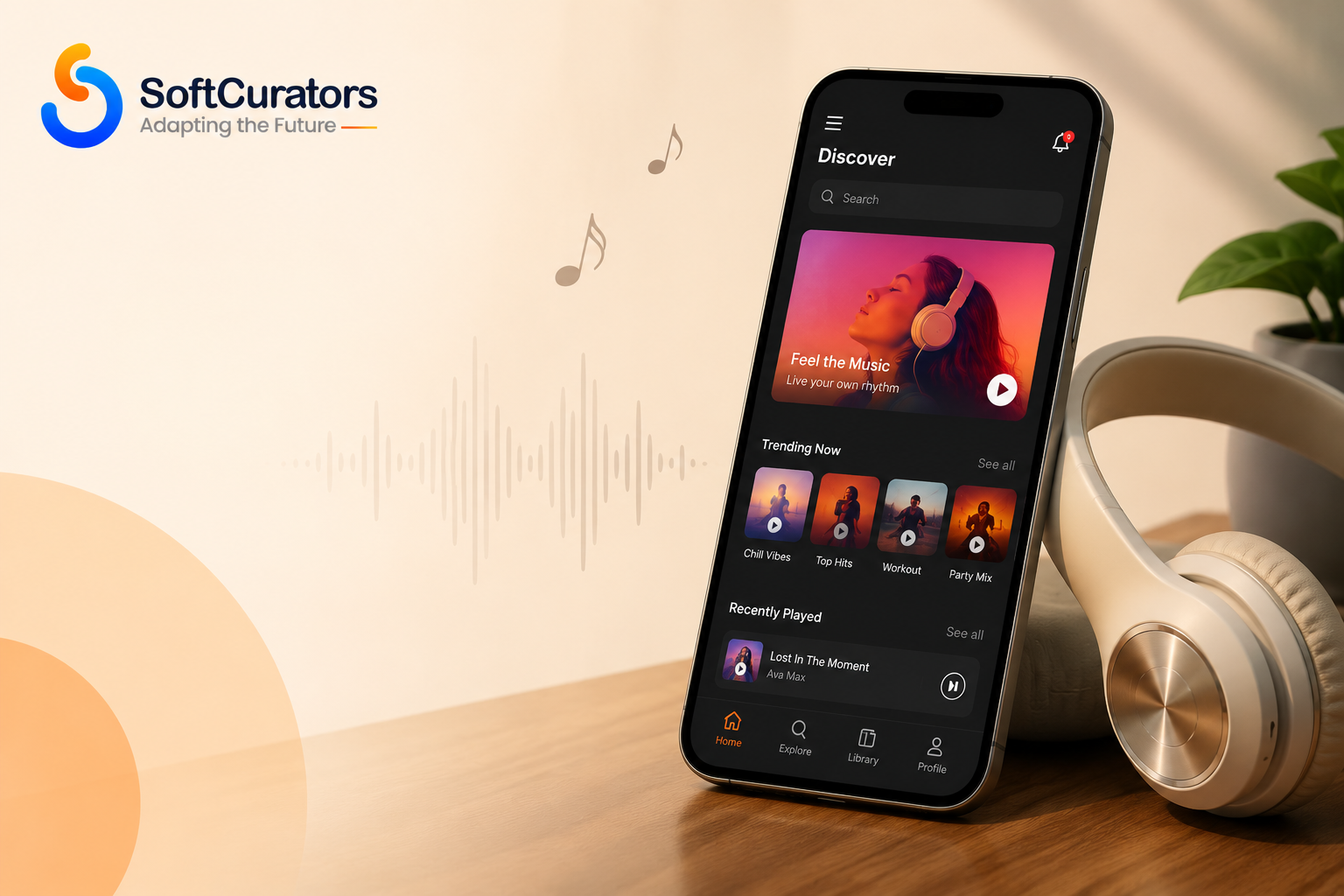
The global music streaming market is booming. According to Grand View Research, the market was valued at USD 26.80 billion in 2023 and is projected to grow at a CAGR of 14.7% through 2030. People are ditching CDs, pirated files, and even radio. Instead, they stream. This shift has created a massive opportunity for entrepreneurs, startups, and enterprises to build the next great music platform and if you are planning to enter this space, knowing the essential features of a music streaming app is your first and most important step.
But here is the challenge: not every music streaming app survives. Many launch with basic playback functionality and fade into obscurity because they lack depth, personalization, and the sticky features that keep users coming back every single day. The apps that win Spotify, Apple Music, YouTube Music all share one thing: a meticulously engineered feature set built to delight users at every touchpoint.
At Softcurators, we have built music streaming apps for clients across the world. We have seen what separates an app that people love from one they delete after three days. In this guide, we are going to walk you through every essential feature of a music streaming app from core must-haves to advanced differentiators so you can build a product that truly competes.
Whether you are a startup founder, a product manager, or a label executive looking to launch your own platform, this comprehensive breakdown will save you months of research. Let us dive straight in.
Why Getting the Feature Set Right Matters More Than Ever
Before we list the features, let us address the elephant in the room: why does your feature list matter so much? The answer is simple competition.
According to Statista, Spotify alone had over 602 million monthly active users as of early 2024. Apple Music, Amazon Music, YouTube Music, and Tidal are all aggressively competing for the same ears. Launching a me-too clone will not cut it.
The only way to win in this market is to build an app that either does everything the big players do just better or finds a focused niche and absolutely dominates it. Either way, you need to know the full landscape of features before you build even a single line of code.
At Softcurators, we have guided dozens of clients through the music streaming app development guide process. The insights in this article come directly from building real products for real markets.
The Business Case for Feature-Rich Music Apps
A feature-rich music streaming app is not just better for users. It is better for business. Here is why:
- Higher retention rates mean lower customer acquisition costs over time
- Advanced personalization drives longer listening sessions and more ad/subscription revenue
- Social features create organic word-of-mouth growth
- Offline listening and download features reduce churn among premium subscribers
- Artist tools and exclusive content create defensible moats competitors cannot easily copy
Now, let us get into the actual features.
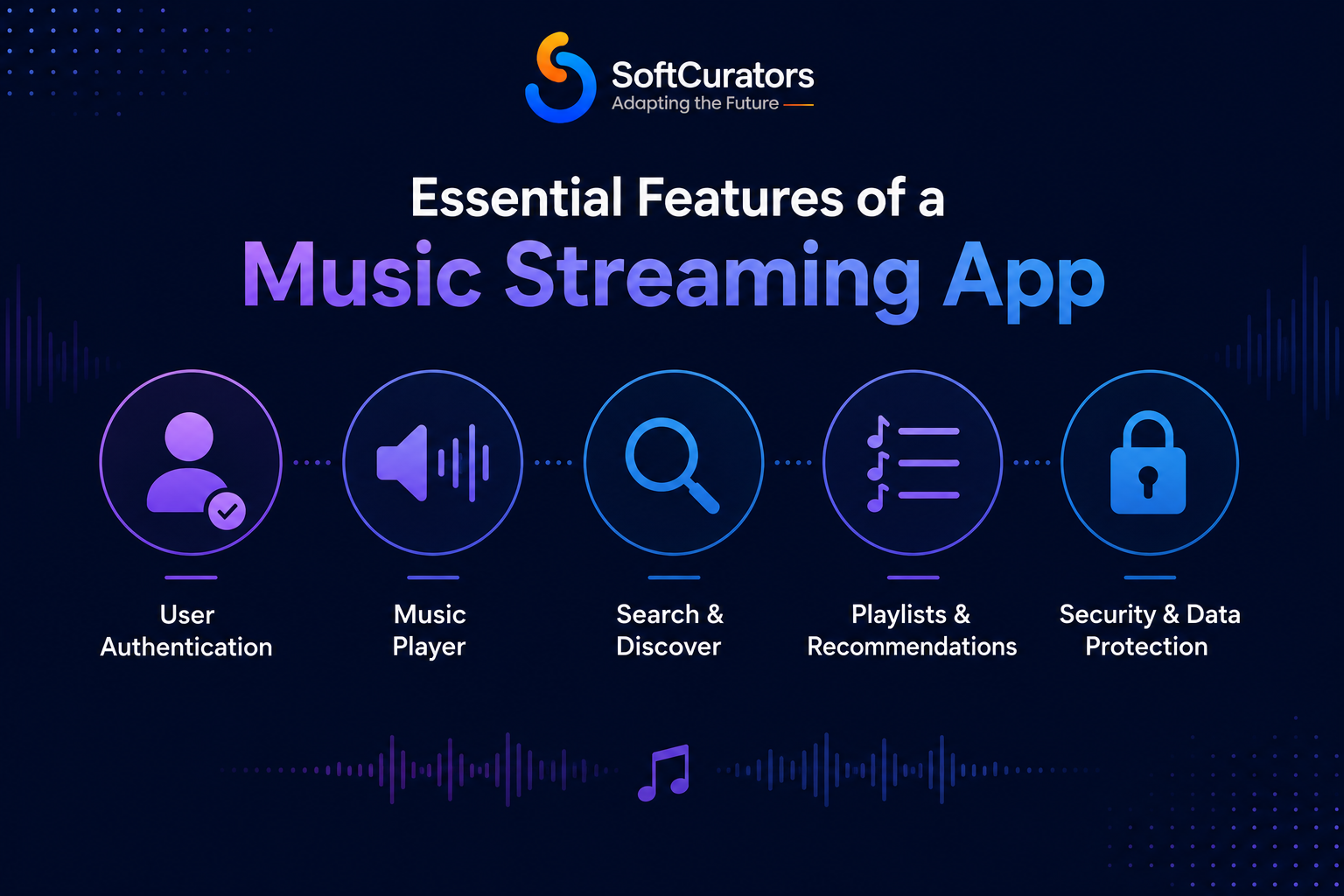
Core Essential Features of a Music Streaming App
These are the non-negotiables. If your app does not have every single one of these, users will delete it within minutes of installing.
1. User Registration and Profile Management
Every music streaming app needs a seamless onboarding experience. Users expect to sign up quickly ideally in under 30 seconds. This means offering:
- Email and password registration
- Social login via Google, Apple, and Facebook
- Phone number OTP-based sign-in for markets like India and Southeast Asia
- Guest mode for casual browsing before committing to an account
Profile management features must allow users to set a display name, profile picture, bio, and link their social accounts. Giving users a sense of identity within your platform is the foundation of long-term engagement. The profile is also where subscription management, listening history, and preferences live.
Softcurators always builds this component with scalability in mind. Our mobile app development team uses JWT-based authentication paired with OAuth 2.0 to ensure security from day one.
2. Music Discovery and Search
Search is arguably the most-used feature in any music streaming app. Users come to find something specific an artist, a song title, an album, or a mood playlist. Your search must be:
- Instant results appearing as the user types
- Forgiving handling misspellings and typos gracefully
- Broad covering songs, artists, albums, playlists, podcasts, and even lyrics
- Contextual surfacing trending content based on the user’s location and listening history
Beyond simple search, music discovery features like Explore pages, genre-based browsing, mood categories, and new release sections dramatically increase session depth. Users who discover new music they love through your platform become your most loyal subscribers.
3. Music Player The Heart of Every Streaming App
The music player is where your app lives or dies. A laggy, feature-sparse, or visually uninspiring player will destroy your app’s reputation overnight. The essential player features include:
- Play, pause, skip forward, skip backward controls
- Shuffle and repeat modes (repeat all, repeat one, no repeat)
- Progress bar with scrubbing (tap/drag to jump to any point in a track)
- Volume control and system audio integration
- Song information display artist name, album art, track title
- Queue management see what is coming next, reorder tracks
- Crossfade between tracks for a seamless DJ-like experience
- Gapless playback for albums that are meant to flow continuously
The audio quality of your player is equally critical. Support for multiple audio quality tiers standard (128 kbps), high (320 kbps), and lossless (FLAC/ALAC) allows you to serve both casual listeners and audiophiles. For a deep dive into the technology stack behind this, check our article on music streaming app development guide.
4. Playlist Creation and Management
Playlists are one of the most powerful engagement tools in music streaming. They represent personal curation users pour their personality into their playlists. Your app must support:
- Creating unlimited playlists with custom names and cover art
- Adding, removing, and reordering songs within playlists
- Collaborative playlists letting friends add songs together
- Smart playlists that auto-update based on rules like ‘most played this month’
- Public and private playlist settings
- Playlist sharing via link, social media, or direct to a contact
The most successful apps also offer curated editorial playlists handpicked collections built by in-house music editors or algorithm-generated blends. This gives users who do not want to curate their own music a ready-made listening experience.
5. Offline Listening and Downloads
Offline mode is a premium feature that converts free users into paying subscribers faster than almost anything else. Users in areas with unreliable connectivity or frequent travelers absolutely depend on it. To build this correctly, you need:
- The ability to download individual tracks, albums, or entire playlists
- A clear visual indicator showing what is available offline
- Automatic sync when connectivity is restored for example, newly added songs to a downloaded playlist
- Storage management tools to help users see and control what is saved
- DRM (Digital Rights Management) implementation to protect licensed content
Building offline functionality requires careful backend architecture. Our mobile app development team uses encrypted local storage with streaming license key management to ensure compliance with music licensing agreements.
6. Personalized Recommendations and AI-Driven Discovery
This is where modern music streaming apps separate themselves from outdated platforms. Personalization is not just a nice-to-have it is an expectation. Users now expect your app to know their taste as well as a trusted friend.
Personalization features must include:
- ‘Daily Mix’ style playlists generated fresh each day based on listening history
- ‘Discover Weekly’ or equivalent new-music suggestion playlists
- Related artists and ‘If you like X, you’ll love Y’ recommendations
- Mood-based suggestions work, focus, sleep, workout, party, commute
- Time-of-day recommendations calming morning music, energetic evening playlists
- Listening history analysis showing patterns and preferences
The engine behind all of this is collaborative filtering combined with content-based filtering the same principles that power Netflix and Amazon recommendations. At Softcurators, our AI development team integrates machine learning models directly into music streaming apps to deliver this kind of powerful personalization from launch day.
Advanced Features That Make a Music Streaming App Stand Out
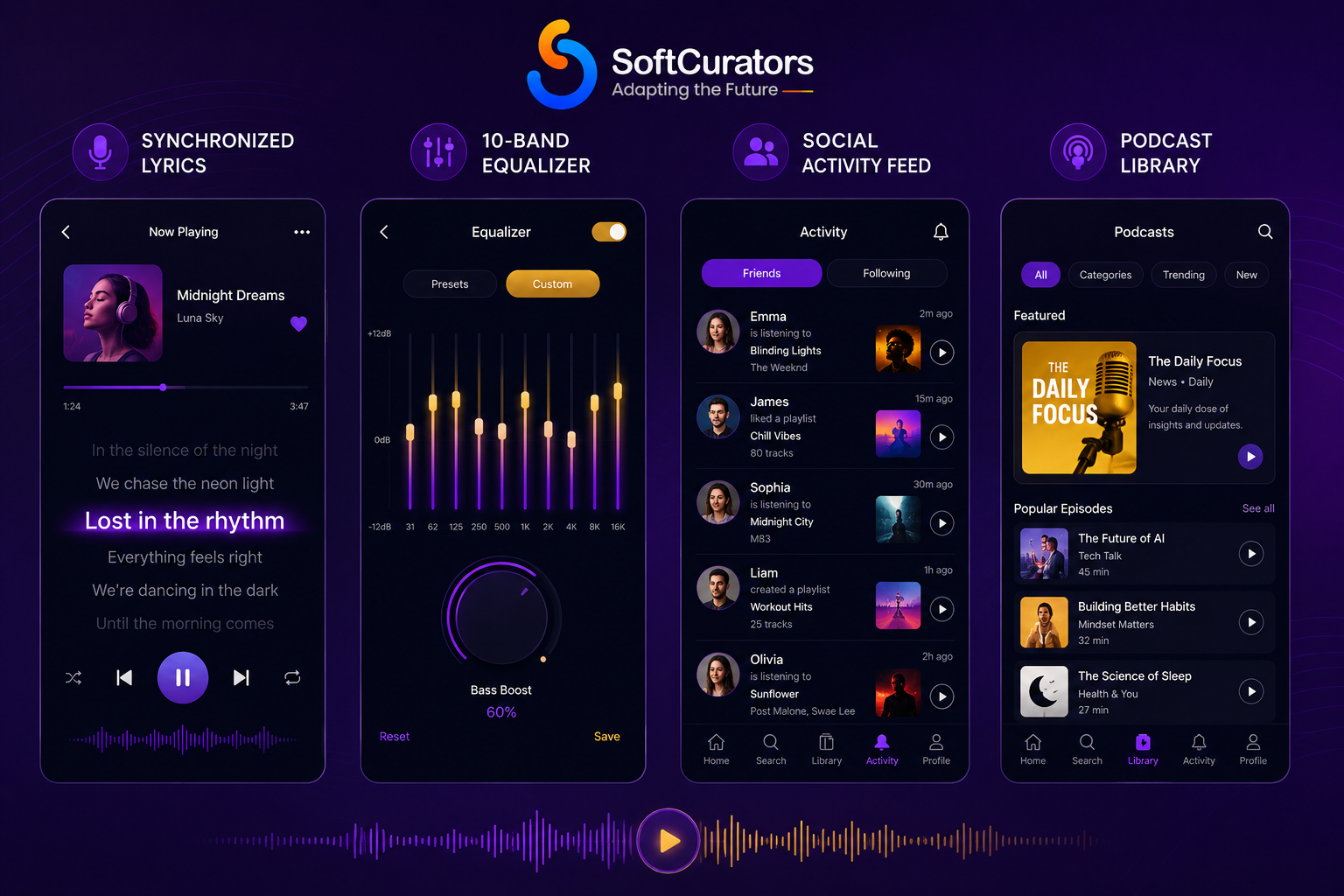
7. Synchronized Lyrics Display
Lyrics are a massive engagement driver. Spotify’s lyrics feature powered by Musixmatch significantly increased session duration after its introduction. Users who follow along with lyrics listen longer and return more frequently. Your app should offer:
- Real-time synchronized lyrics that highlight word-by-word as the song plays
- Static lyrics view for when users want to read ahead
- Translation support for non-native language songs
- Lyrics search finding a song by typing a lyric fragment
Lyrics licensing is a separate legal consideration. Softcurators can guide you through partnerships with providers like Musixmatch or LyricFind to integrate this feature legally and at scale.
8. Social and Community Features
Music is inherently social. The apps that build community around music listening create a category of retention that no algorithm can fully replicate. Essential social features include:
- Activity feeds showing what friends are currently listening to
- Follow system follow artists and friends to see their public activity
- Collaborative playlists that multiple users can edit simultaneously
- Song sharing to Instagram Stories, WhatsApp, and other platforms with album art preview
- In-app messaging or comments on playlists
- Public profiles showing listening stats and favorite tracks
The social layer also powers virality. When a user shares a song to Instagram with your app’s branded card, you get free advertising. This is one reason Spotify’s share feature has been such a powerful growth tool. If you are curious about how social features influence app growth, our blog on mobile app development trends covers this in detail.
9. Equalizer and Audio Settings
Power users and audiophiles want control over their listening experience. An in-app equalizer especially on mobile is a differentiating feature that competitors often overlook. You should build:
- A 5-band or 10-band graphical equalizer with preset modes (bass boost, classical, pop, rock, acoustic)
- Custom EQ settings that users can save and name
- Stereo widening or normalization options
- Volume normalization to prevent jarring jumps between loud and quiet tracks
- Support for spatial audio and Dolby Atmos where device hardware allows
This feature may seem niche, but it is disproportionately valued by your most loyal, high-LTV users the audiophiles who will subscribe for years and tell everyone they know about your app.
10. Artist Profiles and Fan Engagement Tools
If your platform wants to attract independent artists or partnered labels, you need to give artists their own powerful presence on your platform. This means:
- Verified artist profiles with biography, photos, discography, and tour dates
- Artist radio an auto-generated station built around that artist’s sound
- Fan insights for artists aggregate data on who is listening and from where
- Artist merchandise integration linking to an artist’s merch store within their profile
- Exclusive content drops early releases, behind-the-scenes audio, and demos available only to followers
Artist tools transform your platform from a passive listening experience into a live, breathing ecosystem. They also create a reason for artists to actively promote your platform to their fan base an incredibly powerful acquisition channel.
11. Podcast and Audio Content Integration
The most successful music streaming platforms have expanded beyond music into spoken word content. Spotify’s acquisition of podcast networks was not accidental podcasts dramatically increase daily active usage by giving users a reason to open the app outside of traditional music-listening contexts. Your app should support:
- Podcast discovery with category browsing and top charts
- Episode download for offline listening
- Playback speed control (0.5x to 3x)
- Sleep timer automatically stop playback after a set duration
- Progress sync across devices resume a podcast episode on any device
- Audiobook integration as an additional revenue stream
12. Smart Queue and Session Intelligence
The queue is a feature that users interact with constantly during active listening sessions. A poorly designed queue is a major source of frustration. The ideal queue experience includes:
- Auto-populating queue based on current song and listening context
- The ability to drag and drop tracks to reorder
- ‘Add to next’ vs ‘Add to end of queue’ options
- Queue history scroll back to see what you have already heard in a session
- Session handoff take a queue from your phone and resume on a smart TV or speaker
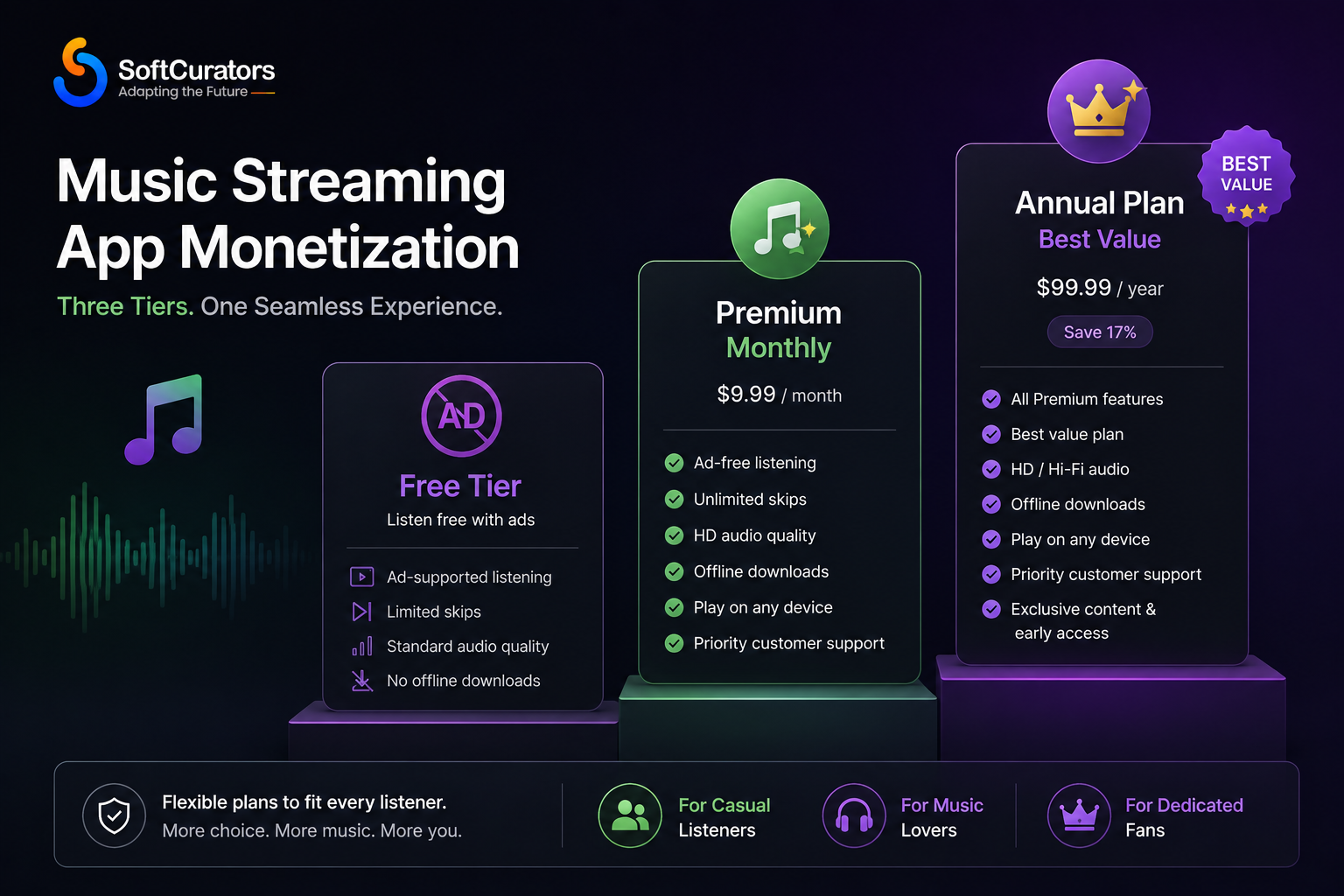
Monetization Features: How Your Music App Will Generate Revenue
Features are not just about user experience they are also about business model. How you monetize determines everything from your tech architecture to your content licensing strategy.
13. Freemium Model Implementation
The freemium model free tier supported by ads, paid tier with full features is the dominant business model in music streaming. Building it correctly requires:
- Ad insertion at regular intervals in the free tier (typically after every 2-3 songs)
- Feature gating limiting offline mode, skips, and high-quality audio to premium users
- Frictionless upgrade prompts placed at moments of natural frustration (like being unable to skip an unwanted song)
- Free trial mechanisms 30-day or 3-month free premium trials for new users
The free-to-premium conversion funnel is a science. At Softcurators, we A/B test upgrade prompt placements and messaging as part of our post-launch maintenance and support services, typically improving conversion rates by 15-30% in the first six months.
14. Subscription Tier Management
Most successful streaming platforms offer multiple subscription tiers. Consider building:
- Individual plan standard single-user premium
- Student plan discounted tier with student email verification
- Family plan up to 6 accounts under one subscription with parental controls
- Duo plan for couples or roommates sharing an address
- Annual plan discounted yearly subscription for committed users
Each tier needs its own feature set, pricing logic, and payment flow. Subscription management also requires a robust cancellation and pause flow making it easy to cancel reduces the anxiety around subscribing in the first place, which paradoxically increases sign-ups.
15. In-App Advertising System
For free-tier users, advertising is your primary revenue driver. Your ad system should support:
- Audio ads 15 to 30 second audio spots played between songs
- Banner ads displayed on the now-playing screen or home screen
- Video ads that play in exchange for a 30-minute ad-free listening session
- Branded playlists and sponsored content from labels and brands
- Programmatic ad integration with platforms like Google Ad Manager or direct brand deals
Ad targeting should use age, location, listening habits, and time of day to maximize CPMs and deliver relevant ads which are less annoying to users and more valuable to advertisers.
Technical Features That Power a Great Music Streaming App
16. Multi-Device Sync and Cross-Platform Streaming
Users do not live on one device. They start a playlist on their phone during their commute, switch to a desktop at work, and continue on a smart TV in the evening. Your app must:
- Sync playback state in real-time across all logged-in devices
- Allow remote control use a phone as a remote for a desktop or smart speaker
- Support web, iOS, Android, macOS, Windows, smart TVs, and game consoles over time
- Handle handoff gracefully no jarring restarts when switching devices
Building cross-platform experiences requires thoughtful architecture decisions from the start. Our team specializes in cross-platform app development and React Native app development, both of which are excellent approaches for music streaming apps targeting multiple platforms simultaneously.
17. Adaptive Streaming and Bandwidth Management
Not all users have fast internet connections all the time. Your app must intelligently adapt to available bandwidth:
- Automatic quality adjustment based on connection speed (similar to adaptive bitrate in video streaming)
- Manual quality setting override for users on unlimited data plans who want maximum quality
- Pre-buffering the next track while the current one plays
- Graceful degradation continuing to play at reduced quality rather than buffering indefinitely
Adaptive streaming is particularly critical for emerging markets where your largest growth opportunities lie but where connectivity is most inconsistent.
18. Push Notifications and Smart Alerts
Push notifications, when done right, bring users back to your app repeatedly without feeling intrusive:
- New release notifications from followed artists
- ‘Your weekly playlist is ready’ reminders
- Streak reminders ‘You’ve listened 6 days in a row, keep your streak going’
- Personalized event alerts concerts by artists in your library happening near you
- Promotional alerts for limited-time free trials or discounts
The key is personalization and frequency capping. Bombarding users with irrelevant notifications is one of the top reasons people disable notifications or uninstall apps entirely.
19. Sleep Timer and Car Mode
These quality-of-life features have outsize impact on retention:
- Sleep timer automatically fades out and stops playback after 15, 30, 45, or 60 minutes, or at the end of the current track
- Car mode a simplified large-button interface designed for safe interaction while driving
- Voice control integration with Siri, Google Assistant, and Alexa
- Android Auto and Apple CarPlay compatibility
20. Music Streaming App Security and Compliance
Security is not glamorous but it is absolutely non-negotiable especially with music licensing, payment processing, and user data all running through your platform.
- End-to-end encryption for all API communications
- DRM implementation for all licensed music content
- GDPR and CCPA compliance for user data handling
- PCI DSS compliance for payment processing
- Two-factor authentication option for user accounts
- Regular security audits and penetration testing
Our comprehensive guide on mobile app security and compliance covers everything you need to know about keeping your streaming platform secure and legally compliant.
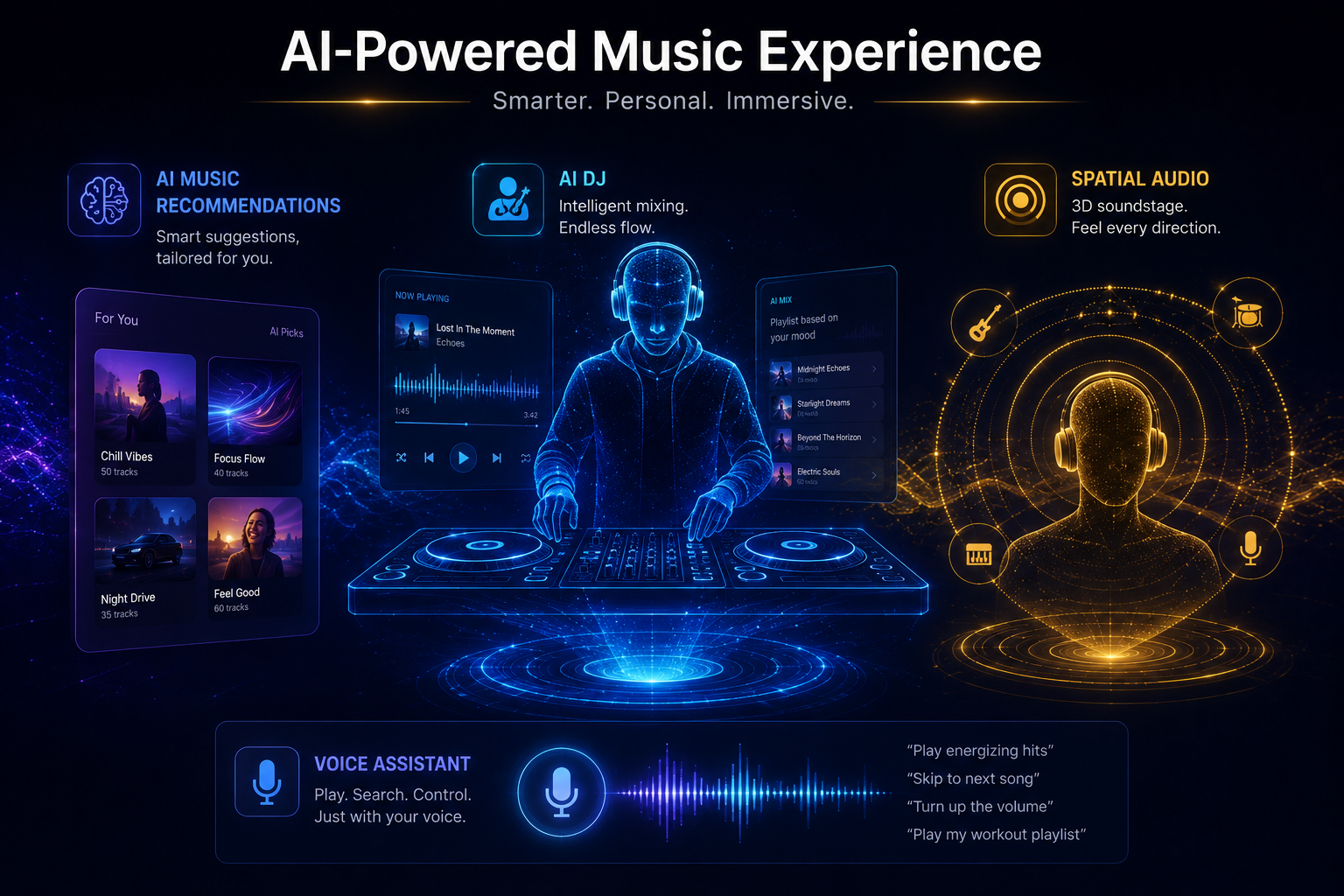
Next-Generation Features: The Future of Music Streaming Apps
The features above are table stakes for any competitive music streaming app today. But if you want to build something that leads the market rather than following it, these next-generation features are where you should invest.
21. AI DJ and Automated Mix Generation
Spotify’s AI DJ feature which generates a personalized radio experience with voice commentary between tracks was one of the most talked-about product launches of 2023. It represents a new category of AI-powered experience in music streaming. Building your own version means:
- Training models on user listening history to generate contextually appropriate track sequences
- Generating real-time voice commentary using text-to-speech AI that bridges between tracks
- Adaptive mood detection that shifts the vibe of the mix as the session progresses
- User feedback loops thumbs up/down to immediately train the model
This type of feature requires deep AI expertise. At Softcurators, our AI app development team builds custom ML pipelines that can power exactly this kind of intelligent, generative music experience.
22. AI-Generated Music and Generative Audio
The rise of AI music generation tools like the ones profiled in our article on how to develop an AI music generation app like Suno AI represents a genuine paradigm shift. Forward-thinking streaming apps are beginning to integrate AI-generated music as:
- Background music for user-created video content within the app
- Personalized jingles and sound identities for user profiles
- Stem separation tools letting users listen to just the vocals or just the instruments of a track
- AI remixes that reimagine existing songs in different genres
23. Spatial Audio and 3D Sound
Spatial audio the technology that makes it feel like sound is coming from all around you is rapidly becoming a standard expectation among premium audio listeners. Apple Music’s Dolby Atmos integration demonstrated clear demand. To build this:
- Support for Dolby Atmos and Sony 360 Reality Audio formats
- Binaural audio rendering for headphone listeners
- Head-tracking support for compatible devices (Apple AirPods Pro and others)
- Spatial audio toggle so users who prefer traditional stereo can easily switch
24. Real-Time Collaborative Listening
Co-listening two or more people listening to the same song simultaneously in sync, even from different locations is a powerful social feature that deepened in relevance during the pandemic and has never lost its appeal:
- ‘Listen party’ rooms where up to X number of friends join a synced playback session
- Host controls only the host can skip, pause, or change tracks
- In-room chat alongside the music
- Reaction emojis that animate on screen in real-time as friends react to music
25. Concert and Event Integration
Connecting the digital listening experience to live music events creates a bridge between your platform and real-world moments one of the most powerful retention tools available:
- Concert listings for artists in a user’s library, filtered by city
- In-app ticket purchasing via a partner like Ticketmaster or Dice
- Post-concert playlists auto-generated after a user attends a show
- Live session recordings and exclusive concert streams for subscribers
UI/UX Design Features That Make Music Apps Addictive
The best features in the world mean nothing if the interface is clunky. Great mobile app UI/UX design is itself a feature one that users feel on every single interaction.
26. Onboarding and Taste Calibration
The first five minutes in your app determine long-term retention. Your onboarding must:
- Ask genre and artist preferences immediately to seed the recommendation engine
- Visually impress use album art, animations, and bold typography from the first screen
- Deliver the first great discovery experience within the first session
- Not overwhelm with too many choices guide users toward a great experience
27. Home Screen and Widget Personalization
The home screen of your music app should feel like it was designed personally for each user:
- Dynamic modules that change based on time of day, day of week, and listening context
- ‘Jump back in’ carousels showing recently played content
- ‘Made for you’ section prominently featuring personalized playlists
- iOS and Android home screen widgets for quick playback control
- Dark mode and theme customization options
28. Gesture Controls and Accessibility
Power users and accessibility-focused users both benefit from thoughtful gesture and accessibility design:
- Swipe up to see the full player, swipe down to minimize
- Double-tap album art to like a song
- Long-press for quick actions add to playlist, go to artist, share
- Full VoiceOver and TalkBack compatibility for visually impaired users
- Haptic feedback on key interactions for a premium tactile feel
Analytics and Admin Features for Music Streaming Platform Owners
A great product is only great if you can measure and improve it. Your admin dashboard and analytics tools are as important as your user-facing features.
29. User Analytics Dashboard
- Daily, weekly, and monthly active user counts with trend graphs
- Listening time per user, per genre, per time of day
- Top tracks, albums, and artists by plays, saves, and shares
- Subscription conversion funnels with drop-off analysis
- Cohort retention charts showing how different acquisition channels retain over time
30. Content Management System
- Upload and manage the music catalog with metadata editing
- Curated playlist creation and scheduling tools for editors
- Content scheduling schedule new releases to go live at midnight
- Licensing rights management by territory
- DMCA and takedown request management tools
At Softcurators, our software development team builds custom admin panels alongside every music streaming app we develop, ensuring platform owners have full visibility and control from day one.
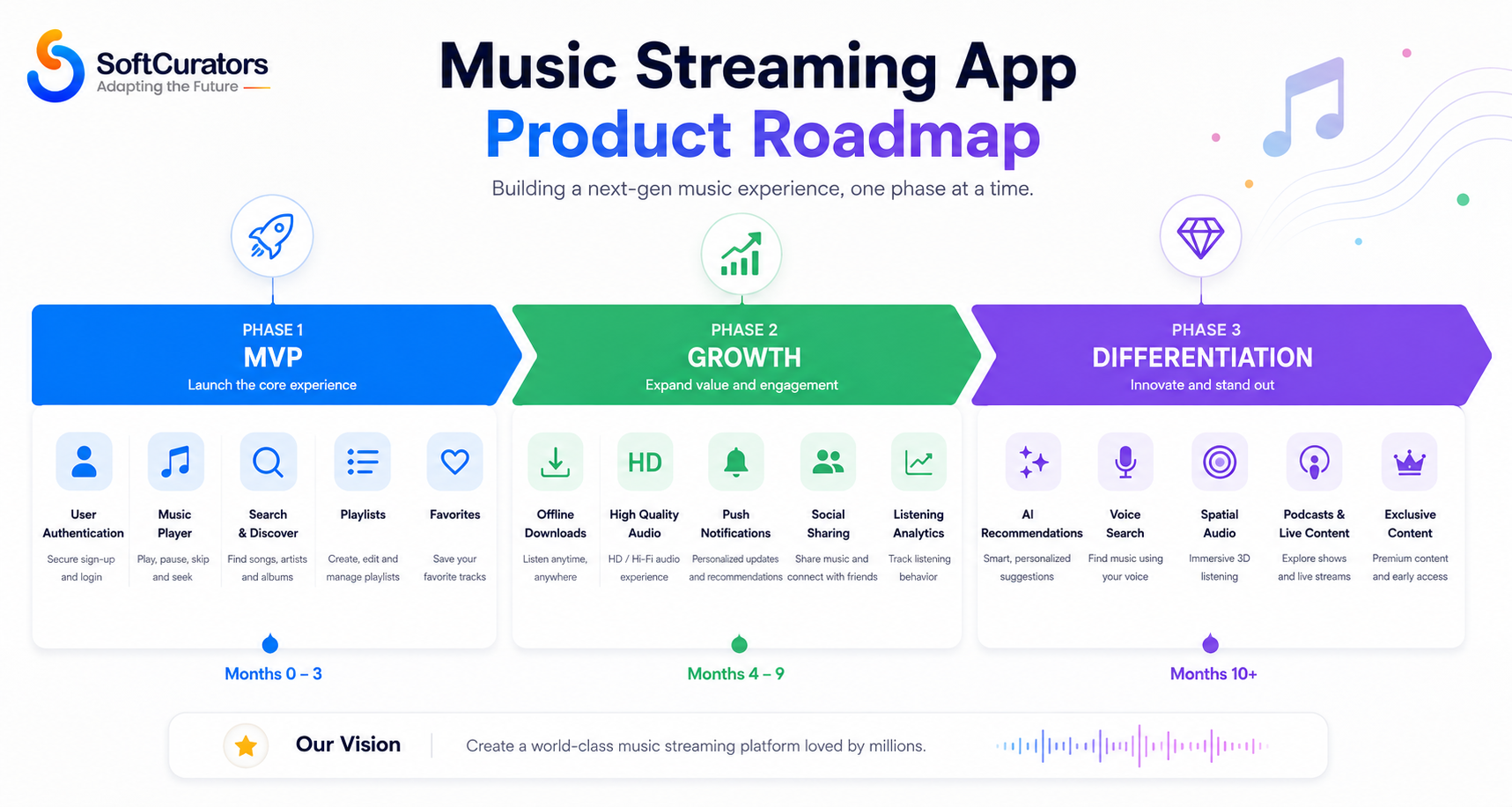
How to Decide Which Features to Build First
With this many features on the table, the question becomes: where do you start? Building everything at once is financially impossible for most early-stage teams, and it dilutes focus. At Softcurators, we recommend a phased approach:
1st Phase : MVP (Months 1-2)
- User registration and social login
- Core music player with full controls
- Search and browse functionality
- Playlist creation and management
- Curated editorial playlists
- Basic personalization based on genre preferences
- Freemium model with ad insertion
- Basic subscription payment flow
- Push notifications
2nd Phase : Growth Features (Months 2-3)
- Offline downloads
- Advanced AI recommendations (Daily Mix, Discover Weekly equivalent)
- Synchronized lyrics
- Social features activity feed, following, sharing
- Podcast integration
- Equalizer and audio quality settings
- Multi-device sync
3rd Phase : Differentiation (Months 3-5+)
- AI DJ and automated mixing
- Spatial audio support
- Collaborative listening rooms
- Artist tools and verified profiles
- Concert and event integration
- Advanced analytics dashboard
- Home screen widgets
For a detailed breakdown of what each phase costs, see our in-depth article on cost to build a music streaming app like Spotify. We cover development costs by feature set, team size, and technology stack.
Why Choose Softcurators to Build Your Music Streaming App?
At Softcurators, music streaming app development is not a side service it is a deep speciality. Our team has built multiple streaming platforms from scratch, navigated the complexities of music licensing, and engineered both the user-facing product and the backend infrastructure that powers it.
Here is what makes us different from generic app development agencies:
Deep Domain Expertise
We have written extensively on topics like music streaming app trends, best music streaming apps, and the Spotify vs Apple Music app features comparison. We know this space inside and out.
End-to-End Development
From UI/UX design through iOS app development, Android app development, and web development, we handle the entire product lifecycle under one roof.
AI Integration Capability
Our dedicated AI development and AI consulting services teams mean your music app can have best-in-class machine learning features from day one, not as an afterthought.
Transparent Process and Proven Portfolio
We believe in radical transparency. Explore our portfolio and read about why clients choose Softcurators to understand how we work and what outcomes we deliver.
Startup-Friendly MVP Development
If you are early stage, our MVP development service and startup app and web development packages get you to market fast and cost-efficiently without sacrificing the essential features that make music apps great.
Essential vs Advanced Features: Quick Reference Table
Use this table as a checklist when planning your music streaming app development:
| Feature | MVP Phase | Priority Level |
| User Registration & Profiles | Yes | Critical |
| Music Player (Full Controls) | Yes | Critical |
| Search & Browse | Yes | Critical |
| Playlist Creation | Yes | Critical |
| Freemium / Subscription Model | Yes | Critical |
| AI Personalization (Basic) | Yes | High |
| Push Notifications | Yes | High |
| Offline Downloads | Phase 2 | High |
| Synchronized Lyrics | Phase 2 | High |
| Social Features | Phase 2 | Medium |
| Podcast Integration | Phase 2 | Medium |
| Equalizer / Audio Settings | Phase 2 | Medium |
| Multi-Device Sync | Phase 2 | High |
| AI DJ Feature | Phase 3 | Differentiator |
| Spatial Audio | Phase 3 | Differentiator |
| Collaborative Listening | Phase 3 | Differentiator |
| Concert Integration | Phase 3 | Differentiator |
| Artist Tools | Phase 3 | Differentiator |
Conclusion: Build a Music Streaming App That Users Cannot Stop Listening To
The essential features of a music streaming app are not just a checklist they are the blueprint for a product people fall in love with. From the foundational music player and search capabilities to next-generation AI DJs and spatial audio, every feature you build should serve one ultimate goal: keeping users inside your app, discovering new music they love, and coming back every single day.
The music streaming market is massive, growing, and still has room for well-built competitors. But only for apps that get the fundamentals right and then relentlessly innovate on top of them.
At Softcurators, we bring the technical depth, product experience, and music industry knowledge needed to build a platform that can genuinely compete. Whether you are launching an MVP to test a concept or building a full-scale platform to take on the market leaders, we are the team that can make it happen.
FAQs
How much does it cost to build a music streaming app with all these features?
The cost varies widely based on feature scope, team size, and technology choices. A basic MVP typically ranges from $10,000 to $20,000, while a feature-rich platform can exceed $50,000+. For a detailed breakdown, read our article on cost to develop a music streaming app.
Which platform should I build my music streaming app for first iOS or Android?
This depends on your target audience. For global audiences with purchasing power, iOS often delivers better early revenue. For markets like India, Brazil, and Southeast Asia, Android's larger install base makes it the priority. Most Softcurators clients choose cross-platform development with React Native or Flutter to launch on both simultaneously at a lower cost.
Do I need to handle music licensing to build a streaming app?
Yes, absolutely. Music licensing is one of the most legally complex aspects of building a streaming app. You need mechanical licenses, synchronization rights, and performance rights depending on your use case. Platforms typically work with licensing bodies like ASCAP, BMI, SESAC, and Soundexchange in the US. Softcurators can connect you with music licensing experts as part of our development process.
What technology stack does Softcurators recommend for a music streaming app?
For mobile, we recommend React Native or Flutter for cross-platform development, or Swift/Kotlin for native iOS/Android apps. For the backend, Node.js with microservices architecture works well for scalability. For audio streaming, we use HLS (HTTP Live Streaming) or MPEG-DASH protocols. For AI features, Python-based ML models integrate seamlessly with our backend infrastructure.
How does AI personalization work in music streaming apps?
AI personalization in music streaming uses collaborative filtering (analyzing what similar users listen to) combined with content-based filtering (analyzing the musical characteristics of tracks you already like). These models are trained on your platform's listening data and improve continuously over time. Spotify's Discover Weekly, for example, uses this approach to generate new playlists every Monday.
What is the difference between a music streaming app MVP and a full product?
An MVP (Minimum Viable Product) includes the core features needed to deliver value and test market fit typically user accounts, a music player, search, basic playlists, and a payment flow. A full product adds advanced features like AI recommendations, offline mode, social features, lyrics, equalizer, multi-device sync, and podcast integration. The MVP lets you validate demand before investing in the full build.
Can Softcurators help with both the music app and the backend infrastructure?
Yes. Softcurators delivers end-to-end development including mobile apps, web platforms, backend APIs, admin dashboards, and AI integrations. We are a full-stack development partner, not just a frontend studio. Learn more at softcurators.com/services.
How long does it take to build a music streaming app?
An MVP typically takes 1 to 2 months with a focused team. A full-featured product including AI, social features, and offline mode usually takes 3 to 5+ months depending on complexity and team size. Softcurators runs agile sprints with two-week delivery cycles, keeping you informed and in control throughout the entire process.
How much data do I need before AI recommendations work well?
Collaborative filtering requires approximately 10,000 monthly active users with meaningful listening histories before recommendation quality becomes noticeably better than manual curation. Content-based filtering works from day one because it uses audio features rather than user behaviour. Softcurators designs V1 platforms to use content-based filtering immediately and layer collaborative filtering in V2 once the user base reaches sufficient scale.
What makes Spotify's recommendation algorithm so powerful?
Spotify uses a combination of collaborative filtering, natural language processing (analyzing music publications and blog posts about artists), and audio feature analysis (tempo, key, energy level, danceability) to build its taste graph. The result is a system that understands both what music objectively sounds like and how it fits into cultural contexts making recommendations uncannily accurate.
Is offline listening legally allowed in music streaming apps?
Yes, offline listening is legally permissible when properly licensed and implemented with DRM (Digital Rights Management). The music files downloaded offline must be encrypted and tied to an active subscription they cannot be played as raw audio files outside the app. Most major licensing agreements explicitly allow offline functionality for premium subscribers.
What audio formats should a music streaming app support?
At minimum, support AAC or MP3 at 128 kbps (standard) and 320 kbps (high). For a premium product, add FLAC or ALAC for lossless audio and Dolby Atmos for spatial audio. The format choice affects streaming bandwidth, storage requirements, and licensing negotiations, so it should be a deliberate architectural decision from the start.
How do I monetize a music streaming app beyond subscriptions?
Beyond subscriptions, music apps monetize through audio and video advertising, brand-sponsored playlists, live event ticketing commissions, merchandise sales (through artist store integration), B2B licensing of the platform to gyms and restaurants, and data insights sold (anonymously and in aggregate) to labels and brands. A diversified monetization model reduces dependence on subscriber growth alone.
What is the best approach for building a music streaming app for a specific genre niche?
Niche music streaming apps can compete successfully against giants by offering deeper curation, more relevant social features, and closer artist relationships within the niche. For example, a jazz streaming app could offer liner notes, musician bios, recording session details, and connections to jazz clubs none of which Spotify prioritizes. The key is going deeper in your niche than any generalist platform can afford to go.
Does a music streaming app need its own music catalog or can it use existing catalogs?
Most streaming apps license music from major label distributors (Universal, Sony, Warner) and independent aggregators (DistroKid, CD Baby, TuneCore). You do not need to own the music you license the right to stream it. However, exclusive content deals with certain artists or labels can become a meaningful competitive differentiator over time.
What is the role of UI/UX design in a music streaming app's success?
UI/UX design is central to music app success. Users interact with music apps during emotionally loaded moments relaxation, commuting, workouts, parties and the design must match the energy of those moments while remaining effortlessly intuitive. Poor navigation, slow load times, or a cluttered interface are among the top reasons users uninstall apps. Read our mobile app UI/UX design best practices guide for detailed guidance.
Can a music streaming app also include video content?
Yes, and this is an increasingly common strategy. Platforms like YouTube Music already lead with video. Adding music video playback, artist live stream recordings, and music documentary content significantly increases session duration and differentiates your product from audio-only competitors. Video content does require higher bandwidth and more complex content licensing agreements.
How do I handle content moderation in a music streaming app?
Content moderation covers explicit content filtering with parental controls, DMCA compliance with takedown processes, AI-based detection of unauthorized content uploads, user-reported content workflows, and territory-based content availability controls. A robust CMS (Content Management System) with moderation tools is essential for any platform that allows third-party content uploads.
What analytics tools should be integrated into a music streaming app?
For product analytics, integrate Mixpanel, Amplitude, or Firebase Analytics. For performance monitoring, use tools like New Relic or Datadog. For A/B testing, Firebase Remote Config or LaunchDarkly work well. Artist-facing analytics are typically built custom and display streaming counts, listener demographics, and playlist placements. Admin dashboards should be built bespoke to your specific business needs.
How important is app store optimization (ASO) for a music streaming app?
ASO is critically important most apps are discovered through App Store and Google Play searches. Key ASO elements include the app name (include keywords like 'music' and 'streaming'), a compelling description with feature highlights, high-quality screenshots showing key features, a preview video of the player in action, and consistent positive reviews. Combined with a strong content marketing and SEO strategy, ASO is one of your most cost-effective user acquisition channels.
Should I build a web app version of my music streaming app?
Yes. A web version dramatically expands your addressable audience, makes sign-ups easier from desktop traffic, and is critical for the share/discovery funnel (when someone clicks a shared song link, a web player lets them preview it without installing the app). Softcurators can build your progressive web app or full web development solution alongside the mobile apps.
What server infrastructure do I need for a music streaming app?
Music streaming requires CDN (Content Delivery Network) infrastructure to deliver audio globally with low latency AWS CloudFront, Cloudflare, or Akamai are standard choices. You need origin servers storing the actual audio files, API servers handling user requests, ML servers running recommendation models, and real-time infrastructure (like WebSockets) for features like collaborative listening. The infrastructure should be auto-scalable to handle traffic spikes.
How do I approach the recommendation engine if I have limited listening data at launch?
This is a classic cold-start problem. Solutions include asking new users to select favorite genres and artists during onboarding (providing initial seed data), using global popularity signals as defaults for new users (recommend what everyone loves before you know individual preferences), and leveraging public signals like social media listening history with user permission. As your user base grows, these bootstrapped recommendations give way to increasingly personalized ones.
Can Softcurators integrate third-party music APIs?
Yes. We have experience integrating the Spotify Web API (for import of listening history and playlists), Apple MusicKit, Last.fm Scrobbling, Musixmatch for lyrics, SeatGeek and Ticketmaster for concert data, and Gracenote and MusicBrainz for music metadata. Third-party API integration significantly accelerates development timelines and enriches your data.
What features are most important for retaining premium subscribers?
Premium subscriber retention hinges on offline mode (the #1 cited reason for paying), exclusive content and early releases, superior audio quality, ad-free experience, higher skip limits, and exclusive social features. The more features that are meaningfully gated behind the premium tier without making the free experience feel punitive the higher your conversion and retention will be.
How does Softcurators handle music streaming app testing?
Our mobile app testing and deployment process includes automated unit and integration testing, manual UX testing across device sizes and OS versions, performance testing under simulated high traffic, audio streaming quality testing across network conditions (3G, 4G, WiFi, offline), and beta testing with real users before any production release.
What features should a music streaming app have for emerging markets?
Emerging markets have specific requirements: support for low-bandwidth streaming at 32kbps or 64kbps, aggressive data saver mode, SMS-based OTP login for users without email accounts, local payment methods (UPI in India, M-Pesa in Africa), local language and content support, local music genre focus, and lightweight app size under 30MB for devices with limited storage. Getting these right in a market like India or Nigeria can be worth more than the entire feature list above.
How do social sharing features in music apps drive organic growth?
Every time a user shares a song, album, or playlist with your app's branded preview card on Instagram, WhatsApp, or Twitter, your platform gets free advertising to that user's social network. If the recipients are not yet users, they see your brand, the album art, and a link. If the linked web player works well, some percentage will install your app. This is a compounding viral loop that costs you nothing per share and the more shareable your content format, the faster it compounds.
What are the differences between building a music streaming app and a podcast app?
Music streaming apps require music licensing, DRM, large-scale CDN infrastructure, and complex recommendation engines trained on musical features. Podcast apps deal primarily with public RSS feeds (no licensing needed for most content), simpler audio file delivery, playback speed control, and chapter markers. Many modern platforms combine both but the music licensing and DRM complexity is the critical differentiating factor in the build.
How can I make my music streaming app compliant with GDPR and CCPA?
GDPR and CCPA compliance requires a clear privacy policy, explicit consent for data collection, data minimization practices (only collecting what you need), the ability for users to request data export or deletion, cookie consent management on web versions, and DPO (Data Protection Officer) appointment in relevant jurisdictions. Our mobile app security and compliance guide covers this in detail.
What is the best way to get started with Softcurators on a music streaming app project?
The best starting point is a free discovery call with our team. We will review your concept, share relevant portfolio work, estimate the project scope, and outline a phased development roadmap. Visit softcurators.com/contact to schedule your call today. You can also explore our music streaming app development solution page to learn more about what we build.
