
Open any music app right now. A track starts in under two seconds. The algorithm already knows your mood. It surfaces an artist you have never heard and the song is perfect.
That experience did not happen by accident. It took deliberate engineering decisions, a well-designed data architecture, and a product team that understood exactly what listeners actually want.
The global music streaming market is on a trajectory that few industries can match. According to Statista, global streaming revenue is projected to surpass $46 billion by 2027. The IFPI Global Music Report confirms that streaming now accounts for 67% of all recorded music revenue worldwide. And the market is still far from saturated regional platforms, niche audio experiences, and creator-first models are all growing fast.
At Softcurators, we build music streaming applications, AI-powered audio platforms, and creator economy products for startups and growth companies. We track music streaming app trends closely because they directly shape what we build for clients. This guide covers every dimension of music streaming app development from features and tech stack to cost, timeline, and the mistakes that kill most audio platforms before they reach 10,000 active users.
Ready to build your audio platform from day one? Book a free strategy call with Softcurators. Our architects respond within 12 hours.
Why Music Streaming App Development Is Still a Growth Opportunity
The biggest platforms Spotify, Apple Music, Amazon Music dominate the mainstream. But they do not own every listener. And that gap is exactly where the opportunity lives for founders entering music streaming app development today.
Consider the niches that remain genuinely underserved: regional music platforms that understand local genres deeply, creator-first platforms that pay artists more than $3 per thousand streams, corporate audio platforms for workplace wellbeing, and educational audio apps for language learning and skill development. Each of these represents a real product opportunity. The best music streaming apps for these niches do not yet exist. They are being built right now by founders who chose the right development partner.
Three Market Forces Making this year the Right Time
First, AI has matured to the point where genuinely intelligent personalisation is no longer reserved for companies with Spotify’s data budget. Second, creator frustration with existing royalty models is driving both artists and audiences toward alternative platforms. Third, the convergence of music, podcasts, and audiobooks into unified audio experiences means that a new entrant can own a listener’s full audio attention not just their music time.
Together, these three forces create the exact brief that Softcurators sees from audio platform founders every week. The technology gap between what listeners want and what existing apps deliver is still wide. That gap is where your platform wins.
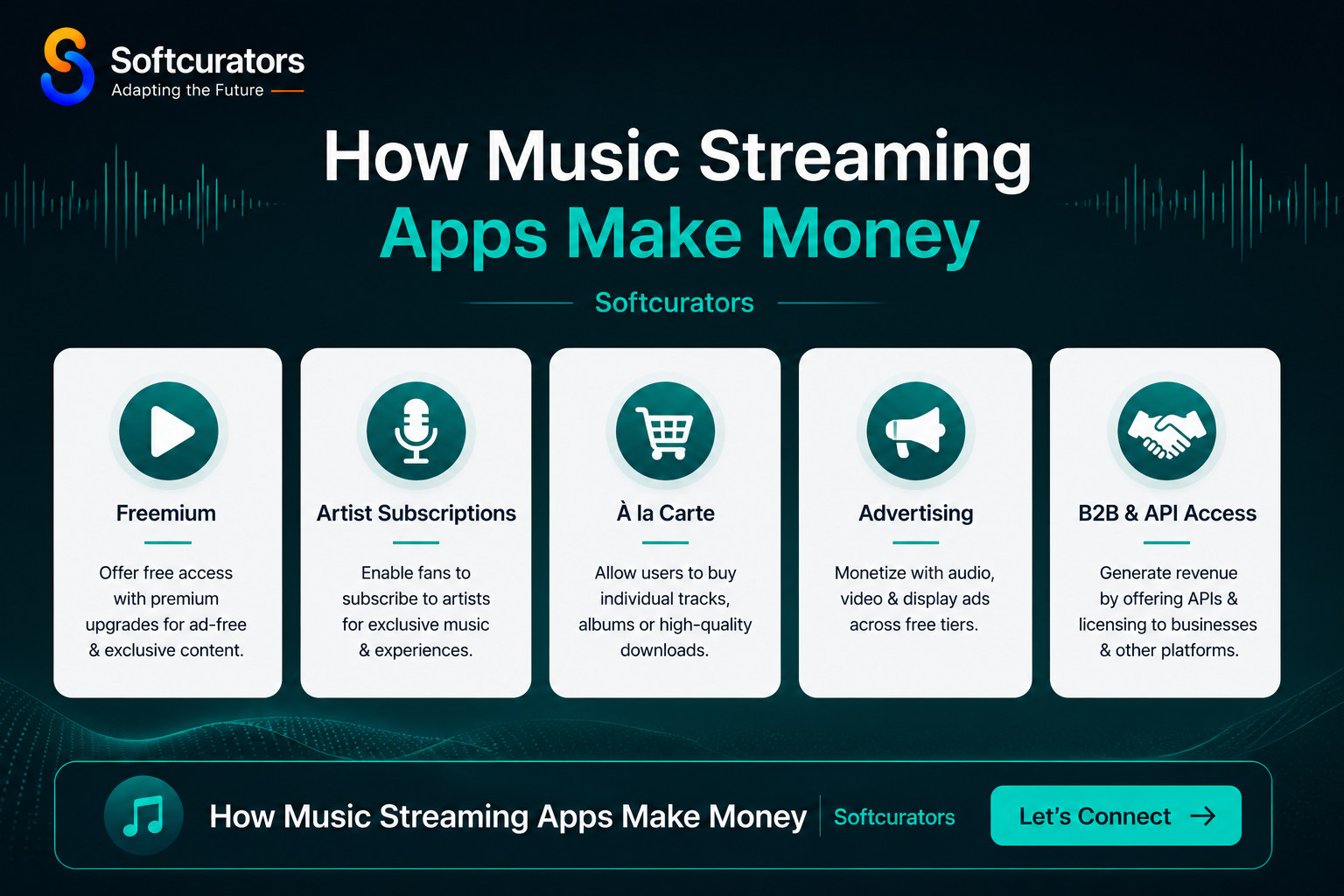
How Music Streaming Apps Make Money: Revenue Models That Work
Before a single line of code is written, you need to understand how your platform will generate revenue. Investors will ask. Hosts will negotiate. And every architectural decision from database schema to payment infrastructure flows from the revenue model you choose.
Freemium Subscription Model
This is the Spotify model. Free listeners get ad-supported access with limitations (shuffle-only on mobile, lower audio quality, limited skips). Premium subscribers pay a monthly fee for full access, offline downloads, and higher audio quality. According to Spotify’s developer documentation, this model converts roughly 25–30% of free users to paying subscribers over time making free listeners a genuine acquisition channel, not just a cost centre.
Artist Subscription and Creator Economy Model
Platforms like Bandcamp, Patreon, and emerging creator-first audio apps allow fans to subscribe directly to individual artists. The platform takes a smaller percentage typically 10–15% while the artist keeps the majority of revenue. This model attracts independent artists who bring their own audience, dramatically reducing your customer acquisition cost on the supply side.
À la Carte and Pay-Per-Listen
Some platforms allow users to purchase individual tracks or albums permanently similar to the old iTunes model, but updated for a streaming context. This works particularly well for classical music, audiobooks, and niche genres where listeners want ownership rather than access.
Advertising Revenue
Ad-supported tiers generate revenue through audio ads, display banners, and sponsored playlist placements. This requires significant monthly active user numbers (typically 500,000+ MAU) before advertising becomes meaningful revenue. However, it enables a zero-barrier entry experience that accelerates user acquisition.
B2B and API Licensing
At scale, your listening behaviour data and music catalogue API become valuable assets. License your API to travel apps, fitness platforms, gaming companies, and corporate wellness tools. Softcurators’ fintech app development expertise informs how we architect the revenue and licensing infrastructure within audio platform builds from day one.
Core Features Every Music Streaming App Needs
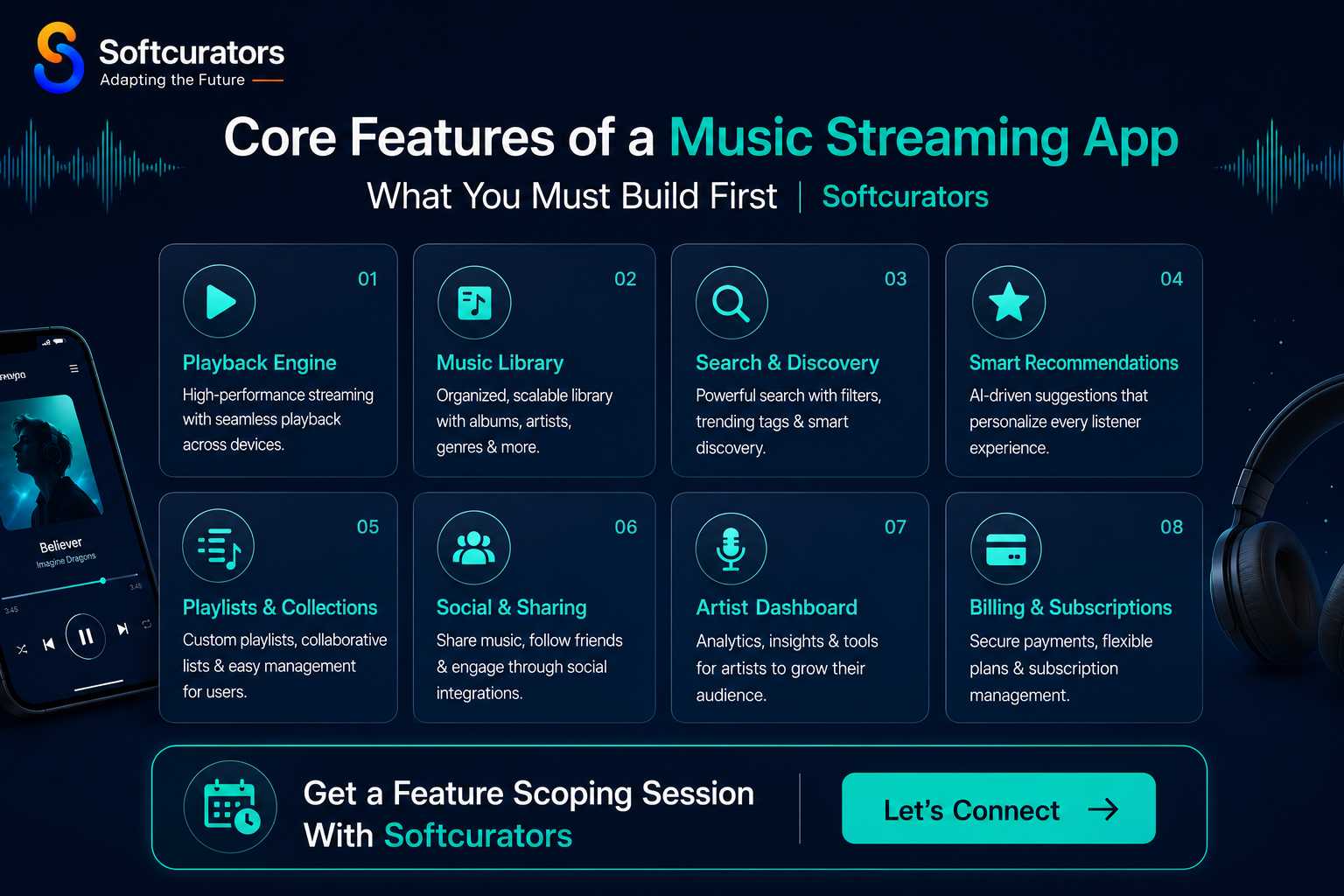
This is where most founders get it wrong. They either build too little releasing an MVP so bare that users churn within the first session or too much, spending eighteen months on features nobody asked for. At Softcurators, we begin every music streaming app development engagement by mapping the minimum feature set that creates a complete listening experience.
Audio Playback Engine
This is the non-negotiable foundation. Your playback engine must handle adaptive bitrate streaming (switching seamlessly between quality levels based on connection speed), gapless playback between tracks, crossfade controls, and background audio that continues when the screen is locked. On iOS, this uses AVFoundation. On Android, ExoPlayer is the industry standard. Buffering must be invisible a single buffer event can cause a user to abandon a session permanently.
Music Library and Catalogue Management
Whether you are licensing a third-party catalogue or enabling artist uploads, you need a robust content management system behind the scenes. This includes metadata management (artist, album, track, genre, BPM, key), DRM-protected content delivery, album art storage and CDN delivery, and rights territory management that restricts content by geographic region.
Search and Discovery
Listeners discover music in two ways: they search for something specific, or they stumble upon something new. Your search must handle typos, partial queries, artist name variations, and multilingual inputs. Your discovery layer curated playlists, mood filters, genre browsing, and algorithmic radio stations determines whether users stay on your platform or go back to Spotify.
Personalised Recommendations
This is the feature that separates good streaming apps from great ones. Start with collaborative filtering (users who liked X also liked Y) as your V1 recommendation engine. As your listening data grows, layer in content-based filtering that analyses actual audio features tempo, key, instrumentation, vocal characteristics. Softcurators’ AI app development and AI development teams build these recommendation systems as modular additions designed from day one to scale from collaborative filtering to deep learning as the platform grows.
Playlists and User Library
Users must be able to create, edit, and share playlists. They must be able to like tracks, follow artists, and build a personal library that persists across devices. Offline download support for premium subscribers requires encrypted local file storage a technically complex feature that dramatically improves retention among commuters and travellers.
Social Features
Music is social. Collaborative playlists let friends build shared listening experiences. Activity feeds show what friends are listening to right now. Artist following creates a direct feed of new releases. These features are not luxuries they are the organic growth engine that reduces your paid acquisition cost. Our social media app development experience informs how we design social graph architecture within audio platforms.
Artist and Creator Dashboard
If your platform allows direct artist uploads which is essential for any creator-first model you need a comprehensive artist-facing dashboard. This includes upload management, analytics (streams, listeners, geographic distribution), royalty tracking, and fan engagement metrics. A powerful artist dashboard is your primary host retention mechanism.
In-App Purchases and Subscription Billing
Seamless subscription management free trial handling, upgrade prompts, cancellation flows, and payment failure recovery is where most platforms leak revenue. Softcurators integrates Stripe for web billing and uses Apple In-App Purchase (StoreKit 2) and Google Play Billing for mobile ensuring compliance with app store requirements while maximising conversion from free to paid.
Advanced Features That Make Music Streaming Apps Worth Funding
Basic features get you to launch. Advanced features get you to Series A. These are the capabilities that signal to investors and to listeners that you understand where the audio market is going.
Spatial Audio and Lossless Streaming
Spatial audio creates a three-dimensional soundstage instruments placed left, right, above, and behind the listener delivering a dramatically more immersive experience for classical, jazz, and live recordings. The mainstream headphone hardware (AirPods Pro, Sony WH-1000XM5) supports spatial audio broadly enough that it has moved from premium differentiator to expected feature for high-end platforms. Building spatial audio requires integration with Apple’s Dolby Atmos mastering standard on iOS and Sony 360 Reality Audio on Android. Lossless audio delivery (FLAC, ALAC) requires adaptive bitrate infrastructure and significantly higher storage capacity. Softcurators’ iOS app development and Android app development teams have implemented both for clients targeting the premium listening segment.
Live Streaming and Virtual Concert Infrastructure
Live audio and video streaming requires a fundamentally different infrastructure from on-demand playback. Specifically, it requires real-time video encoding (H.264/H.265), low-latency CDN delivery (sub-5 seconds for interactive, sub-10 for broadcast), and audience interaction tools (live chat, reactions, Q&A queues) that perform under high concurrent user loads. Adding ticketed virtual events creates a high-margin revenue stream that per-stream royalties cannot match. Softcurators builds live streaming modules as a separate service that integrates with the main platform API. For full context on live streaming infrastructure costs, see our guide on the cost to build a music streaming app like Spotify.
AI Music Generation Integration
Platforms like Suno AI are demonstrating that AI-generated music is moving from novelty to genuine product feature. Integrating AI music generation allowing users to create personalised mood tracks, workout soundtracks, or sleep audio adds a unique capability that pure catalogue licensing cannot replicate. Softcurators’ team has specific experience in this space see our guide on how to develop an AI music generation app like Suno AI for the technical architecture behind this feature.
Podcast and Audiobook Convergence
A listener’s audio attention is finite. Platforms that capture both music time and podcast time and audiobook time dominate that finite attention. Podcast infrastructure requires episode-level play-position tracking across devices, RSS feed ingestion, chapter navigation, and playback speed controls. Adding podcast support to a music app costs $10,000–$20,000 in additional development but dramatically increases daily session frequency. Our mobile app development trends guide covers why converged audio platforms are the fastest-growing format in the space.
Voice and Smart Device Integration
The majority of music streaming sessions in developed markets begin with a voice command or smart speaker interaction. Building voice integration requires separate SDK implementations for Amazon Alexa (Alexa Skills Kit), Google Home (Google Assistant SDK), and Apple HomePod (SiriKit). CarPlay and Android Auto integration provides voice-controlled playback in vehicles. Softcurators’ cross-platform app development team handles all four integrations for clients targeting smart device users.
Music Streaming App Development: The Right Tech Stack
Choosing the right technologies at the start of a music streaming app development project saves months of painful refactoring later. At Softcurators, here is the stack we recommend for scalable audio platforms.
Mobile: Choosing Your Platform Strategy
For most audio app budgets, Flutter app development delivers iOS and Android from a single codebase at 35–40% lower cost than two separate native builds. Flutter’s audio plugin ecosystem (just_audio, audio_service) is mature enough for production streaming apps. However, if spatial audio, advanced AVFoundation features, or native iOS widget support are core to your product, iOS app development with Swift provides finer audio stack control. Our guide on native apps vs hybrid apps covers this decision in full. React Native app development is a strong alternative for teams with existing JavaScript expertise.
Web Frontend
React.js with Next.js is the standard for music platform web apps. Next.js server-side rendering is critical for artist and album page SEO those pages must be crawlable at scale. Our web development team builds streaming web apps with optimised initial load times (under 2 seconds), Web Audio API integration for in-browser playback, and Progressive Web App capability for offline listening in markets where app store friction reduces adoption.
Backend and API Architecture
Node.js with Express handles real-time playback events, playlist management, and messaging well. Python (FastAPI or Django) is the preferred choice for AI recommendation models, audio analysis pipelines, and data-heavy analytics features. A GraphQL API layer speeds up frontend development significantly allowing the web and mobile teams to query exactly the data they need without over-fetching. REST APIs handle third-party integrations (rights management systems, payment gateways, social auth providers).
Database and Storage Architecture
PostgreSQL stores structured data: user accounts, subscriptions, playlists, play history. MongoDB handles flexible content storage for track metadata, artist profiles, and dynamic catalogue data. Redis provides caching and session management for sub-100ms response times on hot data. Elasticsearch powers advanced music search with multi-filter support, fuzzy matching, and audio feature queries. AWS S3 stores audio files and album art, with CloudFront CDN delivering content from edge nodes closest to each listener.
Audio Delivery and Streaming Infrastructure
Audio streaming requires adaptive bitrate (ABR) encoding storing each track at multiple quality levels (96kbps, 160kbps, 320kbps, lossless) and switching automatically based on connection speed. HLS (HTTP Live Streaming) for iOS and DASH (Dynamic Adaptive Streaming over HTTP) for Android are the industry standards. DRM FairPlay on iOS, Widevine on Android encrypts audio files against unauthorised download. Building this infrastructure from scratch is complex. Softcurators uses proven ABR pipeline components to reduce this complexity significantly.
| Layer | Technology Options | Softcurators Recommendation |
| Mobile (iOS) | Swift / AVFoundation | Native for spatial audio and advanced iOS features |
| Mobile (Android) | Kotlin / ExoPlayer | Native for best Android audio performance |
| Cross-Platform Mobile | Flutter, React Native | Flutter preferred 35–40% cost saving, mature audio plugins |
| Web Frontend | React.js, Next.js | Next.js for SSR and SEO-critical artist/album pages |
| Backend | Node.js, Python (FastAPI) | Node.js for real-time; Python for AI/ML recommendation layer |
| Database | PostgreSQL, MongoDB, Redis | PostgreSQL primary; Redis for play history caching |
| Search | Elasticsearch | Multi-filter search, fuzzy matching, audio feature queries |
| Audio Delivery | HLS (iOS), DASH (Android) | ABR streaming with FairPlay / Widevine DRM |
| Cloud | AWS (S3, CloudFront, EC2) | Most reliable global coverage for audio CDN delivery |
| Payments | Stripe, Apple IAP, Google Play Billing | Stripe for web; platform billing for mobile app stores |
Music Streaming App Development: Step-by-Step Process
Building a successful audio platform is not just about writing code. It is a structured process. At Softcurators, we follow a proven software development methodology that minimises risk and maximises launch speed for every music streaming app development engagement.
Step 1: Market Research and Niche Definition
Before a line of code is written, validate your audio platform idea with real people. Who is your target listener? What genre, mood, or use case does your platform serve? What do Spotify, Apple Music, or existing niche platforms get wrong for this specific audience? Talk to 20 potential users. Their answers shape every subsequent product decision.
Step 2: Content Strategy and Rights Architecture
Music streaming requires content. You have two paths: licence a third-party catalogue through a music aggregator or rights licensing company, or build a creator-first platform where artists upload directly under a revenue-share agreement. Each path has dramatically different development complexity, legal requirements, and go-to-market strategies. Decide before you design.
Step 3: UX/UI Design
Great mobile app UI/UX design for an audio platform starts with the Now Playing screen and works outward. The listening experience is the product. Map the user journey from discovering a new artist to saving a playlist to recommending a track to a friend. Build wireframes, then high-fidelity prototypes. Test with real listeners before a line of frontend code is written. Our UI/UX design team runs this as a distinct pre-development phase.
Step 4: MVP Scoping and Prioritisation
A music streaming MVP is not a full Spotify clone. It is the minimum feature set that creates a complete listening experience: core playback, basic search and discovery, playlist management, and subscription billing. Ship that. Get real listener data. Then add AI recommendations, social features, and advanced audio formats in subsequent releases. Our MVP development and prototype development services help founders define and validate exactly this scope.
Step 5: Backend and Audio Infrastructure Development
Build the audio delivery pipeline first. This is the critical path everything else depends on it. Simultaneously build core APIs: user authentication (with social login via Apple, Google, and Spotify), music library management, playlist CRUD operations, and the subscription billing integration. Use a microservices architecture from the start if you anticipate rapid growth.
Step 6: Mobile and Web Frontend Development
Build the listener-facing mobile app and web platform in parallel. Our mobile app development team and startup app and web development company service are structured for exactly this kind of parallel workstream delivery so you do not lose six weeks waiting for backend completion before mobile development starts.
Step 7: AI Recommendation Layer
Build the listening event data pipeline from day one even if you are not launching with AI recommendations in V1. Every play, skip, save, and playlist add is training data for the recommendation models you will build in V2. Without this pipeline, adding AI later requires rebuilding the data layer from scratch. Softcurators’ AI consulting services team designs this pipeline architecture as part of the V1 backend build at minimal additional cost and significant future benefit.
Step 8: Testing, QA, and Security
Audio streaming apps have specific testing requirements beyond standard mobile app QA. Mobile app testing and deployment must include: playback testing across 20+ device/OS combinations, adaptive bitrate switching under simulated poor connection conditions, DRM verification across both platforms, payment flow end-to-end testing, and security and compliance testing for audio file protection and user data handling.
Step 9: Launch Strategy and Artist Seeding
Launch in one market or one genre niche first. Seed the platform with catalogue before you open it to the public a streaming app with 50 tracks in a genre creates a worse first impression than no app at all. Partner with independent artists who bring their own audience. Offer generous early-mover terms to attract the first 100 artists who will seed your catalogue and market your platform to their fans.
Step 10: Post-Launch Growth and Iteration
After launch, mobile app maintenance and support becomes the primary focus. Monitor skip rate by track and genre this is the highest-signal metric for recommendation quality. Track session length. Measure free-to-premium conversion rate weekly. Ship updates every two to four weeks. Platforms that iterate consistently grow three times faster than those with quarterly release cycles.
Music Streaming App Development: Legal and Licensing Requirements
This is the section most development guides skip. It is also the section that kills audio platforms 12 months after launch. Mobile app security and compliance for music apps involves a layer of rights management complexity that does not exist in most other app categories.
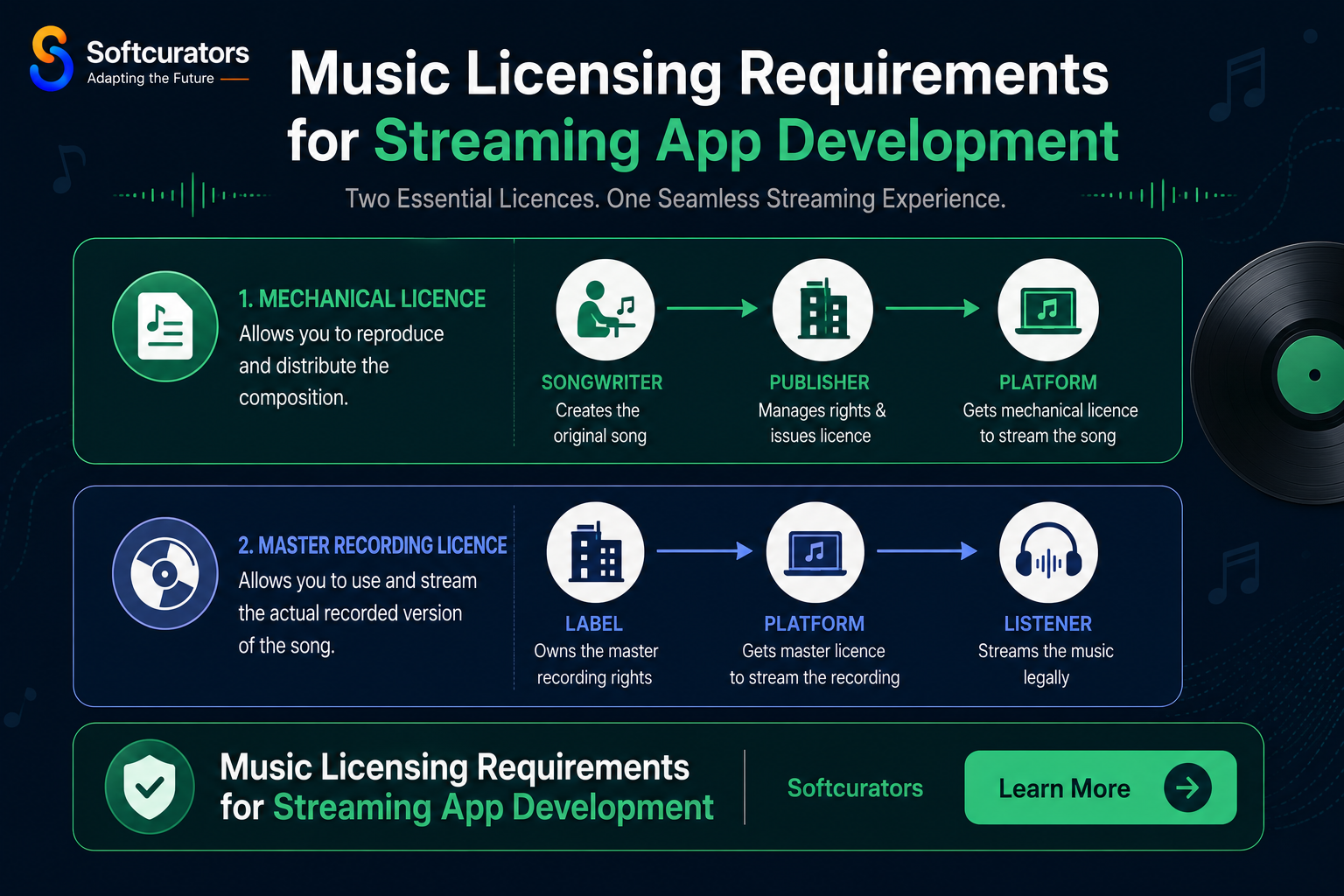
Music Licensing: The Three Rights You Need
Streaming music requires two separate licences for every track played. The mechanical licence covers the underlying musical composition (the notes and lyrics owned by the songwriter or publisher). The master recording licence covers the specific recording of that composition (owned by the record label or the artist). Both must be cleared for every track. Services like DistroKid, TuneCore, and CD Baby aggregate indie artist licences. Major label catalogues require direct negotiation.
Performance Rights and Royalty Obligations
Every time a track streams, royalties are owed to both the master recording owner and the composition copyright holder. In the US, performance rights organisations (ASCAP, BMI, SESAC) handle composition royalties. In the UK, it is PRS for Music. Each country has its own PRO. Building a royalty calculation and distribution system is a significant technical undertaking one that Softcurators approaches with the same financial infrastructure architecture used in our fintech builds.
Data Privacy: GDPR, DPDP, and CCPA
If you serve European users, GDPR governs how you collect, store, and process listener data including listening history used for recommendations. India’s DPDP Act and California’s CCPA apply similarly. Build data privacy architecture from the first database schema. Listening history is deeply personal data. Handle it with explicit consent mechanisms, clear retention policies, and one-click deletion capability.
App Store Compliance for Audio Apps
Both Apple App Store and Google Play have specific requirements for apps that offer subscription billing. In-app subscriptions must use Apple StoreKit or Google Play Billing you cannot route subscription payments through Stripe on mobile without violating platform terms of service (which means app removal and loss of all mobile users). Build this into the payment architecture from day one.
How Much Does Music Streaming App Development Cost?
This is the question every founder asks first. Here is a realistic cost breakdown based on Softcurators’ experience across audio platform builds. For a detailed breakdown, also see our guides on cost to develop a music streaming app and cost to build a music streaming app like Spotify.
| Development Component | Cost Range (USD) | Notes |
| UX/UI Design | $1,000 – $5,000 | Now Playing, discovery, artist pages, subscription flows |
| Audio Infrastructure (ABR + DRM) | $4,000 – $15,000 | HLS/DASH pipeline, FairPlay/Widevine integration |
| Mobile App (iOS + Android) | $15,000 – $25,000 | Flutter cross-platform recommended for budget efficiency |
| Web Frontend (Next.js) | $3,000 – $8,000 | Guest-facing web player and artist/album SEO pages |
| Backend + API Development | $5,000 – $15,000 | Auth, library management, playlist engine, notifications |
| AI Recommendation Layer V1 | $4,000 – $15,000 | Collaborative filtering + listening event data pipeline |
| Artist Dashboard | $3,000 – $7,000 | Upload, analytics, royalty tracking, fan metrics |
| Payment Integration | $1,000 – $6,000 | Stripe (web) + Apple IAP + Google Play Billing |
| Admin Panel | $2,000 – $5,000 | Content moderation, user management, revenue reporting |
| QA and Security Testing | $2,000 – $5,000 | Playback testing, DRM verification, security audit |
| TOTAL (MVP) | $15,000 – $35,000 | Core playback, search, playlists, basic AI, billing |
| TOTAL (Full Platform) | $35,000 – $50,000+ | All advanced features, live streaming, spatial audio |
For broader context on mobile app development cost drivers, see our detailed pricing guide. Our startup app and web development company service is structured for capital-efficient phased development delivering a real, listenable MVP at the lower end of the range, then scaling features as the platform validates.
How Long Does Music Streaming App Development Take?
| Phase | Duration | Key Output |
| Discovery and Rights Planning | 2 – 3 weeks | Feature scope, licensing strategy, tech stack decision |
| UX/UI Design | 3 – 5 weeks | Wireframes, prototypes, design system, Now Playing screen |
| Audio Infrastructure Build | 4 – 6 weeks | ABR pipeline, DRM, CDN configuration |
| Backend Development | 6 – 10 weeks | APIs, database, playlist engine, auth, billing |
| Mobile + Web Frontend | 8 – 14 weeks | Listener app, artist dashboard, web player |
| AI Layer and Data Pipeline | 3 – 5 weeks | Event tracking, collaborative filtering engine |
| Testing and QA | 3 – 4 weeks | Playback, DRM, payments, security, UX |
| Launch and App Store Submission | 2 – 3 weeks | App store review, staged rollout, CDN warm-up |
| TOTAL (MVP) | 2 – 3 months | Core audio platform live on iOS, Android, and web |
| TOTAL (Full Platform) | 3 – 6 months | All features shipped including live streaming and AI |
Working with Softcurators compresses this timeline through parallel workstreams and pre-built infrastructure components. Our agile sprint model means you hear literally working audio playback every two weeks, not a finished platform after twelve months. See our guide on mobile app development for startups for more on timeline planning.
Common Mistakes in Music Streaming App Development
Most audio platforms fail for predictable and entirely avoidable reasons. Here is what Softcurators sees most consistently and how we help clients avoid each one.
Mistake 1: Launching Without Sufficient Catalogue
A streaming app with 200 tracks in a genre creates a worse first impression than no app. Before soft launch, secure enough catalogue to cover at least 100 hours of listening for your target genre niche. For creator-first platforms, seed with 20–30 committed artist partners before opening public signups.
Mistake 2: Ignoring Audio Infrastructure Complexity
Founders underestimate the engineering complexity of adaptive bitrate streaming, DRM, and multi-format audio delivery. Using a simple audio file URL instead of a proper ABR pipeline leads to buffering on slower connections, battery drain from inefficient decoding, and security vulnerabilities that allow track download bypass. Build the audio infrastructure right from the start.
Mistake 3: Skipping the Listening Event Data Pipeline
The recommendation engine you want in V2 needs training data from V1. If you do not capture play events, skip events, save events, and playlist additions from the first user session, adding AI recommendations later requires rebuilding the data layer from scratch. Softcurators designs this pipeline into the initial backend architecture at minimal additional cost.
Mistake 4: Routing Mobile Subscriptions Through Stripe Directly
This violates Apple and Google app store policies and results in app removal. Mobile subscriptions must go through Apple StoreKit (iOS) or Google Play Billing (Android). Web subscriptions can use Stripe. Both must be supported simultaneously for users who subscribe on different devices.
Mistake 5: Choosing a Development Partner Without Audio Stack Experience
Audio streaming has unique technical requirements ABR encoding, DRM, offline playback, background audio session management that most general development agencies have never built. Softcurators has delivered audio platforms with these requirements across multiple client builds. Check our portfolio and why companies choose Softcurators before making your partner decision. Then contact us to discuss your specific build.
Marketing Your Music Streaming App: Getting Your First 10,000 Active Listeners
Building the app is only half the challenge. Getting listeners and keeping them is the other half. And it requires a different strategy for the supply side (artists and catalogue) and the demand side (listeners).
Artist Acquisition: Building Your Supply Side
For creator-first platforms, artist acquisition is your primary go-to-market motion. Start with direct outreach to independent artists on Instagram, TikTok, and Bandcamp. Offer better revenue terms than existing platforms if Spotify pays $3 per thousand streams, offer $6. Give early artists featured placement, promotional support, and direct access to fan analytics they cannot get elsewhere.
Partner with music schools, producer communities, and independent label collectives. One partnership with a producer community can onboard 50 artists simultaneously each bringing their own audience.
Listener Acquisition: Building Your Demand Side
Use Facebook and Instagram ads targeted at music fans of the specific genre your platform focuses on. TikTok is the most powerful music discovery channel artist partners who create short-form content featuring your platform drive more installs than any paid ad campaign of equivalent spend. Build an SEO content strategy around music discovery playlist curation guides, artist interview features, genre deep-dives. Our digital marketing services team helps audio platforms build and execute these growth strategies alongside the development project.
Retention: Why Skip Rate Is Your Most Important Metric
High skip rate on a genre or playlist is the single most actionable signal in a music app. If listeners consistently skip track three of a ‘Focus Music’ playlist, something is wrong with track three wrong tempo, wrong energy, wrong mood. Fix it before it becomes a session abandonment problem. Monitor skip rate weekly, by genre, by playlist, and by recommendation source. This data drives your editorial and AI recommendation improvements faster than any other metric.
How Softcurators Approaches Music Streaming App Development
Understanding music streaming app development is one thing. Building a platform that actually retains listeners is another. Softcurators approaches every audio platform project with an architecture-first philosophy ensuring that V1 is designed for the features you launch with today and the capabilities you will need in V2.
Audio-First Architecture Philosophy
Most development agencies build mobile apps that happen to play audio. Softcurators builds audio platforms that happen to run as mobile apps. The distinction is in how we treat the playback engine as the primary product surface, not a feature bolted onto a generic app template. Every architectural decision, from CDN configuration to database schema design, is evaluated through the lens of: does this make the listening experience better or worse?
Full-Stack Audio Development Capability
Softcurators covers the complete music streaming development stack. Our iOS app development team handles AVFoundation, FairPlay DRM, and spatial audio. Android app development team handles ExoPlayer, Widevine DRM, and Android Auto. Flutter app development practice delivers cross-platform apps at 35–40% lower cost. Our web development team builds the web player and artist-facing tools. Our AI development and AI app development teams build the recommendation and personalisation layer. Everything in one engagement no subcontracting, no handoff delays.
Design That Drives Listening Sessions
The best audio infrastructure does not retain listeners if the app is frustrating to navigate. Our UI/UX design team designs music apps from the Now Playing screen backward applying the mobile app UI/UX best practices we have documented across audio and media platform builds. Discovery interfaces, queue management, artist pages, and social sharing flows each tested with real listeners before a line of frontend code is written.
From MVP to Full Platform at Softcurators
Not every client needs to launch with AI recommendations, live streaming, and spatial audio on day one. Our MVP development and prototype development services help founders define the minimum feature set that validates their specific audio platform thesis then phase advanced features into subsequent releases as listener data confirms what actually drives retention. Our AI automation services layer automates playlist curation, editorial recommendation, and new release surfacing as the platform scales.
What You Do Next Matters: Music Streaming App Development Starts Here
The music streaming app development opportunity of 2025 is real. The technology is accessible. The niches that Spotify underserves are large. The creators frustrated with existing platforms are actively looking for alternatives. And the founders who build audio platforms designed for a specific listener segment with the right architecture from day one will have a significant, compounding advantage over those who retrofit features onto platforms not built to support them.
Softcurators builds from the listener backward. We design V1 with V2 and V3 in mind. Embed the listening event data pipeline before the AI models are trained. We architect the social graph before the social features launch. Build the royalty distribution infrastructure before the first stream is paid. The first conversation is free.
Book a strategy call with Softcurators today and let us map out exactly how to build your music platform for where the audio market is going, not where it has been.
Further reading: Music Streaming App Development | AI App Development | Music Streaming App Trends | Flutter App Development | Mobile App Development Technologies | Our Portfolio
FAQs
How much does it cost to build a music streaming app?
A focused MVP with core playback, search, playlists, basic AI recommendations, and subscription billing costs between $20,000 and $35,000. A full platform with spatial audio, live streaming, advanced AI, a creator dashboard, and podcast convergence ranges from $35,000 to $50,000 or more. For a detailed breakdown, see our guide on the cost to develop a music streaming app. Softcurators provides exact scoped estimates within 12 hours of a free discovery call.
How long does music streaming app development take?
A focused MVP takes 2 to 3 months. A full platform with all advanced features requires 3 to 5 months. Working with Softcurators compresses this timeline through parallel workstreams and pre-built audio infrastructure components so you hear working audio playback every two weeks, not a finished platform after twelve months.
What technology stack is best for a music streaming app?
For most budgets, Flutter for mobile (iOS and Android from one codebase), Next.js for the web frontend, Node.js or Python for the backend, PostgreSQL and Redis for the database, Elasticsearch for music search, AWS S3 and CloudFront for audio CDN delivery, and Stripe combined with Apple IAP and Google Play Billing for payments. The specific stack depends on your feature requirements and target market. Softcurators evaluates this decision for each client individually.
Do I need both iOS and Android apps for a music streaming platform?
For a consumer music platform targeting a broad audience, yes. Most music streaming apps get 60–70% of their traffic on iOS in Western markets and 70–80% Android in South and Southeast Asia. Flutter delivers both platforms from a single codebase at 35–40% lower cost than two separate native builds making it the recommended approach for most music platform budgets.
How do music streaming apps make money?
The primary models are: freemium subscription (ad-supported free tier converting to premium), artist/fan direct subscriptions (creator economy model), à la carte track and album purchases, advertising revenue from the free tier, and B2B API licensing at scale. Most successful platforms combine two or three of these models. Softcurators designs the revenue architecture before writing any code because every payment flow decision affects the entire platform architecture.
What music licences do I need to build a streaming app?
You need two licences for every track you stream: the mechanical licence (for the musical composition notes and lyrics) and the master recording licence (for the specific recording). In the US, mechanical licensing is handled through the Music Licensing Collective (MLC). Master recording licences require direct negotiation with record labels or through a digital distribution aggregator for independent artists. Each country has additional performing rights obligations through local PROs.
What is adaptive bitrate streaming and do I need it?
Adaptive bitrate streaming (ABR) automatically adjusts audio quality based on the listener's current connection speed switching between 96kbps, 160kbps, 320kbps, and lossless formats seamlessly without interruption. Every commercial music streaming platform uses ABR. Without it, listeners on slower connections experience constant buffering which is the single fastest way to lose users permanently. Softcurators implements ABR as standard in every audio platform build.
What is DRM and why is it required?
Digital Rights Management (DRM) encrypts audio files to prevent unauthorised download and redistribution. FairPlay is Apple's DRM standard for iOS. Widevine is Google's standard for Android and the web. Both are required by record labels and music aggregators before they will license their catalogue to a new streaming platform. Without DRM, you cannot licence major catalogue and without major catalogue, you cannot attract mainstream listeners.
How do AI music recommendations work?
Music recommendation systems use two primary approaches. Collaborative filtering recommends music based on what users with similar listening histories enjoy ('users who liked X also liked Y'). Content-based filtering recommends music based on the acoustic and metadata similarities between tracks you have already enjoyed. Most production systems use a hybrid of both. Softcurators builds recommendation architectures that start with collaborative filtering and scale toward deep learning models as platform listening data grows.
How much data do I need before AI recommendations work well?
Collaborative filtering requires approximately 10,000 monthly active users with meaningful listening histories before recommendation quality becomes noticeably better than manual curation. Content-based filtering works from day one because it uses audio features rather than user behaviour. Softcurators designs V1 platforms to use content-based filtering immediately and layer collaborative filtering in V2 once the user base reaches sufficient scale.
Should my music app include podcasts?
If your platform targets daily audio listening habits rather than occasional playlist sessions yes. Podcasts dramatically increase the share of a listener's daily audio time your platform captures. Spotify's data consistently shows that podcast listeners have significantly higher retention rates than music-only listeners. Softcurators estimates adding podcast infrastructure to an existing music app at $10,000–$25,000 in additional development.
What is the difference between collaborative filtering and content-based filtering?
Collaborative filtering recommends based on what people similar to you enjoy. Content-based filtering recommends based on the musical characteristics of tracks you have already liked. Collaborative filtering requires user data to work it is blind for new users. Content-based filtering works from the first listen. Most production music apps use a hybrid: content-based for new users, collaborative filtering as listening history accumulates, and deep learning for users with extensive history.
How do I handle offline listening in a music streaming app?
Offline listening for premium subscribers requires encrypted local file storage audio files downloaded to the device must be protected by DRM even when stored locally. On iOS, this uses FairPlay local key management. On Android, Widevine offline licensing. The app must also manage download queue management, storage quota limits, and automatic expiry of offline content when subscriptions lapse. This is one of the more technically complex features in music streaming development.
What analytics should a music streaming app track?
The most important metrics are: DAU/MAU ratio (engagement depth), session length, streams per session, skip rate by track and genre (highest-signal quality metric), free-to-premium conversion rate, monthly churn by cohort, playlist creation rate, offline download rate among premium users, and social sharing rate. Softcurators builds event tracking pipelines from day one because listening data from the first week of users is irreplaceable for improving recommendation quality.
How do I prevent audio buffering in a music streaming app?
Buffering prevention requires three components working together: adaptive bitrate switching that reduces quality before a buffer event occurs, aggressive client-side pre-buffering that loads the next track while the current one is still playing, and CDN edge caching that places audio content as close to each listener's geographic location as possible. Softcurators implements all three as standard in every music streaming backend.
What is the role of social features in a music streaming app?
Social features in a music app serve two distinct functions. First, they drive organic user acquisition through shared playlists, activity feeds, and track recommendations between friends. Second, they improve retention by creating a social identity within the platform listeners who have established taste profiles and friend connections are dramatically less likely to churn. Softcurators designs social graph architecture into music app data models from the first planning session.
How do I build a music app for a regional or non-English market?
Building for a regional market requires: multi-language UI support (including right-to-left scripts for Arabic and Hebrew), local currency billing integration, regional music catalogue licensing (which requires negotiating with local rights holders separately from global aggregators), recommendation models trained on regional listening data rather than Western-optimised algorithms, and compliance with local data privacy laws. Softcurators has built regional audio platforms with all of these requirements.
What is the best monetisation model for a new music streaming app?
Softcurators recommends a freemium model with creator economy features layered on top for platforms serving independent artists. Freemium converts casual listeners to paying subscribers over time. Artist fan subscriptions create high-margin recurring revenue that per-stream royalties cannot match. Advertising becomes meaningful at 500,000+ MAU. Start with freemium and creator subscriptions add advertising revenue as scale warrants the infrastructure investment.
How does Softcurators handle music rights management in app development?
Softcurators builds rights management architecture that tracks licences, DRM keys, territory restrictions, and royalty calculation rules within the platform data model. For platforms using licensed catalogues, we integrate with content delivery APIs that include rights metadata. For creator-first platforms where artists upload their own content, we build terms-of-service acceptance workflows and content ID matching to prevent unlicensed uploads. Rights management is an architecture-level decision made at the start of every project.
Can I build a music streaming app without a technical background?
Yes. You need to define the product vision, understand your revenue model, and choose the right development partner. You do not need to write code. Softcurators has helped multiple non-technical founders launch successful audio platforms managing the complete technical workstream while keeping the founder informed and in control at every milestone.
What makes Flutter a good choice for music streaming app development?
Flutter's audio plugin ecosystem just_audio for playback, audio_service for background audio management is mature enough for production streaming apps. A single Flutter codebase delivers iOS and Android at 35–40% lower cost than separate native builds. Flutter's performance for audio-intensive applications is near-native. Softcurators' Flutter development practice has implemented full ABR streaming, DRM, and offline playback in Flutter demonstrating that the framework handles production audio requirements reliably.
How do I scale a music streaming app from launch to one million users?
Scaling requires: database read replicas and connection pooling for play history queries, Redis caching for hot playlist and recommendation data, CDN-distributed audio delivery with edge nodes in target geographic regions, microservices separation for playback, search, and recommendation workloads, event-driven processing with a message queue for royalty calculations and notification dispatch, and load testing simulating 10x peak concurrent listening loads before each major release.
What is spatial audio and should my music app support it?
Spatial audio creates a three-dimensional soundstage placing instruments left, right, above, and behind the listener rather than in a flat stereo field. It creates a substantially more immersive experience for classical, jazz, live recordings, and cinematic scores. The mainstream headphone hardware supports it broadly enough that premium-tier streaming platforms are expected to offer it. Building spatial audio requires Dolby Atmos integration on iOS and Sony 360 Reality Audio on Android. Softcurators' iOS and Android teams have implemented both.
How does live streaming differ from on-demand streaming in music apps?
On-demand streaming serves pre-encoded audio files through a CDN. Live streaming requires real-time audio or video encoding, ultra-low-latency delivery (sub-5 seconds for interactive, sub-10 for broadcast), and audience interaction infrastructure (live chat, reactions, Q&A) that must perform under thousands of concurrent connections. The technical requirements are substantially different. Softcurators builds live streaming as a separate microservice that integrates with the main audio platform API.
What are the app store submission requirements for a music streaming app?
Apple App Store review requires: complete and accurate metadata, working demo account credentials for the review team, compliance with audio content guidelines, proper implementation of Apple IAP for subscription billing, and a clear privacy policy covering audio listening data. Google Play has similar requirements. Both platforms have specific guidelines for apps that stream third-party licensed content requiring proof of licensing rights. Softcurators handles the full app store submission process as part of our launch phase.
How do I handle artist royalty payments in a music streaming app?
Royalty payment infrastructure requires: per-stream royalty calculation (based on each artist's contractual rate and the platform's total stream count), monthly or quarterly payout processing (typically via Stripe Connect or a similar marketplace payment platform), tax form collection from artists (W-9 for US artists, W-8 for international), and detailed royalty reporting that artists can access through their dashboard. Softcurators builds this infrastructure drawing on our fintech app development experience with complex payment distribution systems.
Can I add AI music generation to my streaming app?
Yes and it creates a unique capability that catalogue licensing alone cannot replicate. AI music generation allows users to create personalised mood tracks, workout soundtracks, or ambient audio that fits their precise requirements. Softcurators has specific experience building AI music generation features see our guide on how to develop an AI music generation app like Suno AI for the technical architecture. Integration adds $5,000–$15,000 to a standard music platform build.
Q: What is the minimum viable version of a music streaming app?
A trend-aware MVP includes: core audio streaming engine with ABR and DRM, basic music search and browse, playlist creation and management, artist profile pages, freemium subscription billing (Stripe for web, Apple IAP and Google Play Billing for mobile), listening event data pipeline for future AI training, and a basic admin panel for content moderation. This represents a complete listening experience without advanced features validating the core platform thesis before investing in AI recommendations, live streaming, or spatial audio.
How do I get started building a music streaming app with Softcurators?
The first step is booking a free 30-minute strategy call at softcurators.com/contact. Our senior architect will review your audio platform concept, discuss your target listener and content strategy, and evaluate which features are essential for your V1 versus which can wait for V2. We deliver a scoped cost estimate within 12 hours followed by a detailed proposal within three to five business days. No obligation. No generic template. A real architect who has built audio platforms, thinking specifically about your product.
