
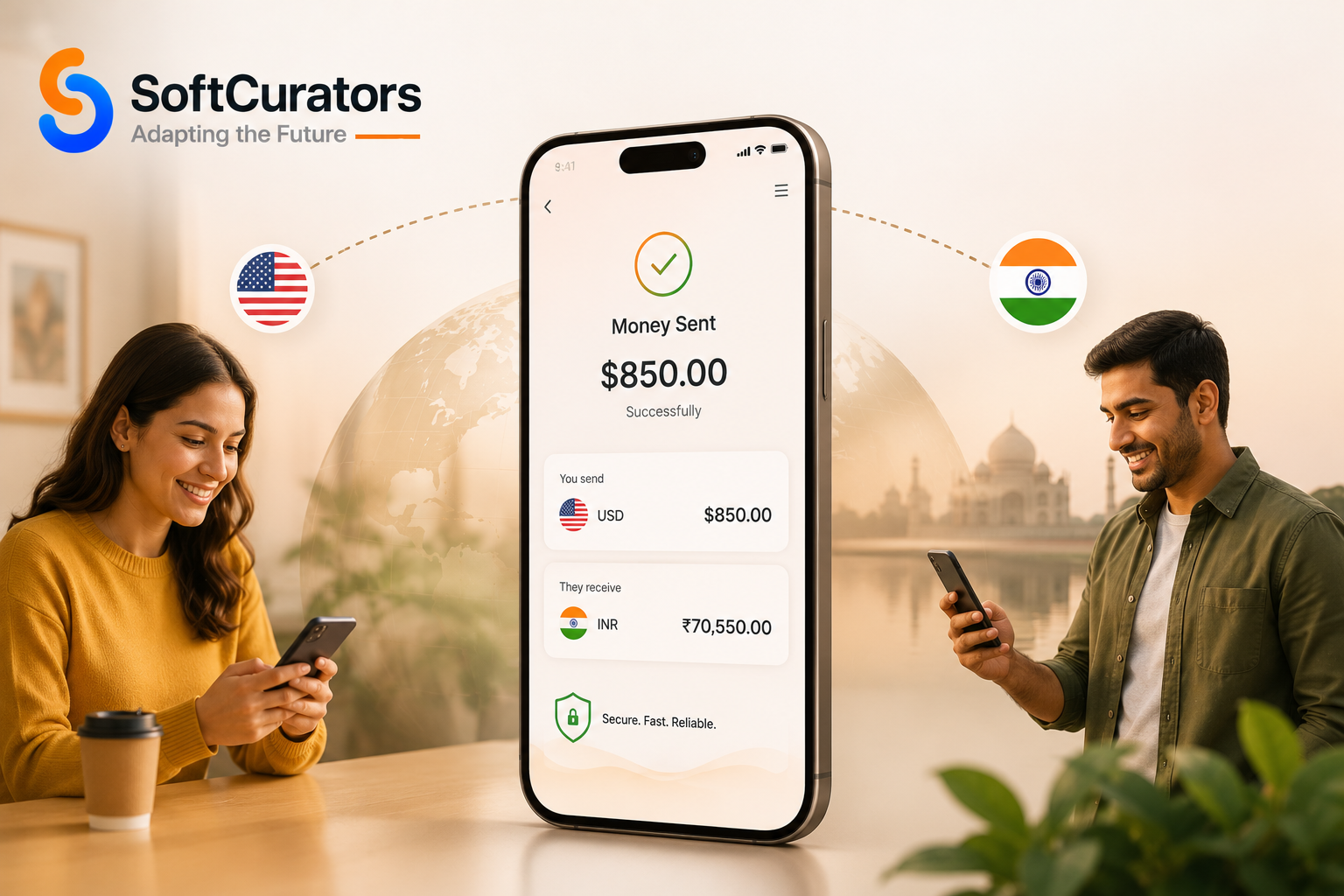
You open your phone. You tap a button. Money crosses borders in seconds. What used to take days and cost a fortune is now instant, affordable, and expected.
The global money transfer market is one of the most lucrative in fintech. And in 2026, the barriers to entry have never been lower if you know what you are building and how to build it right.
This is the complete guide on how to build a money transfer app in 2026. We cover everything: the market opportunity, the core features your app must have, the technology stack, the regulatory minefield, and the realistic cost breakdown. We also explain exactly how Softcurators helps fintech entrepreneurs bring these products to life on time, on budget, and fully compliant.
Whether you are building a domestic P2P payment app, an international remittance platform, or a business-to-business money movement solution this guide will give you the full picture. Let us get started.
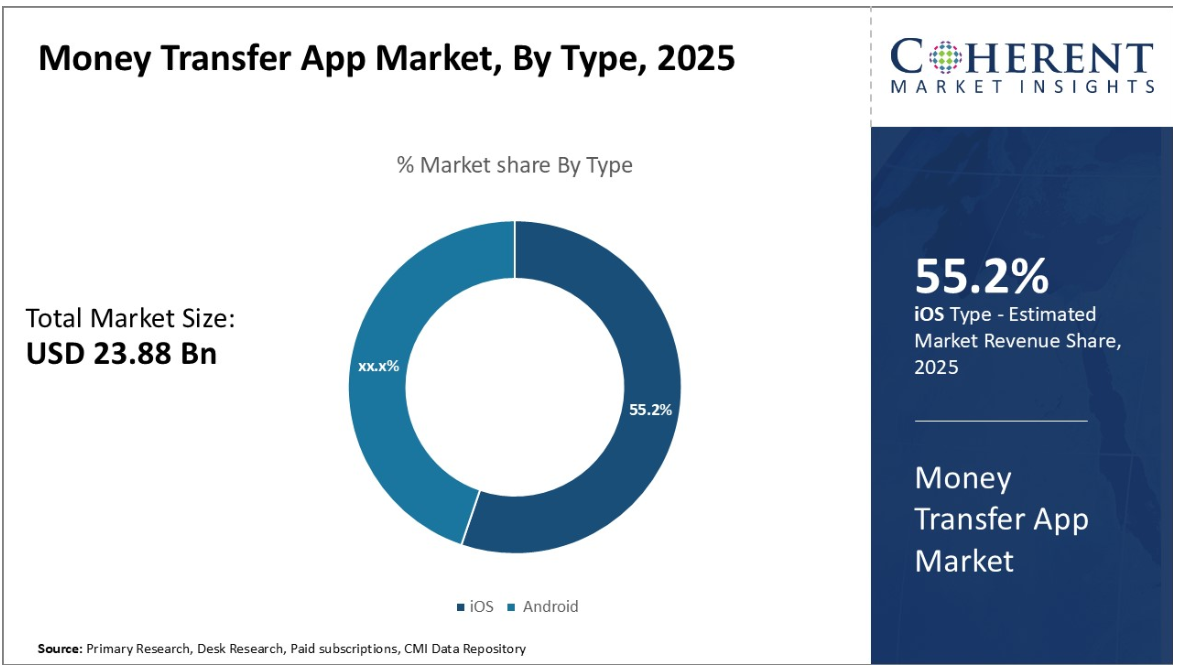
Stat: The global digital remittance market is projected to reach $51.2 billion by 2028, growing at a CAGR of 14.2%. Mobile payment transaction volume surpassed $8.5 trillion globally in 2025.
Why Build a Money Transfer App ? The Market Opportunity
Before investing in development, you need to understand why this market rewards bold entrants.
The Traditional Banking System Is Failing Senders
Bank wire transfers still charge $25–$50 per international transaction and take two to five business days. For the 1.4 billion adults globally who are underbanked or unbanked, even domestic bank transfers are inaccessible.
This gap is enormous. It is also increasingly filled by mobile-first fintech companies not banks. And that creates a significant opportunity for new entrants.
Five Trends Driving the Market
- Smartphone penetration: Over 6.8 billion smartphone users globally in 2026 mobile is the default channel for financial transactions in most markets
- Declining remittance costs: Digital-first operators now charge as little as 0.5%–2% per transfer vs. the traditional 6%–8% users are switching fast
- Cryptocurrency and stablecoins: USDC, USDT, and other stablecoins are being integrated into transfer apps for instant cross-border settlement at near-zero cost
- Embedded finance: Ride-sharing, e-commerce, and social platforms are embedding payment transfer features creating B2B demand for white-label transfer infrastructure
- Diaspora remittances: $700+ billion is sent across borders annually by migrant workers this market is underserved by both banks and first-generation digital apps
Who Is Building Money Transfer Apps?
- Fintech startups targeting specific remittance corridors (e.g., US to Mexico, UK to Nigeria)
- Neobanks adding cross-border transfer features to compete with Wise and Revolut
- B2B platforms building payroll and vendor payment infrastructure for distributed teams
- Telcos launching mobile money services in emerging markets
- E-commerce platforms adding checkout-integrated P2P payment features
Wherever you sit on this spectrum, the same fundamental question applies: how do you build a money transfer app that users trust, regulators approve, and banks integrate with? That is what this guide answers. And if you want a partner to build it, Softcurators is ready to help our fintech app development team has delivered payment products across three continents.
Types of Money Transfer Apps: Which One Are You Building?
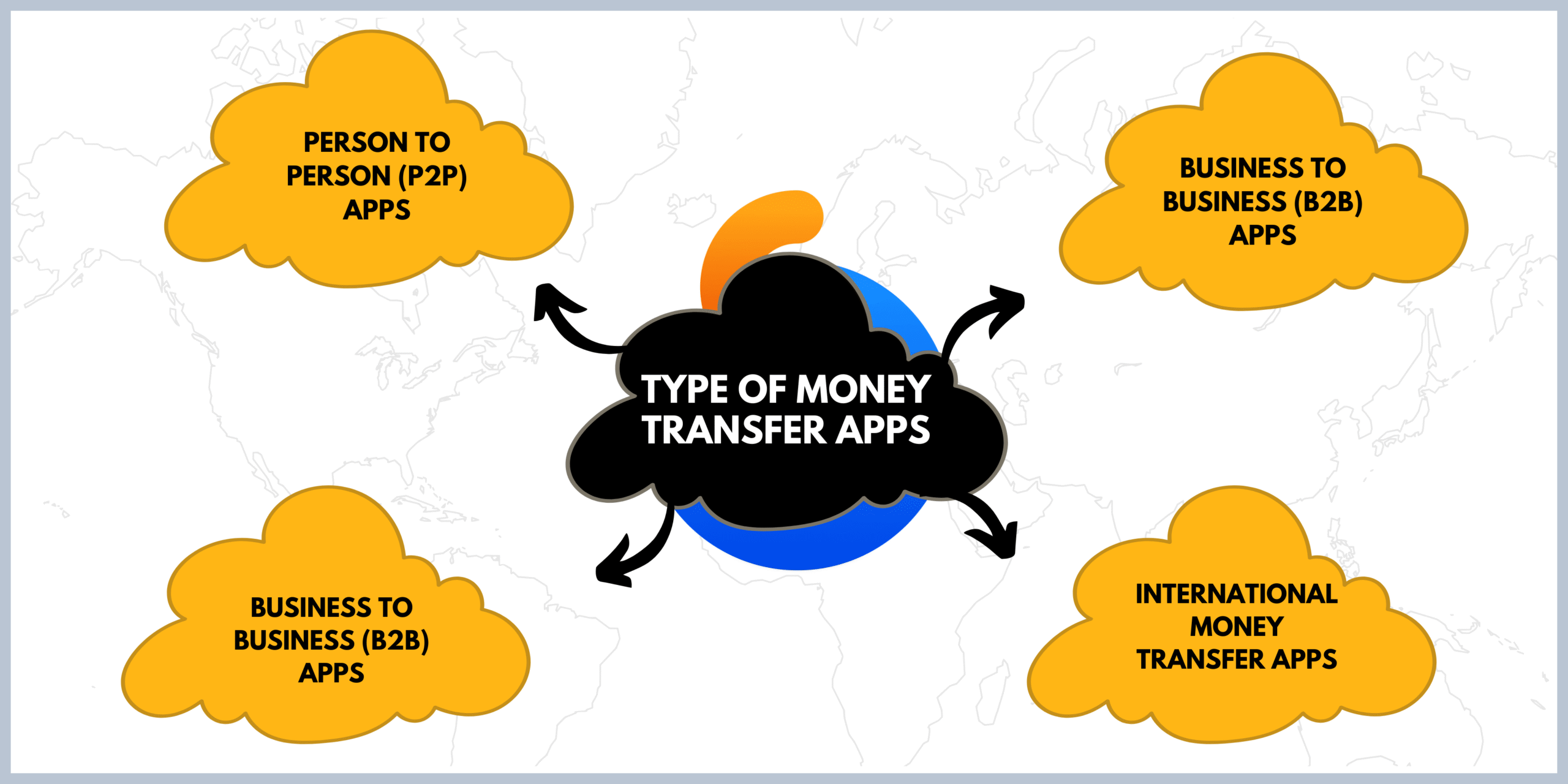
Not all money transfer apps are the same. Knowing which type you are building shapes every decision from the features you need to the licenses you must hold.
Type 1: Peer-to-Peer (P2P) Domestic Transfer
Apps like Venmo, Cash App, and Google Pay let users send money to contacts instantly. These apps operate in a single currency and jurisdiction.
- Lower regulatory complexity typically requires a Money Transmission License (MTL) in the operating jurisdiction
- Competition is fierce dominated by BigTech and well-funded neobanks
- Differentiation comes from UX, social features, and integration with other financial products
Type 2: International Remittance Platform
Apps like Wise, Remitly, and WorldRemit handle cross-border transfers typically consumer-to-consumer across different currencies.
- Highest regulatory complexity licenses required in every country of operation
- SWIFT, SEPA, ACH, and local payment rails must be integrated
- Currency exchange rates and FX margins are central to the business model
This is the most technically and legally demanding type of money transfer app. However, it is also where Softcurators has the most fintech development experience particularly in building compliant cross-border payment infrastructure.
Type 3: Business Payment and Payroll Platform
Apps like Deel, Remote, and Payoneer handle B2B payments contractor payouts, payroll, invoice payments, and vendor transfers across multiple countries.
- Higher average transaction values make compliance investment more economical
- API-first architecture is essential businesses need to integrate payment via API into their own workflows
- Multi-currency wallet infrastructure is a core requirement
Type 4: Crypto-Enabled Transfer App
Apps that use stablecoins or cryptocurrency rails for settlement offer near-instant international transfers at very low cost.
- Fastest settlement of any type transactions settle in seconds on-chain
- Regulatory landscape is evolving rapidly requires specific crypto licenses in most jurisdictions
- User education barrier is higher not all recipients can receive crypto directly
Type 5: Mobile Wallet with Transfer Feature
Apps like M-Pesa (Africa), GCash (Philippines), and Paytm (India) combine a stored-value wallet with transfer capabilities. This model dominates emerging markets. Our guide on how to develop an e-wallet app covers this type in more detail if you are building for this specific model.
Core Features Required to Build a Money Transfer App
Features make or break a money transfer app. Too few and users do not trust it. Too many at launch and you burn budget without validation.
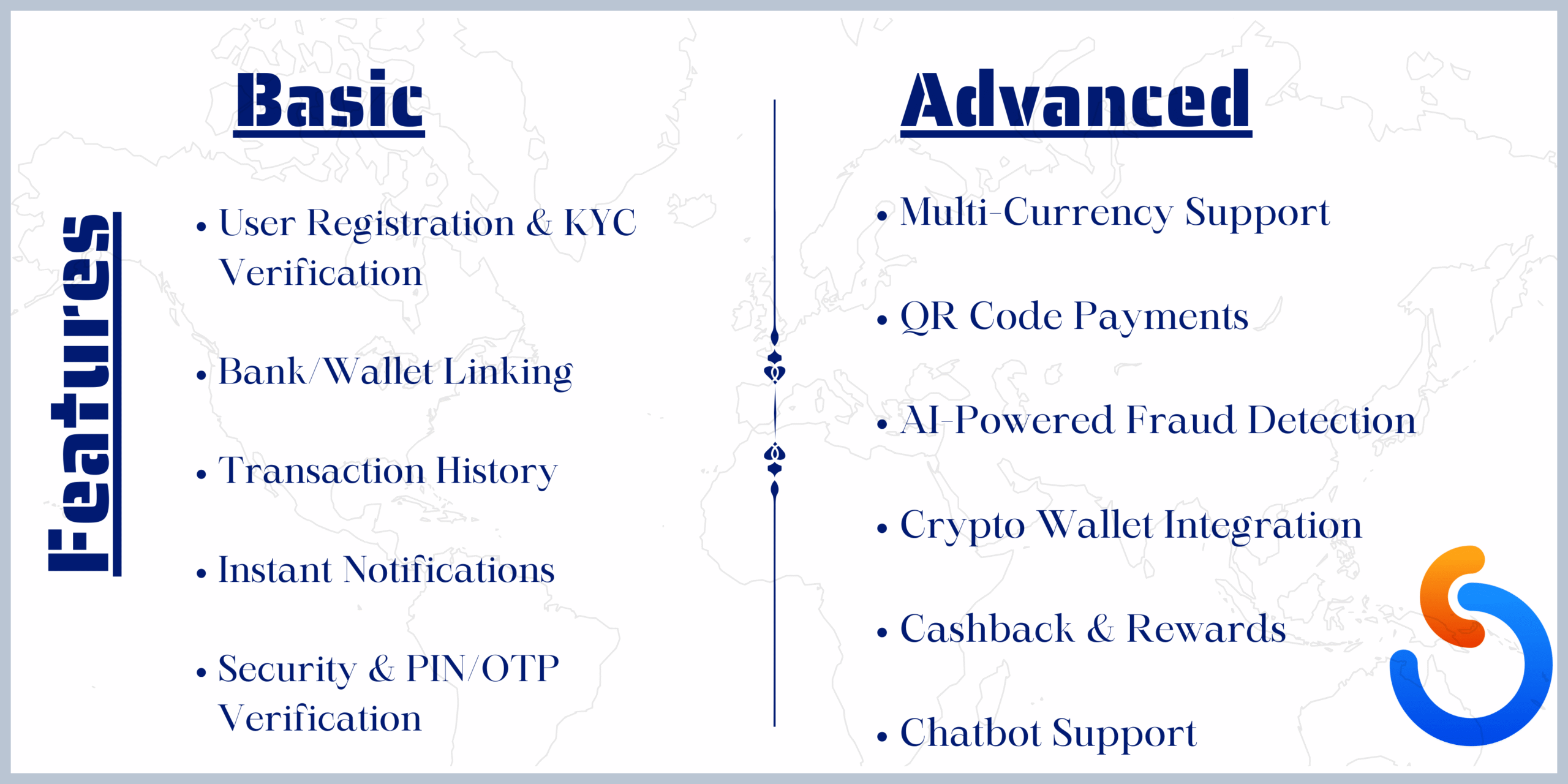
Here is a priority-tiered breakdown of all features needed to build a money transfer app successfully.
Tier 1: Must-Have Features (MVP Launch)
These are non-negotiable. Without them, your app cannot function legally or competitively.
- User Registration and Onboarding: Email, phone, and social sign-up with clear terms and privacy consent compliant with GDPR, CCPA, and local data laws
- KYC Verification: Identity document upload (passport, driver’s license, national ID), selfie verification, and automated identity matching via Jumio, Onfido, or Sumsub
- Bank Account / Card Linking: Connect external bank accounts via Plaid (US/EU) or local open banking APIs. Debit and credit card funding via Stripe or Adyen
- Send Money Flow: Recipient search by phone, email, or bank details. Amount entry with real-time fee and FX rate display. Review and confirm step before submission
- Transaction Status Tracking: Real-time transfer status updates initiated, in progress, completed, failed. Push notifications at each stage
- Transaction History: Complete searchable log of all past transfers with exportable statements
- Receive Money: A linked bank account, wallet address, or unique payment link for receiving funds
- Security Features: PIN, fingerprint, and Face ID authentication. Device binding. Session timeout. Suspicious activity alerts
- In-App Customer Support: Chat support widget, FAQ, and escalation to human agents for disputed transactions
Tier 2: Growth Features (Post-MVP, Months 3–9)
These features drive retention, increase transaction frequency, and unlock premium revenue streams.
- Multi-Currency Wallet: Hold balances in multiple currencies with real-time conversion. Essential for international remittance apps
- Scheduled and Recurring Transfers: Set up weekly, monthly, or event-triggered transfers popular for rent payments, family remittances, and payroll
- Split Payment: Divide a bill or payment among multiple recipients. Standard feature for P2P consumer apps
- Payment Request: Send a payment request link to anyone recipient pays without needing the app installed
- Beneficiary Management: Save and label frequent recipients for one-tap future transfers
- Referral Programme: Reward users for inviting new users one of the highest ROI growth channels in payments
- FX Rate Alerts: Notify users when their preferred currency pair hits a target exchange rate drives engagement and trust
- Bill Payments: Utility bills, mobile top-ups, and subscription payments integrated within the transfer app
Tier 3: Advanced / Scale Features (Month 9+)
These features differentiate a mature platform and open enterprise revenue channels.
- Business Accounts and API Access: B2B accounts with API for bulk payouts, payroll, and platform integrations
- Crypto / Stablecoin Transfer: Offer USDC, USDT, or BTC-based transfer options as settlement rails for faster, cheaper cross-border payments
- Virtual Cards: Issuing virtual debit cards tied to the wallet for spending across merchants
- White-Label Infrastructure: License your payment infrastructure to other businesses high-margin B2B revenue stream
- AI Fraud Detection: Machine learning models that score each transaction in real time for fraud risk reduces chargebacks and false positives
- Advanced Analytics Dashboard: For business accounts spending analysis, transaction reports, tax-ready exports, FX cost analytics
- IBAN / Local Account Numbers: Issue users a local account number in the destination currency allows employer deposits and local bill payments
Expert Tip: At Softcurators, we strongly recommend building to Tier 1 first and validating before expanding. The top reason money transfer app startups fail is over-building features before proving the core transfer experience. Our MVP development process is built around shipping fast and learning faster.
Technology Stack for Building a Money Transfer App
Choosing the right technology stack is one of the most consequential decisions when you build a money transfer app. The wrong choices create security vulnerabilities, scaling bottlenecks, and compliance gaps.
Here is the complete recommended stack.
| Layer | Recommended Technologies | Purpose |
| Frontend (Mobile) | React Native, Flutter, Swift (iOS), Kotlin (Android) | Cross-platform or native mobile apps |
| Frontend (Web) | React.js, Next.js, TypeScript | Web dashboard and admin panel |
| Backend | Node.js (Express), Python (Django/FastAPI), Go | REST/GraphQL API, business logic |
| Database | PostgreSQL, MySQL, MongoDB, Redis (cache) | Transaction records, user data, caching |
| Authentication | OAuth 2.0, JWT, Biometric SDK, OTP via Twilio | Secure login and session management |
| Payment Rails | Stripe, Plaid, MasterCard Send, Visa Direct, SWIFT API | Domestic and cross-border transfers |
| KYC/AML | Jumio, Onfido, Sum&Substance, Trulioo | Identity verification and compliance |
| Notifications | Firebase Cloud Messaging, Twilio, SendGrid | Push, SMS, email notifications |
| Security | AES-256, TLS 1.3, AWS KMS, HSM | Data encryption and key management |
| Cloud Infrastructure | AWS, Google Cloud, Azure (with PCI-DSS compliance) | Hosting, scaling, disaster recovery |
| Fraud Detection | Stripe Radar, Featurespace, custom ML models | Real-time fraud scoring |
| CDN & API Gateway | AWS CloudFront, Kong, NGINX | Performance and rate limiting |
Why the Payment Rails Choice Matters Most
The payment rail is the infrastructure that actually moves money. Your choice here determines your speed, cost, geographic reach, and compliance obligations.
- ACH (Automated Clearing House): Standard domestic rail in the US. 1–3 business day settlement. Low cost (~$0.20–$1.50 per transfer). Good for payroll and recurring transfers
- SEPA (Single Euro Payments Area): Standard for euro-denominated transfers across 36 European countries. Instant SEPA now available in most member states
- SWIFT: Global interbank messaging standard. Supports 180+ currencies. Slower (1–5 days) and more expensive. Essential for large-value international transfers
- Visa Direct / Mastercard Send: Push-to-card rails that settle in minutes to any Visa/Mastercard debit card globally. Excellent for consumer remittance use cases
- Real-Time Payment (RTP / FedNow in US, UPI in India, Faster Payments in UK): Instant domestic settlement. FedNow now covers the majority of US bank accounts
- Stablecoin Rails (USDC on Stellar, Base, Solana): Near-instant global settlement at near-zero cost. Growing in adoption for fintech-to-fintech corridors
Security Requirements for Money Transfer Apps
Security is non-negotiable when you build a money transfer app. A single breach destroys user trust permanently.
- AES-256 encryption for all data at rest
- TLS 1.3 for all data in transit TLS 1.2 is no longer acceptable for new builds
- Hardware Security Module (HSM) for cryptographic key storage
- Multi-factor authentication with FIDO2/WebAuthn support
- Device fingerprinting and anomaly detection for login events
- Rate limiting and IP reputation scoring on all API endpoints
- Immutable audit logs for every transaction event
- Penetration testing by a certified third party before launch
Mobile Platform Choice
For most money transfer app projects, Softcurators recommends React Native app development or Flutter app development for the MVP. A single codebase covers both iOS and Android reducing initial development cost by 35–40%. Native apps become worth the investment when you are processing $1M+ in monthly transaction volume and need maximum performance and biometric security integration.
Regulatory Compliance: The Critical Layer When You Build a Money Transfer App
Compliance is where the majority of money transfer app startups stumble. Many founders treat it as a box to tick after building the product. That is the wrong order. Regulatory requirements shape architecture decisions from day one.
Here is the compliance landscape you need to navigate.
| Regulation / Standard | Region | What It Requires |
| PCI-DSS | Global | Payment card data security standards |
| PSD2 / Open Banking | EU / UK | Strong customer authentication, open APIs |
| AML / CTF | Global | Anti-money laundering, counter-terrorism financing |
| KYC | Global | Identity verification before onboarding |
| GDPR | EU / UK | User data privacy and consent management |
| FinCEN MSB License | USA | Money Service Business registration |
| FCA Authorization | UK | Financial Conduct Authority approval |
| RBI Guidelines | India | RBI payment aggregator and wallet rules |
| ISO 27001 | Global | Information security management certification |
| SOC 2 Type II | USA / Global | Security, availability, confidentiality controls |
KYC: Know Your Customer
KYC is the foundation of any legal money transfer operation. Every user who sends money must be verified. There are three primary KYC approaches:
- Document + Selfie Verification: User uploads a government ID and a selfie. AI compares the selfie to the ID photo and validates document authenticity. Best for: consumer apps. Providers: Jumio, Onfido, Sumsub, Persona
- Database KYC: User provides personal details that are cross-referenced against credit bureau and government identity databases. Fast and frictionless but less robust. Best for: low-value transfer limits
- Enhanced Due Diligence (EDD): For high-value transfers or high-risk users includes source of funds verification, video KYC calls, and additional documentation. Required by most regulations above certain thresholds
AML: Anti-Money Laundering
AML compliance requires ongoing transaction monitoring not just at onboarding. Key AML requirements include:
- Transaction monitoring systems that flag suspicious patterns in real time
- SAR (Suspicious Activity Report) filing capability and processes
- Sanctions screening against OFAC, EU, and UN sanctions lists on every transaction
- PEP (Politically Exposed Persons) screening at onboarding and on transaction events
- AML risk scoring for users based on geography, transaction patterns, and behavior
Licensing Strategy
Licensing is the most complex compliance question when you build a money transfer app internationally.
- US: Money Transmitter License (MTL) required in most states. 45+ separate state licenses for nationwide operation or a single federal Money Service Business registration with FinCEN for oversight, supplemented by state licenses
- EU / UK: Payment Institution License from FCA (UK) or local national authority. Passporting within EU (under PSD2) allows single license to cover all EU member states
- India: Payment Aggregator license from RBI required. Prepaid Payment Instrument license for wallet products
- Nigeria: Payment Service Provider license from CBN (Central Bank of Nigeria)
- Global Strategy: Most startups begin with one jurisdiction, prove the model, then obtain licenses incrementally as they expand corridors
Important: Never launch a money transfer service without legal compliance in place. Operating as an unlicensed money transmitter is a criminal offense in most jurisdictions and carries personal liability for founders.
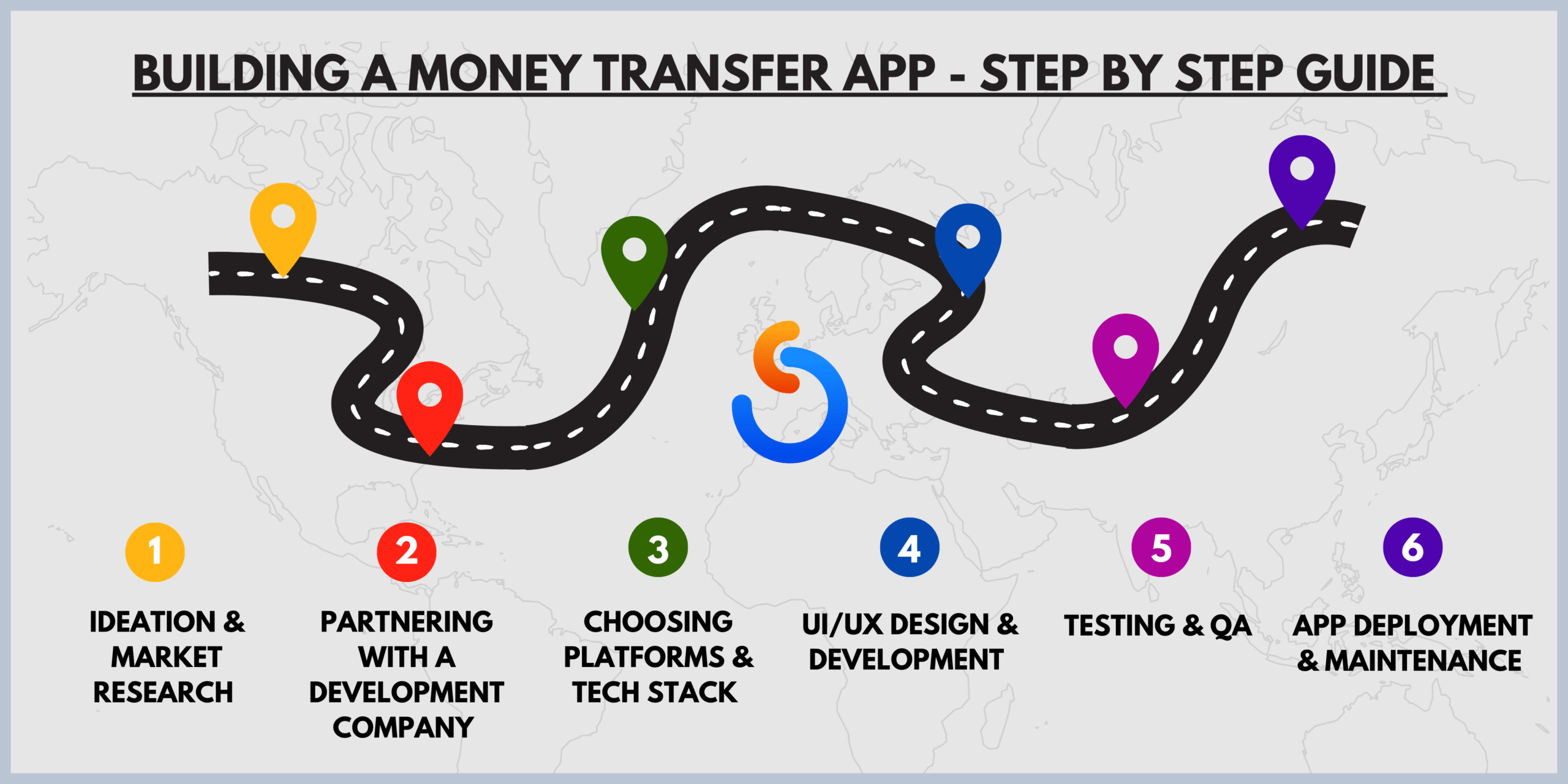
Step-by-Step: How to Build a Money Transfer App
Here is the step-by-step process Softcurators follows when helping clients build a money transfer app from concept to compliant launch.
Step 1: Discovery and Product Strategy (Weeks 1–2)
Great payment apps start with clarity, not code. During discovery, we answer:
- Which transfer corridor(s) are you targeting domestic, regional, or global?
- Who is your primary user consumer, small business, or enterprise?
- What is your differentiator price, speed, UX, specific community served?
- What is your compliance strategy and in which jurisdiction will you launch first?
- What is your revenue model transaction fees, FX margin, subscription, or freemium?
- Which existing payment rails and banking partners are available to you?
Softcurators runs structured discovery workshops for every money transfer app project. The output is a product brief, feature priority matrix, compliance roadmap, and architecture blueprint. This document prevents costly mistakes during development.
Step 2: Compliance and Legal Setup (Weeks 2–6, runs in parallel)
While design begins, your legal and compliance team runs in parallel:
- Engage a fintech-specialized attorney in your launch jurisdiction
- Begin Money Transmitter License applications processing times range from 30 days to 18 months depending on jurisdiction
- Select and contract KYC/AML vendors (Jumio, Onfido, Sumsub) and negotiate pricing
- Draft your AML Policy, KYC Policy, and Terms and Conditions
- Establish banking partnerships most startups use a bank-as-a-service (BaaS) provider like Stripe Treasury, Synapse, or Unit for early-stage operations
- Begin PCI-DSS compliance audit process if handling card data
Expert Tip: Many startups use a ‘sponsor bank’ model for early operations partnering with a licensed financial institution that provides regulatory coverage while you build and apply for your own license. This approach gets products to market 6–12 months faster.
Step 3: UI/UX Design and Prototyping (Weeks 3–6)
Trust is the dominant emotion in a payment app. Users need to feel safe before they send a single dollar. Our UI/UX design team builds payment app interfaces that communicate security, speed, and transparency:
- Clean, uncluttered design cognitive load should be minimal during transfer flows
- Fee and exchange rate transparency displayed before confirmation hidden fees kill trust instantly
- Progress indicators throughout multi-step flows users should always know where they are
- Error states designed for clarity payment failures need clear, calm explanations not cryptic codes
- Interactive prototype testing with 20+ representative users before development begins
Step 4: Backend Architecture and Core API Development (Weeks 5–12)
The backend is the financial nervous system of your app. It must be resilient, auditable, and scalable. Core backend components include:
- Ledger system: Double-entry accounting ledger that records every debit and credit with immutable timestamps the legal record of all transactions
- User management service: Handles registration, authentication, KYC status, and account lifecycle
- Transfer orchestration engine: Routes transfer requests to the appropriate payment rail, handles queuing, retries, and status callbacks
- FX engine: Pulls live exchange rates, calculates conversion amounts, manages rate locking and expiry
- Notification service: Pushes real-time transfer status updates via FCM (push), Twilio (SMS), and SendGrid (email)
- Fraud scoring service: Real-time risk scoring on each transaction using rules engine and ML model
Step 5: Payment Gateway and Rail Integration (Weeks 8–14)
Integrating payment rails is the most technically complex part of building a money transfer app. Each rail has its own API, error codes, settlement timing, and compliance requirements.
- Stripe Connect or Stripe Issuing for card-funded transfers and virtual card issuance
- Plaid for bank account linking and ACH transfer initiation (US)
- Visa Direct or Mastercard Send for push-to-card cross-border delivery
- SWIFT gpi API for correspondent banking wire transfers
- SEPA Instant Credit Transfer API for EU transactions
- Circle API for USDC stablecoin settlement (optional but increasingly common in 2026)
Step 6: KYC and AML Integration (Weeks 10–14)
KYC integration is where regulatory compliance meets product experience. The balance between friction and compliance is delicate.
- Integrate Jumio, Onfido, or Sumsub SDK for automated ID verification typically adds 60–90 seconds to onboarding for users
- Integrate sanctions screening via Dow Jones, Refinitiv, or Trulioo on every transaction initiation
- Build AML rules engine with configurable thresholds and human review queue for flagged transactions
- Implement tiered limits: lower transfer limits for lower KYC tier, higher limits after enhanced verification
- Build SAR reporting workflow for your compliance team
Step 7: Mobile App Development (Weeks 8–16)
With backend and integrations in progress, mobile app development begins in parallel. Key mobile development priorities for a money transfer app:
- Native biometric authentication integration (Face ID, Touch ID, Android BiometricPrompt API)
- Background app state handling transfer status updates delivered even when app is not in focus
- Offline graceful degradation clear messaging when network is unavailable during a transfer attempt
- Deep link handling for payment request links and referral URLs
- Accessibility compliance (WCAG 2.1 AA) financial apps have legal accessibility obligations in many markets
Step 8: Security Testing and Penetration Testing (Weeks 15–17)
Security testing for a money transfer app is not optional and is not the same as standard QA.
- OWASP Mobile Top 10 testing against iOS and Android builds
- API penetration testing by a certified third-party security firm (OSCP/CEH certified)
- SQL injection, XSS, and CSRF testing on all backend endpoints
- Man-in-the-middle attack simulation on the mobile app
- PCI-DSS Qualified Security Assessor (QSA) assessment if handling card data
- Load and stress testing: simulate 10,000 concurrent transfer requests to validate backend resilience
Step 9: Regulatory Approval and App Store Launch (Weeks 16–20)
- Submit Money Transmitter License application if not already approved (or confirm sponsor bank arrangement)
- Prepare Apple App Store submission: financial app category requires specific metadata, privacy policy, and compliance documentation
- Google Play Store: similar financial app requirements plus declaration of licensed financial institution status
- Soft launch to limited user group for final real-world transaction testing before full release
- Partner with one or two banking institutions for launch-day press and credibility
Step 10: Post-Launch Monitoring and Compliance Operations (Ongoing)
Launch is the beginning. A money transfer app requires ongoing compliance operations that do not exist in non-regulated tech products:
- Daily transaction monitoring against AML rules human review of flagged transactions
- Monthly regulatory reporting to financial authorities in each operating jurisdiction
- Annual penetration test and PCI-DSS recertification
- Model retraining for fraud detection as transaction patterns evolve
- License renewal and expansion as new corridors open
Softcurators provides maintenance and support services specifically calibrated for regulated fintech products. We know that a bug in a payment app is not just a UX issue it can be a compliance event.
Revenue Models for Money Transfer Apps: How to Make Money
Understanding revenue models is essential before you build a money transfer app. The wrong monetization strategy can price you out of your market or leave significant margin on the table.
Revenue Model 1: FX Margin
The most profitable model for international transfer apps. You apply a small markup to the mid-market exchange rate (typically 0.3%–2.5%) and pocket the difference. Wise built a $10B+ business primarily on this model while marketing transparent ‘mid-market rates’ which they deliver at lower margins than competitors while still generating significant FX revenue at scale.
Revenue Model 2: Per-Transaction Fee
A flat fee or percentage charged on each transfer. Simple, predictable, and understood by users. Examples:
- Flat fee: $2.99 per domestic transfer regardless of amount
- Percentage: 1.5% of transfer amount for international remittances
- Hybrid: $0.50 + 0.8% of transfer amount
Transaction fees work best for high-frequency, lower-value transfers where a percentage model would feel punitive.
Revenue Model 3: Subscription / Premium Accounts
Charge a monthly fee for a premium tier that includes zero-fee transfers up to a limit, higher transfer limits, priority processing, and additional features like virtual cards or investment accounts.
This model drives strong revenue predictability and reduces price sensitivity users on monthly plans send more money because incremental transfers feel ‘free’.
Revenue Model 4: Float Income
When users hold balances in your app, that money can be held in interest-bearing accounts. In 2026’s interest rate environment, float income on large aggregate balances generates significant passive revenue. This requires appropriate regulatory permissions and deposit insurance in most jurisdictions.
Revenue Model 5: B2B API Access
Offer API access to your transfer infrastructure for businesses to integrate into their own products. Charge per API call, per transaction processed, or as a monthly platform fee. This model scales non-linearly one enterprise client can generate more revenue than thousands of consumer users.
Revenue Model 6: Value-Added Financial Services
Once you have user trust and a payments foundation, expanding into adjacent financial products creates significant additional revenue:
- Savings accounts with competitive interest rates
- International debit cards tied to the multi-currency wallet
- Business loans and working capital advances based on transaction history
- Insurance products for international transfers (currency protection, transfer insurance)
How Much Does It Cost to Build a Money Transfer App ?
Cost is always the first question from founders. The honest answer is: it depends significantly on scope, compliance requirements, platform, and geographic ambitions. Here is an honest breakdown.
| Component | Basic MVP | Mid-Range | Enterprise |
| UI/UX Design | $2,000–$3,000 | $5,000–$10,000 | $15,000–$30,000 |
| User Auth & KYC | $2,000–$5,000 | $6,000–$12,000 | $20,000–$30,000 |
| Payment Gateway Integration | $3,000–$5,000 | $8,000–$15,000 | $20,000–$40,000 |
| Backend API & Database | $3,000–$7,000 | $10,000–$20,000 | $25,000–$50,000 |
| iOS App Development | $5,000–$10,000 | $12,000–$20,000 | $30,000–$50,000 |
| Android App Development | $5,000–$10,000 | $10,000–$20,000 | $25,000–$60,000 |
| Admin Dashboard | $2,000–$4,000 | $5,000–$8,000 | $10,000–$20,000 |
| Security & Encryption | $2,000–$4,000 | $6,000–$10,000 | $15,000–$25,000 |
| Compliance & Licensing | $1,000–$3,000 | $5,000–$10,000 | $15,000–$40,000 |
| QA & Testing | $1,000–$3,000 | $4,000–$7,000 | $10,000–$20,000 |
| DevOps & Cloud Setup | $1,000–$2,000 | $3,000–$6,000 | $7,000–$15,000 |
| TOTAL ESTIMATE | $30,000–$40,000 | $50,000–$70,000 | $80,000–$100,000+ |

What Drives Cost Up
- Multi-jurisdiction licensing (each jurisdiction adds $10,000–$30,000+ in legal fees)
- Custom fraud detection ML model (adds $15,000–$40,000 vs. using Stripe Radar)
- Building on native iOS + Android simultaneously vs. React Native or Flutter
- SWIFT direct membership vs. accessing SWIFT through a correspondent bank (adds infrastructure cost)
- Biometric hardware security module integration for highest-security use cases
- 24/7 human AML operations team (significant ongoing cost)
What Reduces Cost
- Using a BaaS (Bank-as-a-Service) provider for early operations instead of direct banking relationships
- React Native or Flutter cross-platform development for MVP
- Third-party KYC vendors (Jumio, Onfido) instead of building in-house
- Managed cloud services (AWS Managed Compliance, Google Cloud PCI services) instead of self-managed compliance infrastructure
- Phased geographic rollout start in one jurisdiction, expand after revenue validation
Ongoing Monthly Operating Costs
- Cloud infrastructure (PCI-compliant): $3,000–$20,000/month depending on volume
- KYC verifications: $1–$5 per verified user (drops at volume)
- Payment rail transaction fees: varies by rail ($0.05–$0.50 per ACH; 1.5%–2.9% + $0.30 per card)
- AML monitoring software: $500–$5,000/month
- App maintenance and updates: $5,000–$15,000/month
- Compliance officer salary or outsourced compliance: $5,000–$20,000/month
Softcurators provides transparent, detailed money transfer app development pricing with no hidden fees. We also offer phased engagement models that let you start with MVP scope and expand. Contact us at softcurators.com/contact for a free project estimate.
Security Best Practices: Building a Money Transfer App That Users Trust
Security is the product when you build a money transfer app. It is not a feature added at the end it is an architectural principle embedded at every layer.
Application Security
- Certificate pinning on all mobile apps to prevent man-in-the-middle attacks
- OWASP Mobile Top 10 mitigations implemented during development, not during testing
- Input validation and output encoding on every API endpoint
- SQL parameterization no raw string query construction anywhere in the codebase
- Dependency scanning (Snyk, Dependabot) to catch vulnerable third-party libraries
Authentication and Session Management
- Passwordless options (FIDO2/passkeys) for higher security with lower friction
- Transaction authentication separate from login authentication high-value transfers require re-authentication
- Session invalidation on all devices on password reset or security alert
- Behavioral biometrics as an invisible additional authentication layer
Infrastructure Security
- Private VPC for all backend services no public-facing database endpoints
- Web Application Firewall (WAF) in front of all API endpoints
- DDoS protection (AWS Shield, Cloudflare) to protect payment endpoints during attack events
- Intrusion Detection System (IDS) with real-time alerting to security operations team
- Zero-trust network architecture no internal service trusts another without explicit authorization
Fraud Prevention
- Device fingerprinting on every login and transaction device changes trigger additional authentication
- Velocity checks flag accounts with unusual transaction frequency in short windows
- Geolocation anomaly detection flag transactions from unexpected geographies
- Account takeover detection flag login from new device immediately after password reset
Softcurators has implemented mobile app security and compliance architectures for fintech clients across three continents. Our security compliance in digital lending guide covers many overlapping principles if you want deeper reading.
Why Build Your Money Transfer App with Softcurators?
Softcurators (softcurators.com) is a specialist mobile app and web development company with a dedicated fintech app development practice. We have built payment, lending, and banking products for clients across the US, UK, Europe, and emerging markets. When you choose Softcurators to build a money transfer app, you get more than developers you get a team that understands the regulatory, financial, and product nuances of this category.
Our Fintech and Payment Development Services
- Fintech app development payment apps, banking platforms, investment tools
- Banking app development neobank and digital banking products
- eWallet app development stored-value wallet infrastructure
- Loan lending app development lending and credit products
- BNPL app development buy now pay later infrastructure
- AI development AI-powered fraud detection and credit scoring
Key Trends Shaping Money Transfer App Development
Trend 1: AI and ML-Powered Fraud Detection
Traditional rules-based fraud systems cannot keep up with the sophistication of modern financial fraud. In 2026, the leading money transfer apps use ML models that score every transaction in real time across hundreds of signals device fingerprint, behavioral biometrics, network characteristics, and historical patterns. False positive rates have dropped by 60% on platforms using ML vs. rules-only systems.
Trend 2: Stablecoin Settlement Rails
USDC on Stellar and Base, and USDT on Tron, are increasingly used as settlement rails for international remittances. The operational model: receive local currency from sender, convert to stablecoin, transfer on-chain in seconds, convert to recipient local currency on arrival. Settlement costs drop to near zero. Speed drops to under 60 seconds for global transfers. Several remittance apps have already shifted primary corridors to stablecoin rails.
Trend 3: Embedded Finance and API-First Platforms
The most scalable business models in payments are now API-first platforms that power other businesses. Stripe, Plaid, and Wise Platform have proven that licensing your payment infrastructure generates higher margins and faster growth than a direct consumer model. In 2026, building your money transfer app with an API layer from day one positions you for both B2C and B2B revenue.
Trend 4: Open Banking Integration
PSD2 in Europe and Open Banking Standard in the UK have matured significantly. In the US, the CFPB’s Personal Financial Data Rights Rule is accelerating open banking adoption. Money transfer apps that integrate open banking for bank account verification and payment initiation can reduce ACH failure rates by 40% and eliminate card funding fees entirely for bank-funded transfers.
Trend 5: Biometric and Passkey Authentication
Password-based authentication is dying in financial apps. FIDO2 passkeys, which use biometric data stored on the device rather than a server-side password, are being adopted rapidly. They eliminate phishing risk entirely and reduce account takeover fraud by over 90% vs. password + SMS OTP systems. Building passkey support into your app from launch is now best practice.
Trend 6: Super App Model in Emerging Markets
In Southeast Asia, Africa, and Latin America, the most successful financial apps are not single-purpose they are super apps. M-Pesa, GCash, and OPay combine money transfer with payments, loans, savings, insurance, and merchant services in one platform. Building a super app architecture from day one requires careful design but positions you for dramatically higher LTV per user.
Conclusion: Build a Money Transfer App the Right Way
The global demand for fast, affordable, mobile-first money transfer is not slowing down. Every day, millions of people send money to family abroad, pay remote contractors, and move funds between their own accounts across borders. The apps that make this experience faster, cheaper, and more trustworthy capture enormous loyalty and significant revenue.
Building a money transfer app is not a simple product it is a regulated financial service built on top of a software product. That combination demands both technical excellence and regulatory expertise. Get either one wrong and you have either an unlaunchable product or a non-compliant business.
At Softcurators, we bring both to the table. Our fintech app development team understands the payment rails, the KYC vendors, the compliance obligations, and the UX standards that make a money transfer app users actually trust. And our mobile app development practice has the engineering depth to ship secure, scalable products on time.
The best time to start building was yesterday. The second-best time is right now.
Frequently Asked Questions: How to Build a Money Transfer App
How long does it take to build a money transfer app?
An MVP for a domestic P2P transfer app can be delivered in 8–12weeks. An international remittance platform typically takes 12–15weeks due to payment rail integration complexity and compliance setup. An enterprise-grade platform with multiple corridors and currencies takes 20–30weeks. Licensing timelines in your jurisdiction affect the product launch date independently of development timelines.
Do I need a license to build a money transfer app?
Yes. In virtually every jurisdiction, operating a money transfer service requires a license or registration. In the US, you need a Money Transmitter License in each state plus FinCEN registration. In the UK, you need FCA authorization. In the EU, a Payment Institution License. Starting without proper licensing is a criminal offense in most markets. Many startups use a sponsor bank or BaaS provider for early operations while their own license applications process.
What is the best technology stack for a money transfer app?
For the MVP, we recommend React Native or Flutter for mobile, Node.js or Python (FastAPI) for the backend, PostgreSQL for the transaction database, Redis for caching, and AWS for cloud infrastructure with PCI-DSS managed services. For payment rails: Stripe for card funding, Plaid for bank account linking (US), and Visa Direct or Mastercard Send for cross-border delivery. For KYC: Jumio, Onfido, or Sumsub for automated identity verification.
How do money transfer apps make money?
The six primary revenue models are: (1) FX margin on currency conversion (most profitable for international apps), (2) per-transaction fees (flat or percentage), (3) subscription premium accounts with zero-fee transfers up to a limit, (4) float income on held balances, (5) B2B API access fees, and (6) adjacent financial products like savings accounts and insurance. Most successful apps use two or three models simultaneously.
What security certifications does a money transfer app need?
At minimum: PCI-DSS Level 1 if handling card data, SOC 2 Type II for trust and security controls, ISO 27001 for information security management, and jurisdiction-specific requirements (FCA security standards in UK, RBI guidelines in India). Beyond certifications, annual penetration testing by a certified third party is expected by regulators and banking partners.
Can Softcurators build a complete money transfer app end-to-end?
Yes. Softcurators handles the complete development lifecycle product strategy, UI/UX design, backend development, payment rail integration, KYC/AML vendor integration, iOS and Android development, security testing, App Store submission, and ongoing maintenance. Our fintech app development team has delivered payment products across the US, UK, Europe, and Asia. Contact us at softcurators.com/contact.
What is KYC and why is it required for money transfer apps?
KYC stands for Know Your Customer. It is a regulatory requirement that mandates financial services companies verify the identity of their users before allowing money transfers. KYC prevents money laundering, terrorist financing, and fraud. For money transfer apps, KYC typically involves document verification (passport or national ID), selfie matching, and sanctions screening. Most markets set tiered limits lower limits for basic KYC, higher limits for enhanced verification.
What payment rails should I integrate first?
For a US domestic P2P app: start with Plaid for bank linking and ACH for transfers, add Stripe for card funding. For international remittance: start with Visa Direct or Mastercard Send for fastest delivery, add SWIFT for high-value transfers. For EU operations: SEPA Instant Credit Transfer. In emerging markets: integrate with local mobile money operators (M-Pesa, MTN Mobile Money) and local real-time payment systems (UPI in India, PromptPay in Thailand).
How do I prevent fraud in a money transfer app?
Fraud prevention requires a layered approach: device fingerprinting and binding, velocity checks on transaction frequency, geolocation anomaly detection, behavioral biometrics as passive continuous authentication, ML-based transaction risk scoring, manual review queue for high-risk transactions, and real-time sanctions screening. Using a vendor like Stripe Radar or Featurespace significantly reduces the time to implement basic fraud protection.
What is the difference between a money transfer app and a digital wallet?
A money transfer app primarily facilitates moving money from one person or account to another. A digital wallet stores a balance that can be used for payments, transfers, and other financial activities. Many apps combine both users hold a wallet balance and can transfer funds to others or spend at merchants. Our guide on how to develop an e-wallet app covers the wallet-specific architecture in more detail.
How do I handle currency conversion in an international transfer app?
You have two primary options: (1) Build your own FX engine that pulls live mid-market rates and applies a configurable margin requires banking relationships for FX settlement. (2) Use a third-party FX provider like Currencycloud (now part of Visa), Fixer.io, or Open Exchange Rates for rate data, and a FX liquidity provider for actual currency conversion. Most startups use option 2 for the first 12–24 months and build proprietary FX infrastructure at scale.
What is a sponsor bank and do I need one?
A sponsor bank is a licensed financial institution that provides regulatory coverage to a fintech startup allowing the startup to operate money transfer services under the bank's license while its own license application is in progress. Examples include Bancorp, Evolve Bank, and Column Bank in the US; Clearbank in the UK. Most early-stage money transfer apps use a sponsor bank for the first 12–24 months of operation. The bank takes a revenue share (typically 10–30%) in exchange for regulatory coverage.
Should I build natively for iOS and Android or use cross-platform?
For an MVP, cross-platform development with React Native or Flutter reduces development time and cost by 35–40% while delivering excellent performance. For a production app processing significant transaction volume, native iOS (Swift) and Android (Kotlin) development provides better biometric security integration, lower latency, and more granular control over hardware-level security features. Our guide on native vs hybrid apps covers this decision in depth.
How do I integrate biometric authentication in a money transfer app?
On iOS, use the LocalAuthentication framework (Face ID and Touch ID via BiometricKit). On Android, use the BiometricPrompt API introduced in Android 9. In React Native, use libraries like react-native-biometrics. In Flutter, use local_auth package. Importantly, biometric data never leaves the device the biometric authenticates the user to the device, which then provides a cryptographic signature to your app. This is more secure than sending biometric data to a server.
What AML monitoring solution should I use?
For early-stage startups, a third-party AML vendor is strongly recommended over building in-house. ComplyAdvantage, Chainalysis (for crypto), and Featurespace offer SaaS AML monitoring with sanctions screening, PEP screening, and transaction monitoring. Cost ranges from $1,000–$10,000 per month depending on transaction volume. Building AML in-house typically costs $200,000–$500,000 and 9–18 months only justified for apps processing $50M+ per month.
How do I handle failed or delayed transactions?
Every money transfer can fail network errors, insufficient funds, banking partner issues, AML holds, or beneficiary account problems. Your app must handle each failure state gracefully: immediate user notification with plain-language explanation, automatic refund processing within 24 hours, clear escalation path to customer support, and an internal alert to your operations team for every failed transaction above a threshold. Settlement failures in cross-border transfers can require working with multiple banking partners simultaneously.
What makes Softcurators different from other app development companies for fintech?
Three things differentiate Softcurators for money transfer app development: (1) We have built and launched regulated payment products not just prototypes. We understand PCI-DSS, KYC integration, and payment rail APIs from production experience, not theory. (2) We use a compliance-first development process regulatory requirements shape architecture decisions from day one, not as retrofitted features. (3) We offer ongoing fintech-specialized maintenance and support because fintech apps require continuous compliance monitoring and security updates that general support teams are not equipped for.
Can I add crypto transfer features to my app?
Yes, and it is increasingly common in 2026. The most practical approach is using stablecoin rails (USDC, USDT) for settlement rather than volatile cryptocurrencies. Integration options include Circle's API (for USDC), Fireblocks (institutional-grade crypto custody and transfer), or building directly on public blockchains like Stellar or Base. Regulatory requirements for crypto transfers differ from traditional money transfer most jurisdictions require a separate Virtual Asset Service Provider (VASP) registration or license.
How do I market a new money transfer app in a competitive market?
The highest ROI growth channels for money transfer apps are: (1) referral programmes a $10 refer-a-friend bonus costs less than paid acquisition at scale and brings higher-LTV users. (2) Specific corridor focus dominate one remittance corridor (e.g., UK to Ghana) with community-specific marketing before expanding. (3) Partnership with diaspora community organizations, ethnic grocery stores, and money transfer agents in the target community. (4) Transparent pricing marketing if your fees are genuinely lower than competitors, show the comparison directly. Wise built its entire brand on this approach.
What are the most common mistakes when building a money transfer app?
The top five mistakes we see are: (1) Starting development before compliance strategy is decided creates costly rework when regulations shape architecture. (2) Underestimating licensing timelines MTL applications in the US take 6–18 months per state. (3) Building custom KYC and AML systems from scratch instead of using specialist vendors. (4) Over-engineering the feature set for launch instead of validating with an MVP. (5) Treating security as a testing phase rather than an architectural principle security gaps in payment apps are existential, not recoverable with a patch.
