

Most founders come into an MVP conversation asking how to build a smaller version of their product for less money. That’s a reasonable question, and it’s also not quite the right one. MVP development isn’t primarily a cost-reduction exercise – it’s a research method that happens to produce working software as a by-product. The goal isn’t a cheaper product. The goal is a specific, falsifiable answer to a question you don’t currently know.
This distinction matters because it changes what “overbuilding” actually means. Overbuilding isn’t just adding too many features – it’s building anything that doesn’t help you get an answer faster or more cheaply. A perfectly polished login flow that took three weeks to build is overbuilding if the actual question you needed answered was whether anyone wants the core product at all. This guide walks through how to define what you’re actually testing, what to build (and skip) to test it honestly, and where the real cost and risk trade-offs sit in that decision.
If you’re past the MVP stage already and scoping a fuller build, our guide on mobile app development for businesses and startups picks up from where this one leaves off.
It’s worth naming upfront who this framing helps most and who it might frustrate. Founders who already have strong conviction and existing traction sometimes find the emphasis on falsifiable testing overly cautious – and for a genuinely proven concept expanding into an adjacent market, that reaction is fair. This guide is written primarily for the more common and more expensive mistake: teams building an entire product around an assumption nobody has actually tested, discovering the gap only after months of engineering time are already spent.
What an MVP Actually Is (And What It Isn’t)
A minimum viable product is the smallest version of a product that lets you test a specific assumption about whether people want it, will pay for it, or will use it the way you expect. The word “minimum” refers to the assumption being tested, not to the product category – a minimum viable test of “will restaurants pay for this” looks completely different from a minimum viable test of “will this feature reduce churn.” Understanding this distinction upfront saves teams from the most common early mistake in this entire process: treating “MVP” as a fixed shape of product rather than a variable one determined by what you actually need to learn.
It’s Not a Cheaper Version of Your Final Product
This is the misunderstanding that causes the most damage. Teams often treat the MVP as version 1.0 of the roadmap – the same product, just with fewer features checked off – rather than as a deliberately designed instrument for learning something specific. That framing quietly reintroduces every feature back into scope over time, since “version 1.0 of the real product” naturally expands to include whatever the team already believes the product needs.
It’s Not the Same as a Prototype, a Pilot, or a Beta
These terms get used interchangeably, and the difference matters for planning. A prototype demonstrates a concept, often without real backend logic, purely to get reactions to a design or flow. A pilot runs a working product with a small, chosen group of real users, typically after you already believe the concept works. A beta is a pre-release version of a product you’re already committed to shipping, mainly used to catch bugs and refine details. An MVP sits earlier than all three – it exists specifically because you don’t yet know if the underlying assumption holds, and its job is to find out as cheaply as possible.
Consultant’s Tip
Before any scoping conversation, write down the single sentence: “I will build X to find out whether Y is true.” If you can’t fill in a specific, falsifiable Y – not “whether people like it” but something you could actually be wrong about and would recognize if you were – you’re not ready to scope an MVP yet. You’re still doing product discovery, and that’s a different, earlier-stage conversation.
The Assumption Comes First, Not the Feature List
This is the section where we’re going to take a firm position: most MVP scoping conversations start in the wrong place, jumping straight to a feature list before anyone has agreed on what question the product needs to answer. This ordering problem is subtle enough that teams rarely notice they’ve made it – a feature list feels like progress, while sitting with an unresolved question feels like stalling, even though the question is the actual work.
Identify the Riskiest Assumption, Not the Most Obvious One
Every product idea rests on a stack of assumptions – that a problem exists, that people will change behavior to solve it, that they’ll pay, that you can acquire them affordably, that the mechanism you’ve designed actually works. Not all of these carry equal risk. The riskiest assumption is the one that, if false, invalidates the entire business – not the one that’s technically hardest to build or the one you’re most excited to demonstrate. Scoping an MVP around a technically impressive but low-risk assumption is a common way to spend real money learning something that was never actually in question.
Define What Evidence Would Prove You Wrong
Before building anything, decide what result would tell you the assumption doesn’t hold. This is uncomfortable, because it means committing in advance to a threshold that might mean walking away from an idea you’re personally invested in. Practical recommendation: write this threshold down and share it with your team or investors before launch, not after results come in, since it’s far too easy to rationalize a disappointing number after the fact if you didn’t commit to a bar beforehand.
For a broader framework on how this fits into overall product cost planning, our mobile app development cost and pricing guide and mobile app cost calculator are useful companions once you’ve defined what you’re actually testing.
A Worked Example: The Same Idea, Two Different Riskiest Assumptions
Abstract advice about “finding the riskiest assumption” is easy to nod along with and hard to actually apply. A concrete comparison makes the distinction clearer.
Scenario One: A New Marketplace Connecting Two Sides of a Transaction
Imagine a platform connecting freelance specialists with businesses in a niche industry. If specialists and businesses in that niche have never used anything like this before, the riskiest assumption is basic behavior change – will either side bother signing up and engaging at all, regardless of how well the matching works. Testing this doesn’t require a working marketplace; a landing page for each side, or a concierge process manually connecting the first handful of matches by hand, answers the question directly and far more cheaply than building matching algorithms and two-sided onboarding flows.
Scenario Two: The Same Marketplace, But the Category Already Has Established Competitors
Now imagine the same concept in a category where several competing marketplaces already operate successfully. Basic demand isn’t the risky assumption anymore – it’s clearly been validated by competitors already earning revenue. The riskiest assumption shifts to something specific about your differentiation: does your particular matching approach, pricing model, or niche focus actually outperform what’s already available. That’s a mechanism-level question a landing page can’t answer, and it genuinely requires a working single-feature build to test honestly.
The point of this comparison: the same product idea can require two entirely different MVP formats depending on facts about the market that have nothing to do with the product itself. Scoping an MVP without first establishing which of these situations you’re actually in is how teams end up building the wrong test.
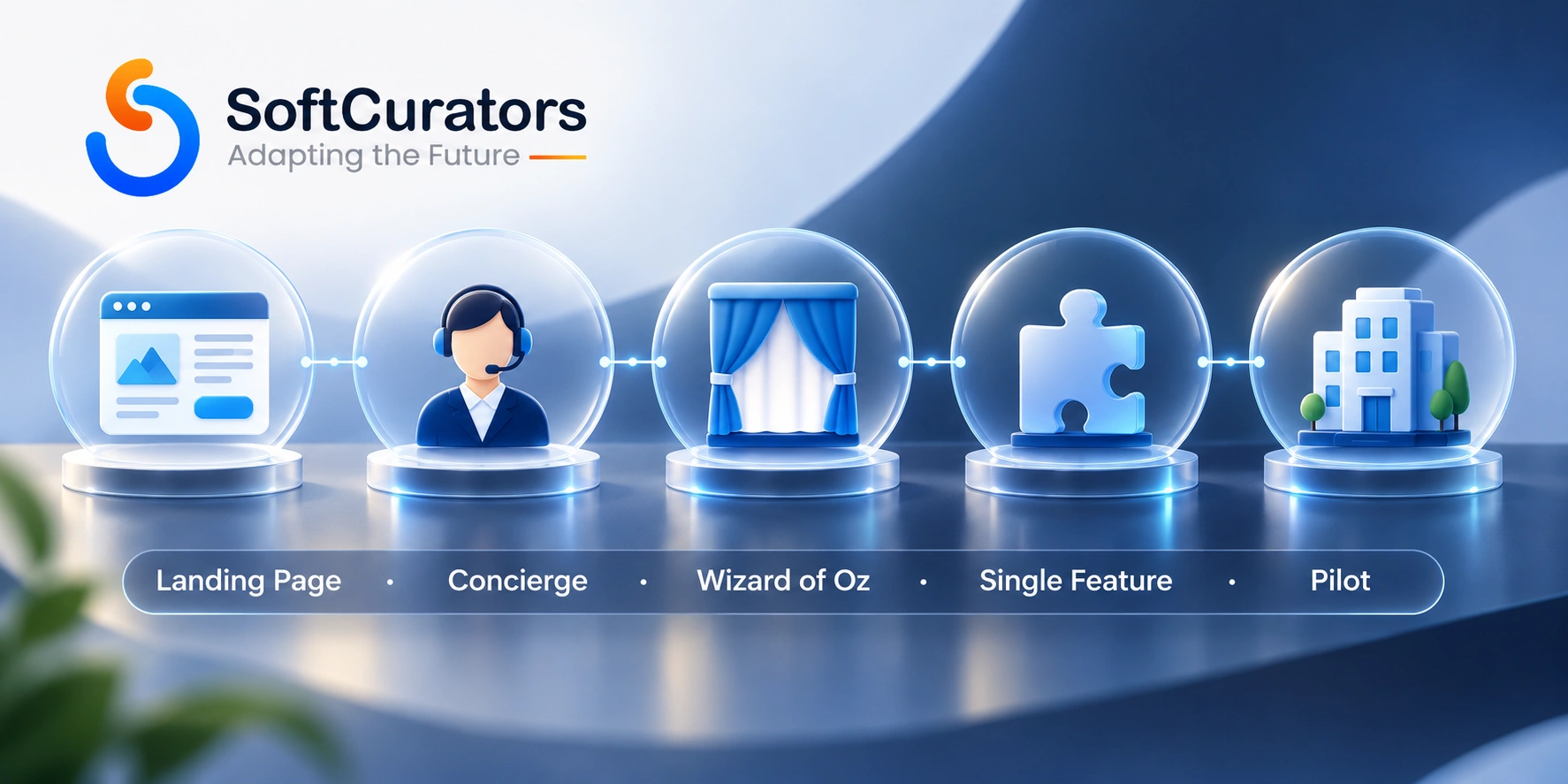
The Five Real MVP Formats (Most of Which Don’t Require Writing Software)
This is the part of MVP planning most guides skip past too quickly, jumping straight to “build a simplified app.” In practice, several formats exist, and the right one depends entirely on what assumption you’re testing – not on which format sounds the most like a real product launch.
The Landing Page or Smoke Test
A page describing the product with a signup or pre-order button, run against real ad spend or organic traffic, to see if people express real intent before you write any product code. Best for: testing demand for a concept before committing to the mechanism that delivers it. Weak for: anything where the actual experience of using the product is the risky part – a landing page can’t tell you whether your onboarding flow works.
The Concierge MVP
You deliver the product’s outcome manually, behind the scenes, without building any automation at all – a human doing by hand what software would eventually do. Best for: validating that people want the outcome before investing in the mechanism, particularly for service-like products where the value is in the result, not the interface. Weak for: products where the software experience itself is the value proposition, since a manual process can’t tell you anything about interface usability.
The Wizard of Oz MVP
The user interacts with what looks like a fully automated product, but a human is quietly doing the work behind the interface. Best for: testing whether an automated experience is desirable before investing in the (often expensive) automation itself. Weak for: anything where response time or the mechanics of automation are part of what’s being tested, since a human can’t replicate real-time automated behavior at scale.
The Single-Feature MVP
A real, working product that does exactly one thing, deliberately excluding every adjacent feature on the roadmap. Best for: testing whether a specific mechanism actually solves the problem, once demand for the general idea is already established. Weak for: validating basic demand – if you’re not sure anyone wants this at all, building even one working feature is more investment than a landing page test requires.
The Piloted Full Build
A genuinely built product, deployed to a small, deliberately chosen group of real users rather than a general audience. Best for: situations where the product genuinely can’t be tested any other way – deep technical products, regulated industries, or B2B tools requiring real integration with a customer’s existing systems. Weak for: early-stage consumer products, where this level of investment before validating basic demand is close to the overbuilding pattern this guide is meant to prevent.
| Format | Validates | Time to Learn | Weakest At |
| Landing page / smoke test | Basic demand and messaging resonance | Days to a couple of weeks | Whether the actual product experience works |
| Concierge MVP | Whether people want the outcome, manually delivered | Weeks | Interface usability and automated mechanics |
| Wizard of Oz MVP | Whether an automated experience is desirable | Weeks | Real-time or at-scale automated behavior |
| Single-feature MVP | Whether a specific mechanism solves the problem | Weeks to a couple of months | Basic demand validation, if that’s still in question |
| Piloted full build | Deep technical or integration-dependent products | A few months | Speed and cost for early-stage consumer ideas |
Business Insight
The instinct to jump straight to a single-feature software MVP is understandable – it feels like real progress, and it’s what most people picture when they hear “MVP.” But if your riskiest assumption is basic demand, a landing page or concierge test answers that question in days, at a fraction of the cost, before you’ve committed engineering time to anything. Save the software build for the assumption that actually requires software to test.
Where Overbuilding Actually Happens (Both Directions)
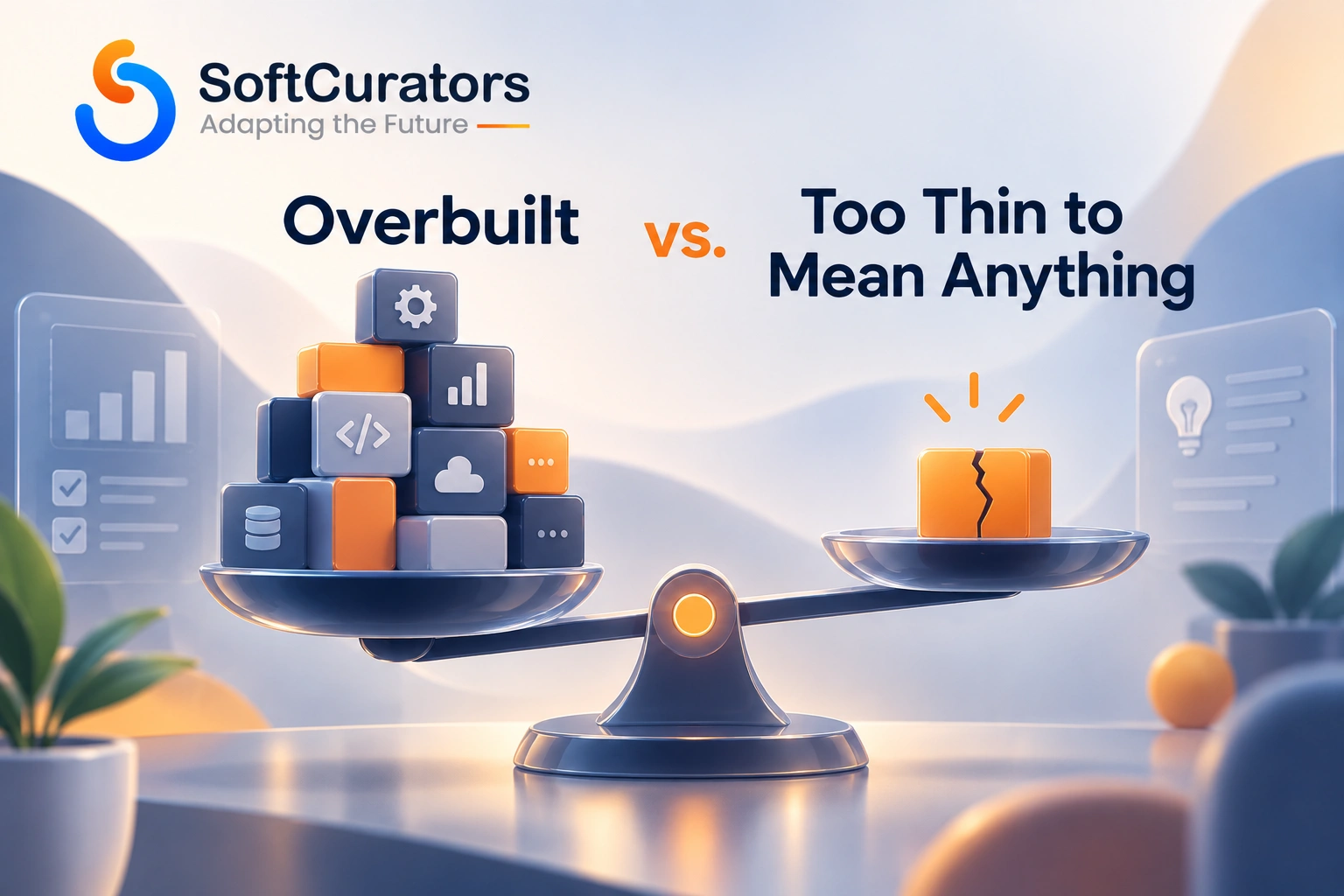
Overbuilding isn’t always about adding too many features. It’s a two-sided risk, and both sides are genuinely common – which is exactly why generic advice to “just cut more” doesn’t reliably help a team avoid either one.
Building Infrastructure for Scale You Don’t Have Yet
Multi-tenancy architecture, horizontally scalable databases, elaborate caching layers, and admin tooling built for a team of fifty when you have a team of three are all forms of overbuilding, because they’re solving a problem you don’t currently have and might never have if the core assumption doesn’t hold. This is the more commonly discussed form of overbuilding, and it’s real – but it’s not the only one.
It’s worth naming why this particular mistake is so persistent despite being widely acknowledged as a mistake: it often comes from genuinely good engineering instincts applied at the wrong time. An experienced engineer who has been burned by technical debt in a previous role reasonably wants to avoid repeating that pain, and building for scale from the start feels like professional discipline rather than waste. The discipline that actually matters at this stage is different – it’s the willingness to accept some technical debt deliberately, in exchange for a faster, cheaper answer to whether the product should exist at all.
Cutting So Much the Test Becomes Meaningless
The less-discussed failure mode: cutting features so aggressively that the resulting product can’t actually deliver the core value proposition, so a quiet launch tells you nothing about whether the idea works – only that a broken version of it didn’t get traction. We’d argue this failure is just as damaging as overbuilding infrastructure, and it’s more common than most MVP advice acknowledges, because “cut more” is repeated so often as generic advice that teams cut past the point where the product can still honestly represent the value it’s meant to test.
The Actual Discipline: Cut Around the Assumption, Not Around Effort
The right question when deciding what to include isn’t “is this hard to build” or “do we have time for this” – it’s “does removing this change whether the test result means anything.” A feature that’s expensive to build but central to the value proposition stays in scope. A feature that’s easy to build but irrelevant to the assumption being tested gets cut, regardless of how little extra time it would take.
Technical Architecture Decisions Specific to MVPs
The right technical choices for an MVP are often different from the right choices for a mature product, and treating them the same is a common source of wasted effort. Every decision in this section should be evaluated against the same question raised earlier: does this choice help you learn faster and more cheaply, or is it solving a problem you don’t have evidence you’ll actually face.
Monolith First, Almost Always
A single, straightforward application architecture is nearly always the right starting point for an MVP, even if you eventually expect to need a more distributed architecture at scale. Technical note: splitting a system into separate services before you understand your actual usage patterns and team structure adds real coordination overhead for a scaling problem you don’t have evidence you’ll ever face. This is one of the clearest, least controversial forms of overbuilding in this entire guide, and it’s still common.
Buy the Undifferentiated Infrastructure
Authentication, payment processing, and basic backend infrastructure are rarely what makes your product valuable, and building them from scratch for an MVP is time spent on something a customer will never notice or credit you for. Using an established authentication provider, a payments platform like Stripe, or a backend-as-a-service platform like Firebase for the undifferentiated plumbing lets your limited build time go toward the part of the product that actually tests your assumption.
Technical note: this isn’t a suggestion to avoid custom code entirely – it’s a suggestion to reserve custom engineering effort specifically for the piece of the product that represents your actual value proposition. A payments integration built on an established platform behaves identically to a custom one from a user’s perspective, while a custom recommendation engine or matching algorithm is exactly the kind of work no off-the-shelf service can substitute for, because it’s the thing you’re actually trying to validate.

No-Code and Low-Code Tools Have a Real, Specific Role
For certain MVP formats – particularly landing page tests, concierge MVPs, and even some single-feature MVPs with simple logic – no-code tools can produce a genuinely adequate test article without custom development at all. When this is the right fit: the core logic is simple enough that a no-code platform’s constraints don’t distort the test, and speed matters more than a polished, brand-consistent experience. When it’s a weaker fit: your core mechanism involves logic or integrations no-code tools handle awkwardly, in which case fighting the tool’s limitations can cost more time than a narrowly scoped custom build would have. Our comparison of native apps vs. hybrid apps covers a related version of this build-tooling trade-off for anything beyond the no-code stage.
Instrumentation Is Not Optional, Even at This Stage
Common mistake: treating analytics and event tracking as a nice-to-have that gets added once the MVP proves itself. Without instrumentation from day one, you can’t actually measure whether your assumption held – you’re left with anecdotes and gut feeling instead of the evidence the entire exercise was supposed to produce. This is one line item that should never be cut, regardless of how aggressively everything else gets trimmed.
In practice, this doesn’t need to be elaborate. A handful of well-chosen events – the specific actions that map directly to your falsifiable threshold – matter more than a comprehensive analytics setup tracking everything a user could possibly do. Over-instrumenting can be its own minor version of overbuilding, generating noise that makes it harder to see the signal you actually need; the discipline is choosing the few events that matter, not maximizing tracking coverage.
Decision Framework: Which MVP Approach Fits Your Situation?
Pulling the formats and technical choices above into an explicit decision framework, rather than leaving the choice implicit.
- When a non-software MVP (landing page, concierge, Wizard of Oz) is the right fit: your riskiest assumption is basic demand or willingness to pay, and you can plausibly deliver or simulate the outcome manually for a small number of early users.
- When a single-feature software build is the right fit: demand is reasonably established, and your riskiest remaining assumption is whether a specific mechanism actually works the way you expect.
- When a piloted, more fully built product is the right fit: the product genuinely can’t be represented by anything simpler – deep technical integration, regulated industry requirements, or a B2B sale that requires a credible, secure product before a customer will even evaluate it.
Cost implications:
Non-software tests cost the least and produce evidence the fastest, but only answer a narrow question; software builds cost more but can test mechanism-level assumptions a landing page never could.
Maintenance implications:
Non-software tests need essentially no ongoing maintenance; even a minimal software MVP needs someone watching for bugs and instrumentation health.
Scalability implications:
This is largely irrelevant at the MVP stage and is exactly the trap this guide has been warning against – don’t let a scalability conversation happen before a demand conversation has been settled.
Risk factors:
The main risk with lightweight formats is testing the wrong thing (a landing page conversion rate doesn’t guarantee the built product will retain users); the main risk with heavier builds is sunk cost bias once real engineering time has been invested.
Time-to-market impact:
Lightweight formats can produce a real answer within days to a couple of weeks; a single-feature build realistically takes weeks to a couple of months depending on how much undifferentiated infrastructure you’re able to buy rather than build.

Choosing the Right Metric Before You Build Anything
This is a step that belongs before development starts, not after launch, and it’s frequently skipped entirely in the rush to start building.
Match the Metric to the Assumption, Not to What’s Easy to Measure
It’s tempting to default to whatever metric is simplest to pull from an analytics dashboard – signups, page views, time on site – regardless of whether that metric actually reflects the assumption being tested. Practical recommendation: work backward from the assumption to the specific behavior that would prove or disprove it, even if that behavior is harder to measure than a generic engagement number.
Leading Indicators vs. Lagging Indicators
Some assumptions (does this reduce churn, will people pay year over year) can only be fully validated over a timeframe longer than most MVP tests run. In these cases, identify a leading indicator – an earlier signal correlated with the outcome you actually care about – rather than waiting months for a lagging metric that would make the test impractically slow. Technical note: be honest about the difference between a leading indicator and the actual outcome you care about; treating a proxy metric as equivalent to the real thing is a subtle way results get over-interpreted later.
Decide the Sample Size You’d Actually Trust
Before launch, estimate roughly how many users or interactions you’d need before drawing a conclusion, even informally. A result based on five early users carries genuinely different weight than one based on five hundred, and deciding this threshold in advance prevents the common trap of declaring victory (or defeat) the moment the first few data points arrive.
What MVP Development Actually Costs
We’re not going to hand you a flat number, because the honest driver of MVP cost isn’t complexity in the abstract – it’s how many genuinely custom user flows the assumption requires you to build, and how much of the surrounding infrastructure you can buy instead of building.
The Real Cost Driver Is Custom Logic, Not Feature Count
Two MVPs with the same number of screens can cost meaningfully different amounts depending on how much of the underlying logic is genuinely custom versus assembled from existing services. A five-screen app that’s mostly forms wired to a database costs far less than a five-screen app with one screen running a custom matching algorithm, even though both count as “five screens” on a feature list.
This is worth internalizing as a planning habit: when scoping an MVP, don’t count features – count genuinely novel logic. A checkout flow using an established payments platform is a feature on your list but not custom engineering work; a recommendation algorithm unique to your product is both a feature and real, differentiated engineering effort. Budgets built around feature counts alone routinely underestimate cost for exactly this reason.
Platform Count Multiplies Cost in a Way Feature Count Doesn’t
Supporting web, iOS, and Android simultaneously roughly multiplies your frontend engineering effort, even with a shared backend, since each platform needs its own interface work regardless of how much logic is shared underneath. Practical recommendation: pick the single platform where your riskiest assumption is easiest to observe, and resist supporting every platform your eventual product might need before you’ve validated that the product should exist at all.
Design Fidelity Should Match the Test, Not Your Brand Ambitions
A fully polished, brand-consistent design system is real, legitimate work – and it’s frequently premature at the MVP stage, since a functional but visually rough interface tests the same underlying assumption at a fraction of the design cost. When higher design fidelity is worth it anyway: your assumption specifically concerns whether people trust or enjoy the experience itself, in which case a rough interface would distort the very thing you’re trying to measure. Our guide on mobile app UI/UX design best practices covers where design investment earns its cost beyond the MVP stage specifically.
Operational perspective: the harder version of this decision isn’t the extremes – it’s the middle ground, where a founder genuinely can’t tell whether their assumption depends on experience quality or not. In that ambiguous case, we’d lean toward slightly more polish than feels comfortable, since a product that looks obviously unfinished can suppress engagement for reasons entirely unrelated to the actual assumption being tested, muddying the result either way.
Business insight: the AWS Activate program and similar cloud provider startup credit offerings can meaningfully offset the infrastructure cost of an early build, and it’s worth checking eligibility before assuming cloud hosting costs are a fixed, unavoidable line item at this stage.
Measuring Whether Your MVP Actually Answered the Question
Launching isn’t the finish line – it’s the point where the actual learning is supposed to happen, and that requires deliberate measurement, not a general sense of how things are going. This is also where the earlier work of defining a falsifiable threshold and the right metric actually pays off, rather than being an abstract exercise disconnected from the real launch.
Quantitative Signals: What Behavior Actually Shows
Conversion rates, retention curves, and usage frequency tell you what people actually did, which is a more reliable signal than what they said they’d do beforehand. Technical note: at early MVP scale, sample sizes are often too small for these numbers to be statistically rigorous in a formal sense – treat them as directional evidence to combine with qualitative signals, not as a definitive verdict on their own.

Qualitative Signals: What People Actually Say, Watched Directly
Direct conversations with early users, and ideally watching them use the product rather than only asking about their experience afterward, surface problems that pure analytics can’t explain – usage data can show you where people drop off, but rarely tells you why. Organizations like the Nielsen Norman Group have documented for decades that even a small number of direct usability sessions surfaces the majority of a product’s major usability problems, which matters directly at MVP scale where your total user count may be modest.
Business perspective: this qualitative work is also where teams most often discover that their assumption was directionally right but specifically wrong – people wanted the outcome, but not delivered the way the MVP delivered it, or wanted an adjacent version of the problem solved rather than the exact one tested. Quantitative data alone rarely surfaces this kind of nuance; a five-minute conversation with a real user frequently does.
Decide the Threshold Before You See the Numbers
Revisit the falsifiable threshold defined before launch, and hold yourself to it honestly. Risk alert: the most common failure at this stage isn’t a bad number – it’s rationalizing a bad number after the fact because walking away from the idea feels worse than continuing with weak evidence. Deciding the bar in advance, ideally with someone outside the immediate team who has less emotional investment in the outcome, is the practical defense against this.
Who Needs to Be Involved, and What They’re Actually Responsible For
MVP projects go wrong operationally as often as they go wrong technically, and being explicit about roles avoids the most common version of that failure.
Someone Needs to Own the Assumption, Not Just the Build
It’s common for a founder to hand a feature list to a developer and treat the project as delegated from there. The riskiest assumption and the falsifiable threshold need an owner who stays engaged through launch and result analysis, not just through the initial scoping conversation – otherwise the discipline this guide describes quietly evaporates once building starts and deadlines take over.
Developers Need the Business Context, Not Just the Spec
A developer who understands which assumption a feature exists to test will make better judgment calls about what’s genuinely necessary versus what’s a nice-to-have, especially under time pressure. A developer working purely from a feature list, without that context, has no basis for pushing back when scope creeps – and scope creep at the MVP stage is exactly how overbuilding happens even with good intentions on both sides.
Design Input Scales With How Much the Experience Itself Is Being Tested
If your assumption concerns whether people trust or enjoy an experience, real design input matters from the start. If your assumption is purely about mechanism or demand, a functional but rough interface is enough, and investing heavily in design polish at this stage is effort spent on something the test doesn’t actually need.
What Happens After the Assumption Is Validated
Validating one assumption is progress, not proof that the whole business works, and treating it as the latter is its own version of the overbuilding problem this guide has focused on throughout.
Move to the Next Riskiest Assumption, Not the Full Roadmap
Most products rest on a stack of assumptions – demand, mechanism, willingness to pay, ability to acquire customers affordably, ability to retain them – and validating one doesn’t validate the rest. Practical recommendation: after a successful MVP test, explicitly identify the next riskiest remaining assumption and scope a test for that, rather than assuming the hard part is over and moving straight into full-scale development.

Resist the Urge to Immediately Add Everything the MVP Deliberately Excluded
A successful test often produces a rush of confidence and a temptation to build every feature that got cut during scoping. Common mistake: treating a validated MVP as permission to build the entire original roadmap at once, rather than continuing to sequence development around what you still don’t know. The discipline that made the MVP useful doesn’t stop being useful once the first test succeeds.
Decide What Changes When You Move From Testing to Building
Once demand and mechanism are both reasonably validated, some of the shortcuts taken deliberately during the MVP phase – rough design, bought-not-built infrastructure, a single platform – genuinely need revisiting. This is a legitimate and necessary transition, distinct from overbuilding, because it’s now backed by real evidence rather than a hypothesis. Our guide on mobile app testing, deployment, and maintenance covers what that next phase actually involves once you’re building on validated ground rather than testing an assumption.
Common Mistakes in MVP Development
Most of these connect back to the same root cause running through this entire guide: treating the MVP as a smaller product to ship rather than a specific question to answer.
- Scoping the feature list before defining the assumption. Without a specific, falsifiable question, there’s no way to know afterward whether a quiet result means the idea failed or the execution did.
- Building the technically impressive assumption instead of the risky one. The most interesting engineering problem and the riskiest business assumption are frequently different things, and teams tend to gravitate toward the former.
- Treating the MVP as version 1.0 of the full roadmap. This quietly reintroduces every planned feature back into scope and defeats the entire purpose of scoping a minimum test in the first place.
- Cutting scope until the product can no longer represent the value it’s meant to test. “Cut more” isn’t universally good advice – cutting past the point where the test still means something produces a meaningless result dressed up as validated learning.
- Skipping instrumentation to save time. Without tracking, you’re left guessing at whether the assumption held, which defeats the purpose of running the test at all.
- Building infrastructure for a scale you don’t have evidence you’ll reach. Multi-tenancy, elaborate caching, and admin tooling built for a future team size are real costs paid against a hypothetical, not a validated need.
- Rationalizing a weak result instead of holding to the threshold set before launch. Deciding what counts as success after you’ve already seen the numbers defeats the purpose of defining a falsifiable test.
Choosing Who Actually Builds It: Freelancer, Agency, or In-House
This decision matters as much as the technical architecture choices covered earlier, and it deserves the same first-principles evaluation rather than a default answer based on budget alone.
A Freelancer or Small Contractor
Best fit when: the scope is genuinely narrow – a landing page test, a simple concierge tool, or a single-feature build with straightforward logic – and you’re comfortable managing the project coordination yourself. Weaker fit when: the build involves several coordinated pieces (frontend, backend, and a genuinely custom mechanism working together), since a single contractor’s availability and skill range become a real constraint as complexity grows.
An In-House Hire
Best fit when: you expect to keep building well past this first test, and the cost of a full-time hire is justified by a multi-year product roadmap rather than a single validation exercise. Weaker fit when: you’re not yet certain the product should exist – hiring before validating the core assumption reverses the entire discipline this guide has argued for, committing to significant fixed cost before you have evidence the investment is justified.
A Development Partner or Consultancy
Best fit when: the MVP involves enough coordinated complexity that a single freelancer’s bandwidth isn’t realistic, but you’re not ready for the fixed cost and hiring process of an in-house team – a partner brings existing team coordination and a range of skills without the commitment of permanent hires. Weaker fit when: the scope is genuinely simple enough that a freelancer or no-code approach fully covers it, in which case a larger team’s overhead isn’t buying you anything the test actually needs.
Our honest take: the mistake we see most often isn’t picking the wrong category – it’s picking a team (of any size) before the assumption and format have been clearly defined, and then having that team’s existing tooling or preferred technology stack quietly dictate the scope instead of the assumption dictating it. Whichever route you choose, do the scoping work in this guide first, and bring that scope to the conversation rather than asking an open-ended “what should we build” question.

How MVP Scoping Differs Across Industries
The general framework in this guide holds everywhere, but what counts as the riskiest assumption – and what a lightweight test even looks like – shifts meaningfully by industry.
Consumer Apps
Demand and behavior change are usually the riskiest assumptions, since consumer attention is scarce and switching costs from existing habits are real. Landing page tests and concierge approaches tend to be genuinely viable here, since the product’s value is usually observable without deep technical infrastructure behind it.
B2B SaaS
The riskiest assumption is often narrower and more specific than general demand – whether a particular workflow integration or automation actually saves a business meaningful time or money, which usually can’t be tested without a working product touching real business data. A single-feature build aimed at one specific workflow, rather than a landing page, tends to be the honest minimum test here.
Fintech and Regulated Industries
Compliance requirements can rule out several lightweight formats entirely – a concierge or Wizard of Oz approach handling real financial transactions manually may create the exact regulatory exposure the format was meant to avoid. A carefully scoped pilot with a small number of real, consenting users is frequently the only honest test available, and the scope should still be as narrow as the compliance requirements and core assumption allow. If you’re scoping a build in this space, our guide on cost to build a fintech app covers additional considerations specific to that category.
AI-Powered Products
The riskiest assumption is frequently whether the AI component actually performs well enough on real, messy inputs to deliver the promised value – not just whether users want the general concept. A Wizard of Oz approach, where a person manually performs the task the AI is meant to eventually automate, is often the fastest honest way to validate demand before investing in the AI implementation itself. Our guides on how to build an AI-powered app and AI integration costs cover what that implementation involves once the underlying assumption is validated.
Final Summary: What We’d Actually Recommend
Start by naming the single riskiest assumption behind your idea, and write down what result would prove you wrong before you build anything. Choose the lightest format that can honestly test that specific assumption – a landing page or concierge test if the question is basic demand, a single working feature if the question is mechanism, and a fuller piloted build only when the product genuinely can’t be represented any other way.
Buy the infrastructure that isn’t your differentiation, build a straightforward architecture rather than one designed for scale you don’t have evidence you’ll reach, and never cut the instrumentation that lets you actually measure what happened. The discipline that separates a useful MVP from a wasted one isn’t how small it is – it’s whether it was built around a real question and honest enough to answer it either way.
None of this is about moving slowly or being overly cautious. It’s the opposite: a well-scoped MVP is usually faster to build and cheaper to run than either an overbuilt version padded with unvalidated features or an undercut version too thin to mean anything. The speed comes from clarity about what you’re actually trying to learn, not from cutting scope reflexively or building everything you can imagine needing eventually.
Decision Checklist
Before building anything, confirm: you’ve named a single riskiest assumption, not a feature list; you’ve defined what result would prove the assumption false, in writing, before launch; you’ve chosen the lightest format that can honestly test that specific assumption; instrumentation is scoped as required, not optional; and you’ve identified what’s genuinely custom versus what can be bought from existing infrastructure.
Next Step: Define the Test Before You Scope the Build
The right MVP format, platform, and scope depend on the specific assumption you’re testing – details a general guide can’t determine for you. Softcurators offers an MVP Planning Session for founders and product teams working through what to build first, helping identify the riskiest assumption, the lightest honest test for it, and a realistic scope before any development commitment is made. Learn more about our approach on our why choose Softcurators page, or reach out directly to schedule a session.
Frequently Asked Questions
How do I know if my MVP is too small or too big?
Ask whether removing a given piece of scope would change whether your test result means anything - if a feature is central to the assumption you're testing, it stays regardless of cost; if it's easy to build but doesn't affect what you're trying to learn, cut it regardless of how little extra effort it would take.
Do I need a mobile app for my MVP, or is a website enough?
Pick whichever platform makes your riskiest assumption easiest to observe and cheapest to test - supporting multiple platforms multiplies frontend effort in a way that rarely earns its cost before you've validated that the underlying idea works at all.
Should I use no-code tools to build my MVP?
For simple logic and formats like landing page tests or concierge MVPs, no-code tools can produce an adequate test without custom development; once your core mechanism involves logic or integrations the tool handles awkwardly, fighting those limitations can cost more time than a narrowly scoped custom build.
How long should an MVP take to build?
This depends entirely on the format - a landing page or concierge test can produce real evidence within days to a couple of weeks, while a single-feature software build realistically takes weeks to a couple of months depending on how much undifferentiated infrastructure can be bought rather than built.
What's a concierge MVP, and when should I use one?
It's a version where you deliver the product's outcome manually, without building any automation, and it's best suited to validating that people want the outcome before investing in the mechanism - particularly for service-like products where the value lies in the result rather than the interface.
Should my MVP include payment processing?
Only if willingness to pay is part of the assumption you're specifically testing - if it is, use an established payments platform rather than building custom billing logic, since payment processing is rarely the differentiated part of your product.
How do I decide what to cut from my MVP scope?
Cut based on relevance to the assumption being tested, not based on how much effort a feature takes - an expensive feature central to the value proposition stays in scope, while a cheap, easy feature unrelated to what you're testing should be cut regardless of how little extra time it requires.
What happens if my MVP fails?
If you defined a falsifiable threshold before launch and the result falls below it, that's the test working as intended - the goal was never guaranteed success, it was a reliable answer, and a clear negative result is more valuable than an ambiguous one that lets a flawed idea limp forward.
Can an MVP be built without writing any code?
Yes, for several formats - landing page tests, concierge MVPs, and Wizard of Oz MVPs all validate real assumptions without custom software, and they're often the right first step when basic demand, not mechanism, is the riskiest open question.
How much should I budget for an MVP?
Budget based on how many genuinely custom user flows your riskiest assumption requires, not on a general feature count - two MVPs with the same number of screens can cost meaningfully different amounts depending on how much underlying logic is custom versus assembled from existing services.
Should I hire a development team or build the MVP myself?
This depends on your own technical background and the format you've chosen - a landing page or concierge test is often achievable without a development team at all, while a single-feature software build benefits from experienced engineering judgment about what genuinely needs to be custom versus bought.
How do I know if my MVP's results are statistically meaningful?
At early MVP scale, sample sizes are often too small for formal statistical rigor, so treat quantitative signals as directional evidence to combine with direct qualitative conversations with users, rather than as a definitive verdict on their own.
What's the biggest risk in MVP development for a regulated industry?
Lightweight formats like landing pages or concierge tests may not be viable if your product requires compliance infrastructure before it can legally operate at all - in these cases, a piloted, more fully built product with a small group of real users is often the only honest way to test the underlying assumption.
How do I avoid building infrastructure I don't need yet?
Start with a straightforward, single-application architecture rather than a distributed system, and buy undifferentiated infrastructure - authentication, payments, basic backend services - rather than building it, so your limited engineering time goes toward the part of the product that actually tests your assumption.
Should I launch my MVP publicly or to a small, invited group first?
This depends on the format and the risk of a poor first impression - a small, invited group lets you catch major usability problems before a wider audience sees them, which matters more for a single-feature or piloted build than for a landing page test where the messaging itself is what's being evaluated.
What should I do after my MVP validates the assumption?
Move to the next riskiest assumption rather than assuming the whole business is now proven - an MVP validates one specific thing, and most products rest on several assumptions that each deserve their own honest test before a larger investment is justified.
How do I choose the right metric to track for my MVP?
Work backward from the specific assumption you're testing to the behavior that would prove or disprove it, rather than defaulting to whatever metric is easiest to pull from a dashboard - a generic engagement number that doesn't map to your actual assumption tells you little about whether the idea works.
What's a leading indicator, and why does it matter for an MVP?
It's an earlier, faster signal correlated with an outcome that would otherwise take too long to observe directly - useful when your real assumption (like long-term retention) can't be validated within a realistic MVP testing window, though it's important not to treat the proxy as equivalent to the actual outcome you care about.
Who should own the MVP project internally?
Someone needs to own the assumption and the falsifiable threshold throughout the project, not just the initial scoping conversation - without that ownership, the testing discipline this guide describes tends to quietly disappear once development starts and deadlines take over.
How does MVP scoping differ for a B2B product versus a consumer app?
Consumer apps usually need to validate basic demand and behavior change first, often through lightweight formats like landing pages, while B2B products more often need a working feature touching real business data to honestly test whether a specific workflow improvement delivers enough value to matter.
Can I test an AI feature's demand without building the AI first?
Yes - a Wizard of Oz approach, where a person manually performs the task the AI would eventually automate, often validates demand for the outcome faster and more cheaply than building the AI implementation, and it tells you whether the concept is worth automating before you invest in the harder engineering work.
What if my MVP results are ambiguous, neither clearly validating nor invalidating the assumption?
Revisit whether your sample size and testing window were actually sufficient to produce a meaningful signal before concluding the result is genuinely ambiguous - a common cause of inconclusive results is ending the test too early, not a real absence of signal.
