
The buy now, pay later (BNPL) market exploded past USD 334 billion in transaction volume in 2024 and analysts at Grand View Research project it will surpass USD 1.8 trillion by 2033. That kind of trajectory attracts serious investor attention, aggressive startup activity, and a natural question from every entrepreneur watching this space: how much does it cost to develop a BNPL app?
The answer is not a single number. It depends on your feature set, your target geography, your compliance requirements, your tech stack, and the experience level of your development team. In this guide, we break all of that down so you can walk away with a realistic cost estimate not a vague range designed to get you on a sales call.
At Softcurators, we build fintech apps including BNPL solutions, loan lending platforms, e-wallet apps, and P2P lending platforms. The numbers in this article come from real project experience not marketing estimates.
By the end, you will know exactly what drives BNPL app development costs up or down, what a realistic budget looks like at each scope level, and what to watch out for when getting quotes from development agencies.
What Is a BNPL App and Why Are Businesses Building Them ?
Before we get into BNPL app development cost, let us make sure we are talking about the same thing. Buy Now Pay Later (BNPL) is a short-term financing model that lets consumers split a purchase into instalments usually 3 to 4 equal payments, often interest-free if paid on time. Unlike credit cards, BNPL approvals happen in seconds and require no hard credit inquiry in most implementations.
How BNPL Works in Practice
- Customer selects BNPL at checkout on a retailer’s website or app
- The BNPL platform does a soft credit assessment (seconds, not days)
- Approval is granted and the retailer receives full payment immediately from the BNPL provider
- Customer repays the BNPL provider in instalments over 4–52 weeks
- BNPL provider charges the merchant a fee (typically 2–8% of transaction value) and earns interest on late payments
Why Build a BNPL App ?
According to Statista, BNPL accounted for 5% of global e-commerce transactions in 2024 up from under 2% in 2020. But the opportunity is not just in consumer payments. BNPL is expanding rapidly into:
- B2B trade credit and invoice financing
- Healthcare and medical expense financing
- Salary advance and employer-sponsored BNPL
- Travel and hospitality financing
- EdTech course payment financing
That expansion creates real market opportunities beyond simply competing with Klarna and Afterpay. For context on how the broader fintech market is evolving, see our guide on what is fintech and our overview of fintech app development.
BNPL Business Models: Know Yours Before You Build
| BNPL Model | How It Works | Who Pays | Revenue Source | Example |
| 4-Pay / Pay-in-4 | 4 equal payments over 6 weeks, 0% interest to consumer | Merchant fee 3–8% | Merchant discount rate + late fees | Afterpay, Klarna |
| Longer-Term Instalment | 3–24 month plans, interest charged to consumer | Consumer interest | Interest income + origination fees | Affirm, Paidy |
| B2B BNPL / Trade Credit | Businesses buy from suppliers on deferred terms | Supplier/buyer fees | Transaction fees + interest | Resolve Pay, Billie |
| Embedded BNPL | Retailer white-labels BNPL in their own checkout | Retailer funded | Merchant buys platform license | Shop Pay Installments |
| Employer-Sponsored | Salary advance, repaid via payroll deduction | Employer fee | Platform subscription + fee | Salary Finance, Wagestream |
Your business model directly determines your tech architecture and compliance requirements. A 4-pay model needs different underwriting logic than a 24-month interest-bearing loan. Choose your model first, then plan your build.
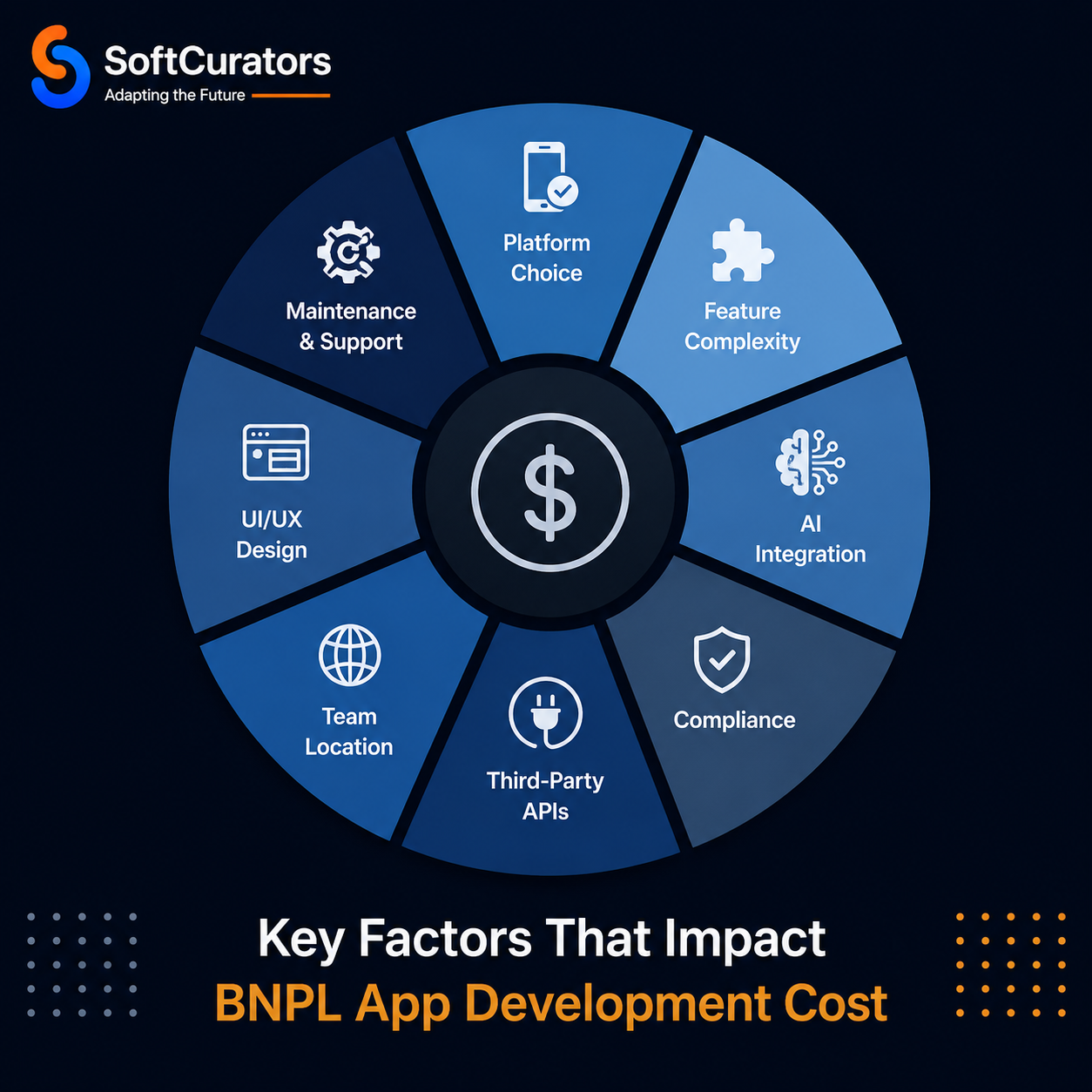
Key Factors That Determine BNPL App Development Cost
Understanding BNPL app development cost requires understanding the variables that move the number. Here are the eight factors that matter most:
Factor 1: Platform Choice
Building for iOS only, Android only, or both platforms simultaneously creates a significant cost difference. Cross-platform frameworks (React Native, Flutter) reduce cost by 30–50% compared to dual native builds for iOS and Android separately.
| Platform Approach | Cost Impact | Dev Timeline | Recommendation |
| iOS Only | Baseline | Shorter | Narrow if your market is iPhone-dominant |
| Android Only | Similar to iOS | Shorter | Choose for emerging market focus |
| Native iOS + Native Android | 80–110% more than single platform | Much longer | Only justified for highest-budget builds |
| React Native (cross-platform) | 30–45% saving vs dual native | Moderate | Best for most BNPL MVPs |
| Flutter (cross-platform) | 35–50% saving vs dual native | Moderate | Growing alternative, excellent performance |
For most BNPL startups, React Native app development or Flutter app development is the right starting point. You get both platforms from a single codebase at a fraction of the cost. See our comparison: native apps vs hybrid apps.
Factor 2: Feature Complexity
This is the single biggest cost driver. A basic BNPL checkout integration is very different from a full BNPL platform with underwriting models, merchant dashboards, repayment scheduling, and fraud detection. We cover this in detail in the features section below.
Factor 3: AI and Machine Learning Integration
Modern BNPL platforms use AI for credit scoring, fraud detection, and repayment prediction. Adding AI features adds cost but also creates a significant competitive advantage. Our AI in credit scoring guide shows how ML-driven underwriting compares to traditional rule-based credit assessment. AI features typically add $15,000–$30,000+ to a BNPL build depending on model complexity.
Factor 4: Compliance and Regulatory Requirements
BNPL is now regulated in most major markets. The UK’s FCA, Australia’s ASIC, and the EU’s Consumer Credit Directive all have specific requirements. US state-by-state lending laws add another layer. Compliance infrastructure KYC, AML, credit disclosure requirements, data protection is not cheap and cannot be skipped.
For a deep dive on compliance in lending platforms, our guide on security and compliance for digital lending platforms is essential reading before you start any BNPL build.
Factor 5: Third-Party Integrations
Every integration adds development time and cost. A BNPL platform typically needs payment processors, credit bureau APIs, KYC providers, bank account verification, fraud detection APIs, and retailer e-commerce platform integrations. Each adds $1,000–$7,000 in integration development cost depending on complexity.
Factor 6: Team Location and Seniority
Developer hourly rates vary from $15/hr (junior offshore) to $250/hr (senior onshore US). The same feature set built by equivalent-seniority teams can cost 5–8× more in San Francisco than in Eastern Europe or South Asia. Importantly, for regulated fintech like BNPL, you need senior developers who understand both the technical and compliance dimensions junior developers are a false economy in this space.
Factor 7: UI/UX Design Investment
BNPL conversion rates are heavily influenced by UX design. A confusing checkout flow kills approvals. A poorly designed repayment dashboard increases missed payments. Design is not a cost to cut it is a revenue driver. See our mobile app UI/UX design best practices guide for the principles we apply on every fintech build.
Factor 8: Post-Launch Maintenance and Iteration
BNPL apps require ongoing maintenance: regulatory updates, fraud model retraining, payment processor changes, new retailer integrations, and OS compatibility updates. Budget 15–20% of your initial development cost annually for maintenance. Our maintenance and support services are structured specifically for this ongoing need.
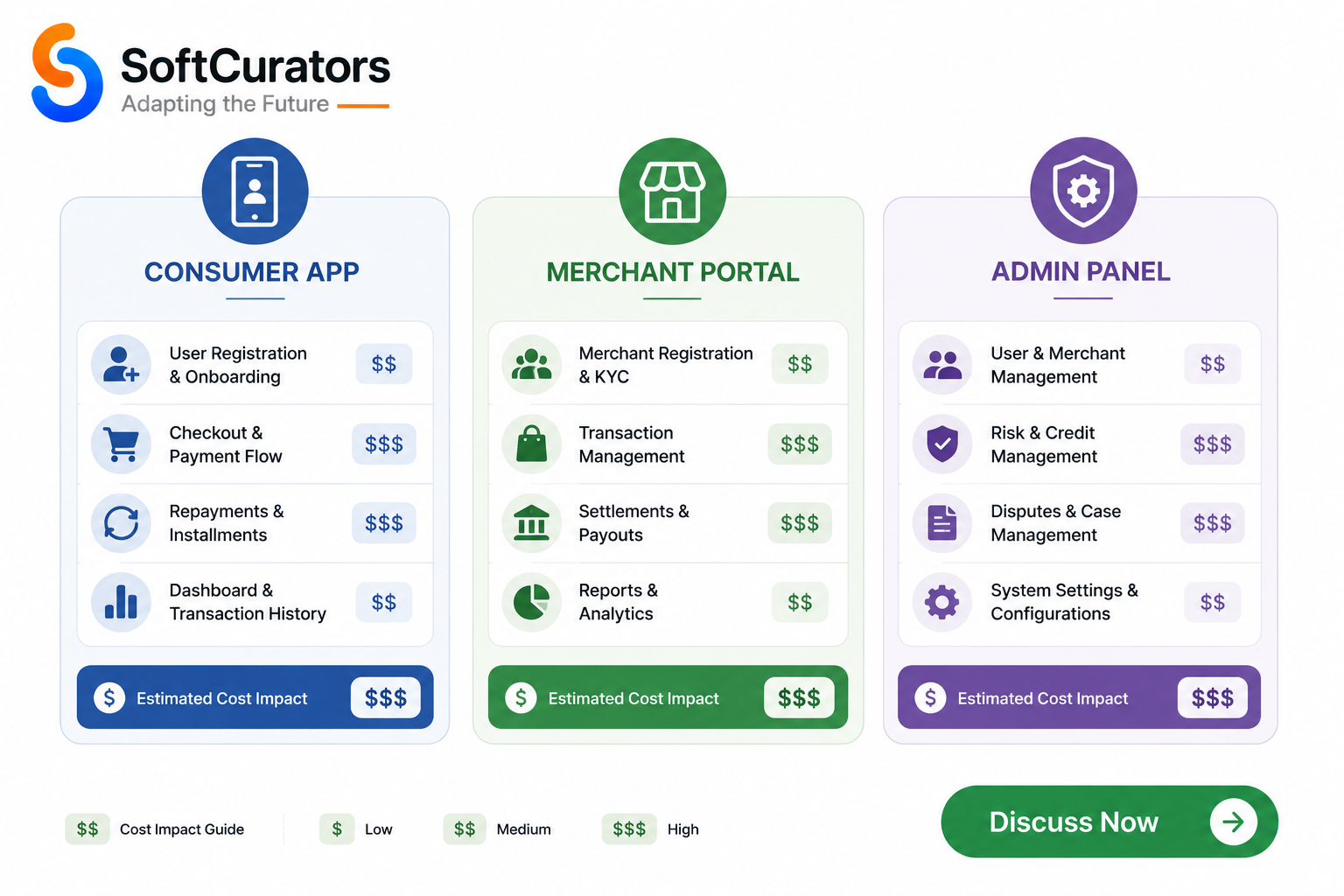
BNPL App Features and Their Individual Development Costs
The most reliable way to estimate BNPL app development cost is to build it feature by feature. Here is how costs break down across the three main parts of a BNPL platform:
Consumer-Facing App Features
| Feature | Description | Est. Dev Hours | Cost Range (USD) |
| User Registration & KYC | Sign-up, email/phone verify, document upload, identity check | 80–150 hrs | $2,000–$5,000 |
| Soft Credit Assessment | Real-time creditworthiness check via bureau API or ML model | 100–200 hrs | $4,000–$12,000 |
| BNPL Checkout Flow | In-app and web checkout widget with plan selection | 80–160 hrs | $3,000–$7,000 |
| Repayment Scheduling Engine | Automated payment dates, amounts, reminders | 120–200 hrs | $5,000–$10,000 |
| Payment Processing Integration | Stripe, Braintree, or direct bank integration | 60–120 hrs | $2,000–$5,000 |
| Bank Account Linking (Open Banking) | Plaid (US), TrueLayer (UK) or equivalent API | 60–100 hrs | $2,000–$6,000 |
| In-App Notifications & Reminders | Push, email, SMS for due dates, confirmations, late alerts | 40–80 hrs | $1,000–$3,000 |
| Transaction History & Statements | Full repayment history, downloadable statements | 40–80 hrs | $1,000–$4,000 |
| Late Fee Management | Automatic late fee calculation and application | 40–80 hrs | $1,000–$3,000 |
| Dispute and Refund Flow | Customer-initiated dispute, refund processing | 60–120 hrs | $1,000–$5,000 |
| User Dashboard (Spending & Limits) | Active plans, spending limits, available credit summary | 60–100 hrs | $1,000–$4,000 |
| Virtual Card (optional) | Single-use or reloadable virtual BNPL card | 80–160 hrs | $3,000–$8,000 |
Merchant/Retailer Integration Features
| Feature | Description | Est. Dev Hours | Cost Range (USD) |
| Merchant Onboarding Portal | Application, document upload, approval workflow | 80–150 hrs | $2,000–$7,000 |
| E-Commerce Plugin (Shopify/WooCommerce) | BNPL widget for retailer checkout pages | 80–160 hrs | $3,000–$8,000 |
| Payment API for Custom Integrations | RESTful API for retailers to build their own checkout | 100–200 hrs | $5,000–$10,000 |
| Merchant Dashboard | Transaction reports, settlement history, dispute management | 100–180 hrs | $3,000–$8,000 |
| Settlement & Reconciliation | Automated daily/weekly payouts to merchants | 80–150 hrs | $4,000–$8,000 |
| Merchant Analytics | Conversion rates, BNPL take-up %, average order uplift | 60–120 hrs | $3,000–$6,000 |
Admin Panel and Backend Features
| Feature | Description | Est. Dev Hours | Cost Range (USD) |
| Admin Dashboard | Platform overview: users, transactions, revenue, risk | 100–180 hrs | $4,000–$8,000 |
| Risk & Underwriting Rules Engine | Configurable credit decision rules, score thresholds | 120–250 hrs | $5,000–$12,000 |
| Fraud Detection System | Behavioural analytics, device fingerprinting, ML flags | 120–250 hrs | $6,000–$18,000 |
| Collections & Delinquency Management | Escalating dunning logic, collections workflow | 80–160 hrs | $3,000–$8,000 |
| AML / Compliance Monitoring | Transaction monitoring, suspicious activity flags, reporting | 100–200 hrs | $4,000–$12,000 |
| Reporting & Regulatory Outputs | Automated regulatory reports for FCA/ASIC/CFPB etc. | 80–160 hrs | $3,000–$8,000 |
| User Management & Roles | Admin roles, permissions, audit trail | 40–80 hrs | $1,000–$4,000 |
Softcurators note: Not every BNPL build needs every feature on day one. Our approach is to define the MVP feature set that validates your business model, then add features in prioritised phases. This avoids spending $300K on a full platform before you know if the market wants what you are building.
Total BNPL App Development Cost: Scope-Level Estimates
Now let us put the feature costs together into scope-level estimates. These ranges reflect real-world BNPL app development costs based on our experience and current market rates not theoretical numbers.
| Scope Level | What Is Included | Team Size | Timeline | Cost Range (USD) |
| Basic BNPL MVP | Consumer app: registration, soft credit check, basic checkout, 4-pay plan, simple dashboard. No merchant portal, no fraud ML, basic integrations. | 4–6 people | 3–5 months | $20,000 – $35,000 |
| Standard BNPL Platform | All MVP features + merchant onboarding portal, e-commerce plugin, admin dashboard, repayment engine, basic fraud rules, Stripe integration, push notifications. | 6–9 people | 4–6 months | $35,000 – $50,000 |
| Advanced BNPL Platform | All Standard features + ML credit scoring, fraud detection ML, open banking, virtual card, multi-currency, collections management, regulatory reporting tools. | 9–14 people | 6–8 months | $50,000 – $70,000 |
| Enterprise BNPL System | All Advanced features + white-label capability, B2B trade credit module, multiple payment rails, advanced analytics, custom compliance tooling, multi-market licensing. | 15–25 people | 8–12 months | $100,000 + |
Cost Breakdown by Development Phase
| Development Phase | % of Total Budget | What It Covers | Notes |
| Discovery & Architecture | 8–12% | Requirements, tech scoping, compliance audit, data model design | Never skip prevents expensive mid-build rework |
| UI/UX Design | 10–15% | User flows, wireframes, high-fidelity mockups, prototype | Design quality directly drives conversion and repayment rates |
| Frontend Development | 18–22% | Consumer app, merchant portal UI, admin panel screens | React Native or Flutter saves 30–45% vs dual native |
| Backend & API Development | 22–28% | Core APIs, repayment engine, payment processing, integrations | Most complex layer underwriting logic lives here |
| AI / ML Components | 10–20% | Credit scoring model, fraud detection, repayment prediction | Only if AI features are in scope; adds significant value |
| Compliance & Security | 8–12% | KYC integration, AML monitoring, encryption, penetration test | Non-negotiable in regulated markets cannot be cut |
| QA & Testing | 8–12% | Functional, security, load, regression testing | Financial apps need higher testing investment than consumer apps |
| DevOps & Infrastructure | 5–8% | Cloud setup, CI/CD pipeline, monitoring, disaster recovery | Plan for high availability from day one in payments |
| Post-Launch Support | 15–20% of build cost per year | Bug fixes, OS updates, model retraining, new integrations | Budget this upfront do not be surprised post-launch |
Rule of thumb: Take your initial development cost and multiply by 1.5 to get your realistic total-cost-of-ownership for Year 1. The 0.5× addition covers infrastructure, compliance tooling licences, third-party API costs, and post-launch iteration.
BNPL App Development Cost by Team Location
Where your development team is based has a dramatic impact on total cost. Here is what the market looks like:
| Team Location | Avg Hourly Rate | Standard Platform Cost | Advanced Platform Cost | Key Consideration |
| USA / Canada | $100–$200/hr | $200,000–$400,000 | $400,000–$800,000 | Highest quality assurance, highest cost |
| UK / Western Europe | $80–$150/hr | $160,000–$300,000 | $300,000–$600,000 | Strong fintech expertise, GDPR native |
| Eastern Europe | $40–$80/hr | $80,000–$160,000 | $160,000–$320,000 | Excellent quality-to-cost ratio |
| India / South Asia | $15–$50/hr | $25,000–$100,000 | $100,000–$200,000 | Wide talent pool, time zone management needed |
| Southeast Asia | $25–$55/hr | $55,000–$120,000 | $120,000–$240,000 | Growing fintech expertise, good quality |
| Latin America | $30–$65/hr | $65,000–$140,000 | $140,000–$280,000 | US time zone overlap, good communication |
Softcurators delivers quality-focused BNPL app development at competitive rates, serving clients in the US, UK, Qatar, and globally. Our fintech development team includes senior engineers with direct experience in payment systems, credit infrastructure, and regulatory compliance not junior developers learning on your budget.
Important: Do not optimise purely for lowest hourly rate on a regulated fintech build. A junior team that does not understand payment reconciliation, credit disclosure requirements, or PCI DSS compliance will cost you far more in rework and regulatory risk than the saving on hourly rate. Experience and domain knowledge matter enormously in BNPL development.
Recommended Technology Stack for a BNPL App
Technology choices made at the start of a BNPL app build are expensive to reverse later. Here is the stack we recommend at Softcurators, with the rationale for each choice:
| Layer | Our Recommendation | Why | Alternative |
| Mobile (consumer app) | React Native or Flutter | Cross-platform, code reuse, strong ecosystem | Native Swift + Kotlin for premium performance |
| Frontend (web portal) | Next.js (React) | SSR for performance, SEO for merchant marketing pages | Nuxt.js (Vue) |
| Backend Framework | Node.js + NestJS | Real-time, TypeScript, excellent for financial APIs | Python Django, Go (for high-throughput) |
| Database (primary) | PostgreSQL | ACID compliance critical for financial data | MySQL (less preferred for complex financial logic) |
| Database (caching) | Redis | Session management, rate limiting, real-time data | Memcached |
| Payment Processing | Stripe or Braintree | Strong BNPL / instalment APIs, PCI DSS Level 1 | Adyen for enterprise multi-currency |
| Open Banking | Plaid (US), TrueLayer (UK), Basiq (AU) | Bank account verification, income verification | Direct bank API integrations |
| KYC / Identity | Onfido, Jumio, or Veriff | Document verification, liveness check, global coverage | Persona, Stripe Identity |
| Credit Bureau APIs | Experian, Equifax, TransUnion (US), Creditsafe (UK/EU) | Soft credit pulls for underwriting decisions | ClearScore (UK), Illion (AU) |
| Fraud Detection | Sift or Sardine + custom ML | Device fingerprinting, behavioural analytics, ML scoring | Kount, Featurespace |
| AI / ML Platform | Python + FastAPI + scikit-learn / XGBoost | Credit scoring, fraud ML, repayment prediction models | AWS SageMaker, Google Vertex AI |
| Cloud Infrastructure | AWS (preferred) or Google Cloud | Financial-grade security, PCI DSS compliance support | Azure |
| Security & Secrets | AWS KMS + HashiCorp Vault | Encryption key management, secrets management | GCP Secret Manager |
| Monitoring | Datadog or New Relic + PagerDuty | Real-time APM, alerts, financial system SLA monitoring | Grafana + Prometheus |
| CI/CD | GitHub Actions + Docker + Kubernetes | Automated testing, deployment, rollback capability | GitLab CI |
PCI DSS Compliance: Non-Negotiable for Payment Apps
Any app that handles card data must comply with Payment Card Industry Data Security Standard (PCI DSS). For most BNPL apps that use Stripe or Braintree as the payment processor, you can achieve PCI DSS SAQ-A or SAQ-A-EP compliance (the simplest levels) by never directly handling card data the processor handles it via tokenisation.
If you process card data directly, you need full PCI DSS Level 1 or 2 compliance which is a significant audit and infrastructure investment. Always consult a PCI QSA (Qualified Security Assessor) during architecture design, before a single line of code is written.
For broader security planning, our mobile app security and compliance guide covers the full framework we apply to every fintech build.
The Team You Need to Build a BNPL App
One of the most common mistakes in BNPL app development is underestimating the team size and skill diversity required. This is not a standard consumer app it touches regulated financial services, real-time payment processing, and machine learning-driven credit decisions. Here is what a production-grade team looks like:
| Role | Responsibility | MVP Need? | Seniority Needed | Avg Cost (USD/month) |
| Product Manager / BA | Requirements, prioritisation, compliance mapping | Yes | Senior fintech domain exp | $3,000–$7,000 |
| UX/UI Designer | Checkout flows, repayment UX, merchant portal design | Yes | Mid-Senior fintech UX exp | $2,000–$5,000 |
| Frontend Developer(s) | Consumer app, merchant portal, admin panel | Yes (2) | Mid-Senior | $2,000–$5,000 each |
| Backend Developer(s) | APIs, payment logic, repayment engine, integrations | Yes (2) | Senior payment systems exp | $3,000–$6,000 each |
| ML / AI Engineer | Credit scoring model, fraud detection ML | Phase 2+ | Senior fintech ML exp | $3,000–$7,000 |
| QA Engineer | Test plans, automation, security testing | Yes | Mid fintech testing exp | $2,000–$4,000 |
| DevOps Engineer | Infrastructure, CI/CD, PCI compliance infrastructure | Yes | Senior AWS/GCP fintech exp | $3,000–$6,000 |
| Security / Compliance Specialist | PCI DSS, KYC/AML compliance, data protection | Yes | Senior fintech regulatory | $3,000–$7,000 |
| Project Manager | Delivery coordination, stakeholder communication | Yes | Senior PM fintech delivery | $2,000–$4,000 |
Building this team in-house takes 4–8 months and costs USD 600,000–$1,500,000 per year in salaries alone. Working with a specialist agency like Softcurators gives you immediate access to this full team at a fraction of the cost, without the hiring overhead and key-person retention risk. Learn more about our approach to building fintech products at our BNPL app development company page.
BNPL App Development Timeline: Phase by Phase
| Phase | Duration | Key Activities | Deliverables |
| 1. Discovery & Compliance Scoping | Weeks 1–4 | Requirements, compliance mapping, data architecture, API vendor selection | PRD, compliance plan, architecture diagram |
| 2. UI/UX Design | Weeks 3–8 | User flows, wireframes, mockups, usability testing on checkout flow | Figma prototype, design system |
| 3. Core Backend Development | Weeks 5–16 | Repayment engine, payment processor integration, KYC API, credit bureau API | Functional API layer, core logic working |
| 4. Consumer App Development | Weeks 8–18 | All consumer screens: registration, checkout, dashboard, repayments | Consumer app on iOS + Android |
| 5. Merchant Portal Development | Weeks 10–20 | Merchant onboarding, dashboard, Shopify/WooCommerce plugin | Merchant portal live in staging |
| 6. Admin Panel Development | Weeks 12–22 | Admin dashboard, risk tools, compliance reporting, collections module | Admin panel functional |
| 7. AI/ML Integration (if in scope) | Weeks 14–24 | Credit scoring model training, fraud detection, deployment | ML models deployed as microservices |
| 8. QA, Security Testing & Penetration Test | Weeks 20–26 | Full QA cycle, PCI/security audit, UAT with real test transactions | QA sign-off, security audit report |
| 9. Regulatory Review | Weeks 24–28 | Legal review, FCA/ASIC/state licence checks, T&C finalisation | Legal clearance for launch market |
| 10. Launch & Monitoring Setup | Week 28+ | Production deployment, monitoring, support team briefed | Live platform, incident response plan |
These phases overlap in a well-run Agile project. Backend development starts while design is being finalised. AI development begins while core backend is being built. The net result is typically 4–6 weeks shorter than sequential development would suggest.
Softcurators insight: The biggest single cause of BNPL project overruns is discovering compliance and regulatory requirements mid-build rather than in Discovery. We conduct a compliance scoping exercise in Week 1 of every fintech engagement before wireframes, before architecture, before estimates become commitments.
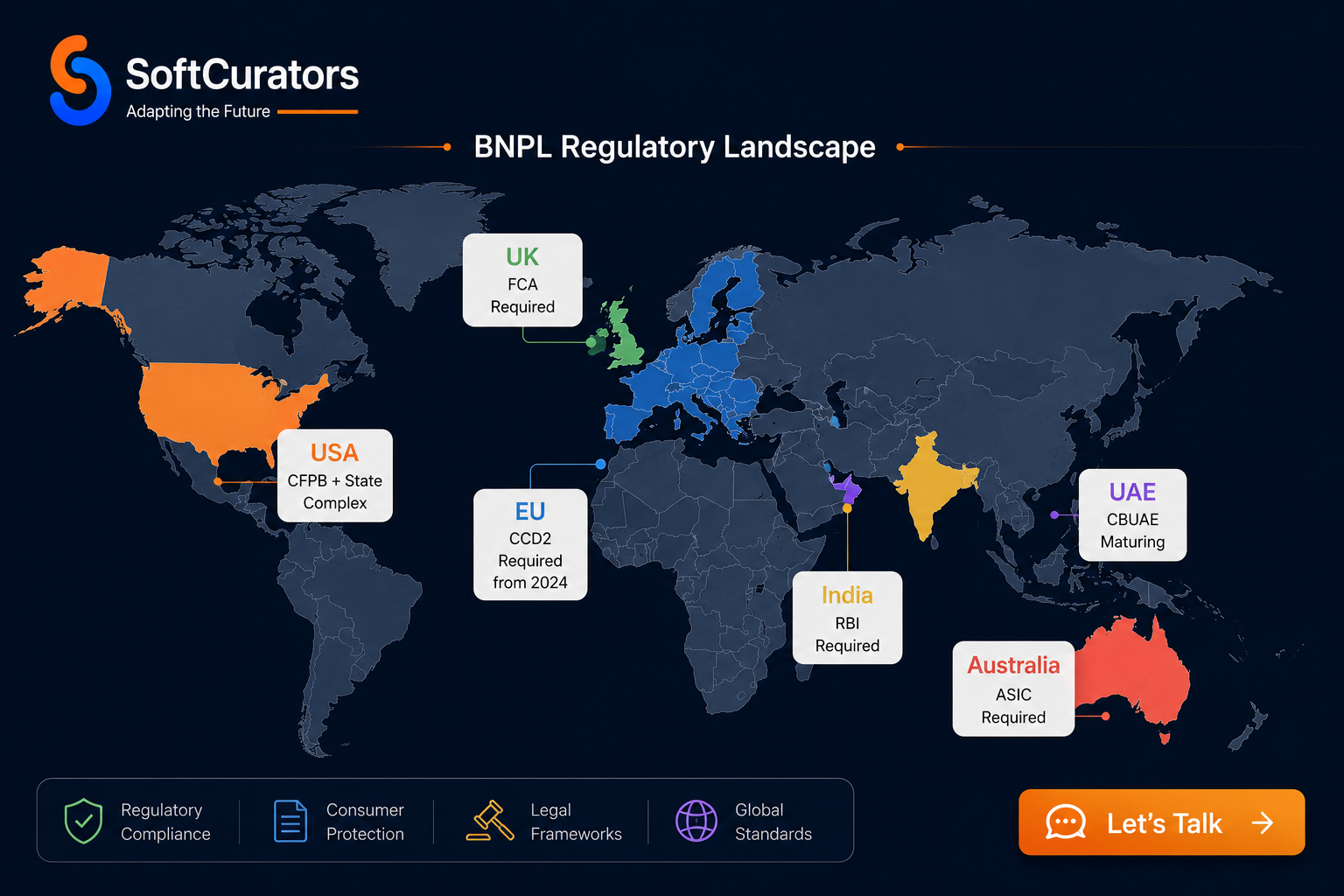
Compliance and Regulatory Costs: The BNPL Factor That Surprises Most Founders
Compliance is the most underestimated cost in BNPL app development. It is also the area most likely to kill a BNPL business post-launch if ignored. Here is the regulatory landscape in major markets:
| Market | Regulatory Body | Key Requirements | Estimated Compliance Cost | Notes |
| United Kingdom | FCA | Consumer Duty, credit broker authorisation, affordability checks, BNPL registration (from 2025) | $30,000–$80,000+ legal + implementation | FCA full authorisation now required for most BNPL providers |
| Australia | ASIC / Treasury | Small Amount Credit Contract (SACC) rules, hardship provisions, responsible lending | $20,000–$60,000+ legal + implementation | BNPL Code of Practice and new credit laws apply |
| European Union | EBA / National CAs | EU Consumer Credit Directive (CCD2), GDPR, AML/CFT compliance | $25,000–$70,000+ legal + implementation | CCD2 significantly tightened BNPL regulation from 2024 |
| United States | CFPB / State regulators | ECOA, Truth in Lending Act (for interest-bearing BNPL), state lending licences | $40,000–$150,000+ legal + implementation | Complex patchwork of state-by-state lending laws |
| India | RBI | Digital Lending Guidelines, NBFC licence required, Fair Practice Code | $15,000–$50,000+ legal + implementation | RBI tightened fintech lending regulations significantly in 2022–2024 |
| UAE / GCC | CBUAE / DFSA | Fintech licence, data localisation, Sharia-compliant structure where required | $20,000–$60,000+ legal + implementation | Growing BNPL market, maturing regulatory framework |
KYC and AML: Your Mandatory Baseline
Regardless of market, every BNPL platform must implement:
- Know Your Customer (KYC): Identity verification at onboarding. This means document scanning, selfie liveness check, and name-against-watchlist screening.
- Anti-Money Laundering (AML): Ongoing transaction monitoring for suspicious activity. Reporting requirements to national financial intelligence units.
- Sanctions Screening: Checking users and merchants against OFAC (US), HM Treasury (UK), and EU consolidated sanctions lists in real time.
- Politically Exposed Person (PEP) Checks: Higher due diligence requirements for individuals in politically sensitive roles.
The ongoing cost of KYC/AML is not just the upfront integration it is the monthly API fees, the ongoing monitoring, and the compliance team time required to review alerts. For more on building compliant lending platforms, see our guide on security and compliance for digital lending and AI in loan lending.
Recurring Compliance Costs to Budget
| Compliance Cost Item | Typical Annual Cost | Notes |
| KYC API (Onfido / Jumio / Veriff) | $0.50–$3.00 per verification check | Depends on check type and volume |
| AML / Transaction Monitoring | $500–$5,000/month for SaaS tools | Scales with transaction volume |
| Credit Bureau API fees | $0.10–$1.50 per soft pull | Per-query pricing in most markets |
| Open Banking API (Plaid/TrueLayer) | $0.10–$0.50 per bank connection | Varies by market and volume |
| Legal / Compliance retainer | $2,000–$10,000/month | Ongoing regulatory advice, policy updates |
| Penetration testing (annual) | $5,000–$25,000 | Required for PCI DSS and most fintech licences |
| PCI DSS compliance (QSA audit) | $10,000–$50,000/year | Level depends on card data handling scope |
Build vs Buy vs White-Label: The BNPL Platform Decision
Before committing to custom BNPL app development, consider all three routes. Each has legitimate use cases and the wrong choice for your context is expensive:
| Approach | What It Means | Cost Range | Time to Launch | Best For | Risk |
| Custom Build | Built from scratch for your exact requirements | $80K–$600K+ | 3–18 months | Unique model, specific market, full IP ownership | High upfront cost |
| White-Label BNPL Platform | License an existing platform, rebrand it as yours | $5K–$30K/month SaaS | 2–6 weeks | Fast launch, standard BNPL model, limited budget | Less differentiation, ongoing fees, vendor lock-in |
| BNPL-as-a-Service (BaaS) | Use Stripe, Affirm Network, or Paidy-style partner APIs to embed BNPL in your checkout | Revenue share (2–8% per transaction) | Days to weeks | Retailers embedding BNPL, not building a BNPL business | No ownership, revenue share eats margin |
| Hybrid (White-Label + Custom) | Start with white-label, build custom features on top or migrate to custom | $20K–$100K setup + monthly fee | 1–4 months | Staged approach: launch fast, go custom later | Migration cost and complexity later |
For most BNPL startups with genuine market ambition, custom development is the right long-term choice. White-label platforms limit your ability to differentiate on credit model, user experience, or unique market positioning. Softcurators helps clients evaluate this decision during our AI consulting services and discovery phase and we are honest when white-label or BaaS is the better fit for a specific context.
BNPL App Revenue Models: How You Make Your Money Back
The cost to develop a BNPL app is an investment and like any investment, it needs a clear return path. Here are the revenue streams available to BNPL platform operators:
| Revenue Stream | How It Works | Typical Rate | Notes |
| Merchant Discount Rate (MDR) | Retailers pay a percentage of each BNPL transaction | 2–8% per transaction | Primary revenue stream for 4-pay models |
| Late / Missed Payment Fees | Charged to consumers for payments past due date | $5–$25 flat or % of missed amount | Regulated in some markets check local rules |
| Interest Income | Charged on longer-term instalment plans (>3 months) | 12–36% APR | Requires consumer credit licence in most markets |
| Interchange Income | Earn a share of card interchange on virtual BNPL cards | 0.5–1.5% per transaction | Only for virtual card implementations |
| Subscription / Platform Fee | Charge merchants a monthly platform fee on top of MDR | $50–$500/month per merchant | For enterprise and B2B BNPL platforms |
| Data and Insights Products | Sell anonymised consumer spending data to brands and retailers | Negotiated per deal | Must comply with GDPR/CCPA data rules |
| Referral / Affiliate Income | Earn fees for referring consumers to other financial products (insurance, savings accounts) | Varies | Common in super-app BNPL strategies |
For more on building revenue-generating fintech products, see our guides on how money lending apps make money and how to start a money lending business.
BNPL App Development Cost vs Other Fintech Apps: How Does It Compare?
Context helps calibrate your budget expectations. Here is how BNPL app development cost compares to related fintech products we build at Softcurators:
| Fintech App Type | Typical MVP Cost | Full Platform Cost | Relative Complexity | Key Cost Driver |
| BNPL App | $40,000–$80,000 | $160,000–$400,000+ | High | Credit logic + compliance + payment rails |
| E-Wallet App | $30,000–$70,000 | $100,000–$250,000 | Medium–High | Payment processor + KYC + security |
| Loan Lending App | $50,000–$100,000 | $180,000–$450,000+ | Very High | Underwriting + compliance + collections |
| P2P Lending Platform | $60,000–$120,000 | $200,000–$500,000+ | Very High | Two-sided marketplace + credit risk + regulation |
| Payment Transfer App | $30,000–$60,000 | $80,000–$200,000 | Medium | Payment rails + FX + AML/KYC |
| Banking / Neobank | $80,000–$150,000 | $300,000–$800,000+ | Extreme | Banking licence + core banking integration + full regulation |
| Investment Platform | $50,000–$100,000 | $150,000–$400,000 | High | Brokerage API + compliance + portfolio logic |
For detailed cost breakdowns on related products, explore our guides: cost to develop a loan lending app, how to develop an e-wallet app, cost to build a fintech app, and how to create a P2P lending app.
BNPL App Development Checklist: What to Confirm Before You Start
Business and Strategy
- Business model defined: 4-pay, instalment, B2B, or embedded BNPL
- Target market identified: geography, consumer segment, retail vertical
- Primary competitors analysed: know who you are differentiating from and how
- Merchant acquisition strategy defined: how will you sign your first 50 merchants?
- Revenue model modelled: what MDR/fee levels make unit economics work?
- Funding confirmed: enough runway to cover build + 6 months of post-launch operation
Compliance and Legal
- Legal counsel engaged with BNPL / fintech regulatory experience
- Licencing requirements confirmed for target launch market
- KYC/AML provider selected (Onfido, Jumio, Veriff, or equivalent)
- Credit bureau API access confirmed and pricing agreed
- PCI DSS compliance approach determined with QSA guidance
- GDPR/CCPA data protection approach mapped and documented
- Terms & Conditions and Privacy Policy drafted by fintech-specialist solicitor
Technical
- Platform choice confirmed: iOS, Android, or cross-platform (React Native / Flutter)
- Payment processor selected and test account activated (Stripe, Braintree, Adyen)
- Open banking provider confirmed (Plaid, TrueLayer, Basiq)
- Tech stack finalised and documented
- Cloud infrastructure choice confirmed (AWS, GCP, Azure) with fintech security configuration
- MVP feature set defined no scope creep before launch
- Post-MVP feature roadmap documented for Phase 2
Team and Partner
- Development partner or agency selected with verified fintech experience
- Contract reviewed: IP ownership, code repository access, warranty period confirmed
- Post-launch support model confirmed with SLA for critical payment bugs
- Compliance specialist engaged for ongoing monitoring post-launch
Budget and Timeline
- Total development budget confirmed including compliance, legal, and third-party API costs
- Ongoing monthly costs modelled: API fees, cloud, AML monitoring, legal retainer
- Realistic timeline confirmed: no agency is promising a full BNPL platform in 6 weeks
- Year 1 operating runway confirmed beyond just the build cost
Why Fintech Founders Choose Softcurators to Build Their BNPL Platform
At Softcurators, fintech development is a core specialism not a side project. We have built BNPL apps, loan lending platforms, e-wallet apps, and P2P lending platforms for clients across multiple regulated markets. We understand payment rails, credit infrastructure, and regulatory compliance not as abstract concepts but as things we have built and shipped.
What Makes Us Different for BNPL Builds
- Compliance-first discovery: We map regulatory requirements in Week 1, before architecture decisions lock you into expensive compliance remediation later.
- Full-stack fintech capability: Credit scoring models, payment processor integrations, KYC/AML pipelines, admin dashboards all in-house, no critical dependencies on external specialists.
- AI-native development: Our dedicated AI development and AI app development teams build ML credit scoring and fraud detection models alongside our fintech engineers not as an add-on.
- Phased engagement: We build your MVP first to validate your market thesis before committing to the full platform budget.
- Post-launch partnership: Our maintenance and support team handles the ongoing model retraining, regulatory updates, and new integrations that every live BNPL platform needs.
Explore our work at our portfolio, read about why clients choose Softcurators, or learn how we approach mobile app development for businesses and startups.
We also build adjacent fintech products: banking apps, money transfer apps, how to develop an Afterpay-like app, and how to create an investment platform. If it touches money, we have built it.
Conclusion: What a Realistic BNPL App Budget Looks Like
The cost to develop a BNPL app ranges from around $40,000 for a focused MVP to $300,000+ for a full enterprise platform. The number that matters for your business depends on your model, your market, your compliance requirements, and your competitive positioning.
Three things every BNPL founder should remember before signing with a development agency:
- Compliance is not optional it is architectural. Your tech choices affect your regulatory compliance. Make these decisions with legal and technical input before you build.
- Cheap development in regulated fintech is expensive long term. A junior team that does not understand payment reconciliation or credit disclosure law will cost you multiples of the saving in rework, regulatory exposure, and lost merchant trust.
- An MVP is not a small version of your vision it is a strategic tool. Build the smallest thing that generates real transaction data, validate your unit economics, then invest in the full platform.
If you are serious about building a BNPL platform, Softcurators is the team that gets it right. We bring the fintech domain expertise, the compliance-first approach, the full-stack technical capability, and the honest project management that regulated payment products demand.

Frequently Asked Questions: Cost to Develop a BNPL App
How long does it take to develop a BNPL app?
A basic BNPL MVP takes 3–4 months with a dedicated team. A standard platform with merchant portal and admin dashboard takes 4–5 months. An advanced platform with AI credit scoring, fraud detection, open banking, and multi-currency support takes 6–8months. Enterprise platforms with white-label capability can take 8–12months. These timelines assume continuous development pauses for funding rounds or strategic pivots extend them proportionally.
Do I need a financial licence to launch a BNPL app?
This depends entirely on your market and your BNPL model. In the UK, FCA authorisation is required for most BNPL providers. In Australia, ASIC licensing applies. In the US, the picture varies by state and by whether you charge interest (interest-bearing BNPL = lending licence required). In the EU, the Consumer Credit Directive (CCD2) applies from 2024. Never launch a BNPL product without legal advice specific to your target market. Getting this wrong post-launch is catastrophically expensive.
What is the difference between BNPL and a regular loan app?
BNPL is a specific form of short-term credit with four distinguishing characteristics: (1) Approval happens in seconds at the point of purchase. (2) Most 4-pay BNPL is interest-free to consumers who pay on time. (3) The merchant pays a fee, not the consumer. (4) BNPL is embedded in the checkout experience rather than being a standalone credit application. Longer-term instalment BNPL (3–24 months) does charge consumer interest and is more similar to personal loan products. For more on lending app development, see our guide on cost to develop a loan lending app.
Can I build a BNPL app without AI features?
Yes many successful early-stage BNPL platforms use rule-based credit decision engines rather than machine learning models. A rule-based system (e.g., approve if credit score above X AND income above Y AND no active defaults) is cheaper to build and easier to explain to regulators. AI/ML becomes more valuable at scale when you have enough proprietary transaction data to train models that outperform generic bureau scores. We recommend starting with rules and planning the AI migration path from day one.
How does a BNPL app make money?
The primary revenue stream for most BNPL platforms is the merchant discount rate (MDR) typically 2–8% of each transaction, paid by the retailer. Secondary revenue comes from late fees charged to consumers, interest on longer-term instalment plans, interchange on BNPL virtual cards, and data products sold to brands. For a comprehensive breakdown of fintech revenue models, see our guide on how money lending apps make money.ny.
What is the cost of KYC integration in a BNPL app?
KYC API integration typically costs $5,000–$15,000 in development time, depending on the provider and the complexity of your verification flow. Ongoing costs are per-verification: Onfido, Jumio, and Veriff charge roughly $0.50–$3.00 per identity check depending on check type (document scan only vs document + liveness vs enhanced due diligence). At scale, these costs are manageable but they must be modelled into your unit economics from day one.
Should I build a native app or cross-platform for BNPL?
For most BNPL platforms targeting both iOS and Android, cross-platform development using React Native or Flutter is the right choice for the MVP. It reduces development cost by 30–50% compared to building separate native apps, and the performance difference is negligible for a payment/finance use case (unlike, say, a graphics-intensive game). See our detailed comparison: native apps vs hybrid apps and React Native app development vs Flutter app development.
What is the cost of fraud detection in a BNPL app?
Rule-based fraud detection (velocity checks, device fingerprinting, IP analysis) can be implemented for $10,000–$20,000. ML-based fraud detection using behavioural analytics and trained anomaly detection models adds $20,000–$50,000 in development cost but delivers significantly better results at scale. Third-party fraud platforms like Sift or Sardine cost $500–$5,000/month in SaaS fees depending on volume. Most BNPL platforms use a combination: third-party platform plus custom rules tuned to their specific fraud patterns.
Can a white-label BNPL platform save me money?
In the short term, yes a white-label BNPL platform gets you to market in 2–6 weeks at $5,000–$30,000/month in SaaS fees, versus $80,000–$300,000+ for a custom build. In the medium term, it depends: if your BNPL business is differentiated by a unique credit model, target market, or user experience, white-label limits you and the migration cost later is significant. If you are embedding standard BNPL in a retail checkout to compete with Afterpay, white-label may be permanently sufficient. The decision should be driven by your differentiation thesis, not just initial cost.
What is the cost of open banking integration in a BNPL app?
Open banking integration (connecting to bank accounts for income verification and bank-based repayment) typically costs $5,000–$12,000 in development time. Ongoing API costs: Plaid (US) charges approximately $0.10–$0.50 per bank connection; TrueLayer (UK/EU) has similar pricing. Open banking significantly improves credit decision accuracy users who verify income via open banking have lower default rates, which directly improves your unit economics and risk profile.
How much does it cost to integrate Shopify or WooCommerce into a BNPL app?
Building a Shopify plugin (app) for your BNPL platform costs approximately $8,000–$18,000 including Shopify app store compliance requirements. A WooCommerce plugin costs $5,000–$12,000. Additional e-commerce platform plugins (Magento, BigCommerce, Squarespace) are $4,000–$10,000 each. Providing a direct API for custom retailer integrations (rather than platform plugins) costs $10,000–$25,000 but covers a much broader merchant base including custom-built e-commerce sites.
What are the ongoing infrastructure costs for a BNPL app?
Monthly infrastructure costs vary significantly by traffic volume. At early stage (under 1,000 transactions/day): $500–$2,000/month on AWS or GCP. At growth stage (1,000–50,000 transactions/day): $3,000–$15,000/month. At scale (50,000+ transactions/day): $15,000–$100,000+/month. Financial applications require higher-availability infrastructure (multi-region deployment, automatic failover) than standard consumer apps which increases base infrastructure cost. Include these in your financial model from the start.a
How does AI credit scoring reduce BNPL app development risk?
AI credit scoring models trained on your platform's own transaction data can outperform generic bureau scores by 15–30% in default prediction accuracy particularly for thin-file borrowers (young adults, migrants, first-time credit users) who are underserved by traditional credit bureaus. Lower default rates directly improve your unit economics. The investment in AI in credit scoring typically pays back within 6–12 months at meaningful transaction volume through reduced credit losses.
What is the cost difference between a B2C and B2B BNPL app?
B2B BNPL (trade credit, invoice financing) is typically 20–40% more expensive to build than B2C BNPL due to: more complex onboarding (business verification vs individual KYC), invoice management and reconciliation features, higher average credit amounts requiring more sophisticated underwriting, and integration with business accounting systems (Xero, QuickBooks, SAP). However, B2B BNPL often has better unit economics (lower fraud, higher average transaction values, business customer loyalty) than B2C.
How should I structure payment terms with my BNPL development agency?
Never pay 100% upfront. The standard structure for a fintech build of this complexity is: 20–30% at project start (to confirm commitment and cover discovery costs), milestone payments at agreed deliverables (typically 30–40% across 3–4 milestones), and a final 10–20% on acceptance testing completion and code handover. Ensure your contract includes: IP ownership in your name from day one, code in your repository from day one, a bug warranty period post-launch (minimum 30 days, ideally 90 days for financial apps), and a defined process for handling payment processor or compliance API changes.
What is the cost to develop an Afterpay-like app?
Afterpay's model (4 equal fortnightly payments, 0% interest to consumer, merchant discount rate as revenue) is the standard 4-pay BNPL model. Building an Afterpay-like MVP typically costs $60,000–$120,000 including consumer app, merchant onboarding, basic admin, payment processor integration, and KYC. A full platform with merchant analytics, Shopify integration, collections management, and fraud tools costs $150,000–$300,000+. For a detailed guide, see our article on how to develop an app like Afterpay.
Can Softcurators help with BNPL app development for specific markets?
Yes. Softcurators has delivered fintech builds for clients across North America, Europe, the Middle East, and South Asia. Each market has different regulatory requirements, preferred payment rails, and open banking infrastructure and we account for all of these in our discovery and architecture phase. Our fintech app development expertise spans multiple regulated markets. Contact us to discuss your specific geography.
How do I validate my BNPL business model before spending on full development?
The most cost-effective validation approach is a focused MVP covering: (1) A working BNPL checkout flow embedded in 2–3 pilot merchants. (2) A basic consumer app covering registration, credit check, and repayment tracking. (3) A minimal admin panel for monitoring transactions. This gives you real transaction data real default rates, real merchant conversion rates, real consumer behaviour before you invest in the full platform. Our MVP development service is designed exactly for this validation-first approach.
What questions should I ask a BNPL development agency before hiring them?
Ask specifically: Have you built payment processing integrations with Stripe or Braintree? Have you implemented KYC/AML flows? Have you worked on credit decision engines? Can you show me a live BNPL or lending app you have built? Who owns the code will it be in my repository from day one? How do you handle compliance requirements in my specific market? What is your post-launch support model for payment-critical bugs? For a complete guide to evaluating development agencies, see our article on how to choose an app development company.
