
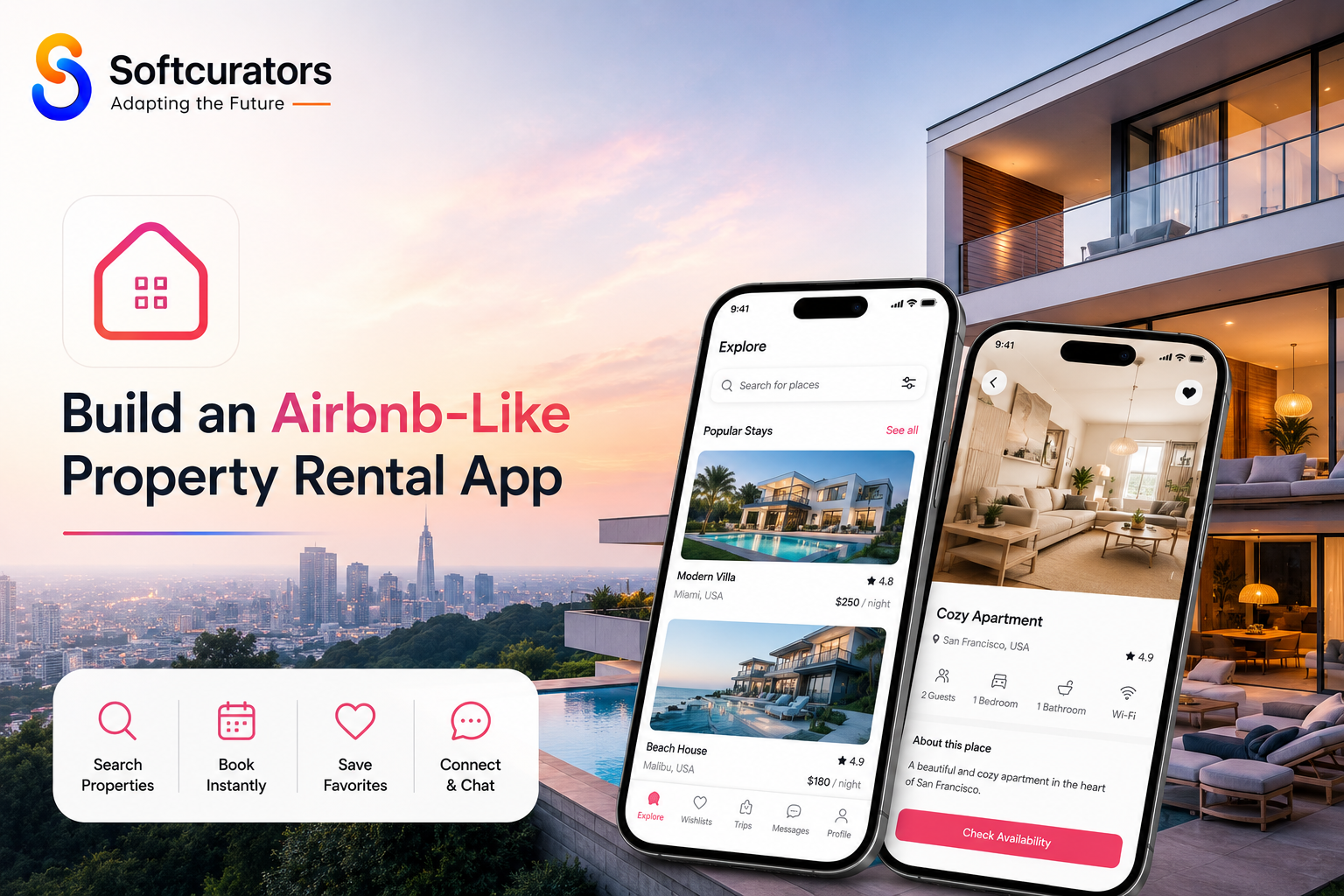
Open any property rental app right now. You tap in a city. Dozens of listings appear. You filter by price, dates, and amenities. Within three minutes, you book a home you have never seen in person from a stranger you have never met.
That experience took years to engineer. And yet it still has enormous gaps.
The global short-term rental market surpassed $100 billion in 2024. According to Statista, the market is projected to reach $229 billion by 2030. Airbnb proved the model works. But it does not own every niche, every geography, or every use case. The space for a well-built competitor or a focused alternative has never been larger.
At Softcurators, we have built property rental platforms, on-demand marketplace apps, and two-sided platforms for startups and growth companies across the US, UK, UAE, and South Asia. We have seen what separates the platforms that grow from the ones that stall at launch. This guide covers every dimension of property rental app development features, technology, process, cost, and the mistakes that kill most platforms before they reach 1,000 bookings.
Want to build for the rental market from day one? Book a free strategy call with Softcurators. Our architects respond within 24 hours.
Why this Is a Strong Year to Enter Property Rental App Development
The short-term rental market is not slowing down. But growth alone is not the story. What makes this year particularly interesting for property rental app development is a structural shift in what renters and hosts actually want and the gap between that and what existing platforms deliver.
Airbnb’s trust and safety issues have pushed hosts toward alternative platforms. Remote work has created new demand for month-long rentals in smaller cities. Eco-travel has generated appetite for rural stays and sustainable accommodations. And corporate travel managers are actively looking for Airbnb-style flexibility without Airbnb’s inconsistency.
Three Forces Making This Market Open Right Now
First, host frustration with Airbnb’s fee structure and algorithm changes is creating switching intent. Second, niche audiences digital nomads, corporate travellers, pet owners, eco-tourists are underserved by generic platforms. Third, regional markets in India, Southeast Asia, Latin America, and Africa have strong rental demand but weak local platforms.
Together, these three forces create the same product opportunity that Softcurators sees consistently in the briefs we receive from real estate entrepreneurs. The gap between what today’s best rental apps offer and what a specific segment of renters actually wants is still wide. That gap is where the opportunity lives.
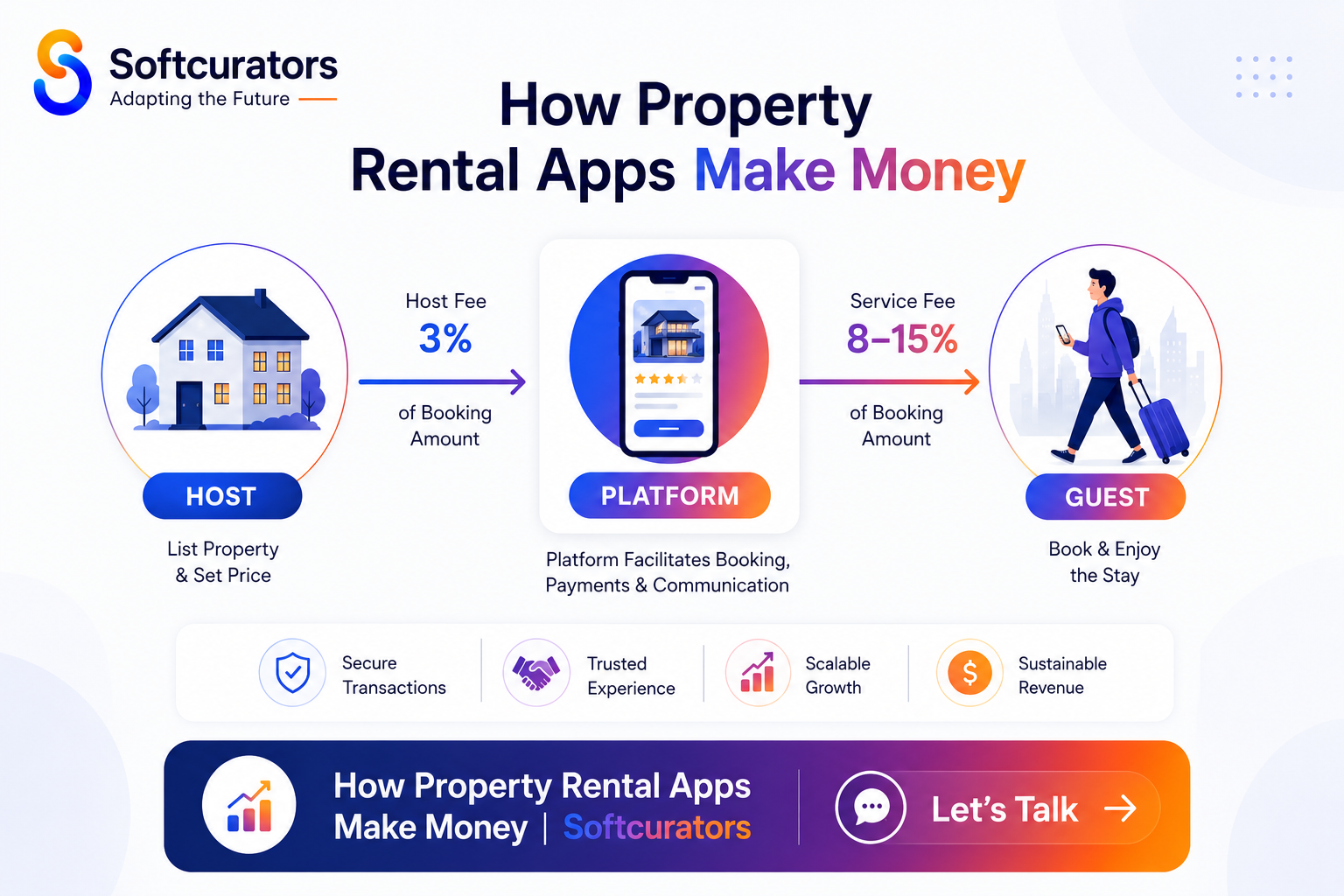
How Airbnb Makes Money and How Your Rental App Can Too
Before writing a line of code, you need to understand the revenue model. It is what keeps the lights on and what investors will interrogate in your pitch.
Airbnb uses a split-fee structure. Guests pay a 14–16% service fee on top of the nightly price. Hosts pay a 3% service fee per booking. On a $200/night booking, Airbnb earns roughly $34–$38 in fees. Multiply that across millions of bookings per day and you see why this is a billion-dollar business built on a remarkably simple mechanism.
For your property rental app, you can replicate or adapt this model.
Commission-Based Revenue
Charge a percentage of every booking processed through your platform. This is the most scalable model. It aligns your incentives with your hosts the more revenue they earn, the more you earn.
Host Subscription Tiers
Offer premium listing tiers. Hosts pay monthly or annually to unlock analytics dashboards, priority search ranking, professional photography credits, or unlimited active listings. This creates predictable recurring revenue independent of booking volume.
Featured and Promoted Listings
Charge property owners to appear at the top of search results for specific dates, locations, or categories. This mirrors Google Ads and hotel booking platform models.
Add-On Services and Partnerships
Partner with cleaning service providers, professional photographers, insurance companies, and smart lock manufacturers. Take a referral fee when hosts or guests use these services through your platform.
B2B Data and API Licensing
Once your platform reaches meaningful scale, your property data and booking data become valuable assets. License your API to property management companies, travel agencies, or corporate travel managers.
Softcurators‘ fintech app development expertise informs how we architect payment flows, revenue splits, and payout systems in rental platforms. Getting the money mechanics right from day one prevents expensive re-architecture later.
Core Features of a Property Rental App: What You Must Build First
This is where most founders get confused. They try to build everything and end up with a bloated MVP that takes 18 months to launch and costs three times the initial estimate. At Softcurators, we always start with what is essential for property rental app development to validate the core booking loop.
Features for Guests (Renters)
Detailed Property Listings. Each listing needs high-resolution photos, a clear description, a full amenities list, house rules, a cancellation policy, and verified host information. Guests make high-value decisions based entirely on trust signals. Every missing detail is lost revenue.
Real-Time Availability Calendar. Show accurate availability. Sync with external calendars (Google Calendar, iCal) for hosts who list across multiple platforms. Stale availability data destroys both bookings and trust.
Instant Book vs. Request to Book. Some guests need to book immediately. Others prefer to send a request and wait for host approval. Both flows must work smoothly within your booking engine.
Secure Payment Processing. Guests must pay with credit cards, debit cards, digital wallets, and increasingly buy-now-pay-later options. Payment must feel safe. According to Stripe’s research, every additional second of payment friction reduces conversion by 2–3%.
In-App Messaging. Guests need a private channel to communicate with hosts before, during, and after a stay. Good messaging reduces complaints and builds the relationship that drives repeat bookings.
Reviews and Ratings. Guests trust other guests. After a completed stay, prompt both parties to leave reviews. Display star ratings prominently on every listing. Review velocity matters a listing with 50 reviews converts at dramatically higher rates than a listing with 5.
Booking Management Dashboard. Give guests a clear view of upcoming, ongoing, and past bookings. Include one-tap cancellation (subject to policy), modification requests, and rebooking options.
Features for Hosts (Property Owners)
Easy Listing Creation. Hosts must be able to create a listing in under ten minutes. Use a step-by-step wizard location, property type, amenities, photos, pricing, availability. Mobile photo upload is non-negotiable these days.
Host Dashboard and Analytics. Give hosts visibility into booking trends, occupancy rates, earnings, and guest demographics. Hosts who understand their data list more properties, set better prices, and stay on your platform longer.
Dynamic Pricing Tools. Help hosts set smart prices based on season, local events, and competitor data. Even a basic pricing suggestion feature dramatically improves host revenue which means they stay on your platform.
Calendar and Booking Management. Hosts need to block personal-use dates, approve or decline requests, and manage multiple listings from one screen.
Guest Screening and Verification Alerts. Notify hosts when a guest has completed ID verification, connected their social profile, or has prior positive reviews. Trust signals matter enormously on the host side.
Payout Management. Hosts must connect bank accounts or payment services and receive payouts on a predictable schedule. Be transparent about fees and payout timelines.
Admin Panel Features for Platform Operators
The admin panel is often under-specified in early platform builds. This is a mistake. The admin panel is how you run the business not just how you manage the technology.
Core admin features include: user management (view, verify, suspend, ban accounts); listing moderation (review and approve new listings, flag suspicious properties); dispute resolution (structured workflow for refunds, damage claims, and complaints); revenue and payout reports (platform-wide financial performance); and promotions management (referral bonuses, coupon codes, seasonal discounts). Additionally, a CMS layer lets your content team update pages, FAQs, and help articles without involving a developer.
Advanced Features That Separate Fundable Platforms from Failed MVPs
Basic features get you to launch. Advanced features get you to Series A. Consequently, these are the capabilities that signal to investors that you understand where the market is going.
AI-Powered Property Recommendations
Machine learning significantly improves the guest discovery experience. Recommendation engines use collaborative filtering (guests who booked X also booked Y) and content-based filtering (this property shares characteristics with properties you viewed) to surface listings that match each guest’s actual preferences. Softcurators‘ AI app development and AI development teams build these recommendation layers as a modular add-on starting with collaborative filtering and scaling toward deep learning models as user data grows.
Smart Dynamic Pricing Engine
A pricing algorithm that adjusts nightly rates automatically based on demand signals local events, competitor occupancy, seasonal patterns, and day-of-week trends directly increases host revenue and platform GMV. Our AI consulting services team evaluates the right pricing model for each client’s data volume and market context.
Identity Verification and Background Checks
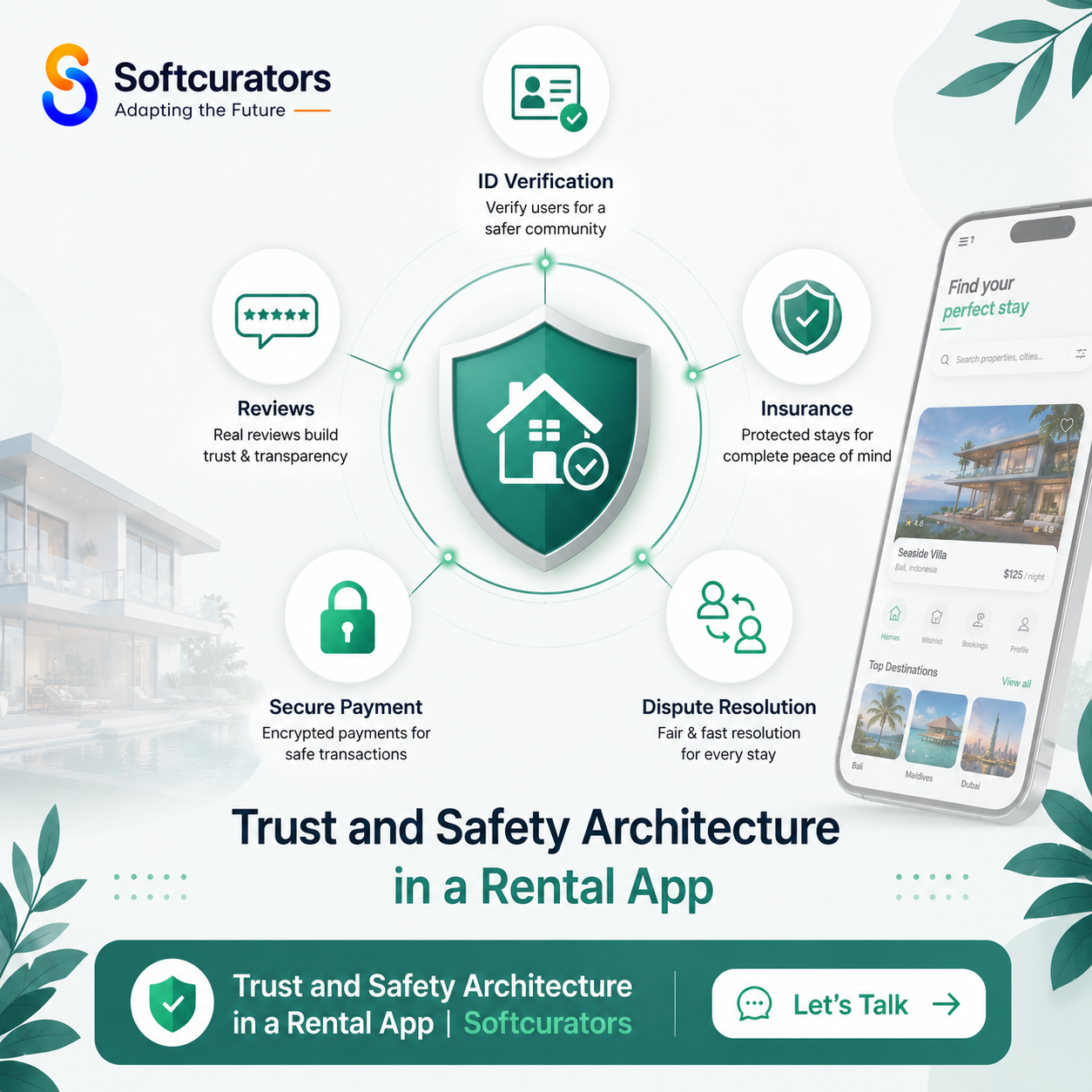
Partner with a KYC provider (Stripe Identity, Onfido, or Jumio) to offer verified user badges. Verification reduces fraudulent listings, ghost bookings, and property damage claims. It is the single highest-ROI trust investment a rental platform can make.
Damage Protection and Insurance Integration
Partner with an insurtech provider to offer short-term property insurance with every booking. This is the primary operational anxiety point for new hosts. Solving it creates strong host loyalty. Our experience with fintech app development and payment architecture informs how we build insurance integration flows that work within the existing booking payment structure.
Smart Home and Keyless Entry Integration
Integrate with smart lock providers (August, Yale, Schlage) to allow hosts to send digital access codes to guests automatically upon booking confirmation. This removes the single biggest logistical friction point in short-term rentals key handoff and opens the door to fully contactless stays.
Multi-Language and Multi-Currency Support
If you are targeting international markets, your platform must operate in local languages and accept local currencies. This is not a nice-to-have for global platforms it is table stakes. Localisation at the infrastructure level (not just surface translation) significantly reduces drop-off in non-English-speaking markets.
Property Rental App Development: The Right Tech Stack
Choosing the right technologies early saves months of painful refactoring later. At Softcurators, here is the stack we recommend for scalable property rental app development.
Mobile: Cross-Platform vs. Native
For most rental app budgets, Flutter app development is the recommended approach delivering iOS and Android from a single codebase at 35–40% lower cost than two separate native builds. However, if deep Apple Maps integration, advanced CoreLocation features, or native iOS home screen widgets are core to the product, iOS app development with Swift provides finer platform control. Similarly, Android app development with Kotlin/Jetpack delivers the best Android performance for markets where Android has dominant market share. Our guide on native apps vs hybrid apps covers this decision in detail.
Additionally, React Native app development is a strong alternative for teams with existing JavaScript expertise. Cross-platform app development across both Flutter and React Native forms a core competency at Softcurators.
Web Frontend
React.js or Next.js for server-side rendering is the standard for guest-facing web platforms. Next.js is particularly important for property listing SEO, because individual listing pages must be crawlable by Google at scale. Our web development team builds web platforms optimised for both guest UX and search engine crawlability. Progressive Web App development is a complementary option for markets where app store friction reduces mobile adoption.
Backend and API
Node.js with Express handles real-time booking flows and messaging well. Python (Django or FastAPI) is powerful for data-heavy features and AI model integrations. A GraphQL API layer speeds up frontend development significantly. REST APIs handle third-party integrations.
Database Architecture
PostgreSQL stores structured data users, bookings, listings, payments. MongoDB provides flexible storage for listing content, amenity tags, and search metadata. Redis handles caching and session management for fast load times. Elasticsearch powers advanced property search with multi-filter support and geospatial queries.
Cloud, Payments, and Maps
AWS (EC2, S3, RDS, CloudFront) is the most reliable choice for global platforms. Google Maps API or Mapbox provides location-based search and listing map display. Stripe handles split payments, escrow, and payouts it is the standard for marketplace payment flows. Regional alternatives include Razorpay and Paytm for India-focused platforms. Our software development team designs the full backend architecture to support each of these layers from the first sprint.
| Layer | Technology Options | Softcurators Recommendation |
| Mobile (iOS) | Swift / SwiftUI | Best for Apple-first or feature-heavy iOS builds |
| Mobile (Android) | Kotlin / Jetpack Compose | Native performance for Android-dominant markets |
| Cross-Platform Mobile | Flutter, React Native | Both |
| Web Frontend | React.js, Next.js | Next.js for SSR and SEO-critical listing pages |
| Backend | Node.js, Python (FastAPI) | Node.js for real-time; Python for AI/ML layers |
| Database | PostgreSQL, MongoDB, Redis | PostgreSQL primary; Redis for caching |
| Search | Elasticsearch | Geospatial + multi-filter property search |
| Cloud | AWS (EC2, S3, CloudFront) | Most reliable global coverage |
| Payments | Stripe, Razorpay, PayPal | Stripe for global; Razorpay for India |
| Maps | Google Maps API, Mapbox | Google Maps for reliability; Mapbox for customisation |
How to Build a Property Rental App: Step-by-Step Development Process
Building a successful platform is not just about writing code. It is a structured process. At Softcurators, we follow a proven software development methodology that minimises risk and maximises launch speed for every property rental app development engagement.
Step 1: Market Research and Niche Validation
Before a single line of code is written, validate your idea with real people. Who is your target host? Who is your target guest? What city or region are you launching in first? What does Airbnb get wrong in that specific market? Talk to 20 potential hosts and 20 potential guests. This research becomes the blueprint for every feature decision.
Step 2: Business Model and Revenue Architecture
Decide exactly how your platform will make money. Choose your fee structure. Model the unit economics. How many bookings per month do you need to reach break-even? When do you project profitability? These answers must exist before development begins because they shape every architectural decision from payment flow to payout timing.
Step 3: UX/UI Design
Great mobile app UI/UX design is what separates apps people use from apps people delete. Create user personas. Map the key user journeys from a guest discovering a listing to completing a booking, and from a host creating a listing to receiving a first payout. Build wireframes, then high-fidelity prototypes. Test with real users before development begins. Our UI/UX design team runs this process as a distinct pre-development phase.
Step 4: Build the MVP First
Do not build everything at once. Start with a Minimum Viable Product (MVP) that includes only the core booking loop: property listing creation, search and filtering, booking engine, payment processing, basic messaging, and user profiles. Launch in one city. Gather real data. Improve. Our prototype development service helps founders validate the core user experience before committing to full development.
Step 5: Backend Development
Build core APIs and database architecture. Focus on: user authentication (with social login), listing management, the booking and reservation engine, payment processing with escrow logic, and the notification system. Use a microservices architecture from the start if you anticipate rapid growth it is far easier to build right the first time than to re-architect under load.
Step 6: Frontend and Mobile Development
Build the guest-facing and host-facing experiences in parallel. Our mobile app development team and startup app and web development company service are structured for exactly this kind of parallel workstream delivery.
Step 7: Quality Assurance and Testing
Before launch, run thorough testing across all critical flows. Mobile app testing and deployment must cover functional testing, performance testing (can the app handle 10,000 simultaneous users?), security and compliance testing, and real-user usability testing. A single payment processing bug found after launch costs ten times more to fix than one caught in QA.
Step 8: Phased Launch and Market Seeding
Launch in phases. Start with a soft launch in one market. Onboard hosts manually if necessary. Offer free listing periods or reduced commission rates to attract early supply. Without properties to book, no guest will return and no amount of marketing spend will fix a supply problem.
Step 9: Post-Launch Iteration and Growth
After launch, mobile app maintenance and support becomes the primary responsibility. Monitor crash reports, analyse user behaviour, collect NPS scores, and ship updates consistently. Platforms that release updates every two to four weeks grow at three times the rate of those with quarterly release cycles.
Property Rental App Legal and Compliance Requirements
This is the section most development guides skip. It is also the section that kills platforms 12 months after launch. Mobile app security and compliance is not an optional layer it is a core architectural requirement for any platform handling property access, personal data, and financial transactions.
Short-Term Rental Regulations
Barcelona, New York, Amsterdam, San Francisco, and dozens of other cities have strict regulations on short-term rentals. Some require host registration numbers. Or limit rental days per year. Some ban short-term rentals in certain residential zones. Your platform must inform hosts of local rules and, where possible, automate compliance reporting to protect both the host and the platform from regulatory exposure.
Data Privacy: GDPR, DPDP, and CCPA
If you serve European users, you are bound by GDPR. India’s Digital Personal Data Protection Act applies to Indian users. California’s CCPA applies to California residents. All three affect how you store user data, how you handle deletion requests, and how you process payment information. Build data privacy architecture from the first database schema design retrofitting compliance is expensive and imperfect.
KYC and Anti-Money Laundering
Payment platforms require KYC checks for hosts receiving payouts above specific thresholds. Build identity verification into the host onboarding flow from the start using Stripe Identity, Onfido, or Jumio rather than adding it later when your first high-value host triggers a compliance review.
Property Verification and Fraud Prevention
You are legally and reputationally responsible for what gets listed on your platform. Build a clear listing verification process. Require host ID verification before the first listing goes live. Implement photo duplication detection to catch hosts copying property images from other platforms or listing properties they do not control.
How Much Does Property Rental App Development Cost?
This is the question every founder asks first. The honest answer is: it depends on scope, team location, and feature complexity. Here is a realistic breakdown based on Softcurators‘ project experience across rental and marketplace platform builds. For a detailed breakdown of real estate platform economics, see our guide on real estate app development cost and cost to develop a property listing app.
| Development Component | Cost Range (USD) | Notes |
| UX/UI Design | $2,000 – $4,000 | Wireframes, prototypes, user testing |
| Frontend (Web Next.js) | $4,000 – $12,000 | Guest-facing + host-facing web app |
| Mobile App (iOS + Android) | $8,000 – $25,000 | Flutter/ React Native cross-platform recommended |
| Backend + API Development | $6,000 – $15,000 | Booking engine, auth, notifications |
| Admin Panel | $2,000 – $6,000 | User, listing, payout, dispute management |
| Payment Integration (Stripe) | $1,000 – $3,000 | Escrow, split payments, payouts |
| Maps and Search | $1,000 – $3,000 | Google Maps API + Elasticsearch |
| QA and Testing | $1,000 – $4,000 | Functional, performance, security |
| Project Management | $1,000 – $3,000 | Agile sprint management overhead |
| TOTAL (MVP) | $12,000 – $30,000 | Core booking loop + essential features |
| TOTAL (Full Platform) | $22,000 – $50,000+ | Advanced AI, live features, full compliance |
For a broader context on mobile app development cost and what drives it, see our detailed pricing guide. Our startup app and web development company service is specifically structured for capital-efficient phased development delivering a real MVP at the lower end of the range, then scaling features as the business validates.
How Long Does Property Rental App Development Take?
| Phase | Duration | Key Output |
| Discovery and Planning | 2 – 3 weeks | Feature scope, tech stack, project plan |
| UX/UI Design | 3 – 5 weeks | Wireframes, prototypes, design system |
| Backend Development | 6 – 10 weeks | APIs, database, booking engine |
| Mobile + Frontend Development | 8 – 14 weeks | Guest and host apps, web platform |
| Testing and QA | 3 – 4 weeks | Bug fixes, performance validation |
| Launch and Deployment | 1 – 2 weeks | App store submissions, live deployment |
| TOTAL (MVP) | 2 – 3 months | Core booking platform live |
| TOTAL (Full Platform) | 3 – 8 months | All advanced features shipped |
Working with Softcurators compresses this timeline significantly. Our agile sprint model means you see working, testable features every two weeks not a finished product after 12 months. Our team covers every phase in-house, eliminating the handoff delays that add weeks to agency-subcontractor models. See our mobile app development for startups guide for more on timeline planning.
Common Mistakes That Kill Property Rental Platforms Before Launch
Most rental marketplace startups fail for predictable and entirely avoidable reasons. Here is what we see most often and how Softcurators helps clients avoid each one.
Mistake 1: Trying to Be Global Before Being Local
Airbnb launched in San Francisco. Then New York. Then the world. Start in one city or one niche. Dominate it. Then expand. Founders who launch in 20 cities simultaneously almost always run out of runway before any city reaches critical supply density.
Mistake 2: Building Before Recruiting Hosts
Your platform is worthless without property supply. Before your app is finished, start recruiting hosts manually. Call property management companies. Visit real estate offices. Offer free listing periods, reduced first-year commissions, or co-marketing support. You need listings before you need users.
Mistake 3: Underinvesting in Trust Infrastructure
Reviews, ID verification, and insurance are not nice-to-haves. They are the commercial foundation of every successful rental marketplace. If guests do not trust your listings, they do not book. If hosts do not trust your guests, they do not list. Build trust infrastructure before you build marketing campaigns.
Mistake 4: Ignoring Mobile-First Design
Over 70% of travel and rental bookings happen on mobile devices. If your app is not fast, beautiful, and intuitive on a smartphone, your conversion rates will be poor. Good UI/UX design is not an aesthetic preference it is a revenue driver.
Mistake 5: Choosing a Development Partner Without Marketplace Experience
Not every development agency understands two-sided marketplace dynamics. Payment escrow, split payouts, dispute workflows, dynamic availability calendars, and host-guest trust systems require specific experience. Softcurators has built two-sided platforms across real estate, travel, on-demand services, and fintech. Check our portfolio and read why companies choose Softcurators before making your decision. Then contact us to discuss your specific project.
Mistake 6: Not Designing for Scale on Day One
The database schema, API design, and cloud infrastructure decisions made in Week 1 will determine whether your platform can grow to 100,000 users without a complete rebuild. Work with engineers who think about scale from the first architecture session even when the MVP will have 100 users.
Marketing Your Property Rental App: Getting Your First 1,000 Bookings
Building the app is only half the challenge. Getting the first thousand bookings is the other half. And it requires a fundamentally different strategy for each side of the marketplace.
Supply-Side Strategy: How to Acquire Hosts
Start with direct outreach. Identify Airbnb hosts in your target city using publicly available listing data. Message them directly on LinkedIn, Instagram, or via their existing Airbnb profiles. Offer a free listing period, zero commission on first ten bookings, or exclusive early-mover positioning in search results.
Partner with local property management companies. These firms manage 20–100 properties each. Sign one partnership and you get 30 listings instantly with photos, descriptions, and availability already managed by professionals.
Demand-Side Strategy: How to Acquire Guests
Use Facebook and Instagram ads targeted at travellers planning trips to your focus city. Use Google Ads against searches like ‘apartments in [city]’ or ‘vacation rentals [city].’ The cost-per-click in rental searches is high but the intent signal is extremely strong.
Partner with travel bloggers and micro-influencers in your niche. A single article from a respected travel blogger can drive hundreds of qualified bookings at far lower cost than broad digital advertising. Build an SEO content strategy around your target destinations long-form guides like ‘Best Neighbourhoods to Stay in [City]’ drive organic traffic for years. Our digital marketing services team helps app companies build and execute these growth strategies alongside the development project.
Referral Loops and Word-of-Mouth
Offer guests a booking credit for referring a friend who completes a booking. Offer hosts a commission for referring another host who lists at least five properties. Referral programmes have a cost-per-acquisition an order of magnitude lower than paid advertising and the users they generate have higher lifetime value.
Emerging Trends Shaping Property Rental App Development in 2026 and Beyond
AI-Powered Guest Matching and Predictive Availability
Platforms are moving beyond basic search to AI systems that predict which property a guest will love before they finish typing their query. Furthermore, predictive availability models flag properties likely to become available in a guest’s preferred window reducing search abandonment. Softcurators‘ AI development team builds these systems as modular additions to the core platform.
Blockchain-Based Rental Agreements
Smart contracts are beginning to replace traditional rental agreements for some use cases automating security deposit release, damage claim processing, and payout timing without manual platform intervention. This reduces operational overhead and removes a significant source of host-guest disputes.
Hyper-Local Experience Bundling
The most successful rental platforms are not just listing properties they are bundling local experiences into the booking flow. Cooking classes, guided tours, surf lessons, and farm-to-table dinners booked alongside the accommodation. The platform becomes a gateway to local culture, not just a place to sleep.
Corporate and Monthly-Stay Optimisation
Remote work has permanently shifted a segment of rental demand toward monthly stays. Platforms that optimise for this use case monthly pricing, work-from-anywhere amenity verification, co-working space integration are growing faster than those focused exclusively on nightly vacation rentals. See how how to develop an AI real estate website covers the AI layer that makes these long-stay features more intelligent.
Sustainability Ratings and Eco-Certification
Eco-conscious travellers are a fast-growing segment. Platforms that allow hosts to display verified sustainability credentials solar energy, recycled amenities, carbon offset programmes have a real conversion advantage with this demographic. Consequently, sustainability scoring is moving from niche differentiator to mainstream expectation. Our guide on mobile app development trends covers the broader technology context behind these shifts.
Property Rental App Development : Quick Reference
| Area | Key Decision | Investment Range | Softcurators Capability |
| Mobile Platform | Flutter/ React Native (cross-platform) vs. Native iOS/Android | $10,000 – $25,000 | Flutter, React Native, Swift, Kotlin |
| Backend Architecture | Monolith (MVP) vs. Microservices (Scale) | $6,000 – $16,000 | Node.js, Python, GraphQL, REST |
| Payments | Stripe (global) vs. regional gateway | $1,000 – $4,000 | Stripe, Razorpay, PayPal, Paytm |
| AI Recommendations | Collaborative filtering V1 → deep learning V2 | $6,000 – $25,000 | Full ML pipeline development |
| Trust and Safety | KYC, reviews, damage protection | $1,000 – $6,000 | Onfido, Stripe Identity, insurance API |
| Compliance | GDPR, DPDP, KYC, local rental law | $1,000 – $5,000 | Architecture-level compliance design |
| Maps and Search | Google Maps API + Elasticsearch | $1,000 – $3,000 | Geospatial search, radius filtering |
| Admin Panel | Full platform management suite | $2,000 – $6,000 | Custom admin build, no white-label |
| Post-Launch | Maintenance, monitoring, iteration | $1,000 – $2,000/month | Dedicated maintenance and support |
Why Softcurators for Your Property Rental App Development
Understanding property rental app development is one thing. Building a platform that captures a real market is another. Softcurators approaches every rental platform project with a market-aware architecture philosophy ensuring that V1 is designed for the features you launch with today and the capabilities you need in V2.
Marketplace-First Architecture
Most development agencies build what you ask for. Softcurators builds what you need which often means designing the data model, API contracts, and infrastructure for capabilities that will not ship until V2. For example, a rental app launching without AI recommendations today still needs a booking event data pipeline that captures the training data those recommendation models will need tomorrow. Without that pipeline, adding AI six months later requires rebuilding the data layer from scratch. With it, recommendations can be layered on in weeks.
Full-Stack Rental Platform Capability
Softcurators covers the complete property rental development stack. Our iOS app development team handles CoreLocation, MapKit, and Apple Pay. Android app development team handles Google Maps SDK and Android Pay. Our Flutter development practice delivers cross-platform apps at 35–40% lower cost. Web development team builds the guest-facing web platform. Our AI app development and AI consulting services teams build the recommendation and pricing intelligence layer. Everything in one engagement no subcontracting, no handoff delays.
Design That Drives Bookings
The best booking infrastructure in the world does not retain guests if the app is frustrating to navigate. Our UI/UX design team designs rental apps from the booking experience backward applying principles from our mobile app UI/UX best practices guide to every screen. Search interfaces, listing pages, booking flows, and host dashboards each tested with real users before any frontend code is written.
From MVP to Full Platform
Not every client needs to build a full Airbnb competitor in V1. Our MVP development and prototype development services help founders identify the minimum feature set that validates their specific product hypothesis then phase advanced features into subsequent releases as the business scales. Our startup app and web development company service is designed for exactly this kind of phased, capital-efficient launch strategy.
What You Do Next Matters: Property Rental App Development Starts With One Conversation
The property rental app development opportunity is real. The market is growing. The technology is accessible. The niches that Airbnb underserves are large and undermonetised. And the founders who build platforms designed for a specific segment with the right architecture from day one will have a significant advantage over those who try to retrofit features onto platforms built without a plan.
Softcurators builds from the market backward. We design V1 with V2 and V3 in mind. Embed the data pipelines before the AI models exist. We architect the social trust systems before the review features launch. We build payment infrastructure that supports creator monetisation and host payout management before the operational load makes it critical.
The first conversation is free. Book a strategy call with Softcurators today and let us map out exactly how to build your property rental platform for where the market is going, not where it has been.
Further reading: Real Estate App Development | AI App Development | Mobile App Development Trends | Flutter App Development | Mobile App Technologies | Our Portfolio
FAQs
How much does it cost to build a property rental app like Airbnb?
A focused MVP typically costs between $12,000 and $30,000. A full-featured platform with advanced search, AI recommendations, damage protection integration, and multi-platform support ranges from $22,000 to $50,000 or more. The total cost depends on features, team location, and technology stack. Softcurators provides exact scoped estimates within 12 hours of a free discovery call.
How long does it take to build a rental app?
A focused MVP takes 2 to 3 months. A full platform with all advanced features typically requires 3 to 8 months. Working with an experienced team like Softcurators compresses this timeline significantly our agile sprint model delivers working features every two weeks rather than a finished product after twelve months.
What technology stack is best for a property rental app?
A recommended stack includes Next.js for the web frontend, Flutter or React Native for mobile, Node.js or Python for the backend, PostgreSQL for structured data, Redis for caching, Elasticsearch for property search, and Stripe for payments. The right stack depends on your team, timeline, and scalability goals. Softcurators evaluates this decision specifically for each client's context.
Can I build a rental app with a limited budget?
Yes by launching a focused MVP first. Build only the core booking loop: listing creation, search, booking engine, payment processing, and messaging. Skip advanced features until real user data tells you what matters. Softcurators helps founders prioritise ruthlessly and launch faster within budget constraints.
Do I need separate iOS and Android apps?
Not necessarily. Flutter / React Native allows you to build one codebase that runs natively on both iOS and Android reducing cost and development time by 35–40% compared to separate native builds. Softcurators' Flutter / React Native development practice delivers high-performance cross-platform rental apps at significantly lower cost than two parallel native builds.
How does Airbnb make money and can my app use the same model?
Airbnb charges guests a 14–16% service fee and hosts a 3% service fee per booking. You can adopt the same commission model, or combine it with host subscription tiers, featured listing fees, and partnership revenue from cleaning services, insurance, or smart home providers. Multiple revenue streams protect the platform from dependency on booking volume alone.
What are the most important features for a rental marketplace MVP?
The non-negotiable MVP features are: property search with map and filters, property listing creation, a booking engine with availability calendar, secure payment processing with escrow, in-app messaging between host and guest, and post-stay reviews. Everything else can follow once the core booking loop is validated with real users.
How do I attract hosts to a new rental platform?
Start with direct outreach to existing Airbnb hosts in your target city. Offer zero commission on first bookings, free professional listing photography, and priority search placement. Partner with local property management companies for instant bulk supply. Without sufficient host supply at launch, no guest acquisition effort will succeed.
Is AI important in a property rental app?
AI significantly improves the guest discovery experience and host revenue through smart pricing. However, it is not required for an MVP. What IS required from day one is a listening and booking event data pipeline because that data trains the AI models you will add in V2. Softcurators designs this pipeline into the initial architecture even when AI features are not yet in scope.
How do I handle payments securely in a rental app?
Use Stripe for marketplace payment flows it natively supports split payments between platform and host, escrow-style payment holding, and multi-currency payouts. Never store raw card data on your own servers. Implement SSL encryption, PCI-DSS compliance, and 3D Secure authentication from the first payment integration.
What is the difference between a rental marketplace and a real estate app?
A real estate app facilitates property buying and selling connecting buyers with sellers and agents, typically for one-time transactions. A rental marketplace connects hosts with guests for temporary stays with recurring booking revenue, dynamic pricing, and ongoing host-guest relationships. The revenue models, trust systems, and technical architectures are distinct. Softcurators builds both types. See our guide on how to create a real estate app for the full comparison.
Can I build a rental platform without a technical background?
Yes. You need to define the product vision, understand your business model, and choose the right development partner. You do not need to write code yourself. Softcurators has helped many non-technical founders launch successful rental and marketplace platforms managing the full technical workstream while keeping the founder informed at every milestone.
Should I use a white-label Airbnb clone or build from scratch?
White-label clone scripts are cheaper upfront but severely limit your ability to customise, scale, or differentiate. They typically carry security vulnerabilities, poor mobile UX, and no long-term vendor support. Building from scratch with a team like Softcurators gives you full control over architecture, features, and user experience which is what you need to compete.
What legal issues should I consider when building a rental app?
Key legal considerations include: short-term rental regulations in each city you operate in, GDPR and local data privacy laws, KYC compliance for host payouts, platform terms of service and cancellation policy architecture, property verification processes, and insurance liability. Softcurators helps clients address these requirements at the architecture level during the discovery phase not as a retrofit after launch.
How do I build trust on a two-sided rental platform?
Trust is built through: verified user profiles with ID checks, a review system where both parties rate each other after each stay, clear cancellation and refund policies, in-app messaging that keeps communication on-platform, damage deposit handling, and structured dispute resolution. Softcurators designs trust systems as a core architectural layer not a secondary feature.
Q: What is dynamic pricing and do I need it?
Dynamic pricing automatically adjusts nightly rates based on demand signals weekends, local events, competitor occupancy, and seasonal patterns. It directly increases host earnings and platform GMV. It is not required for an MVP but is highly valuable once a platform reaches meaningful listing density. Softcurators builds dynamic pricing as a modular AI feature added in V2.
How do I handle disputes between guests and hosts?
Build a structured dispute resolution workflow in the admin panel: automated refund eligibility check, then human review by the platform team, then final arbitration. Define clear escalation steps in your terms of service. Most disputes arise from unclear house rules, inaccurate listing photos, or ambiguous cancellation policies fixing these at source reduces dispute volume significantly.
What are the best payment gateways for a rental app?
Stripe is the most popular for its split-payment marketplace functionality, global currency support, and developer-friendly API. PayPal and Braintree are widely trusted alternatives. Razorpay and Paytm are the standard choices for India-focused platforms. Choose based on your target market, fee structure, and the payout currencies your hosts need.
How important is the admin panel in a rental app?
Extremely important. The admin panel is how you run the business moderating listings, resolving disputes, tracking revenue, managing user accounts, and running promotional campaigns. A poorly built admin panel creates operational chaos at scale. Softcurators builds the admin panel as a dedicated workstream, not as an afterthought.
Can I build a rental app for a specific niche instead of competing with Airbnb directly?
Absolutely and this is often the smarter strategy. Successful niche rental platforms include pet-friendly stays, eco-lodges, corporate housing, co-living spaces, surf camps, digital nomad retreats, and student housing. Narrow focus creates stronger community, lower customer acquisition cost, and more defensible market position than generic platforms.
What is the role of reviews in a rental marketplace?
Reviews are the primary trust mechanism. They influence booking decisions, improve host quality over time through accountability, and create the social proof that converts first-time visitors into bookers. Automate review requests immediately after checkout for both parties. Display ratings prominently on listing cards and host profiles not just on the individual listing page.
Do I need a Progressive Web App as well as native apps?
A Progressive Web App provides a fast, installable web experience without requiring an app store download. It is a strong option for markets where app store friction reduces adoption, or as a complement to native apps during an early-stage soft launch. Softcurators builds Progressive Web Apps as standalone or complementary solutions alongside native or Flutter mobile apps.
How do I handle multi-currency and multi-language support?
Use an i18n library (such as i18next for React) for language handling. For currencies, integrate with an exchange rate API and display prices in the user's local currency. Process payouts in the host's local currency through your payment gateway's multi-currency support. Build localisation architecture from the first database schema retrofitting it is expensive and error-prone.
What cloud infrastructure should I use for a rental app?
AWS is the most popular choice for global reliability, availability zones, and service breadth. Use S3 for property photo storage, CloudFront CDN for fast global image delivery, RDS (PostgreSQL) for the database, and auto-scaling EC2 groups to handle traffic spikes during peak travel booking periods. Softcurators designs cloud architecture for both day-one cost efficiency and long-term scale.
How do I measure success after launching a rental app?
Key metrics include: Gross Merchandise Value (total booking value processed), booking conversion rate (visitors who search vs. those who complete a booking), host retention rate (proportion of hosts who list again after their first month), guest repeat booking rate, average review score, and monthly active users. Set baseline targets before launch and review weekly in the first six months.
Can I add AI property recommendations after launch?
Yes but only if you built the booking event data pipeline from day one. Without a record of what guests searched, viewed, and booked, there is no training data for a recommendation model. Softcurators designs this pipeline into the initial backend architecture even when AI features are not in the V1 feature scope, making the V2 AI addition far faster and less expensive.
How do I scale a rental app from launch to 100,000 users?
Scaling requires: database read replicas and connection pooling, Redis caching for hot property and availability data, CDN-distributed photo delivery, microservices separation for booking and search workloads, event-driven processing with a message queue for notifications and payout processing, and load testing simulating 10x peak concurrent user loads before each major release.
What is the best way to handle host onboarding in a rental app?
Use a step-by-step listing wizard with clear progress indication location, property type, amenities, photos, pricing, and availability. Provide a live preview of how the listing will appear to guests. Send a celebratory notification when the listing goes live. Follow up with an email sequence covering pricing tips, guest communication best practices, and platform policies. Make onboarding feel rewarding because first-time hosts who succeed quickly become loyal multi-listing hosts.
How do I get started building a property rental app with Softcurators?
The first step is booking a free 30-minute strategy call at softcurators.com/contact. Our senior architect will review your concept, ask about your target market and niche, and discuss which features are essential for your V1 versus which can wait for V2. We deliver a scoped cost estimate within 24 hours followed by a detailed proposal within three to five business days. No obligation. No generic template. A real architect who has built rental platforms, thinking specifically about your product.
