

For decades, credit scoring has been the backbone of lending decisions. Banks, financial institutions, and lenders have relied on fixed scoring systems to evaluate whether a borrower is eligible for credit. But here’s the problem.
Traditional credit scoring systems were built in a time when data was limited, processes were manual, and financial behavior was relatively simple. Today, the financial ecosystem is far more complex, digital, and dynamic. Millions of individuals remain underserved because they lack traditional credit history. At the same time, lenders struggle with fraud, inaccurate risk assessments, and delayed approvals.
This is where artificial intelligence is changing everything. AI is not just improving credit scoring it is redefining how financial trust is measured.
Businesses entering this space often begin by understanding the broader fintech ecosystem through What is Fintech. They also evaluate investment and infrastructure insights like Cost to Develop a Loan Lending App. Companies like Softcurators are at the forefront of building intelligent fintech platforms that leverage AI to create faster, smarter, and more inclusive lending systems.
The Problem with Traditional Credit Scoring Systems
Before understanding AI, it’s important to understand why traditional systems fall short.
Limited Data Sources
Traditional credit scoring relies heavily on:
- Credit history
- Loan repayment records
- Bank statements
This excludes millions of potential borrowers.
Slow Decision-Making
Loan approvals can take days or even weeks.
High Risk of Inaccuracy
Traditional models fail to capture real-time financial behavior.
Financial Exclusion
Many users especially freelancers, gig workers, and small business owners — are excluded.
Comparison Table
| Limitation | Impact on Lending |
|---|---|
| Limited data | Incomplete borrower profile |
| Slow processing | Poor user experience |
| High bias | Unfair decisions |
| Low adaptability | Outdated risk models |
How AI Solves These Problems
AI introduces a completely new approach to credit scoring. Instead of relying on static data, AI systems analyze dynamic and behavioral data.
Real-Time Data Processing
AI evaluates data instantly.
Multi-Dimensional Analysis
AI considers:
- Spending behavior
- Transaction patterns
- Digital activity
- Lifestyle indicators
Predictive Risk Assessment
AI predicts future behavior, not just past activity. Businesses building such intelligent systems often integrate solutions similar to:
Deep Dive: Data Sources Used in AI Credit Scoring
AI credit scoring uses a wide range of data.
Financial Data
- Bank transactions
- Income streams
- Credit usage
Behavioral Data
- Spending patterns
- Payment habits
- Digital activity
Alternative Data
- Utility bill payments
- Mobile usage
- e-wallet transactions
Platforms collecting such data often integrate systems similar to E-Wallet App Development

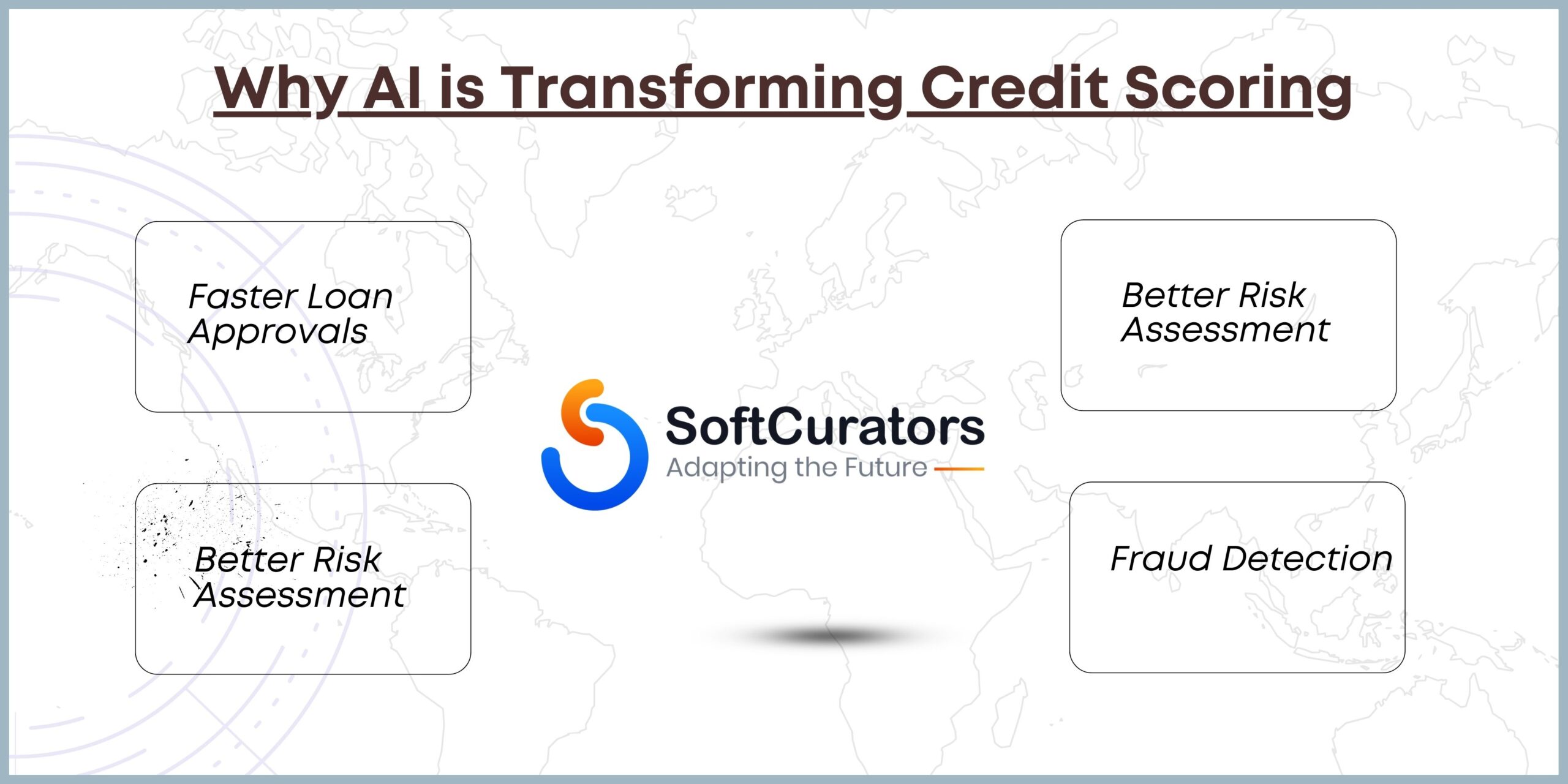
Benefits of AI Credit Scoring
1. Hyper-Accurate Risk Assessment
AI evaluates thousands of variables simultaneously.
2. Faster Loan Approvals
Decisions are made in seconds.
3. Financial Inclusion at Scale
AI enables lending for:
- Gig workers
- Freelancers
- Small businesses
4. Fraud Detection
AI identifies anomalies instantly.
5. Personalized Lending
Borrowers receive customized loan offers.
Benefits Table
| Benefit | Business Impact |
|---|---|
| Accuracy | Better decisions |
| Speed | Higher conversions |
| Inclusion | Larger user base |
| Fraud prevention | Reduced losses |
Real-World Applications of AI Credit Scoring
AI is already widely used across financial systems.
Digital Lending Platforms
Instant loan approval systems.
BNPL Platforms
Micro-credit decisions in real time. Cost to Develop a BNPL App
Banking Systems
Enhanced customer risk evaluation. Banking App Development

AI Credit Scoring in Different Industries
| Industry | Use Case |
|---|---|
| Fintech | Loan approval |
| Banking | Risk assessment |
| Insurance | Policy evaluation |
| Ecommerce | Buy now pay later |
Challenges of AI in Credit Scoring
Data Privacy Concerns
Handling sensitive data responsibly is critical.
Regulatory Compliance
Must follow strict financial regulations.
Bias in Algorithms
AI must be trained carefully to avoid bias.
Integration Complexity
Requires proper system architecture.
Businesses overcome these challenges by partnering with experts like Softcurators, which provides:
Why Softcurators is the Right Partner
Softcurators helps businesses build intelligent credit scoring systems that are:
- Scalable
- Secure
- Data-driven
- Future-ready
Additional Platforms and Solutions by Softcurators
Softcurators builds applications across multiple industries. Examples include:
- Fantasy App Development
- Taxi Booking App Development
- Food Delivery App Development
- Travel Booking App Development
- Logistics App Development
- Social Media App Development
- Dating App Development
- Laundry App Development
- Car Wash App Development
- Fuel Delivery App Development
Future of AI in Credit Scoring
AI will evolve into:
- Real-time credit engines
- Predictive financial advisors
- Autonomous lending systems
Build AI-Powered Lending Systems with Softcurators
If you are planning to build a fintech platform, AI-powered credit scoring is essential. Softcurators helps businesses develop intelligent lending platforms designed for growth and scalability. Contact us
FAQs
Can AI eliminate bias in credit scoring?
AI can reduce bias when properly trained and monitored.
Is AI credit scoring safe?
Yes, when implemented with strong security frameworks.
What data does AI use?
Financial, behavioral, and alternative data.
Is AI credit scoring expensive?
Costs vary depending on platform complexity.
Who should use AI credit scoring?
Fintech startups, banks, and lending platforms.
Why Softcurators?
Softcurators builds scalable fintech solutions.
