
Choosing the wrong mobile app development company is one of the most expensive mistakes a founder or business owner can make. We have spoken to dozens of entrepreneurs who came to Softcurators after spending $40,000, $70,000, even $120,000 with agencies that delivered unusable products, missed deadlines by months, and then disappeared when bugs started appearing.
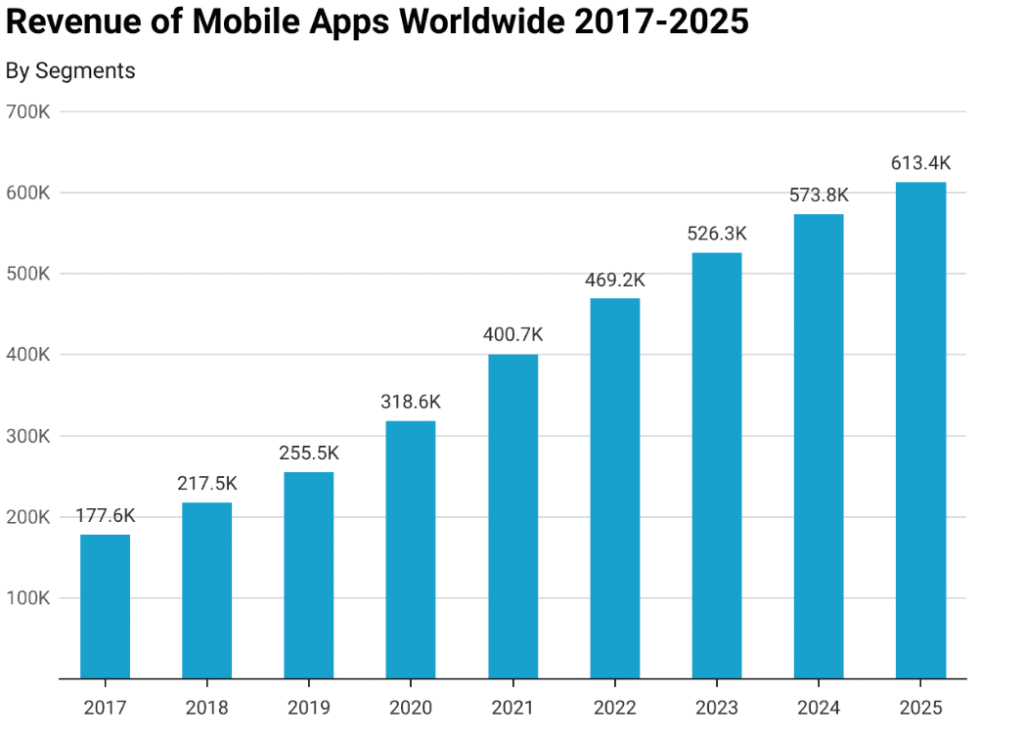
The global mobile app market is expected to generate over $935 billion in 2025. Thousands of agencies worldwide are competing for your budget. Most of them will tell you everything you want to hear during the sales call. So how do you separate the genuine mobile app development company from the ones that will let you down?
This guide answers that question comprehensively. We cover what to look for, what to ask, what to avoid, and what the right development partnership actually looks like in practice. We also share how Softcurators approaches client engagements because after years of building apps across healthcare, fintech, e-commerce, real estate, and more, we know exactly what separates a good partner from a costly mistake.
Whether you are a first-time founder or an experienced product manager, this guide will help you make the single most important decision in your app build with clarity and confidence.
Why Choosing the Right Mobile App Development Company Matters More Than Ever
According to research published on Statista, there are now more than 26 million software developers globally and thousands of agencies offering app development services. That sounds reassuring. In practice, it means the signal-to-noise ratio when searching for a mobile app development company is extremely poor.
Your app is not just a product. It is the front door to your business. A poorly built app drives users away permanently. A well-built one becomes the core of a scalable, defensible business. The difference between those two outcomes starts with who you choose to build it.
The Real Cost of a Bad Development Partner
Bad experiences with app development agencies tend to fall into three painful patterns:
- The Underquoter: Wins the project with a low price, then expands the scope mid-build with change requests that triple the budget.
- The Disappearer: Delivers an initial version, collects full payment, and becomes unreachable when bugs and issues emerge post-launch.
- The Overpromiser: Agrees to every requirement in the sales call without flagging complexity, then delivers a product that partially works at best.
All three patterns share a root cause: the client did not have a structured process for evaluating the agency before signing. This guide gives you that process.
What Is Actually at Stake
Consider these figures: the average mobile app development cost for a mid-complexity app ranges from $15,000 to $50,000+. A complete rebuild when the first agency fails costs that again, plus the months of lost time. Plus the opportunity cost of a delayed launch. Plus the morale cost of starting over.
The decision you make at the beginning determines whether you launch in 6 months or 18. Whether you spend $40,000 or $80,000. Whether your app works or does not. This is genuinely one of the most consequential vendor decisions your company will make.
Types of Mobile App Development Companies: Understand Before You Choose
Before evaluating individual companies, you need to understand the landscape. Not all development partners are the same and the right type for your project depends on your budget, timeline, and complexity.
| Type | Team Size | Cost Range (USD) | Best For | Main Risk |
| Individual Freelancer | 1 person | $5K – $30K | Very simple apps, tight budgets, prototypes | Bandwidth, reliability, limited skills |
| Small Agency (boutique) | 2–15 people | $25K – $100K | MVPs, focused apps, startups | Limited capacity, key-person dependency |
| Mid-Size Agency | 15–100 people | $80K – $300K+ | Full-featured consumer apps, business platforms | Varying account management quality |
| Large Enterprise Agency | 100+ people | $200K – $1M+ | Enterprise systems, complex integrations | Bureaucracy, cost, you are a small client |
| Offshore Agency (India/E.Europe) | Varies | $20K – $150K | Cost efficiency, wide skill range | Communication, time zones, quality variance |
| Product + Dev Studio | 10–50 people | $60K – $250K | Startups wanting product thinking + code | Higher cost than pure dev shops |
Which Type Is Right for You?
For most startup founders and SMEs building their first or second app, a mid-size specialist agency or a product-focused boutique agency delivers the best balance of quality, reliability, and cost. Here is a simple rule:
- Under $10K budget: Freelancer or very small agency, but accept higher risk.
- $15K – $50K budget: Boutique agency with relevant domain experience is your sweet spot.
- $50K – $80K budget: Mid-size specialist agency. Look for domain expertise, not just technical skills.
- $100K+ budget: Large agency or enterprise studio but still vet carefully. Size does not equal quality.
At Softcurators, we sit in the specialist mid-size category large enough to handle complex full-stack builds across iOS, Android, React Native, and Flutter, but focused enough that every client engagement gets senior-level attention from day one.

10 Essential Criteria for Evaluating a Mobile App Development Company
When choosing your mobile app development company, gut feel is not enough. You need a structured evaluation across ten dimensions. Score each agency on these criteria and you will make a data-driven decision rather than an emotional one.
1. Domain Expertise and Relevant Experience
General app development experience matters less than specific domain experience. An agency that has built three fintech apps understands compliance, security, and financial API integration in ways that a generalist agency never will. Ask for:
- Case studies of apps in your specific industry vertical
- The names of the specific developers who worked on those projects and whether they are still at the agency
- Specific technical challenges they solved in similar projects and how
At Softcurators, we have deep experience across healthcare app development, fintech app development, real estate, on-demand platforms, education, and more. This vertical depth means we bring pre-existing knowledge to your project not learn-on-your-dime exploration.
2. Portfolio Quality and Depth
Any agency can build a portfolio page. The question is what is actually in it. When you review an agency’s portfolio, look beyond the pretty screenshots:
- Can you download and use the apps they built? Test them. Look for performance, design quality, and UX coherence.
- Are the case studies specific describing the problem, their approach, the result or generic and vague?
- Are the clients real and contactable? LinkedIn searches on the company names in their case studies will tell you.
- How recent is the portfolio work? An agency living on 5-year-old case studies may have lost its best people.
Pro tip from Softcurators: Ask for the App Store / Play Store link to apps they have built. Download them. If the apps they claim to be proud of are buggy, slow, or have poor ratings that is your answer.
3. Technical Capability Breadth
Your project may start simple and grow complex. Your development partner needs the technical depth to grow with you. Evaluate:
| Technical Area | Questions to Ask | Why It Matters |
| Platform coverage | Do they build iOS, Android, and cross-platform natively? | Ensures you are not forced onto one platform |
| AI/ML integration | Have they built apps with AI features? Can they show examples? | AI is increasingly table stakes |
| Backend & APIs | Do they build the backend or just the frontend? Who manages the server? | Frontend-only shops create dependency problems |
| UI/UX design | Do they have in-house designers or outsource design? | Design quality directly drives retention |
| QA & testing | Do they have a dedicated QA team and automated testing? | Cutting QA creates expensive post-launch bugs |
| DevOps & cloud | Do they set up and hand over the infrastructure or use their own accounts? | You need to own your infrastructure |
| Security practices | Do they follow OWASP guidelines? Have they done security audits? | Security cannot be retrofitted |
Softcurators covers all of these areas in-house: mobile app development, UI/UX design, software development, AI development, web development, and maintenance and support. No critical dependencies on external parties.
4. Process Transparency and Project Management
A development agency without a clear, documented process will be chaotic to work with. Before signing, ask:
- What project management methodology do you use Agile, Scrum, Kanban?
- How frequently do you deliver working software for review weekly sprints or monthly milestones?
- What tools do you use for communication (Slack, Teams), task tracking (Jira, Linear, Trello), and documentation?
- Who is your primary point of contact and what is their seniority? Will you deal with a project manager or a salesperson who hands you off?
- How do you handle scope changes fixed-price change orders or flexible Agile adjustment?
At Softcurators, every project runs on two-week Agile sprints with a working demo delivered at each sprint end. You see progress every two weeks not every two months. This keeps everyone aligned and catches misunderstandings early, before they become expensive rework.
5. Communication Quality and Cultural Fit
You are going to spend 6-18 months working closely with this team. Poor communication different time zones, language barriers, slow response times, unclear emails will make that experience painful regardless of technical skill.
- What is their typical response time to messages? Test it before you sign send a pre-sales email and measure.
- Are their written communications (proposals, emails, documentation) clear and professional?
- Do they ask smart questions during the sales process, or do they just agree with everything you say?
- What time zone overlap do you have? At minimum, 4 hours of overlapping working time is needed for real-time collaboration.
Red flag: An agency that agrees with every requirement without pushing back or asking clarifying questions during the sales call is not doing due diligence. A good partner asks hard questions early. It is far better to surface complexity in week one than week twelve.
6. Client References and Verifiable Reviews
Third-party reviews matter but only from verifiable sources. Check Clutch, GoodFirms, and G2 for independently verified reviews. On these platforms, reviewers are verified anonymous Google reviews are easy to manipulate.
- Ask for 2-3 client references and actually call them do not just send a LinkedIn message
- Ask references specifically: “What went wrong and how did the agency handle it?” Every project has problems. How they handled them is what matters.
- Ask: “Would you hire this agency again?” the answer is always more revealing than the formal recommendation
- Check LinkedIn: do any of their team members have recommendations from past clients?
7. Intellectual Property and Code Ownership
This is critical and frequently overlooked. You must confirm upfront before signing who owns the code, designs, and any proprietary tools used to build your app.
- You should own 100% of the custom code written for your project
- All designs, assets, and documentation should be handed over to you
- Third-party libraries and SDKs used must be open source or properly licensed no hidden dependencies
- Source code should be in a repository you own (GitHub, GitLab, Bitbucket under your account) from day one
Critical red flag: Any agency that refuses to put code in your repository, requires you to use their infrastructure, or is vague about IP ownership is a serious legal and business risk. Walk away.
8. Post-Launch Support and Long-Term Capability
Building the app is only the beginning. Apps need ongoing maintenance, OS updates, bug fixes, performance optimisation, and feature additions. Ask:
- What post-launch support do you offer and at what cost?
- What is your process for handling bugs discovered after launch?
- Will the same team that built it maintain it, or is it handed to a separate support team?
- What is your response time SLA for critical production bugs?
Softcurators offers structured maintenance and support services with defined SLAs for critical, high, and standard priority issues. The same team that built your app maintains it no knowledge transfer loss, no fresh-start cost.
9. Pricing Model and Contract Structure
How an agency prices is as important as how much they charge. The main models:
| Pricing Model | How It Works | Best For | Risk to Client |
| Fixed Price | Agreed scope, agreed cost, no surprises | Well-defined, simple projects | Scope gaps → change order disputes |
| Time & Materials (T&M) | Pay per hour/day logged, flexible scope | Complex, evolving projects | Cost can escalate without control |
| Dedicated Team / Staff Aug | You “hire” their developers as if they are yours | Long-term, high-volume needs | Management overhead falls on you |
| Milestone-Based | Fixed payments at defined deliverables | MVPs, phased projects | Milestone disputes if spec is vague |
| Hybrid (Fixed + T&M) | Core fixed, additions at T&M rate | Balanced approach for most projects | Requires clear scope boundary |
Our typical engagement at Softcurators uses a milestone-based model for MVPs and a hybrid model for longer projects. This gives you cost predictability on defined work while maintaining flexibility as your understanding of requirements deepens during the build. See our MVP development service for how we structure phased engagements.
10. Their Ability to Challenge You
This sounds counterintuitive, but the best development partner is one that pushes back when your requirements are unclear, risky, or unnecessarily complex. An agency that says yes to everything is not protecting your budget or your timeline. Look for:
- Did they flag scope or complexity risks during the proposal process?
- Did they suggest a simpler approach to achieve the same outcome in their proposal?
- Did they ask about your business model, target users, and success metrics or just about features?
- Did they recommend an MVP approach rather than the full feature list from day one?
Softcurators perspective: We turn down projects that are not the right fit. If a client’s budget cannot deliver a viable product, or if their business model has fundamental problems, we say so. We would rather lose a contract than take money and deliver a product that fails. This honest approach is why clients recommend us.
12 Red Flags That Reveal a Bad Mobile App Development Company
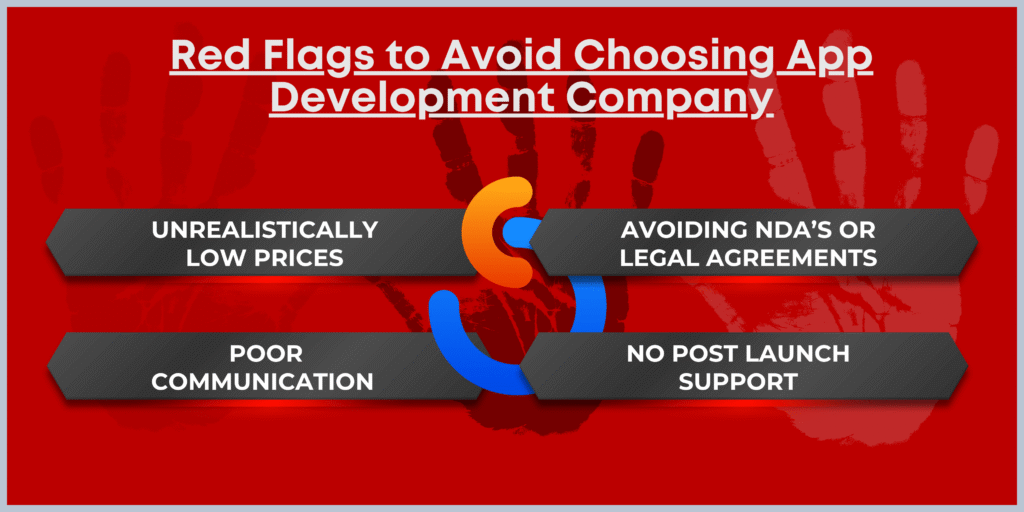
These are the warning signs that experienced founders have learned usually the hard way. Spot even two or three of these during your evaluation and walk away.
- No verifiable portfolio work. If they cannot show you live, downloadable apps they have built, there is a reason.
- Vague or missing discovery process. A good agency cannot quote without understanding your requirements in depth. An instant quote with no discovery is a price to get you signed, not a real estimate.
- Extremely low pricing. Building a good app is expensive. Agencies quoting significantly below market rate are either underscoping or planning to compensate with change orders.
- No named developers on your project. You should know who is actually building your app. “Our team” without names or LinkedIn profiles is a red flag.
- Unclear IP ownership. If they are not clear upfront that you own the code, designs, and assets that is a problem.
- No post-launch support offering. Any agency that does not discuss post-launch support is planning to disappear after delivery.
- Pressure to sign quickly. “This price is only valid until Friday” is a sales tactic, not a reality. Take all the time you need.
- No references they will let you contact directly. Review links are not enough. You need to speak to real past clients.
- They outsource everything externally. An agency that does not own its development team is a middleman adding margin, not value.
- No testing process described. QA is not optional. If testing is not in their proposal, it is not happening.
- They agree with every single thing you say. A yes-man agency is a dangerous one. You need expertise, not validation.
- Communication delays before you have even signed. If it takes them 3 days to respond to a pre-sales inquiry, imagine how long post-contract responses take.
Key Benefits of Hiring the Right Mobile App Development Company
The flip side of avoiding a bad agency is understanding what a great one actually delivers. These are the concrete benefits that a genuinely good development partner provides:
Speed to Market Without Quality Compromise
A specialist mobile app development company with the right team structure can deliver a quality MVP in 10-16 weeks. In-house teams at early-stage startups, by contrast, often take 12-18 months to hire, onboard, and deliver an equivalent product. That speed advantage can be the difference between first-mover positioning and arriving in a crowded market.
For most startup founders, the fastest path to a validated product is a focused agency build. Our startup app and web development service is specifically designed for this: a lean, fast-moving engagement that gets you to market without the overhead of building a full internal team.
Access to a Full Multi-Discipline Team
When you hire an agency, you get a complete team immediately:
- Product manager / business analyst to structure requirements
- UX designer to create the user experience
- UI designer for visual design and brand application
- Frontend developers for the interface
- Backend developers for the server and database layer
- AI/ML engineers for intelligent features
- QA engineers for testing
- DevOps engineers for infrastructure and deployment
Hiring this team in-house would take 6-12 months and cost $800,000–$1,500,000 per year in salaries alone. An agency gives you this full capability immediately at a fraction of the cost.
Technology Expertise Without the Learning Curve
The mobile app development technologies landscape changes constantly. React Native, Flutter, Swift, Kotlin, Next.js, GraphQL, AWS a specialist agency stays current because it is their business to do so. Your internal team would need significant investment in training and tooling to achieve the same breadth.
Reduced Risk Across the Development Lifecycle
A quality agency has built and launched dozens of apps. They have made the expensive mistakes already and they have processes in place to prevent those mistakes from happening on your project. Their experience with mobile app testing, deployment and maintenance protocols, mobile app security and compliance requirements, and App Store submission processes means fewer surprises for you.
Scalability: Grow the Team When You Need It
An agency can scale capacity up or down based on your project needs. Need extra developers for a feature push before a product launch? An agency can add capacity within weeks. Need to reduce spend during a funding gap? Scale down the engagement. This flexibility is impossible with an in-house team.
A Long-Term Product Partner, Not Just a Vendor
The best agency relationships evolve into genuine product partnerships. Softcurators has multi-year relationships with clients who started with a single MVP build and now work with us on ongoing product development, AI feature additions, and platform scaling. This continuity where the agency deeply understands your product, your users, and your business is genuinely valuable and impossible to replicate with one-off project vendors. Read more about our approach in our post on why clients choose Softcurators.
20 Essential Questions to Ask a Mobile App Development Company Before Hiring
Most people ask two or three questions during the agency evaluation process. The best clients ask twenty. Here they are and what to listen for in the answers.
Questions About Experience and Portfolio
- Have you built apps in [your specific industry]? Listen for specific named clients and concrete technical challenges, not generic statements.
- Can I speak directly with a client from a similar project? A refusal or significant hesitation is a red flag.
- Can I download and test apps you have built? No real portfolio work = no proven track record.
- Who specifically on your team will work on my project? Named people with LinkedIn profiles you can verify.
Process and Project Management Questions
- What is your development methodology and how are sprints structured? You want Agile, 2-week sprints, working demos at each sprint end.
- How do you handle scope changes during the project? Listen for a clear, fair process not either “no changes ever” or “any change at any price anytime”.
- What project management tools will we use and who has access? You should have access to task boards, not just weekly email updates.
- How frequently will I see working software not just screenshots? At minimum, every two weeks. Anything longer creates misalignment risk.
Questions About Technical Approach
- Will you build native or cross-platform and why is that your recommendation for my project? The right answer depends on your specific context, not their preferred tools.
- How will you handle the backend and what cloud infrastructure will you use? You want a clear answer. “We will figure that out” is not acceptable.
- Who owns the code and where will it be hosted? Your repository. Your accounts. No exceptions.
- How do you approach mobile app security? They should mention OWASP, data encryption, secure API design, and penetration testing.
Costs and Timeline Questions
- What is included in the quoted price and what is not? A good proposal is specific about what is in scope.
- How do you handle bugs discovered after launch and at what cost? Post-launch bugs should be covered under warranty for a defined period.
- What is a realistic timeline for my specific project? Agencies that promise very fast delivery without understanding your scope are usually overpromising.
Questions About Team and Culture
- Where is your development team located and what are their hours? Transparency here is a positive sign. Evasiveness about location is suspicious.
- What happens if a key developer leaves the project? Good agencies have documented processes and knowledge management. Bad ones have key-person risk.
Post-Launch Questions
- What is your post-launch support model? Defined SLAs, named contacts, clear pricing for ongoing work.
- How do you handle App Store submission and what is your experience with rejection? Every experienced agency has dealt with App Store rejections. Their answer reveals experience.
- Will the same team that built the app maintain it? Continuity matters. A handover to a separate “support team” often means lost context.
In-House Development vs Hiring an App Development Agency: A Practical Comparison
This is a genuine strategic decision, not just a tactical one. Here is the honest comparison:
| Factor | In-House Team | External Agency |
| Time to start | 3–12 months (hiring) | 2–4 weeks |
| Cost (Year 1) | $600K–$1.5M (salaries + overheads) | $60K–$300K (project-based) |
| Talent availability | Limited by local market | Access to global talent |
| Domain expertise | Must be built internally | Immediately available |
| Technology currency | Requires ongoing training investment | Agency’s core responsibility |
| Scale flexibility | Slow to scale up or down | Fast to adjust capacity |
| IP ownership | 100% (employed team) | 100% (if contract is clear) |
| Long-term continuity | High if retention is strong | Relationship-dependent |
| Product context depth | Builds over time | Grows with longer engagements |
| Best suited for | Companies with $1M+ runway, long-term tech vision | Startups, MVPs, specific project builds |
The honest answer: for most startups building their first app, an external mobile app development company is the faster, more cost-effective, and lower-risk choice in year one. As the business grows and the product matures, building selective in-house capability often starting with a product manager and later adding developers makes increasing sense. The two approaches complement each other at different stages.
For more on this topic, read our detailed guide on mobile app development for businesses and startups which covers the build-vs-buy decision in depth.
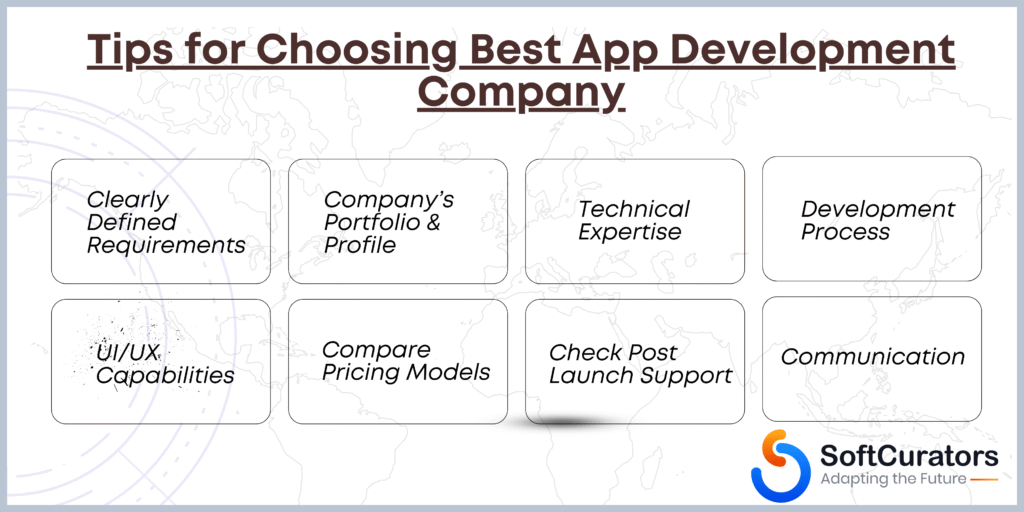
How to Evaluate Proposals from App Development Companies
You have spoken to five agencies. You have received four proposals. Now you need to compare them fairly and choose one. Here is how to do that without being fooled by presentation quality or pricing alone.
The Proposal Evaluation Scorecard
| Evaluation Criterion | Weight | What to Look For | Score (1–10) |
| Portfolio relevance to your project | 20% | Apps built in your industry, comparable complexity | |
| Technical approach detail | 15% | Specific tech choices with rationale, not generic | |
| Process and methodology clarity | 15% | Clear Agile description, sprint cadence, demo schedule | |
| Team composition and experience | 15% | Named people, verifiable seniority, continuity commitment | |
| Commercial terms and IP clarity | 10% | Your code, your accounts, clear change order process | |
| Post-launch support quality | 10% | SLA, named contact, warranty period, pricing clarity | |
| Communication in sales process | 10% | Response speed, question quality, honesty about challenges | |
| Client references quality | 5% | Directly contactable, independently verified |
Score each agency on each criterion (1–10), multiply by the weight, and total the scores. This is not about the lowest price or the most impressive pitch deck. It is about the combination of factors that predicts a successful build.
Comparing Pricing Apples to Apples
When comparing quotes, the headline number is nearly meaningless without understanding what is and is not included. Always clarify:
- Does the quote include design or only development?
- Does it include project management time?
- Does it include QA and testing?
- Does it include App Store submission?
- Does it include a post-launch warranty period?
- Does it include infrastructure setup (or does cloud hosting cost extra)?
A $60,000 all-inclusive quote is often better value than a $45,000 quote that excludes design, QA, and infrastructure. Build a comparison spreadsheet that normalises all proposals to the same scope before comparing numbers. For benchmarks on what specific app types should cost, see our mobile app development cost and pricing guide.
Onshore, Nearshore, or Offshore App Development: Which Model Is Right for You?
Geography matters but not for the reasons most people think. The debate is not “onshore quality vs offshore cost.” The real consideration is communication, cultural alignment, time zone overlap, and how you manage quality regardless of location. Here is the honest breakdown:
| Model | Geography | Typical Hourly Rate | Time Zone Overlap | Best For |
| Onshore | Same country | $80–$200/hr | Full overlap | Highly regulated industries, complex communication needs |
| Nearshore | Nearby time zone (1–4 hrs diff) | $40–$90/hr | Partial to full overlap | Good quality-cost balance, close collaboration |
| Offshore | Distant time zone (5–12 hrs diff) | $15–$50/hr | Limited overlap | Cost priority, clear specs, experienced remote teams |
The key to successful offshore development is not avoiding it it is managing it correctly. Best practices for offshore engagement:
- Require minimum 4 hours of overlapping working time daily not just async communication
- Use video calls for requirement discussions, not just text-based specs
- Insist on daily standups (15 minutes) during active development sprints
- Require working software demos at the end of every sprint not just screenshots
- Visit the agency’s office at least once if the budget is significant
Softcurators has served clients across the US, UK, Qatar, and multiple global markets. We have refined our remote collaboration model to deliver the quality standards of onshore engagement at significantly more competitive rates.
The Complete App Development Company Selection Checklist
Portfolio and Experience Checks
- Reviewed at least 3 live, downloadable apps from their portfolio
- Confirmed apps work well and have positive App Store ratings
- Found case studies relevant to your specific industry and complexity level
- Verified named developers on past projects still work at the agency
- Spoke directly with at least one past client reference (not just saw their logo)
Process and Communication Checks
- Received a clear description of their Agile/sprint process
- Confirmed two-week sprint cycle with working demo at each sprint end
- Identified your named project manager and their seniority
- Confirmed access to project management tools (Jira, Linear, Trello)
- Tested pre-sales response time under 24 hours is a good sign
- Assessed written communication quality clear, professional, specific
Technical and Legal Checks
- Confirmed they build both frontend and backend (not frontend-only)
- Confirmed all code will be in your own repository from day one
- Confirmed all intellectual property is owned by you after payment
- Asked about security practices and received a substantive answer
- Confirmed their testing process includes both manual and automated QA
- Confirmed they handle App Store submission as part of the engagement
Commercial and Contractual Checks
- Compared quotes on a normalised basis (same scope, same inclusions)
- Confirmed what triggers a change order and the process for managing them
- Reviewed post-launch warranty terms what is covered and for how long
- Confirmed post-launch support pricing and SLA for critical bugs
- Verified no hidden dependencies you own the infrastructure accounts
- Had a solicitor review the contract before signing if the value exceeds $50K
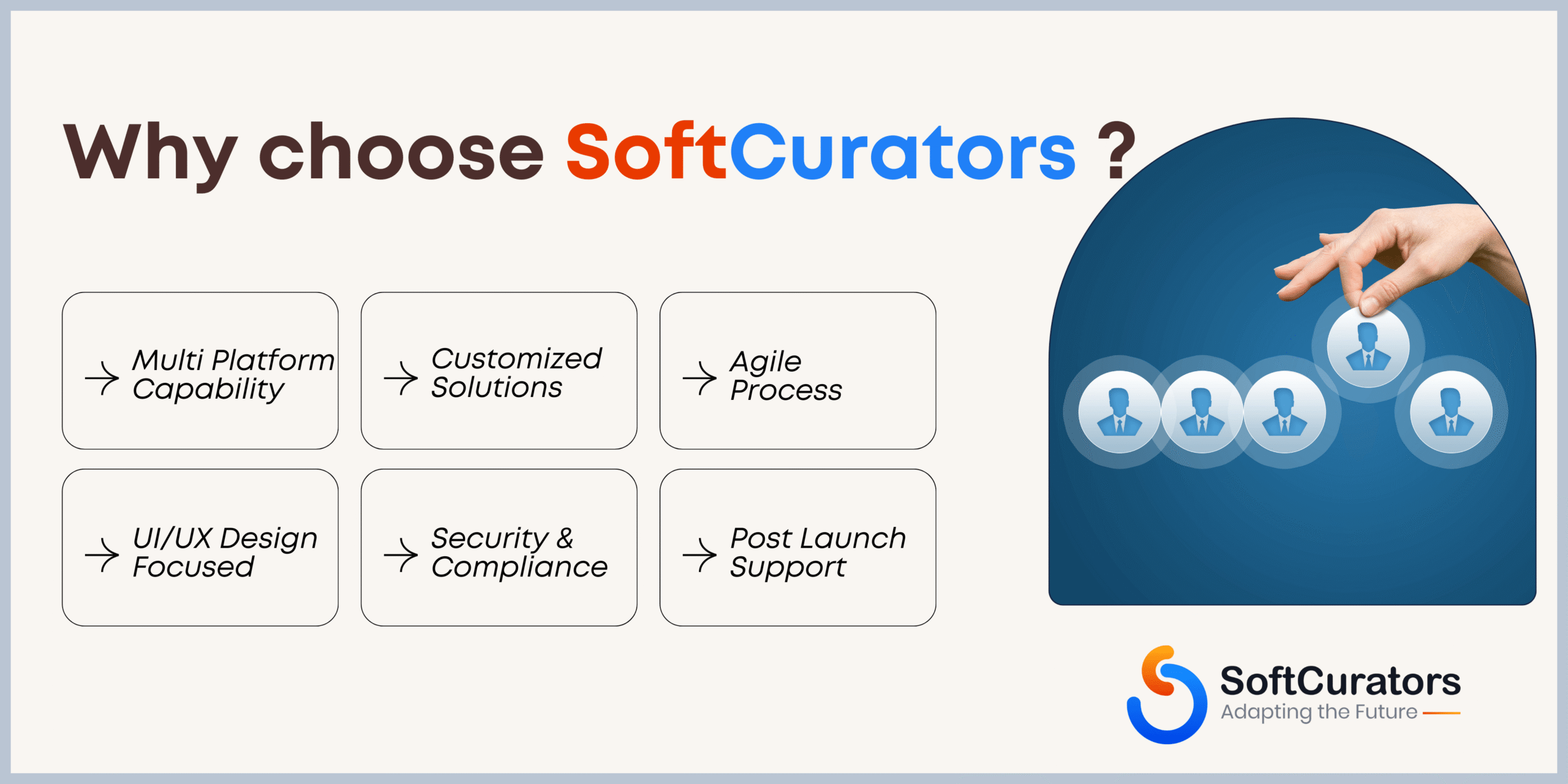
Why Clients Choose Softcurators as Their Mobile App Development Partner
Ready to find a development partner you can trust? Contact Softcurators today for a free, no-obligation discovery call. We will assess your idea, give you an honest scope estimate, and tell you what a realistic build looks like before you commit to anything.
We wrote this guide because we believe you deserve to make an informed decision even if that means you choose a different partner. But if you have read this far and are looking for a mobile app development company that ticks every box above, here is why Softcurators consistently earns multi-year client relationships:
Transparent, Honest Engagement from Day One
We do not tell you what you want to hear. We tell you what you need to hear. If your budget is too small for your vision, we say so and we help you scope an MVP that makes sense. If your app idea has a technical challenge we need to flag, we flag it in week one, not week twelve. This honest approach is described in detail in our post on why clients choose Softcurators.
Deep Industry Expertise Across Verticals
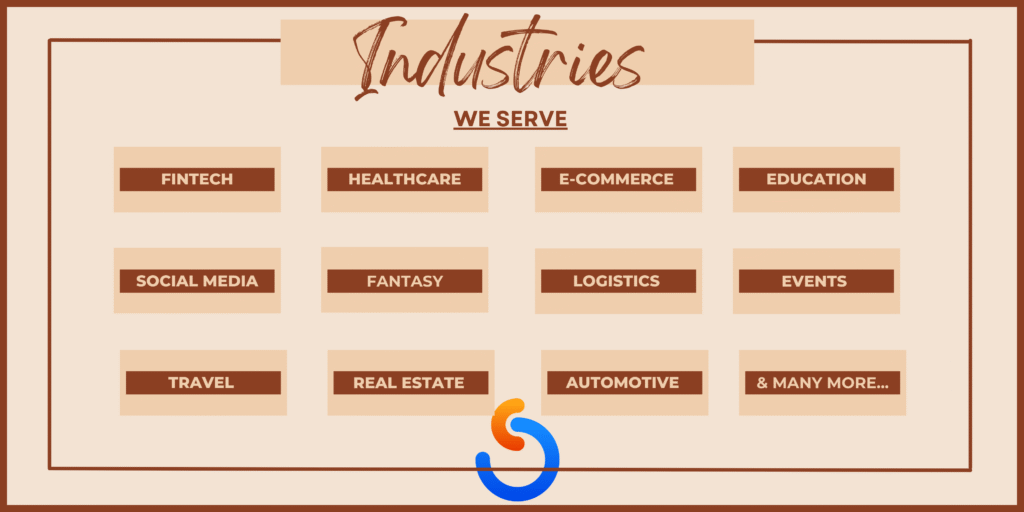
We have built apps across healthcare, fintech, banking, real estate, on-demand platforms, education, e-commerce, dating, food delivery, music streaming, and many more. This vertical depth means you get a team that understands your industry, not one that is learning on your budget.
Full-Stack Capability Under One Roof
We deliver iOS development, Android development, React Native, Flutter, cross-platform development, web development, UI/UX design, AI development, AI app development, AI consulting, progressive web app development, and software development all in-house, all under one roof.
Proven for Startups and Enterprises Alike
Whether you need a rapid MVP to validate your concept or a startup-focused full product build, we scale our engagement to fit. We also work with larger enterprises on digital marketing services, AI automation services, and long-term product development. Explore our portfolio and about us pages to see the range of what we deliver.
Conclusion: Make the Right Choice Your App Deserves It
Choosing the right mobile app development company is not a procurement decision. It is a strategic one. The partner you choose will shape your product, your timeline, your budget, and ultimately your business outcomes for the next 12–24 months.
The good news: a structured evaluation process using the criteria, questions, red flags, and checklist in this guide removes most of the guesswork. Agencies that genuinely deliver quality will welcome your detailed questions. Agencies that struggle with them are showing you something important.
At Softcurators, we are confident that a rigorous evaluation process leads more clients to us not away from us. Because we have the portfolio, the process, the team, and the track record to stand behind every claim on this page. If you are ready to take the next step, we would love to speak with you.
Frequently Asked Questions About Choosing a Mobile App Development Company
What is the average cost of hiring a mobile app development company?
Costs vary significantly by scope, complexity, and geography. A simple MVP built by a specialist agency typically ranges from $15,000–$30,000. A mid-complexity consumer app ranges from $30,000–$50,000. Complex enterprise or marketplace apps can exceed $80,000. For detailed category-specific cost benchmarks, see our mobile app development cost guide.
Should I choose a local app development company or is offshore fine?
The right answer depends on your project, budget, and communication style. Offshore development works very well when: the agency has strong English communication, there is meaningful time zone overlap (4+ hours), you have a structured process for managing remote teams, and you have clear specifications. Poor offshore outcomes are usually caused by poor process management, not geography. If your project involves highly sensitive data or regulatory compliance requirements, local or nearshore may be worth the premium.
How long does it take a mobile app development company to build an app?
Timelines depend heavily on complexity and scope. A simple MVP: 4-8weeks. A mid-complexity consumer app: 2-4 months. A complex enterprise or marketplace platform: 4-6 months. AI-powered apps add 1-2 months for model development and training. Any agency that quotes a dramatically shorter timeline than these benchmarks without explaining how is overpromising.
What should I prepare before approaching a mobile app development company?
At minimum, prepare: (1) A clear description of the problem your app solves. (2) Your primary user type. (3) The core features you need (a simple list, not a full spec). (4) Your approximate budget range. (5) Your target launch timeline. (6) Your target platform (iOS, Android, or both). You do not need a full technical specification a good agency will help you develop that. But you do need clarity on the business problem you are solving. Also read our guide on mobile app development trends to understand the current landscape before your first agency call.
What is the difference between a mobile app development company and a software development company?
A mobile app development company specialises in building applications for iOS and Android smartphones and tablets. A software development company is a broader term that includes desktop software, enterprise systems, web applications, and mobile apps. Some software companies have strong mobile practices; others do not. When evaluating, focus on their specific mobile work not their general software portfolio.
Can a mobile app development company also build my website?
Many do, yes including Softcurators. We offer web development and progressive web app (PWA) development alongside mobile app builds. Working with one partner for both your app and web presence typically improves design consistency, reduces integration complexity, and lowers overall cost.
What questions reveal the most about an app development company?
The most revealing questions are not the obvious ones. Ask: "Tell me about a project that went wrong and how you handled it." "What would you have done differently on your most challenging project?" "What do you wish clients told you upfront that they usually do not?" The quality and honesty of the answers reveal more about culture, experience, and integrity than any portfolio presentation.
Is it worth paying more for a premium app development company?
Sometimes but "premium" does not always mean better. The right question is: are you paying more for a demonstrably better team, better process, and verifiable track record? Or are you paying more for a bigger office and a better sales team? Run the evaluation criteria in this guide and let the scores guide the decision, not the invoice header.
How do I protect myself legally when hiring an app development company?
Key legal protections: (1) IP ownership clause you own all custom code, designs, and assets created for you. (2) Code in your repository from day one. (3) Confidentiality / NDA covering your product concepts. (4) Clear milestone payment structure never pay 100% upfront. (5) Bug warranty period post-launch. (6) Defined termination clause that includes code handover. For any engagement above $50,000, have a solicitor review the contract.
What happens if I am unhappy with the app the development company built?
This depends entirely on what is in your contract. Best-in-class contracts include: a defined acceptance testing period post-delivery, a bug fix warranty covering defects discovered in a defined period (typically 30-90 days), and a clear escalation process for disputed deliverables. Before signing, confirm exactly what the remediation process is if the delivered app does not meet the agreed specification. This conversation reveals a lot about the agency confident, quality-focused agencies are comfortable discussing it.
Should I hire a mobile app development company or build an in-house team?
For most startups and SMEs building their first or second app, an external agency is the faster and lower-risk option. In-house teams take 6-12 months to hire and cost significantly more in year one. The agency route gets you to market in months with a complete, experienced team. As your product matures and your technical needs become more predictable, building selective in-house capability makes increasing sense. Our guide on mobile app development for businesses and startups covers this decision in detail.
How do I evaluate a mobile app development company's technical skills without being a developer myself?
You do not need to be a developer to evaluate technical quality. Download and use their portfolio apps evaluate performance, smoothness, load times, and UX quality. Ask them to explain their technical choices in plain English; a good developer can do this clearly. Check the App Store ratings and reviews for their portfolio apps. Ask what they would change about an app they built previously and why the quality of their self-critical answer reveals technical maturity.
What is a mobile app development company's discovery phase and is it worth paying for?
The discovery phase (sometimes called scoping or technical discovery) is a paid, upfront engagement where the agency deeply analyses your requirements, maps user flows, validates technical feasibility, and produces a detailed specification. It typically costs $2,000–$15,000 depending on project complexity. It is almost always worth paying for, because it: produces a shared understanding of exactly what will be built, catches requirement gaps before development begins, produces a more accurate cost estimate, and reduces expensive mid-development surprises.
Can I hire a mobile app development company just to fix an app someone else built?
Yes and this is more common than most people expect. Many agencies, including Softcurators, take on rescue projects. Before agreeing to take over, a good agency will conduct a technical audit of the existing codebase to assess its quality, scalability, and security. Sometimes a rebuild is more cost-effective than remediation. Our maintenance and support services team has extensive experience in app takeovers and rescue projects.
What is the difference between native and cross-platform app development?
Native apps are built separately for each platform Swift/Objective-C for iOS, Kotlin/Java for Android. They offer the best performance and access to platform-specific features but cost more to build and maintain (essentially two separate codebases). Cross-platform frameworks like React Native and Flutter allow building for both iOS and Android from a single codebase, typically at 30-50% lower cost and with 70-90% code reuse. For an in-depth comparison, read our guide on native apps vs hybrid apps.
How do I know if a mobile app development company understands my business, not just technology?
Ask them to describe your target user and the core problem your app solves in their own words, after your initial brief. Ask what feature they would cut from your list if the budget needed to be reduced by 20%. Ask what you should measure in the first 90 days post-launch. An agency that understands your business answers these questions thoughtfully. One that only understands technology gives vague or feature-focused answers.
Is it better to hire a specialist mobile app development company or a full-service digital agency?
Specialist companies typically have deeper technical bench strength in their area of focus. Full-service agencies offer more breadth but sometimes at the cost of depth. The question is: what does your project primarily require? If you need a complex, technically ambitious mobile app, a specialist development agency usually outperforms a generalist full-service agency. If you need an app alongside a brand refresh, marketing strategy, and social media management, a full-service agency may be more convenient but vet the mobile development capability specifically.
What should I look for in a mobile app development company's contract?
A well-structured contract includes: clear IP assignment clause (you own everything), code repository access from day one, milestone-based payment schedule (never 100% upfront), a bug warranty period (minimum 30 days), a change request process with defined pricing, a confidentiality clause, a termination clause with code handover requirements, and agreed deliverables at each milestone. If any of these are missing, request them. If the agency refuses, that is informative.
How does Softcurators handle new client projects differently from other agencies?
Every Softcurators engagement starts with a structured Discovery phase even for smaller projects. We spend time understanding your business, your users, and your market before recommending a feature set or quoting a price. We do not believe in one-size-fits-all proposals. Every project gets a bespoke approach, a named team, and a direct line to senior developers not just a project manager. Read more about how we work at why choose Softcurators or contact us directly to discuss your project.
Q22. What is a prototype and should I request one before full development?
A prototype (sometimes called a clickable mockup or interactive wireframe) is a simulated version of your app's user interface that looks and feels like the real thing but has no working backend. It lets you test the user experience, validate key flows, and get stakeholder feedback before a single line of code is written. At Softcurators, we include prototyping as part of our prototype development service and recommend it for any project above $50,000 in development budget. It consistently saves more than it costs by catching design issues early.
Can a mobile app development company help with App Store launch strategy?
The best ones yes and this is often overlooked. App Store Optimisation (ASO), screenshot design, app description copywriting, keyword research, and launch day submission are all skills a quality full-service mobile agency handles. Ask specifically about their App Store launch experience and whether they have examples of apps they helped rank or gain featured placements. Post-launch marketing, user acquisition strategy, and analytics setup are also valuable additions that the best agencies offer.
What is a prototype and should I request one before full development?
A prototype (sometimes called a clickable mockup or interactive wireframe) is a simulated version of your app's user interface that looks and feels like the real thing but has no working backend. It lets you test the user experience, validate key flows, and get stakeholder feedback before a single line of code is written. At Softcurators, we include prototyping as part of our prototype development service and recommend it for any project above $30,000 in development budget. It consistently saves more than it costs by catching design issues early.
