
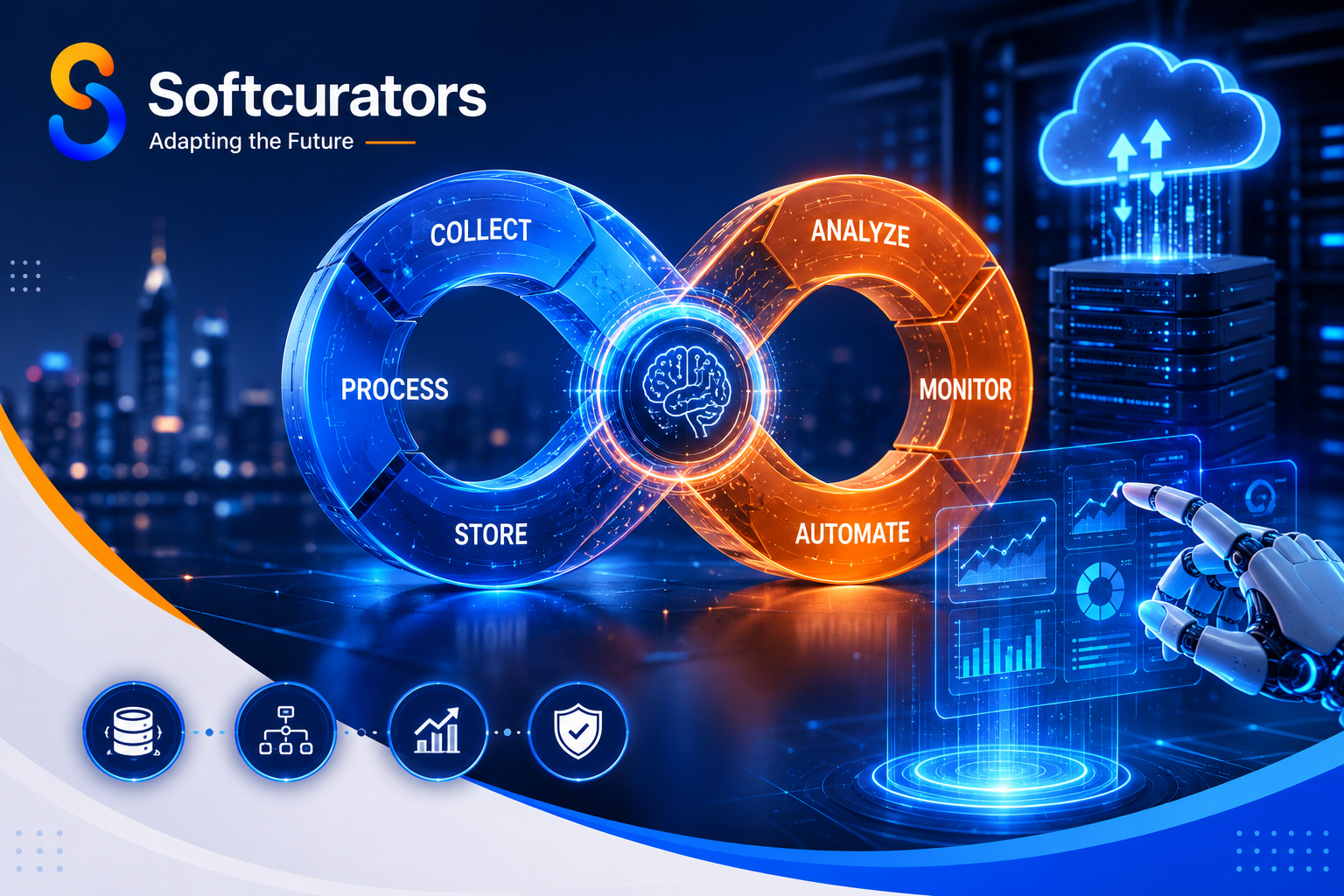
If your data pipelines are slow, your teams are fighting over stale dashboards, and your AI models keep breaking in production you are not alone. Most enterprises in 2026 are sitting on mountains of data they cannot fully use. The problem is rarely the data itself. The problem is the DataOps process or the lack of one. That is exactly why AI-Powered DataOps has become one of the most talked-about strategies in enterprise technology this year.
In this complete guide, we break down what AI-Powered DataOps actually means, why it matters, how leading companies are using it, which tools to consider, and how to implement it step by step. Whether you are a CTO, a data engineering lead, or a startup founder trying to scale your data infrastructure, this guide has everything you need.
At Softcurators, we help businesses build intelligent, scalable, and future-ready digital systems from mobile app development to AI development and AI consulting services. We have seen firsthand how AI-Powered DataOps transforms businesses. Let us walk you through it.
What Is DataOps? A Clear Definition for 2026
DataOps is a collaborative data management practice. It borrows principles from DevOps and Agile and applies them to the full data lifecycle. The goal is simple: deliver high-quality data faster, with fewer errors, and at scale.
Think of DataOps as the engine room of your data strategy. Without it, your data scientists wait weeks for clean data. Your analysts work with inconsistent figures. Your machine learning models drift silently. With DataOps in place, your entire data supply chain becomes predictable and reliable.
How DataOps Differs from Traditional Data Management
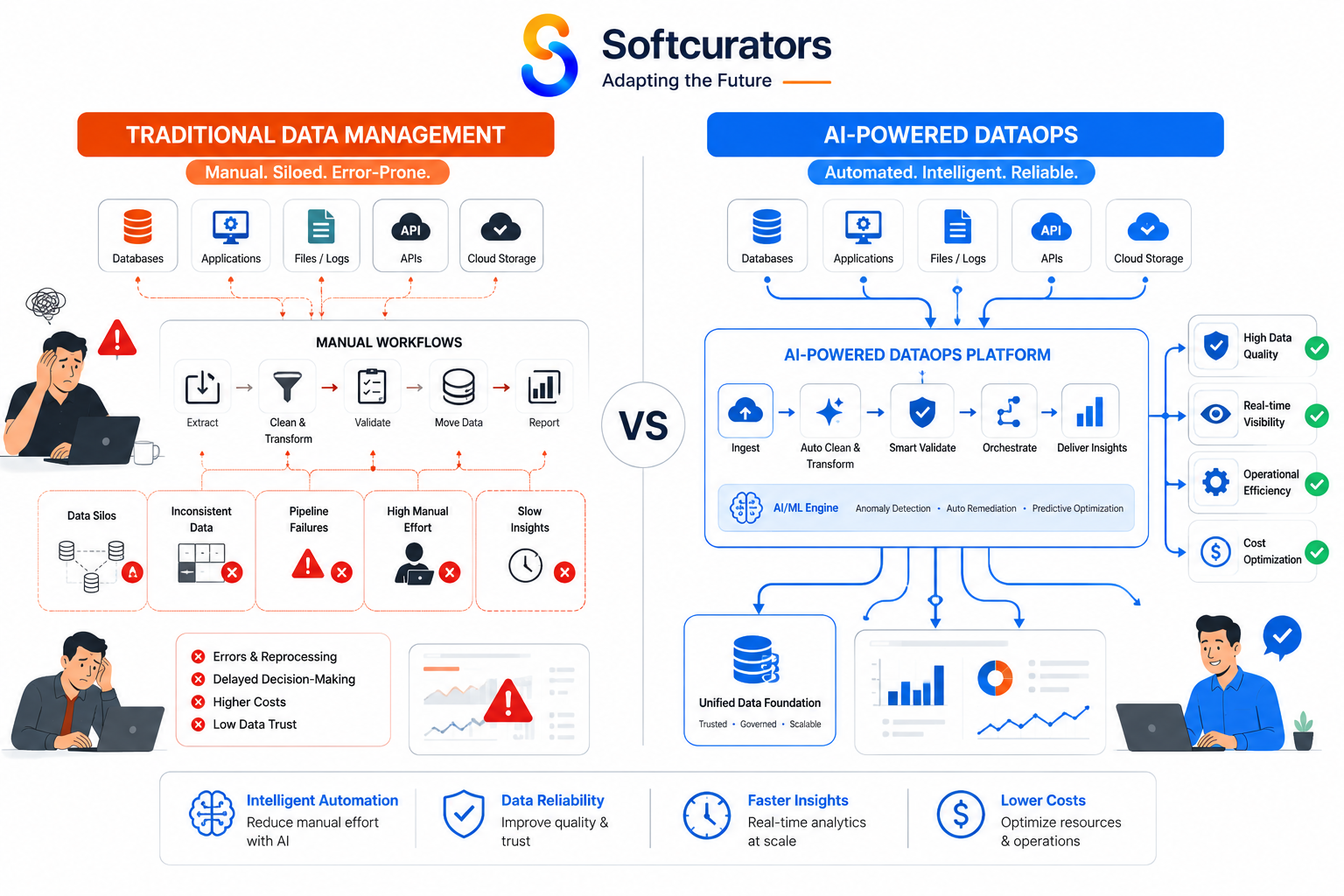
Traditional data management is reactive. Something breaks, someone fixes it. DataOps is proactive. You define quality rules upfront, you automate testing, and you monitor everything continuously. The shift is from “fix it when it fails” to “prevent it from failing in the first place.”
In 2026, that difference matters more than ever. AI workloads are data-hungry. Real-time personalization demands instant pipelines. Regulatory requirements like GDPR and DPDP in India mean data lineage is not optional it is mandatory.
What Is AI-Powered DataOps? The Next Evolution
AI-Powered DataOps is the next generation of DataOps. It uses artificial intelligence and machine learning to automate, optimize, and intelligently manage the entire data pipeline from ingestion to consumption.
Traditional DataOps still relies heavily on manual rule-setting, human monitoring, and scripted automation. AI-Powered DataOps goes further. It learns patterns, predicts failures, suggests fixes, and continuously improves without needing constant human input.
The Core Components of AI-Powered DataOps
AI-Powered DataOps brings together several technologies working in concert:
- Automated Data Pipeline Orchestration: AI schedules, monitors, and reorders pipelines based on changing conditions.
- Intelligent Data Quality Management: ML models detect anomalies, flag errors, and suggest corrections in real time.
- Self-Healing Pipelines: When a pipeline breaks, AI diagnoses the issue and triggers automated remediation.
- Predictive Monitoring: AI predicts infrastructure bottlenecks before they happen, preventing downtime.
- Smart Data Cataloging: Natural language processing makes data discovery conversational and fast.
- AI-Driven Observability: Continuous, intelligent monitoring across every layer of the data stack.
Why AI-Powered DataOps Matters in 2026
Data volumes are not slowing down. By 2026, global data creation is projected to exceed 120 zettabytes annually. Enterprises generating terabytes of daily transactional, behavioral, and operational data cannot afford manual DataOps anymore.
Here is the problem every data team faces: the bigger your data estate, the harder it is to maintain quality, governance, and speed simultaneously. Something always gives. AI-Powered DataOps is designed to hold all three without compromise.
The Business Case for AI-Powered DataOps
Executive teams often ask for a business case before investing. Here is what the numbers say from industry research and enterprise case studies:
- Up to 60% reduction in data pipeline failures through predictive monitoring.
- 30–50% faster time-to-insight because data is clean and accessible on demand.
- 40% reduction in data engineering overhead due to automation.
- Significant improvement in model accuracy because ML models train on consistently clean data.
- Lower compliance risk because data lineage and audit trails are automated.
At Softcurators, our AI app development engagements consistently show that clients who invest in AI-Powered DataOps foundations see significantly better ROI from their AI initiatives.
Key Benefits of AI-Powered DataOps
1. Dramatically Faster Data Delivery
Speed is the first and most visible benefit. AI-Powered DataOps automates the slow, manual steps in your pipeline data validation, transformation, scheduling, and deployment. What used to take days now takes hours or minutes.
Faster data delivery means faster decisions. In competitive markets, that speed advantage compounds over time.
2. Continuous, Automated Data Quality
Data quality is not a one-time effort. It degrades constantly as source systems change, schemas evolve, and upstream data providers update their formats. AI-Powered DataOps monitors quality continuously and adapts automatically.
ML-based anomaly detection catches issues like sudden drops in row counts, unusual distributions, or unexpected null rates issues that rule-based systems miss entirely.
3. Reduced Mean Time to Resolution (MTTR)
When something breaks in a traditional pipeline, data engineers spend hours reading logs, tracing lineage, and identifying the root cause. AI-Powered DataOps cuts this dramatically. Intelligent observability pinpoints the issue automatically and often triggers a fix before the on-call engineer is even paged.
4. Scalable Governance and Compliance
Regulations are tightening globally. India’s DPDP Act, GDPR in Europe, CCPA in California all require organizations to know exactly where their data is, how it flows, and who can access it. AI-Powered DataOps automates data lineage, tagging, and audit trails, making compliance scalable rather than painful.
5. Better AI and ML Model Performance
Your machine learning models are only as good as the data they train on. AI-Powered DataOps ensures your training datasets are fresh, clean, and representative. It also monitors for data drift in production, alerting your team when model inputs start diverging from training distributions.
6. Lower Total Cost of Ownership
Fewer manual interventions. Fewer production incidents. Less overtime for data engineering teams chasing pipeline failures. The cost savings from AI-Powered DataOps typically exceed the investment within 12–18 months for mid-sized enterprises.
Real-World Use Cases of AI-Powered DataOps
Understanding the theory is important. But seeing how AI-Powered DataOps works in practice makes it real. Below are concrete use cases across different industries.
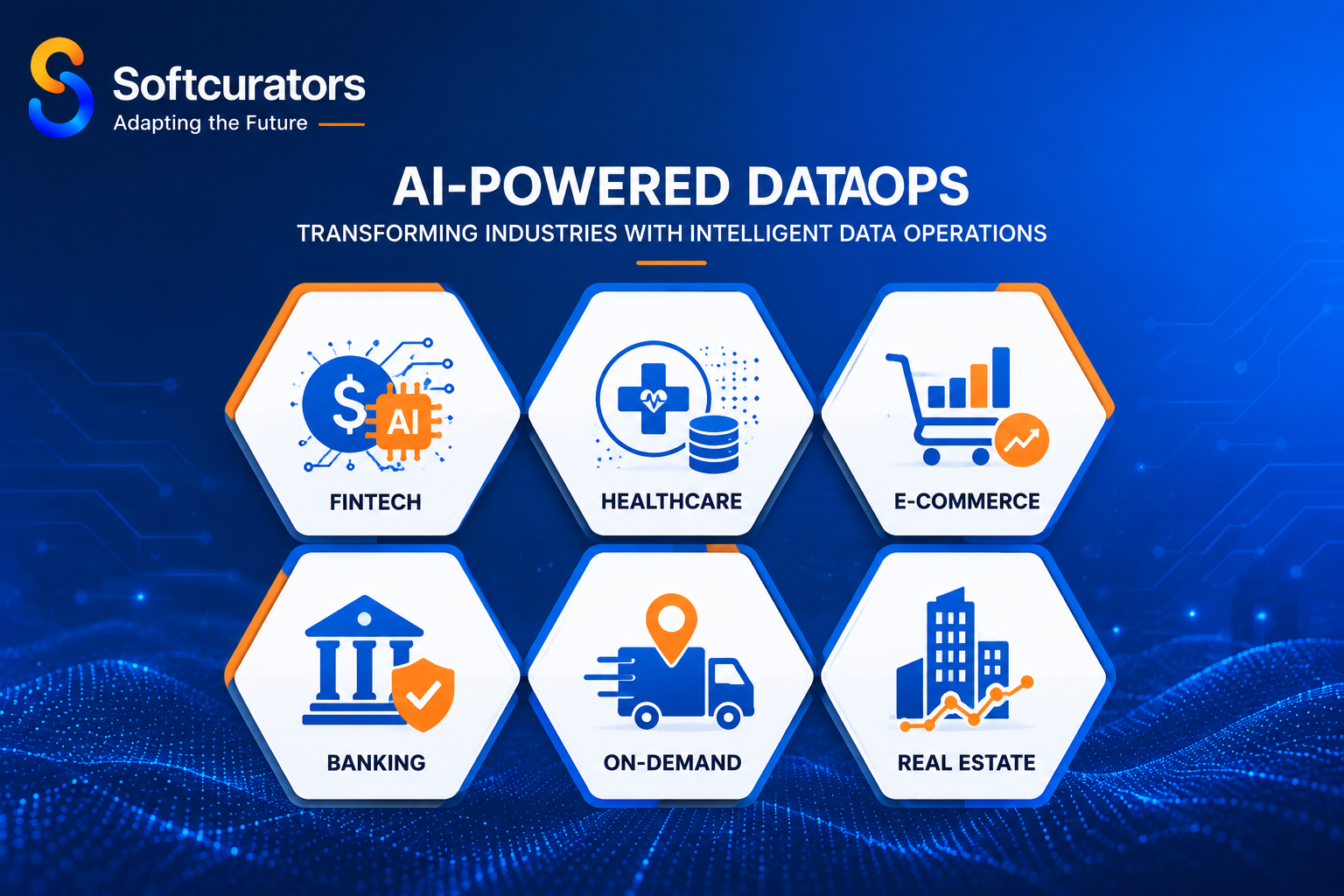
Use Case 1: Fintech Real-Time Fraud Detection Pipelines
Fintech companies process millions of transactions per day. Fraud patterns change constantly. AI-Powered DataOps enables self-updating fraud detection pipelines that continuously monitor data quality, detect drift in transaction patterns, and retrain models automatically when performance degrades.
If you are building or scaling a fintech platform, Softcurators’ fintech app development services include data pipeline architecture designed for exactly this kind of real-time, AI-driven operation.
Use Case 2: Healthcare Clinical Data Pipelines
Healthcare organizations deal with some of the most sensitive and complex data in the world. EHR systems, lab results, imaging data, and wearable feeds must all be integrated reliably. AI-Powered DataOps ensures clinical data pipelines maintain quality and compliance automatically.
Softcurators’ healthcare app development expertise includes building HIPAA-aware data infrastructure that supports both clinical operations and AI-driven diagnostics.
Use Case 3: E-Commerce Personalization Engines
E-commerce personalization depends on freshness. Stale recommendation data means wrong products, lower conversion, and lost revenue. AI-Powered DataOps keeps recommendation pipelines synchronized with real-time user behavior, inventory changes, and pricing updates.
Our eCommerce development team builds data-driven personalization layers directly into platform architectures.
Use Case 4: Banking Regulatory Reporting Automation
Banks must submit regulatory reports on tight deadlines. Any error in the underlying data can result in penalties and reputational damage. AI-Powered DataOps automates data validation, lineage tracking, and report generation reducing human error and compliance risk simultaneously.
See how our banking app development practice approaches data-intensive banking solutions.
Use Case 5: On-Demand Platforms Operational Analytics
On-demand platforms ride-hailing, food delivery, logistics run on real-time operational data. Driver availability, demand patterns, route optimization, and pricing algorithms all depend on millisecond-fresh data. AI-Powered DataOps makes this possible at scale.
Softcurators builds scalable backend data systems for on-demand app development that handle high-velocity, high-volume data reliably.
Use Case 6: Real Estate Property Intelligence Platforms
Real estate platforms aggregate listing data, market trends, location analytics, and user behavior. AI-Powered DataOps ensures all these feeds stay synchronized, clean, and enriched powering accurate property valuations and smart recommendations.
Explore how Softcurators approaches real estate app development with data-first thinking.
Top AI-Powered DataOps Tools in 2026
Choosing the right tools is critical. The AI-Powered DataOps tooling landscape has matured significantly. Here is a curated overview of the leading platforms and tools in 2026.
Data Pipeline Orchestration
- Apache Airflow + AI Extensions: The industry standard for pipeline orchestration, now enhanced with AI-based scheduling and anomaly prediction.
- Prefect: Modern workflow orchestration with native observability and dynamic scheduling.
- Dagster: Asset-centric orchestration with built-in data lineage and software-defined data pipelines.
AI-Driven Data Quality
- Monte Carlo: The leading data observability platform with ML-based anomaly detection across tables, columns, and pipelines.
- Great Expectations: Open-source data validation with a large community and strong integration ecosystem.
- Soda Core: Lightweight data quality monitoring with AI-assisted rule suggestions.
Data Cataloging and Governance
- Alation: Enterprise data catalog with AI-powered search and policy automation.
- Collibra: Market-leading data governance with deep compliance automation.
- DataHub (LinkedIn): Open-source metadata platform with strong lineage tracking and AI enrichment.
MLOps and Data + AI Integration
- MLflow: Experiment tracking, model registry, and deployment the DataOps layer for ML teams.
- Weights & Biases: AI experiment tracking with deep dataset versioning for DataOps-ML bridges.
- Tecton: Feature store platform that operationalizes ML features with DataOps-grade reliability.
Cloud-Native DataOps Platforms
- Databricks Lakehouse: Unified analytics and AI platform with Delta Live Tables for automated pipeline management.
- Snowflake + Cortex AI: Cloud data platform now with embedded AI capabilities for data transformation and quality.
- Google Cloud Dataplex: Intelligent data fabric for managing, monitoring, and governing distributed data.
The AI-Powered DataOps Architecture: How It All Fits Together
Architecture is where strategy meets engineering. A well-designed AI-Powered DataOps architecture handles data from source to consumption reliably at any scale.
Layer 1: Intelligent Data Ingestion
Data enters your system from dozens of sources APIs, databases, streaming platforms, SaaS tools, IoT sensors. AI-Powered DataOps applies schema inference, automatic format detection, and anomaly flagging at ingestion before bad data contaminates downstream systems.
Layer 2: Automated Data Transformation
Transformation pipelines convert raw data into usable formats. AI assists here by suggesting transformation logic, detecting breaking changes, and automatically updating transformation rules when source schemas evolve.
Layer 3: Continuous Quality Monitoring
After transformation, AI-Powered DataOps runs continuous quality checks. ML models establish baselines for every metric row counts, null rates, statistical distributions and alert when values deviate beyond learned thresholds.
Layer 4: Intelligent Orchestration
Orchestration decides when and how pipelines run. AI-Powered DataOps adds intelligence here dynamically reprioritizing jobs based on business priority, predicting resource constraints, and auto-scaling compute when needed.
Layer 5: Governance and Lineage
Every movement of data is tracked automatically. Who touched it, when, what transformed it, and where it went. This layer makes compliance audits fast and root-cause analysis simple.
Layer 6: Consumption and Serving
Clean, governed, and reliable data reaches consumers BI dashboards, ML models, APIs, and operational applications. AI-Powered DataOps ensures SLA adherence and monitors consumer-side anomalies too.
Step-by-Step Implementation Guide for AI-Powered DataOps in 2026
Implementation is where most organizations struggle. They understand the value but do not know where to start. Here is a practical, phased approach that Softcurators has refined across multiple enterprise engagements.
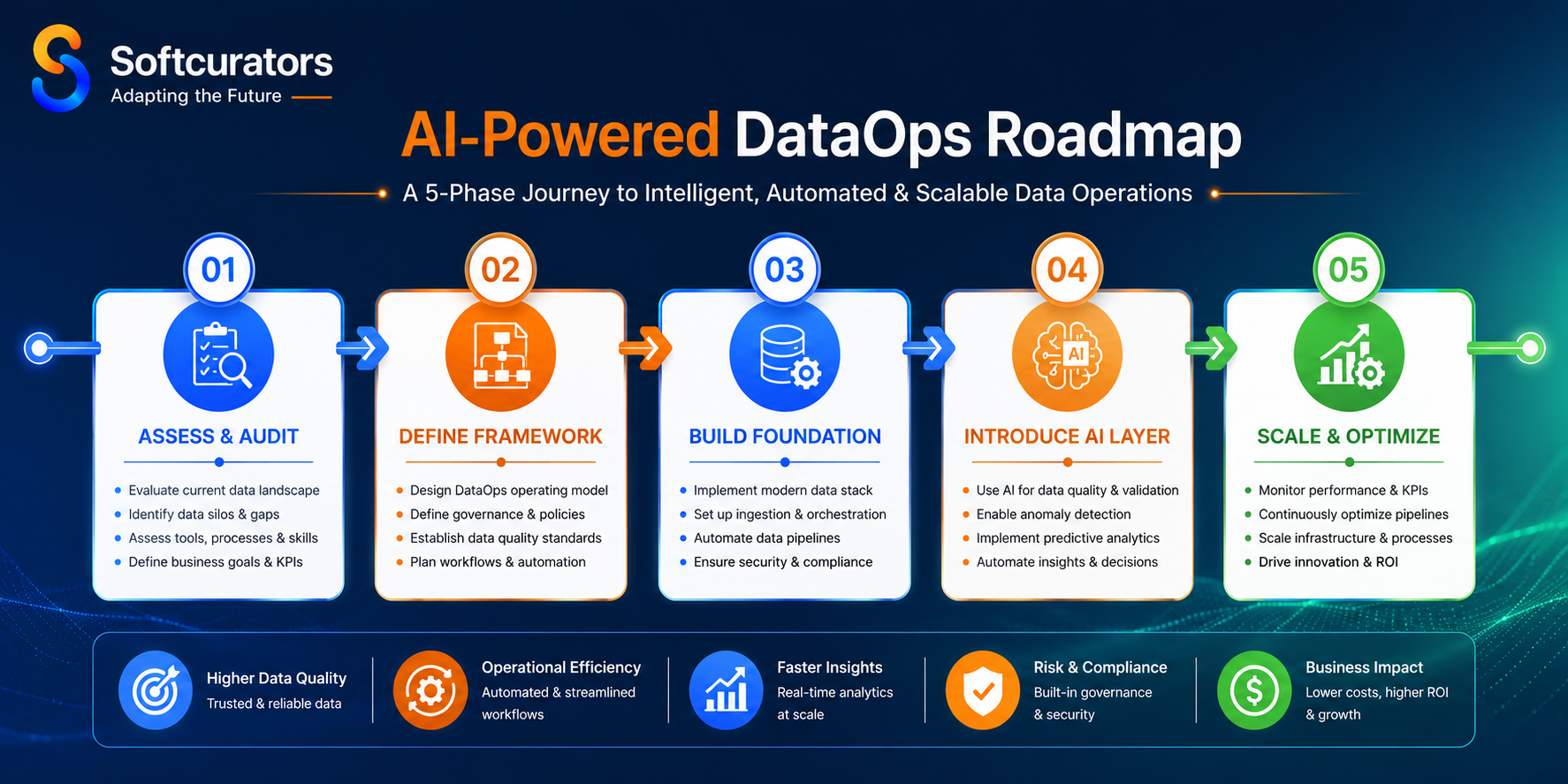
Phase 1: Assess and Audit (Weeks 1–3)
Before you can fix anything, you need to understand what you have. Audit your current data landscape:
- Map all data sources and their quality levels.
- Document existing pipelines, their owners, and their failure rates.
- Identify the highest-cost data quality problems.
- Assess team maturity DataOps requires both technical and cultural readiness.
This phase gives you a baseline. Without a baseline, you cannot measure progress.
Phase 2: Define Your DataOps Framework (Weeks 4–6)
Establish your DataOps principles, standards, and governance model:
- Define data quality SLAs for each domain.
- Establish data ownership and stewardship roles.
- Choose your tooling stack based on your infrastructure and team skills.
- Define incident management and escalation protocols for pipeline failures.
Phase 3: Build the Foundation (Weeks 7–14)
This is where you start building. Focus on high-impact, high-visibility pipelines first:
- Implement pipeline orchestration with monitoring hooks.
- Deploy data quality checks on your most business-critical datasets.
- Set up basic data lineage tracking.
- Create dashboards for DataOps health pipeline run rates, error rates, SLA adherence.
Quick wins in this phase build organizational trust and momentum.
Phase 4: Introduce AI Layer (Weeks 15–24)
Now you add intelligence to the foundation:
- Deploy ML-based anomaly detection on monitored datasets.
- Implement predictive alerting for infrastructure and pipeline performance.
- Introduce self-healing mechanisms for common failure modes.
- Add NLP-powered data catalog for self-service data discovery.
This phase delivers the most dramatic productivity improvements for data engineering teams.
Phase 5: Scale and Optimize (Ongoing)
AI-Powered DataOps is not a project with an end date. It is a continuous capability:
- Expand coverage to more pipelines and data domains.
- Continuously tune ML models for anomaly detection and predictive monitoring.
- Measure and report DataOps metrics to leadership regularly.
- Iterate on tooling as the ecosystem evolves.
Common Challenges and How to Overcome Them
No implementation journey is without obstacles. Here are the most common challenges organizations face when adopting AI-Powered DataOps and practical ways to address them.
Challenge 1: Organizational Resistance
DataOps changes how data teams work. Some engineers feel threatened by automation. Some data owners resist governance requirements. The solution is change management communicate the “why” clearly, involve teams in tool selection, and celebrate early wins publicly.
Challenge 2: Data Silos
AI-Powered DataOps requires visibility across your entire data estate. Siloed teams, disconnected systems, and undocumented pipelines make this difficult. Start with the domains most willing to collaborate and expand from there.
Challenge 3: Tooling Overload
The DataOps tooling market is crowded. Organizations often buy too many tools that overlap and underdeliver. Start with a lean stack one orchestration tool, one quality tool, one catalog. Add complexity only when you have exhausted what your current tools can do.
Challenge 4: Skill Gaps
AI-Powered DataOps requires a blend of data engineering, ML knowledge, and operational mindset. This combination is rare. Bridge the gap with training programs, hiring for growth potential, and partnering with experienced vendors.
Challenge 5: Measuring ROI
Leadership wants to see results. Define your metrics before you start pipeline reliability rates, time-to-insight, incident resolution time, and data quality scores. Track them from Day 1 and report them consistently.
AI-Powered DataOps vs MLOps: Understanding the Relationship
A common point of confusion: how does AI-Powered DataOps relate to MLOps? They are related but distinct disciplines.
DataOps focuses on the data supply chain ingestion, quality, transformation, governance, and delivery.
MLOps focuses on the machine learning lifecycle experimentation, training, deployment, monitoring, and retraining.
In practice, they overlap significantly. ML models consume data that DataOps provides. Model monitoring in MLOps feeds signals back into DataOps quality systems. The organizations that succeed with AI in 2026 treat DataOps and MLOps as complementary practices, not competing ones.
Softcurators’ AI development practice covers both we help clients build the complete AI infrastructure, from data pipelines to production model deployment.
AI-Powered DataOps for Startups vs Enterprises
The principles of AI-Powered DataOps apply at every scale. But the approach differs significantly depending on your organization size.
For Startups
You do not need enterprise-grade tooling on Day 1. Start with:
- A lightweight orchestration tool like Prefect or Dagster.
- Open-source quality libraries like Great Expectations.
- A cloud-native data warehouse with built-in monitoring.
The goal for startups is to establish good habits early. The cost of retrofitting DataOps into a messy legacy stack is enormous. Building it right from the start is always cheaper.
Softcurators’ startup app development services are specifically designed to set startups up for scalable growth from Day 1.
For Enterprises
Enterprises face different challenges legacy systems, large teams, strict governance requirements, and complex multi-cloud environments. The focus is on:
- Standardizing tooling across data domains.
- Creating center-of-excellence teams for DataOps.
- Integrating AI-Powered DataOps with existing data governance frameworks.
- Managing change across large, distributed data teams.
How Softcurators Helps You Build AI-Powered DataOps
At Softcurators, we are a full-stack mobile app and web development company with deep expertise in AI development, AI consulting services, and intelligent system design. We have helped startups and enterprises across fintech, healthcare, real estate, and on-demand industries build data infrastructure that actually works.
What Softcurators Brings to AI-Powered DataOps
- End-to-End Implementation: From data architecture design to pipeline deployment and monitoring setup.
- AI Model Integration: We connect your DataOps infrastructure with AI and ML workflows seamlessly.
- Cloud-Native Expertise: Deep experience with AWS, GCP, and Azure data services.
- Industry-Specific Solutions: We understand the data requirements of fintech, healthcare, real estate, and e-commerce.
- Post-Launch Support: Maintenance and support services ensure your DataOps environment stays healthy over time.
- Startup-Friendly Engagement: From MVP development to full-scale rollout, we scale with you.
The Future of AI-Powered DataOps: What Comes Next
AI-Powered DataOps is not a static destination. The field is evolving rapidly. Here is what to watch for in the coming years.
Autonomous DataOps
The next frontier is fully autonomous DataOps systems that not only detect and diagnose problems but also fix them entirely without human intervention. Several vendors are already building toward this vision. Expect production-grade autonomous pipeline management within 2–3 years.
AI-Native Data Products
Data products packaged, governed, reusable data assets are becoming the standard unit of data delivery. AI will make data products self-describing, self-monitoring, and self-healing. Every data product will have its own embedded quality and governance intelligence.
Natural Language Data Operations
Data engineers will increasingly interact with their pipelines using natural language. Ask questions like “Why did the customer table fail last night?” or “Show me all pipelines touching PII data” and get immediate, accurate answers. LLM integration into DataOps tooling is accelerating fast.
Real-Time DataOps as the Default
Batch processing is giving way to streaming. By 2027, most enterprise data pipelines will be real-time by default. AI-Powered DataOps is uniquely suited to manage the complexity of real-time pipelines at scale.
Federated DataOps
As data mesh architectures become mainstream, DataOps will federate across domain teams while maintaining central governance standards. AI will play a critical role in enforcing consistency and quality across decentralized data estates.
Start Your AI-Powered DataOps Journey with Softcurators
Data is your most valuable asset. But only if it is reliable, accessible, and intelligent. AI-Powered DataOps is how you get there.
Softcurators is ready to be your technology partner. Whether you are starting from scratch, modernizing a legacy stack, or scaling an existing data platform, our team has the expertise to guide you. Contact Softcurators today to discuss your project.
You can also explore why companies choose Softcurators and learn about our portfolio of successful digital products.
FAQs
How is AI-Powered DataOps different from traditional DataOps?
Traditional DataOps relies on manual rule-setting and human monitoring. AI-Powered DataOps learns from your data patterns, detects anomalies automatically, predicts failures before they happen, and self-heals without constant human intervention.
Which industries benefit most from AI-Powered DataOps?
Fintech, healthcare, banking, e-commerce, real estate, logistics, and on-demand platforms all benefit significantly. Any industry with high data volume, quality requirements, and real-time decision needs is a strong candidate.
What are the best tools for AI-Powered DataOps in 2026?
Leading tools include Monte Carlo for data observability, Apache Airflow and Dagster for orchestration, Databricks for unified analytics, Collibra for governance, and MLflow for ML-DataOps integration.
How long does it take to implement AI-Powered DataOps?
A foundational implementation covering core pipelines, quality monitoring, and basic AI typically takes 3–6 months. Full-scale enterprise deployment with advanced AI capabilities takes 9–18 months depending on complexity.
What is the ROI of AI-Powered DataOps?
Most organizations see 30–60% reductions in pipeline failures, 40% reduction in data engineering overhead, and faster time-to-insight. ROI typically materializes within 12–18 months of initial investment.
Do I need a large data team to implement AI-Powered DataOps?
No. Even small data teams can implement DataOps principles effectively. The right tooling and a phased approach make it achievable for teams of 3–5 engineers. Softcurators can also augment your team as needed.
Can AI-Powered DataOps help with GDPR and data compliance?
Yes. Automated data lineage, tagging, access controls, and audit trails all components of AI-Powered DataOps are directly applicable to GDPR, CCPA, HIPAA, and India's DPDP Act compliance requirements.
What is data observability in AI-Powered DataOps?
Data observability is the practice of continuously monitoring the health, freshness, distribution, volume, and schema of your data. AI-powered observability tools use ML to detect anomalies without requiring manual threshold-setting.
How does AI-Powered DataOps support machine learning?
AI-Powered DataOps ensures ML models receive consistently clean, fresh, and representative training data. It also monitors for data drift in production, alerting teams when model inputs start diverging from training distributions.
What is a self-healing data pipeline?
A self-healing pipeline automatically detects failures, identifies root causes, and triggers remediation actions such as retrying failed jobs, rerouting data flows, or alerting specific stakeholders without manual intervention.
Is AI-Powered DataOps suitable for startups?
Yes. Startups benefit from establishing DataOps habits early. Starting with lightweight, open-source tools and cloud-native platforms makes it cost-effective. The alternative fixing data quality problems reactively as you scale is far more expensive.
What is the difference between DataOps and data engineering?
Data engineering is the technical discipline of building and maintaining data pipelines. DataOps is the operational framework the practices, standards, and culture that governs how data engineering work is done, measured, and improved.
What is data lineage and why does it matter?
Data lineage is the documented history of how data flows through your systems where it originated, what transformed it, and where it went. It matters because it enables root-cause analysis, compliance auditing, and impact assessment when changes occur.
How does AI-Powered DataOps handle real-time data?
Real-time DataOps uses stream processing technologies like Apache Kafka, Flink, and Spark Streaming alongside AI monitoring that operates at the millisecond level ensuring quality and governance even for high-velocity data streams.
What is a data mesh and how does it relate to DataOps?
A data mesh is a decentralized data architecture where domain teams own their own data products. DataOps provides the governance and operational standards that make a data mesh work reliably across distributed teams.
Can AI-Powered DataOps reduce cloud data costs?
Yes. Intelligent pipeline scheduling, compute auto-scaling, and elimination of redundant processing jobs all contribute to lower cloud spend. Organizations commonly see 20–35% reductions in data infrastructure costs after DataOps maturity.
What metrics should I track for DataOps success?
Key metrics include pipeline reliability rate, mean time to detection (MTTD), mean time to resolution (MTTR), data freshness SLA adherence, data quality score by domain, and time-to-insight for business consumers.
How does AI-Powered DataOps improve BI and reporting?
By ensuring that the data powering BI dashboards is always fresh, accurate, and validated, AI-Powered DataOps eliminates the most common complaint from business users: "I do not trust this report."
What is the role of a data catalog in DataOps?
A data catalog is the central registry of all data assets in your organization. It documents what exists, what it means, who owns it, and how it is used. AI-enhanced catalogs add automated metadata generation, smart search, and usage recommendations.
How do I choose the right DataOps tools for my organization?
Evaluate tools based on your current infrastructure, team skills, budget, and maturity level. Start with orchestration and quality monitoring. Add governance and AI layers as your program matures. A technology partner like Softcurators can help you make these decisions.
Does AI-Powered DataOps work with legacy systems?
Yes. Modern DataOps tools are designed to integrate with legacy databases, ETL systems, and data warehouses. The AI layer can be added gradually without requiring a full infrastructure replacement.
What is the connection between DataOps and data quality?
DataOps makes data quality continuous rather than periodic. Instead of running quality checks at month-end, AI-Powered DataOps monitors quality in every pipeline run catching and flagging issues before they reach downstream consumers.
How does AI help with anomaly detection in DataOps?
ML models analyze historical patterns for each metric row counts, null rates, value distributions and learn what "normal" looks like. When current values deviate from these learned baselines, the AI raises an alert, often before human monitoring would catch it.
Is AI-Powered DataOps expensive to implement?
Costs vary by organization size and tool choices. Many foundational components like Great Expectations and Apache Airflow are open source. Commercial tools add cost but reduce implementation time. The ROI typically justifies the investment within 12–18 months.
How does Softcurators support AI-Powered DataOps implementation?
Softcurators provides end-to-end support from DataOps strategy and architecture design to tool implementation, team training, and ongoing maintenance. Explore our AI consulting services or contact us directly to discuss your needs.
What is the role of automation in DataOps?
Automation is the backbone of DataOps. Manual processes do not scale, introduce human error, and create bottlenecks. DataOps automation covers testing, deployment, monitoring, alerting, and documentation everything that a human engineer does today but should not have to tomorrow.
Can AI-Powered DataOps help with data science productivity?
Absolutely. Data scientists spend up to 80% of their time on data preparation tasks. AI-Powered DataOps significantly reduces this by delivering clean, validated, and documented data on demand freeing data scientists to focus on modeling and insights.
How does AI-Powered DataOps relate to data governance?
Data governance defines the policies and standards for how data is managed. AI-Powered DataOps operationalizes those policies automatically enforcing quality rules, tagging sensitive data, tracking access, and generating audit trails.
What should I do first if I want to get started with AI-Powered DataOps?
Start with an honest audit of your current data estate pipelines, quality, ownership, and failure rates. Then prioritize the highest-impact areas to address first. If you want expert guidance, reach out to Softcurators. We will help you build a practical roadmap tailored to your organization.
What makes Softcurators different from other technology companies?
Softcurators combines deep domain expertise across industries with full-stack technology capability from mobile app development to AI systems and data infrastructure. We focus on outcomes, not just deliverables. Learn more about us.
How do I measure the maturity of my DataOps program?
DataOps maturity models typically define 4–5 levels from ad hoc data management to fully autonomous, AI-driven operations. A maturity assessment identifies where you are today and what specific capabilities to build next.
