
Open any music streaming app right now. A song starts before you finish tapping. The app already knows what mood you are in. It surfaces a track you have never heard and it is perfect.
That experience took years to build. And it is about to get dramatically more sophisticated. The music streaming app trends shaping 2026 are not incremental upgrades. They are structural shifts in how audio platforms work, how artists get paid, and how listeners connect with music. According to the IFPI Global Music Report, streaming now accounts for 67% of all global recorded music revenue. That number will keep climbing.
At Softcurators, we build music streaming applications, AI-powered audio platforms, and creator economy products for startups and growth companies. We track these trends closely because they directly shape what we build for clients. This guide covers every major music streaming app trend you need to understand before building or updating an audio platform in 2026.
Want to build for these trends from day one? Book a free strategy call with Softcurators. Our architects respond within 24 hours.
Why 2026 Is a Pivotal Year for Music Streaming Trends
The streaming market is not slowing down. Statista projects the global music streaming market will surpass $46 billion by 2027. However, growth alone is not the story. The music streaming app trends of 2026 reflect something deeper: listener expectations have fundamentally shifted.
Users no longer accept a passive listening experience. They expect the app to anticipate what they want, with better sound quality. They expect to support artists directly. And they expect the social dynamics of their favourite platforms to work inside their music app too.
Three Forces Driving the 2026 Music Streaming Shift
First, AI maturity has reached a point where real-time personalisation is genuinely possible at consumer scale. Second, creator frustration with existing royalty models is pushing both artists and fans toward alternative platforms. Third, audio hardware improvements AirPods Pro, spatial audio headsets, smart speakers are finally making high-quality audio formats a mass-market feature, not a niche one.
Together, these three forces create a product opportunity that Softcurators sees consistently in the briefs we receive from music platform founders. The gap between what today’s best apps offer and what listeners actually want is still wide. That gap is where the opportunity lives.
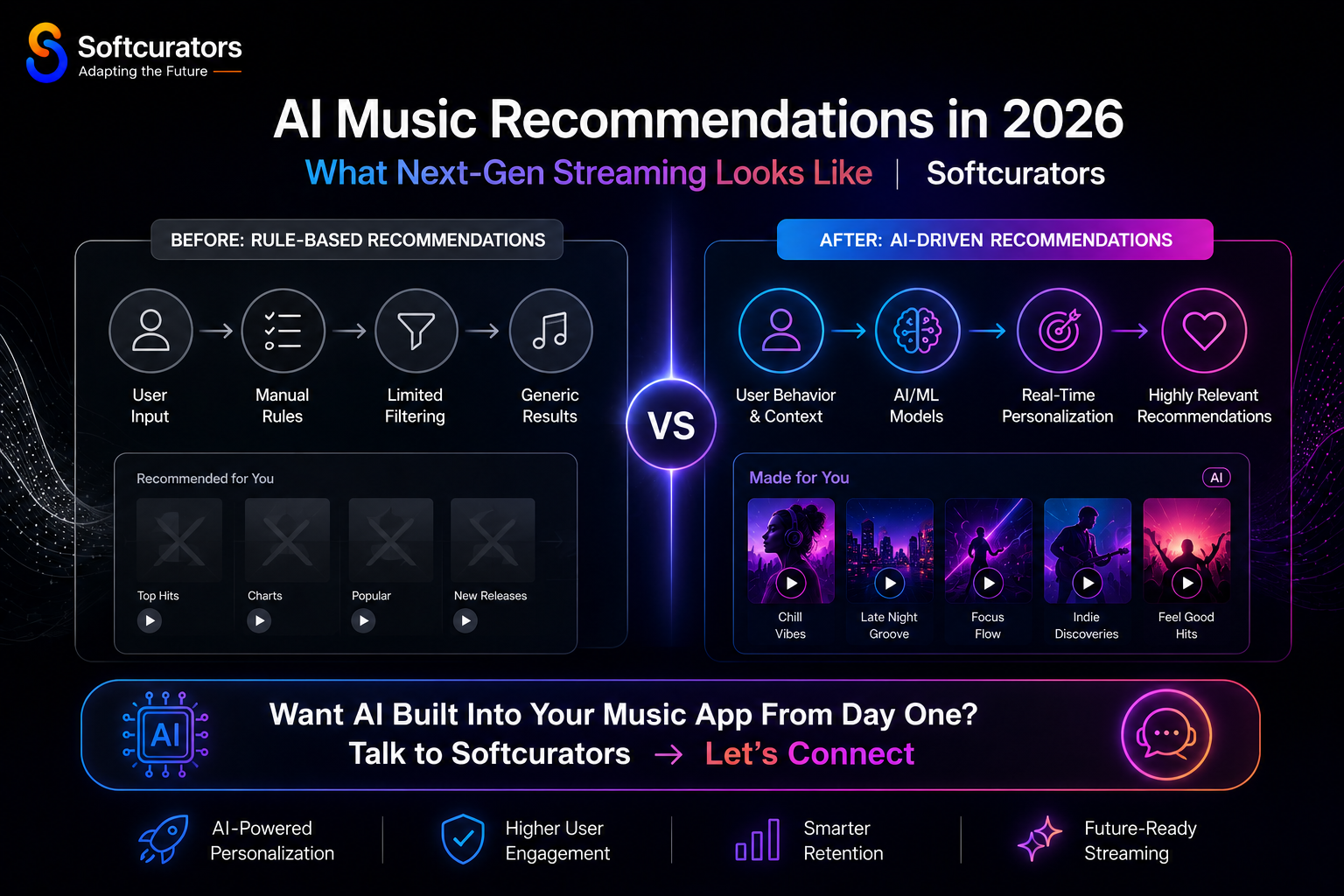
Trend 1: AI Music Recommendations Are Getting Genuinely Smart
This is the most commercially important of all the music streaming app trends in 2026. Spotify’s Discover Weekly changed listener expectations a decade ago. But in 2026, recommendation AI has evolved well beyond collaborative filtering.
What Next-Generation Music AI Actually Does
Modern music recommendation engines do three things that older systems could not. First, they analyse audio features in real time not just metadata like genre and BPM, but the actual acoustic characteristics of a track. Second, they understand contextual listening signals: what device you are using, what time it is, how fast you are moving. Third, they adapt to micro-mood shifts within a session noticing when you start skipping tracks and adjusting the queue immediately.
Furthermore, generative AI is entering the recommendation space. Platforms like Suno and Udio are demonstrating that AI can generate music tailored to a listener’s preferences. Consequently, streaming platforms are beginning to explore AI-generated interstitial tracks that fill gaps in personalised playlists seamlessly.
What This Means for App Builders
Building this kind of recommendation layer is no longer reserved for companies with Spotify’s budget. Softcurators‘ AI development and AI app development teams build recommendation systems that start with collaborative filtering and scale toward deep learning models as user data grows. Additionally, our AI consulting services help founders choose the right AI strategy for their stage not the most sophisticated one, but the one that delivers the best user outcome per development dollar invested.
Our AI automation services also allow music platforms to automate playlist curation, editorial recommendation, and new release surfacing reducing the editorial team overhead that most streaming platforms carry.
Trend 2: Spatial Audio and Lossless Streaming Are Going Mainstream
This music streaming trend has been building for three years. In 2026, it tips into mass-market territory.
Apple Music, Tidal, and Amazon Music HD have all offered lossless and spatial audio for years. However, until recently, the hardware to actually experience the difference was too expensive or too niche. That has changed. AirPods Pro, Sony WH-1000XM5, and a growing range of spatial audio headsets are now in the hands of everyday listeners.
Lossless Audio: What Developers Need to Know
Lossless audio files are significantly larger than compressed MP3 or AAC files. Therefore, streaming lossless audio requires a fundamentally different infrastructure approach. Specifically, it requires adaptive bitrate algorithms that can switch seamlessly between lossless (FLAC, ALAC) and compressed formats based on connection quality without the user noticing a gap or quality drop.
Moreover, storage costs increase substantially when you store lossless files alongside compressed versions. Softcurators builds audio infrastructure with multi-format file management from the start using AWS S3 with intelligent tiering and CloudFront edge caching to make lossless delivery economically viable at scale.
Spatial Audio: The Experience Shift
Spatial audio creates a three-dimensional soundstage instruments placed left, right, above, and behind the listener. For certain genres (classical, jazz, cinematic scores, live recordings), it creates a genuinely different listening experience. Consequently, platforms that offer spatial audio for these genres have a real retention advantage with their most engaged users.
Building spatial audio support requires integration with Apple’s Dolby Atmos mastering standards (for iOS) and Sony 360 Reality Audio (for Android). Both are now mature SDKs. Softcurators‘ iOS development and Android development teams have implemented both for clients targeting the premium listening market.
Trend 3: The Creator Economy Is Reshaping Artist Platforms
This is arguably the most disruptive of all current music streaming app trends. Artists are exhausted with the streaming royalty model. On Spotify, 1,000 streams earn roughly $3–5. An independent artist needs millions of streams to earn a living wage. That model is unsustainable for the long tail of music creators.
What Creator-First Platforms Are Building
The response is a new generation of creator-first platforms that invert the standard streaming model. Instead of paying artists per stream, these platforms enable artists to earn directly from fans through subscriptions, digital goods, exclusive content access, and direct tipping.
Furthermore, fan relationship tools direct messaging between artist and fan, exclusive listening parties, pre-release access for subscribers are becoming a core product requirement, not an optional feature. Artists bring their own audiences. Therefore, the platform’s job is to facilitate the monetisation of that relationship, not replace it with algorithmic discovery.
Bandcamp’s model validated this approach years ago. Patreon expanded it to all creator types. In 2026, purpose-built music creator platforms are the fastest-growing segment of the audio app market.
Building a Creator-First Music App
A creator-first music platform requires a dual-product architecture: the listener-facing streaming experience and the artist-facing management and monetisation dashboard. Softcurators builds both sides simultaneously drawing on our experience with social media app development for the community mechanics and fintech app development for the payment and subscription infrastructure.
Additionally, direct payment flows for artist subscriptions, merchandise integration, and virtual event ticketing all require payment architecture that our experience with on-demand platform development and fantasy app monetisation models informs directly.
Trend 4: Social Features Are Becoming Core, Not Optional
Music has always been social. Yet most streaming apps treat social features as secondary. That is changing. The music streaming app trend toward social integration is accelerating driven partly by TikTok’s dominance in music discovery and partly by listener research showing that shared listening experiences dramatically improve retention.
Social Features That Drive Real Retention
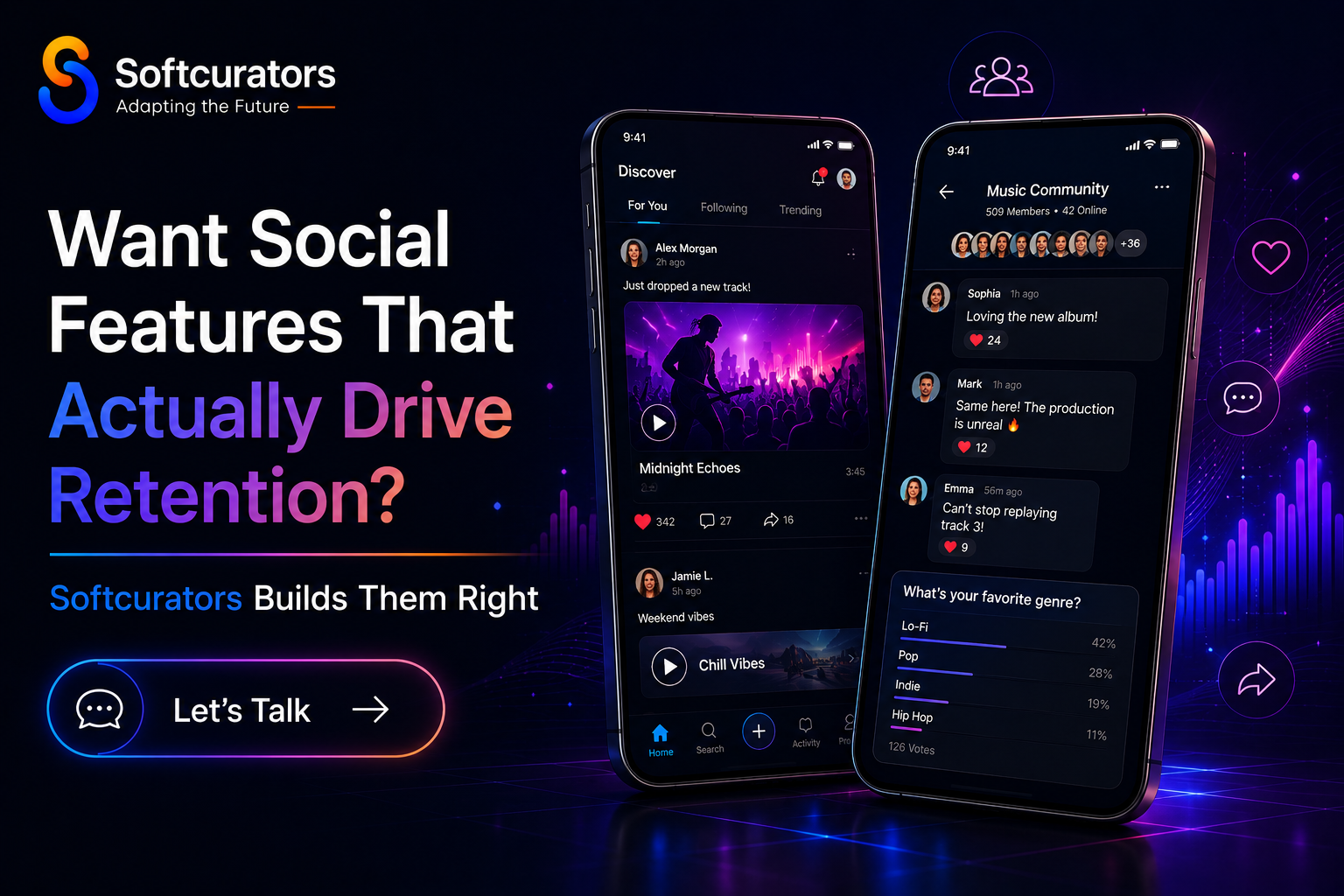
The social features that move the needle are not generic. They are music-specific. For example, collaborative playlists let friends build a shared listening experience together. Activity feeds show what friends are listening to right now. Song reactions let listeners share emotional responses to specific moments in a track.
Moreover, social listening sessions where multiple users listen to the same track simultaneously in a shared virtual space are growing rapidly. Spotify has tested this repeatedly. Discord music bots demonstrate the demand. In 2026, group listening with a live chat layer is a feature expectation from a growing segment of engaged listeners.
The Discovery-Social Loop
There is a powerful product dynamic at play here. Social sharing drives discovery. Discovery drives new users. New users create more social activity. This loop when well-designed creates organic growth that no paid acquisition budget can replicate. Softcurators designs this discovery-social loop into music app architecture from the first planning session, not as a feature bolt-on.
Our UI/UX design team applies the social interaction patterns from our social media app development experience to music apps specifically. The mobile app UI/UX best practices we have documented cover social feed design, notification architecture, and engagement mechanics that work across audio-first products.
Trend 5: Live Streaming and Virtual Concert Experiences
COVID-19 accelerated virtual concerts as a necessity. In 2026, they have evolved into a genuine entertainment format with its own audience, its own revenue model, and its own product requirements.
The music streaming app trend toward live audio and video is clear. Spotify acquired Podz and Locker Room. Apple Music has live radio. Twitter (now X) built Spaces. The question is not whether live audio belongs in music apps it is how to build it well.
What Live Streaming Requires Technically
Live streaming infrastructure is fundamentally different from on-demand audio. Specifically, it requires real-time video encoding (typically H.264 or H.265), low-latency CDN streaming (sub-5 seconds for interactive experiences, sub-10 seconds for broadcast-style), and audience interaction tools (live chat, reactions, Q&A queues) that work under high concurrent user loads.
Furthermore, ticketing integration allowing artists to sell access to paid virtual events requires payment processing, access control, and refund management that adds meaningful development complexity. Softcurators builds this infrastructure drawing on our on-demand app development experience with real-time systems and high-concurrency user management.
Micro-Events: The New Live Format
Full virtual concerts are expensive to produce and attend. Consequently, a new format is gaining traction: micro-events. These are intimate, 30–60 minute listening sessions where an artist plays a set for a small paying audience, takes questions, and shares unreleased tracks. The economics work for independent artists. The intimacy is what fans actually want.
Building micro-event infrastructure into a music streaming app adds $10,000–$15,000 to development cost. However, it creates a monetisation layer that no per-stream royalty model can match. Softcurators includes this in our music streaming app development service for clients targeting the creator-first segment.
Trend 6: Web3 and Blockchain Are Rewriting Music Ownership
This music streaming trend is the most polarising and also the most genuinely interesting from a first-principles perspective. The core problem with streaming royalties is a data problem: nobody in the rights chain has a single, authoritative source of truth for who owns what.
Blockchain changes that. Specifically, it allows music rights to be represented as smart contracts automatically distributing royalties to every rights holder in real time, every time a track streams.
NFTs as Fan Ownership Instruments
Beyond royalty management, music NFTs are creating a new category of fan engagement. When a fan owns a token tied to a specific track or album, they have a verifiable stake in that artist’s work. Additionally, that token can carry utility: exclusive access, merchandise discounts, early listening rights, or a share of streaming royalties.
Platforms like Audius, Royal, and Sound.xyz have validated this model with early adopters. In 2026, the technology is mature enough that mainstream music apps are beginning to layer NFT-based fan ownership onto their existing streaming infrastructure particularly for the independent artist segment where the artist-fan relationship is closest.
What Softcurators Builds for Web3 Music
Softcurators builds Web3-enabled music platforms using smart contracts on Polygon (for low gas fees), IPFS for decentralised audio file storage, and custodial wallet architecture that makes Web3 features accessible to mainstream users who have never held crypto. Our AI development and software development teams work together on these hybrid Web2/Web3 architectures because a pure Web3 build is still too friction-heavy for most consumer music audiences in 2026.
Trend 7: Podcasts and Audio Content Are Fully Converging
This music streaming app trend is already well underway but it accelerates significantly in 2026. Spotify spent over $1 billion acquiring podcast companies. Apple’s dominant position in podcasting feeds directly into Apple Music. Amazon Music includes Audible content.
The convergence logic is simple. A listener’s audio attention is finite. Platforms that capture both music time and podcast time dominate that finite attention. Therefore, any new audio platform that launches as music-only leaves half the listener’s audio session on the table.
What Podcast Integration Requires
Podcast infrastructure differs from music streaming in several important ways. First, podcasts are episode-based each episode needs individual play-position tracking across devices. Second, podcast discovery relies heavily on category browsing and keyword search, not mood-based curation. Third, podcast content is almost never licensed through a central rights body each creator controls their own RSS feed.
Consequently, adding podcast support to a music app requires a separate content ingestion pipeline (RSS feed processing), episode-level metadata management, chapter navigation, playback speed controls (1x, 1.5x, 2x), and a distinct discovery interface. Softcurators estimates the addition of podcast infrastructure to an existing music app at $10,000–$20,000 in additional development.
Audiobooks: The Third Pillar
Audiobook integration is emerging as the third pillar of the converged audio platform. Spotify’s acquisition of Findaway and the subsequent launch of Spotify Audiobooks signals where the major platforms are heading. For independent audio platforms, audiobook content provides a catalogue depth that is difficult to compete with in music alone.
Furthermore, audiobooks attract a different demographic older, higher-income, and willing to pay a premium subscription. Adding audiobook support broadens both the addressable market and the monetisation ceiling. Softcurators‘s MVP development service helps founders sequence which audio format to launch first and how to architect the platform for multi-format expansion from day one.
Trend 8: Voice and Smart Device Integration Is Now Expected
By 2026, the majority of music streaming sessions in most developed markets start with a voice command or a smart speaker interaction. This music streaming trend has been building for years. In 2026, it is a user expectation, not a differentiator.
Smart Speaker Integration Requirements
Integrating a music app with Amazon Echo (Alexa Skills Kit), Google Home (Google Assistant SDK), and Apple HomePod (SiriKit) each require separate development work. Moreover, each platform has distinct requirements for authentication, playback control, and voice command handling.
Additionally, in-car integration via Apple CarPlay and Android Auto is increasingly important as streaming sessions shift from headphones to car speakers. CarPlay and Android Auto each require a purpose-built app interface with simplified navigation designed for glance-friendly interaction. Softcurators‘ iOS app development and Android development teams have implemented both for media platform clients.
Voice Search and Natural Language Discovery
Beyond playback control, voice search is changing how listeners discover music. ‘Play something like what I was listening to this morning’, ‘find jazz that is good for studying’, ‘play the song that goes like this’ these are natural language queries that require a fundamentally different search architecture than keyword matching.
Building natural language search requires NLP integration either through a custom model or via a third-party NLP API. Softcurators‘ AI consulting team evaluates the right NLP approach for each client’s use case and data volume.
Trend 9: Hyper-Personalised Discovery Goes Beyond Genre
Personalisation has been a music streaming app trend for a decade. However, the definition of ‘personalised’ is evolving rapidly in 2026.
Yesterday’s personalisation was genre-matching. Today’s is mood-matching. Tomorrow’s is life-context matching understanding not just what kind of music you like, but what you need right now based on your current activity, location, time of day, and even biometric data from wearables.
Activity-Aware and Biometric-Responsive Playlists
Fitness streaming is one of the clearest examples. Platforms like Peloton, Apple Fitness+, and Fiit have demonstrated that music synced to workout intensity creates dramatically better exercise experiences and dramatically better retention metrics. A running app that automatically adjusts BPM to match your pace is not science fiction. It is available today.
Furthermore, wearable integration reading heart rate data from Apple Watch or a Garmin device allows a music app to detect when you are in a high-intensity interval and shift the playlist to match. Softcurators‘s AI app development practice builds these biometric-responsive systems as part of fitness-adjacent music platform builds.
Cultural and Regional Personalisation
Global streaming platforms optimise for Western listening patterns. Consequently, massive opportunities exist for regional and cultural music platforms that understand local taste patterns deeply. An Indian classical music platform. A platform for K-indie artists and their global diaspora fans. A platform for Afrobeats that understands the genre’s regional sub-styles.
Building genuine cultural personalisation requires training recommendation models on culturally-specific listening data not just adding regional content to a Western-optimised algorithm. Softcurators has built data pipeline architectures specifically for regional audio platforms that need to develop their own recommendation logic rather than licensing a generic recommendation API.
Trend 10: Short-Form Audio and Micro-Content Formats
TikTok’s dominance has fundamentally changed how music gets discovered. A 15-second clip drives more streams than a full radio campaign. This music streaming app trend toward short-form audio as a discovery mechanism is now reshaping how streaming platforms surface new music.
The 30-Second Preview Economy
Platforms are testing formats where users browse music through 30-second previews arranged in a TikTok-style vertical scroll feed. Each swipe reveals a new track. A tap saves it to a playlist. This dramatically lowers the friction of music discovery and increases the number of new artists a user is exposed to per session.
Furthermore, short-form audio content voice notes from artists, behind-the-scenes recordings, acoustic snippets creates a direct artist-to-fan communication channel that supplements the music itself. Consequently, this format is particularly powerful for creator-first platforms where the artist relationship is the core product.
User-Generated Content and Music
TikTok-style user-generated content built around music videos, reactions, covers drives enormous amounts of music discovery. Platforms that enable users to create and share content using licensed tracks within the app create a content loop that generates organic reach far beyond the platform’s own user base.
Building UGC music tools requires careful rights management. Softcurators‘ software development team architects the rights tracking layer that allows UGC creation within the scope of existing music licences matching the approach that platforms like Instagram Reels and TikTok have established as the de facto standard.
Music Streaming App Trends 2026: Quick Reference
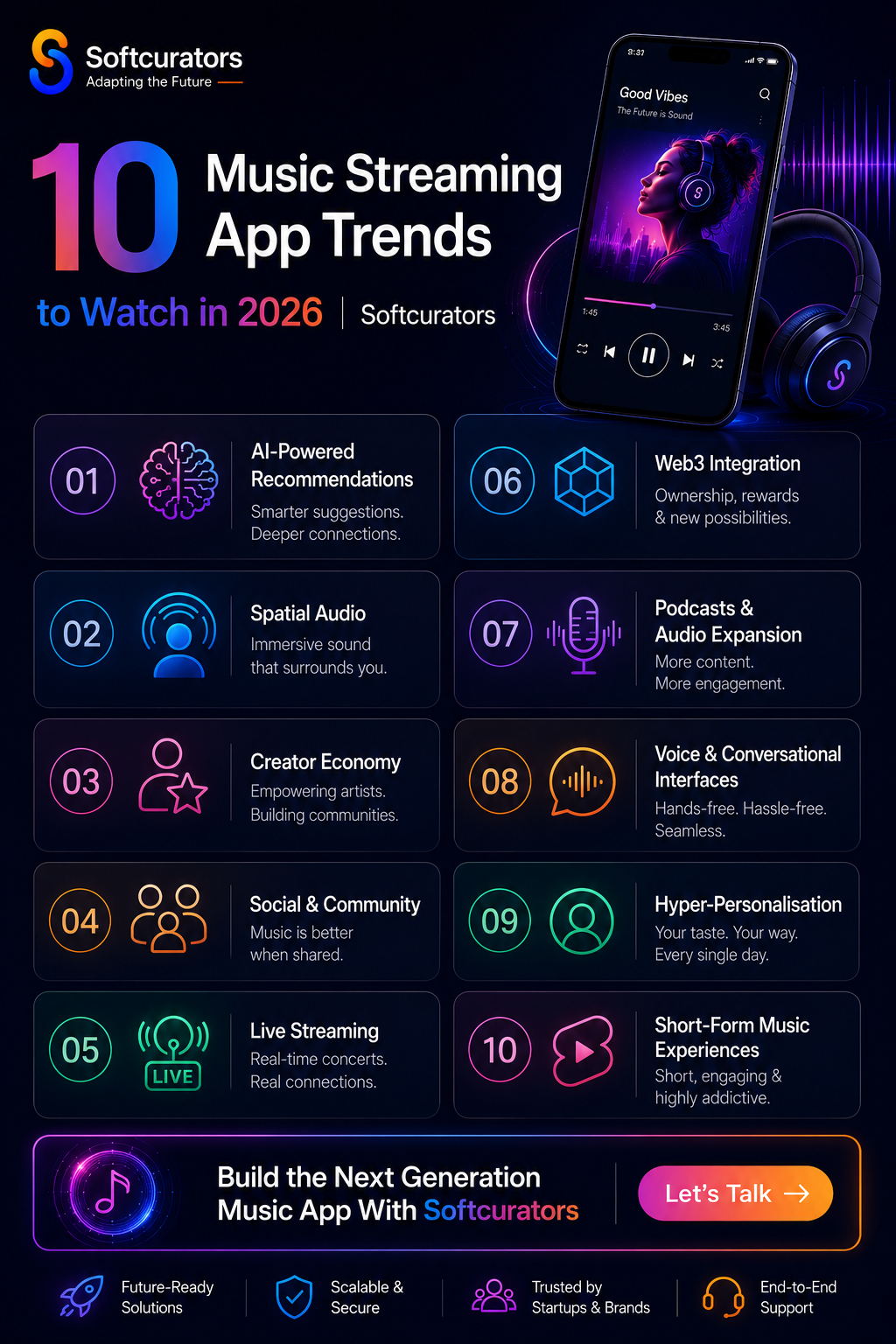
| Trend | Maturity Level | Investment Required | Softcurators Capability |
| AI Music Recommendations | Production-Ready | $5,000–$25,000 (add-on) | Full ML pipeline development |
| Spatial / Lossless Audio | Production-Ready | $4,000–$8,000 (add-on) | iOS + Android audio SDK integration |
| Creator Economy / Artist Tools | Production-Ready | $8,000–$25,000 (add-on) | Full dual-product architecture |
| Social Listening Features | Production-Ready | $4,000–$12,000 (add-on) | Social graph + activity feed development |
| Live Streaming / Virtual Events | Maturing | $8,000–$20,000 (add-on) | Real-time video + ticketing infrastructure |
| Web3 / NFT Music Ownership | Early Mainstream | $10,000–$30,000 (add-on) | Smart contracts + custodial wallet UX |
| Podcast + Audio Convergence | Production-Ready | $8,000–$20,000 (add-on) | Multi-format content pipeline |
| Voice / Smart Device Integration | Production-Ready | $4,000–$11,000 (add-on) | Alexa, Google, CarPlay, Android Auto |
| Hyper-Personalisation / Biometrics | Emerging | $6,000–$20,000 (add-on) | Wearable API + real-time ML models |
| Short-Form Audio / UGC Tools | Production-Ready | $7,000–$18,000 (add-on) | TikTok-style feed + rights management |
How Softcurators Builds for These Music Streaming Trends
Understanding music streaming app trends is one thing. Building a platform that capitalises on them is another. Softcurators approaches every music streaming project with a trend-aware architecture philosophy ensuring that V1 is designed for the features you launch with today and the trends you want to capitalise on in V2.
Our Architecture-First Approach
Most development agencies build what you ask for. Softcurators builds what you need which often means designing the data model, the API contracts, and the infrastructure for capabilities that will not ship until V2. This prevents the expensive re-architecture that kills most music app businesses twelve months after launch.
For example, a music app launching without AI recommendations today still needs a listening event data pipeline that captures the training data those models will need tomorrow. Without that pipeline, adding AI six months later requires rebuilding the data layer from scratch. With it, AI recommendations can be layered on top of existing infrastructure in weeks, not months.
Full-Stack Music Development Capability
Softcurators covers the complete music streaming development stack. Our iOS development team handles AVFoundation audio, FairPlay DRM, and spatial audio integration. Android development team handles ExoPlayer, Widevine DRM, and Android Auto. Our Flutter development practice delivers cross-platform apps that work on both platforms from a single codebase saving 35–40% in development cost for budgets that require both platforms.
Additionally, our web development team builds the PWA and browser streaming experience. Our software development architects design the backend microservices. And our AI development and AI app development teams build the recommendation and personalisation layer. Everything in one engagement no subcontracting, no handoff friction.
Design That Drives Listening
The best audio infrastructure in the world does not retain users if the app is frustrating to navigate. Our UI/UX design team designs music apps from the listening experience backward applying the principles documented in our mobile app UI/UX best practices guide to every screen. Discovery interfaces, now-playing screens, playlist management flows each one tested with real users before a line of frontend code is written.
From MVP to Full Platform
Not every client needs to build all ten trends into their first release. Our MVP development service and prototype development approach help founders identify the minimum feature set that validates their specific product hypothesis then phases advanced trend features into subsequent releases as the business scales. Our startup app development service is specifically designed for exactly this kind of phased, capital-efficient launch strategy.
Explore more: Our music streaming service | AI development | Mobile app development | App development trends | Our portfolio | Why choose Softcurators
Music Streaming App Trends 2026: What You Do Next Matters
The music streaming app trends of 2026 represent a genuine turning point. AI personalisation is no longer a differentiator it is a baseline expectation. Creator economy tools are separating the platforms artists choose to build on from the platforms they are forced to use. And converged audio experiences are redefining what a music app even is.
The founders who build platforms designed for these trends from the first architecture session will have a significant advantage over those who retrofit trend features onto existing apps that were not designed to support them.
Softcurators builds from the future backward. We design V1 with V2 and V3 in mind. Embed AI data pipelines before the models are built. We architect social graphs before the social features launch. We build payment infrastructure that supports creator monetisation before the creator tools are designed.
The first conversation is free. Book a strategy call with Softcurators today and let’s map out exactly how to build your music platform for where the market is going not where it has been.
Further reading: Music Streaming App Development | AI App Development | Mobile App Development Trends | Flutter App Development | Mobile App Technologies | Our Portfolio
FAQs
How is AI changing music streaming apps in 2026?
AI is changing music streaming in three fundamental ways. First, recommendation systems now analyse actual audio features not just metadata to identify similar tracks with far greater accuracy. Second, contextual AI understands when and where you are listening and adapts the queue in real time. Third, generative AI is beginning to create interstitial music that fills personalised playlist gaps seamlessly. Softcurators' AI development and AI app development teams build all three layers for music platform clients.
What is spatial audio and why does it matter for streaming apps?
Spatial audio creates a three-dimensional soundstage instruments placed left, right, above, and behind the listener rather than a flat stereo image. It creates a significantly more immersive listening experience for certain genres (classical, jazz, film scores, live recordings). In 2026, mainstream headphone hardware supports spatial audio widely enough that it has moved from niche to expected for premium-tier streaming platforms. Softcurators implements Dolby Atmos and Sony 360 Reality Audio on iOS and Android respectively.
How does the creator economy trend affect music streaming app development?
Creator economy platforms require a dual-product architecture: the listener-facing streaming experience and a full artist dashboard covering analytics, direct fan subscriptions, merchandise integration, and virtual event management. This is significantly more complex than a standard streaming app. Softcurators builds both sides of creator-first platforms drawing on fintech experience for payment infrastructure and social app experience for fan community mechanics.
What social features drive retention in music streaming apps?
The social features with the strongest retention impact are: collaborative playlists (friends building shared listening experiences), real-time activity feeds (seeing what friends are listening to now), song reactions tied to specific track moments, and synchronised group listening sessions with live chat. Softcurators designs these features from the architecture phase, not as post-launch additions because the social graph infrastructure needs to be built into the data model from day one.
How does live streaming work in a music app?
Live streaming in a music app requires real-time video encoding (H.264 or H.265), low-latency CDN streaming (sub-5 seconds for interactive experiences), audience interaction tools (live chat, reactions, Q&A queues), and for paid events ticketing and access control. This infrastructure differs fundamentally from on-demand audio delivery. Softcurators builds live streaming modules as a separate service that integrates with the main music platform API.
What is Web3 music and how does blockchain change streaming?
Web3 music uses blockchain smart contracts to represent music rights and automate royalty distribution in real time. Every time a track streams, the smart contract automatically splits the revenue among all rights holders according to pre-defined terms with no manual intervention, no payment delays, and no dispute about who owns what. NFTs add a fan ownership layer where listeners can hold verifiable stakes in artists' music. Softcurators builds Web3 music platforms on Polygon for low gas costs, with custodial wallet UX for mainstream user adoption.
Should my music app include podcasts?
If your platform targets daily active listening habits rather than occasional playlist sessions, yes. Podcasts dramatically increase the share of listener audio time your platform captures. The convergence of music, podcasts, and audiobooks into single platforms is one of the clearest music streaming app trends in 2026. Softcurators estimates adding podcast infrastructure to an existing music app at $10,000–$20,000 in additional development.
How does voice integration work in a music streaming app?
Voice integration requires separate SDK implementations for Amazon Alexa (Alexa Skills Kit), Google Assistant (Google Assistant SDK), and Apple HomePod (SiriKit). Each platform has distinct requirements for authentication, playback control commands, and voice query handling. Additionally, CarPlay and Android Auto integration provides voice-controlled playback in vehicles. Softcurators handles all four integrations for clients targeting smart device users.
What is lossless audio streaming and how does it affect infrastructure costs?
Lossless audio (FLAC, ALAC, WAV) preserves the full quality of the original recording without compression. Lossless files are 3–10 times larger than standard MP3 or AAC files. Consequently, streaming lossless audio requires substantially higher storage capacity, more bandwidth, and adaptive bitrate infrastructure that switches between lossless and compressed formats based on connection quality. Softcurators builds multi-format audio pipelines that make lossless delivery economically viable at consumer scale.
How do music streaming apps use biometric data from wearables?
Music apps read heart rate, activity type, and movement data from Apple Watch, Garmin, and other wearables via HealthKit (iOS) and Google Fit / Health Connect (Android). This data feeds a real-time playlist adjustment algorithm that increases BPM when you start running faster, shifts to calmer tracks when your heart rate drops, and recognises when you transition from workout to cooldown. Softcurators' AI app development team builds these biometric-responsive systems as part of fitness-adjacent music platform builds.
What is a short-form audio discovery feed?
A short-form audio discovery feed presents 30-second track previews in a TikTok-style vertical scroll format. Each swipe reveals a new track. A tap saves it to a playlist. This dramatically increases the number of new artists a user encounters per session and reduces the friction of music discovery. It is one of the fastest-growing music streaming app trends in 2026. Softcurators builds this feature as a separate discovery tab within the main app navigation.
How much does it cost to add AI recommendations to a music app?
Adding a V1 AI recommendation engine (collaborative filtering + content-based filtering) to an existing music app costs $10,000–$20,000. A full deep learning recommendation model trained on audio features costs $12,000–$30,000 depending on data volume and model complexity. Softcurators recommends starting with collaborative filtering and upgrading to deep learning once the platform has sufficient listening data typically after 10,000+ active monthly users.
What is the difference between collaborative filtering and content-based filtering in music recommendations?
Collaborative filtering recommends music based on what users with similar listening histories enjoy ('users who liked X also liked Y'). Content-based filtering recommends music based on the acoustic and metadata similarities between tracks you have already enjoyed ('this track has similar tempo, key, and instrumentation to tracks in your history'). Most production recommendation systems use a hybrid of both approaches. Softcurators builds hybrid recommendation architectures that improve accuracy over pure single-method models.
How does Softcurators approach music app development for the creator economy?
Softcurators builds creator-first music platforms with three parallel workstreams: the listener-facing streaming experience, the artist-facing management dashboard, and the monetisation infrastructure (fan subscriptions, virtual events, merchandise integration, direct tipping). We draw on our fintech development experience for payment architecture and our social app development experience for fan community mechanics. The result is a platform that works as well for the artist as for the listener.
What is the role of NFTs in music streaming apps?
Music NFTs serve three distinct functions in streaming apps. First, they represent proof of fan ownership a verifiable stake in a specific track or album. Second, they carry utility: exclusive access, early listening rights, merchandise discounts, or a share of royalties. Third, they create a secondary market where fans can trade artist tokens, creating ongoing royalty income for artists from secondary sales. Softcurators builds NFT functionality on Polygon with custodial wallet architecture that makes Web3 features accessible to mainstream (non-crypto-native) users.
How important is music app localisation for regional markets?
Extremely important for non-English markets. Global streaming platforms optimise recommendation algorithms on Western listening data, which produces poor results for regional music genres. A platform that genuinely understands regional tastes Bollywood sub-genres, K-indie scenes, regional African music styles provides dramatically better personalisation for its target market than a generic global platform can. Softcurators builds culturally-specific recommendation models trained on regional listening data for clients targeting specific geographic markets.
What development framework is best for a music streaming app in 2026?
For most music app budgets, Flutter is the recommended framework in 2026 delivering iOS and Android from a single codebase at 35–40% lower cost than two separate native builds. However, if spatial audio, advanced ARKit features, or deep Apple Music integration are core to the product, native Swift development provides finer audio stack control on iOS. Softcurators evaluates this decision specifically for each client's feature requirements and target market. Our native vs hybrid apps analysis provides the detailed framework for this decision.
How does Softcurators handle music rights management in app development?
Softcurators builds rights management architecture that tracks licences, DRM keys, territory restrictions, and royalty calculation rules within the platform's data model. For platforms using licensed catalogues, we integrate with content delivery APIs that include rights metadata. For creator-first platforms where artists upload their own content, we build terms-of-service acceptance workflows and content ID matching to prevent unlicensed uploads. Rights management is an architecture-level decision that must be made at the beginning of the project.
What is the best monetisation model for a new music streaming app in 2026?
Softcurators recommends a freemium subscription model as the baseline, with creator economy features layered on top for platforms serving independent artists. Freemium converts casual listeners to paying subscribers. Fan subscriptions, virtual events, and merchandise integration create high-margin revenue streams that pure per-stream royalties cannot. Additionally, B2B data licensing selling listening behaviour analytics to labels and brands is emerging as a significant revenue stream for platforms with large active user bases.
How do you prevent audio buffering in a music streaming app?
Buffering prevention requires three architectural components working together: adaptive bitrate streaming that automatically reduces audio quality before a buffer event occurs, aggressive client-side pre-buffering that loads the next track before the current one ends, and CDN edge caching that places audio data as close to the user's geographic location as possible. Softcurators implements all three as standard in every music streaming backend because a single buffer event can cause a user to abandon a listening session permanently.
Q: What analytics should a music streaming app track?
The most important metrics for a music streaming app are: Daily Active Users and Monthly Active Users (DAU/MAU ratio shows engagement depth), streams per session, session length, skip rate by track and genre (highest-signal metric for recommendation quality), free-to-premium conversion rate, monthly churn by cohort, playlist creation rate, and social sharing rate. Softcurators builds event tracking pipelines from day one because analytics data from the first week of user activity is irreplaceable for improving the product.
How does Softcurators keep up with music streaming app trends?
Softcurators tracks music streaming industry trends through IFPI reports, Billboard industry analysis, platform developer blog updates, and direct conversations with founders building in the audio space. Additionally, our AI development and mobile development teams monitor open-source developments in audio ML, recommendation systems, and streaming protocol standards. This knowledge feeds directly into client discovery sessions and architecture recommendations.
What does it cost to build a music streaming app that captures 2026 trends?
A trend-aware MVP (AI recommendations V1, social features, creator tools) costs $350,000–$70,000. A full platform with spatial audio, live streaming, and advanced personalisation costs $30,000–$80,000+. An enterprise creator economy platform with Web3, virtual events, and biometric personalisation costs $50,000–100,000+. Softcurators provides exact, scoped estimates within 12 hours of a free discovery call not ranges, but a specific proposal with defined deliverables.
Can I add live streaming to an existing music app?
Yes. Softcurators adds live streaming capability to existing music apps as a modular integration. The live streaming module operates as a separate service that connects to the main app via API so it does not require re-architecting the existing music player infrastructure. Adding live streaming to an existing app typically costs $10,000–$20,000 depending on whether you need interactive (low-latency) or broadcast-quality streaming.
How does podcast discovery differ from music discovery in app design?
Music discovery is primarily mood-based and algorithm-driven. Podcast discovery is primarily topic-based and keyword-driven. These require different UI patterns (podcast browsing needs category hierarchies and keyword search; music browsing needs mood filters and visual genre exploration), different recommendation algorithms, and different content freshness mechanics (podcasts release on schedules; music releases are irregular). Softcurators designs distinct discovery interfaces for each content type within converged audio platforms.
What is the impact of TikTok on music streaming app development?
TikTok has fundamentally changed music discovery making 15–30 second clips more powerful than full-length album campaigns. Consequently, music apps in 2026 are building TikTok-style short-form discovery feeds as a core tab, not a secondary feature. Additionally, TikTok has raised the bar for content shareability: music apps now need one-tap sharing with pre-generated clip previews and social attribution tracking. Softcurators builds these UGC music tools with integrated rights management.
How does Softcurators ensure music apps scale to millions of users?
Softcurators designs for scale from the architecture phase: horizontally scalable microservices on Kubernetes, Redis caching for hot listening data, CDN-distributed audio delivery via CloudFront, read replicas for database query load, and load testing simulating 10x peak concurrent user loads before launch. Music apps face specific scaling challenges around simultaneous playback starts (for example, when a major artist releases a new album) and Softcurators plans for these spike scenarios explicitly.
What is the minimum viable version of a trend-aware music app?
A trend-aware MVP includes: core audio streaming engine, AI recommendation V1 (collaborative filtering), one social feature (activity feed or collaborative playlists), basic creator profile pages, freemium subscription billing, and a listening event data pipeline for future ML training. This represents a well-scoped V1 that validates the core product hypothesis while laying the data foundation for V2 trend features. Softcurators estimates this at $25,000–$45,000 depending on platform (web-only vs. web plus one mobile platform).
How do I get started building a music streaming app with Softcurators?
The first step is booking a free 30-minute strategy call at softcurators.com/contact. Our senior architect will review your concept, discuss which 2026 music streaming trends are most relevant for your specific market and positioning, and deliver a scoped cost estimate within 12 hours followed by a detailed proposal within 1–2 business days. No obligation. No generic template. A real architect who has built music platforms, thinking specifically about your product.
