
The real estate industry is going digital fast. Real estate app development cost is the first question every property entrepreneur asks. And it should be. According to Statista, over 97% of home buyers now use the internet at some point during their search. That number is not slowing down.
So, what does it actually cost to build a real estate app? The short answer ranges from $15,000 to $100,000+. However, that range is only useful when you understand what drives every dollar in it.
At Softcurators, we build real estate apps, property management platforms, and AI-powered proptech solutions for startups and growth companies. We have answered the real estate app development cost question dozens of times. In this guide, we break every factor down plainly, honestly, and with real numbers.
Want a cost estimate for your specific idea? Book a free 30-minute call with Softcurators. Our architects respond within 12 hours.
The Proptech Market in 2025: Why Timing Matters
The global proptech market is worth over $30 billion. Furthermore, it is growing at a compound annual rate of 16.8%. That growth is driven by one clear shift: buyers, renters, and investors all want digital-first property experiences.
Moreover, the National Association of Realtors reports that 73% of buyers found their home through a digital channel. As a result, real estate businesses without a strong digital product are losing deals to those that have one.
Three Niches With the Strongest App Opportunity
First, rental marketplaces are booming. Urban renters want instant booking, verified listings, and transparent pricing. Second, commercial property platforms remain under-digitized. Third, fractional investment apps are growing as retail investors seek low-entry property exposure. Therefore, the real estate app development cost question is not just about building something. It is about building the right thing for the right niche. That is where Softcurators starts every engagement with market clarity before architecture decisions.
Types of Real Estate Apps and How Type Affects Cost
Not all real estate apps cost the same. In fact, the type of app is one of the biggest cost drivers. Consequently, understanding the type you need is the first step to understanding the real estate app development cost you are facing.
Property Listing and Search Apps
These apps let users search, filter, and browse property listings. Think Zillow or Realtor.com. They require a strong search engine, map integration, and listing management. Additionally, MLS data integration adds significant complexity. Cost range: $12,000–$35,000.
Property Rental Apps
Rental apps need booking flows, availability calendars, identity verification, and payment processing. Furthermore, they often need a landlord portal alongside the tenant-facing app. This dual-side architecture increases cost. Cost range: $15,000–$50,000.
Real Estate Investment Platforms
Investment platforms connect investors with property deals. As a result, they require compliance architecture, investor dashboards, document management, and often regulatory licensing infrastructure. These overlap significantly with fintech app development patterns. Cost range: $30,000–$80,000.
Property Management Apps
Property managers use these to track maintenance requests, collect rent, manage leases, and communicate with tenants. They are primarily B2B tools. Therefore, they require deep workflow automation and integrations with accounting tools. Cost range: $20,000–$60,000.
Virtual Tour and AR Property Apps
These apps let buyers explore properties remotely using 3D walkthroughs or augmented reality. Consequently, they require 3D modelling pipelines, AR SDKs, and high-performance rendering. Cost range: $20,000–$50,000.
Commercial Real Estate (CRE) Platforms
CRE platforms serve brokers, developers, and institutional buyers. They handle complex deal rooms, lease management, and financial modelling. As a result, they are the most expensive category. Cost range: $30,000–$80,000+.
| App Type | Complexity | Estimated Cost (USD) | Timeline |
| Property Listing & Search | Medium | $12,000–$35,000 | 6–12 weeks |
| Rental Marketplace | Medium–High | $15,000–$50,000 | 8–11 weeks |
| Real Estate Investment Platform | High | $30,000–$80,000 | 10–25 weeks |
| Property Management App | Medium–High | $20,000–$60,000 | 9–15 weeks |
| Virtual Tour / AR App | High | $20,000–$50,000 | 8–20 weeks |
| Commercial Real Estate Platform | Very High | $30,000–$80,000+ | 15–30 weeks |
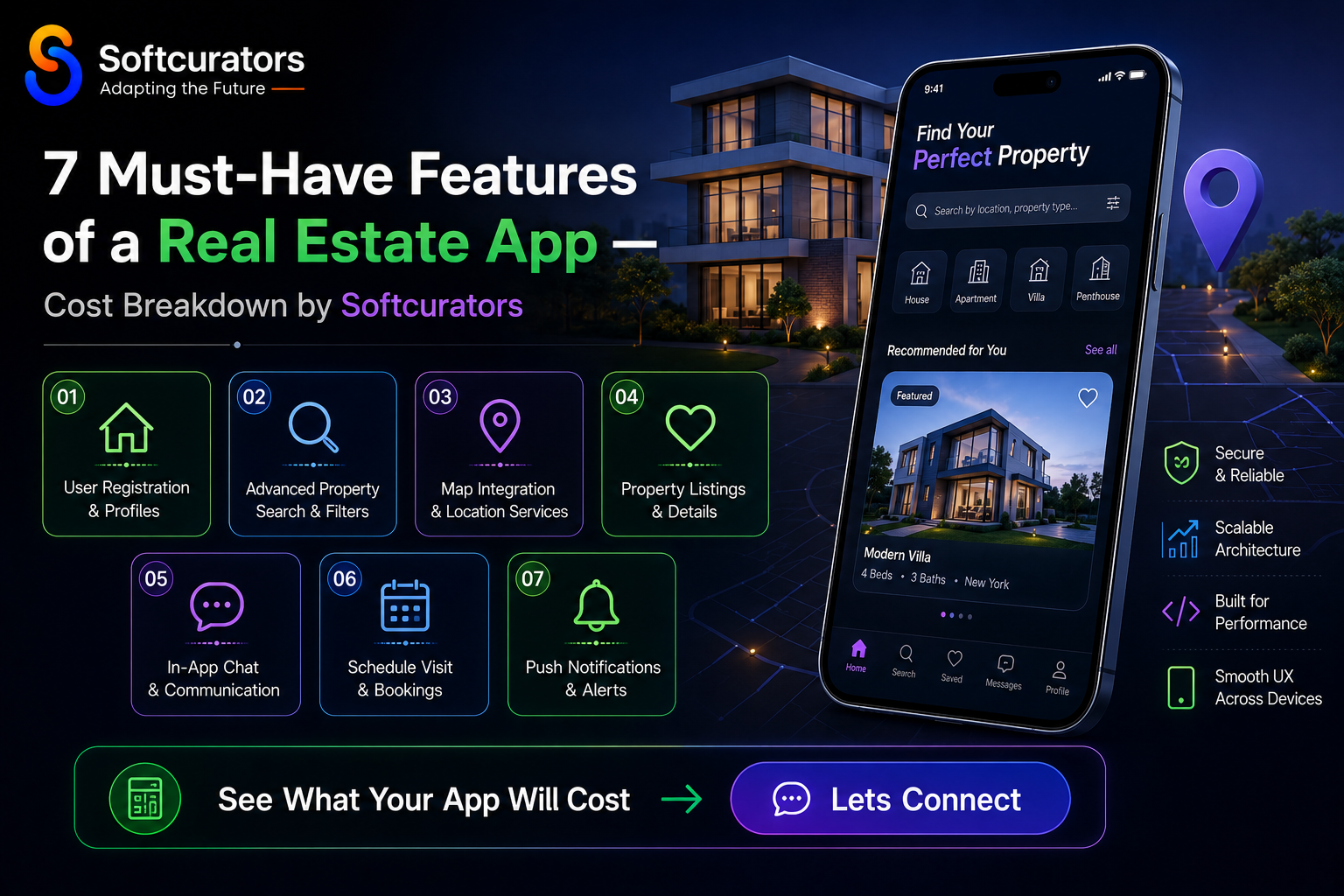
7 Must-Have Features and What Each Costs
Every real estate app regardless of type is built from a core set of features. Understanding what each feature involves is essential to understanding real estate app development cost. Let us break them down one by one.
Feature 1: User Registration and Profiles
Users need to register, log in, and maintain profiles. However, in real estate this goes further. Buyer profiles store saved searches and favourited listings. Agent profiles store listings, ratings, and contact details. Landlord profiles manage multiple properties. Therefore, this is more complex than a standard auth layer.
Estimated cost: $2,000–$6,000
Our UI/UX design team builds onboarding flows that convert applying the patterns from our mobile app UI/UX best practices guide to every real estate app we build.
Feature 2: Property Listings and Search
This is the core feature of most real estate apps. It includes property creation forms, rich media uploads (photos, videos, floor plans), and a powerful search and filter engine. Furthermore, map-based search showing properties on a live, zoomable map is now a user expectation, not a nice-to-have.
Estimated cost: $5,000–$10,000
Feature 3: Advanced Search and Filters
Users search by price, location, property type, bedrooms, bathrooms, amenities, school district, and more. Additionally, saved search alerts notify users when new matching listings appear. This requires a robust, indexed search backend. Softcurators uses Elasticsearch for real estate search delivering sub-50ms results even across millions of listings.
Estimated cost: $4,000–$8,000
Feature 4: Map and Location Features
Google Maps or Mapbox integration enables property pins, neighbourhood overlays, commute time calculators, and proximity searches. Moreover, heat maps showing price trends by area are increasingly expected on modern platforms. Integration with map APIs adds both development time and ongoing API cost.
Estimated cost: $3,000–$8,000
Feature 5: Messaging and Enquiry System
Buyers and renters need to contact agents or landlords directly from the app. As a result, a real-time messaging system with read receipts, notification triggers, and enquiry threading is essential. This system needs to work across the app and via push notification.
Estimated cost: $4,000–$10,000
Feature 6: Booking and Scheduling
Property viewings need to be bookable inside the app. Therefore, a calendar integration, availability management, and automated confirmation system are required. For rental apps, this extends to full booking flows with payment processing. Our experience with on-demand app development and taxi booking systems informs how we build scheduling infrastructure.
Estimated cost: $5,000–$10,000
Feature 7: Agent and Listing Dashboard
Agents and landlords need a management interface to create listings, manage enquiries, track performance, and update availability. Furthermore, analytics showing listing views, enquiries, and conversion rates make this dashboard genuinely useful rather than just functional.
Estimated cost: $4,000–$9,000
Advanced Real Estate App Features That Drive Competitive Advantage
Beyond the must-have features, these advanced capabilities are what separate a good real estate app from a market-leading one. Softcurators recommends planning for at least two or three of these in V1 architecture even if they ship in V2 to avoid costly retrofits.
AI-Powered Property Recommendations
Machine learning models analyse a user’s search behaviour, saved listings, and interaction patterns. Consequently, they surface properties the user is likely to want before the user explicitly searches for them. This is the Spotify-for-property experience that dramatically increases session length and listing conversion.
Our AI development and AI app development teams build recommendation models that improve with every user interaction. Additional cost: $8,000–$25,000.
3D Virtual Tours and AR Staging
Buyers increasingly expect to explore properties virtually before visiting in person. Virtual tours reduce unproductive viewings by up to 40%. Furthermore, AR staging lets buyers visualise furniture in an empty property. These features require 3D processing pipelines and ARKit/ARCore SDK integration.
Additional cost: $10,000–$30,000.
Mortgage Calculator and Affordability Tools
Integrated mortgage calculators with live interest rate data significantly increase user engagement and time-on-app. Additionally, affordability scoring showing which properties fall within a user’s budget drives higher-quality enquiries to agents.
Additional cost: $3,000–$7,000.
Document Management and e-Signature
For rental and sales transaction platforms, secure document storage, contract generation, and e-signature integration (DocuSign, HelloSign) reduce deal friction significantly. Moreover, they are increasingly required by GDPR and local property transaction regulations.
Additional cost: $5,000–$12,000.
Property Valuation and Price Prediction
AI-powered Automated Valuation Models (AVMs) estimate property values based on comparable sales, location data, and market trends. This feature used by Zillow’s Zestimate adds significant trust and stickiness. Therefore, it is a strong V2 priority for listing platforms.
Our AI consulting services and AI automation capabilities make this feature buildable without requiring a dedicated data science team. Additional cost: $8,000–$25,000.
Investment Analytics Dashboard
For investment platforms, ROI calculators, rental yield estimators, cap rate analysis, and portfolio performance dashboards are essential. These overlap with our investment platform development and fintech app experience. Additional cost: $7,000–$20,000.
Tech Stack for a Production-Grade Real Estate App
Technology choices directly affect real estate app development cost, performance, and long-term maintainability. Softcurators selects every component based on three factors: performance at scale, developer ecosystem maturity, and total cost of ownership.
| Layer | Technology | Why Softcurators Uses It |
| iOS App | Swift + SwiftUI | Native maps, AR support, smooth property gallery animations |
| Android App | Kotlin + Jetpack Compose | Modern UI toolkit, native Google Maps integration |
| Cross-Platform | Flutter/React Native + Dart | Single codebase, 40% cost saving, near-native performance |
| Web Platform | React.js + Next.js | SEO-friendly SSR for property listing pages, fast load times |
| Backend API | Node.js (NestJS) + Go | REST + GraphQL APIs, Go for high-speed search queries |
| Database | PostgreSQL + PostGIS | Relational data + geospatial queries for map-based search |
| Search Engine | Elasticsearch | Sub-50ms property search across millions of listings |
| Caching | Redis | Fast listing retrieval, session management, saved search alerts |
| Real-Time Messaging | WebSockets + Socket.io | Instant buyer-agent messaging with read receipts |
| Media Storage | AWS S3 + CloudFront | Property photos, videos, floor plans with global CDN delivery |
| Maps & Location | Google Maps API + Mapbox | Property pins, neighbourhood overlays, commute routing |
| 3D / AR | ARKit (iOS) + ARCore (Android) | Virtual property tours and AR furniture staging |
| AI/ML | Python (FastAPI) + TensorFlow | Recommendation engine, price prediction, AVM models |
| Payments | Stripe + Escrow API | Rental deposits, booking fees, fractional investment transactions |
| Auth | Auth0 / Firebase Auth | Social login, MFA, secure session management |
| DevOps | AWS EKS + Terraform + GitHub Actions | Auto-scaling, infrastructure-as-code, zero-downtime deploys |
| Monitoring | Datadog + Sentry | Real-time error tracking, performance alerts |
This stack reflects Softcurators‘s hands-on experience across mobile app development technologies, iOS development, Android development, Flutter, and web development. We also evaluate cross-platform vs native development for every real estate client because the right answer depends on your specific market and budget.
Real Estate App Development Cost: 3-Tier Breakdown
Here is the detailed real estate app development cost breakdown across three investment levels. All ranges are based on Softcurators‘ actual engagement history. All figures are in USD.
Tier 1: MVP Real Estate App
This tier targets startups validating product-market fit, raising seed funding, or launching in a single geography. Web platform plus one mobile platform. Core search, listings, and messaging. No AI features yet.
| Module | Hours Estimate | Cost (USD) |
| User Auth + Buyer & Agent Profiles | 100–150 hrs | $2500–$4,000 |
| Property Listings + Photo Upload | 120–180 hrs | $3,000–$6,000 |
| Search + Filters + Map View | 140–200 hrs | $4,000–$8,000 |
| Enquiry and Messaging System | 100–150 hrs | $2,000–$4,500 |
| Booking / Viewing Scheduler | 80–120 hrs | $2,000–$4,000 |
| Agent / Landlord Dashboard | 100–140 hrs | $3,000–$5,000 |
| UI/UX Design (All Screens) | Included | $2,000–$5,000 |
| Admin Panel (Core Functions) | 80–120 hrs | $2,000–$3,500 |
| QA, DevOps & Deployment | 100–140 hrs | $2,500–$5,500 |
| Project Management + Docs | Included | $2,000–$3,000 |
| TOTAL MVP | 820–1,200 hrs | $15,000–$40,500 |
Tier 2: Full-Featured Real Estate Platform
This tier targets funded startups and established agencies launching a production platform with iOS + Android apps, AI recommendations, virtual tours, document management, and a full payment layer.
| Module | Hours Estimate | Cost (USD) |
| All Tier 1 Features | 820–1,200 hrs | $15,000–$40,500 |
| iOS + Android Native Apps (both) | 480–720 hrs | $12,000–$20,000 |
| AI Recommendation Engine (V1) | 180–280 hrs | $5,000–$9,500 |
| Virtual Tour Integration (3D) | 200–320 hrs | $5,000–$9,000 |
| Mortgage Calculator + Affordability Tool | 80–120 hrs | $2,000–$5,000 |
| Document Management + e-Signature | 160–260 hrs | $5,000–$7,500 |
| MLS / Property Data API Integration | 160–240 hrs | $4,500–$6,000 |
| Payment Layer (Deposits + Booking Fees) | 140–220 hrs | $3,500–$6,000 |
| Security Audit + Pen Testing | 80–120 hrs | $2,000–$5,500 |
| TOTAL TIER 2 | 2,300–3,480 hrs | $40,000–$70,000 |
Tier 3: Enterprise / Proptech Platform
This tier targets well-funded companies building full proptech ecosystems investment marketplaces, CRE platforms, or national-scale listing networks with AI valuation, AR, and regulatory compliance.
| Module | Hours Estimate | Cost (USD) |
| All Tier 2 Features | 2,300–3,480 hrs | $40,000–$70,000 |
| AI Property Valuation (AVM) | 280–420 hrs | $6,000–$12,000 |
| AR Staging Feature | 240–380 hrs | $7,000–$10,000 |
| Investment Dashboard + ROI Tools | 200–320 hrs | $5,000–$10,000 |
| Fractional Investment + Compliance Layer | 280–440 hrs | $6,000–$12,000 |
| Multi-Region MLS Integration | 200–320 hrs | $6,000–$10,000 |
| Enterprise CRM Integration | 160–260 hrs | $50,000–$8,500 |
| Advanced Analytics & BI Dashboard | 160–260 hrs | $5,000–$8,500 |
| TOTAL TIER 3 | 3,820–5,880 hrs | $70,000–$100,000+ |
Hidden Costs of Real Estate App Development
Development cost is only part of the total picture. These ongoing and one-time costs are consistently underestimated. Furthermore, missing them in your business plan creates cash flow problems after launch.
Third-Party API Costs
Google Maps API charges $0.004–$0.007 per map load. For an app with 50,000 monthly active users, this adds up quickly. Additionally, MLS data feeds (from providers like RETS/RESO), property data APIs (CoreLogic, Attom Data), and mortgage rate APIs all carry subscription fees.
| Service | Purpose | Monthly Cost Estimate |
| Google Maps Platform | Map search, routing, geocoding | $200–$3,000 (usage-based) |
| MLS / IDX Data Feed | Listing data from MLS networks | $500–$3,000/month |
| CoreLogic / Attom Data | Property history, AVM data | $500–$5,000/month |
| DocuSign / HelloSign | e-Signature for contracts | $25–$150/user/month |
| AWS Infrastructure | Hosting, storage, CDN | $800–$8,000/month |
| Auth0 / Firebase Auth | Authentication service | $0–$1,000/month |
| Stripe / Payment Processing | Payments, deposits | 0.3–2.9% per transaction |
| Push Notifications (FCM/APNs) | User alerts, new listing alerts | $0–$300/month |
| Engineering Maintenance Retainer | Bug fixes, updates, security patches | $3,000–$8,000/month |
App Store Fees and Revenue Share
Apple charges 30% on in-app purchases (15% after year one for retained subscribers). Google Play charges the same. For platforms with transaction fees or premium subscriptions, this is a structural cost. Therefore, plan your pricing model around it from day one.
Compliance and Legal
Real estate platforms that handle money rental deposits, investment transactions are subject to financial regulations. Similarly, GDPR (EU), CCPA (California), and local property data privacy laws require legal review. Budget $5,000–$25,000 for initial legal structuring. Our experience in security and compliance for digital platforms informs how Softcurators architects compliant systems from the start.
Ongoing Maintenance Budget
Production apps require continuous engineering. OS updates break map integrations. New device types need optimisation. User feedback drives rapid iteration. As a result, budget 15–20% of initial build cost annually for maintenance. Alternatively, engage Softcurators on our dedicated maintenance and support retainer for priority-access engineering.
How to Reduce Real Estate App Development Cost Smartly
Cutting real estate app development cost does not mean cutting corners. It means making smarter architectural and strategic choices. Here are the six most effective strategies Softcurators recommends to proptech founders:
- Launch on one platform first: Build iOS only if your market skews premium. Build Android first if you target India or Southeast Asia. Adding the second platform in V2, after validating with real users, saves $25,000–$45,000 in initial cost. Our analysis of native apps vs hybrid apps explains when this makes sense.
- Use Flutter for cross-platform: If you need iOS and Android from day one, Flutter development delivers both from a single codebase at 60–70% of the cost of two separate native builds. Performance for map and gallery-heavy real estate apps is strong at this time.
- Start with rule-based recommendations: A collaborative filtering recommendation model (users who saved X also saved Y) at launch costs $5,000–$8,000. A full ML engine costs $15,000–$45,000 more. The ML version only improves meaningfully once you have sufficient user data. Therefore, start with rules and upgrade when data volume justifies it.
- Use a property data API instead of building your own database: Integrating with an existing MLS feed or property data API (RESO Web API, Attom, CoreLogic) is dramatically cheaper than building and maintaining your own property database. Softcurators handles these integrations regularly.
- Build an MVP first validate before scaling: Our MVP development service is purpose-built for this. A $60,000–$90,000 MVP that proves user engagement gives you the data to raise funding for the full build rather than asking investors to back a $250,000 platform on a concept alone.
- Use Softcurators’ pre-built real estate modules: Softcurators has pre-built components for property search, map integration, messaging, and booking flows. These accelerate development by 25–35% compared to building from scratch without sacrificing customisation for your specific use case.
Softcurators’ Real Estate App Development Process
Building a real estate app is genuinely complex. Therefore, the process matters as much as the technology. Here is exactly how Softcurators builds every real estate application:
- Discovery and Strategy (Week 1): We map your target user, competitive landscape, data strategy (MLS vs. user-generated listings), and monetisation model. Output: a Technical Specification Document and confirmed cost estimate.
- UI/UX Design Sprint (Week 2-3): Our UI/UX design team delivers wireframes and high-fidelity Figma prototypes for all core flows. Map-based search, listing detail, and booking flow get particular design attention. We test with real users before development begins.
- Backend Architecture Setup (Week 3–5, parallel): Cloud infrastructure, database schema (including PostGIS geospatial extensions), search index setup, and API skeleton all built before the first feature sprint. This parallel workstream prevents backend bottlenecks.
- Feature Development Sprints (Week 5–8+): Two-week Agile sprints, each delivering testable features. Daily standups. Weekly staging demos. Transparent sprint boards. Clients attend every sprint review.
- Integration Phase (Week 8–12): MLS data feed integration, maps API configuration, payment gateway setup, and third-party service connections run as a focused workstream. These integrations are where most unexpected delays occur, Softcurators plans for them explicitly.
- QA and Security Testing (Week 12–15): Manual QA, automated regression testing, map performance testing, payment flow testing, and penetration testing. Our app testing and deployment approach covers every edge case before live traffic hits the system.
- App Store Submission and Launch (Week 15–18): Full App Store optimisation screenshots, descriptions, preview videos and submission management. Real estate apps with in-app purchases receive additional App Store review scrutiny.
- Post-Launch Hypercare (Week 18–20): 30-day on-call engineering support as standard. First-month user feedback drives the first iteration sprint. Softcurators does not disappear after delivery.
Why Softcurators for Your Real Estate App?
The real estate app development market is full of generalist agencies. Most have built a listing page or two. Very few have shipped production proptech platforms with MLS integration, AR features, investment compliance layers, and AI recommendation engines.
Softcurators is different and the difference is grounded in specific capability, not marketing language:
- Dedicated real estate industry practice: Our real estate app development service is a specialist practice. We have built property search platforms, rental marketplaces, and investment tools at production scale.
- Full mobile and web coverage: From iOS to Android, Flutter, React Native, web development, and PWA we cover every platform with senior engineers who know map APIs and media-heavy interfaces at the implementation level.
- AI-first real estate intelligence: Our AI development, AI app development, and AI consulting practices embed recommendation, valuation, and prediction capabilities into real estate platforms from Day 1.
- Fintech and compliance expertise: Real estate investment platforms need fintech-grade compliance architecture. We bring this from our work on loan lending apps, investment platforms, and BNPL products.
- Transparent, fixed-scope delivery: Real estate app development cost surprises are common in the industry. Softcurators prices on fixed scope. No open-ended retainers. No scope creep surprises. Read why businesses choose Softcurators.
- Post-launch partnership: Our maintenance and support service keeps your platform current, secure, and competitive long after launch.
Explore our portfolio, read our about us page, or browse our full services directory to understand the full scope of what Softcurators delivers.
Also helpful: our guide on how to choose the right app development company written to help you make the best decision, even if that is not us.
Real Estate App Development Cost: The Final Word
Real estate app development cost is never just a single number. It depends on your app type, your feature set, your platform choices, and the team you choose to build with.
However, one thing is consistent: the businesses that invest in quality engineering solid architecture, proper data integration, genuine UX design see dramatically better user retention and conversion than those that cut corners on the initial build.
At Softcurators, we bring specialist real estate development expertise, AI-powered proptech capabilities, and full-stack mobile and web engineering to every engagement. We build real estate apps that compete not just launch.
The first call is free. The cost estimate takes 12 hours. The process is transparent from start to finish.
Talk to Softcurators today and let’s figure out exactly what your real estate app needs and what it will cost to build it right.
Further reading: Real Estate App Development Service | Mobile App Development Cost Guide | AI App Development | Fintech App Development | Our Portfolio | Mobile App Development Trends
FAQs
How long does it take to build a real estate app?
An MVP takes 6–12 weeks. A full-featured platform with iOS and Android apps, AI recommendations, and MLS integration takes 12–18 weeks. Enterprise platforms with AR, investment compliance, and national-scale data integration take 15–25 weeks. Softcurators uses parallel workstreams — design, backend, and mobile development run simultaneously — to compress timelines without sacrificing quality.
What features are must-have in a real estate app?
Every real estate app needs: user registration and profiles, property listings with photo/video upload, advanced search and filters, map-based property search, buyer-agent messaging, viewing or booking scheduler, and a landlord or agent management dashboard. These seven features represent the core of every real estate app Softcurators builds.
How much does MLS integration cost?
MLS integration via RESO Web API or an IDX data provider costs $9,500–$15,000 in development time. Additionally, ongoing MLS data feed subscription fees typically run $500–$3,000 per month depending on the MLS network and geographic coverage. Softcurators handles the full integration — from technical setup to compliance with MLS display rules.
Do I need a native iOS and Android app or can I use Flutter/React Native ?
For map-heavy, media-rich real estate apps, Flutter/React Native performs excellently. Building with Flutter/React Native saves 35–40% compared to two separate native builds. However, if AR staging, advanced camera features, or deep Apple Maps integration are core to your product, native iOS development gives finer control. Softcurators walks through this decision specifically for every real estate client — the right answer depends on your budget, target market, and feature set.
What is the real estate app development cost for a Zillow-like platform?
A Zillow-comparable platform — national MLS data, map search, Zestimate-like AVM, agent profiles, and mortgage tools — represents a Tier 2 to Tier 3 build. Softcurators estimates $50,000–$100,000+ for a production platform at this feature depth. However, a niche version of this concept targeting one city or property type can be built as a strong MVP for $30,000–$60,000.
How does Softcurators handle property data — do I need my own database?
For most real estate apps, Softcurators recommends integrating with existing property data APIs (RESO/IDX for MLS data, CoreLogic or Attom Data for property history and valuations) rather than building and maintaining a proprietary property database. This approach is faster to launch, cheaper to maintain, and keeps your data current without engineering effort.
What payment integrations does a real estate app need?
Rental deposit collection, booking fee payment, and fractional investment transactions all require payment integration. Softcurators uses Stripe for standard payment flows and Escrow API for transaction-protected deals. For investment platforms, additional compliance layers (KYC, AML) are required. Our fintech and BNPL development experience informs every payment architecture decision.
How does AI improve a real estate app?
AI improves real estate apps in four specific ways: personalised property recommendations (showing users properties they are likely to want before they search), automated property valuation models (instant price estimates), chatbot-based enquiry handling (answering buyer questions 24/7), and predictive market analytics (showing investors where values are likely to move). Softcurators' AI development team builds all four capabilities.
What is an AVM and how much does it cost to build?
An Automated Valuation Model (AVM) estimates property values using comparable sales data, location factors, and property characteristics. Zillow's Zestimate is the most famous example. Building an AVM requires a machine learning model trained on property transaction data. Softcurators estimates $9,000–$25,000 for a V1 AVM, depending on data sources and accuracy requirements.
Do I need AR features in my real estate app?
AR features — virtual tours and AR furniture staging — are increasingly expected by buyers in premium property markets. However, they add $10,000–$35,000 to development cost. Softcurators recommends AR as a V2 feature for most MVP budgets. If AR is a core part of your value proposition (for example, a proptech focused on remote international buyers), it belongs in V1.
How much does a rental marketplace app cost compared to a listing app?
A rental marketplace costs roughly 30–50% more than a listing-only app at the same feature depth. This is because rental apps require a booking flow, availability calendar, identity verification, deposit payment processing, and a landlord-side management portal alongside the tenant-facing app. Softcurators estimates $15,000–$45,000 for a rental marketplace MVP to full platform.
What is the cost of building a property management app?
A property management app — covering maintenance request tracking, rent collection, lease management, and tenant communication — costs $20,000–$60,000 depending on the number of integrations and the depth of workflow automation. These are primarily B2B tools, which means the design complexity is lower but the workflow and integration complexity is higher.
How does real estate app development cost compare in India vs the US?
US-based development agencies charge $100–$250 per hour. India-based senior development teams charge $15–$30 per hour for equivalent quality. Softcurators operates an India-based senior engineering team with US and UK quality standards — delivering premium real estate app builds at 40–60% below Western agency rates.
What security measures does a real estate app need?
Real estate apps handle personal data, financial transactions, and property information. Therefore, they require TLS 1.3 encryption in transit, AES-256 encryption at rest, JWT authentication with refresh token rotation, GDPR-compliant data handling, PCI-DSS compliance for payment flows, and penetration testing before launch. Softcurators embeds these requirements into architecture design, not post-launch patching. Our mobile app security and compliance guide covers this framework in detail.
Can Softcurators build a real estate investment platform?
Yes. Softcurators builds real estate investment platforms covering investor onboarding with KYC/AML compliance, property deal listing and due diligence documentation, investment calculators (ROI, rental yield, cap rate), fractional investment mechanics, and investor portfolio dashboards. This work draws on our fintech and investment platform development experience.
How do I integrate Google Maps into a real estate app?
Google Maps Platform provides the Geocoding API (address to coordinates), Maps JavaScript API (for web map display), Places API (for address autocomplete), and Distance Matrix API (for commute time calculation). Softcurators integrates all required Maps APIs and optimises usage to control ongoing API costs — which can escalate quickly without careful caching and request batching.
What is PropTech and why does it matter for real estate apps?
PropTech (property technology) refers to the use of technology to disrupt or improve real estate processes. It encompasses listing platforms, virtual tours, AI valuation, fractional investment, property management software, and smart building technology. The PropTech market is growing at 16.8% CAGR. Building a real estate app is fundamentally a PropTech business — and Softcurators is a PropTech development partner, not just a generic app agency.
How does Softcurators price real estate app development projects?
Softcurators prices on fixed scope, not open-ended time-and-materials billing. We define scope clearly, price accordingly, and deliver what was promised. This gives clients cost certainty — which is especially important for real estate app projects where scope can expand significantly if not defined rigorously upfront. Contact us for a scoped proposal within 12 hours.
What ongoing costs should I budget for after my real estate app launches?
Budget for: cloud infrastructure ($800–$8,000/month), MLS/property data API fees ($500–$3,000/month), Google Maps API ($200–$3,000/month usage-based), payment processing (0.3–2.9% per transaction), engineering maintenance ($3,000–$8,000/month), and App Store revenue share (30%). Total operational costs for a platform with 10,000 active monthly users typically run $8,000–$22,000/month.
Can I build a real estate app on a $20,000 budget?
A $20,000 budget can deliver a focused proof-of-concept or internal MVP — for example, a web-only listing display tool for a single agency with no booking or payment layer. However, for a consumer-facing marketplace with real user acquisition ambitions, Softcurators recommends a minimum budget of $30,000 for a viable MVP. Our startup development service is designed to get the maximum validated product within your budget constraints.
How does Softcurators ensure knowledge transfer after delivery?
Softcurators delivers comprehensive documentation with every project: architecture diagrams, API reference docs, database schema docs, deployment runbooks, and CI/CD pipeline documentation. We also conduct structured handover sessions with your internal team. Post-delivery, our maintenance and support retainer provides ongoing access to the engineers who built the system.
What is the difference between an IDX feed and an MLS integration?
MLS (Multiple Listing Service) is the database where agents enter property listings. IDX (Internet Data Exchange) is the system that allows real estate websites and apps to display MLS listings. For most real estate apps, Softcurators integrates via IDX — using the RESO Web API standard — which provides access to listing data without requiring direct MLS membership.
Does Softcurators offer a white-label real estate app solution?
Yes. Softcurators has a pre-built real estate app framework covering core search, listing management, messaging, and booking flows. This framework can be fully branded and configured for your specific use case, delivering a production-ready platform faster and cheaper than a ground-up build. Contact us to see a demo of the framework.
How does real estate app development cost scale with user volume?
Development cost is largely fixed. However, infrastructure cost scales with user volume. A platform serving 1,000 monthly active users costs $500–$1,500/month in infrastructure. At 50,000 MAU, that rises to $5,000–$15,000/month. Softcurators designs auto-scaling infrastructure from Day 1 — so your platform handles traffic spikes without manual intervention or emergency re-architecture.
What is the best tech stack for a real estate app ?
Softcurators recommends: React Native or Flutter for mobile (unless AR is a core feature, in which case native Swift/Kotlin); Next.js for web (for SEO-critical listing pages); NestJS + Go for backend; PostgreSQL with PostGIS for geospatial queries; Elasticsearch for search; AWS for infrastructure; and Google Maps Platform for mapping. This stack delivers production performance at a maintainable total cost of ownership.
How does Softcurators handle post-launch real estate app support?
Softcurators provides 30 days of post-launch hypercare as standard — on-call engineering for P1 incidents, rapid response to user-reported bugs, and first-iteration planning based on real user data. Beyond hypercare, our maintenance and support retainer covers monthly security patches, OS update compatibility, performance monitoring, and ongoing feature development.
What makes a real estate app retain users?
The three biggest retention drivers in real estate apps are: alert quality (do new listing alerts match what the user actually wants?), search experience quality (is map-based search fast, accurate, and intuitive?), and content freshness (are listings current and accurate?). Softcurators designs for all three from the architecture phase — because retention is far cheaper to build in than to retrofit.
Can Softcurators integrate with Salesforce or other CRMs for a real estate platform?
Yes. Softcurators integrates real estate apps with Salesforce, HubSpot, Zoho, and custom CRM systems via API. For large real estate agencies and CRE platforms, CRM integration means every enquiry from the app flows directly into the agent's workflow tool — no manual data transfer. This is a common requirement in our Tier 2 and Tier 3 engagements.
How do I get started building my real estate app with Softcurators?
The first step is booking a free 30-minute discovery call at softcurators.com/contact. Our senior architect will review your concept, ask targeted questions about your market and feature requirements, and deliver a ballpark cost range within 12 hours — followed by a detailed scoped proposal within 3–5 business days. No obligation. No generic templated response.
Is real estate app development cost higher for rental vs. sales platforms?
Generally, yes. Rental platforms require additional infrastructure: availability calendars, booking flow, deposit payment processing, identity verification for tenants, and landlord-side management tools. Each of these adds development scope. Softcurators estimates rental marketplace builds at 25–40% higher cost than equivalent listing-only platforms at the same feature depth.
