
Imagine running out of petrol at midnight on a remote highway. Or managing a fleet of 200 delivery vehicles that all need refuelling without pulling a single one off the road. Or operating an industrial generator farm that cannot afford an unplanned fuel outage. These are the exact problems that a fuel delivery mobile app solves and in 2026, the market for solving them has never been larger or more clearly defined.
The global on-demand fuel delivery market was valued at USD 6.3 billion in 2024 and is projected to grow at a CAGR of 14.2% through 2031, according to Grand View Research. Startups like Filld, Booster, and Yoshi have raised tens of millions of dollars proving the model in the US. WeFuel, Fuel Fox, and FuelBuddy have validated it in the UK, South Africa, and India respectively. The category is real, growing, and still far from saturated in most geographies.
But building a fuel delivery mobile app is genuinely more complex than most on-demand apps. You are coordinating GPS-tracked fuel tankers, managing flammable liquid volumes and safety compliance, integrating real-time pricing from fuel card networks, and handling multiple user types simultaneously consumers, fleet managers, tanker drivers, and operations admins. Get any one of those wrong and your platform fails.
At Softcurators, we build on-demand delivery platforms including fuel delivery apps, food delivery apps, logistics platforms, and taxi booking apps. This guide is built on real project experience not templates.
By the end of this article, you will know exactly what features a competitive fuel delivery mobile app needs, which technology stack to build on, what a realistic development cost looks like in 2026, and the operational mistakes that kill fuel delivery platforms before they reach scale.
The Fuel Delivery App Market in 2026: Why Now Is the Right Time to Build
Three converging trends are making 2026 an ideal moment to develop a fuel delivery mobile app:
Trend 1: Fleet Electrification Is Creating New Fuel Demand Patterns
Counterintuitively, the EV transition is actually increasing demand for mobile fuel delivery in the near term. Hybrid fleets with both EV and ICE vehicles create complex energy management requirements. Fleet operators cannot afford the downtime of driving every vehicle to a filling station. Mobile diesel delivery to depot keeps ICE vehicles running while the EV charging infrastructure catches up. The IEA Global EV Outlook 2024 confirms that ICE commercial vehicles will remain the majority of global fleets through 2030.
Trend 2: The Rise of Contactless, On-Demand Everything
Post-pandemic consumer and business behaviour normalised home and site delivery for almost every product. Fuel is not exempt. The same expectation that drives grocery delivery apps is driving fuel delivery adoption customers expect to tap, order, and have the problem solved without leaving their location. According to Statista, on-demand service app revenue is projected to exceed USD 335 billion globally in 2026.
Trend 3: Construction, Agriculture, and Events Industries Are Underserved
Traditional fuel retail serves road vehicles. It does not serve construction sites that need 2,000 litres of red diesel delivered to a remote location, or agricultural operations that need farm diesel tracked against machinery hours, or festival operators that need generator fuel on a rolling basis. These B2B segments represent higher average order values and stickier customer relationships than consumer fuel delivery and almost no dedicated apps serve them well.
Market Opportunity Snapshot
| Market Segment | Current Adoption | Average Order Value | Growth Driver | Competition Density |
| Consumer Roadside Fuel | Medium US/UK leaders | $40–$80 | Convenience, subscriptions | Moderate (Filld, Booster, Yoshi) |
| Fleet & Corporate Fuel | Low–Medium | $300–$3,000+ | Efficiency, compliance tracking | Low in most markets |
| Construction & Industrial | Low | $500–$10,000+ | Site productivity, cost control | Very Low |
| Agricultural / Rural | Very Low | $800–$5,000+ | Remote access, harvest time peaks | Near zero dedicated apps |
| Events & Generators | Low | $200–$2,000+ | Event uptime, last-minute delivery | Very Low |
| Marine / Waterfront | Low | $500–$5,000+ | Dock-side convenience | Very Low |
The most defensible market entry points in 2026 are B2B segments particularly fleet, construction, and agriculture because the customer LTV is dramatically higher, churn is lower, and dedicated apps are rarer. Consumer fuel delivery is more competitive but has proven network effects once critical mass is achieved in a geography. For more on on-demand platform strategy, see our guide to on-demand app development.
Types of Fuel Delivery Apps You Can Build
Not all fuel delivery mobile apps are the same. Your market segment, business model, and geography determine which type fits. Understanding this before you brief a development team saves significant rework cost.
| App Type | Who It Serves | Core Differentiator | Revenue Model | Complexity |
| Consumer On-Demand Fuel | Individual car owners, motorists | Speed, convenience, location flexibility | Delivery fee + fuel margin | Medium |
| Fleet Management Platform | Fleet operators, logistics companies | Scheduled delivery, fuel cost reporting, fleet analytics | Subscription + volume pricing | High |
| B2B Industrial Fuel Portal | Construction, agriculture, mining, events | Large volume orders, remote delivery tracking, compliance docs | Volume contract + per-delivery fee | High |
| Fuel Subscription Service | Regular commuters, ride-share drivers | Weekly fill-ups, loyalty rewards, predictive scheduling | Monthly subscription + margin | Medium |
| Multi-Fuel / Energy Delivery | Mixed EV/ICE fleets, data centres | Diesel + AdBlue + portable EV charging coordination | Hybrid billing model | Very High |
| White-Label Fuel Platform | Fuel distributors, petrol companies | Branded experience, independent retailer tools | Licence fee + revenue share | High |
For most new entrants, the recommended starting point is either consumer on-demand (if targeting a specific city with proof of demand) or fleet management (if you have relationships with fleet operators). Fleet has higher development complexity but better unit economics. Consumer has faster initial growth potential but thinner margins. At Softcurators, we help clients choose based on their existing market relationships, not just technical preference.
The Multi-Panel Architecture: Understanding All 4 User Types
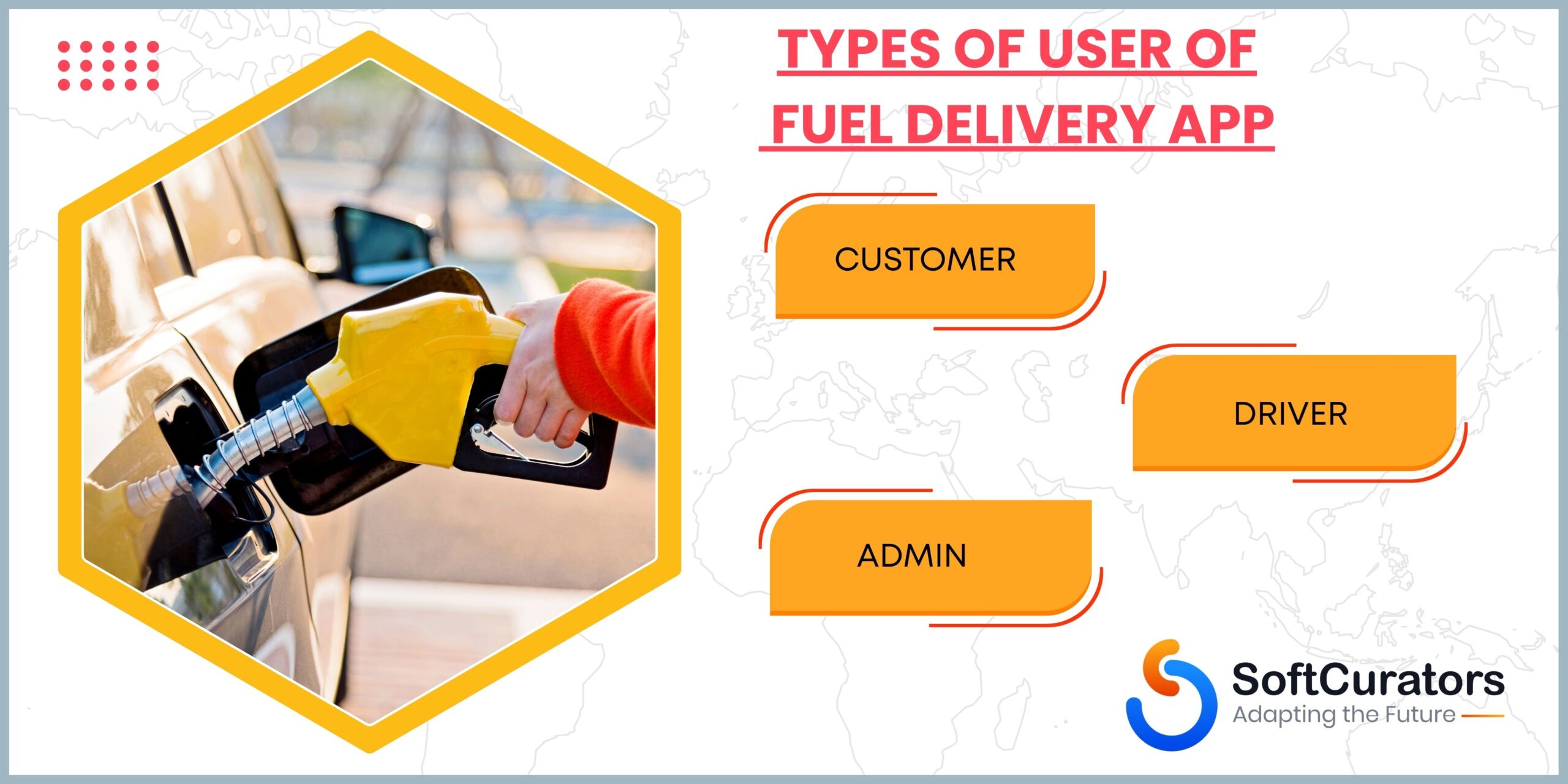
A fuel delivery mobile app is not a single app it is a platform with four distinct user experiences. Each panel must be designed and developed independently, with different data access, different workflows, and different performance requirements. Get this architecture wrong and you create coordination failures that cost you customers and drivers simultaneously.
Panel 1 Customer App (iOS + Android)
The customer app is what your end users see. For consumer fuel delivery, this means homeowners, car owners, and individuals. For B2B delivery, it is the site manager, fleet coordinator, or operations director. The customer panel handles:
- Fuel type selection and quantity input
- Delivery location selection (GPS auto-detect or manual pin-drop)
- Scheduling: order now (ASAP) or schedule for a specific time slot
- Driver tracking on a live map once the order is dispatched
- Payment (card, wallet, fuel card, purchase order for B2B)
- Order history, receipts, and digital fuel delivery certificates
- Subscription management for recurring delivery customers
Panel 2 Driver / Tanker Operator App (iOS + Android)
The driver app is mission-critical. A driver who cannot find the delivery location, cannot update delivery status, or cannot process payment loses your customer. The driver panel handles:
- New order alerts with accept/decline workflow and deadline
- Turn-by-turn navigation optimised for tanker vehicle routing (avoiding low bridges, weight-restricted roads)
- Digital delivery checklist: safety inspection before departure, delivery confirmation protocol
- Volume dispensing: input actual litres delivered (may differ from ordered amount)
- Photo proof of delivery (location, odometer, fuel gauge)
- In-app communication with customer and dispatch
- Cash, card, and digital payment collection
- Tanker inventory management: remaining fuel volume tracking across shifts
Panel 3 Fleet Manager / B2B Dashboard (Web + Mobile)
For B2B customers managing multiple vehicles or sites, a self-service web dashboard with mobile companion app is essential. This panel handles:
- Add and manage vehicles: registration, fuel type, tank capacity, driver assignment
- Schedule recurring deliveries: weekly, fortnightly, or triggered by GPS-tracked fuel level
- Centralised billing and purchase order management
- Fuel consumption reports: by vehicle, by driver, by period, compared to benchmark
- Cost centre allocation: assign fuel costs to specific projects or departments
- Delivery history with digital fuel delivery certificates for compliance audits
- Driver access cards or QR codes for authorised fuelling
Panel 4 Admin / Operations Panel (Web)
The platform owner panel controls everything. This is where Softcurators invests significantly in design quality because your operations team uses it all day, every day:
- Order management: live view of all active, pending, and completed orders
- Driver management: onboarding, performance scores, shift scheduling, tanker assignments
- Pricing engine: dynamic fuel price updates, zone-based pricing, surge pricing configuration
- Geographic zone management: define delivery areas, add new zones, set delivery fees per zone
- Tanker inventory management: fleet-level fuel stock levels, refilling schedules
- Customer management: account health, order frequency, subscription status, support tickets
- Revenue dashboard: daily, weekly, monthly P&L, margin per delivery, driver cost analysis
- Compliance documents: driver licences, tanker certifications, fuel type documentation
Complete Feature List for a Fuel Delivery Mobile App in 2026
Here is the complete feature set organised by panel and by priority MVP features that you need on day one, and advanced features that you add as you scale:
Customer App MVP Features
| Feature | Description | Priority | Est. Dev Time |
| User Registration & Login | Email, phone, social login (Google/Apple). OTP verification. | MVP | 2–3 weeks |
| Fuel Type & Volume Selection | Petrol, diesel, premium, AdBlue. Volume slider or preset amounts. | MVP | 1–2 weeks |
| Location Services | GPS auto-detect, manual address search, save favourite locations. | MVP | 2–3 weeks |
| Schedule Now or Later | ASAP dispatch or calendar scheduler up to 7 days ahead. | MVP | 1–2 weeks |
| Real-Time Driver Tracking | Live map showing tanker location, ETA, and route progress. | MVP | 3–4 weeks |
| In-App Payment | Credit/debit card, Apple Pay, Google Pay, fuel cards. | MVP | 2–3 weeks |
| Push Notifications | Order confirmed, driver dispatched, arrival in 10 min, delivered. | MVP | 1 week |
| Order History & Receipts | Digital receipts with fuel type, litres, price, location, timestamp. | MVP | 1 week |
| Driver Rating & Review | Rate the driver and delivery experience after completion. | MVP | 1 week |
| In-App Chat / Call | Contact driver via masked call or in-app message. | MVP | 1–2 weeks |
| Promo Codes & Referrals | Enter discount codes; refer a friend for credit. | Growth | 1–2 weeks |
| Subscription Plans | Weekly or monthly recurring delivery for regular users. | Growth | 3–4 weeks |
| Fuel Price Comparison | Show current price vs local station average. | Growth | 1–2 weeks |
| AI Price Predictor | Show whether current prices are high/low vs 7-day trend. | Advanced | 3–5 weeks |
| Carbon Offset Option | Opt-in to offset delivery carbon footprint. | Advanced | 1–2 weeks |
Driver App MVP Features
| Feature | Description | Priority | Est. Dev Time |
| Driver Onboarding & KYC | Licence upload, vehicle docs, background check integration. | MVP | 2–3 weeks |
| Order Alerts & Acceptance | Push alert with order details; accept or decline with timer. | MVP | 2 weeks |
| GPS Navigation (HGV-Aware) | Turn-by-turn routing avoiding low bridges, weight limits. | MVP | 3–4 weeks |
| Delivery Checklist | Pre-delivery safety check; customer identity verification. | MVP | 1–2 weeks |
| Volume Dispensing Input | Enter actual litres dispensed; system confirms against ordered. | MVP | 1 week |
| Digital Proof of Delivery | Photo upload of delivery confirmation + customer e-signature. | MVP | 2 weeks |
| Payment Collection | Collect card or cash payment; in-app POS for card payments. | MVP | 2–3 weeks |
| Shift & Earnings Dashboard | Hours worked, deliveries completed, earnings per shift. | MVP | 2 weeks |
| Tanker Inventory Tracking | Current fuel volume in tanker; alert at refuel threshold. | MVP | 2–3 weeks |
| Driver Support Chat | Escalate issues to dispatcher; customer contact via masked call. | MVP | 1–2 weeks |
| Optimised Multi-Stop Routing | AI-optimised route for multiple deliveries in one shift. | Growth | 3–5 weeks |
| Offline Mode | Continue using app in low-connectivity areas; sync when online. | Growth | 2–3 weeks |
Advanced Features Unique to Fuel Delivery Apps
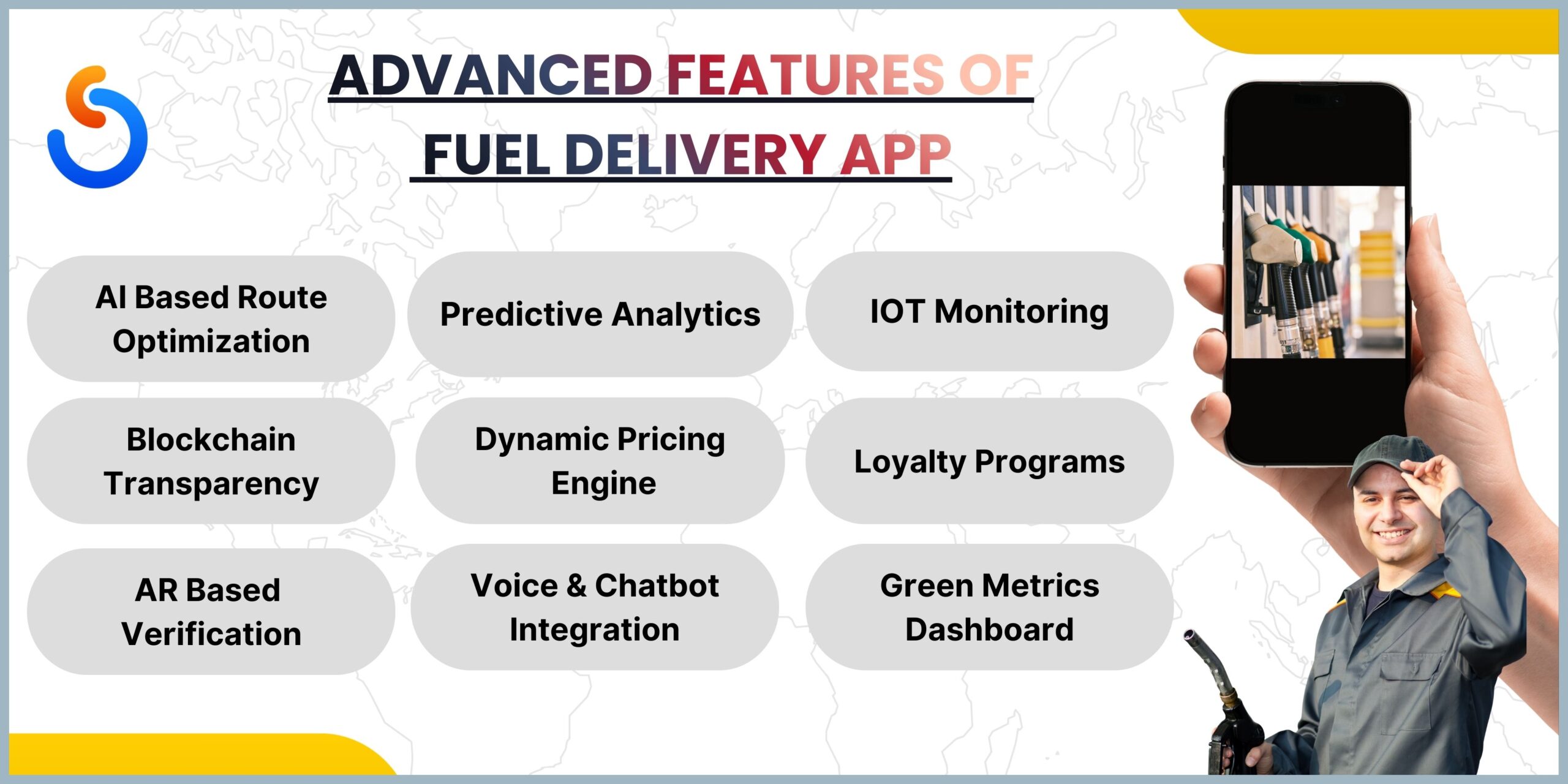
Beyond standard on-demand app features, a fuel delivery platform needs several capabilities that are unique to the fuel industry:
- IoT Tank Level Monitoring: Connect to IoT fuel level sensors on customer tanks (particularly for B2B and agricultural customers). When the tank drops below threshold, the app automatically triggers a delivery request. No human intervention required.
- Telematics Integration: Integrate with fleet management systems (Samsara, Verizon Connect, Geotab) to monitor vehicle fuel levels remotely and trigger deliveries when a vehicle reaches minimum fuel thresholds.
- Dynamic Surge Pricing: Adjust delivery fees based on demand, weather, time of day, and driver availability similar to ride-hailing surge pricing but applied to fuel delivery zone economics.
- Digital Fuel Delivery Certificate (FDC): Generate and store a legally valid fuel delivery certificate for each delivery critical for commercial and agricultural customers who need compliance documentation.
- Fuel Card Integration: Accept fuel card payments from providers like Allstar, Shell Fleet, and BP Plus essential for B2B customers who manage all fuel spend through centralised fuel cards.
- CO2 Emissions Tracking: Calculate and report the carbon footprint of fuel purchases increasingly required for ESG-conscious corporate clients.
- Multi-Site Management: Allow a single B2B customer to manage deliveries across 50+ sites from one account with different authorised users and budget centres per site.
- Predictive Reorder Engine: Use consumption history and delivery patterns to predict when a customer will need fuel next and pre-schedule a delivery before they run out.
Recommended Technology Stack for a Fuel Delivery Mobile App in 2026
Technology choices for a fuel delivery mobile app must account for GPS precision, real-time order updates, offline capability for drivers in low-signal areas, and IoT integration for tank-level monitoring. Here is the full stack we recommend at Softcurators in 2026:
Layer |
Technology |
Reason |
Alternative |
| Customer App (iOS + Android) | React Native 0.74+ | Fast cross-platform development, strong Maps/GPS libraries, large community | Flutter 3.x excellent performance alternative |
| Driver App (iOS + Android) | React Native with offline-first architecture | Background location, offline sync for low-signal areas, native device permissions | Flutter with Hive local storage |
| Fleet Manager Dashboard (Web) | Next.js 14 (React) | SSR for SEO, fast load, excellent data visualisation with Recharts/Chart.js | Nuxt.js 3 (Vue.js alternative) |
| Admin Panel (Web) | Next.js + Tailwind CSS | Component-rich UI, performant, responsive data tables for operations use | Remix.js growing alternative |
| Backend Framework | Node.js + NestJS | TypeScript, modular architecture, excellent WebSocket support for real-time | Go (Golang) for extreme throughput requirements |
| Real-Time Engine | Socket.io / WebSockets | Live order updates, driver location streaming to customer app | Firebase Realtime DB simpler but less scalable |
| Primary Database | PostgreSQL + PostGIS | Geospatial queries for zone detection, ACID for financial data, robust | MySQL with spatial extensions |
| Caching Layer | Redis | Session storage, rate limiting, real-time leaderboards/rankings | Memcached |
| Maps & Navigation | Google Maps Platform + HERE Routing API | Best geocoding, HGV-aware routing from HERE for tanker drivers | Mapbox GL + OSRM for custom routing |
| IoT Integration | AWS IoT Core or Azure IoT Hub | Tank sensor data ingestion, MQTT protocol, scalable device management | Custom MQTT broker for smaller scale |
| Push Notifications | Firebase Cloud Messaging (FCM) + APNs | Multi-platform push, reliable delivery, analytics | OneSignal simpler but less control |
| Payment Processing | Stripe + Stripe Terminal (in-person) | Card, wallet, fuel card API integrations, POS for driver card collection | Adyen for enterprise multi-currency |
| Cloud Infrastructure | AWS (primary) or Google Cloud | Auto-scaling for traffic spikes, managed Postgres (RDS), CDN (CloudFront) | Google Cloud better Maps integration |
| Background Location | iOS Core Location + Android WorkManager | Continuous driver GPS tracking even when app is backgrounded | react-native-background-geolocation library |
| File Storage | AWS S3 + CloudFront | Proof-of-delivery photos, compliance documents, driver KYC docs | Google Cloud Storage |
| AI/ML | Python + FastAPI microservice + scikit-learn / XGBoost | Route optimisation, demand prediction, predictive reordering models | AWS SageMaker for managed ML |
| Monitoring & Alerting | Datadog + PagerDuty | Real-time APM, on-call alerts for delivery failures, driver app crashes | New Relic + OpsGenie |
| CI/CD | GitHub Actions + Docker + Kubernetes | Automated testing, zero-downtime deployments, horizontal scaling | GitLab CI |
Critical Technical Challenge: GPS Accuracy in Fuel Delivery
Fuel delivery has a stricter GPS requirement than most delivery apps. A food delivery driver who stops 30 metres from the customer is mildly inconvenient. A fuel tanker driver who stops in the wrong location causes a safety incident. Your GPS implementation must:
- Use geofencing to confirm the tanker is within the correct delivery zone before the delivery protocol activates
- Record a GPS-stamped proof of delivery that is legally defensible for commercial deliveries
- Handle GPS drift in underground car parks and dense urban environments gracefully
- Track driver location at 10-second intervals to provide accurate ETA to customers
- Stop tracking location between deliveries to preserve driver privacy and battery life
Critical Technical Challenge: Offline Capability for Drivers
Drivers operating in rural, industrial, or underground areas frequently lose mobile data connectivity. Your driver app must function fully offline for at least 30 minutes without data, then sync seamlessly when connectivity returns. This requires:
- Local SQLite / AsyncStorage database on the driver device storing current order details
- Queue-based API calls that retry automatically when connection is restored
- Conflict resolution logic for the unlikely case that two state changes occur while offline
- Clear offline indicator in the driver UI so the driver knows to expect a sync when back in range
For more on mobile app performance and offline architecture, our guide on mobile app development technologies covers the frameworks and patterns we use in on-demand apps.
Fuel Delivery Mobile App Development Cost in 2026
The fuel delivery mobile app development cost in 2026 varies significantly based on scope, team location, and platform complexity. Here are realistic ranges based on current market rates:
Cost by Scope Level
| Scope | What Is Included | Team Size | Timeline | Cost Range (USD) |
| Basic MVP | Customer app (iOS + Android) + Driver app + basic admin. Core order flow, GPS tracking, Stripe payments, push notifications. Single fuel type, single city. | 4–6 devs | 3–4 months | $15,000 – $25,000 |
| Standard Platform | Full MVP + Fleet manager dashboard + advanced admin panel + multiple fuel types + zone management + subscription model + driver KYC + delivery certificates. | 6–10 devs | 5–6 months | $25,000 – $40,000 |
| Advanced Platform | All Standard features + IoT tank integration + telematics API + AI route optimisation + predictive reorder + fuel card payments + multi-currency + emissions tracking. | 10–16 devs | 6–8 months | $50,000 – $70,000 |
| Enterprise / White-Label | All Advanced features + white-label capability + B2B multi-site management + custom ERP integration + regulatory compliance tools + multi-market deployment. | 16–25 devs | 8–10 months | $80,000+ |
Feature-Level Cost Breakdown
| Component | Dev Effort | Cost Range (USD) | Notes |
| Customer App (iOS + Android) | 300–600 hrs | $6,000–$10,000 | React Native for both platforms |
| Driver App (iOS + Android) | 350–700 hrs | $7,000–$12,000 | More complex than customer app GPS, offline, dispensing logic |
| Fleet Manager Web Dashboard | 200–400 hrs | $5,000–$10,000 | Next.js, data visualisation, multi-user accounts |
| Admin / Operations Panel | 250–500 hrs | $5,000–$12,000 | Order management, driver management, pricing engine |
| Backend API & Database | 400–800 hrs | $8,000–$20,000 | Most complex layer real-time, geospatial, financial data |
| Real-Time Order Tracking | 100–200 hrs | $4,000–$7,000 | WebSocket implementation, GPS streaming, ETA calculation |
| Payment Integration (Stripe) | 80–150 hrs | $2,000–$4,000 | Card + wallet + subscription billing |
| Fuel Card Payment Integration | 80–160 hrs | $3,000–$7,000 | Allstar, BP Plus, Shell Fleet APIs vary in complexity |
| IoT Tank Level Integration | 100–250 hrs | $6,000–$12,000 | MQTT/AWS IoT Core, sensor protocol varies by hardware |
| AI Route Optimisation | 150–300 hrs | $5,000–$12,000 | Multi-stop delivery optimisation, HGV routing constraints |
| HGV-Aware Navigation (HERE API) | 60–120 hrs | $2,000–$5,000 | Integration + vehicle profile config for tanker routing |
| Push Notification System | 40–80 hrs | $1,000–$3,000 | FCM + APNs + in-app notification centre |
| KYC / Driver Onboarding | 60–120 hrs | $2,000–$5,000 | Document upload + third-party identity verification |
| UI/UX Design (all panels) | 250–500 hrs | $4,000–$10,000 | 4 distinct user experiences need independent design |
| QA & Testing | 200–400 hrs | $4,000–$8,000 | GPS simulation, real-device testing, load testing |
| DevOps & Cloud Setup | 80–160 hrs | $2,000–$7,000 | AWS setup, CI/CD, monitoring, scaling config |
Cost by Development Team Location
| Team Location | Hourly Rate | MVP Cost | Standard Platform | Enterprise |
| USA / Canada | $100–$200/hr | $120,000–$250,000 | $250,000–$500,000 | $500,000–$1M+ |
| UK / W. Europe | $80–$150/hr | $90,000–$180,000 | $180,000–$350,000 | $350,000–$700,000 |
| Eastern Europe | $40–$80/hr | $45,000–$90,000 | $90,000–$180,000 | $180,000–$360,000 |
| India / South Asia | $15–$50/hr | $25,000–$60,000 | $60,000–$130,000 | $130,000–$260,000 |
| Southeast Asia | $25–$55/hr | $30,000–$70,000 | $70,000–$140,000 | $140,000–$280,000 |
Softcurators delivers quality-focused fuel delivery app development at competitive rates, serving clients in the US, UK, Qatar, and globally. Our on-demand delivery expertise means you get a team that has already solved the GPS tracking, real-time order management, and driver optimisation problems not one learning them on your project.
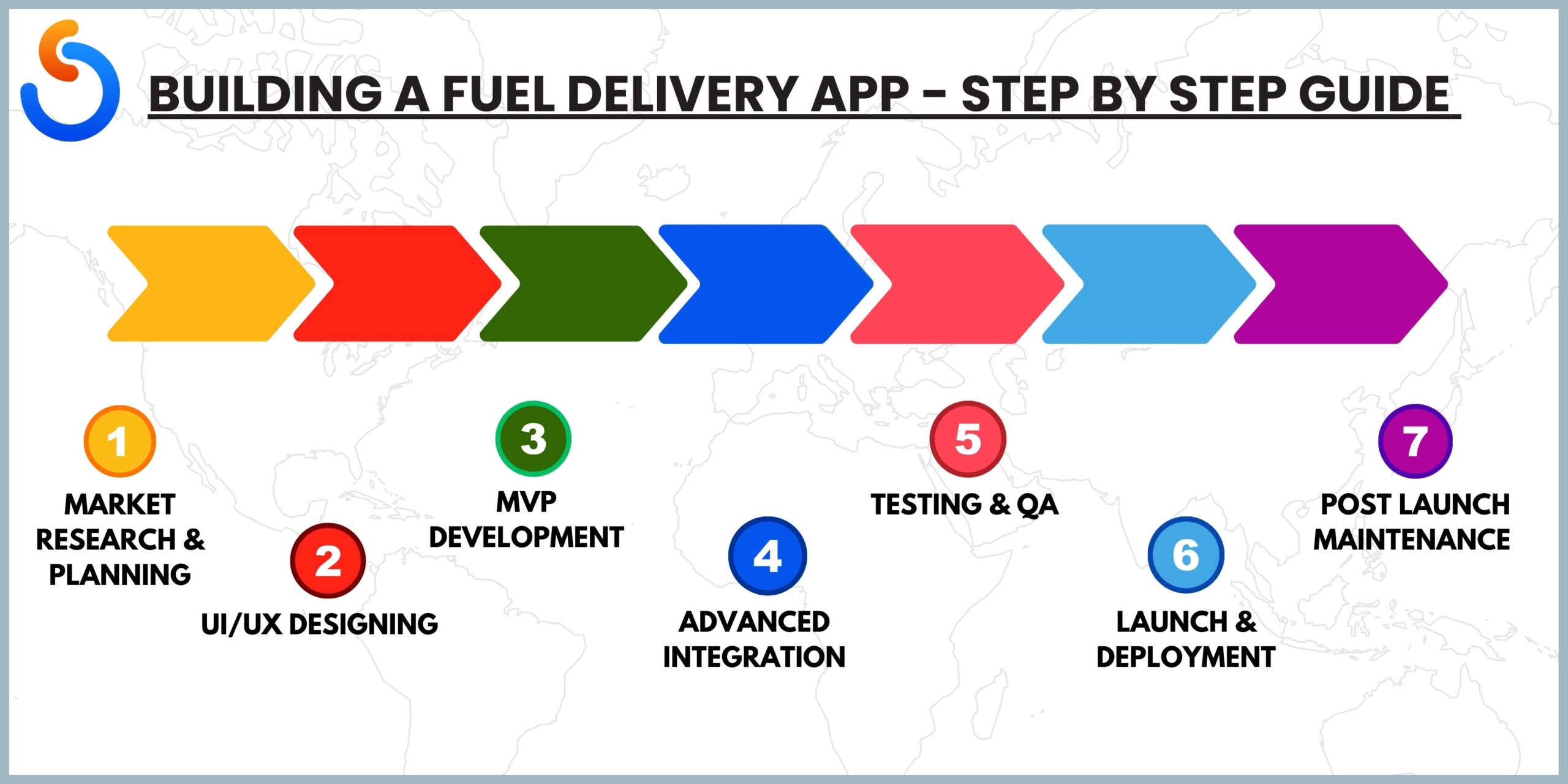
Step-by-Step Process to Develop a Fuel Delivery Mobile App
Step 1: Discovery and Business Model Validation (Weeks 1–3)
Before writing a line of code, you must answer these business questions:
- What is your target geography for launch specific city, region, or national?
- Who is your primary customer consumer, SME fleet, or enterprise?
- What fuel types will you deliver petrol, diesel, AdBlue, LPG, or marine fuel?
- How many tanker drivers will you operate at launch versus scale?
- What is your pricing model fixed margin, dynamic, or subscription?
- Who are your 3–5 key competitors and what is your differentiation?
- What safety and environmental regulations apply in your target market?
The output is a Product Requirements Document (PRD) that drives all subsequent design and development decisions. At Softcurators, our discovery phase produces the PRD, an initial sitemap, a data model outline, and a phased feature roadmap before any design begins. Learn about our approach via our MVP development service page.
Softcurators Discovery Deliverables: Competitor analysis, regulatory overview for target market, user persona documents for all 4 panel types, MVP feature shortlist with rationale, architecture diagram, and phased project plan with realistic timelines and cost.
Step 2: UI/UX Design All 4 Panels (Weeks 3–8)
Fuel delivery UX has specific requirements that generic on-demand templates do not cover. Key design principles we apply at Softcurators:
- Driver app must be fully operable with one hand while wearing gloves large touch targets, minimal text input, voice confirmation options
- Customer order flow must complete in under 60 seconds from app open to order confirmed
- Real-time tracking map must show tanker position, ETA, and driver details in a single glance no drilling into sub-menus
- Fleet manager dashboard must handle 200+ vehicle tables without performance degradation
- Admin operations panel must surface the 5 most critical live metrics without requiring scrolling
For the full framework we apply to delivery app UX, see our guide on mobile app UI/UX design best practices. Every Softcurators project includes usability testing with real target users before development begins.
Step 3: Backend and Database Architecture (Weeks 5–14)
The backend is where fuel delivery app complexity lives. Three subsystems require particular care:
Geofencing Engine: Your platform needs to detect when a customer is in a serviceable zone, when a driver enters a customer’s delivery zone, and when a tanker crosses jurisdictional fuel regulation boundaries. PostGIS-powered geospatial queries handle this at scale.
Real-Time Order State Machine: A fuel delivery order passes through 8–12 distinct states (placed → confirmed → driver assigned → en route → arrived → fuelling → completed → invoiced). Each state transition triggers notifications, updates the live map, and records an audit log. This state machine must be atomic no order can be in two states simultaneously, even under high load.
Pricing Engine: Fuel prices fluctuate daily. Your pricing engine must update base fuel prices from your supplier, apply zone-specific delivery fees, calculate surge multipliers during peak demand, and produce a real-time price quote to the customer in under 500ms.
Step 4: Customer App Development (Weeks 7–16)
The customer app is developed in parallel with the backend, using mock API responses during early stages. Key development considerations:
- Background location tracking must be implemented without destroying battery life use region monitoring, not continuous GPS polling
- The order tracking map must update the tanker position smoothly using interpolation between GPS fixes, not jarring jumps
- Offline detection must prevent order placement when the user has no data no partial orders that cannot be confirmed
- Biometric payment authentication (Face ID, fingerprint) must be supported to reduce payment friction
Step 5: Driver App Development (Weeks 8–18)
The driver app is the most technically complex component. Key development challenges:
- Background GPS tracking must run continuously across a full 8-hour shift without app crashes or battery death
- HGV-aware routing must load the correct vehicle profile from the driver’s account and apply it automatically to every navigation request
- The proof-of-delivery photo must be compressed, geo-tagged, and uploaded before the delivery can be marked complete
- Volume dispensing input must integrate with the backend order record and generate an accurate digital delivery certificate automatically
Step 6: Fleet Manager Dashboard and Admin Panel (Weeks 10–20)
The web dashboards are built in parallel with the mobile apps. The fleet manager dashboard requires the most complex data visualisation work consumption charts, vehicle fuel level heat maps, and cost reporting tables all need careful performance optimisation for large datasets.
The admin panel is built as an internal tool but should never be treated as one. Operations teams who find their admin panel difficult to use will create support escalations that slow down your platform’s growth. Invest in the admin UX as if it were a customer-facing product.
Step 7: Integrations (Weeks 12–22)
| Integration | Purpose | Priority | Complexity |
| Stripe / Payment Processor | Card payments, subscriptions, driver earnings payout | MVP | Medium |
| Google Maps Platform | Geocoding, customer-facing maps, place search | MVP | Low |
| HERE Routing API | HGV-aware turn-by-turn navigation for tanker drivers | MVP | Medium |
| Firebase Cloud Messaging | Push notifications across iOS and Android | MVP | Low |
| Twilio / SendGrid | SMS and email notifications for order updates | MVP | Low |
| Onfido / Jumio | Driver KYC licence verification and identity check | MVP | Medium |
| Fuel Card APIs (Allstar, BP Plus) | B2B payment acceptance via fuel cards | Growth | High |
| AWS IoT Core | Tank level sensor data ingestion (for B2B IoT deployments) | Advanced | High |
| Telematics APIs (Samsara/Geotab) | Vehicle fuel level monitoring for fleet trigger ordering | Advanced | High |
| ERP / Accounting APIs (Xero/SAP) | B2B purchase order and invoice integration | Enterprise | High |
Step 8: QA, Safety Testing, and Launch (Weeks 18–26)
Fuel delivery apps have a unique QA requirement: safety. Incorrect GPS coordinates, failed delivery confirmation, or a driver dispensing the wrong fuel type are not minor bugs they are safety incidents. Our mobile app testing, deployment, and maintenance framework for fuel apps includes:
- GPS simulation testing simulate driver movement, ETA calculation, and geofence triggers across 100+ real delivery scenarios
- Fuel type validation testing verify the system never allows petrol to be ordered for a diesel vehicle in the fleet database
- Payment reconciliation testing verify that the amount charged equals the volume delivered × the real-time price, every time
- Driver offline scenario testing simulate network loss during active delivery and verify clean sync on reconnection
- Load testing simulate 500 simultaneous orders to verify the real-time tracking system handles peak demand

Safety, Regulatory, and Compliance Requirements for Fuel Delivery Apps
This is the section that separates experienced fuel delivery mobile app developers from generalists. Fuel is a hazardous material. Its transportation, storage, and delivery are governed by specific regulations in every market. Getting this wrong exposes you to prosecution, insurance voidance, and catastrophic liability.
Key Regulatory Frameworks by Market
| Market | Primary Regulation | Key Requirements | Implications for App |
| United Kingdom | Petroleum (Consolidation) Regulations 2014, ADR (Carriage of Dangerous Goods) | Tanker driver ADR certification, vehicle compliance marking, delivery site safety checks | Driver ADR cert stored and verified in app; site safety checklist mandatory per delivery |
| United States | DOT HazMat Regulations (49 CFR), EPA fuel storage regulations, State fire codes | HAZMAT endorsement on driver CDL, spill prevention plans, state-by-state delivery licence | Driver CDL + HAZMAT cert verified at onboarding; state zone compliance logic in backend |
| European Union | ADR Agreement (Dangerous Goods by Road), REACH regulations | ADR-compliant tanker marking, driver training certification, fuel quality documentation | ADR cert verification in driver KYC; digital fuel quality docs generated per delivery |
| Australia | Dangerous Goods Acts (state-level), AS 1940 (flammable liquids storage) | State dangerous goods licence, vehicle compliance, delivery site suitability checks | State-specific licence records in driver profile; delivery site checklist with photo proof |
| India | Petroleum Act 1934, PNGRB regulations, Central Motor Vehicles Rules | Petroleum Licence for delivery operations, tanker compliance, driver authorisation | Licence verification in onboarding; PNGRB-compliant delivery records maintained |
| UAE / GCC | Civil Defence Standards, ESMA fuel quality regulations | Civil Defence approval for tanker operations, fuel quality certification | Civil Defence docs stored in admin panel; fuel batch quality docs per delivery |
In-App Safety Features That Are Non-Negotiable
- Pre-Delivery Safety Checklist: Driver must complete and photograph a safety check (tanker seals, hose integrity, grounding cable) before the delivery protocol activates. App records all checks with timestamps.
- Vehicle Fuel Type Lock: For fleet customers, the system stores each vehicle’s fuel type and prevents ordering the wrong fuel. Diesel vehicles cannot accidentally receive petrol.
- Delivery Zone Geofence: Driver cannot initiate fuel dispensing until the app confirms the tanker is within the correct delivery zone via GPS geofence.
- Emergency Contact Integration: One-tap emergency services contact from the driver app. Log the GPS location automatically when emergency button is pressed.
- Fuel Spill Reporting: Driver can report an incident directly from the app; it immediately notifies the operations admin, logs GPS location and timestamp, and provides step-by-step spill response instructions.
For broader mobile app security considerations, see our mobile app security and compliance guide.
Revenue Models for Your Fuel Delivery App
Building a fuel delivery mobile app is an investment that requires a clear return path. Here are the revenue streams that successful fuel delivery platforms use in 2026:
| Revenue Model | Description | Margin Potential | Best For | Notes |
| Fuel Margin | Buy fuel at wholesale, sell at retail price + delivery premium | Low–Medium (2–10p/litre net) | Consumer delivery, fleet contracts | Volume-dependent requires scale to generate meaningful revenue |
| Delivery Fee | Fixed or distance-based fee per delivery, charged to customer | High (usually pure margin) | All segments | Most sustainable revenue stream; must cover driver cost + overhead |
| Subscription Plans | Monthly/annual plan for fixed delivery credits or unlimited deliveries | Very High (LTV-based) | Regular commuters, SME fleets | Predictable recurring revenue; reduces customer acquisition cost over time |
| Fleet Management SaaS Fee | Monthly fee for fleet dashboard, analytics, and management tools | Very High | B2B fleet operators | Software margin is excellent no fuel purchase required |
| Merchant/Retailer White-Label Licence | Licence platform to fuel distributors or petrol companies | Very High | Fuel distributors, regional operators | High value contracts but long sales cycles |
| Advertising & Partnerships | In-app ads for car servicing, insurance, motor products | Low–Medium | Consumer apps with large user bases | Only viable at significant scale (100K+ users) |
| Carbon Offset Upsell | Charge premium for carbon-neutral delivery option | Medium | ESG-conscious consumers, corporate clients | Growing segment; low incremental cost |
The most defensible revenue model for a new entrant is the combination of delivery fee + fleet management SaaS. Delivery fees cover operational costs while SaaS revenue from B2B fleet dashboards provides high-margin recurring income that does not depend on fuel price volatility. For context on how on-demand platform revenue models work, see our guide on on-demand app development.
Competitor Analysis: What the Leading Fuel Delivery Apps Do Right
Understanding what the existing leaders have built helps you identify where to compete and where to differentiate. Here is how the major players compare:
| App / Platform | Primary Market | Key Strengths | Weaknesses / Gaps | Opportunity for New Entrant |
| Filld | USA (West Coast focus) | Strong brand, subscription model, car-type detection | Limited geography, no B2B fleet tools | B2B fleet and industrial segments underserved |
| Booster Fuels | USA (Bay Area, select cities) | Corporate fleet focus, strong enterprise contracts | Not available in most US cities or internationally | Geographic expansion, international markets |
| WeFuel | UK | Good consumer UX, London focus | Limited to major UK cities, no industrial delivery | UK rural, agricultural, and fleet segments |
| FuelBuddy | India | First-mover advantage in Indian market, B2B focus | Limited geographic coverage within India | Indian tier-2 cities, agricultural regions |
| CAFU | UAE / Middle East | Strong UAE consumer and fleet presence | Limited to GCC, Arabic/English only | GCC expansion, B2B industrial segments |
| Yoshi | USA | Car service integration (tyre pressure, wiper fluid) | Geographic limitations, complex service scope | Single-service fuel delivery is simpler to launch |
The consistent gap across all existing players: B2B industrial, construction, agriculture, and events segments remain deeply underserved in every geography. A fuel delivery platform that leads with these higher-value B2B customers builds better unit economics than any consumer-first approach.
Fuel Delivery App Development Checklist: What to Confirm Before You Start
Business and Market
- Primary customer segment defined (consumer, fleet, industrial, or hybrid)
- Launch geography confirmed with proof of demand (or pilot partner agreements)
- Fuel supplier relationships secured or in negotiation
- Pricing model modelled: does the margin cover driver cost + overhead at realistic volumes?
- Key B2B design partner identified: one fleet or industrial customer to co-design the platform with
- Competitor analysis completed: know their geography, pricing, and weaknesses
- Funding confirmed: enough runway to cover build + 6 months of post-launch operations
Safety, Legal, and Compliance
- Regulatory requirements mapped for target launch market (ADR, DOT HAZMAT, state permits, etc.)
- Legal counsel engaged with experience in fuel transport / dangerous goods regulations
- Tanker vehicle compliance requirements documented (vehicle markings, tank inspections)
- Driver qualification requirements documented (ADR cert, CDL HAZMAT endorsement, local licences)
- Insurance requirements confirmed (public liability, cargo, tanker-specific policy)
- Fuel delivery site assessment process defined (who authorises delivery to a new site?)
- Spill response protocol documented and integrated into driver app flow
Technical
- Platform decision confirmed: iOS + Android cross-platform (React Native / Flutter)
- HGV-aware routing provider confirmed (HERE Maps recommended for tanker routing)
- Real-time tracking architecture planned: WebSocket vs Firebase vs polling strategy
- Offline driver app architecture confirmed: local storage + sync protocol defined
- Payment processor confirmed: card + fuel card + subscription billing capability verified
- IoT integration plan defined (if B2B tank monitoring is in scope)
- Geofencing strategy confirmed for delivery zone detection and driver arrival verification
Operations
- Driver onboarding process defined: KYC, licence verification, ADR cert check, vehicle inspection
- Tanker refuelling process defined: where and how often do drivers refuel their tankers?
- Customer support process defined: who handles delivery issues outside business hours?
- Pricing update process defined: how frequently does the fuel price update and who authorises?
- Driver incentive structure defined: base rate, per-delivery bonus, tip handling
Launch
- Minimum viable fleet confirmed: how many tankers and drivers are needed for launch day?
- Beta customer list identified: who are your first 20 customers and how will you recruit them?
- App Store and Google Play accounts set up in company name
- Monitoring and alerting configured before go-live (not after first incident)
- Post-launch iteration budget confirmed: at least 15% of build cost available for Month 1-3 fixes

Why Fuel Delivery Startups Choose Softcurators to Build Their Platform
At Softcurators, on-demand delivery platform development is one of our deepest specialisms. We have built fuel delivery apps, food delivery apps, taxi booking apps, logistics and delivery platforms, and car wash apps. The real-time GPS, multi-panel architecture, and driver-side UX challenges in fuel delivery are problems we have already solved.
What Sets Softcurators Apart for Fuel Delivery Builds
- On-demand domain expertise: We understand the multi-panel architecture, real-time state management, and GPS precision requirements that on-demand delivery platforms demand not as concepts, but as shipped products.
- Safety-first approach: We map fuel transport regulations for your specific market in Week 1 of every engagement. Safety and compliance requirements are built into the architecture not added at the end.
- IoT capability: Our AI development and software engineering teams handle IoT tank sensor integration and telematics API connections capabilities that generic app agencies cannot offer.
- Phased delivery: We build your MVP first, validate your core delivery model with real drivers and customers, and then add advanced features based on what actually matters to your users.
- Post-launch partnership: Our maintenance and support team handles the ongoing monitoring, OS updates, pricing engine changes, and new integrations that every live delivery platform requires.
Our Full-Stack Development Capability
We deliver iOS app development, Android app development, React Native development, Flutter development, web development, UI/UX design, software development, AI development, and AI app development all under one roof, no critical external dependencies.
Whether you need a rapid MVP or a full enterprise platform, explore our portfolio, read about why clients choose Softcurators, and contact us to start the conversation.
Conclusion: Building a Fuel Delivery App That Actually Works in 2026
Developing a fuel delivery mobile app in 2026 is a genuine opportunity in a market that is growing fast, in categories that are still deeply underserved, and with technology that has matured to make real-time GPS tracking, IoT integration, and AI route optimisation commercially viable for startups.
But it is also a platform that requires more preparation than most on-demand apps. Safety compliance, tanker routing, offline driver capability, and multi-panel architecture are not problems that can be solved by copying a food delivery app template. They require domain expertise, careful architecture, and a team that has solved these problems before.
The step-by-step guide, feature breakdowns, cost benchmarks, and compliance framework in this article give you the foundation to start your build informed. The checklist prevents the operational and legal mistakes that kill fuel delivery platforms in their first year. And if you want a development partner who has already solved these problems Softcurators is ready to build with you.
Frequently Asked Questions: Fuel Delivery Mobile App Development
How long does it take to develop a fuel delivery app?
A basic MVP takes 3–4 months with a dedicated team. A standard platform takes 5–6 months. An advanced platform with IoT integration and AI features takes 8–14 months. Enterprise platforms take 6–8 months. These timelines assume continuous development funding rounds or strategic pivots extend them proportionally. The driver app is typically the most time-consuming component due to background GPS, offline capability, and proof-of-delivery requirements.
Do I need a special licence to operate a fuel delivery app?
Yes in every major market. You need: fuel transport permits from your local transport authority, dangerous goods (HAZMAT) transport licences for your drivers, vehicle compliance certification for your tankers, and depending on your market, a petroleum licence or petroleum dealer registration. In the UK, ADR certification for drivers and vehicles is mandatory. In the US, drivers need a CDL with HAZMAT endorsement. In Australia, state-level dangerous goods licences apply. Always obtain legal advice specific to your launch geography before operating.
What is the difference between a consumer fuel delivery app and a B2B fleet fuel platform?
A consumer fuel delivery app serves individual car owners who order small quantities (20–50 litres) on demand for personal vehicles. A B2B fleet fuel platform serves businesses that manage dozens or hundreds of vehicles, order large volumes regularly, require centralised billing and cost reporting, and need compliance documentation for audit purposes. B2B fleet platforms are more complex to build (more user types, more data, more integrations) but deliver significantly higher order values and longer customer retention.
Which technology stack is best for a fuel delivery app?
We recommend React Native or Flutter for the mobile apps (customer and driver), Next.js for web dashboards (fleet manager and admin), Node.js/NestJS for the backend, PostgreSQL + PostGIS for geospatial data, and HERE Routing API for HGV-aware driver navigation. For real-time order tracking, WebSockets via Socket.io handle driver location streaming efficiently. For IoT tank level monitoring, AWS IoT Core handles MQTT device data at scale. This stack balances development speed, performance, and scalability for the specific demands of fuel delivery.
What makes fuel delivery app development different from food delivery?
Three things make fuel delivery technically harder than food delivery. First, GPS precision: a fuel tanker pulling up at the wrong location is a safety incident, not a minor inconvenience. Second, driver app complexity: the driver must complete a safety checklist, dispense a measured volume of hazardous material, generate a legal delivery certificate, and handle a payment all within the app, often in low-signal industrial environments. Third, offline capability: drivers frequently enter areas (depots, underground facilities, rural zones) with no mobile data the app must function fully offline and sync cleanly on reconnection.
How do fuel delivery apps handle real-time price updates?
Fuel prices fluctuate daily. Your pricing engine updates base fuel prices from your supplier's price feed (or a manual admin update if you lack an API connection), applies your delivery margin, adds zone-specific delivery fees, and generates a real-time quoted price visible to the customer before they confirm an order. Price quotes generated at order placement are typically locked for 30–60 minutes to protect the customer from price changes during the delivery. If the price changes significantly between order and delivery, your terms of service should define the handling policy.
Can a fuel delivery app integrate with IoT fuel tank sensors?
Yes and this is one of the most powerful features for B2B fuel delivery platforms. IoT tank level sensors (from providers like Kingspan, Crowcon, or EcoMeter) transmit tank level data via GSM or MQTT to cloud platforms like AWS IoT Core. Your fuel delivery app subscribes to this data and can automatically trigger a delivery request when a specific customer's tank level drops below a configured threshold. This creates a genuinely proactive service the customer never has to remember to order fuel. It is particularly valuable for agricultural, construction, and generator customers.
How do you handle driver safety in a fuel delivery app?
Driver safety is built into the delivery protocol through the app. Before any delivery can proceed: the driver completes a digital pre-delivery safety checklist (tanker seals, grounding cable, hose integrity) with photo confirmation of each check. The app verifies via GPS geofence that the driver is at the correct location before dispensing can begin. Emergency escalation is one tap from the driver app home screen. Spill and incident reporting captures GPS location, timestamp, and photo evidence automatically. All these safety records are stored in the admin panel with full audit trail.
What payment methods should a fuel delivery app support?
For consumer delivery: credit/debit card (Stripe), Apple Pay, Google Pay, and subscription-based pre-payment. For B2B fleet customers: fuel cards (Allstar, BP Plus, Shell Fleet, WEX), purchase orders with net-30 or net-60 invoicing, and centralised account billing for multi-vehicle fleets. Driver-side payment collection: Stripe Terminal integration for card-on-delivery, and cash collection with manual cash reconciliation in the admin panel. Fuel card integration is significantly more complex than card payments budget an extra $8,000–$20,000 for each fuel card network you want to accept.
Should I build native iOS/Android apps or cross-platform for fuel delivery?
Cross-platform development using React Native or Flutter is appropriate for most fuel delivery MVPs. The performance difference between cross-platform and native is negligible for the GPS, mapping, and UI requirements of a fuel delivery app. The 30–50% cost saving versus building separate native apps is significant at the budget levels involved. We recommend React Native for teams with strong JavaScript/React experience and Flutter for teams prioritising maximum UI performance. See our comparison: native apps vs hybrid apps.
How does GPS routing work differently for fuel tankers?
Standard consumer navigation (Google Maps, Apple Maps) routes for cars. Fuel tankers are large, heavy vehicles with specific routing restrictions: height restrictions (low bridges), weight limits (especially on rural roads), hazardous goods transport route restrictions, and turning radius constraints. The HERE Routing API provides HGV-specific routing profiles that you configure with your tanker dimensions and weight. Without HGV-aware routing, your drivers will be navigated into situations they literally cannot drive out of which is both dangerous and damaging to your platform's reliability.
How do I handle multiple fuel types in one app?
Multiple fuel types (petrol, diesel, premium diesel, AdBlue, LPG) are managed at several levels. The product catalogue in your backend defines available fuel types per zone. The customer ordering flow shows only the fuel types available in their zone and compatible with their vehicle (for fleet customers where vehicle profiles are stored). The tanker management system tracks each tanker's fuel configuration (single-compartment vs multi-compartment tankers carry different fuel types). The driver app shows only the fuel types available in their assigned tanker. The pricing engine has separate price feeds and margin rules per fuel type.
What is the best way to acquire customers for a new fuel delivery app?
For consumer delivery: geo-targeted digital advertising (Google, Meta), partnership with roadside assistance providers and breakdown services, and referral programs that give both referrer and referee a free or discounted delivery. For B2B fleet: direct outreach to fleet managers (LinkedIn, fleet industry events), partnership with fleet management software providers (Samsara, Geotab) who can refer their customers, and pilot programs offering the first month free in exchange for a minimum volume commitment. The consumer market has higher acquisition costs and lower LTV; B2B has higher LTV and lower long-term acquisition cost once reference customers are established.
How do fuel delivery apps calculate and track CO2 emissions?
CO2 calculation for fuel delivery has two components: the carbon in the fuel itself (well-to-wheel emissions from burning the delivered fuel) and the delivery logistics emissions (the fuel the tanker uses to make the delivery). Most apps calculate only the delivery logistics emissions, since the fuel itself would emit CO2 regardless of delivery method. Delivery logistics CO2 is calculated from the distance driven to the customer multiplied by the tanker's emission factor (kg CO2 per km). Carbon offset is typically offered as an opt-in at checkout, with a small premium added to the delivery fee that is passed to a certified offset provider.
Can a fuel delivery app be built as a white-label platform for fuel distributors?
Yes and this is a high-value commercial opportunity. Existing fuel distributors often have the tanker fleet, the customer relationships, and the fuel contracts but lack the technology to offer a modern on-demand digital experience. Licensing your fuel delivery platform to them as a white-label product (their branding, their pricing, your technology) creates recurring SaaS revenue without you needing to operate tankers yourself. Softcurators builds white-label capability into fuel delivery platforms for clients who want to pursue this business model. The multi-tenancy architecture that enables white-labelling must be planned from the start it cannot be easily retrofitted.
What operational challenges should I plan for before launching?
Three operational challenges catch most fuel delivery founders off guard. First, driver supply: you need trained, ADR-certified drivers with compliant vehicles at launch you cannot import Uber drivers. Recruiting and certifying this pool takes 8–12 weeks minimum. Second, tanker refuelling logistics: your tankers will empty during the day. Where, when, and how they refuel is a logistics problem your app must account for through shift management and tanker inventory tracking. Third, demand forecasting: without historical data, you will have too many or too few drivers available on any given day, which leads to either wasted driver cost or failed orders. Build demand forecasting tools into your admin panel from day one.
How does subscription pricing work for fuel delivery apps?
Subscription fuel delivery plans offer customers a fixed number of deliveries per month (or unlimited deliveries) for a monthly fee, typically at a per-litre price discount versus pay-as-you-go. Subscriptions dramatically improve customer LTV, create predictable demand for driver scheduling, and reduce the cost of repeat customer acquisition. The downside: fuel price volatility makes fixed-price monthly subscriptions risky if fuel prices spike significantly mid-month, your margins compress. Build in a fuel price adjustment clause in your subscription terms to protect against this.
What monitoring and alerting do I need for a live fuel delivery platform?
Financial and delivery platforms cannot afford silent failures. Your monitoring stack must alert in real-time when: a driver app crashes during an active delivery (before proof of delivery is submitted), a payment fails mid-order, the real-time order tracking pipeline drops (customers lose visibility of their driver), the pricing engine fails to update (customers get stale prices), or API uptime drops below SLA for any core integration. At Softcurators, we configure Datadog + PagerDuty monitoring on every live platform we build with on-call escalation paths defined before launch day. See our mobile app testing, deployment and maintenance guide for the full framework.
How do I choose the right app development company for my fuel delivery platform?
Look for an agency that has built on-demand delivery apps specifically not just generic apps. Ask to see live, downloadable delivery apps in their portfolio. Ask how they have handled background GPS and offline capability in previous projects. Ask about their experience with HGV routing and safety compliance features. Ask who specifically on their team will work on your project and what their relevant experience is. Red flags: a team that has never built a delivery app but says it is "similar to any other app", or a team that quotes without a discovery phase. For a full agency evaluation framework, see our how to choose an app development company guide.
What is the ROI timeline for a fuel delivery app investment?
ROI timeline depends heavily on your market segment and volume. For consumer delivery in a single city with 200+ daily deliveries: break-even on the development investment typically takes 12–18 months post-launch. For B2B fleet platforms with long-term contracts: break-even can come in 6–9 months if 3–5 enterprise fleet contracts are secured at launch. The SaaS revenue model (fleet management subscription) compounds LTV significantly faster than pure delivery fee revenue. The most important metric for ROI is customer LTV versus customer acquisition cost model these before you build, not after.
Can Softcurators build a fuel delivery app for my specific market?
Yes. Softcurators has delivered on-demand platform builds for clients across North America, Europe, the Middle East, and South Asia. Our team understands the regulatory landscape differences between markets, the local payment method requirements, and the geographic data infrastructure available in each region. Our fuel delivery app development service is market-agnostic we configure the compliance, routing, and payment layers to your specific launch geography. Contact us to discuss your target market.
