
Over the past years, the way people use to pay for goods and services has been changed intensely.
Consumers who once trusted cash and plastic cards are now taking on mobile wallet applications for their day to day transactions.
Whether it is paying for groceries, splitting a dinner bill or subscribing to a streaming service, e-wallet app has become central to how money moves in an associated world.
The numbers tell the story. Global mobile wallet transaction capacity has been predicted to surpass $16 trillion by 2028, with a compound annual growth rate-(CAGR) of more than 25 %.
There are many factors that are fueling this growth:
- Smartphone addiction in both developed and developing markets
- Well known use of Near Field Communication-(NFC) and QR codes
- Strong consumer preference for contactless and easy payments
- Government incentives for cashless economies
For startups, banks, and fintech enterprises, developing an e-wallet app is more than a trend, it is a calculated investment.
The demand for protected mobile payment solutions shows no signs of slowing down and businesses that act now can secure a valuable foothold in this quickly increasing digital payments space.
We create scalable, regulation compliant solutions that meet global security standards.
This guide discovers everything you need to know to build a successful e-wallet app.
From having essential and innovative technologies to development costs and profitable strategies.
What Is an E-Wallet Mobile Application?
An e-wallet is also known as a digital wallet or mobile wallet. It is a secure application that stores users’ payment credentials and supports fast and cashless transactions.
Instead of carrying real cash and taking a plastic card, users can easily load money digitally and can pay with a simple tap, QR scan or one click checkout.
Key Capabilities
- Storage of multiple payment methods such as credit cards, debit cards, bank accounts, UPI handles and even cryptocurrencies
- Instant peer-to-peer (P2P) transfers for splitting bills and sending transfers
- Online and offline purchases through NFC or QR code scanning
- Integration with loyalty programs or rewards systems for added accessibility
Types of E-Wallets
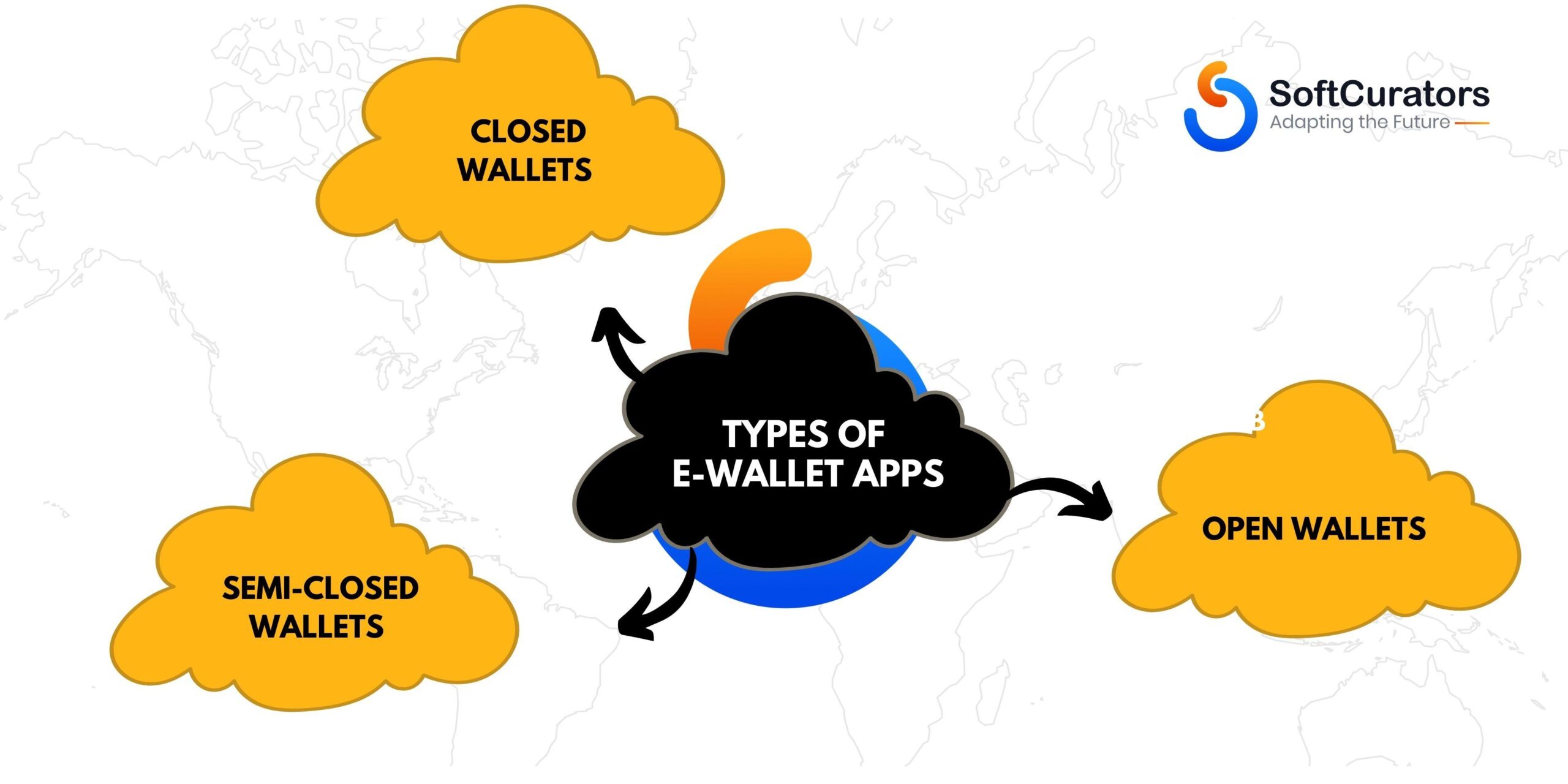
- Closed Wallets – It is issued by a single company for transactions within its ecosystem, like Amazon Pay
- Semi-Closed Wallets – These allow purchases with selected wholesalers who have a contract with the issuer.
- Open Wallets – These operate like virtual banks, supporting direct bank withdrawals and broad commercial acceptance.
Examples include PayPal, Google Pay, Apple Pay, PhonePe and Paytm.
The niche players still have sufficient room to thrive as they are focused on the local markets and specialized industries.
Why Invest in an E-Wallet App
The e-wallet industry is entering into a golden age.
Here are the three primary reasons why businesses should invest in this now:
Explosive Market Growth
The global digital wallet market is increasing at a CAGR of over 25 %.
This is driven by rapid 5G adoption, Internet of Things-(IoT) connectivity and consumer desire for faster and safer transactions.
Governments are also promising cashless initiatives, which will further fast track the growth.
Multiple Revenue Streams
Unlike the old fashioned banking services, an e-wallet app can be profitable through different channels:
- Transaction fees on every single transfer or payment
- Merchant partnerships and commission structures
- Premium services such as high limit accounts or priority support
- Loyalty programs and gamified rewards
- Embedded finance features like Buy Now Pay Later-(BNPL) or micro lending
This variety creates a strong and high margin business model.
Borderless Business Reach
A well-designed mobile wallet application can be balanced internationally while reaching masses of unbanked or underbanked consumers.
With proper permitting and agreement with regional financial systems, an e-wallet platform can help markets from Southeast Asia to Africa, offering truly global opportunities.
Must-Have Features of a Successful E-Wallet
Trust and usability centers on a healthy feature set.
The following capabilities are non-negotiable for modern e-wallet apps:
- User Registration & KYC Verification – Secure onboarding with identity checks that satisfy anti money laundering-(AML) laws.
- Multi Currency & Bank Integration – Continuous support for local and international currencies and direct bank links.
- Add & Withdraw Funds – Quick top ups via cards or bank transfers and easy withdrawals.
- P2P Transfers – Instant, low fee money transfers between users.
- Bill Payments & Mobile Recharges – Utility, telecom and subscription payments from a single dashboard.
- QR Code & NFC Payments – Tap and go or scan and pay suitability for in store shopping.
- Transaction History & Analytics – Transparent spending records and downloadable receipts.
- Push Notifications – Real time updates for payments, offers and security alerts.
- Customer Support – 24/7 chat and call assistance to handle user issues quickly.
Implementing these core features ensures that your e-wallet provides a smooth and trustworthy experience.
Advanced Features for a Future-Ready Wallet
To stand out in 2025 and beyond, consider incorporating next generation abilities:
- AI Driven Personal Finance Insights – Smart budgeting, automatic savings tips and spending analysis powered by machine learning.
- Biometric Authentication – Face ID and fingerprint recognition for cooperation and secure logins
- Cryptocurrency Support – Built-in wallets for Bitcoin, Ethereum and stable coins to attract the crypto understanding users.
- Integrated Loyalty & Rewards – Cashback, gamified challenges and points that inspire repeated usage.
- Voice Command Payments – Hands free transactions through the AI voice assistants.
- Blockchain-Based Security – Irreversible transaction ledgers that protect against fraud and tampering.
Accumulation of these innovations will not only boost the user satisfaction but also position your app as a future-ready digital wallet solution.
Technology Stack for E-Wallet Apps
Selecting the right tech stack is crucial for adaptability, security and long term maintenance.
Below is a proven and high performance stack that is used in many SoftCurators projects:
- Frontend: Flutter or React Native for the cross platform builds and Swift-(iOS) and Kotlin-(Android) for the native apps
- Backend: Node.js, Django or Ruby on Rails for trustworthy and RESTful APIs
- Database: PostgreSQL or MongoDB for managing high transaction volumes
- Payments: Stripe, PayPal, Razorpay or the local gateways for the global handling
- Security: AES 256 encryption, SSL/TLS, tokenization and biometric APIs
- Cloud Hosting: AWS, Google Cloud or Microsoft Azure to ensure uptime and adaptability
This stack balances quick development with enterprise-grade security and is flexible enough to adopt new technologies like blockchain and central bank digital currencies-(CBDC).
Step by Step Guide to Developing an E-Wallet App
Building an e-wallet application is a multi-phase journey.
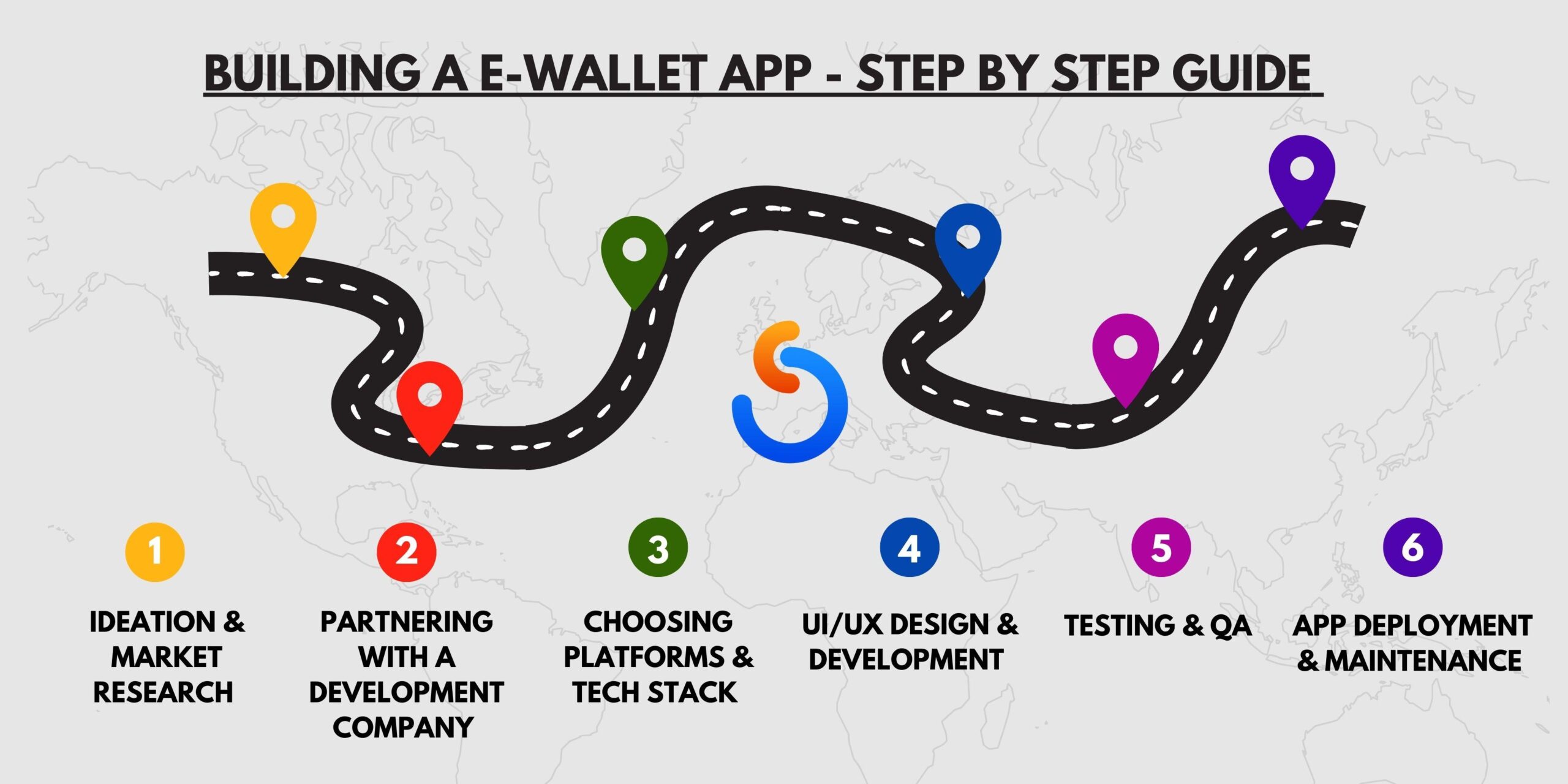
Here is a detailed roadmap that SoftCurators follows to create a well secured and a high performing apps:
Step 1: Market Research & Compliance Analysis
It all starts with deep research into the target group of people and the key players.
We identify must have features for your region and map out monitoring requirements such as KYC/AML compliance, payment gateway licensing and data privacy laws (GDPR, PCI DSS).
Step 2: UI/UX Wireframing & Design
Create wireframes and clickable examples that prioritize simplicity and trust.
Users get advantage to be able to add cards, transfer funds and check balances in just a few taps.
Step 3: MVP Development (Basic Features)
Develop a Minimum Viable Product with important functions like user registration, fund transfers and secure payment gateway combination.
This approach speeds up the time to market and helps to validate your concept.
Step 4: Integration of Advanced Features
Once the MVP is live and user feedback is collected, integrate the AI driven analytics, biometric login and the blockchain security or the cryptocurrency wallets.
Step 5: Testing & Quality Assurance
Conduct rigorous testing of functional, performance and security to promise error free transactions and compliance with standards like PCI DSS.
Step 6: App Store Deployment (iOS & Android)
Next step includes launching on iOS and Android with the proper app store optimization by submitting your app to the Apple App Store and Google Play Store.
and making sure that both these platform guidelines are met.
Step 7: Post Launch Support & Maintenance
Continuous monitoring, quick bug fixes and regular feature updates keep the app economical and secure.
Constant support is critical for long term user trust.
Step 8: Cost of Developing an E-Wallet Application
The cost to develop an e-wallet app varies commonly depending upon the difficulty, region and technology stack you have chosen.
By understanding the key cost groupings, you can easily plan budgets and set accurate expectations.
Key Factors Affecting Development Cost
-
Feature Scope
A basic wallet with essential functionality costs far less than one with AI analytics, blockchain and crypto support.
-
Platform Choice
Cross platform apps like Flutter or React Native reduce costs as compared to separate native apps.
-
Design Complexity
Highly customized UI/UX with good animations adds up both time and expense.
-
Third-Party Integrations
Payment gateways, KYC providers, analytics and push notification services often require paid APIs or transaction fees.
-
Compliance & Security
Meeting PCI DSS, GDPR and regional banking regulations adds up to engineering and legal costs.
-
Development Team Location
Rates differ dramatically in the region like: In North America or Western Europe, the average rate is $100–$200 per hour, while in the Eastern Europe and Asia the rate may range from $30–$80 per hour.
Typical Cost Ranges
| PROJECT TYPE | APPROX. BUDGET |
| Basic MVP (core features only) | $30,000 – $50,000 |
| Mid-Tier App (advanced features like loyalty programs, analytics) | $70,000 – $150,000 |
| Enterprise-Grade (blockchain, AI, crypto support) | $200,000+ |
Be informed that these figures only cover the initial development.
Post launch support and maintenance updates, server scaling and the security patches usually adds up 15–20 % of the initial build cost annually.
SoftCurators provides detailed and phased cost estimates to you so that you can secure funding and plan the internal budgets with confidence.
How E-Wallet Apps Make Money
One of the major advantage of the mobile wallet applications is that there are a variety of monetization models.
Expanding revenue streams builds flexibility and also improves ROI.
Common Revenue Channels:
1. Transaction & Withdrawal Fees
Charge a small percentage or fixed fee for each and every transfer or merchant payment.
2. Merchant Commissions
Earn a share of every sale made through the app. This is a primary source of income for many large investors.
3. Subscription or Premium Tiers
Offers higher transfer limits, priority support or special rewards for a monthly or annual fee.
4. In App Advertising & Cross Promotions
Carefully targeted ads and partner offers can generate stable ad revenue without degrading the user experience.
5. Partnership Programs
Collaborate with banks, non bank financial companies-(NBFCs) or retail chains to share profits on joint services.
6. Embedded Finance & Lending
Providing microloans, Buy Now Pay Later (BNPL) or investment products directly in the app, capturing the additional interest or service fees.
When planned advantageously, these channels can operate simultaneously by turning an e-wallet from a cost center into a high margin fintech business.
Compliance, Security & Regulatory Requirements
Security is non-negotiable for any of the secure mobile payment solutions.
Users trust your platform with their sensitive financial data and regulators enforce firm standards.
Key Compliance Measures
- KYC/AML – Know Your Customer and Anti Money Laundering procedures are compulsory in most jurisdictions to verify identities and to prevent fraud.
- PCI DSS Certification – Ensures safe handling of cardholder data and encryption of payment transactions.
- Data Privacy Laws – Compliance with GDPR-(EU), CCPA-(California) or the regional counterparts to protect the user information.
- Payment Licenses – Some of the regions requires an e money or payment institution license before launch.
Essential Security Features
- AES-256 Data Encryption and SSL/TLS secure all data in transit and at rest.
- Two Factor & Biometric Authentication adds extra layers of protection.
- Blockchain Based Ledgers can provide tamper-proof transaction histories.
- Continuous Penetration Testing & Code Audits identify liabilities before attackers do.
SoftCurators incorporates these safeguards from day one by combining the compliance first architecture with strong encryption and regular security audits to meet global standards.
Latest Trends in Digital Wallet Technology
To keep your e-wallet competitive through 2025 and beyond, consider the following emerging trends that will shape the industry:
- Contactless Wearables – Smartwatches, rings and IoT devices that allow for seamless tap and go payments.
- Central Bank Digital Currency (CBDC) Integration – Many governments are piloting official digital currencies. Early adoption compromises the competitive edge.
- Decentralized Finance (DeFi) Features – Peer to peer lending, staking and savings accounts built directly into wallets.
- AI Powered Fraud Detection – Real time machine learning models that detect the doubtful patterns and stop fraudulent transactions instantly.
- Voice Activated Transactions – Secure voice recognition for hands free payments. It is ideal for multitasking.
These innovations can uplift the user experience by improving the security and can also help your brand to stay ahead of the curve.
Why Choose SoftCurators for E-Wallet App Solution
Choosing the right e-wallet app development partner is as critical as the technology itself.
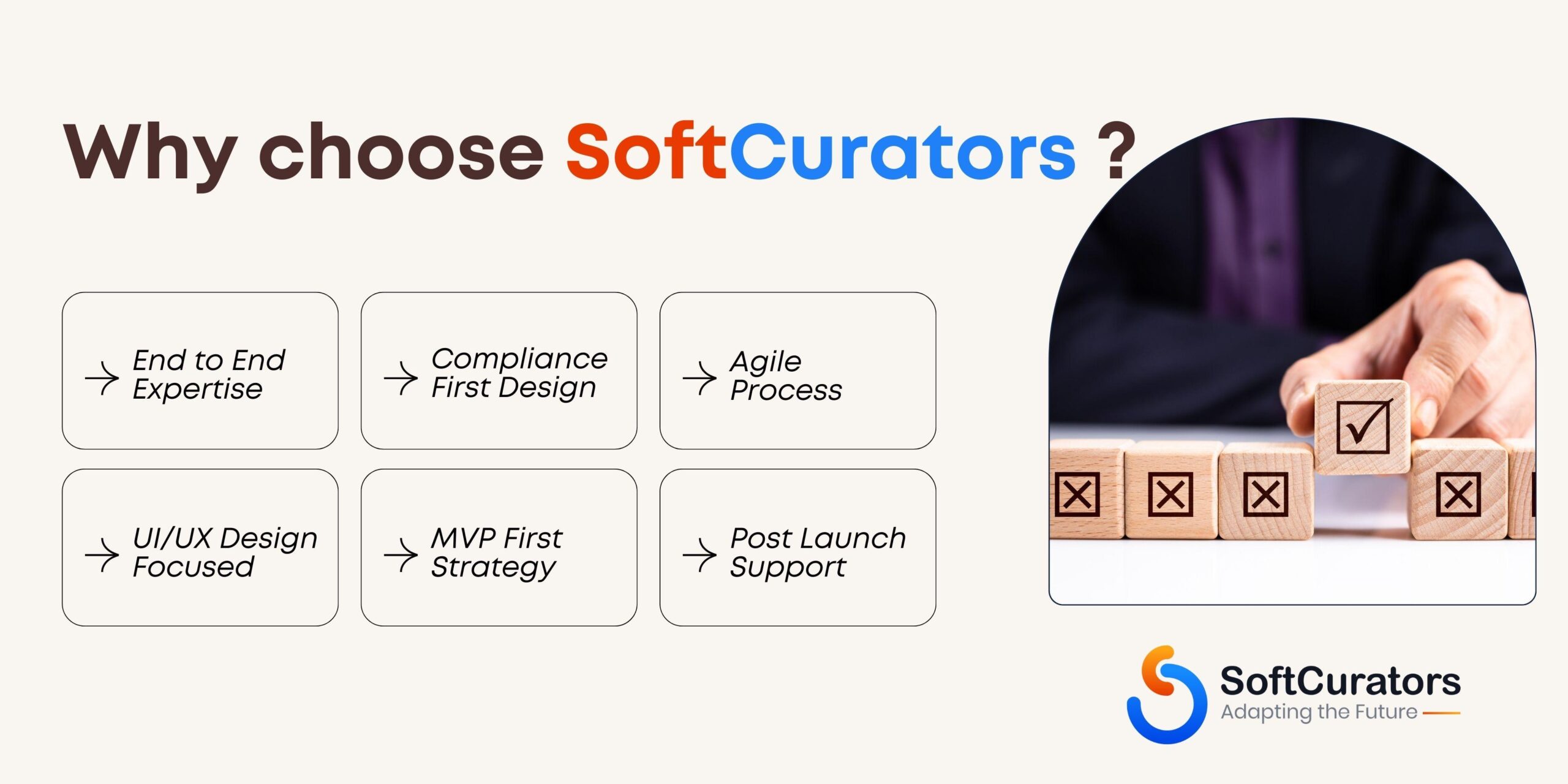
SoftCurators brings proven expertise in fintech app development services while offering the following:
- End to End Expertise – From market research and UI/UX design to the deployment and long term maintenance.
- Compliance First Design – Built in KYC/AML workflows and observance to PCI DSS, GDPR and regional financial regulations.
- MVP First Strategy – Quick launch with essential features to capture market share and authenticate ideas.
- Scalable Architecture – Cloud native infrastructure is capable of supporting millions of users.
- Post Launch Support – Constant updates, performance monitoring and feature improvements.
Our agile methodology ensures on-time delivery and smooth communication while turning your concept into a secure, user-friendly and future-ready e-wallet application.
Conclusion
The shift toward a cashless economy is no longer a prediction, it is a global reality.
Businesses that embrace e-wallet app will gain significant traction while tapping into a market projected to process trillions of dollars annually.
Building a successful e-wallet requires careful planning, strong technology and strict governing compliance.
By partnering with SoftCurators, you will gain an expert team that is experienced in secure mobile payment solutions and is capable of delivering an accessible and the feature rich product that delights users and drives profits.
Whether you are a fintech startup, a bank diversifying digital services or a retailer who is seeking a branded payment solution.
SoftCurators can help you create a best in class mobile wallet application that will grow well in the years ahead.
How long does it take to develop a digital wallet app?
A basic Minimum Viable Product-(MVP) typically takes 4 to 6 months, while a fully featured app with AI or a blockchain enhancements may require 8 to 12 months.
What is the average cost of e-wallet app?
Cost generally depends upon the features and the region. The costs will range from $30,000 for a basic MVP to $200,000 or more for the enterprise grade wallet.
How do e-wallets ensure transaction security?
They employ AES-256 encryption, two factor authentication, PCI DSS compliance and often blockchain based ledgers to protect each and every transaction.
Can an e-wallet support cryptocurrencies?
Yes. Modern wallets can include Bitcoin, Ethereum and stablecoins. Alongside the traditional sanction currencies for continuous crypto fiat transactions.
What monetization models work best for e-wallets?
Common revenue streams include transaction fees, merchant commissions, premium subscriptions and embedded lending services such as BNPL or microloans.
Why choose SoftCurators for e-wallet app Solutions?
SoftCurators offers end to end fintech expertise, compliance-first architecture and accessible cloud infrastructure which ensures that your app is secure, user-friendly and future ready.
